AI tools that publish directly to Ghost CMS

Table of contents
1. Why Ghost CMS users need more than a writing assistant
2. What to actually look for in an AI tool that publishes to Ghost
3. How Blogtude handles AI publishing for Ghost CMS users
Ghost CMS has earned a loyal following among bloggers, SaaS teams, and small business owners who want a fast, clean publishing platform without the bloat of WordPress. But Ghost gives you the engine, not the fuel. Writing, researching, formatting, and publishing articles consistently is still a full-time job, and most people running a Ghost blog are already stretched thin. That is where AI tools that publish to Ghost CMS start to matter. A growing category of tools now connects content generation directly to Ghost, so articles move from idea to live post without you touching a single button in the admin panel. In this article, I want to walk you through how that actually works, what to look for in a tool that handles Ghost publishing, and why getting this workflow right can be the difference between a blog that compounds traffic over time and one that goes quiet after a few months.
Why Ghost CMS users need more than a writing assistant
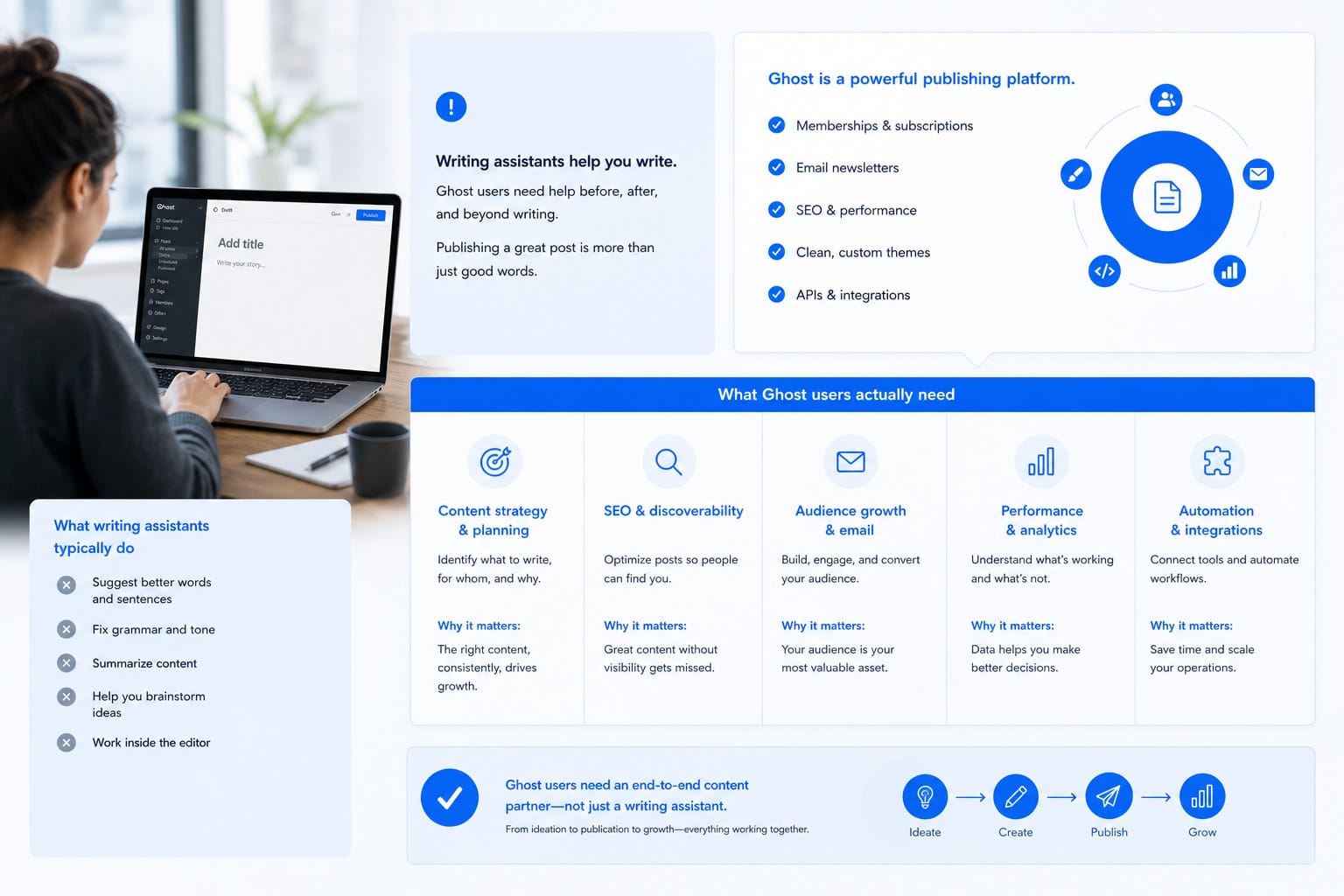
Ghost is a purpose-built publishing platform. It loads fast, it handles membership and newsletters natively, and its editor is clean enough that most writers genuinely enjoy using it. Those are good reasons to choose Ghost over a heavier CMS. But those same qualities mean Ghost does not come with a built-in content strategy layer. It does not tell you what to write, when to publish, or how to structure articles for search. It is a delivery vehicle, not a content engine.
Most Ghost users end up doing one of two things. They either publish in bursts when inspiration strikes and then go silent for weeks, or they hire a writer and spend most of their time editing and briefing rather than actually growing the business. Neither approach is sustainable if the goal is consistent organic traffic.
This is the gap that AI publishing tools are designed to fill. The best ones do not just generate text. They handle keyword research, content planning, article structure, internal linking, and then push the finished post directly to Ghost through the platform's API. You end up with a fully formatted article sitting in your Ghost drafts or already live, depending on how you configure the workflow.
That last part matters more than it sounds. Ghost's Content API and Admin API are well-documented and support programmatic publishing with full control over post status, tags, feature images, metadata, and scheduling. A tool that integrates properly with Ghost is not just pasting text into a text box. It is sending a structured payload that respects how Ghost organizes content.
For Ghost users specifically, that means the article shows up with the right tags already applied, the meta title and description filled in, the feature image attached, and the post set to draft or published based on your preference. That is a meaningfully different experience from copying and pasting from a Google Doc, which still requires you to manually configure every one of those fields before the post is ready.
Think about what that manual process actually costs. You write or receive an article, then you open your Ghost admin panel, create a new post, paste in the content, fix any formatting that broke during the paste, upload a feature image, write a meta title, write a meta description, add the appropriate tags, set the canonical URL if needed, schedule the publish time, and then hit publish. That sequence takes anywhere from fifteen minutes to half an hour per post, even when the writing itself is done. Multiply that by four posts a week and you have burned two hours on logistics alone, every single week, forever.
An AI tool with a real Ghost integration eliminates that entire sequence. The post arrives in your Ghost instance already configured. You review it, make any edits you want, and approve it. That is a fundamentally different relationship with your publishing workflow.
I have seen a lot of content teams discover Ghost and fall in love with the editor, then quietly burn out six months later because the writing workload did not change just because the publishing platform got better. The platform improvement and the content workflow improvement need to happen together. A better editor does not help you if you do not have time to write. A faster site does not help you if you are not publishing consistently enough for search engines to notice.
There is also the strategic dimension to consider. Random articles published whenever time allows do not build topical authority. Search engines reward sites that cover a subject with depth and consistency. If you publish three posts about email marketing in January and then nothing related to email for the next four months, you are signaling fragmentation rather than expertise. A tool that builds and executes a coherent content plan changes that dynamic entirely.
The compounding nature of SEO content means that the gap between a blog that publishes consistently and one that publishes sporadically gets wider every month. Early-stage organic traffic growth is slow regardless of what you do, but the sites that maintain a steady publishing cadence during that early period are the ones that eventually see traffic accelerate. The sites that publish in fits and starts reset their own momentum repeatedly.
If you are thinking about how often you actually need to publish to see SEO results, it is worth reading how often to publish blog posts for SEO growth before you commit to any publishing schedule or tooling decision. The short version is that consistency matters more than volume, and a tool that can maintain a steady drumbeat of posts is more valuable than one that helps you sprint and then stop.
Ghost users who get the most out of the platform are the ones who pair it with a system that removes the content creation bottleneck entirely. Ghost handles delivery beautifully. The question is what handles creation, and that is where the right AI publishing tool becomes the missing piece.
What to actually look for in an AI tool that publishes to Ghost
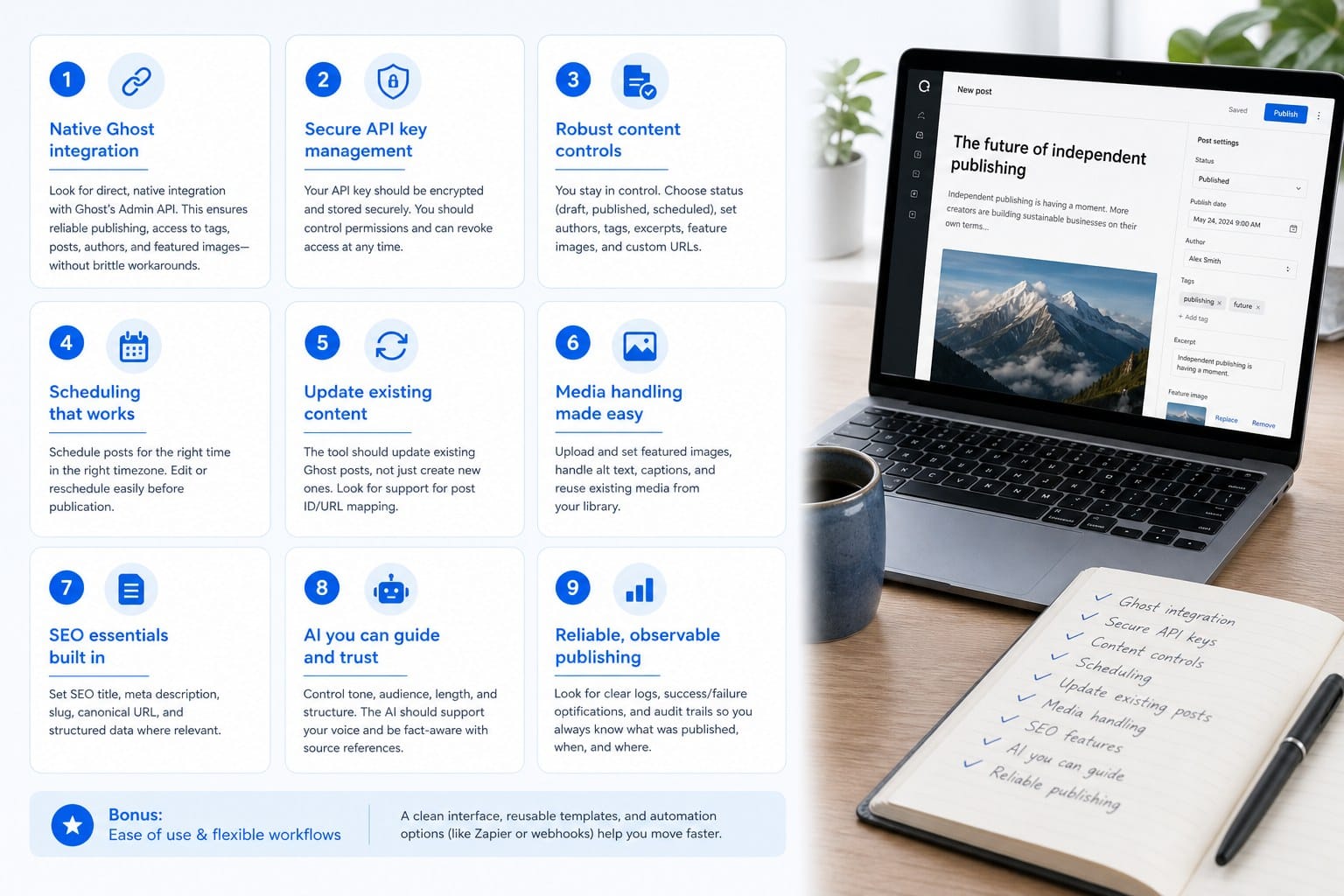
Not every AI writing tool that claims to support Ghost CMS actually integrates with it in a meaningful way. Some tools let you export a markdown file that you then import manually. Others support a basic API connection but do not handle images, metadata, or scheduling. Before you commit to any tool in this space, it is worth understanding what a real Ghost publishing integration looks like versus a surface-level one.
Here are the specific things worth checking before you choose a tool.
Does it use the Ghost Admin API, or does it just export content?
The Ghost Admin API is what allows a third-party tool to create, update, and publish posts programmatically. If a tool is only generating text and asking you to copy it somewhere, that is a writing assistant, not a publishing integration. A genuine Ghost integration will ask you for your Ghost site URL and an Admin API key during setup, then handle the rest without you opening your Ghost dashboard at all. During the setup process, you should be generating an API key inside your Ghost admin panel, not downloading a file.
If the tool's documentation does not mention the Admin API, that is a signal that the integration is shallow. It may still be useful, but you will still be doing manual work every time you want to publish.
Does it handle feature images automatically?
Ghost is a visually oriented platform. Posts without feature images look incomplete in almost every Ghost theme, and most themes display the feature image prominently at the top of the post and in any index or archive views. Any tool that publishes to Ghost should either generate an appropriate image or pull one from a licensed source and attach it to the post automatically.
If you have to source and upload images separately after the fact, you are still doing a significant chunk of manual work, and it is exactly the kind of low-value task that slows down a publishing operation. The whole point of an integrated tool is to eliminate these steps, not reduce them from ten to nine.
Does it write with SEO structure built in from the start?
Generating a long article is not the same as generating an article optimized for a specific keyword. A good tool will conduct keyword research before writing, structure the article with a proper heading hierarchy that reflects how people search for and consume the topic, include the target keyword naturally in the title and meta description, and handle internal linking to relevant content already on your site.
Ghost SEO relies on the same fundamentals as any other platform. The HTML output of a Ghost post is clean and fast, which gives you a technical advantage, but that advantage only matters if the content itself is built for search. A tool that generates generic long-form content without keyword research is not helping your SEO; it is filling your server with words.
Also worth checking: does the tool write meta descriptions that are actually descriptive and within the character length that search engines display, or does it generate a generic sentence? Ghost gives you a dedicated meta description field, and what goes in that field influences click-through rates in search results. It deserves as much attention as the article itself.
Does it support content planning, not just one-off articles?
One article will not move the needle on organic traffic. What actually compounds over time is a consistent publishing cadence built around a coherent keyword strategy. Tools that give you a 30-day or 90-day content plan tied to your niche are more valuable than tools that generate individual posts on demand, because they help you build a content library instead of a collection of random articles.
Topical authority is built by covering a subject from multiple angles over time. If you sell accounting software, you need articles about invoicing, expense tracking, tax preparation, cash flow management, and payroll, not five articles about the same general idea of accounting software. A content planning layer that maps out keyword clusters and assigns them to specific publishing dates is what turns a writing tool into a growth strategy.
What level of control do you retain after articles are created?
Some tools just fire and forget. Better tools give you a way to review drafts before they go live, adjust the publishing schedule, regenerate sections that do not meet your standards, or add your own edits before approval. Ghost's draft and scheduling system is flexible, so a good integration will take advantage of that flexibility rather than bypass it.
The ability to review and edit before publishing is not just a quality control feature. It is also a trust feature. You are putting your name or your company's name on these articles, and you should have a final look before they go live. Any tool that removes that step entirely is making a tradeoff that most publishers will eventually regret.
What is the total time cost, not just the feature list?
For small business owners especially, the time cost of using a tool matters as much as its capabilities. If a tool technically publishes to Ghost but requires 45 minutes of configuration per article, it is not saving you much. The goal is to get to a place where you approve a content plan, set your preferences once, and then receive polished drafts in your Ghost instance on a schedule you chose.
That is the workflow worth looking for. Not a tool that makes writing easier, but a tool that makes the entire publishing operation manageable with a small time investment on your part.
If you are evaluating tools in this space and want a framework for making the decision, AI blog tools for small business owners: what to look for before you buy breaks down the key criteria in a way that applies directly to Ghost users as well.
One more thing worth mentioning: pricing models in this category vary significantly. Some tools charge per word, which creates unpredictable costs as your publishing volume grows. Others charge a flat monthly fee for a certain number of posts. For Ghost users building a long-term content library, predictable pricing matters because you are committing to a publishing cadence that will continue for months or years, not just generating a few articles to test a concept. Make sure the pricing model you choose supports the volume you actually need without penalizing you for consistency.
How Blogtude handles AI publishing for Ghost CMS users
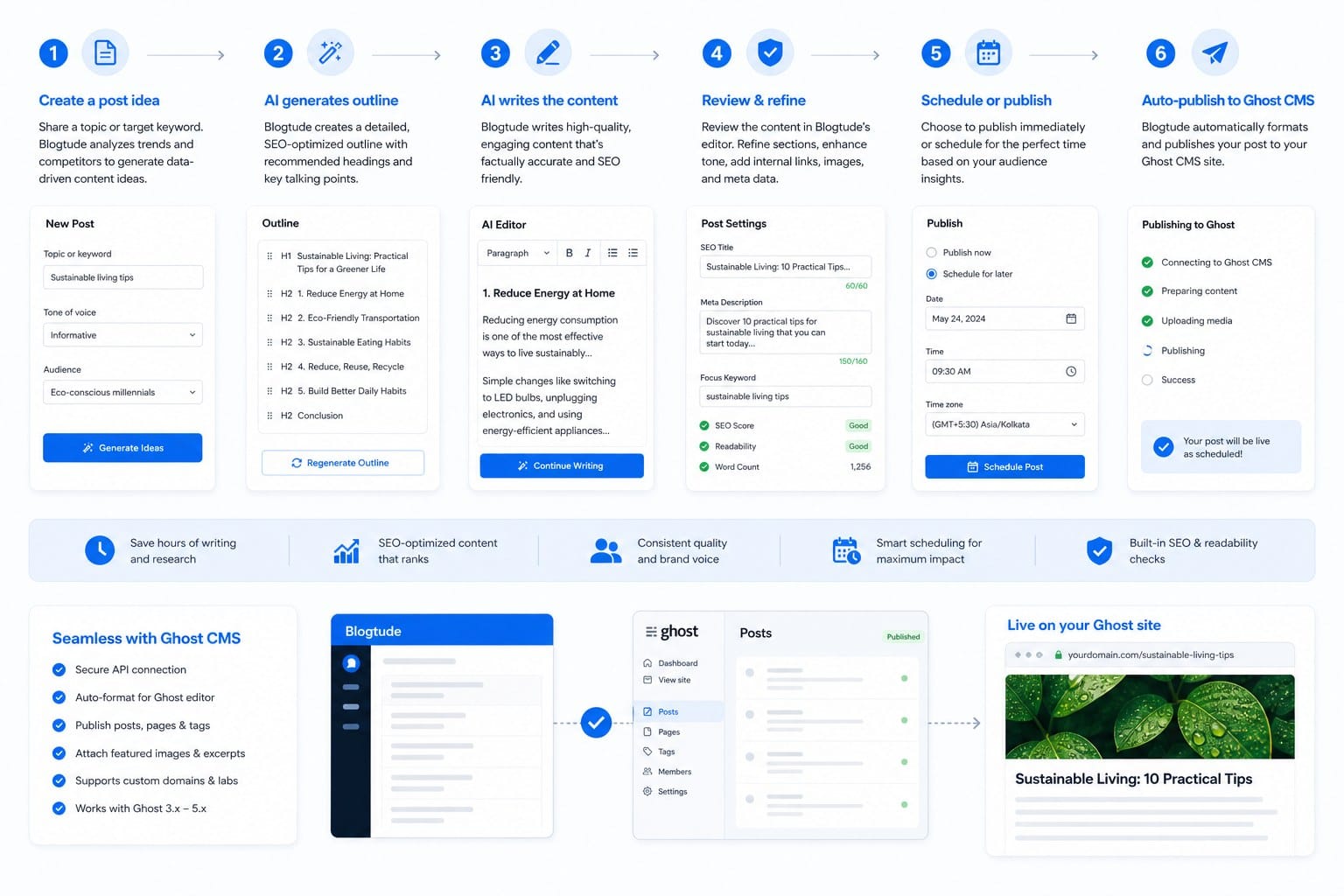
Blogtude was built to solve the problem described throughout this article. It is not a general-purpose AI writing tool that added a Ghost export option as an afterthought. It is a content engine designed from the start to handle the full workflow from strategy to published post, with Ghost as one of its core publishing targets.
Here is how the workflow actually runs.
Connecting your Ghost site
When you connect your Ghost site to Blogtude, you provide your site URL and your Ghost Admin API key. That is the only technical step required. You generate the API key inside your Ghost admin panel under Settings, then paste it into Blogtude during setup. From that point forward, Blogtude can create, format, and publish posts to your Ghost instance without you opening your Ghost dashboard. Posts arrive with feature images attached, tags applied, meta titles and descriptions filled in, and post status set according to your preferences. If you want everything to land as a draft for your review, it lands as a draft. If you want it to publish on a schedule, it publishes on that schedule.
This is the Admin API integration described in the previous section, done properly. It is not a markdown export or a copy-paste workflow dressed up with a fancy interface. It is a genuine programmatic connection that treats Ghost the way Ghost is designed to be used.
Strategy before writing
Before any article is written, Blogtude builds a 30-day content strategy for your niche. This is not a list of generic blog topics. It is a mapped set of keywords organized around your audience's actual search behavior, structured so that the articles you publish work together to build topical authority over time.
If you are a SaaS company writing about project management, your content plan will reflect the specific keyword clusters that matter in that space: articles about task prioritization frameworks, team collaboration tools, agile versus waterfall planning, project status reporting, and resource allocation. Those articles speak to different stages of your audience's awareness and together signal to search engines that your site covers project management with genuine depth. That is very different from publishing five articles that all broadly address project management software without targeting distinct search intents.
The strategy layer is what separates a content engine from a writing tool. Writing tools start when you tell them what to write. A content engine starts by figuring out what you should write and in what order, then executes against that plan.
Long-form, substantive articles
Each article Blogtude produces is long-form and built around the keyword it is targeting. The goal is not to generate content that technically contains a keyword but to produce articles that readers find genuinely useful and that search engines recognize as substantive. That means covering subtopics thoroughly, using a clear heading hierarchy that maps to how readers navigate content, writing at a reading level that communicates clearly without talking down to the audience, and including the kind of practical detail that makes a reader bookmark the article rather than click back to search results.
This distinction matters because thin content does not compound. It might index briefly, but it rarely earns the kind of dwell time, return visits, or external links that move a site up in search rankings over time. The articles worth publishing are the ones a reader could actually use to solve a problem or make a decision, and that is the standard Blogtude applies when generating content for your Ghost blog.
Visuals that fit your brand
On-brand visuals are part of the package. Blogtude generates feature images and in-article visuals that reflect your brand's visual identity. For Ghost users, this matters because Ghost puts feature images front and center in most themes. A post that arrives with a polished, relevant feature image looks like it was produced by a professional content team, even if the creation process involved no manual design work.
This is one of the details that separates a fully integrated publishing tool from a writing assistant. A writing assistant delivers words. A publishing tool delivers a complete post, ready to represent your brand in search results, in email newsletters, and on social media where Ghost's native sharing features will pull that feature image automatically.
Automatic internal linking
Internal linking is handled automatically as well. As your content library grows, Blogtude connects new articles to relevant existing ones, which is one of the most underrated SEO levers available to any blog. Internal links pass authority between pages, help search engines understand the structure of your content, and give readers a path to explore related topics on your site.
Ghost does not handle internal linking natively. If you want your articles to link to each other, someone has to go back through existing posts and add links manually as new content is published, or add them during the writing process when you are already managing a dozen other things. Blogtude handles this programmatically, which means your content library gets more interconnected and more valuable over time without you doing anything extra.
The compounding effect for SaaS founders and startups
For SaaS founders and early-stage startups, the compounding nature of organic traffic is what makes this model worth the investment. Paid acquisition costs money every time someone clicks. Organic traffic, once earned, continues to deliver visitors without ongoing spend. The tradeoff is time: organic traffic takes months to build, and the teams that start building it earliest end up with an advantage that is genuinely hard for later competitors to replicate quickly.
Blogtude is designed to accelerate that timeline by maintaining a consistent publishing cadence from day one, without requiring a full content team to do it. A startup that publishes four well-structured, keyword-targeted articles per week for twelve months will have built a content library that generates meaningful organic traffic, establishes topical authority in its space, and creates a durable moat against competitors who are still relying entirely on paid channels.
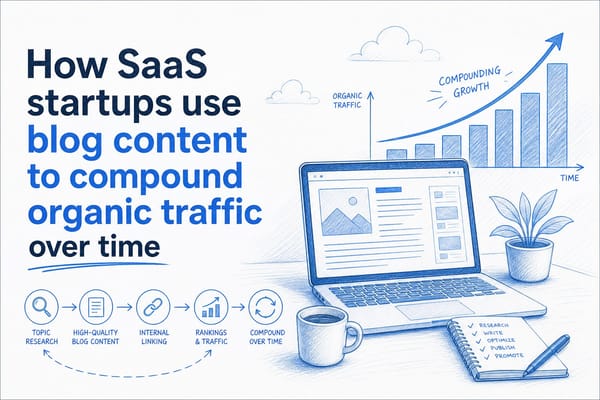
If you want to understand the mechanics behind why this works, how SaaS startups use blog content to compound organic traffic over time explains the dynamics in detail, including why the compounding effect accelerates rather than flattening out over time when the content strategy is executed consistently.
The value for independent bloggers and digital marketers
For independent bloggers and digital marketers, the bottleneck is usually not strategy but execution. You may know exactly what you want to write about. You may have a detailed editorial calendar mapped out for the next six months. But finding the time to research, draft, edit, format, source images for, and publish a full article consistently while also running every other part of your business or creative practice is genuinely difficult. Something always gets deprioritized, and it is usually the blog.
Blogtude handles the execution layer so you can stay focused on the parts of your work that actually require your judgment and expertise. The strategy is set, the articles are produced, and the posts arrive in Ghost on the schedule you chose. Your role becomes reviewer and editor rather than writer and publisher, which is a much more sustainable position for someone who is also responsible for everything else a business requires.
What Blogtude is not
One thing worth being direct about: Blogtude is not a tool you use to generate content you do not care about. It is a tool you use to produce content you would be proud to publish under your name, at a volume and consistency that would not otherwise be possible without a full content team. The articles it produces are meant to represent your brand well, not just fill a publishing slot.
This distinction matters because there is a version of AI-generated content that actively harms a website: thin, repetitive, keyword-stuffed articles that signal to both readers and search engines that the publisher does not care about quality. That approach produces short-term volume and long-term damage. Blogtude is designed around the opposite philosophy, which is that the only content worth publishing is content that earns its place by being genuinely useful to the person who finds it.
How the Ghost experience stays familiar
For Ghost CMS users specifically, the fact that Blogtude integrates at the API level means your Ghost experience does not change in any way that disrupts your existing workflow. You still see your posts in your Ghost dashboard. You can still edit them before they go live. You can still use Ghost's native scheduling, membership, and newsletter features alongside Blogtude's publishing workflow. The integration adds capability without taking away control or changing the interface you already know.
If your Ghost blog has an email newsletter connected to it and you send new posts to subscribers automatically, that works exactly the same way. If you use Ghost's member tiers to gate certain content, you can configure Blogtude to publish to the appropriate access tier. The integration sits on top of Ghost without replacing or overriding any of the features you chose Ghost for in the first place.
If you are running a Ghost blog and have been frustrated by the gap between the platform you chose and the publishing cadence you actually manage to maintain, the category of AI tools that publish to Ghost CMS exists precisely because that frustration is common and legitimate. Ghost did not create the problem, and no writing assistant by itself can solve it. What solves it is a tool that handles the full loop from strategy to published post, integrated tightly enough with Ghost that the whole system works without constant manual intervention.
That is what Blogtude is designed to be for Ghost users, and it is why the platform is worth looking at seriously if consistent, high-quality blog output is a goal you have been trying to reach without enough hours in the day to get there.
Ready to take the next step?
If you are ready to stop managing your Ghost blog manually and start publishing consistently without the overhead, Blogtude is worth a closer look. Visit blogtude.com to see how the platform works and get started with a content strategy built for your niche.