
How SaaS startups use blog content to compound organic traffic over time

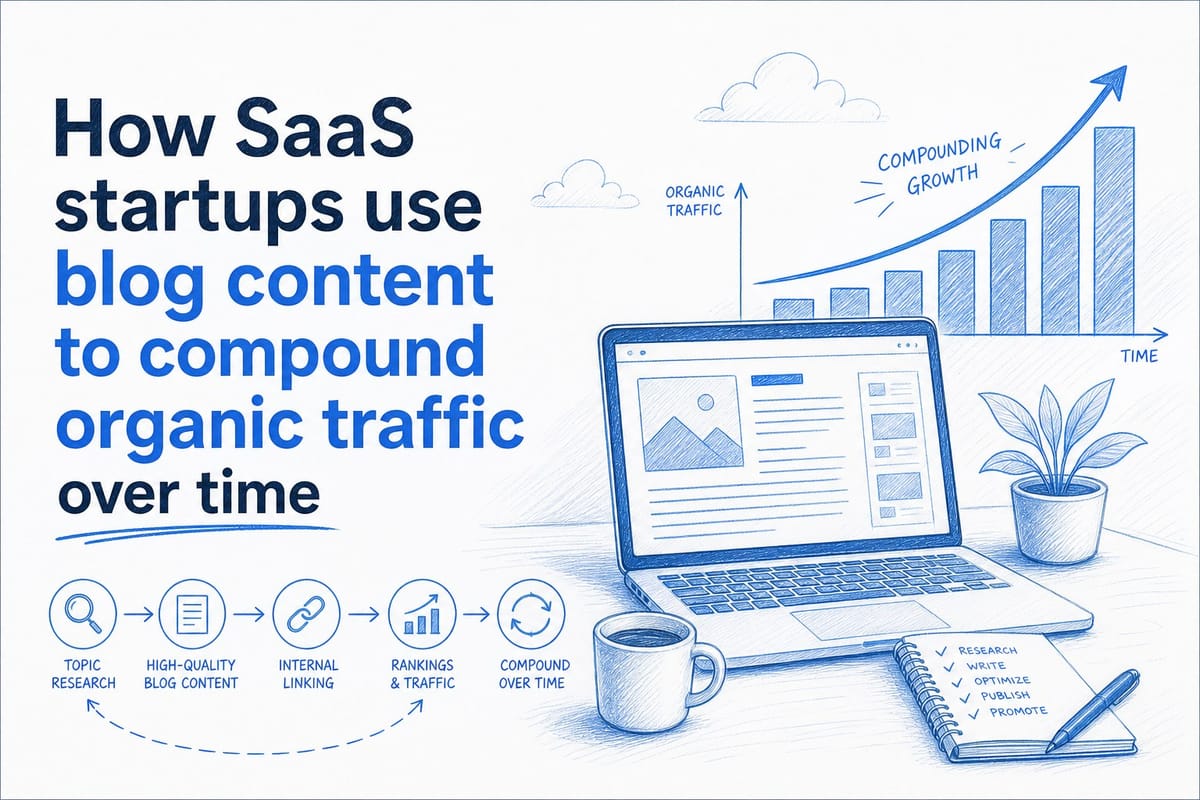
Table of contents
1. Why blog content compounds the way money does
2. How SaaS startups actually build compounding content systems
3. The role of automation in keeping blog content consistent at scale
Most SaaS startups treat their blog like a project. They publish a few posts when they launch, go quiet for a month, then come back with another burst of content when someone remembers it exists. That cycle rarely builds anything lasting. The startups that actually grow organic traffic over time treat their blog differently. They treat it like an investment that compounds. This article explains how that compounding process works, why it rewards consistency more than perfection, and what SaaS founders can do to set it in motion. If you have been wondering how saas blog content compounding organic traffic actually happens in practice, this breaks it down in plain terms.
Why blog content compounds the way money does
The word compounding gets used a lot in marketing, but it means something specific when we apply it to blog content. With money, compounding means your returns generate their own returns over time. With blog content, something similar happens. Each article you publish can attract links, earn search rankings, pull in readers, and generate internal link value that strengthens your other posts. That effect does not happen overnight, but it does not stop happening either. A post you published two years ago can still bring in traffic today without you touching it.
This is fundamentally different from paid ads. The moment you stop paying for ads, the traffic stops. With organic blog content, the work you did last year keeps working. The posts you wrote in January are still indexed. They are still answering questions. They are still sending readers to your product pages. That is the core mechanic behind SaaS blog content compounding organic traffic.
Search engines reward age and authority. A blog that has been publishing consistently for eighteen months has more domain authority than one that launched three months ago with ten posts. That authority lifts newer content faster. It is easier to rank your fifteenth post than your first, assuming you have built topical depth and earned some backlinks along the way. The compounding effect accelerates as the foundation grows stronger.
There is also a topical authority dimension here. When you publish thirty posts about SaaS onboarding, search engines start to associate your domain with that topic. You become a recognized source. When a new post on the same topic goes live, it has a head start because your site already holds authority in that space. This is why SaaS startups that pick a focused content niche and go deep tend to outperform those that publish wide and shallow.
One more layer: internal links. As your blog grows, each new article can link to older ones, and older ones can be updated to link back. That web of internal links passes authority around and helps search engines understand how your content fits together. A large, well-linked blog functions as an ecosystem rather than a collection of isolated pages. Each piece supports the others.
The compounding effect is real, but it requires consistency. A blog that publishes once a month for two years will compound. A blog that publishes twenty posts in one month and nothing for the next six will not. The rhythm matters as much as the volume. This is one of the main reasons SaaS startups struggle to realize the benefits. Consistency is hard when the team is small and blog content competes with product development, customer support, and fundraising for attention.
Understanding what a blog content strategy is and why every brand needs one is the first step toward building a system that can sustain that consistency. A strategy gives you a publishing calendar, a topic framework, and a clear reason for each piece of content. Without it, you are reacting instead of building.
How SaaS startups actually build compounding content systems
Let me walk through what a compounding content system looks like in practice for a SaaS startup. I will use a hypothetical example to make it concrete. Imagine a startup that sells project management software to small creative agencies. They have a founder, two developers, and one part-time marketer. They cannot afford a content team. But they want organic traffic.
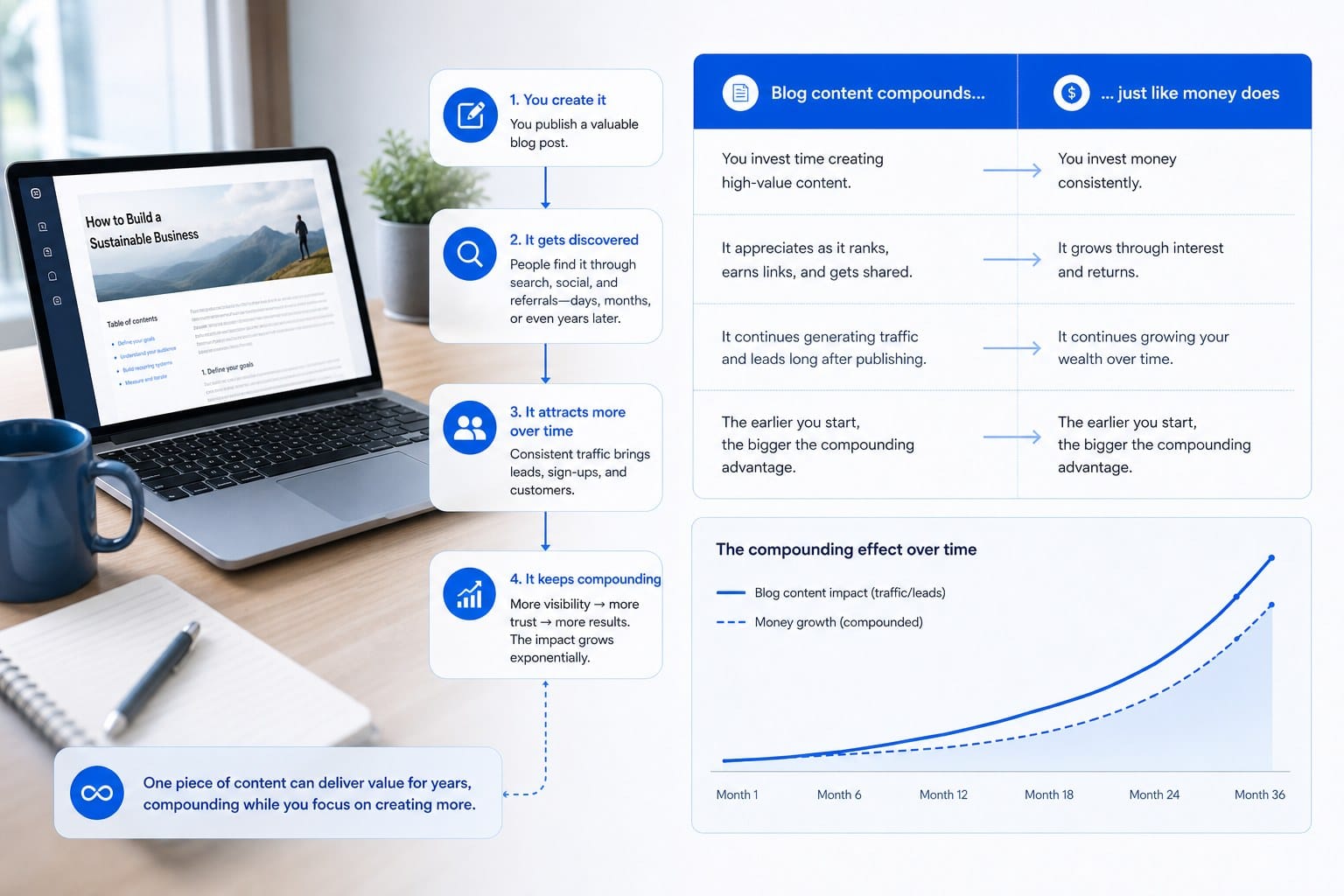
The first thing they do is pick a specific topic cluster. Rather than writing about project management broadly, they write about everything related to how creative agencies manage client projects. That includes articles about scope creep, client communication, retainer pricing, project handoffs, and freelancer management. Every article targets a specific search query that their ideal customer is likely to type.
They publish two posts per week. After six months, they have about fifty articles. At this point, search traffic is modest. Maybe a few hundred visits per month. But their domain authority has grown. Some posts have earned backlinks from agency blogs and design communities. Their internal linking is solid. And they have deep topical coverage of a focused subject.
At twelve months, something shifts. The first posts they published are now aged enough to hold strong positions. Some are ranking in the top three results for their target keywords. Traffic doubles from the previous quarter, then doubles again. By month eighteen, they have more than a thousand organic visitors per day, most of them from posts that were written six to twelve months earlier. The team is not writing more content than before. The existing content is just doing more work.
This pattern shows up repeatedly in SaaS companies that commit to organic content. The early months feel slow. The returns feel disproportionately small relative to the effort. Then a threshold gets crossed and the numbers start moving in ways that feel surprising. That surprise is the compounding effect becoming visible.
To build this kind of system, you need a few things in place. First, a content calendar that covers at least ninety days at a time. This prevents the stop-start pattern that kills compounding. You need to know what you are publishing next week, not just this week. Second, a keyword research process that connects your content topics to actual search demand. Writing about things nobody searches for does not compound. It just sits there. Third, a publishing workflow that does not depend entirely on one person showing up on the right day. Single points of failure break consistency.
That third piece is where most small SaaS teams get stuck. The founder writes three great posts, then gets pulled into a product sprint. The marketer builds a good content calendar, then gets assigned to a campaign. The blog stalls. By the time anyone comes back to it, the momentum is gone and the team has to start over.
Building a blog content workflow that runs without you is not a luxury for SaaS startups. It is the difference between compounding and not compounding. The system has to be able to keep producing and publishing even when the team is busy with everything else. That usually means using tools, templates, and automation to remove the manual bottlenecks.
Another thing SaaS startups do well when they build compounding content is updating existing posts. This often gets overlooked. A post you published fourteen months ago might be ranking on page two for a keyword you care about. With some updates, sharper headings, a few added sections, and refreshed internal links, it can move to page one. That is easier and faster than writing a new post from scratch. The compounding effect applies to updates as much as new content.
SEO also rewards posts that answer questions completely. When someone clicks your post and finds a thorough, well-organized answer, they stay on the page longer. They visit other pages on your site. They are less likely to go back to the search results. Search engines notice that behavior and reward it with higher rankings. This means quality matters alongside consistency. A blog that publishes two thoughtful, well-researched posts per week will outperform one that publishes five thin posts. SaaS startups building for compounding focus on depth, not volume for its own sake.
One practical tactic that many SaaS content teams use is the pillar-cluster structure. A pillar post covers a broad topic in depth. For example, a comprehensive guide to client project management for creative agencies. Cluster posts are shorter articles that go deep on specific subtopics and link back to the pillar. This structure helps search engines understand the relationship between your posts and signals that your site is a thorough resource on the topic. It also makes internal linking natural and logical rather than forced.
Finally, SaaS startups that do this well track their progress over time with a small set of consistent metrics. Organic sessions per month. Number of posts ranking in the top ten for target keywords. Average position for tracked keywords. These numbers change slowly at first, then faster. Watching them gives the team evidence that the compounding effect is real and reason to keep investing in the system.
The role of automation in keeping blog content consistent at scale
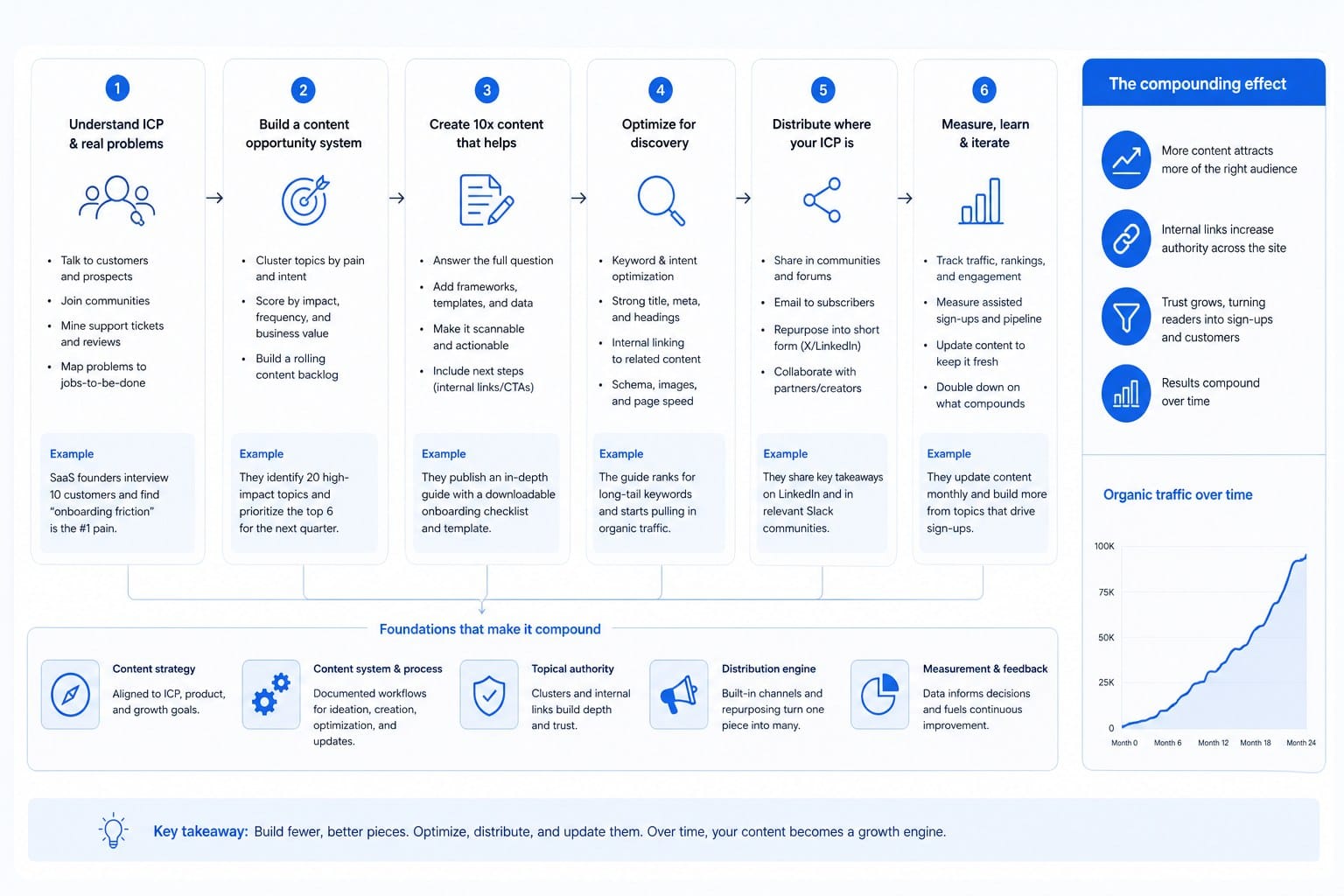
Consistency is the engine of compounding. But consistency requires effort that most SaaS startups cannot sustain manually. This is where content automation becomes genuinely useful, not as a shortcut to lower quality, but as a way to remove the friction that causes blogs to go quiet.
I want to be specific about what automation can and cannot do here. Good blog content still requires research, real examples, and accurate information. Automation that skips those things produces content that does not rank, does not earn links, and does not convert readers into users. The goal of automation is to handle the mechanical and repetitive parts of content production so that the remaining human effort goes into substance and strategy.
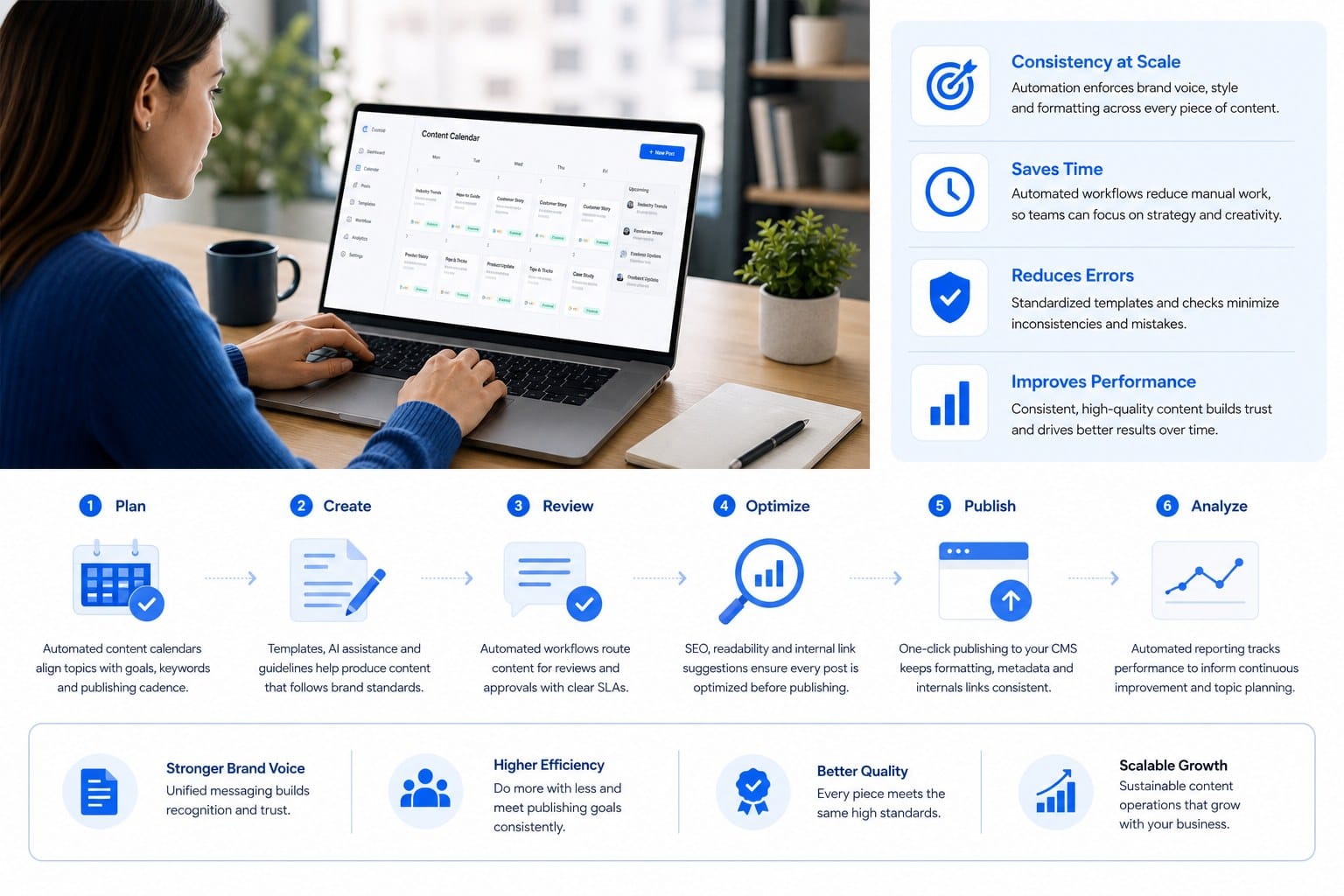
The parts of content production that benefit most from automation include topic research and keyword mapping, content scheduling and calendar management, publishing to CMS platforms, formatting and visual production, and performance tracking. These are real time sinks. A content marketer managing a SaaS blog manually might spend two to three hours per week just on scheduling and publishing tasks. Automate those, and that time goes back into writing and research.
For SaaS startups using Ghost as their CMS, there are strong reasons to invest in an integrated publishing workflow. Ghost is built for fast, clean content delivery and has solid SEO defaults. But managing a consistent publishing schedule in Ghost still requires someone to draft posts, format them, add images, set metadata, and hit publish on time. Integrations that automate those steps make the difference between a blog that publishes consistently and one that publishes when someone gets around to it. I wrote about Ghost CMS integrations that enable automated publishing at scale in more detail if you want to go deeper on the technical side.
SaaS startups also benefit from having a thirty-day or ninety-day content strategy built out in advance. When the next month of content is already planned and assigned, the team does not have to make a decision about what to write each week. Decision fatigue is real. When publishing requires a fresh decision every time, it happens less often. When the decision has already been made and the system is just executing, it happens every time.
Another thing automation does well is ensuring that content is published at a consistent cadence even when the team is under pressure. If a startup is in a fundraising sprint or a major product launch, the last thing on anyone's mind is the blog. An automated workflow keeps publishing on schedule during those periods. The blog does not go dark. The compounding does not reset.
I should address a concern that comes up often here. Some SaaS founders worry that automated content will feel generic or miss the specific voice and context of their product. That is a valid concern. The solution is to build the brand voice, audience context, and product specifics into the content system from the start. When an automation tool knows who your customers are, what problems they face, what your product does, and how you like to communicate, the output reflects that. Generic output usually comes from generic input.
One practice that helps is auditing automated content before it goes live, at least in the early months. Review the first ten or fifteen posts to check that the voice is right, the information is accurate, and the structure matches your standards. Then adjust the inputs accordingly. Over time, the output requires less oversight because the system has been tuned to your context.
SaaS startups also get more out of automation when they combine it with a human-in-the-loop for strategy decisions. Automation handles execution. A founder or marketer makes the strategic calls about which topics to prioritize, which keywords to target, and when to update older content. This division of labor plays to the strengths of both. Humans are good at judgment and context. Systems are good at consistency and speed.
The compounding effect in content is not a secret. It is well documented in how organic traffic grows for blogs that commit to consistent, quality publishing over time. What is harder is actually sustaining that consistency through the pressures of running an early-stage SaaS company. Automation lowers the activation energy required to publish. When publishing is easier, it happens more often. When it happens more often, the compounding starts sooner and builds faster.
To tie this back to the broader picture: SaaS blog content compounding organic traffic is not a marketing theory. It is a mechanical process with predictable inputs and outputs. The inputs are consistent publishing, focused topical depth, quality research, and smart internal linking. The outputs are growing domain authority, rising keyword rankings, and an increasing flow of organic visitors who are looking for exactly what your product does. The gap between the two is usually execution, specifically the ability to keep producing and publishing without burning out or falling behind.
Building or buying a system that handles the execution layer gives SaaS startups access to the compounding effect without requiring a full content team. That is a meaningful advantage for a company that is still finding product-market fit and needs every resource focused on growth. The blog becomes an asset that grows in value over time, rather than a task that competes for time and attention every week.
If you are a SaaS founder who has been meaning to get serious about content but keeps deprioritizing it, the best thing you can do is not write one great post. It is to put a system in place that will publish consistently for the next twelve months regardless of what else is happening. That system is what creates compounding. The posts are just the fuel.
Ready to take the next step?
Blogtude is built to solve exactly this problem. It generates a full 30-day content strategy, produces deeply researched long-form articles with on-brand visuals, and publishes automatically to Ghost and other CMS platforms. If you want your blog to compound without requiring manual effort every week, start with Blogtude and see what consistent publishing looks like when the system does the work.


