
How Cabin Plus structures its blog for maximum SEO impact

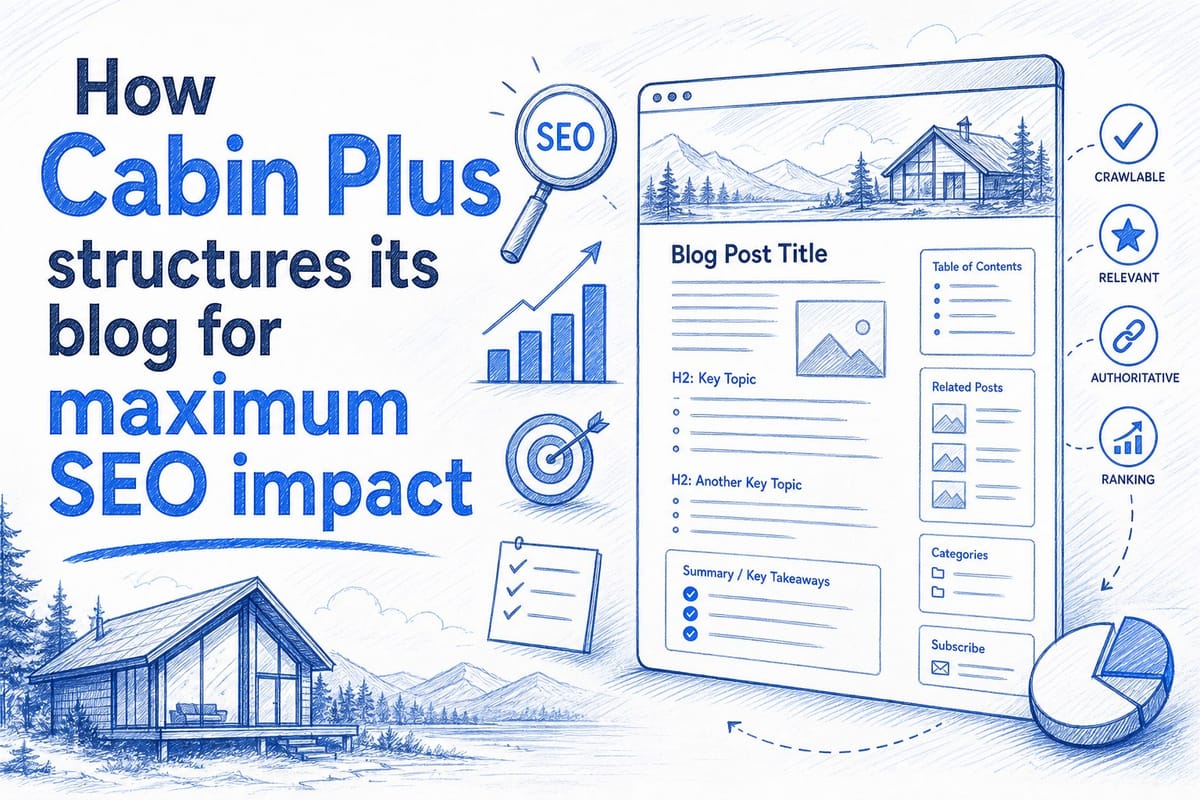
Table of contents
1. Why blog architecture matters more than most people realize
2. How consistent publishing creates compounding SEO results
3. What you can apply from this to your own blog strategy
When I look at how a well-structured blog compounds organic traffic over time, Cabin Plus stands out as a useful case study. Running something like site:cabinplus.co inurl:blog in Google gives you a quick window into how their blog section is organized, which pages are indexed, and how their content hierarchy holds together. That kind of search operator research is genuinely practical for any content team trying to understand what good blog SEO looks like in the real world. In this article I want to break down what strong blog structure actually looks like, why URL and site architecture decisions carry so much weight for search visibility, and how any brand can build that same kind of consistent, indexed content presence without burning out the people responsible for producing it.
Why blog architecture matters more than most people realize
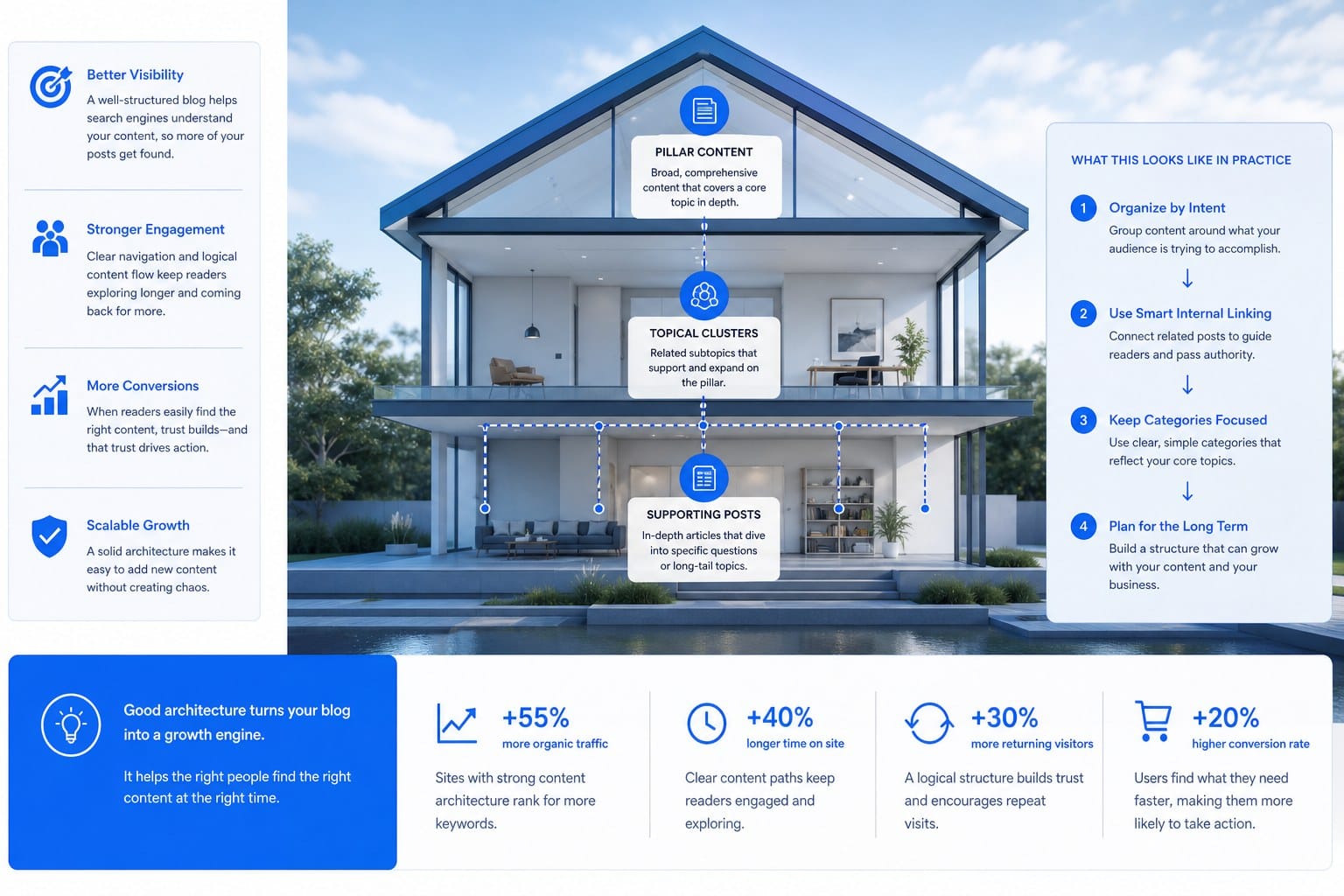
A lot of blog owners focus almost entirely on writing quality content. That matters, but if the structure holding that content together is weak, even genuinely useful articles struggle to rank. Blog architecture covers the way your pages connect to each other, how your URLs are formatted, and how search engines understand what your site is about at a category and topic level. Get those things wrong and you are building on sand.
When you use the site: and inurl: operators in Google, you are asking the search engine to show you pages from a specific domain that also contain a certain word or path in the URL. Running site:cabinplus.co inurl:blog tells Google to surface all indexed pages on the Cabin Plus domain that include the word blog in their URL. This is a simple but powerful audit technique. It shows you exactly what Google has crawled and stored from that specific section of a website, which is different from what you think is published.
What you want to see when you run that kind of check is a clean, consistent list of blog posts. Each URL should follow a predictable pattern, something like domain.com/blog/article-slug. When URLs are inconsistent, carry extra parameters, or use date formats that vary across posts, they create confusion for crawlers and for readers. Cabin Plus keeps their blog section clearly separated from the rest of their site, which makes it easy for Google to understand that the blog is its own content hub rather than a scattered collection of pages.
This structural clarity matters for several concrete reasons. First, Google distributes what many SEOs call link equity across a domain. When your blog posts link to each other in a logical way, that equity flows between related pages and helps the whole section rank better over time. Second, a consistent URL structure makes it easier to submit accurate sitemaps and monitor crawl coverage in Google Search Console without second-guessing which URLs belong to which section. Third, it helps you spot gaps quickly. If you expected thirty blog posts to show up and only nineteen appear, you know something is blocking the other eleven from being indexed, and you have a specific problem to investigate.
The inurl: operator also reveals whether a site has accidentally published content in unintended locations. Some CMS platforms generate duplicate versions of posts under different paths. If you see the same article appearing under both /blog/ and /posts/ during a site audit, that is a signal to investigate canonical tags and redirect rules before the duplication starts to dilute your authority. Cabin Plus avoids this problem by keeping a single clear path for all blog content, which keeps the signal clean.
URL slugs themselves deserve careful attention. Short, descriptive slugs that include the target keyword tend to perform better than slugs that are auto-generated strings of numbers or vague labels. A post about cabin rentals in Colorado should have a slug like /blog/cabin-rentals-colorado, not /blog/?p=4421. This is a basic practice, but many sites skip it, especially when publishing quickly or migrating content from an older platform where someone let the defaults stand.
If you want to understand what a good blogging platform looks like in terms of this kind of architecture and how different CMS choices affect your options, the Best blogging platform in 2025: Ghost, WordPress, Webflow and more breakdown is worth reading before you make any platform decisions. The choice of CMS has downstream effects on every structural element discussed here.
One more thing worth understanding is the relationship between site structure and topical authority. Google rewards sites that demonstrate real depth on a subject. If Cabin Plus publishes twenty well-linked posts on cabin travel, maintenance tips, and rental guides, all living cleanly under /blog/, the domain starts to build a recognizable reputation in that space. That reputation compounds. Each new post benefits from the authority the section has already earned, which means later posts often rank faster than earlier ones did even when the later posts cover narrower sub-topics.
This compounding effect is not automatic. It depends on the architecture being clean enough for Google to understand the relationships between pages. Orphaned posts that receive no internal links, posts buried under inconsistent URL paths, and content spread across multiple subdirectories all slow down or prevent the compounding from happening. The sites that earn consistent organic traffic are almost always the ones where someone thought carefully about structure before hitting publish on the first post, or fixed the structure early enough that the damage was limited.
Another element that often gets overlooked is page speed as part of architecture. A blog that loads slowly, particularly on mobile, loses crawl budget and hurts user experience metrics that Google now weighs more heavily. Clean URL structures and lean CMS choices tend to correlate with faster load times because there is less bloat in the system. When you audit a site using search operators and find a tightly organized blog section with consistent URLs and fast load times, you are usually looking at a site that made deliberate platform and architecture choices rather than one that accepted defaults.
Canonical tags are also part of this conversation. Even when your URL structure is clean, syndicated content, pagination, or filtered views can create duplicate content issues that only canonical tags resolve. A well-architected blog has canonical tags set correctly on every post, pointing to the preferred version of each URL. This is something you can verify by inspecting the HTML of any blog post and checking the head section for the canonical link element. If it is missing or pointing to the wrong URL, that is a problem worth fixing before scaling up content production.
Finally, think about what happens when a site migrates platforms or restructures categories after publishing hundreds of posts. Every URL that changes needs a 301 redirect to preserve the equity that URL has built. Getting this wrong during a migration is one of the most common causes of sudden traffic drops for established blogs. Cabin Plus has avoided this kind of disruption by building a consistent structure from the start. The lesson for any blog owner is that architecture decisions made early are much cheaper than migrations made under pressure later.
How consistent publishing creates compounding SEO results
One of the most common mistakes I see from small business blogs is treating content publishing as a one-time project. A site launches with eight articles, gets some early traffic, and then goes quiet for months. When publishing stops, crawl frequency tends to drop. Google's systems learn how often a site updates, and they adjust how frequently they check in. A site that publishes consistently trains crawlers to come back regularly, which means new posts get indexed faster and start competing for traffic sooner.
Cabin Plus appears to maintain a regular publishing rhythm based on what surfaces when you explore their blog index. That consistency is not just good for crawlers. It signals to Google that the site is actively maintained and trustworthy, and it gives readers a reason to return. A blog that updates regularly creates the expectation of fresh information, which over time builds an audience rather than just capturing search traffic.
The challenge for most small teams or solo operators is that consistent publishing is genuinely hard to sustain. Research takes time. Writing takes time. Finding relevant images, formatting for the web, handling internal links, and actually hitting publish all take time. Most businesses start with good intentions and then fall behind when other priorities compete. The blog section that was supposed to drive organic traffic becomes a graveyard of posts from two years ago, and the crawl frequency drops to match.
This is where automation starts to make real sense, not to remove human judgment from the process entirely, but to remove the repetitive and time-intensive parts so that strategy and voice can stay human while execution scales. The goal is a workflow where research is thorough, articles are substantive, and publishing happens on a predictable schedule without requiring a full-time editorial operation to maintain it.
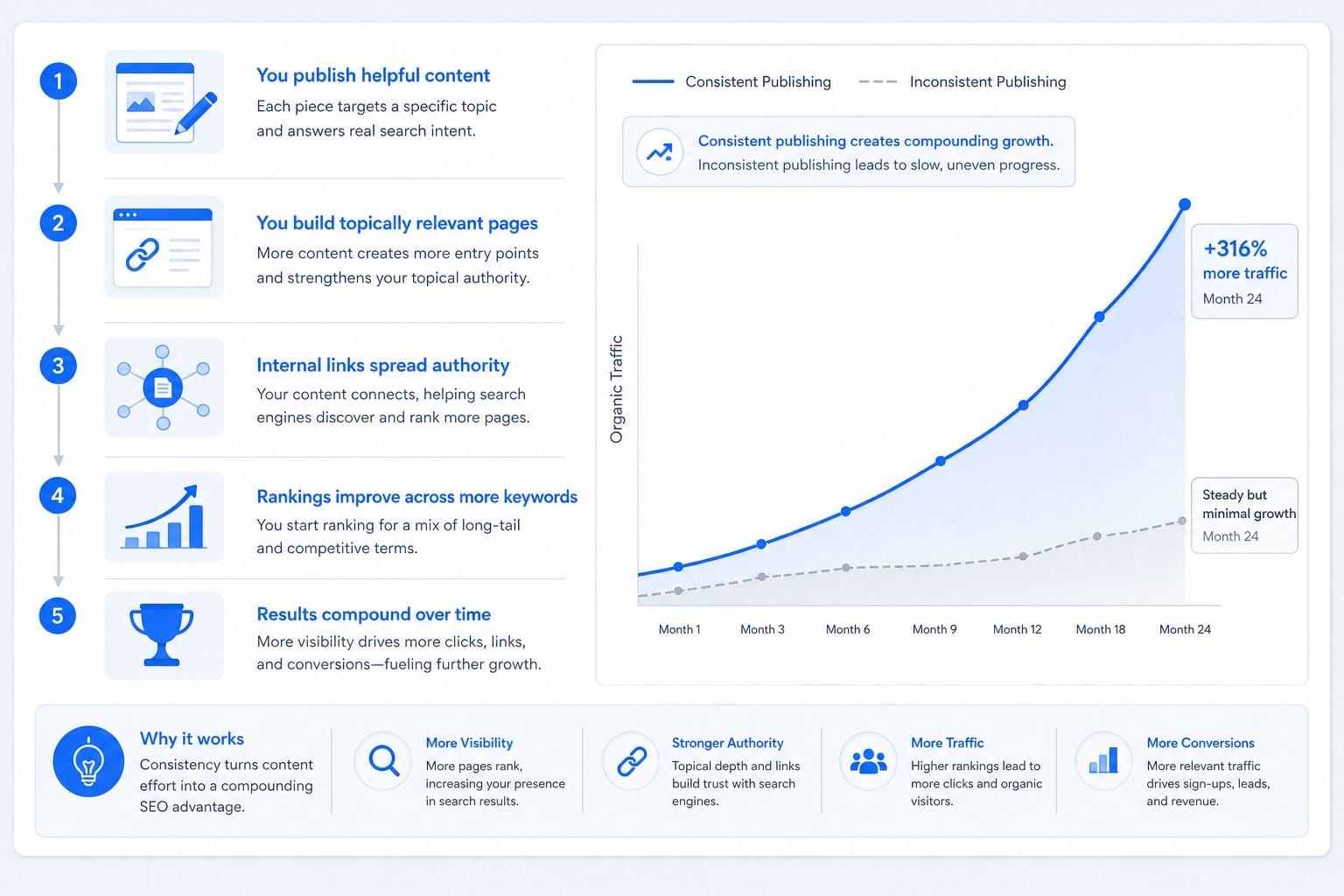
Consistent publishing also feeds internal linking opportunities in a way that infrequent publishing cannot. Every new post is a chance to link back to older cornerstone content and to link forward to newer supporting articles. When a blog publishes a post about winterizing a cabin and links it to an older post about seasonal maintenance, both pages benefit. The new post inherits some authority from the older one, and the older post receives a signal that it is still relevant and connected to current content. Over a twelve-month period of consistent publishing, a blog with good internal linking builds a dense, interconnected web of content that Google reads as genuine topical expertise.
Internal linking is one of the highest-leverage SEO activities available to a blog team because it costs nothing beyond time and strengthens the whole site simultaneously. But it requires knowing your existing content well enough to spot connection points as new posts go live. When you are publishing manually and infrequently, this is manageable. When you are scaling to multiple posts per week, you need a system that tracks what has been published and surfaces logical link opportunities without requiring someone to hold the entire content catalog in their head.
I want to address something that comes up consistently when brands think about scaling content: the concern that more content means lower quality. This worry is legitimate when scaling means churning out shallow posts stuffed with keywords and no real research behind them. It is not a valid concern when scaling means producing well-researched, substantive articles at a higher frequency. The key is that research depth has to stay constant even as volume increases. Scaling a process that skips research just produces more low-quality content faster. Scaling a process that keeps research non-negotiable produces more genuinely useful content, which is what actually ranks.
This distinction matters because Google has gotten significantly better at identifying thin content, even when that content is grammatically correct and keyword-rich on the surface. Articles that answer a specific question thoroughly, cover related sub-topics that a reader would logically want to understand, and demonstrate familiarity with the subject beyond surface-level definitions tend to hold rankings over time. Articles that check the keyword box without offering real depth tend to rank briefly, if at all, and fall off as Google refines its understanding of the topic.
For content creators who publish in multiple languages or for audiences in different regions, consistent structure matters even more because the architecture has to work across different URL patterns and hreflang configurations simultaneously. The principles do not change based on language, but the execution requires more attention to detail. A Spanish-language post benefits from the same clean URL structure, the same internal linking discipline, and the same publishing consistency as any English post. If you are curious about what AI-powered publishing looks like in a multilingual context, Blogueando con inteligencia artificial: publica sin esfuerzo shows how that approach can work across different content contexts without sacrificing quality.
Another dimension of consistent publishing that rarely gets enough attention is the effect on brand perception. A blog that publishes regularly communicates that the organization behind it is active, invested, and worth paying attention to. A blog that posts sporadically communicates the opposite, even if the individual posts are well-written. For brands trying to build trust with an audience that has never heard of them, publishing frequency is part of the credibility signal. Cabin Plus reinforces its authority in the cabin travel and rental space every time a new post goes live, and that accumulation of published expertise builds over years into a meaningful competitive advantage.
The mechanics of this advantage are worth spelling out. When a brand publishes consistently on a focused set of topics, Google begins to treat that domain as a reliable source of information on those topics. New posts on the same subject benefit from this reputation and often rank faster than a brand-new site covering the same topic would. This is sometimes called topical authority, and it is why a well-established niche blog can outrank a larger, more authoritative domain on specific sub-topics. The niche blog has more relevant content, more internal links connecting related posts, and a longer history of satisfying searchers on that specific subject.
Building this kind of authority is a long game. The brands that win at it are the ones that treat their blog as a core business asset rather than a marketing afterthought. They publish on a schedule. They research topics before writing about them. They link new posts to older ones. They track what is indexed and what is not. And they do not stop when the first few months produce modest results, because the compounding nature of this kind of traffic means the strongest results often come in year two and year three, not in the first ninety days.
What you can apply from this to your own blog strategy
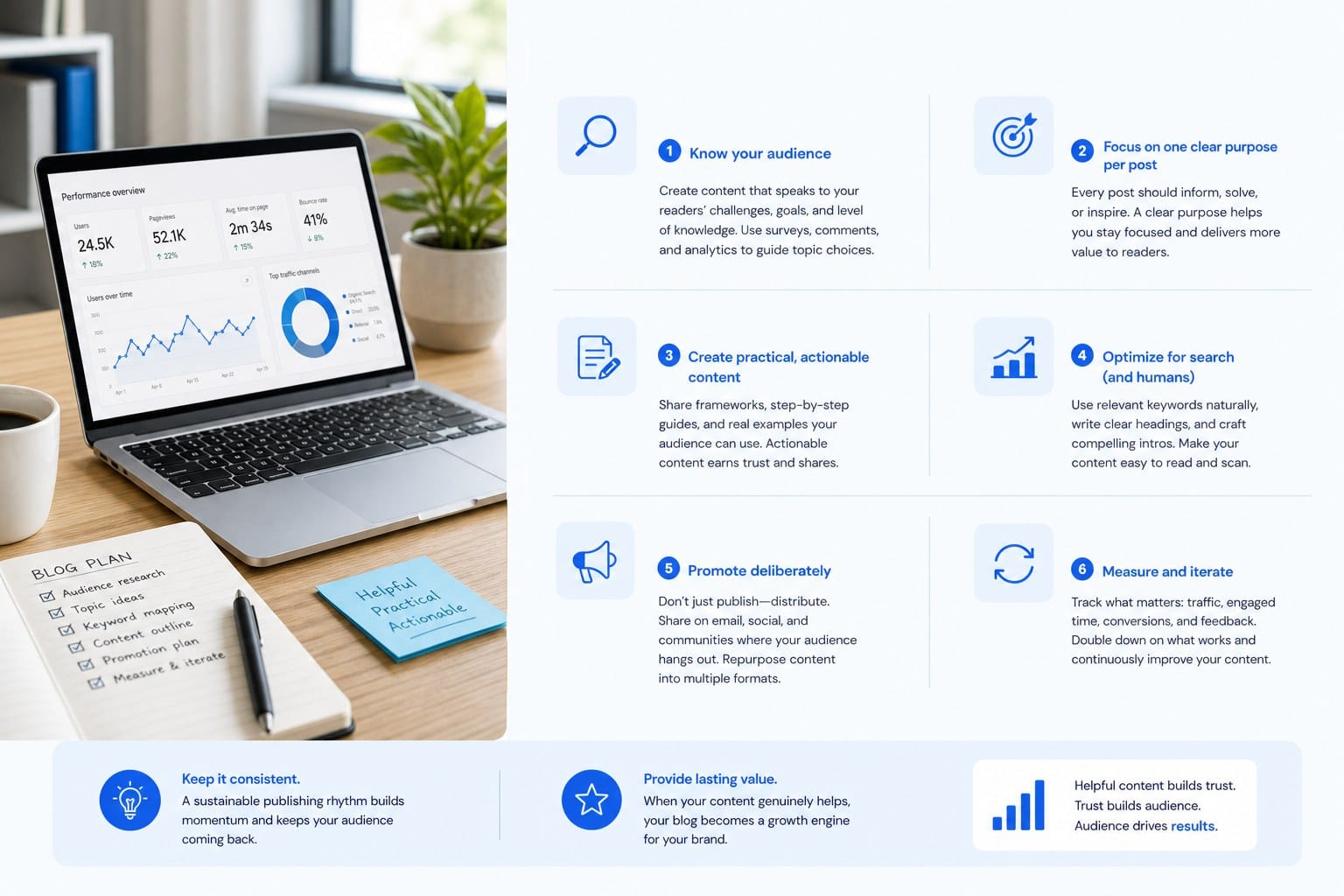
Understanding what site:cabinplus.co inurl:blog reveals is useful, but the real value is in knowing how to apply those same analytical techniques to your own blog. The lessons here are not specific to cabin rentals or to any particular industry. They apply to any content-driven site trying to earn organic traffic over time. Let me walk through the specific things any blog owner or content team can audit and improve starting this week.
First, run the same kind of search on your own domain. Open Google and type site:yourdomain.com inurl:blog. Count how many results appear and compare that number to how many posts you know you have published. If the numbers do not match, you have an indexing problem worth diagnosing. Posts might be blocked in your robots.txt file, missing from your sitemap, returning server errors that prevent crawling, or sitting behind a noindex tag that someone added and forgot about. Google Search Console will give you more specific detail on what is happening with each URL, including whether it is excluded from the index and why.
Second, examine the URLs that do appear in those results. Are they consistent? Do they follow a clear pattern? Are the slugs descriptive and keyword-relevant, or are they auto-generated strings that reveal nothing about the content? If you see a mix of formats, some posts with dates in the URL and some without, some under /blog/ and some under /news/ or /articles/, that inconsistency fragments your authority across different URL patterns and makes it harder for Google to understand your content hierarchy. Standardizing your slug format and using 301 redirects to consolidate old URLs into the preferred structure is a worthwhile investment even though it requires careful execution.
Third, audit your internal linking by picking five of your most important blog posts and counting how many other posts on your site link to them. If cornerstone content has few or no internal links pointing to it, those pages are not receiving the authority signal they need to rank competitively. Build a simple spreadsheet tracking your top posts alongside the pages that link to them, and then systematically update older posts to include links to newer relevant content. This is unglamorous work but it has a measurable impact on rankings, and it costs nothing beyond time.
Fourth, look at your publishing frequency over the past six months. How many posts went live? Were they distributed evenly across that period or concentrated in a few bursts with long gaps between them? If you published ten posts in one month and nothing for the following three, your crawl rate and topical momentum both suffered. Regular publishing, even if that means two solid posts per week instead of ten mediocre ones, will outperform the burst-and-pause pattern over a twelve-month period. The crawlers learn your rhythm and return accordingly.
Fifth, think about whether your content categories form coherent topic clusters or whether your blog is a collection of loosely related articles with no clear organizational logic. A well-structured blog does not just publish individual articles. It builds groups of related content that together signal expertise in a given area. If Cabin Plus has a cluster around off-grid cabin living, that cluster might include posts about solar power for cabins, water filtration systems, insulation strategies for cold climates, composting toilets, and internet connectivity in remote areas. Each post stands on its own and ranks for its own keywords, but each one also reinforces the others through internal links and shared thematic relevance. This is the architecture that builds long-term topical authority in a way that individual posts cannot achieve alone.
Sixth, check whether your most important posts are receiving external links from other sites. Internal linking strengthens your architecture, but external links from relevant, authoritative domains are still a significant ranking factor. If your cornerstone content has no external links pointing to it, that is a gap worth addressing through outreach, partnerships, or creating content that is genuinely worth citing. Useful data, original research, comprehensive guides, and well-designed visual assets tend to earn links more reliably than generic informational posts.
Seventh, look at your page speed, particularly on mobile. Use Google's PageSpeed Insights tool to test your most important blog posts and identify what is slowing them down. Large unoptimized images are the most common culprit, followed by render-blocking scripts and excessive plugin loads. Fixing speed issues on a blog that already has good architecture and consistent publishing is one of the fastest ways to improve crawl efficiency and user experience simultaneously.
For teams that want to build a structured content program without hiring a full editorial staff, the question becomes how to get there efficiently without sacrificing the quality that makes content worth publishing. Planning a 30-day content calendar, researching each topic thoroughly, writing articles that are substantive enough to actually cover a subject, adding visuals, and then publishing and cross-linking all require significant coordinated effort. When that effort falls on one person or a small team already managing other responsibilities, something usually gives. Quality drops, frequency drops, or the blog gets abandoned entirely.
Blogtude addresses this by handling the full workflow from strategy through publishing. The process starts with a 30-day content plan so there is always a clear editorial roadmap rather than reactive or random topic selection. The articles are built to cover topics with the kind of depth that earns rankings rather than thin content that gets ignored by both readers and search engines. And the automatic publishing to Ghost and other platforms means the gap between finished article and live post does not become another bottleneck in a workflow that is already stretched.
If you are evaluating whether this kind of approach fits your situation, the Outrank.so alternative: why Blogtude may be the better fit post is a useful read if you are already familiar with other AI content platforms and want to understand what distinguishes the approach in terms of research depth, publishing workflow, and content quality.
One final point about applying these lessons: the structural decisions you make early in a blog's life are significantly harder to undo later. Switching URL formats, restructuring categories, or migrating platforms after hundreds of posts are published creates extensive redirect work and risks temporary ranking drops that can take months to recover from. Getting the architecture right from the start, or fixing it deliberately as early as possible, saves a substantial amount of pain later and protects the authority you have already built.
This is why studying how sites like Cabin Plus have structured their blogs is worth more than a few minutes of your time. The search operator research is not just an academic exercise. It surfaces patterns that you can benchmark against your own site and use to identify specific structural gaps. The blog section that earns consistent organic traffic is almost always one with clean architecture, regular publishing, smart internal linking, and a coherent topic strategy. Those elements work together as a system. When one part is missing, the whole system underperforms, even when the individual articles are well-written.
Building that system does not require hiring a team of writers, editors, and SEO specialists. It requires a workflow that handles the repeatable parts reliably so you can focus on the strategic and creative decisions that actually require human judgment. The brands that compound their organic traffic fastest are the ones that figured out early which parts of content production can be systematized and which parts need human attention, and then built or adopted a workflow accordingly. Cabin Plus is a good example of what that looks like when the structural side is handled well. The goal is to build something equally solid under your own domain.
Ready to take the next step?
If you are ready to build a blog that earns consistent organic traffic without the manual grind, Blogtude handles the strategy, research, writing, visuals, and publishing for you. Visit blogtude.com to see how the 30-day content engine works and start building the kind of compounding blog presence that keeps growing long after you hit publish.


