
Outrank.so alternative: why Blogtude may be the better fit


Table of contents
1. What people are actually looking for when they search for an alternative
2. How Blogtude approaches blog automation differently
3. Making the decision: questions to ask before you switch
If you have been shopping around for content automation tools, you have probably landed on Outrank.so at some point. It promises to take the grind out of blog publishing, and for some users it delivers on that. But a growing number of founders, marketers, and independent bloggers find themselves asking whether there is a better fit for their specific situation. That question is exactly what I want to answer here. I will walk you through what makes a solid Outrank.so alternative worth considering, where the real gaps tend to show up for different types of users, and why Blogtude has become the go-to choice for teams and solo creators who need more than just generated text dropped into a dashboard.
What people are actually looking for when they search for an alternative
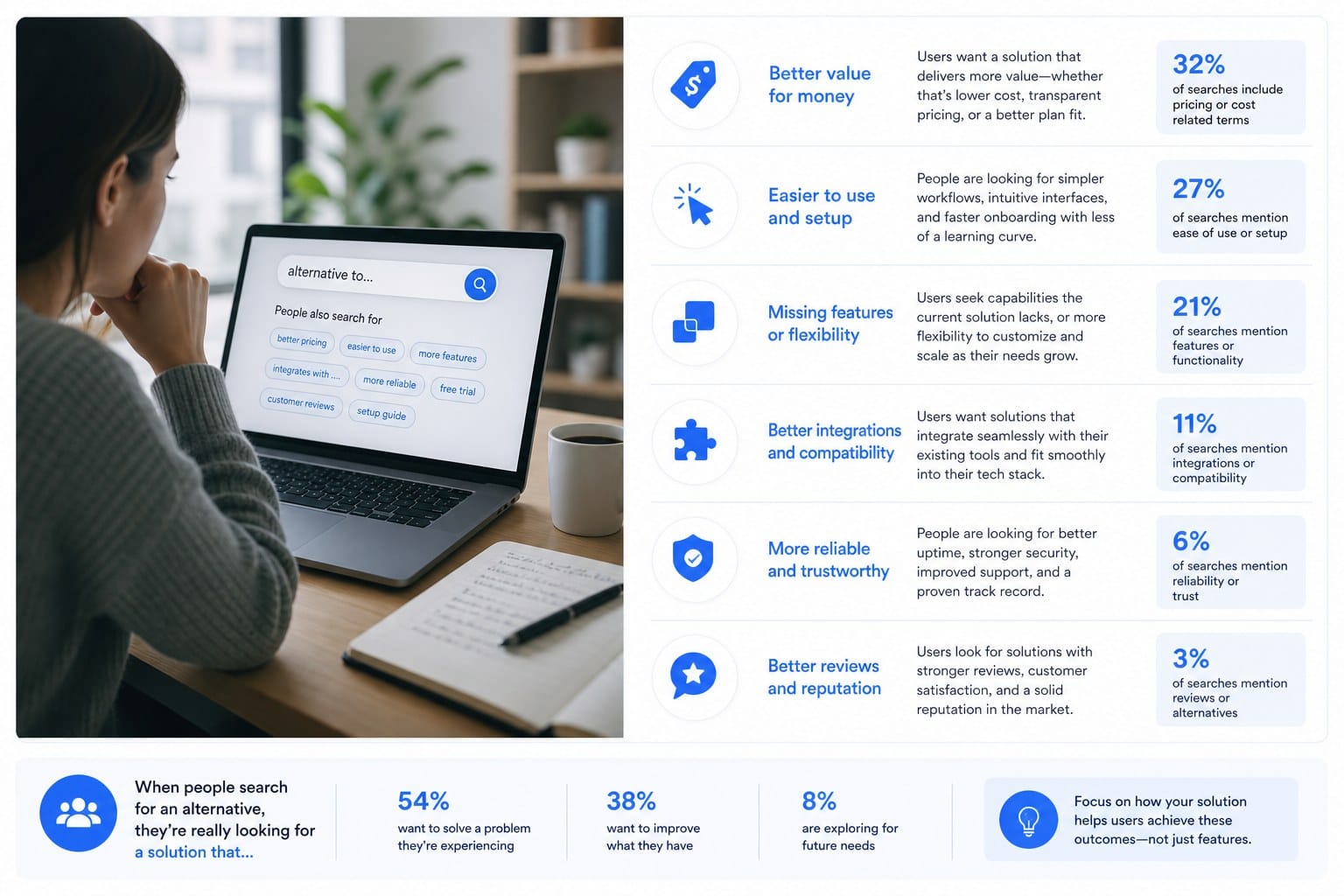
Before comparing any two tools, it helps to understand why someone starts looking in the first place. Most people who search for an Outrank.so alternative are not unhappy with the idea of AI-assisted blogging. They are unhappy with something specific: the content feels too generic, the workflow still demands too much manual effort, the publishing step is not truly automated, or the strategy layer is missing entirely.
Those four pain points point to very different needs, so it is worth breaking each one down carefully.
Generic content is the most common complaint across AI writing tools in general. When a tool pulls from a large language model without feeding in brand voice, niche context, or deep research, the output reads like it could belong to any company in any industry. That is a real problem for SEO, because search engines have gotten much better at identifying thin, undifferentiated content. It is also a problem for readers, who can tell within two paragraphs whether an article was written with any real understanding of their situation. Generic content does not earn backlinks, does not build trust, and does not convert browsers into buyers.
Think about what happens when two SaaS companies in the same niche both use an AI writing tool on default settings. They end up publishing articles with nearly identical structure, nearly identical examples, and nearly identical conclusions. Neither one stands out in search results. Neither one gives a reader a reason to come back. The writing is technically correct but commercially useless.
Manual effort is the second issue. Many tools automate the writing step but leave you to handle keyword research, topic selection, internal linking, image sourcing, formatting, and scheduling on your own. That is still a significant time commitment, especially if you are a SaaS founder or small business owner who already has a full plate. The promise of automation falls flat when you are still spending four or five hours a week managing the process around the tool. You have shifted the work, not eliminated it.
The problem compounds quickly. A founder who sets aside Monday mornings for content work will find that the keyword research alone can eat an hour. Picking the right topic, briefing the tool, reviewing the draft, sourcing a featured image, formatting the post for the CMS, adding internal links, writing the meta description, and hitting publish — that is not a workflow. That is a part-time job that happens to involve software.
Publishing integration is the third sticking point. Some tools generate a document and call it done. Getting that document into your CMS, formatted correctly, with the right metadata, the right featured image, and the right publish date, is a separate job that many platforms leave entirely to you. At that point the tool has saved you time on the writing but added back friction everywhere else. For someone managing a blog across a client portfolio or running a content-heavy growth strategy, that friction adds up fast.
True publishing integration means the content is live on schedule without you opening a tab. Anything short of that is a workflow with a manual gap in it.
The strategy layer is the fourth gap, and in many ways the most consequential one. A content calendar built around actual keyword opportunities, your business goals, and your audience's search behavior is fundamentally different from a list of blog post titles generated on demand. Without a strategy, you are publishing content that may never compound into real organic traffic growth. You might publish fifty posts over a year and find that your search traffic barely moved, not because the writing was poor, but because the topics were chosen without any logic connecting them to what your audience actually searches for.
Topical authority is how search engines decide which sites to trust for a given subject. You build it by publishing a coherent body of work that covers a topic from multiple angles over time, with articles that link to and reinforce each other. A random assortment of posts, even well-written ones, does not build that authority. A planned content calendar does.
Understanding which of these four gaps matters most to you is the first step in figuring out whether any Outrank.so alternative is actually worth switching to, or whether you would just be trading one set of limitations for another.
If you want to go deeper on what actually makes a blog post perform well in search, Anatomy of a high-performing blog post: 12 elements that drive traffic is a useful reference point. It lays out the structural and strategic elements that separate content that ranks from content that sits quietly on page seven of Google.
It is also worth asking what success actually looks like for your blog before you evaluate any tool. Are you trying to generate leads? Build an audience? Rank for competitive keywords in a crowded niche? Support a sales cycle by answering questions buyers have before they reach out? Each of those goals calls for a different kind of content strategy, and a tool that does not start with strategy cannot help you achieve any of them reliably.
The users who feel most stuck with their current tool are usually people who chose it for one specific feature — the AI writing, the keyword suggestions, the browser interface — without thinking through the full workflow from topic selection to published post. They got the feature they wanted and then discovered that the rest of the work was still sitting on their desk. That is the experience that sends people searching for alternatives.
How Blogtude approaches blog automation differently
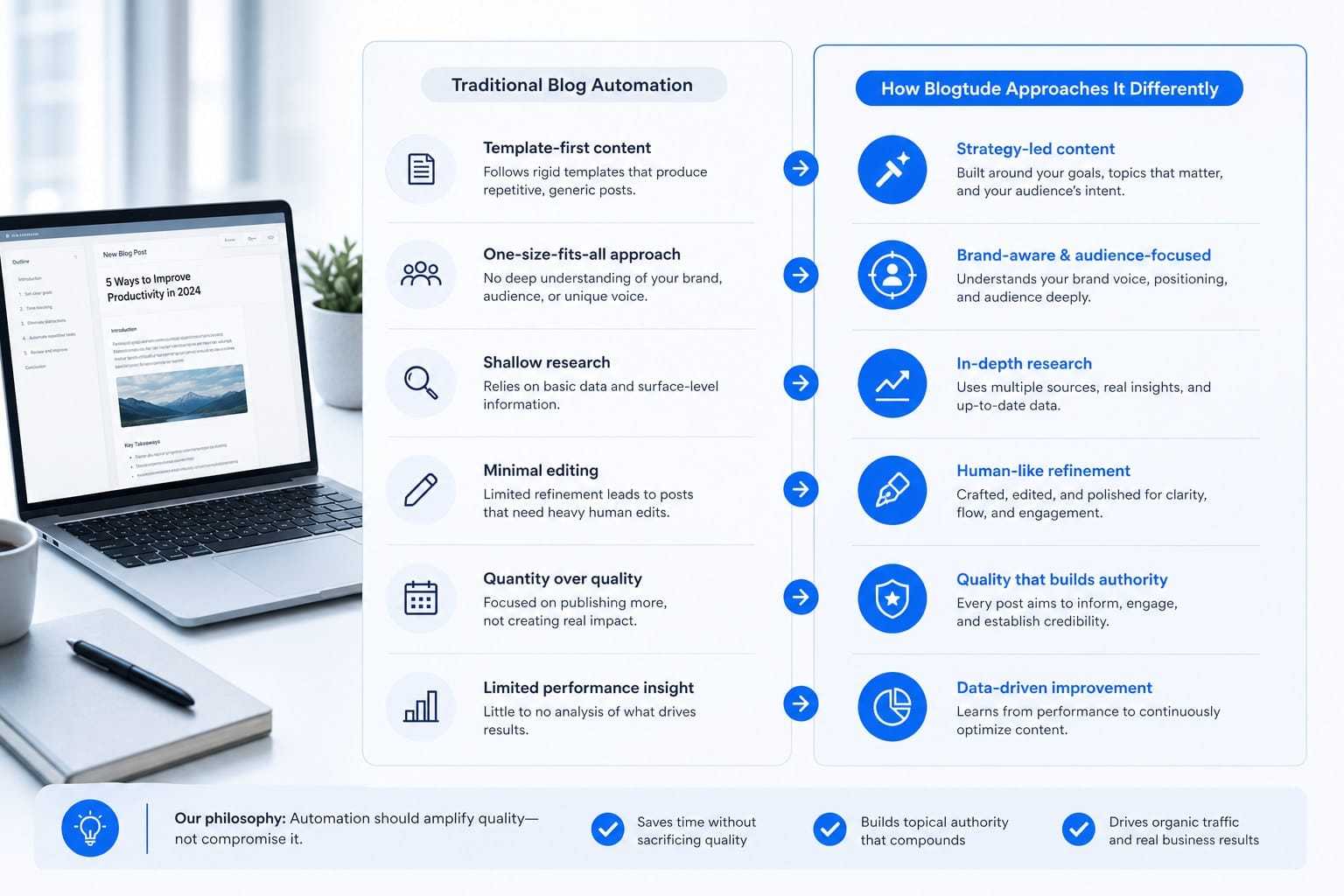
Blogtude is built around a specific belief: blog content should work for your business without requiring you to manage it like a part-time job. That sounds simple, but most tools only solve one piece of that equation. Blogtude is designed to solve the whole thing, from the first keyword to the published post.
Here is how the approach is structured, and why each piece matters.
The starting point is a 30-day content strategy. When you set up Blogtude, it does not hand you a text editor and wait for you to give it prompts. It builds out a month's worth of content topics based on your niche, your audience, your business goals, and real keyword data. That means every piece of content has a reason to exist before anyone writes a word. Each topic is mapped to something your target audience is actually searching for, and the topics are sequenced in a way that lets them build on each other over time.
This matters more than it might seem at first. One of the biggest reasons business blogs fail to generate traffic is not that the writing is bad. It is that the topics were chosen without any strategic logic. A series of disconnected posts on vaguely related subjects does not build topical authority. A planned content calendar does. When you start with a strategy, every article you publish is a step toward something — a cluster of related content that signals to search engines that your site knows this subject deeply.
Compare that to the alternative. A founder opens an AI writing tool, types in a topic that occurred to them while reading the news, generates a post, and publishes it. That happens twelve times over three months. The result is twelve articles on twelve unrelated topics, none of which reinforce each other, none of which were chosen because of search demand, and none of which build toward any particular business outcome. The blog technically exists and content technically went up, but the organic traffic numbers tell a different story.
The second piece is the content itself. Blogtude generates long-form articles, not short summaries or SEO-thin pieces padded out to 800 words. Long-form content consistently outperforms shorter content for competitive keywords, partly because it has more room to cover a topic thoroughly, and partly because it tends to earn more backlinks and social shares. Each article is researched before it is written, which means it goes beyond rephrasing common knowledge and actually addresses the specific questions and concerns your audience brings to that topic.
The research step is what separates content that answers real questions from content that restates the obvious. When a tool skips research and goes straight to writing, you get articles that cover the surface of a topic without going anywhere useful. Readers notice, and so does Google. Depth is not just a quality marker — it is a ranking signal.
Long-form content also gives you more internal linking opportunities, more chances to include semantically related terms, and more space to demonstrate expertise. A 2,000-word article on a specific topic can address the main question, anticipate follow-up questions, provide concrete examples, and still have room for a practical conclusion. An 800-word piece cannot do all of that, and the difference shows in how the content performs over time.
The third piece is visuals. On-brand images are generated and embedded as part of the article production process. This is not a small thing. A blog post without a featured image, or with a stock photo that feels completely disconnected from the content, makes a poor first impression and tends to get skipped over in social feeds. Visual quality is part of what makes the difference between content that looks professional and content that looks automated, even when both were produced with AI.
Having visuals that actually match the tone and subject of each article is part of what makes the finished product feel intentional rather than assembled. For consumer-facing brands especially, that distinction matters. A reader who lands on a post with a compelling, relevant featured image is more likely to stay and read than one who lands on a post with a generic stock photo of someone typing at a laptop.
The fourth piece, and arguably the one that creates the most day-to-day value, is automatic publishing. Blogtude connects directly with Ghost CMS and other platforms, and it handles the entire publishing step without you needing to touch it. The article goes from draft to live with the right metadata, the right image, and the right scheduling. If you are a Ghost user specifically, this integration is tight enough that it genuinely removes the publishing step from your workflow entirely.
For anyone who has spent time thinking through the best blogging platform in 2025, you already know that Ghost is one of the strongest options for content-focused sites that want fast load times, clean SEO defaults, and a subscription-ready architecture. The fact that Blogtude treats Ghost integration as a core feature rather than an afterthought makes it a natural pairing for that audience.
Now, it is worth being direct about what Blogtude is not. It is not a tool that works well if you want to write your own content and use AI only as a light editing assistant. It is designed for people who want to hand off the blog entirely, or at least the bulk of the production work, so they can focus on other parts of their business. If you enjoy writing and want to stay hands-on with every post, that is a valid choice, but it is not the use case Blogtude is built for.
The users who get the most out of Blogtude tend to fall into a few clear categories. SaaS founders who know they need consistent content to build organic traffic but cannot justify hiring a full content team yet. Small business owners who have tried maintaining a blog and found that it always gets deprioritized when things get busy. Digital marketers managing brand blogs across multiple clients who need a reliable, predictable content output. Independent bloggers who want to scale their publishing volume without scaling their hours.
If you are in any of those groups, the difference between what Blogtude offers and what you would get from a tool that simply generates text on request is significant. The strategy, the research, the visuals, and the automatic publishing are not add-ons or premium features bolted onto a text generator. They are the core of how the product works.
For Spanish-speaking audiences or creators running bilingual content operations, it is also worth noting that this approach to AI-powered blogging translates across languages. Blogueando con inteligencia artificial: publica sin esfuerzo explores how AI-driven publishing works for creators operating outside the English-language SEO bubble, which is an underserved use case in most content automation tools. The strategic and structural principles are the same regardless of language — consistent, researched, well-structured content builds authority in any market.
One more thing worth noting: the compounding effect. A blog that publishes one well-researched, strategically planned article per week will, over twelve months, build a body of work that reinforces itself. Early posts link to later ones. Later posts fill gaps left by earlier ones. The site develops topical depth that individual posts cannot achieve on their own. That compounding is what turns a blog from a publishing expense into a traffic asset, and it only happens when the content is consistent and strategically connected. An automated content engine that maintains that cadence without depending on your schedule or energy is a structural advantage, not just a convenience.
Making the decision: questions to ask before you switch
Switching content tools is not a trivial decision. You have probably already invested time setting up your current workflow, uploading brand guidelines somewhere, or at minimum learning how the interface works. The switching cost is real, and it deserves honest consideration before you commit to anything.
So instead of simply declaring that Blogtude is the better choice, here is a set of questions you can use to evaluate whether any Outrank.so alternative, including Blogtude, is actually the right move for your situation.
How much time are you currently spending on blog production each week, and how much of that feels like it could be automated?
If the answer is a couple of hours and most of that time is writing, any capable AI writing tool might close the gap for you. But if you are spending meaningful time on research, topic selection, image sourcing, formatting, and publishing coordination, then a tool that only automates the writing step is not going to give you your time back. You need something that handles the full production chain.
It helps to actually track this for one week before you make any decisions. Write down every task that touches your blog and how long it takes. Most people who do this exercise discover that writing is a smaller share of the total time than they assumed. Research, revision, image work, and publishing coordination often take longer than the writing itself. A tool that saves you an hour on writing but leaves the rest of the work in place is not solving your problem.
Is your current content actually generating organic traffic, or is it sitting on your site without meaningful search visibility?
This is where strategy matters enormously. If you have published thirty or forty posts and are not seeing growth in search traffic, the problem is usually not the writing quality. It is the topic selection, the keyword targeting, or the lack of internal linking and topical structure. A tool that generates text without addressing those strategic elements will produce more of the same result. A tool that starts with a research-backed content calendar gives you a fundamentally different foundation.
Check your Google Search Console data before you switch anything. Look at which posts are generating impressions and clicks, and which ones are invisible. If the visible ones are clustered around a few related topics and the invisible ones are scattered across unrelated subjects, that is strong evidence that your strategy — not your writing tool — is the constraint. Switching to a better writer will not fix a strategy problem.
How important is publishing integration to you?
If you are using Ghost, WordPress, or another CMS that you want to publish to automatically, you need to verify that any tool you consider actually integrates at the publishing level, not just at the export level. Exporting a document and then uploading it manually is better than nothing, but it is still a manual step that breaks the automation. True publishing integration means the content goes live on schedule without you touching it.
This is particularly important for people managing content across multiple sites or client accounts. Manual publishing at scale is not just inconvenient — it introduces errors. The wrong featured image, a missing meta description, an incorrect publish date — these are things that happen when publishing is a human task. When it is automated, they stop happening.
Do you need on-brand visuals as part of the content, or is text alone sufficient?
This varies a lot by industry and audience. For some niches, a well-written article with a simple featured image is enough to perform well. For others, particularly consumer-facing brands and lifestyle publications, the visual quality of a blog post is part of what determines whether someone reads it or bounces. If visuals matter to your brand, make sure any tool you evaluate actually handles them as part of the workflow, not as a separate step you manage yourself.
Ask specifically how the tool handles image selection or generation. Does it pull from a stock library? Does it generate images based on the article content? Does it let you define a visual style that stays consistent across posts? The answers to those questions will tell you a lot about whether the tool was designed with the full reader experience in mind or just the text.
What does consistent look like for your blog, and can your current tool maintain it without you pushing it forward manually?
Some businesses need two posts per week. Others are well served by four posts per month. The right tool is one that matches your target cadence and can maintain it reliably without depending on your initiative every time a post needs to go out. One of the quieter benefits of an automated content engine is that consistency becomes structural rather than motivational.
This distinction matters more than most people expect when they start using a content tool. The first few weeks usually go well. The founder is energized, the tool is new, and posting happens on schedule. By week eight, when there is a product launch happening and three customer calls on the calendar, the blog is the first thing that gets skipped. An automated system does not skip. It keeps the cadence going regardless of what else is demanding your attention.
If you work through those five questions honestly, you will have a much clearer picture of what you actually need from a content tool, and whether the gaps in your current setup are the kind that a full-stack solution like Blogtude addresses.
For teams and founders who have done that evaluation and concluded that they need end-to-end automation — not just an AI writer — Blogtude tends to stand out clearly. The 30-day strategy, the researched long-form articles, the on-brand visuals, and the automatic publishing to Ghost and other platforms are not features that commonly appear together. Most tools in this space do one or two of those things well and leave the rest to you.
There is also a practical argument for starting with a strategy-first tool even if you are not sure your blog will ever be a major traffic channel. When content is chosen strategically, every post you publish has a chance to contribute to your site's authority. When content is chosen randomly, most posts are essentially invisible. The difference in return on investment — even holding writing quality constant — is substantial over a twelve-month horizon.
The compounding nature of consistent, strategically planned content is one of the most reliable dynamics in SEO. A blog that publishes one well-researched, keyword-informed article per week for a year will, in almost every niche, significantly outperform a blog that publishes sporadically whenever someone finds the time. The organic traffic benefits of consistent publishing are well documented, and they are one of the main reasons businesses invest in content at all. An automated engine that keeps that cadence going without depending on your schedule or energy is not a luxury. For growing brands competing for search visibility in crowded markets, it is a real competitive advantage.
If you are evaluating Blogtude as an Outrank.so alternative and want to understand exactly what you would be getting, the clearest way to assess it is to look at the full workflow from strategy to published post and ask honestly whether your current setup delivers that end-to-end, or whether you are still filling in gaps manually. For most people searching for alternatives in this space, the answer is that they are still doing a significant amount of work that a better-integrated tool could handle for them.
The goal of any good content tool should be to make your blog a reliable growth channel without requiring you to treat it as a second job. That is the standard Blogtude is built to meet, and it is the standard worth holding any alternative to before you make a decision.

Ready to take the next step?
Ready to see how Blogtude handles the full content workflow from strategy to published post? Visit blogtude.com and explore how the platform can keep your blog consistent, researched, and live without the manual effort.


