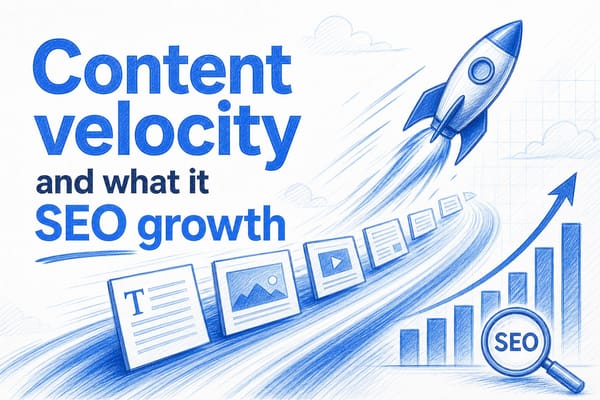
How to build a 30-day blog content strategy without a marketing team

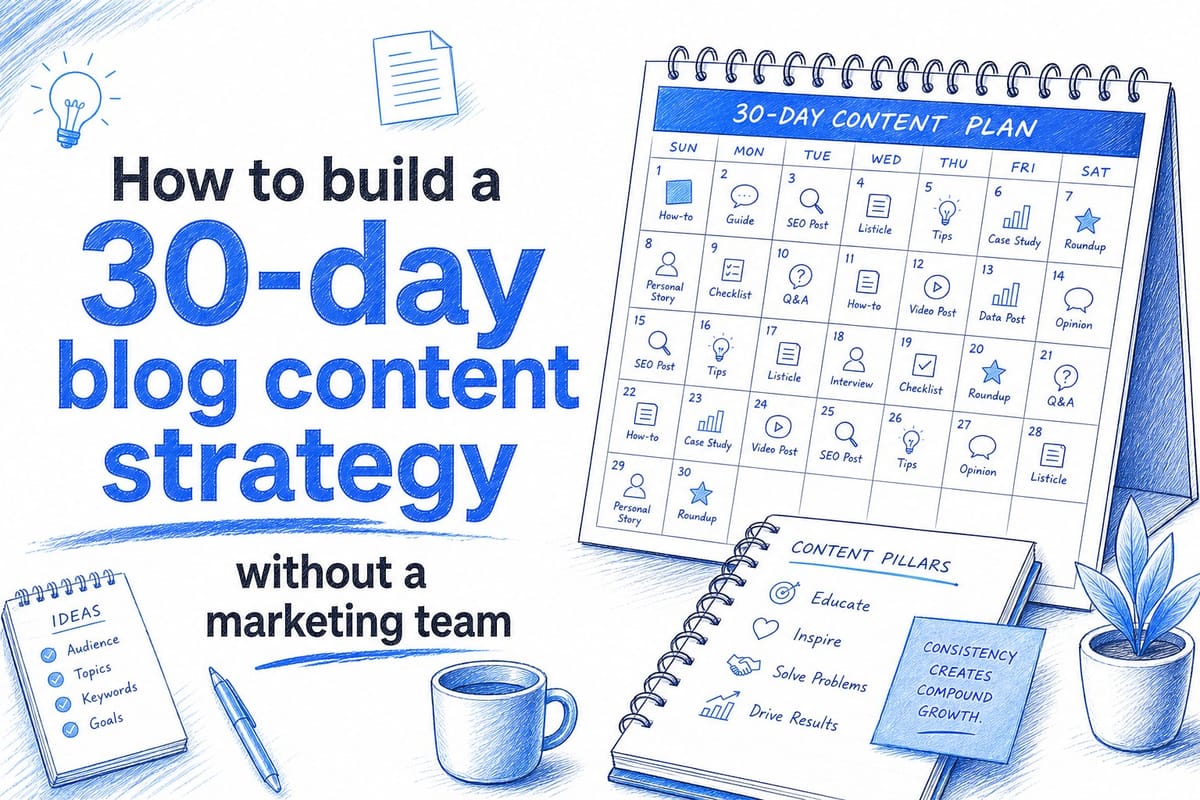
Table of contents
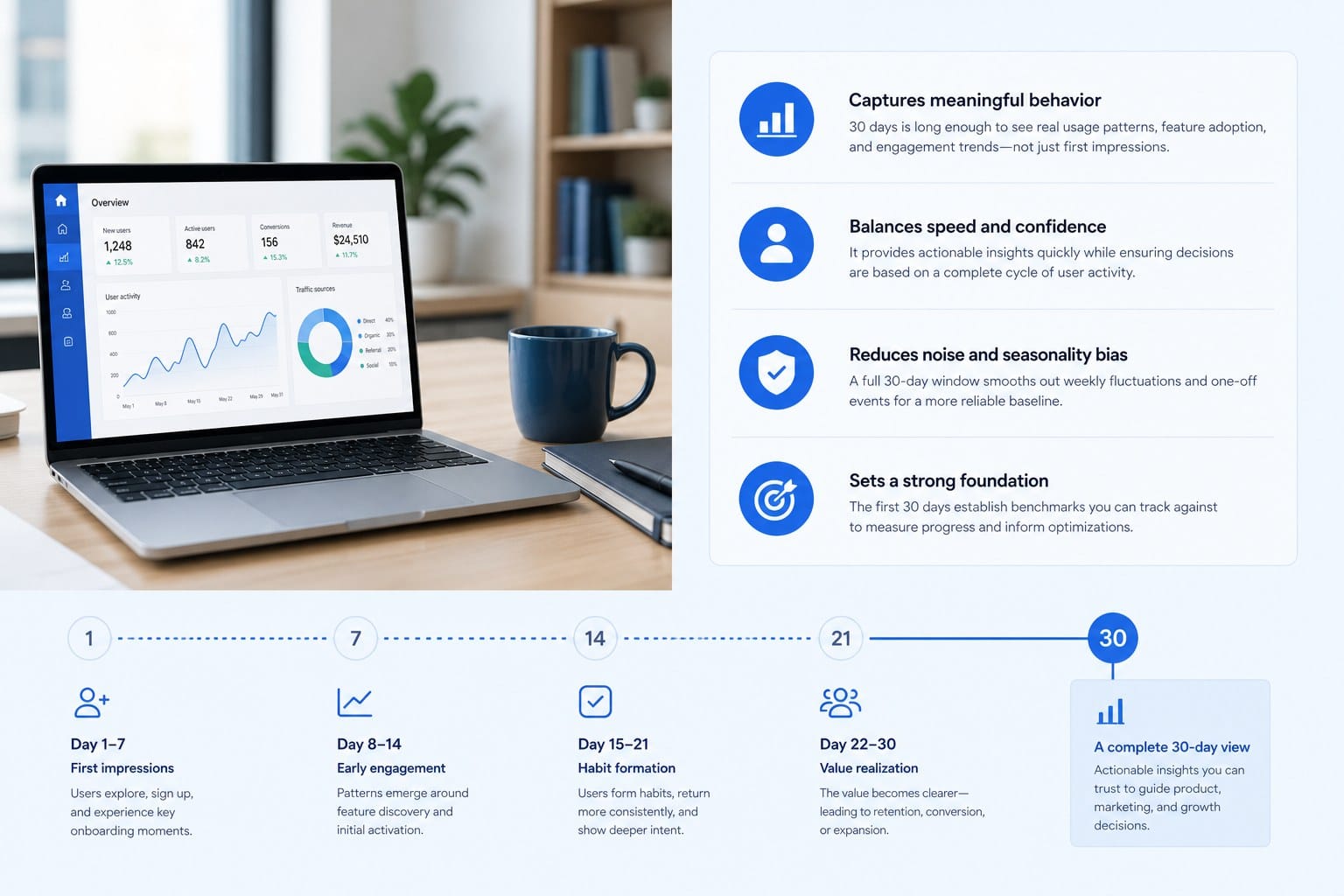
1. Why a 30-day window is the right starting point
2. How to build your 30-day content plan from scratch
3. How to sustain your blog content strategy without burning out
Most blog content strategies fail before they get started. Not because the ideas are bad, but because there is no structure holding them together. You sit down to write, stare at a blank document, and eventually publish something random that does not connect to anything else you have done. A few weeks pass. The blog goes quiet. Sound familiar? A 30 day blog content strategy changes that. It gives you a fixed window, a clear goal, and a repeatable process you can actually follow without a dedicated marketing team behind you. I want to walk you through exactly how to build one, even if you are running things solo.
Why a 30-day window is the right starting point
A lot of content advice tells you to think in quarters or build a year-long editorial calendar. That sounds organized, but for most independent bloggers, founders, and small business owners, it is paralyzing. Twelve months of content feels like a mountain. Thirty days feels like a sprint you can actually finish.
The 30-day frame works because it is long enough to show real SEO progress but short enough to stay realistic. Google does not reward one-off posts. It rewards consistent publishing over time. When you ship eight to twelve well-researched articles in a single month, you start building topical authority in your niche. Internal links between those articles pass authority around your site. Readers who land on one post find a natural path to others. That is how blogs grow.
It also forces you to be specific. When you plan for 30 days, you cannot get away with vague goals like 'post more often.' You have to decide which topics to cover, in what order, and for whom. That specificity is the difference between a blog that drifts and one that builds an audience.
Here is a concrete way to think about it. Imagine you run a SaaS tool for freelance designers. A 30-day content strategy might focus entirely on the theme 'running a profitable freelance design business.' Every article you publish that month supports that theme. You cover pricing, contracts, client communication, tools, and tax basics. By the end of the month, your blog is a small but authoritative resource on that topic. Someone searching for any of those questions is likely to land on your site and find three or four other useful articles waiting for them.
That is topical clustering in action, and it is one of the most effective organic SEO tactics available right now. You do not need a marketing team to pull it off. You need a plan.
Before you build that plan, you need to answer three questions. Who are you writing for? What problems do they have that your blog can solve? And what outcome do you want from the next 30 days? More email subscribers? More organic traffic? More demo requests? Your answers shape every decision that follows.
How to build your 30-day content plan from scratch
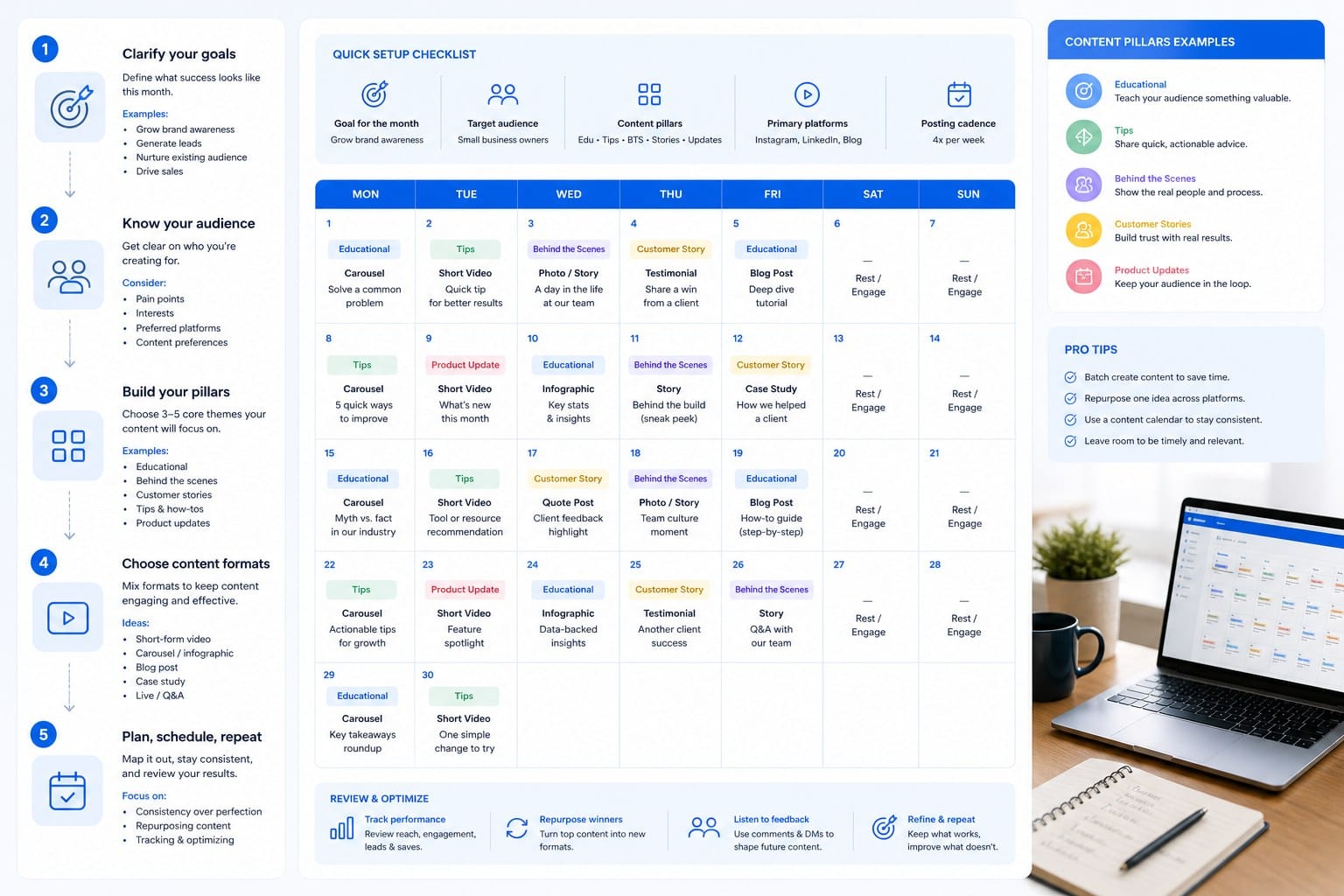
Building a solid 30-day blog content strategy involves five concrete steps. Let me take you through each one.
Step 1: Pick a core theme and supporting topics
Start with one broad theme that matters to your audience right now. This is your pillar. Everything you publish in the next 30 days should connect back to it. Think of the pillar as the main question your audience is asking, and each article as a specific answer to a part of that question.
For example, if you run a small e-commerce business selling kitchen tools, your pillar might be 'cooking at home for busy families.' Supporting topics might include meal prep tips, how to choose the right knives, quick weeknight dinner recipes, how to organize a small kitchen, and so on. Each article is useful on its own, but together they paint a full picture.
Aim for eight to twelve articles per month. That is a sustainable pace for most solo operators, especially if you are not writing every post yourself from scratch.
Step 2: Do keyword research for each topic
Keyword research does not have to be complicated. For each supporting topic, you want to find a specific search phrase that real people are typing into Google. Look for phrases with meaningful search volume and realistic competition for a site at your stage.
Free tools like Google Search Console (once you have some traffic), Google's autocomplete feature, and the 'People also ask' section of search results are all useful starting points. Paid tools like Ahrefs or Semrush give you more precise data if you have the budget.
The goal is to match each article to one primary keyword phrase. Write that phrase down next to the article title in your plan. This keeps you focused and makes sure each post has a clear SEO purpose.
Step 3: Map your publishing schedule
Decide how many posts you will publish per week and on which days. Consistency matters more than frequency. Two solid posts per week published on Tuesday and Thursday is better than five posts in the first week and nothing for the rest of the month.
Map your topics to specific dates on a calendar. This simple act makes the strategy real. It also helps you spot potential problems early, like a week where you have three heavy research pieces in a row with no lighter content to balance things out.
If you are publishing to Ghost, WordPress, or another CMS, scheduling tools built into those platforms let you queue posts in advance. You can write in batches and let the calendar take care of the rest.
Step 4: Create briefs for each article
A content brief is a one-page document that tells you (or a writer, or an AI tool) exactly what an article needs to cover. A good brief includes the target keyword, the intended audience, the word count, the main points to cover, any competing articles worth studying, and the call to action at the end.
Briefs take 15 to 20 minutes each to write, but they save enormous amounts of time later. When you sit down to write or review a piece, there is no guesswork. You already know what the article needs to do.
For a 10-article month, you might spend a few hours one Sunday afternoon writing all ten briefs. That upfront investment makes the rest of the month much smoother.
Step 5: Build an internal linking map
Before you write anything, look at your list of ten articles and draw arrows between the ones that naturally connect. Article A about meal prep should link to Article B about choosing the right containers. Article C about quick weeknight dinners should link back to Article A.
You do not need every article to link to every other article. You just need a natural web of connections so that readers and search engines can move through your content. Plan at least two to three internal links per article, and note them in each brief.
This step is easy to skip when you are busy, but it is one of the highest-leverage things you can do for SEO on a small blog. A well-linked cluster of ten articles can outperform a disconnected collection of fifty.
Handling content production
Writing eight to twelve in-depth articles in a single month is a significant output, especially if you are also running a business or managing other responsibilities. There are a few approaches people use.
Some founders set aside two to three hours every Saturday morning to write. Some hire a freelance writer and spend their time editing and approving. Some use AI-powered content tools to produce first drafts that they then review and refine.
The approach you choose depends on your budget, your schedule, and how much your personal voice matters to your audience. For a personal brand blog, your voice is central and you will want to be more hands-on. For a SaaS content blog focused on driving organic traffic, a well-structured AI-generated draft that you review and approve can be a very efficient path.
The key point is this: production should not be an afterthought. When you build your 30-day plan, you need to be honest about how each article will actually get written. If you do not have a clear answer, the calendar you built in Step 3 will not hold.
Tracking what matters
At the end of 30 days, you want to know whether the strategy worked. Set two or three simple metrics before you start. Organic traffic to the articles. Email signups from blog readers. Ranking position for the keywords you targeted.
Do not try to measure everything. Pick the numbers that connect most directly to your business goal for the month. Review them at day 15 and day 30. If something is not working, you have the structure in place to adjust for the next month.
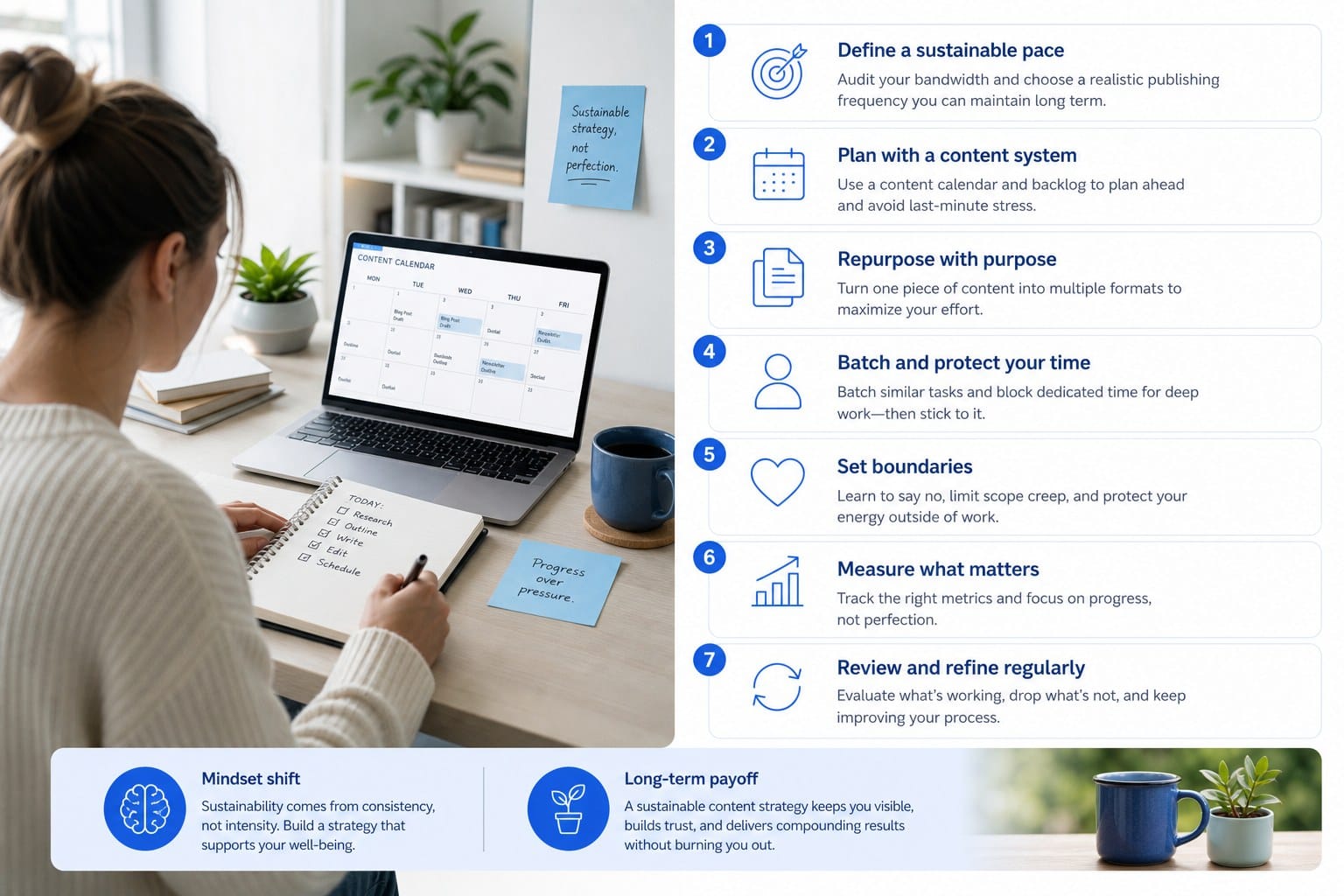
How to sustain your blog content strategy without burning out
The first 30 days are the hardest. You are building habits, testing what resonates, and learning how long content production actually takes in practice. Most people underestimate the time by about 50 percent. That is normal.
Here is how to make the second, third, and fourth month easier.
Repurpose what you have already built
Every article you publish is a source of raw material for other content. A 2,000-word post on pricing strategy for freelancers can become a LinkedIn post, a short email to your list, three quote graphics, and a thread on X. You wrote the hard part once. The repurposing is mostly editing and reformatting.
This matters for blog strategy because it means your content investment compounds. The article you published in week one of month one keeps generating traffic, social shares, and email clicks for months afterward. When you factor in that compounding, the time you spend on quality content looks much more efficient.
Use templates and systems to speed up planning
After your first 30-day cycle, you have a working template. You know the five-step process. You know how long each step takes. You have a format for briefs that works for your blog. You can reuse all of that.
In month two, planning takes half the time it did in month one. By month three, it is a routine. This is why the 30-day framework is more powerful than a one-off content push. Each cycle reinforces the last.
Keep a simple running document with topics and keyword ideas that do not fit the current month's theme. Every time you get an idea, a reader question, or a search term you notice in your analytics, add it to the list. When it is time to plan the next month, you already have a bank of raw ideas to draw from.
Automate the parts that don't need your judgment
There are parts of content publishing that genuinely require your expertise and your voice. Topic selection informed by your audience. The angle that makes an article different from the ten other articles on the same subject. The intro that hooks a reader in the first three sentences.
And then there are parts that do not require your judgment at all. Formatting articles for your CMS. Scheduling posts. Generating social captions. Resizing images. These are tasks that eat time without creating value.
Automate as much of the second category as you can. Most CMS platforms support scheduled publishing natively. Ghost, in particular, has a clean scheduling interface and supports webhooks that connect to other tools. If you are publishing to Ghost and want a more end-to-end automated workflow, tools built specifically for that ecosystem can handle drafting, scheduling, and image generation in one place.
The goal is to protect your time for the thinking work while letting systems handle the execution work.
Match content to where readers are in their journey
Not every article should be aimed at the same type of reader. Some people land on your blog because they are completely new to your topic. They need foundational explanations and clear definitions. Other people are already familiar with the basics and are looking for specific, tactical help. A third group is close to making a buying decision and is looking for comparisons, case studies, and proof.
A well-rounded 30-day content strategy includes articles for all three groups. In practice, that might look like this: four educational posts aimed at beginners, four tactical deep-dives for intermediate readers, and two posts aimed at people who are close to converting. The exact split depends on your business goals and where most of your audience currently falls.
When you mix content types like this, you also naturally create more internal linking opportunities. A beginner post can link to a more advanced tactical post for readers who want to go deeper. A comparison post can link back to a foundational article that explains the basics. This keeps people on your site longer and signals to Google that your content covers a topic thoroughly.
Review and improve, not just publish
One habit that separates blogs that grow from blogs that plateau is a regular content review. Once a month, spend one hour looking at which articles are performing well and which are not. Specifically, look at which articles are ranking on page two of Google results for their target keyword. These are your best optimization opportunities.
A post on page two often needs a few small improvements to break into page one. That might mean adding a few hundred words, including a section that answers a related question, improving the meta description, or building a few more internal links to it from other posts. These updates take far less time than writing a new article, and they can move the needle significantly.
Publishing new content and updating existing content are both part of a healthy long-term content strategy. If you only ever publish and never revisit, you leave a lot of SEO value on the table.
The role of tools in scaling without a team
I want to be direct about this. Running a consistent blog content strategy solo is genuinely hard. The planning, writing, editing, formatting, publishing, and promotion add up to a significant time commitment every month. Most people who say they are going to blog consistently do not stick with it, not because they lack ideas or discipline, but because the operational load becomes too heavy.
This is exactly the problem that AI-powered content tools are designed to solve. When a tool can take your topic and keyword input, generate a deeply researched long-form draft, create on-brand visuals, and publish directly to your CMS on a schedule you set, the time investment drops dramatically. You still need to review and approve the work. You still make the strategic decisions. But the execution layer becomes manageable for a solo operator.
Blogtude is built specifically for this workflow. It generates a full 30-day content strategy, produces researched long-form articles with visuals, and publishes directly to Ghost and other platforms. If you are a founder, independent blogger, or small business owner trying to maintain consistent content output without hiring a team, it is worth understanding how the tool fits into the workflow I have described in this article. You can learn more about how it works and what it costs at the Blogtude pricing page.
The point is not that you need any specific tool. The point is that sustainable content strategy at volume almost always requires some combination of process, templates, and automation. The people who publish consistently for years are not working harder than everyone else. They have built systems that make consistency the default rather than the exception.
What month two looks like
If you follow the five-step process I outlined and publish consistently for 30 days, here is what you can realistically expect to see. Some of your articles will start appearing in Google Search Console as impressions grow. A handful of posts will start ranking on page two or three for their target keywords. Your internal linking structure will start moving authority around the site. Email signups from the blog will tick up slightly if you have an opt-in in place.
None of this is dramatic in month one. SEO is a slow game. But month two builds on month one. Month three builds on both. By month six, if you have maintained the pace and kept improving your content, you will have a blog that generates meaningful organic traffic, has clear topical authority in your niche, and produces inbound leads or readers without requiring paid advertising.
That is the real case for a 30-day blog content strategy. Not that it produces overnight results, but that it creates a repeatable structure you can sustain long enough for the compounding to kick in.
Ready to take the next step?
If you are ready to stop guessing and start publishing with a real system behind you, Blogtude can build your 30-day strategy, write the articles, and publish them to Ghost or your CMS automatically. See how Blogtude works and check the pricing page to find a plan that fits where you are right now.