How to evaluate AI blog tools: a checklist for founders and marketers


Table of contents
1. Start with what the tool actually produces
2. How to evaluate AI blog tools checklist: workflow, integration, and strategy fit
3. The factors most buyers miss: support, pricing structure, and long-term fit
Picking the right AI blog tool is harder than it looks. The market is full of platforms making big promises about traffic growth, time savings, and content quality. Some of them deliver. Many of them do not. If you are a founder, marketer, or independent creator trying to cut through the noise, you need a clear, practical way to compare your options before you commit money or time to any of them. That is exactly what this guide gives you. I have put together a working checklist for how to evaluate AI blog tools, so you can make a smarter call without spending weeks on trial runs and comparison spreadsheets. We will cover what the tool actually produces, how well it fits into your existing workflow, and the less obvious factors that most buyers overlook until it is too late.
Start with what the tool actually produces
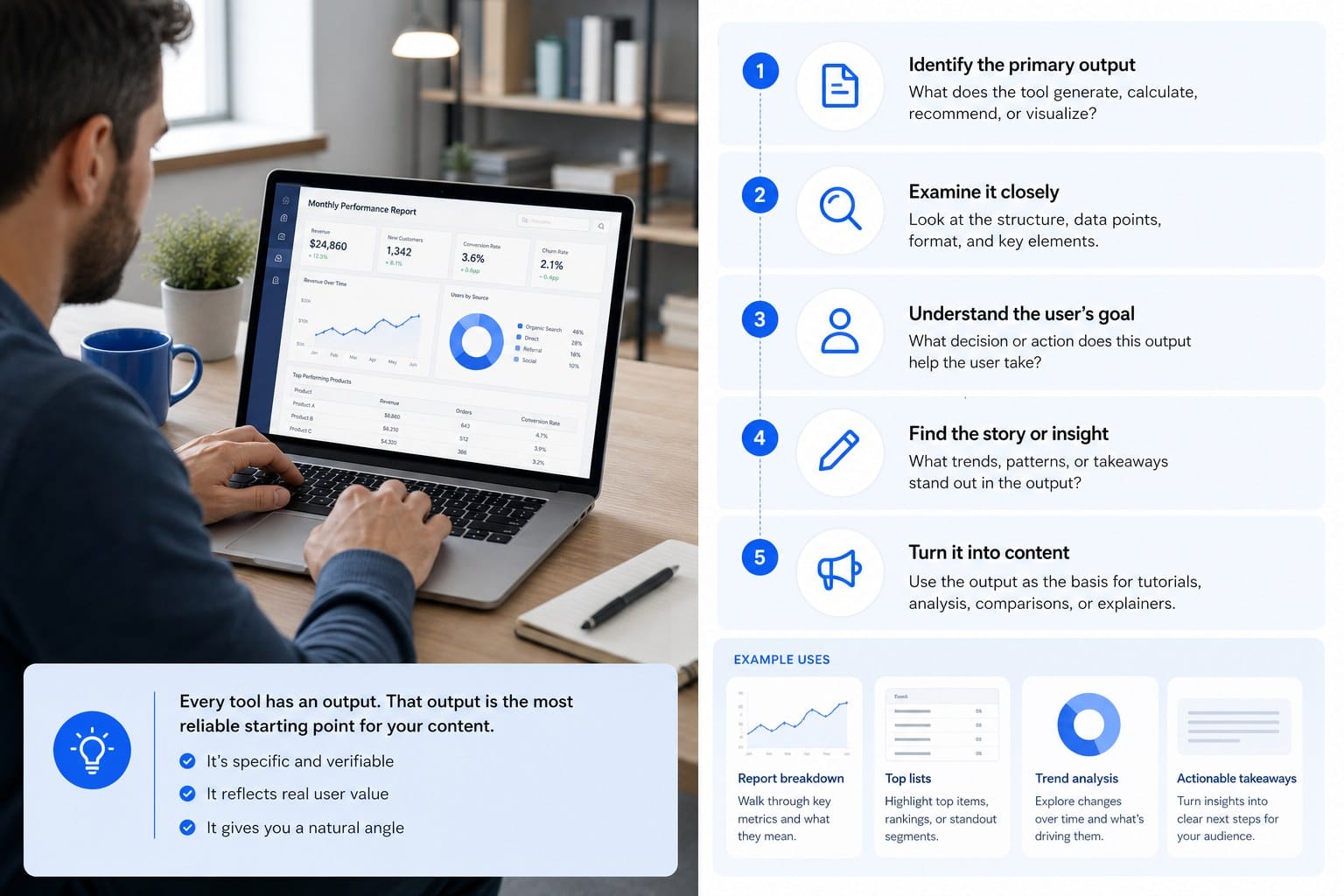
Before you look at pricing pages or feature lists, your first job is to understand what the tool puts out. A lot of AI blog tools generate content, but the word 'content' covers a huge range of quality levels. You need to be specific about what you are evaluating.
The first thing to check is article depth. Does the tool produce short, generic summaries of a topic, or does it write long-form articles that actually explore ideas, use data, and give readers something they could not find in the first three Google results? Shallow content might fill a calendar, but it does not build authority or rank well over time. Ask to see a sample article on a real topic in your niche, not a demo topic the company has hand-picked to show off.
Next, look at research quality. Good AI blog tools pull from credible sources and show their work. You want to see articles that reference real statistics, cite recognizable publications, and draw logical conclusions from evidence. If the sample content is full of vague statements like 'many experts agree' without naming who those experts are, or if the numbers sound made up, that is a warning sign. The tool either does not do real research or it cannot surface reliable sources.
Structure matters too. A well-produced article should have a clear opening that sets context, organized sections that build on each other, and a conclusion that ties everything together. If the draft reads like a list of loosely connected paragraphs with no thread running through them, editing it into something usable will cost you more time than writing from scratch.
Visuals are another output factor worth checking. Some AI blog tools stop at text. Others produce on-brand images, featured graphics, or social media previews as part of the same workflow. If you are publishing to a blog regularly, visual content is not optional. It affects click-through rates, time on page, and how professional your content looks to first-time visitors. Ask directly whether the tool generates visuals and, if so, whether those visuals are generic stock-style images or something more specific to the article topic and your brand.
Finally, check for consistency across multiple articles. Anyone can show you one great piece of content. The real test is whether the tenth article looks as strong as the first. Ask for a batch of recent outputs, or better yet, look at the actual blogs of existing customers. Consistent quality at scale is the hardest thing for any content tool to deliver, and it is the most important thing for your long-term SEO results.
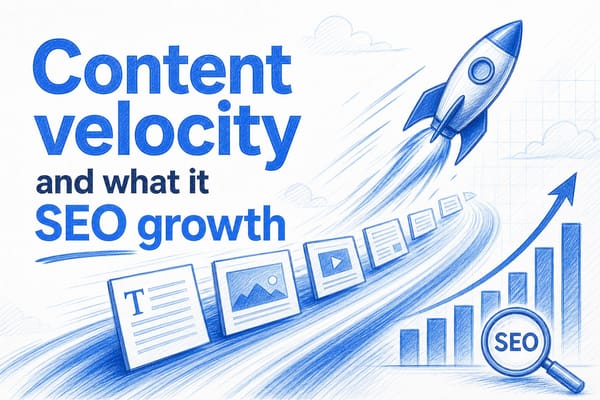
If you want to understand why consistent output matters so much for search growth, it helps to read about content velocity and what it means for SEO growth. Publishing regularly, with articles that are genuinely useful, compounds over time in a way that one-off content bursts never can.
How to evaluate AI blog tools checklist: workflow, integration, and strategy fit
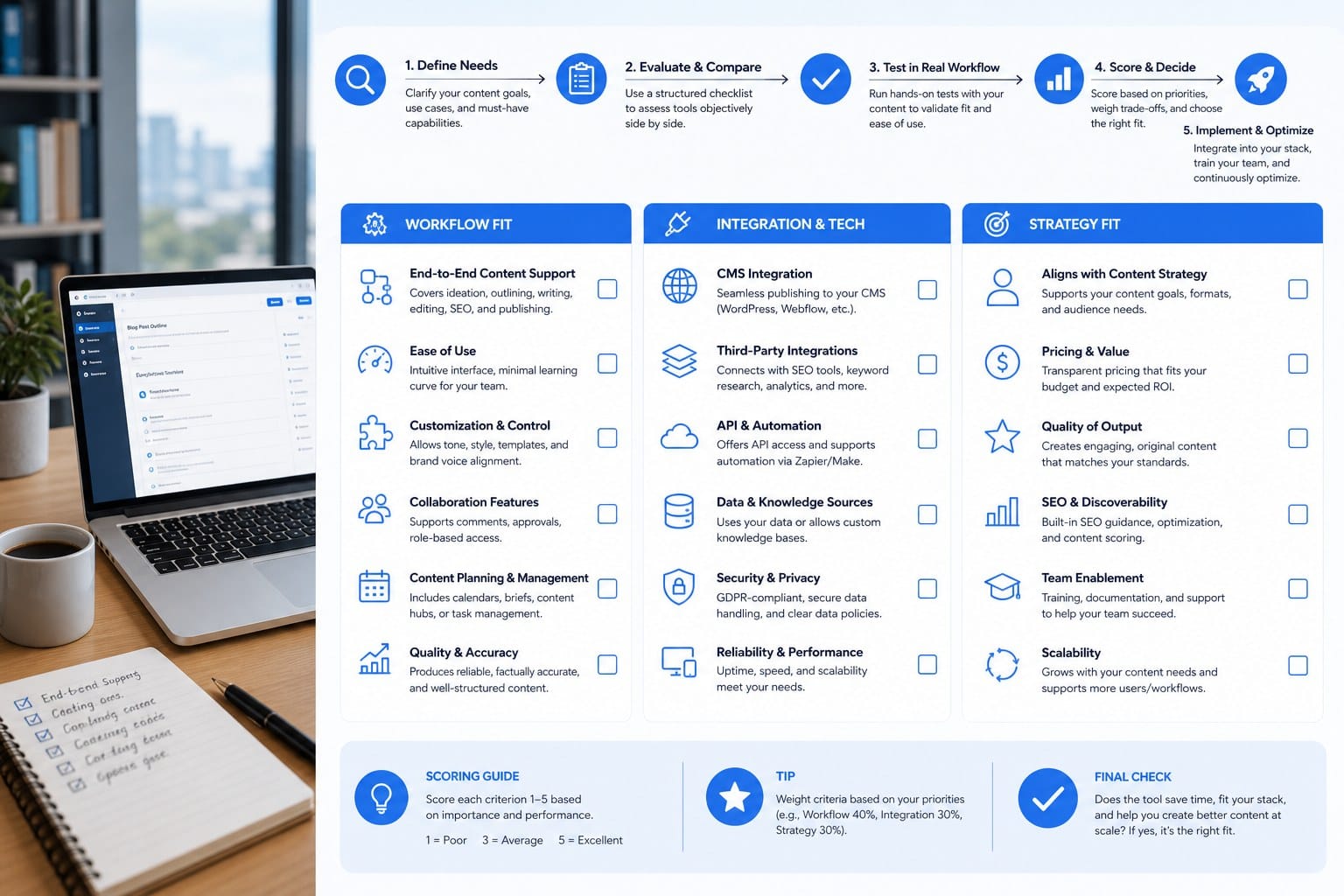
Once you are satisfied with the quality of what a tool produces, the next layer of evaluation is about fit. A tool that makes great content but requires you to spend three hours per article on setup, editing, and publishing has not actually saved you much. The workflow needs to make sense for how you actually operate.
Start with the strategy layer. Does the tool help you decide what to write, or does it just execute whatever you tell it? The best AI blog tools do not just fill a blank page. They help you build a content plan based on your niche, your audience, and the keywords you actually want to rank for. A 30-day content strategy, for example, gives you a structured publishing roadmap instead of a random collection of articles with no clear direction. If the tool only handles the writing but leaves all the planning to you, you are still doing a significant chunk of the hardest work.
Keyword research integration is a related point. Does the tool surface topics based on real search data, or is it generating ideas based purely on what sounds relevant? You want a tool that understands how people search, what questions they are actually asking, and where your content has a realistic chance of ranking given your domain authority and competition level. A tool that ignores keyword intent will produce content that reads fine but attracts no organic traffic.
Next, think about how the tool handles your brand voice. Generic AI content tends to sound like it was written by a committee. Your blog should sound like you, or at minimum like a coherent version of your brand. Ask whether the tool accepts a brand voice guide, whether it can be trained on your existing content, or whether it produces outputs that can be meaningfully customized before publishing. If every article sounds the same regardless of who publishes it, that sameness will eventually work against you.
Publishing integration is a major workflow factor. Many AI blog tools stop at the draft stage and leave you to copy, paste, format, and publish manually. That process adds up. If you are publishing four or more articles per month, manual formatting and publishing can consume several hours that you could spend on other things. Look for tools that connect directly to your CMS and push finished articles automatically. For Ghost CMS users in particular, native integration that handles scheduling, formatting, and publishing without a manual step is a genuine time multiplier.
Check what the approval and review process looks like. Full automation is only useful if you trust the output. Some tools publish without any human review at all. Others give you a review queue where you can approve, edit, or reject drafts before they go live. If you are running a brand blog with any reputational stakes, you probably want at least a light review step. Make sure the tool's workflow matches your comfort level.
Also ask about the content calendar. Does the tool give you visibility into what is scheduled, what has been published, and what is coming up? A content calendar view is not just a nice-to-have. It is how you spot gaps, avoid topic repetition, and coordinate your blog content with campaigns, product launches, or seasonal topics. If the tool has no calendar or planning interface, you will end up managing that in a separate spreadsheet, which defeats part of the purpose.
It is also worth thinking about whether the tool supports scaling. If your blog grows from four articles a month to sixteen, does the tool handle that without breaking down or suddenly requiring a lot more manual input from you? Scalability is often where cheaper or simpler tools hit their limits. The workflow that works at low volume needs to hold up when you increase the pace.
One question many buyers skip is asking about the underlying content safety. Does the tool produce content that is accurate and defensible, or does it sometimes generate plausible-sounding claims that are simply wrong? This matters for SEO because factual errors can result in corrections, user distrust, and eventually ranking drops. It also matters for your reputation. Ask whether the tool has any fact-checking or source verification step built into its process.
For anyone wondering whether automation is actually safe for search rankings, the broader question of what is autopilot blogging and is it safe for SEO is worth exploring. The short answer is that automation done well, with real research and genuine editorial value in the output, is not a risk. Automation done carelessly, producing thin or duplicated content, is a different story.
The factors most buyers miss: support, pricing structure, and long-term fit
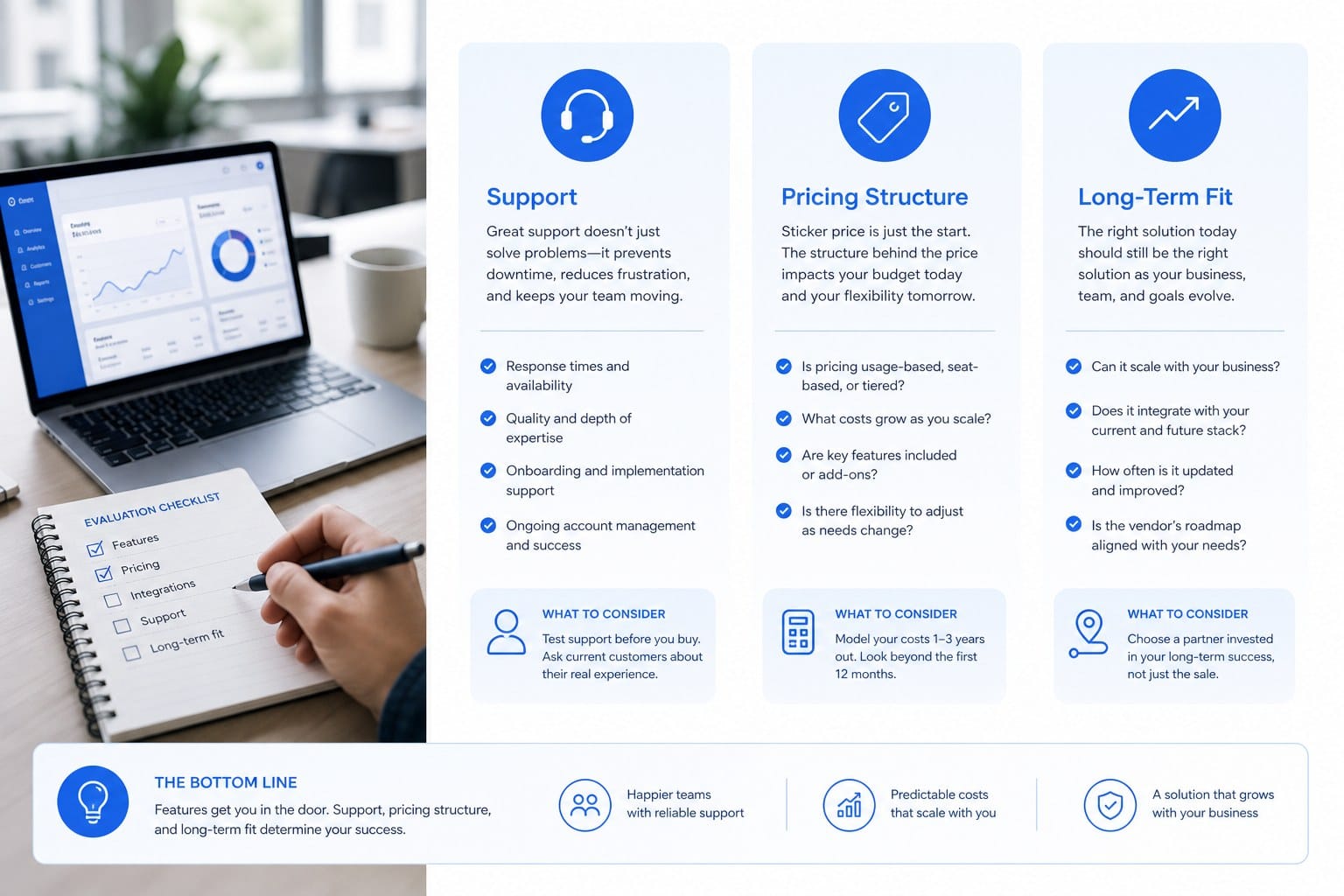
Most evaluation checklists for AI blog tools focus on features and content quality, which makes sense. But there is a third layer that often determines whether a tool actually works for you over six or twelve months, not just during a trial period. These are the less visible factors: how the company supports you, how pricing works as you grow, and whether the tool's direction aligns with where your content program is heading.
Start with support. When something goes wrong, or when you have a question about optimizing your output, how do you get help? Some AI blog tools are self-serve only, with a knowledge base and a support email that responds in two to four business days. Others offer live chat or dedicated onboarding calls. For independent bloggers or small teams with limited technical resources, accessible support can be the difference between actually using the tool well and abandoning it after the first frustrating experience.
Ask about onboarding specifically. Does the tool walk you through setup in a structured way, or does it drop you into a dashboard and assume you will figure it out? A good onboarding process connects your brand voice, your CMS, your keyword priorities, and your publishing schedule all at once, so you are producing useful content from the first week rather than spending a month experimenting.
Pricing structure deserves careful attention. Many tools advertise a low starting price that covers basic features, then charge separately for the things you actually need: higher article counts, visual generation, CMS integration, keyword research, or priority support. Run the numbers on what you would actually pay for the output volume and feature set you need, not just the entry-level plan. A tool that costs a bit more upfront but includes everything in one plan is often cheaper than one with a tempting base price and expensive add-ons.
Also check whether pricing scales in a way that makes sense for your growth. If you double your publishing volume, does your cost double too, or does the tool have a structure that rewards higher usage with better rates? This matters most for SaaS founders and startups that expect their content programs to grow significantly over the next year or two.
Look at how actively the product is being developed. An AI blog tool that was impressive eighteen months ago may have been outpaced by newer approaches. Check the product changelog or release notes if they are publicly available. Are new features being added regularly? Is the team responding to user feedback? A stagnant product in a fast-moving category is a risk, because the gap between what it offers and what competitors offer will keep widening.
User reviews are useful but require some interpretation. Look for reviews from people in a similar situation to yours, not just aggregate star ratings. A tool that works well for a large agency with a dedicated editor might work very differently for a solo founder who wants minimal manual involvement. Pay attention to reviews that mention the workflow experience, the learning curve, and what happened when something went wrong. Those tend to be more informative than reviews that just describe the feature set.
Ask whether the tool has any lock-in effects. If you decide to switch platforms later, can you export your content easily? Are articles stored in a portable format, or are they trapped inside the tool's ecosystem? Content you produce is an asset that belongs to you, and you should be able to take it with you if you ever change tools.
Think about how the tool handles niche specificity. Some AI blog tools work reasonably well for broad, high-traffic topics but struggle with specialized industries or technical subject matter. If your blog covers a specific vertical, like cybersecurity, supply chain management, or specialty food, test the tool on genuinely niche topics, not generic business or marketing questions. The quality gap between good and average tools becomes most visible when the subject matter is specific.
Finally, consider the question of who the tool is actually built for. Some AI blog tools are designed for high-volume content agencies producing hundreds of short articles per month. Others are built for individual creators who want a small number of long-form pieces done well. Most are somewhere in between. The tool that fits a digital marketing agency managing twelve client blogs is probably not the same tool that fits a SaaS startup trying to publish two or three in-depth articles per week on their own domain. Match the tool's design philosophy to your actual use case.
For independent creators specifically, the competitive landscape has shifted in ways that make good tooling more important than ever. The piece on how independent bloggers can compete with big media using AI tools lays out how smaller publishers can actually hold their own against larger, better-resourced competitors when they use the right systems. The key is not just having an AI tool, but having one that produces the kind of depth and consistency that larger editorial teams can sustain.
To pull the full checklist together: evaluate the quality and depth of the output, the research and sourcing behind the content, the visual generation capability, the brand voice flexibility, the CMS integration and publishing automation, the strategy and keyword planning layer, the review and approval workflow, the scalability of the system, the support and onboarding experience, the pricing structure at your actual usage level, the product development pace, and the lock-in and portability of your content. That is a longer list than most buyers work through, but each item on it has caught people off guard after they committed to a tool that looked fine on the surface.
The goal is not to find a perfect tool. No tool is perfect. The goal is to find one that fits your situation well enough that you actually use it consistently, produce content you are proud of, and see measurable results in your organic traffic over time. That outcome is achievable, but only if you evaluate your options seriously before signing up.
Ready to take the next step?
Blogtude is built for exactly this kind of use case. It generates a 30-day content strategy, produces deeply researched long-form articles with on-brand visuals, and publishes automatically to Ghost and other CMS platforms, so your blog keeps moving without requiring your constant attention. If you want to see how it fits your situation, visit blogtude.com and take a closer look at what a structured, automated content engine can do for your organic growth.