
What is autopilot blogging and is it safe for SEO


Table of contents
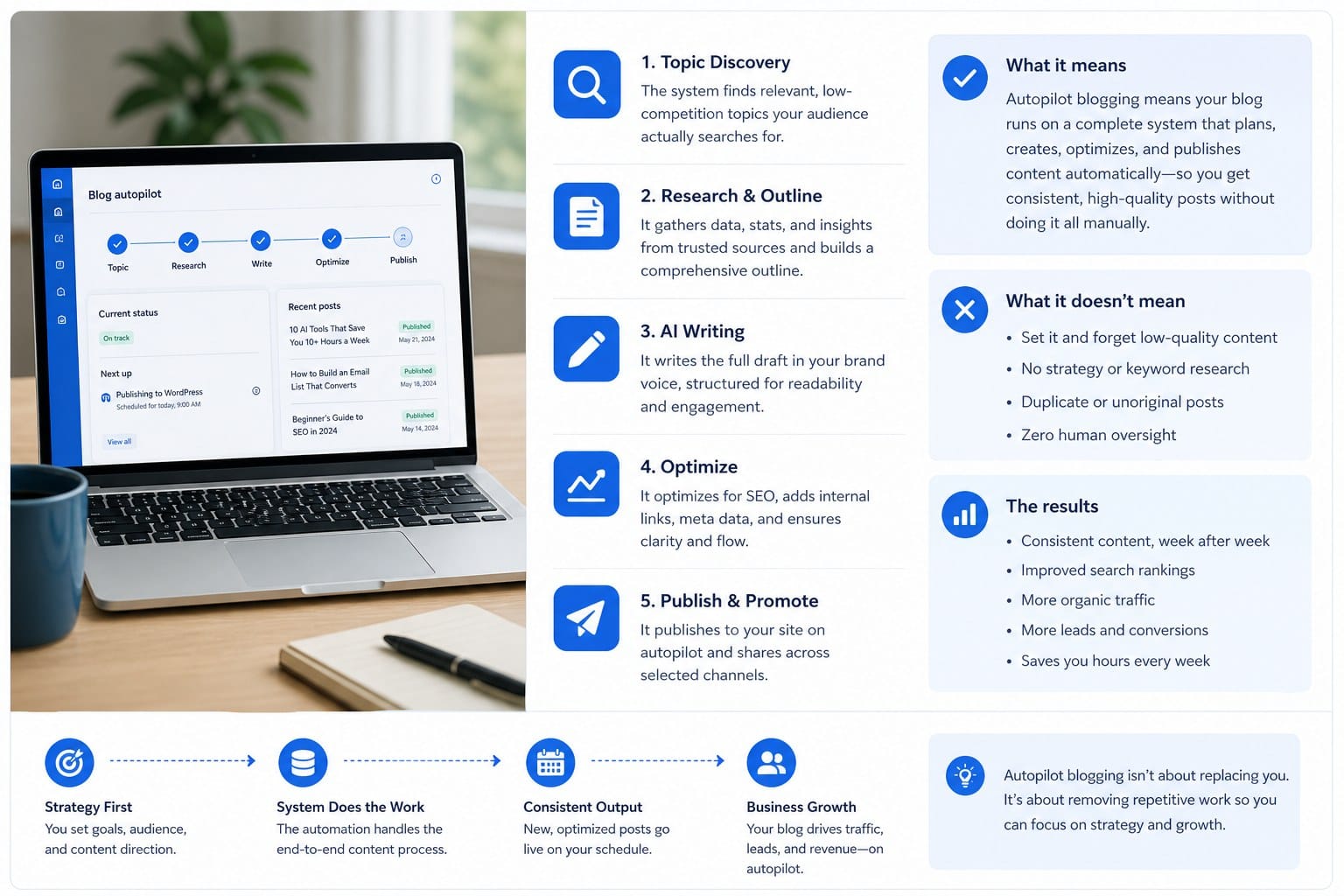
1. What autopilot blogging actually means
2. The real SEO risks of autopilot blogging and how to avoid them
3. How to set up autopilot blogging that holds up over time
Autopilot blogging is one of those phrases that sounds almost too good to be true. Set it up once, let it run, and watch your blog fill up with content while you focus on everything else. I get why it appeals to people. Running a blog while also managing a business, a product, or a client roster is genuinely exhausting. But whenever something sounds this convenient, the obvious question follows: is autopilot blogging safe for SEO, or is it a shortcut that quietly tanks your rankings? The honest answer sits somewhere in the middle, and it depends almost entirely on how you do it. In this article, I want to break down what autopilot blogging actually means, what the real SEO risks are, and how to run an automated content operation that Google respects rather than penalizes.
What autopilot blogging actually means
The term autopilot blogging gets used loosely, so it helps to define it clearly before anything else.
At its most basic level, autopilot blogging means using tools, systems, or workflows that reduce or eliminate the manual steps involved in producing and publishing blog content. That can include anything from scheduling posts in advance to using AI to generate full articles and publish them automatically to your CMS.
There is a wide spectrum here. On one end, you have a solo blogger who writes everything manually but uses a scheduling tool to publish posts at consistent times. That is a mild form of automation. On the other end, you have a fully automated pipeline where software researches topics, generates long-form articles, adds visuals, and publishes directly to your site without a human clicking anything between those steps.
Most real-world setups fall somewhere between those two extremes.
The common thread is this: autopilot blogging is about removing friction from the publishing process so that content goes out consistently, even when you are busy, unavailable, or simply do not want to spend your day writing.
Why does consistency matter so much? Because search engines reward sites that publish regularly. Google's crawlers revisit sites more frequently when they detect consistent new content. Regular publishing also gives you more pages in the index, which means more opportunities to rank for different keywords. And when your audience sees fresh posts every week or two, they are more likely to come back, subscribe, and share.
The challenge has always been that maintaining that consistency is hard. Most bloggers and business owners start strong and then slow down. Life gets in the way. Writing takes longer than expected. Topics run dry. Autopilot blogging solves the consistency problem, but it introduces new questions about quality, accuracy, and how Google interprets the content it finds on your site.
Before we get into the risks, it is worth understanding why people choose automated publishing in the first place. For a SaaS founder trying to grow organic traffic, writing two to four blog posts per week while also managing a product roadmap is simply not realistic. For a small business owner who knows their trade inside and out but struggles to sit down and write 1,500 words about it, the barrier is even higher. For a digital marketer handling five client blogs at once, the math on manual content production does not add up.
Automation solves a real and practical problem. The question is whether it solves it in a way that holds up under SEO scrutiny. That is what the next section is about.
I also want to be clear about what autopilot blogging is not. It is not spinning or scraping. Spinning takes existing articles and swaps words around to produce something technically different but effectively worthless. Scraping pulls content from other sites and republishes it without meaningful transformation. Both of those practices are harmful and have been penalized by Google for years. Autopilot blogging, done properly, is something genuinely different. It uses research and generation to create original content, not to copy and disguise existing material.
That distinction matters a lot when we talk about whether autopilot blogging is safe for SEO, because the risks and the safeguards are completely different depending on which category your setup falls into.
One more thing worth noting: the rise of large language models has changed what is possible in automated content. A few years ago, automated blog posts were easy to spot. They were repetitive, shallow, and full of awkward phrasing. Today, well-configured AI systems can produce articles that are structured clearly, cover a topic with genuine depth, and read naturally. That does not mean all automated content is good. It means the gap between good and bad automated content has widened significantly, and the quality of the system you use matters more than it ever has.
If you want to understand how independent bloggers are using AI tools to compete at scale without sacrificing quality, the article on how independent bloggers can compete with big media using AI tools covers that in detail.
The real SEO risks of autopilot blogging and how to avoid them
Let me be direct: autopilot blogging done poorly is absolutely a risk to your SEO. There are several specific failure modes that can hurt your rankings, and knowing what they are is the first step to avoiding them.
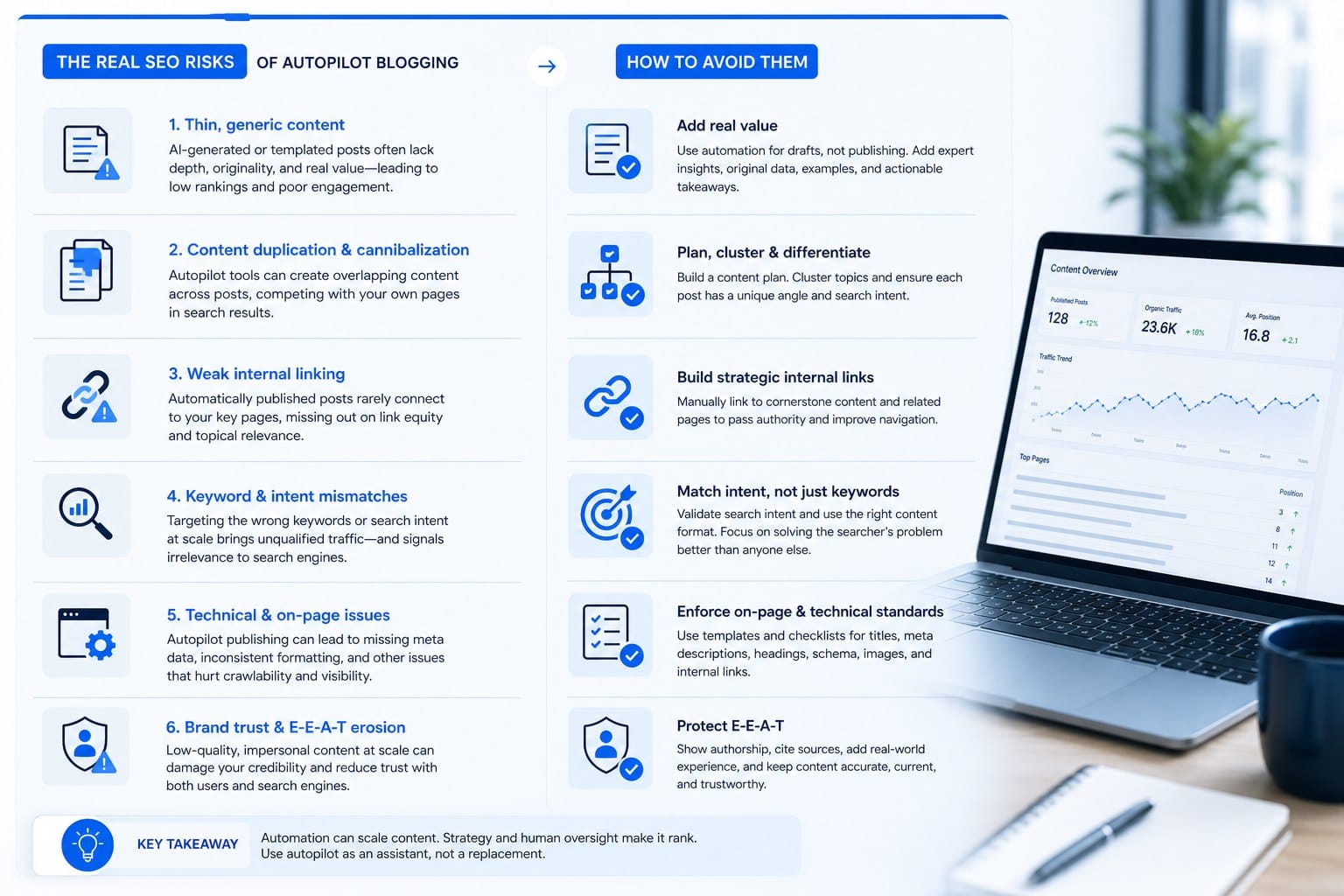
The first risk is thin content. Thin content means articles that are short, vague, or repetitive without adding real value to the reader. Google has been targeting thin content since the Panda algorithm update back in 2011, and it has only gotten better at identifying it since then. If your automated system produces 400-word articles that restate the same points in slightly different ways, those pages are likely to underperform in search or be actively devalued. The fix is to ensure your automated workflow produces genuinely substantive content. Long-form articles that cover a topic thoroughly, answer follow-up questions, and give the reader something concrete to walk away with are far less likely to be flagged as thin. Depth matters more than length, but length is often a proxy for depth when configured correctly.
The second risk is factual inaccuracy. AI systems can hallucinate. That is the blunt reality. Without proper research grounding, an automated blog post might state something confidently that is simply wrong. In niches like health, finance, legal, or anything that falls under Google's Your Money or Your Life (YMYL) guidelines, inaccurate content can actively harm your rankings and your reputation. The solution here is research integration. A well-built autopilot system should pull from credible sources and ground its content in verifiable information rather than generating claims from pure language pattern matching. If your system cannot tell you where its facts came from, that is a red flag.
The third risk is duplicate or near-duplicate content. If your automated system is publishing the same angle on a topic repeatedly across multiple posts, or if it is producing content that closely mirrors what is already on your site, you can run into issues with keyword cannibalization and content duplication. Search engines may struggle to determine which page to surface, and the result is that none of them rank as well as a single, well-developed page would. The fix is a smart content strategy layer. Your automated system should plan topics deliberately, avoid overlapping keyword targets, and create a content map that builds authority progressively rather than circling the same ground.
The fourth risk is publishing at volume without indexing signals. Some sites go from zero to fifty posts overnight using automation, and while that sounds impressive, it can trigger crawl budget issues on smaller sites. Google allocates a crawl budget based on your site's authority and crawl health. If you publish faster than Google can index your existing pages, some content may not get indexed at all. The answer is to publish at a consistent, sustainable pace rather than dumping large batches of content at once. Consistent publishing over time builds crawl priority without overwhelming your budget.
The fifth risk is ignoring on-page SEO fundamentals. Automation does not automatically mean optimized. If your system is generating articles without proper heading structure, without target keyword integration, without meta descriptions, and without internal linking, you are leaving ranking potential on the table. A good autopilot blogging setup should handle these elements as part of the content production process, not as an afterthought.
Now here is the important flip side: the risks above are all avoidable. They are not inherent to automation. They are failures of implementation. A poorly configured manual blog also produces thin content, inaccurate claims, and cannibalized keywords. The problem is not the automation itself. The problem is the absence of quality controls.
When those quality controls are in place, automation can actually improve your SEO performance. Here is why. Consistency is one of the strongest signals you can send to a search engine that your site is active and authoritative. A blog that publishes two well-researched articles per week, every single week, will outperform a blog that publishes three posts in January and then goes silent until March. Automation makes the consistent schedule achievable for people who would otherwise burn out or fall behind.
There is also the question of content velocity. Publishing more high-quality content means more indexed pages, more keyword coverage, and more internal linking opportunities. All of those compound over time. I wrote more about this in the article on content velocity and what it means for SEO growth, which goes deeper into why publishing pace is a strategic asset when the quality is there.
So to directly answer whether autopilot blogging is safe for SEO: yes, it can be, but it requires a system that prioritizes research depth, content structure, keyword strategy, and consistent quality. It is not a set-and-forget situation in the sense that you never think about it again. It is a set-and-trust situation where you configure a reliable system and then let it run without doing the manual labor yourself.
One practical benchmark I find useful: before running any automated content at scale, publish a handful of posts and check them manually. Read them like a reader, not a content manager. Ask whether you would genuinely find this article useful if you came across it in a search result. If the answer is yes, your system is producing something worth publishing. If the answer is no, something in the configuration needs to change before you scale it up.
Another thing to watch is your Google Search Console data after you start publishing automated content. Look at your average position, your click-through rate, and which pages are getting impressions. If your automated posts are picking up impressions and clicks at rates similar to your manually written posts, that is a strong signal that the quality is holding up. If they are getting impressions but very few clicks, your titles and meta descriptions may need refinement. If they are getting no impressions at all, check whether they are being indexed.
How to set up autopilot blogging that holds up over time
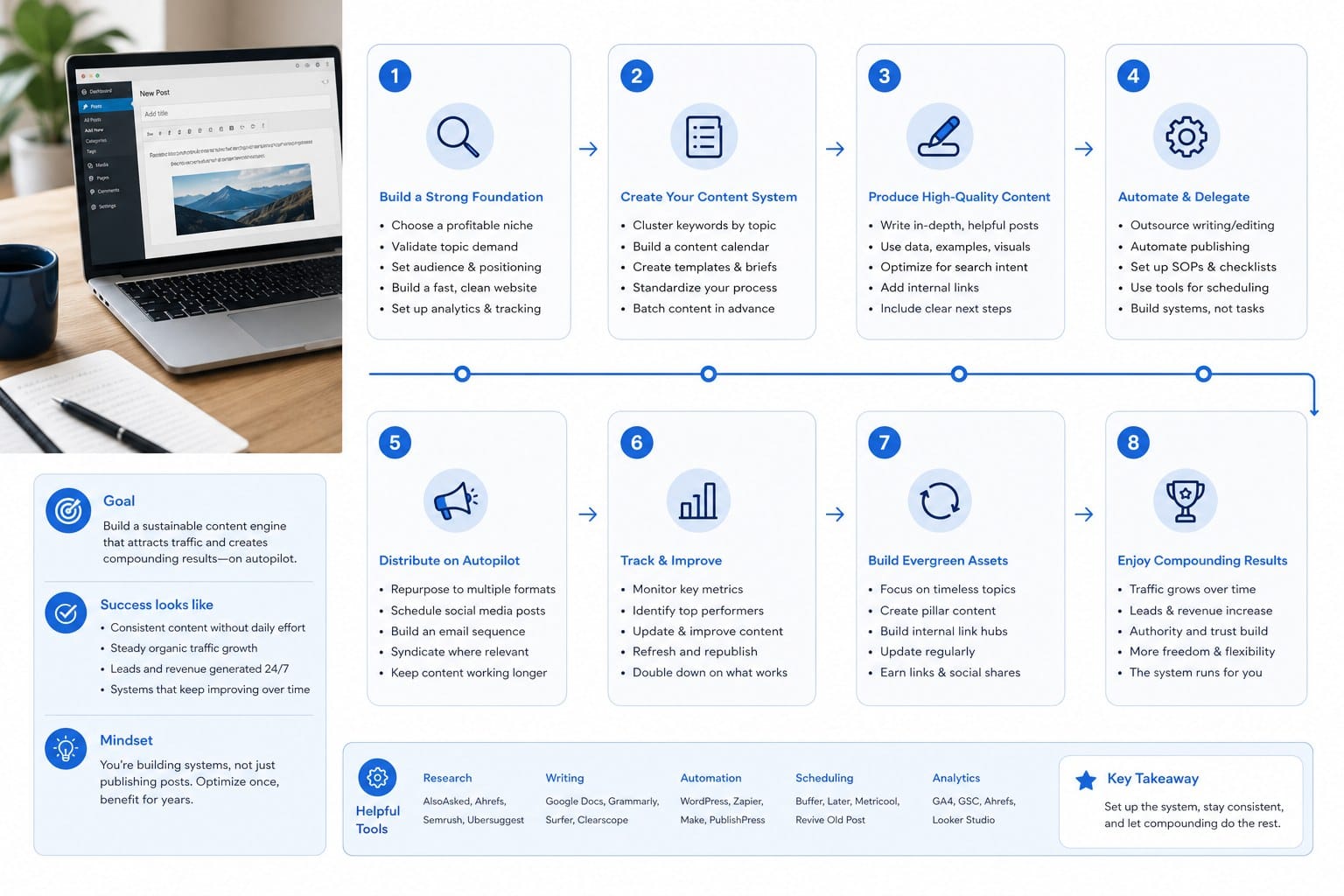
Building an autopilot blogging system that is genuinely sustainable comes down to a few core principles. I want to walk through each of them practically, because the difference between a system that helps your SEO and one that hurts it often comes down to details.
Start with a real content strategy, not a keyword list. A keyword list tells you what people are searching for. A content strategy tells you why your site should be the one answering those searches, how your articles relate to each other, and what sequence of topics builds authority over time. A good automated content system should begin with strategy, not with a dump of keywords that get assigned to random articles. The topics should connect. Earlier articles should support later ones. Your content should progressively demonstrate expertise in your niche rather than scattering in all directions.
A 30-day content calendar is a practical starting point. It is long enough to create real momentum and internal linking opportunities, but short enough to adjust if you notice certain topics are underperforming or if your keyword targets shift. When I think about sustainable autopilot blogging, I think about a rolling calendar that plans ahead while staying responsive to what the data shows.
The next principle is research-grounded generation. The word automated should not mean uninformed. The best automated content systems are not just generating text from a prompt. They are pulling in relevant source material, synthesizing it, and building arguments or explanations that reflect real information about the topic. That is what separates content that actually helps readers from content that just fills a page.
If you want to go deeper on what makes AI-generated long-form content actually rank, the article on how to use AI to write long-form SEO articles that actually rank covers the mechanics of that clearly.
The third principle is structural consistency. Every article that comes out of your automated system should follow a structure that works for both readers and search engines. That means a clear headline that addresses the search intent, a logical flow of sections with descriptive headings, short paragraphs that are easy to scan, and a conclusion that wraps up the key takeaways. It also means consistent use of internal links, which pass authority between your pages and help search engines understand how your content is organized.
Internal linking is often the part of automated blogging that gets neglected, and that is a missed opportunity. When your automated system publishes a new article, it should be linking to related articles on your site, and ideally, older articles should be updated to link back to the new one. This creates the web of connections that builds topical authority over time.
The fourth principle is visual coherence. Content is not just text. Readers engage more with articles that include relevant visuals, whether those are custom images, charts, diagrams, or featured images that match the article's tone. An automated system that publishes walls of text will have higher bounce rates than one that pairs its content with visuals that support the reader's experience. Bounce rate and time on page are engagement signals that influence how search engines evaluate your content quality.
Fifth, CMS integration matters more than people realize. If your automated system generates great content but requires you to manually copy it into your publishing platform, you have only solved half the problem. The final step, actually getting the content live, still requires your time and attention. A system that connects directly to your CMS and publishes on a schedule removes that bottleneck entirely. For Ghost users in particular, native integration means your automated posts appear in the same format and with the same consistency as manually written posts, with no extra steps between generation and publication.
One thing I want to address directly: some people worry that using automation somehow violates Google's content guidelines. Google's guidance on this topic has evolved. The current stance, based on publicly available statements from Google, is that automation is not inherently against their policies. What they penalize is content produced with the primary intent to manipulate rankings rather than to help people. The intent and the quality of the output are what matter, not whether a human typed every word. If your automated content is accurate, useful, well-structured, and designed to genuinely answer what readers are searching for, it holds up under that standard.
This does not mean you can publish anything and expect it to rank. Google's quality raters look at signals like expertise, authoritativeness, and trustworthiness, which they group under the term E-E-A-T (experience, expertise, authoritativeness, trustworthiness). Your automated content should demonstrate these qualities through its depth, accuracy, and connection to a credible source. An author bio that establishes credentials, accurate sourcing within articles, and consistent topic focus across your site all contribute to these signals.
Finally, I want to talk about what ongoing management of an autopilot system looks like. Autopilot does not mean you disappear. It means you move from doing the work to overseeing the work. You should be reviewing performance data regularly, checking that the topics being published align with your current business goals, and updating older content when information changes. You should also be paying attention to the comments and questions your posts generate, because those surface the exact angles your audience wants you to go deeper on.
The realistic workload for someone running a well-configured autopilot blogging system is a few hours per month rather than a few hours per week. That is a meaningful reduction in effort, and it is what makes consistent publishing achievable for founders, marketers, and small business owners who have limited time to dedicate to content.
If you are evaluating whether autopilot blogging is the right move for your site, the clearest test is this: can your current setup produce and publish high-quality, researched, structured articles consistently without burning you out? If not, automation is not a compromise on quality. It is the mechanism that makes quality sustainable at scale.
Ready to take the next step?
If consistent, high-quality blogging has felt out of reach because of how much time and effort it takes, Blogtude was built to solve exactly that problem. We generate a full 30-day content strategy, produce deeply researched long-form articles with on-brand visuals, and publish them directly to Ghost and other CMS platforms automatically. You get the content output of a full editorial team without managing one. Visit blogtude.com to see how it works and start building the kind of consistent blog presence that compounds in search over time.