Content velocity and what it means for SEO growth

Table of contents
1. What content velocity actually means and why it matters for SEO
2. How topical authority and publishing consistency compound your rankings
3. Building a sustainable content system that keeps velocity high without burning out
If you have ever wondered why some blogs climb search rankings fast while others stall despite publishing solid articles, content velocity is likely a big part of the answer. Content velocity is the rate at which a website consistently publishes new, relevant content over time. It is not just about volume. It is about showing up regularly, building topical depth, and giving search engines a steady stream of signals that your site is active, authoritative, and worth ranking. For growing brands, independent bloggers, and SaaS founders trying to build organic traffic, understanding content velocity and what it means for SEO growth can be the difference between a blog that compounds and one that flatlines. This post breaks down what content velocity actually is, how it builds the kind of topical authority that drives compounding rankings, and what a sustainable publishing system looks like in practice.
What content velocity actually means and why it matters for SEO
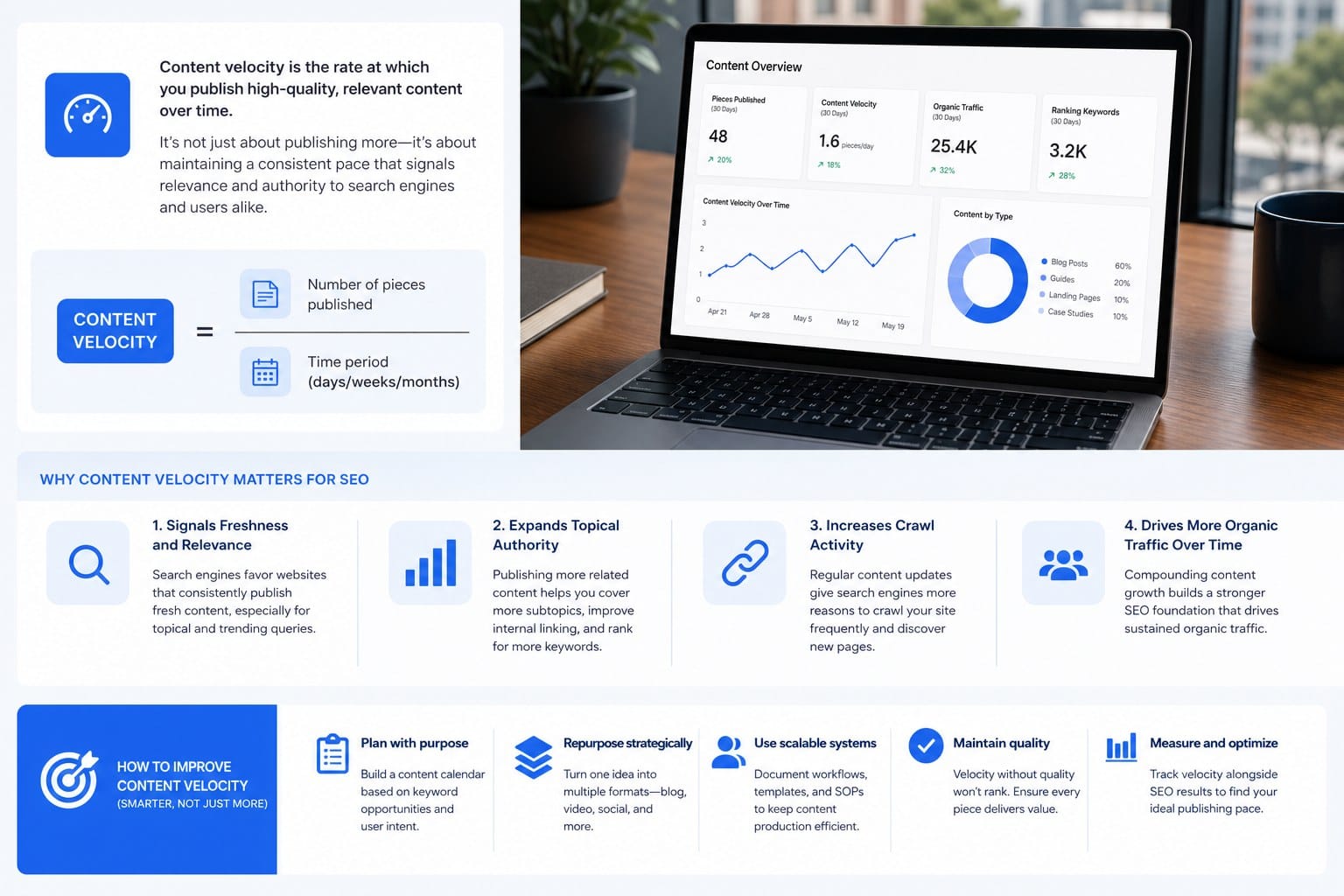
Content velocity is not a single metric you find in Google Search Console. It is a concept that describes how quickly and consistently a site adds new indexed pages, internal links, and topical coverage over a set period of time. Understanding it properly means understanding the difference between raw output and strategic publishing.
Picture two blogs in the same niche. Blog A publishes two articles a month, scattered randomly, with no clear theme connecting them. Blog B publishes eight articles a month, each one targeting a related subtopic inside a well-defined subject area. After six months, Blog B does not just have more content. It has a web of interconnected pages that signal deep expertise on a specific subject. Search engines reward that kind of depth, and the gap between these two blogs compounds with every passing month.
Google has never confirmed a direct publishing frequency ranking factor, but the indirect effects are well documented through how the algorithm works. More quality content means more indexed pages. More indexed pages mean broader keyword coverage. Broader keyword coverage creates more internal linking opportunities. More internal links help distribute page authority across your site. Each of those things feeds organic growth in a way that reinforces itself over time.
Content velocity also affects crawl budget in ways that matter practically. Search engine bots allocate a certain amount of time to crawling each domain. Sites that publish frequently tend to get crawled more often because bots learn to return and check for updates. Fresh content gets indexed faster. That is a meaningful competitive advantage when you are trying to rank in a busy niche where competitors are also publishing regularly.
Here is something worth being clear about before going further: velocity without quality is a trap. Publishing thin, repetitive, or padded articles quickly will not help you rank. It can actually dilute your site's topical authority and waste crawl budget on low-value pages that search engines learn to skip. A site with fifty shallow articles is not in a better position than a site with twenty genuinely useful ones. The goal is sustained, high-quality output at a meaningful pace, not just high output for its own sake.
So when we talk about content velocity and SEO growth, we are really talking about three things working together: publishing frequency, content quality, and topical coherence. You need all three. Pull one out and the others lose most of their power.
Frequency without quality produces a site full of forgettable articles that attract thin traffic and no backlinks. Quality without frequency produces a site that earns respect but never builds the coverage depth needed to dominate a niche. Quality and frequency without topical coherence produces a scattered blog that ranks for isolated keywords but never builds the kind of domain authority that lifts all pages.
For a lot of brands, especially small businesses, early-stage startups, and solo creators, the bottleneck is not knowledge or strategy. It is capacity. Writing deeply researched, well-structured articles takes time. A solid long-form article covering a topic thoroughly takes most writers three to five hours to produce, not counting research, editing, formatting, and publishing. Doing that consistently, week after week, is genuinely hard without a reliable system behind the effort. That is why so many blogs start strong in January and go quiet by March, which is exactly the pattern that stalls SEO growth.
If you want to understand the real cost of that inconsistency, The hidden cost of inconsistent blogging and how automation fixes it walks through it in detail. The short version is that gaps in publishing do more damage than most people realize, both to rankings and to audience trust. A blog that publishes eight articles and then goes dark for three months does not hold its position. It slowly slides as fresher competitors fill the space.
None of this means you need an unlimited content budget or a full editorial team. It means you need to treat publishing as a system rather than a sporadic project. Content velocity is a lever you can actually pull. The brands that pull it consistently are the ones whose organic traffic curves look very different from the ones that do not.
To put some concrete numbers behind this, consider what consistent publishing does to indexed page counts over a year. A blog publishing two articles a month adds twenty-four pages annually. A blog publishing eight articles a month adds ninety-six. Assuming comparable quality, the second blog has four times more keyword coverage, four times more internal linking opportunities, and four times more chances to earn backlinks and social shares. Over two years, that gap widens to a point where it is genuinely difficult for the slower publisher to catch up, even with strong individual articles.
The practical takeaway is straightforward. Content velocity is not a vanity metric. It is a structural advantage that accumulates over time. Building and maintaining it is one of the highest-leverage investments a brand can make in long-term organic growth.
How topical authority and publishing consistency compound your rankings
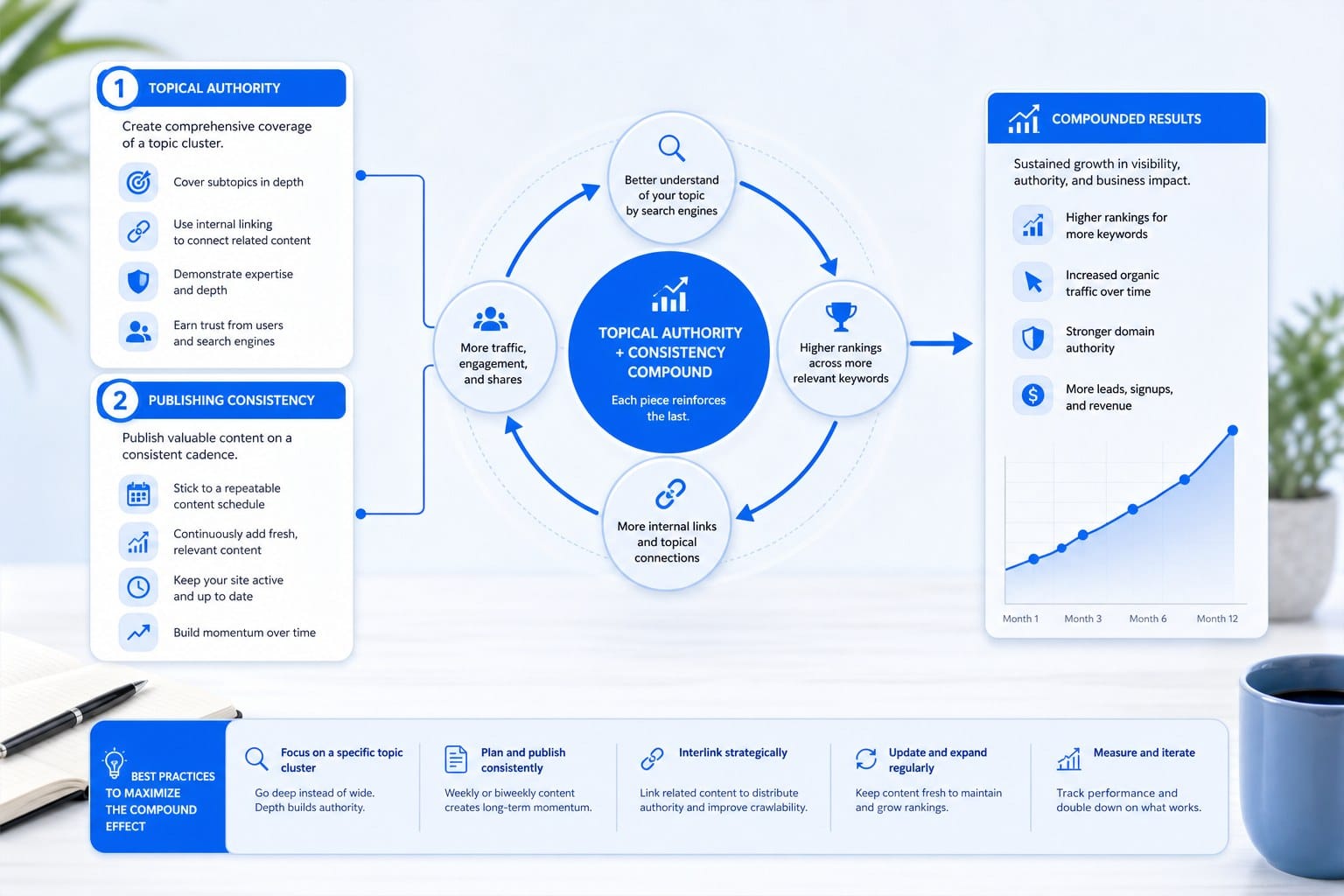
One of the most important ideas in modern SEO is topical authority. It describes how thoroughly a site covers a given subject area across multiple interconnected pages. The more completely you address a topic and its subtopics, the more search engines trust you as a reliable source on that subject. Content velocity is the mechanism that builds topical authority over time, because you cannot establish deep coverage of any subject with a handful of articles.
Here is a practical example. Imagine you run a SaaS product in the project management space. You start with a core pillar article on project management best practices. Then over the following weeks, you publish supporting articles on sprint planning, remote team communication, agile versus waterfall methodology, how to run a retrospective, tools for tracking project milestones, and how to handle scope creep. Each article links to the others where the connection is natural. After three months, you are not just ranking for one keyword. You are covering the full landscape of topics your target reader cares about.
Search engines can see that pattern. Algorithms understand that your site addresses the full subject space of a topic, not just isolated keywords. That is what topical authority looks like, and it is what drives compounding organic growth rather than a collection of one-off ranking wins.
The compounding part deserves emphasis because it is often misunderstood. SEO growth is rarely linear. In the early months of consistent publishing, you might see modest results that feel discouraging relative to the effort you are putting in. But around month four or five, something shifts. Older articles start picking up rankings they did not have before. New articles index and rank faster because your domain already carries authority in the niche. Internal links from established pages pass equity to newer ones. The system starts feeding itself in a way that requires less external effort to sustain.
This is why brands that maintain high content velocity over six to twelve months often see traffic curves that look almost exponential compared to brands that publish sporadically. The math of compounding only works if you keep the inputs consistent. Stop the inputs and the compounding stops with them.
Publishing consistency also matters for something that does not always appear in SEO discussions: reader trust. When someone lands on your blog and sees the last post was eight months ago, they are less likely to subscribe, share, or return. That low engagement sends indirect signals that affect how search engines evaluate your content. A consistently updated blog keeps those engagement signals healthy, which supports rankings in ways that are harder to measure but genuinely real.
Internal linking is another compounding mechanism that grows directly with content velocity. Every new article you publish is a chance to link back to older content and to update older articles with links forward to newer ones. A site with one hundred articles has vastly more internal linking potential than a site with fifteen. More internal links mean better crawlability, better distribution of link equity across the site, and stronger signals to search engines about which pages are most important. Sites that publish consistently and manage internal links deliberately become structurally stronger with every article they add.
For AI-assisted content to work in this context, the quality bar has to stay high. Generic summaries and padded articles will not build topical authority regardless of how many you publish. You need articles that are genuinely useful, well-researched, and specific enough to answer real reader questions at a depth that competing pages do not. How to use AI to write long-form SEO articles that actually rank covers what makes AI-assisted content actually competitive in search, and it is worth reading if you are thinking seriously about scaling output without sacrificing the quality that drives topical authority.
For founders and small business owners, the long-term framing matters here. Paid advertising stops the moment you stop paying. A blog that earns traffic organically through consistent publishing keeps working long after the articles are written. A business that publishes two hundred deeply useful, interconnected articles covering every question a potential customer might have is a genuinely hard competitive position to displace. It takes time and consistency to build, but once it exists, it generates traffic and leads continuously.
The sequencing of articles within a topical cluster also affects how quickly authority compounds. Publishing a pillar article first and then supporting cluster articles that link back to it concentrates authority on the pillar page faster than publishing articles at random. This sequencing does not require a complex editorial calendar. It just requires knowing which topics belong together and publishing them in a logical order rather than whatever feels ready on a given day.
A concrete way to think about this: search engines are trying to answer a question every time someone runs a query. The site that most comprehensively and reliably answers the full range of questions around a subject is the one that earns persistent rankings. One great article answers one question well. A cluster of well-connected articles answers the full conversation a reader is having with a topic. Content velocity is what turns single answers into full conversations, and full conversations are what build durable authority.
The brands that understand this and commit to building topical depth through consistent publishing are not gambling on any single article ranking. They are building a structural advantage that grows more defensible with every article they add to the cluster.
Building a sustainable content system that keeps velocity high without burning out
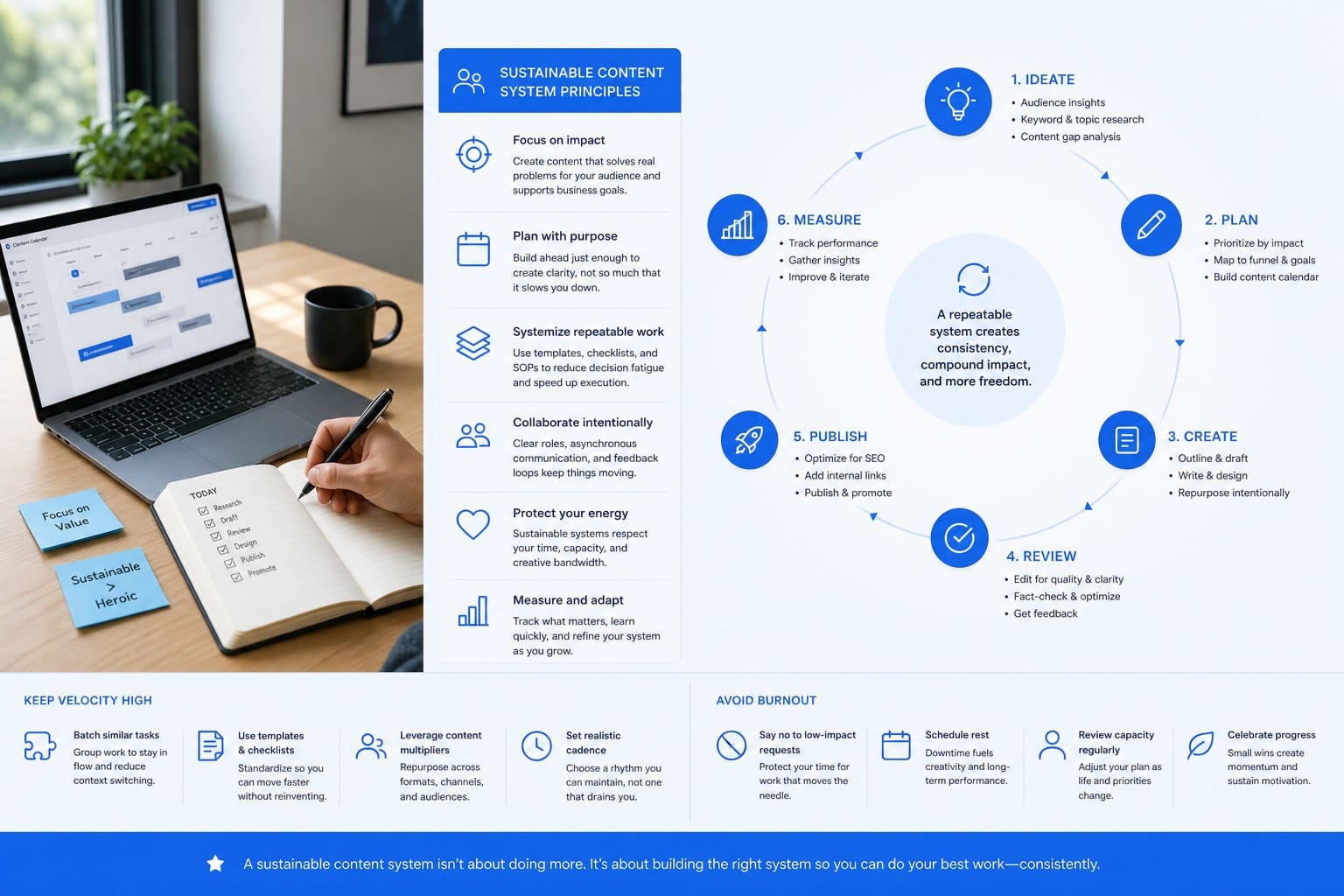
Motivation gets you started. Systems keep you going. This is true for exercise habits, financial discipline, and content marketing. The bloggers and brands that win at SEO over the long term are not necessarily the most talented writers or the ones with the biggest teams. They are the ones who built a process that makes consistent publishing the path of least resistance rather than a heroic effort.
To build that kind of system, it helps to understand exactly where manual content production breaks down. Most teams do not fail because they lack good ideas or subject matter expertise. They fail because the full pipeline from idea to published article involves more steps than people account for up front, and each step requires time and attention that competes with everything else demanding that same time and attention.
The pipeline looks something like this. First, strategy: you need to know which topics to cover, in what order, targeting which keywords, with what angle, to serve which audience. Without a clear content strategy, you end up with a random collection of articles that never build into a coherent authority structure. Creating that strategy well requires keyword research, competitive gap analysis, audience understanding, and deliberate topical cluster mapping. For most brands doing this manually, strategy work alone can consume an entire day each month.
Second, research: long-form SEO articles need real depth. That means understanding what competitors are covering for each keyword, what questions readers are actually asking, what the search intent behind the keyword actually is, and what angle will make your article more useful than what is already ranking. Shallow research produces shallow articles. Doing this properly for each piece takes one to two hours per article at minimum.
Third, writing and editing: a solid long-form article of 1,500 to 2,500 words, thoroughly researched and properly structured, takes most skilled writers three to five hours to produce. At a target of eight articles a month, that is twenty-four to forty hours of writing time alone, before editing, which adds another two to three hours per piece for anyone doing it carefully.
Fourth, production and publishing: even with the article ready, someone has to format it for the CMS, add header images and inline visuals, write meta descriptions, handle title tags, check internal linking, schedule publication, and possibly cross-post to other channels. Each of these steps adds time that compounds across a month of publishing.
When you lay the full pipeline out like this, the reason most brands struggle to maintain content velocity becomes obvious. It is not lack of commitment. It is a genuine capacity problem. Twenty to thirty hours a month of focused content work is a significant ongoing demand for any small team or solo operator who also has a business to run. The most common response is to start strong, hit a crunch period, let the blog slide for a few weeks, and then find it has been three months since the last post went live.
Automation changes the math here in a meaningful way. When a system handles strategy generation, keyword research, article writing, visual production, and direct publishing to your CMS, the human role shifts from execution to oversight. You review, refine, and approve rather than producing from scratch. That is a fundamentally different workload, one that scales in a way that manual production never can.
For Ghost CMS users specifically, integration between an automated content engine and the platform matters enormously for sustained velocity. If articles can be drafted, scheduled, and published directly to Ghost without manual uploads, copy-paste workflows, or repeated reformatting, the friction that causes publishing gaps largely disappears. The seamless connection is what makes velocity sustainable in practice rather than theoretical on a content calendar.
One dimension of automated content that often gets shortchanged in these conversations is brand voice. Consistent output is not enough if the content sounds generic, overly formal, or obviously disconnected from how your brand actually communicates. Readers notice within a few paragraphs, and long-term audience retention suffers for it. How to maintain brand voice when using AI to write blog content covers how to preserve what makes your writing sound like you even when AI is doing the heavy lifting. The short answer is that the quality of the inputs, brand guidelines, tone examples, audience descriptions, and topic framing, determines the quality of the output. Generic inputs produce generic content. Specific inputs produce content that sounds like it belongs on your site.
For digital marketers managing brand blogs, this is a practically important point. You are accountable for quality and on-brand output, not just for articles existing. An automated system that produces content meeting editorial standards is genuinely useful. One that produces content you have to substantially rewrite before publishing just moves the bottleneck without solving it.
The strategic layer of a 30-day content plan is also where a lot of manual efforts break down in ways that matter for topical authority. When you plan a month at a time with deliberate sequencing, you can publish a pillar piece first and then follow it with supporting cluster articles that link back naturally. You can build out a topical cluster before moving to the next one. You can distribute articles across the month so that publishing is steady rather than front-loaded in one week and absent for the next three. This kind of sequencing maximizes the compounding effect described in the previous section.
Articles published at random, even individually strong ones, contribute less than they could because they are not reinforcing each other. Articles planned deliberately, sequenced strategically, and linked intentionally across a cluster amplify each other in ways that build authority faster and more durably.
For SaaS founders, the benefits extend beyond SEO traffic. A content library covering every question a potential customer might ask before a sales conversation is a powerful trust signal that shortens sales cycles. Prospects who have read four or five of your articles before scheduling a demo already understand your perspective, your approach, and your credibility. They arrive warmer. That is a real business outcome that a consistent content strategy drives over time.
For independent bloggers and creators, sustained content velocity is what separates a hobby blog from a traffic-generating asset that earns income through affiliate partnerships, sponsorships, or products. Most creators have the ideas and the subject matter expertise. The infrastructure to turn those ideas into published articles consistently, without it consuming every spare hour, is what most of them are missing.
The goal is to reach a state where your content system runs predictably. Articles go live on schedule. Topical authority grows week over week. Organic traffic trends consistently upward. That compounding growth is achievable. The brands that get there are the ones who stopped treating content as a manual task requiring heroic effort and started treating it as a system requiring smart setup and light ongoing management.
Blogtude is built specifically to enable that system. It generates a 30-day content strategy tailored to your niche, produces deeply researched long-form articles with on-brand visuals, and publishes automatically to Ghost and other platforms. The goal is to give growing brands a way to maintain genuine content velocity without requiring a full editorial team or unsustainable manual effort. If you have been struggling to keep your blog active, or if you have watched competitors outpace you simply because they publish more consistently, the issue is almost certainly a systems problem. The right infrastructure changes the outcome.
Ready to take the next step?
Ready to build a content system that keeps pace with your SEO goals? Blogtude handles the strategy, research, writing, and publishing so you can focus on growing your business. Visit Blogtude to see how it works and start your first 30-day content plan.