How independent bloggers can compete with big media using AI tools

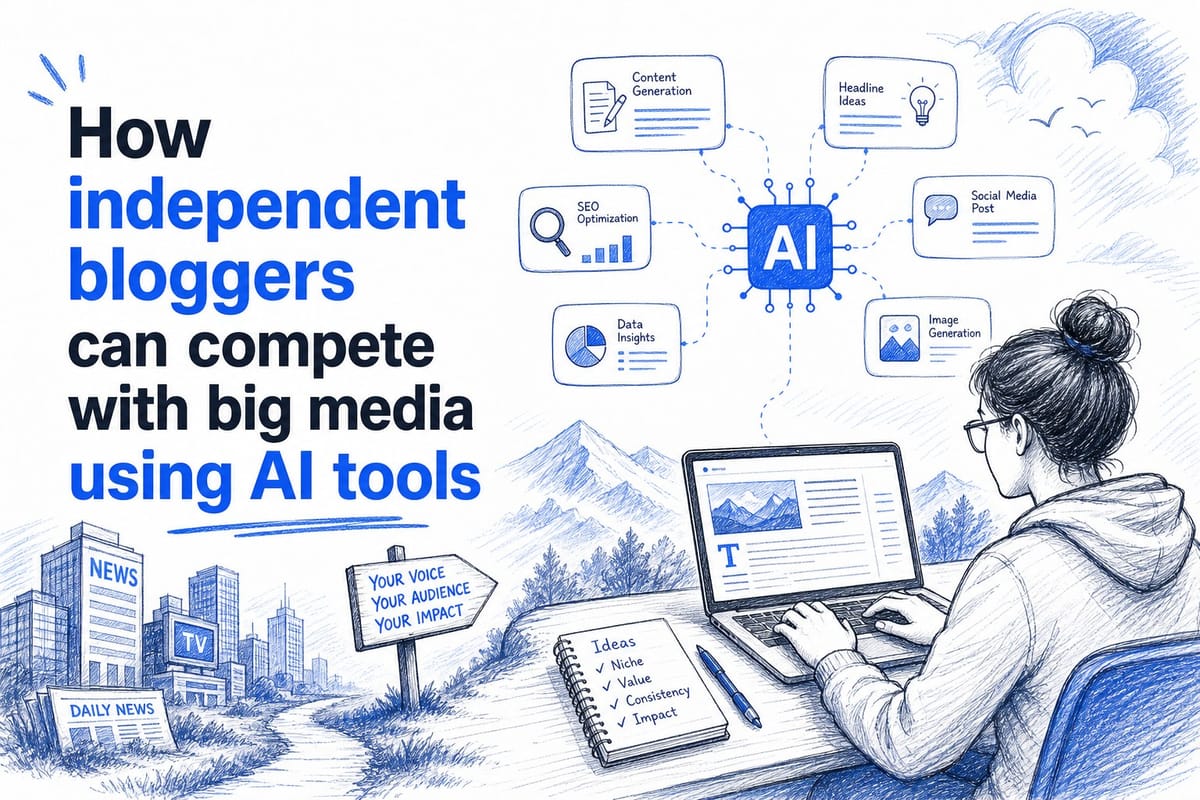
Table of contents
1. Why big media has always had the advantage (and why that is changing)
2. The specific ways AI tools level the playing field for independent bloggers
3. Building a sustainable workflow that actually scales
Big media outlets have teams of dozens of writers, editors, SEO specialists, and content strategists working full time. As an independent blogger, you are probably doing all of that alone, in your spare time, on a budget that does not stretch very far. That gap used to feel impossible to close. But the way independent bloggers compete with big media using AI tools has changed faster in the last two years than in the previous twenty. This article breaks down exactly how that shift works, what tools and strategies actually make a difference, and how you can start closing the gap today without burning out or breaking the bank.
Why big media has always had the advantage (and why that is changing)
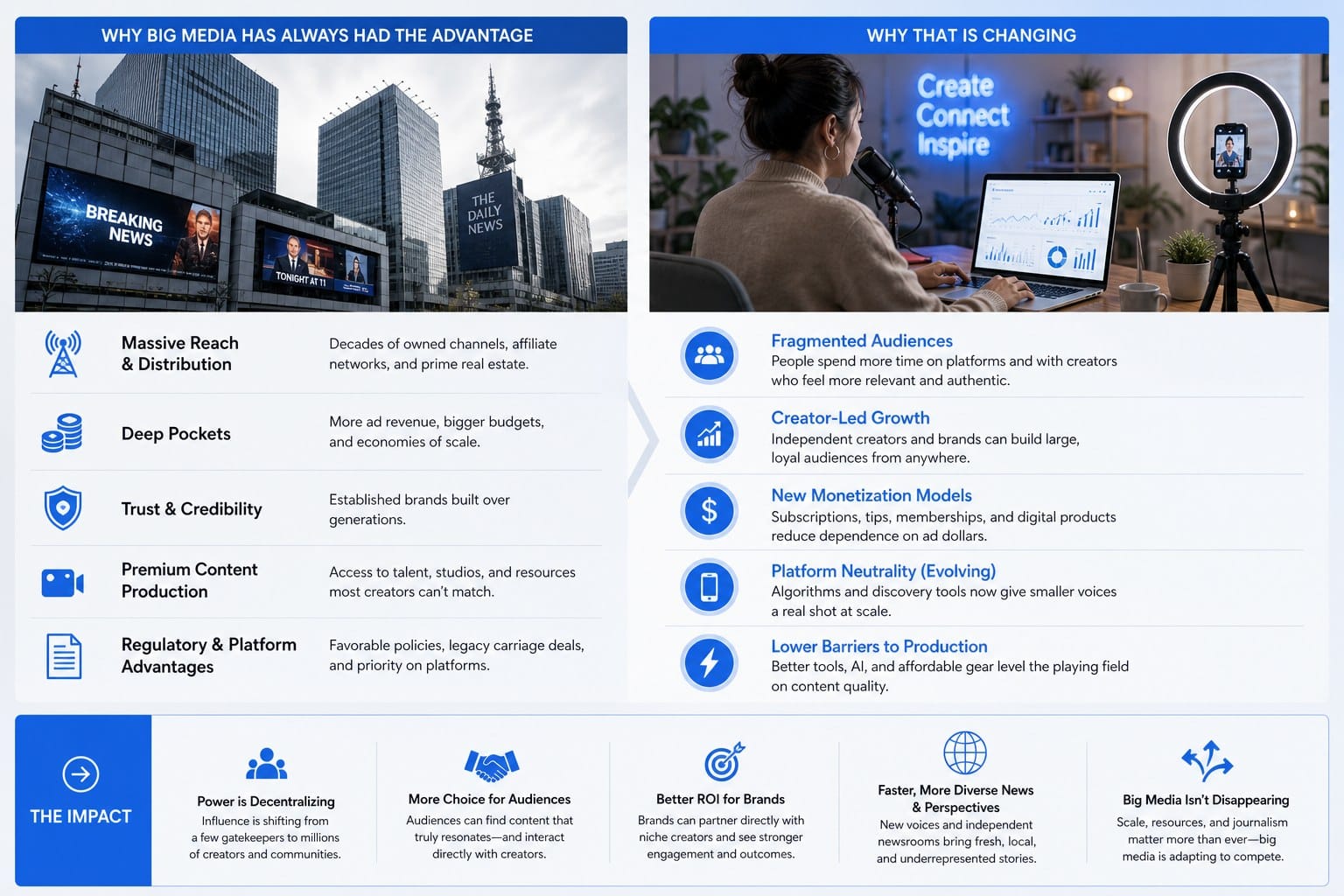
Let me be honest about what we are up against. A publication like Forbes, Business Insider, or a large trade magazine does not just have more writers. It has infrastructure. It has editorial calendars mapped out months in advance. It has SEO teams running keyword research continuously. It has distribution networks, email lists with millions of subscribers, and domain authority built up over decades. That combination of speed, scale, and authority has kept independent bloggers in a permanent underdog position.
But here is the thing: most of that infrastructure is built around solving problems of coordination and consistency. How do you get 50 writers to produce 200 articles a month, all on-brand, all optimized for search, all published on schedule? Big media solved that problem by throwing people and money at it. AI tools are now solving that same problem in a fundamentally different way.
The core advantage big publications have always held is volume. Google rewards sites that publish consistently and frequently. A site that publishes five solid articles a week will almost always outrank a site that publishes one great article a month, assuming the content quality is comparable. Search engines interpret consistent publishing as a signal of authority and relevance. They see an active site as one worth sending traffic to. Independent bloggers have traditionally struggled to match that pace because writing five articles a week on top of a day job, or even as your main job, is exhausting.
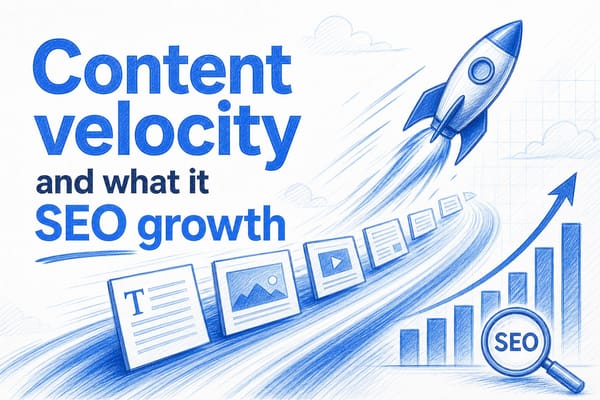
This is where understanding content velocity and what it means for SEO growth becomes genuinely useful. Content velocity is the rate at which you publish new material, and it is one of the clearest signals search engines use to determine how seriously to take your site. Big media has always won on content velocity by default. Now, AI-assisted workflows let independent bloggers produce content at a pace that was simply not possible before, without sacrificing the depth or specificity that actually attracts and retains readers.
There is also the question of research depth. A staff writer at a major outlet can spend a full week on a single investigative piece because that is literally their job. An independent blogger might have four hours on a Saturday. AI tools do not replace the expertise and perspective you bring, but they do compress the research phase dramatically. They can surface relevant studies, pull key statistics, identify the angles competitors are missing, and organize that information into a usable structure before you write a single sentence. That means your four Saturday hours go a lot further than they used to.
I also want to push back on one assumption that holds a lot of independent bloggers back: the idea that bigger always means better in the eyes of readers. Large media sites often produce content that is broad, cautious, and optimized for the widest possible audience. That is not always what people are searching for. Readers often prefer someone who writes from real experience in a specific niche, who has a clear point of view, and who does not feel like they are reading a press release. Independent bloggers have always had the potential to win on depth, specificity, and voice. The challenge has been winning on volume and consistency at the same time. That is exactly what AI tools address.
The specific ways AI tools level the playing field for independent bloggers
I want to get concrete here because vague advice about using AI does not help anyone. Let me walk through the specific functions where AI tools make the biggest difference for independent bloggers trying to compete with larger operations.
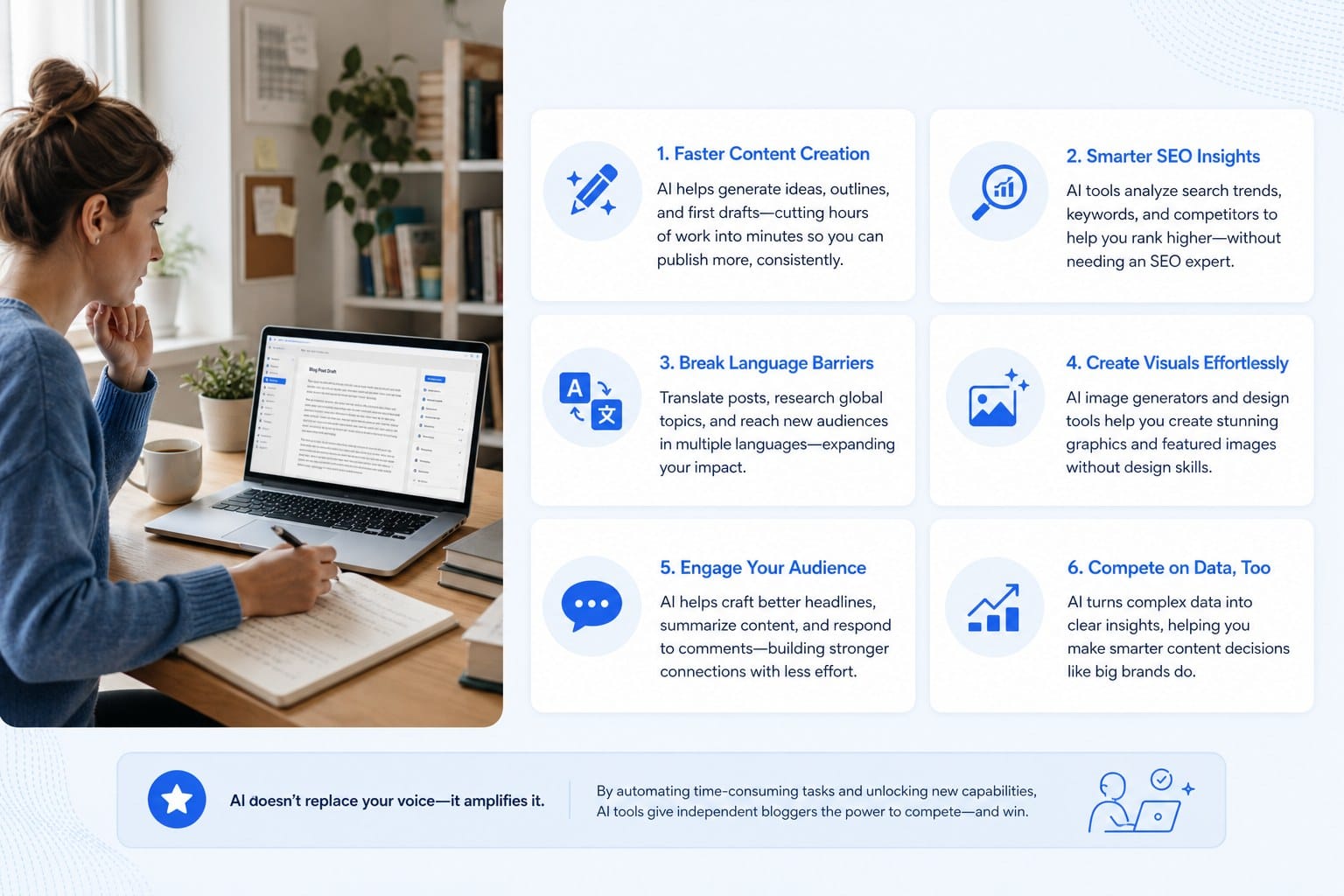
The first is content planning. A big publication has editorial meetings, audience data, and trend analysis running in the background constantly. As an independent blogger, you might decide what to write about based on what you are interested in that week, or what a quick Google search suggests. That is a fine starting point, but it is not a strategy. AI-powered content planning tools can analyze your niche, identify keyword clusters that have real search volume, spot topics your competitors are not covering well, and generate a structured publishing calendar you can actually follow. Instead of staring at a blank document wondering what to write next, you have a roadmap for the next 30 days.
This matters more than it might seem. Random publishing does not build topical authority. When Google sees that your site consistently covers a specific subject from multiple angles, going deep rather than wide, it starts to treat you as an authority on that topic. That is how independent bloggers can realistically compete for search rankings against sites with far higher domain authority. You do not have to be the biggest site on the internet. You have to be the most comprehensive and consistent source on your specific corner of the internet.
The second area is article production itself. This is where most people think of AI tools first, and it is also where the most misunderstanding exists. Using AI to generate shallow, generic 500-word articles and publishing them in bulk is not a strategy that works. It actually hurts you. Search engines have gotten much better at identifying thin content, and readers leave immediately when they land on something that does not answer their actual question. The right use of AI in article production is different. It involves using AI to do the heavy lifting on structure, research synthesis, and draft generation, while you focus on adding the genuine expertise, specific examples, and distinctive voice that make an article worth reading.
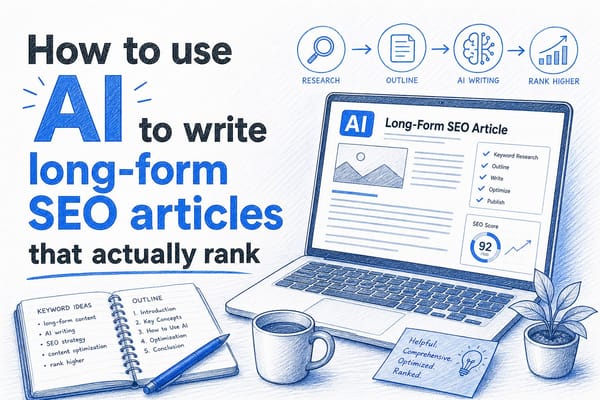
Learning how to use AI to write long-form SEO articles that actually rank is genuinely one of the highest-leverage skills an independent blogger can develop right now. Long-form content, typically anything over 1,500 words and often well beyond that, consistently outperforms shorter content for competitive keywords. It captures more featured snippets. It earns more backlinks. It keeps readers on the page longer, which improves your site's engagement metrics. But writing 2,000 to 4,000 word articles consistently is grueling if you are doing it entirely from scratch. AI tools make that pace sustainable by handling the structural and research-intensive parts of the process.
The third area is publishing consistency, which is related to but distinct from content planning. You can have a great editorial calendar and still fall behind because life gets in the way, inspiration runs dry, or other priorities take over. This is one of the most common patterns I see with independent bloggers: a burst of three or four posts, then silence for six weeks, then another burst. That pattern is genuinely damaging to SEO performance. Search engines do not just reward frequency. They reward consistency. A site that publishes reliably on a predictable schedule outperforms one that publishes sporadically, even if the total volume is similar.
The hidden costs of that inconsistency are real, and they compound over time. If you want to understand exactly how much ground you lose every time you go dark, the breakdown of the hidden cost of inconsistent blogging and how automation fixes it is worth reading before you plan your next content push. Automated publishing workflows, where content moves from draft to published without requiring you to manually push it live every time, solve this problem practically. You can batch your work on weekends or whenever you have capacity, and the content goes out on schedule regardless of what else is happening in your life.
The fourth area worth mentioning is visuals. Big media publications have graphic designers and photo editors. Independent bloggers typically either skip visuals entirely, use the same stock photos everyone else uses, or spend hours trying to create something that looks halfway professional. AI image generation and on-brand visual tools have changed this equation significantly. You can now generate featured images and in-article visuals that match your site's aesthetic without design skills or a budget for custom graphics. This matters for reader experience and it matters for social sharing, where visual content consistently gets more engagement than text-only posts.
Finally, there is the question of SEO optimization at the article level. Keyword placement, internal linking structure, meta descriptions, header hierarchy, semantic coverage of a topic. Big publications have SEO editors who review every piece before it goes live. Independent bloggers usually do a quick check themselves or skip it altogether. AI tools can handle much of this automatically, flagging missing elements and suggesting improvements before you publish. That means every article you put out has a better chance of performing from day one rather than requiring you to go back and optimize it months later.
Building a sustainable workflow that actually scales
Knowing that AI tools can help is one thing. Building a workflow around them that you actually stick to is another. I have seen a lot of independent bloggers get excited about AI tools, experiment for a few weeks, and then drift back to their old habits because the new process felt complicated or the results were inconsistent. So let me talk about what a sustainable, scalable workflow actually looks like in practice.
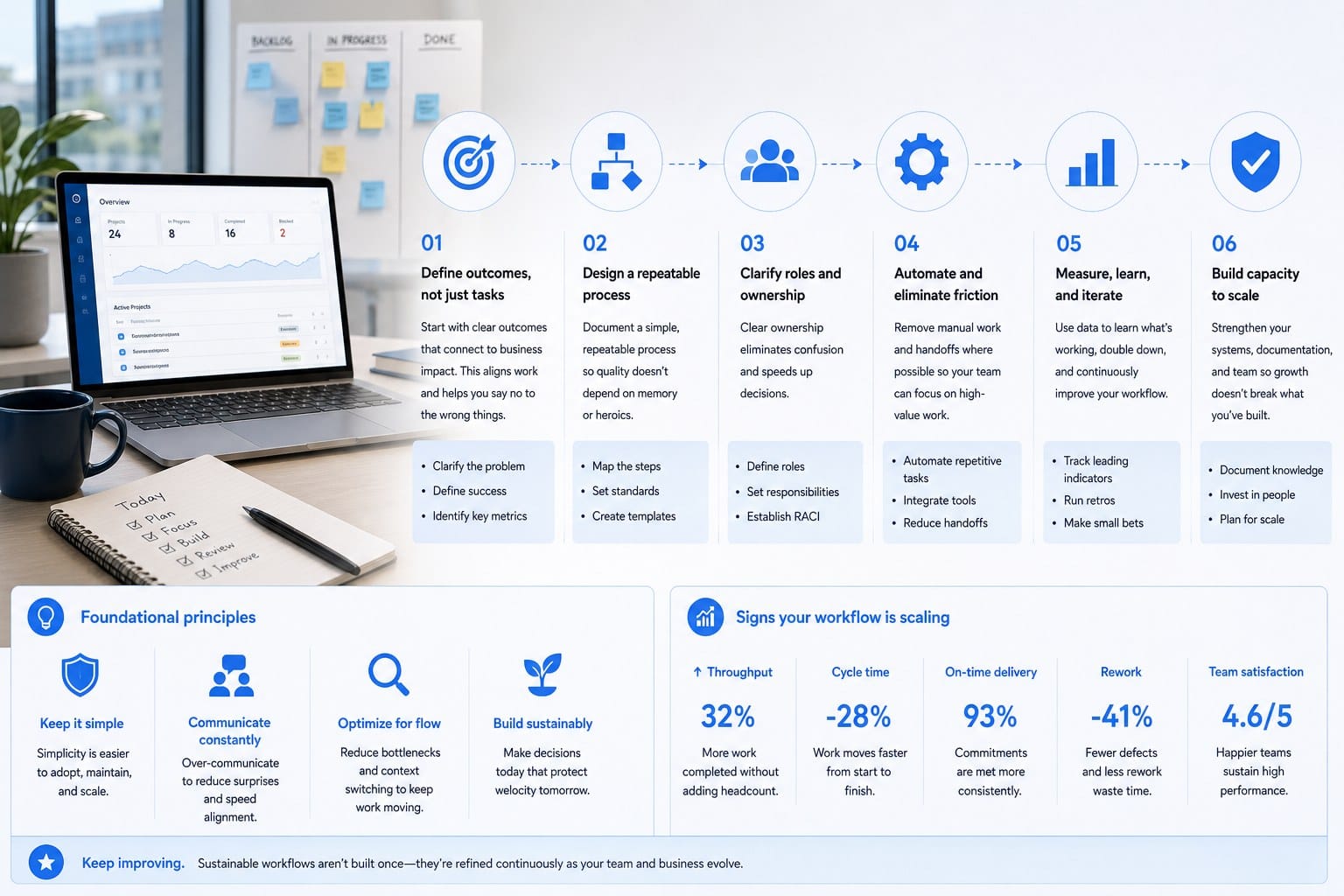
Start with your content strategy before you touch any writing tools. The biggest mistake I see is jumping straight into article production without a clear plan. Spend time, or use an AI tool to help you spend that time more efficiently, mapping out the topics that matter most for your niche. Think in clusters: a central topic, then a series of supporting articles that address related questions, subtopics, and use cases. This cluster approach to content organization is not new, but AI tools make it much faster to execute. You can go from a broad subject to a 30-article cluster map in an afternoon rather than a week.
Once you have that map, build your editorial calendar around it with specific publish dates. Do not leave it vague. If the calendar says a specific article publishes on a specific date, treat that like a deadline. The discipline of a real deadline, even a self-imposed one, changes how you manage your time. Tools that automate the scheduling and publishing step remove the friction of the final push, which is often where things stall.
For the writing itself, find the role that AI plays best in your specific process and be honest about where you need to stay in control. For most independent bloggers, the sweet spot is using AI to generate a detailed outline and a research brief, maybe a rough first draft that captures the main points, and then doing a significant rewrite yourself to add your voice, your real-world examples, and your genuine perspective. The articles that perform best are the ones where the structure and research efficiency come from AI tools but the expertise and personality come from you.
Do not try to publish AI-generated content without meaningful human input. Not because of any abstract principle, but because it does not work as well. Readers can tell the difference between something that feels like it was written by someone who actually knows and cares about the topic versus something that was assembled algorithmically and pushed out the door. Your credibility as an independent blogger depends on your readers trusting that what you say reflects real knowledge and experience. That trust is harder to build than search rankings and much more valuable long term.
Set a publishing cadence that is actually sustainable for you and stick to it rather than setting an ambitious pace you cannot maintain. If you can realistically produce two well-researched articles a week with AI assistance, that is an excellent baseline. Two articles a week is over 100 articles a year. Over two years, that is a substantial content library that covers your topic from many angles, targets dozens of keywords, and builds the kind of topical authority that moves the needle on organic traffic. Compare that to the typical independent blogger pace of maybe 20 to 30 articles a year, and the compounding advantage becomes obvious.
Monitor your performance and let data guide your strategy over time. Which articles are getting traffic? Which ones are ranking but not converting readers into email subscribers or returning visitors? Which topics seem to resonate with your audience based on comments and shares? AI tools can help you analyze this data and adjust your content plan accordingly, but you need to actually look at it regularly. Set a monthly review habit where you check your top-performing content, identify gaps, and update your editorial calendar based on what you are learning.
One specific tactic that independent bloggers often overlook is updating and expanding older articles rather than always creating new ones. Big media publications do this systematically because their editorial teams track content performance over time. An article you wrote 18 months ago might be ranking on page two of Google for a valuable keyword. A targeted update, adding new information, expanding thin sections, improving the structure, can push it to page one without starting from scratch. AI tools make this audit and update process much more efficient because they can quickly identify what a piece is missing and suggest specific improvements.
I also want to address the question of specialization versus breadth, because it matters a lot for independent bloggers specifically. Big media outlets cover everything. They can because they have the staffing to do it. Independent bloggers who try to do the same thing end up with a scattered site that does not have clear authority in any specific area. The smarter play is to go deep in a defined niche, build a reputation as the most useful, most consistent, most knowledgeable source in that specific space, and let that reputation compound over time. AI tools make it possible to produce enough content to dominate a niche without the content becoming shallow or repetitive. You can cover every meaningful angle of your topic, answer every question your audience is asking, and do it at a pace that builds real search authority.
Finally, think about your distribution strategy alongside your production strategy. Publishing great content that nobody sees solves only half the problem. Email newsletters, social media repurposing, and strategic outreach to other bloggers and sites in your niche all matter. AI tools can help with repurposing specifically, turning a long-form article into a series of social posts, an email newsletter, or a shorter summary piece, without requiring you to rewrite everything from scratch. That kind of content multiplication, where one piece of core work gets distributed through multiple channels, is something big media outlets do automatically. Independent bloggers can do it too, and AI tools make it much less time-consuming.
The gap between what independent bloggers can accomplish and what large media outlets produce is narrowing in ways that matter for real business outcomes. More organic traffic, stronger topical authority, more consistent publishing, better-optimized content. You do not need a team of 50 people to compete at a high level anymore. You need a clear strategy, the right tools, and the consistency to execute.
Ready to take the next step?
If you are ready to stop publishing in bursts and start building a content operation that runs consistently, Blogtude was built for exactly this. It generates a full 30-day content strategy, produces deeply researched long-form articles with on-brand visuals, and publishes directly to Ghost and other CMS platforms automatically. You bring the expertise and the niche. Blogtude handles the volume and the consistency. Visit blogtude.com to see how it works and get started.