
How to use AI to write long-form SEO articles that actually rank

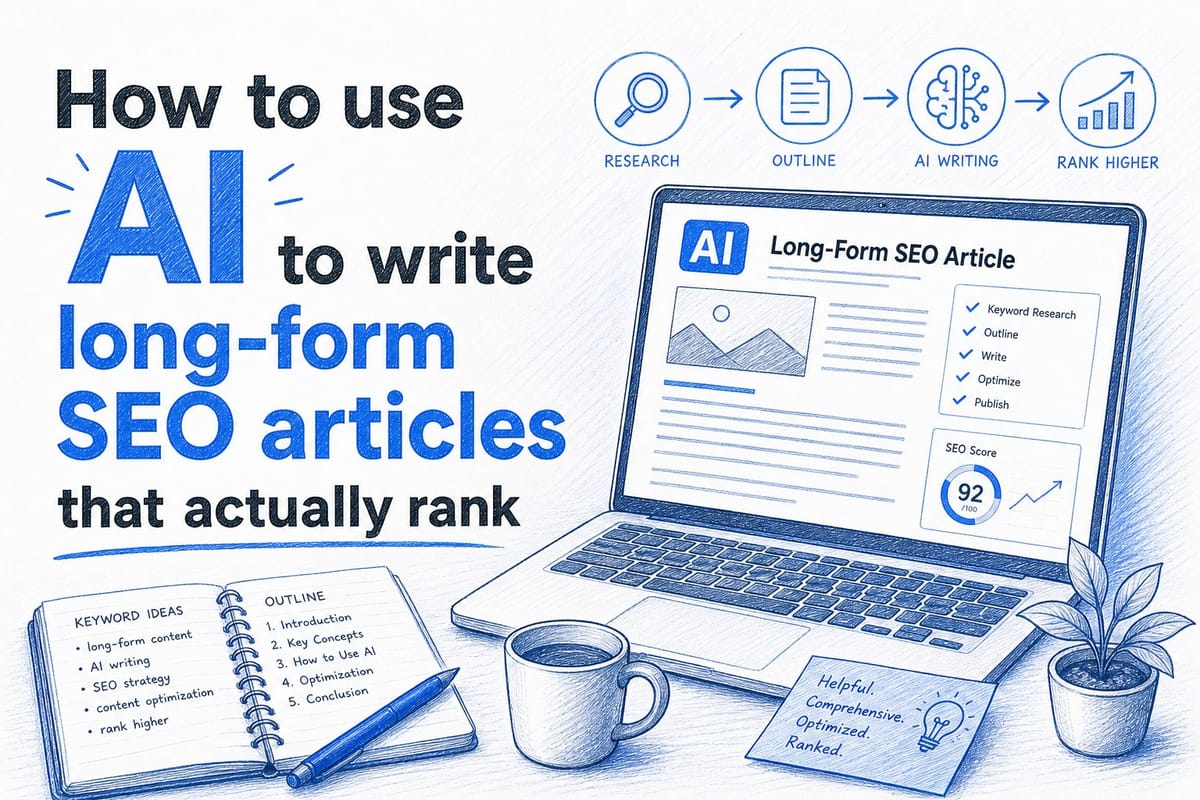
Table of contents
1. Why most AI articles fail to rank (and what is actually missing)
2. Building a workflow that lets AI write long-form SEO articles that rank
3. How to scale this without burning out or losing quality
I want to be honest with you: most AI-generated blog posts are forgettable. They hit publish, sit on page four of Google, and do nothing for your traffic. But that is not a problem with AI itself. It is a problem with how people use it. When you understand what Google actually rewards, and you build a workflow that combines AI speed with real editorial thinking, you can absolutely use AI to write long-form SEO articles that rank. This guide walks through exactly how to do that, step by step.
Why most AI articles fail to rank (and what is actually missing)
Before we talk about the right way to do this, let us look at why so many AI articles fall flat in search.
Google has been clear that it rewards content that demonstrates experience, expertise, authoritativeness, and trustworthiness. SEOs have shortened this to E-E-A-T. It is not just a buzzword. It is the lens Google uses when it decides which articles deserve the top spots.
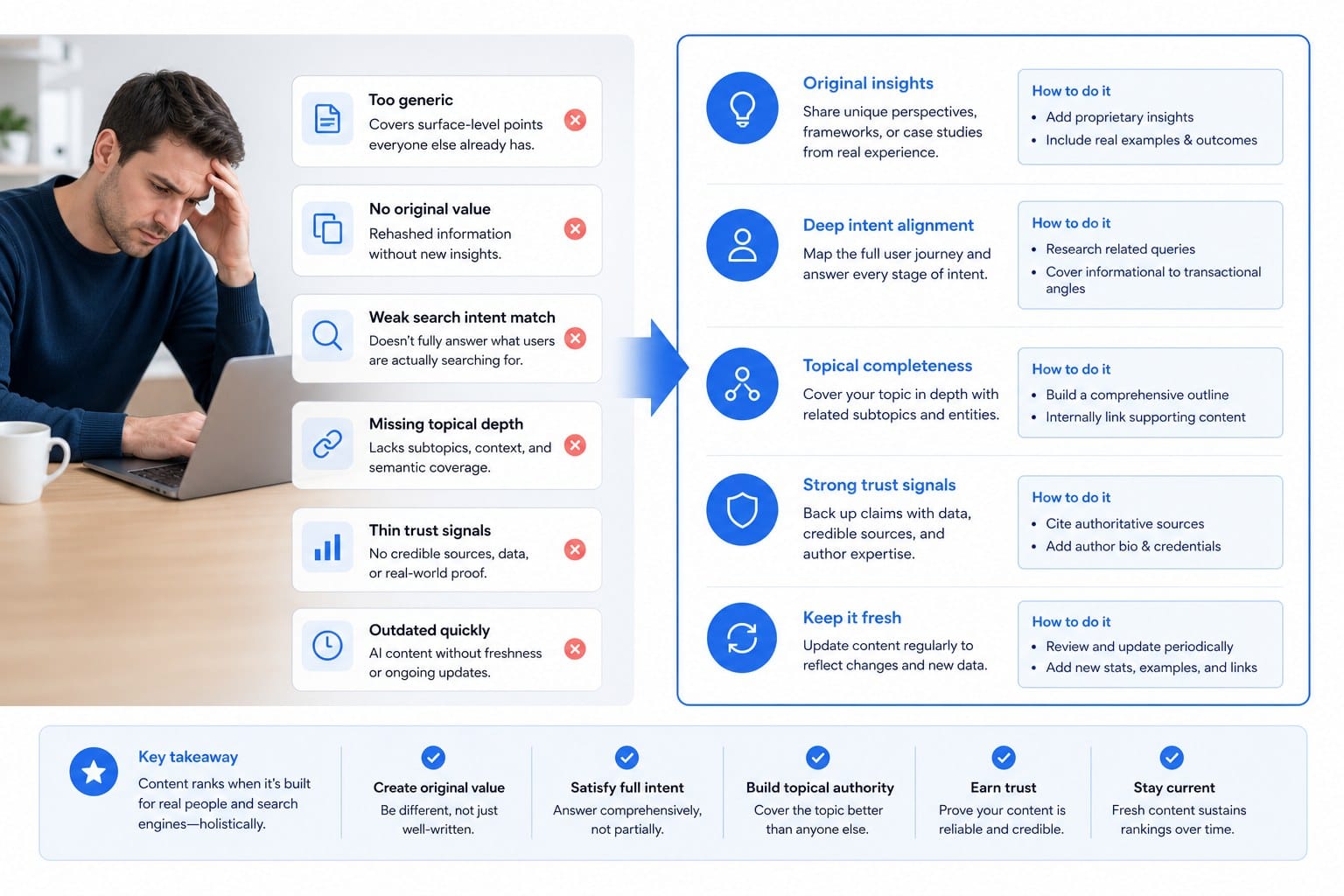
Most AI-generated articles fail this test for a few specific reasons.
First, they lack depth. A generic 800-word article that covers a topic at surface level does not satisfy search intent. Someone searching for how to set up email automation for a SaaS onboarding flow does not want a fluffy overview. They want a real answer with real steps. Google knows the difference.
Second, they lack original perspective. AI trained on existing web content tends to regurgitate the consensus. If your article says the same things in roughly the same order as the top ten results, Google has no reason to rank you above them. You need a point of view, a unique angle, or information the other articles do not include.
Third, most AI articles are not structured for how people actually read. People scan. They jump to the section that answers their question. If your headings are vague and your paragraphs are dense blocks of text, readers bounce. A high bounce rate signals to Google that your content did not satisfy the searcher, and your rankings suffer.
Fourth, and this one surprises people, thin topical coverage kills long-form AI articles. You might publish a 2,000-word article and still have thin content. Word count alone means nothing. If you cover one narrow slice of a topic without addressing related subtopics and questions the reader naturally has, the article will feel incomplete. Google sees this too.
So what is actually missing? It is editorial judgment. AI can write at scale. It can format, summarize, and generate text fast. What it cannot do on its own is decide which angle will resonate, which questions a real reader actually has, or which details are worth including versus cutting. That judgment has to come from you.
The good news is that this is a learnable workflow. You do not need to be an SEO expert. You do not need to write every word yourself. You just need to understand what the workflow looks like when it is done right.
One more thing worth mentioning: inconsistency is a silent killer for organic growth. Publishing one great article and then going quiet for six weeks sends the wrong signals to both Google and your audience. I wrote more about this in The hidden cost of inconsistent blogging and how automation fixes it. The short version is that consistent publishing builds topical authority over time, and topical authority is one of the strongest ranking signals you can build.
Building a workflow that lets AI write long-form SEO articles that rank
Here is the workflow I recommend. It treats AI as a research and drafting partner, not a replacement for thinking.
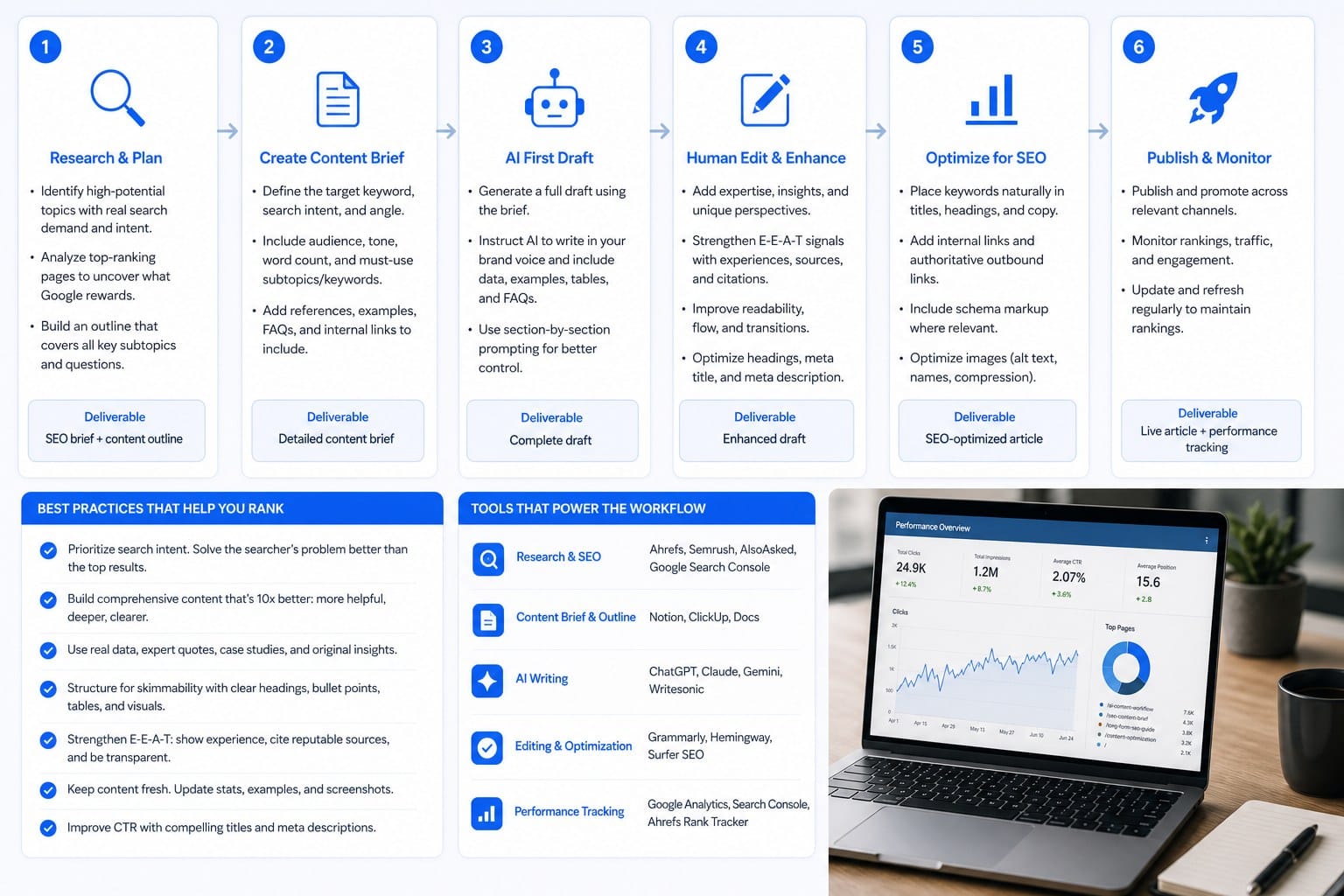
Step one: Start with keyword and intent research
Before you write a single word, you need to know what your target reader is searching for and why. This means understanding the keyword, the search intent behind it, and the questions that naturally surround it.
Search intent has four basic flavors: informational (the person wants to learn something), navigational (they are looking for a specific website), commercial (they are comparing options before buying), and transactional (they are ready to buy or sign up). Long-form blog content almost always targets informational or commercial intent.
Let us say you are writing for a SaaS audience and your target keyword is something like "how to reduce churn in a SaaS product." That is an informational query. The reader wants to understand strategies. They are not ready to buy anything yet. Your article needs to answer the question thoroughly, not pitch a product.
To figure out what the reader actually wants, look at the top-ranking articles for your keyword. What subtopics do they cover? What questions do they answer? What do they miss? That gap is your opportunity.
You can also look at the "People also ask" box in Google, Reddit threads on the topic, and review sections of related tools. These sources surface real language that real people use, and that language should show up in your article naturally.
Step two: Build a research brief before you prompt the AI
This is the step most people skip, and it is the biggest reason AI articles underperform.
A research brief is a structured document you create before you ask the AI to write anything. It typically includes:
- The target keyword and related keywords - The primary search intent - The audience (who is reading this and what do they already know) - The angle (what unique perspective or framing will this article take) - Subtopics and questions to cover - Any specific facts, examples, or data you want included - The desired tone and structure
When you feed a well-built brief to an AI writing tool, the output is dramatically better than when you just say "write me an article about X." The AI has constraints to work within. It has a specific angle to pursue. It knows the audience. The result reads more like a purposeful article and less like a Wikipedia entry.
If you are managing a blog for a startup or small business, this brief-building step is also where you inject brand voice. Generic AI output sounds like everyone else. A brief that includes your specific vocabulary, your audience's pain points in their own words, and your brand's position on the topic produces output that actually sounds like you.
For more on keeping AI content on-brand, I recommend reading How to maintain brand voice when using AI to write blog content. It goes deep on the specific ways brand voice gets diluted during AI drafting and how to prevent it.
Step three: Generate a draft, then edit for depth and accuracy
Once your brief is ready, you can use an AI tool to generate a full draft. For long-form articles, aim for a structure that includes a strong opening that frames the problem, several substantive sections that each address a real question or subtopic, and a closing section that either summarizes or points to a next step.
When the draft comes back, your job is editorial, not clerical. You are not just fixing typos. You are asking:
- Does this section actually answer the question, or does it hedge and say nothing? - Are there any claims that are vague or unverifiable? - Is there a real example I could add here to make this concrete? - Does the structure match how someone would actually read this? - Does this article say something the other top results do not say?
Concrete examples are one of the fastest ways to improve AI-generated drafts. If the AI writes "email automation can improve onboarding completion rates," that is fine but forgettable. If you add a specific scenario, like a SaaS tool that sends a targeted email when a user has not completed their profile after 48 hours, and explain what happens when they do, that is a detail the reader can actually use.
Depth also means covering adjacent questions. If someone is reading about long-form SEO articles, they probably also want to know about internal linking, heading structure, and how long the article should be. Covering those subtopics within the same article builds what SEOs call topical authority. It tells Google that your site genuinely covers this subject.
Step four: Optimize structure for both readers and search engines
Long-form articles need to be scannable. Here is what that looks like in practice:
Use H2 and H3 headings that clearly describe what each section covers. Vague headings like "More to consider" help no one. Specific headings like "How to structure a brief for AI-generated content" tell the reader exactly what they are about to get.
Keep paragraphs short. Two to four sentences is usually enough before you break. Dense paragraphs feel like homework. Short paragraphs feel like a conversation.
Use lists and numbered steps when you are walking through a process. This is not just for readability. Google often pulls list-based content into featured snippets, which gives you visibility above the traditional search results.
Add a table of contents for articles over 1,500 words. It improves navigation and can show up in search results as sitelinks, giving your result more visual real estate on the page.
Make sure your target keyword appears naturally in your title, your first paragraph, at least one H2 heading, and throughout the body. Natural means it reads like you would actually say it, not like you forced it in. The goal of using AI to write long-form SEO articles that rank is not to stuff a phrase into every paragraph. It is to build an article that genuinely serves the reader asking that question.
Step five: Add internal links and let AI handle the publishing workflow
Internal links do two things. They help Google understand the structure of your site and which pages are related. And they keep readers on your site longer, which is a behavioral signal that Google notices.
Every long-form article you publish should link to at least two or three other relevant articles on your site. If you are a startup building a content library, this is also where a 30-day content strategy pays off. When you publish articles in a connected cluster around a topic, each article strengthens the others. They link to each other, they share topical authority, and together they are much harder for a thin competitor to outrank.
For startups specifically, building this kind of content cluster early is one of the highest-leverage things you can do. I covered this in detail in Startup content marketing: a blogging strategy for early-stage SaaS, including how to prioritize topics when you have limited time and budget.
Once an article is written, edited, and optimized, the final step is publishing. This sounds simple, but for teams managing multiple pieces per month, the publishing workflow itself becomes a bottleneck. Formatting for your CMS, adding metadata, uploading visuals, scheduling the post -- these tasks add up fast. Automating this part of the workflow, the handoff from finished draft to live post, is where tools like Blogtude save the most time.
How to scale this without burning out or losing quality
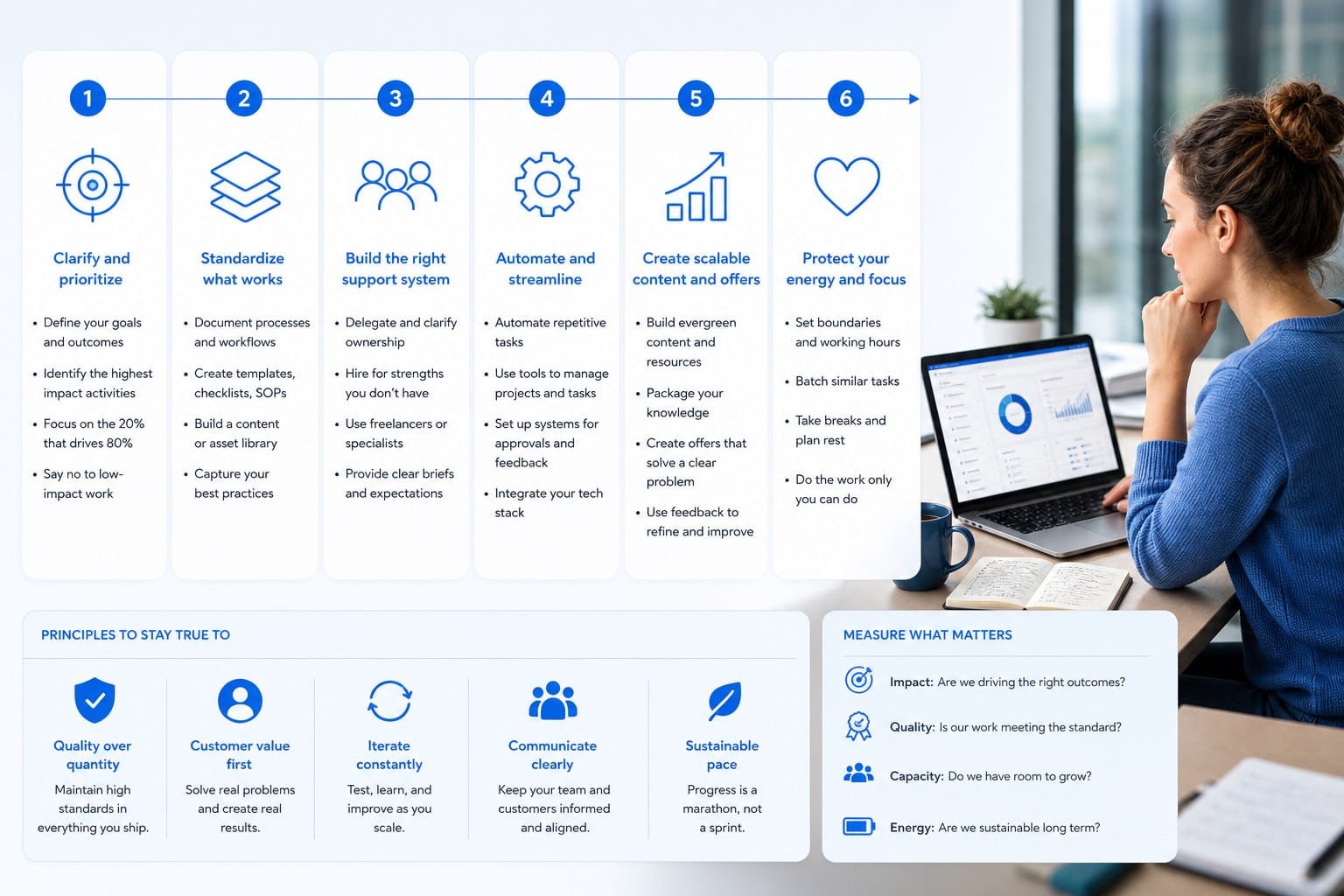
Getting one great AI-assisted article published is achievable for almost anyone. Getting ten published per month, consistently, without sacrificing quality, is where most people hit a wall.
Here is what scaling actually looks like, and where the common breaking points are.
The volume problem
Search engines favor sites that publish consistently and build out their topical coverage over time. One article per week is a reasonable target for many brands. That is 52 articles per year. If each article takes four to six hours of work, that is 200 to 300 hours of content production annually. For a solo blogger or a small startup team, that math does not work.
The solution is not to cut corners on quality. It is to reduce the time spent on the parts of the process that do not require human judgment.
Briefing, drafting, and basic formatting are tasks AI handles well when given good inputs. Editing for depth, adding original examples, fact-checking, and making final decisions about what to publish are tasks that still benefit from human review. When you split the workflow this way, a piece that used to take five hours can realistically take one to two hours without losing the quality signals that help it rank.
The consistency problem
Consistency is harder than it sounds. You might have a great month where you publish four articles, then fall off to zero the next month because a client project takes over or the team gets sick. That gap is more damaging than it looks. Google notices when a site goes quiet. Your audience notices too.
The fix is to build a content calendar that is planned at least 30 days out, ideally with drafts ready before their publish date. This buffer means that a busy week does not automatically result in a missed publication. You are publishing from a queue, not writing against a deadline.
This is one of the core problems that a content engine approach solves. Instead of deciding each week what to write about, you plan the month in one sitting, generate the drafts in a batch, review and edit them over a few days, and then let the publishing happen automatically on schedule.
The strategy problem
Lot of bloggers and small business owners write about whatever feels interesting that week. This is a natural way to work, but it does not build topical authority. From a search perspective, you end up with a scattered collection of articles that do not reinforce each other.
A stronger approach is to pick three to five core topic clusters for your site and build articles within each cluster deliberately. Each cluster has a main pillar topic, several supporting articles that go deep on subtopics, and internal links connecting them all.
For example, if you run a blog about remote work tools, your clusters might be async communication, team productivity, remote hiring, home office setup, and time zone management. Within each cluster, you publish the pillar article first, then build out the supporting articles over several months. By the end, you have a dense, well-linked library on each topic, and Google can see that your site genuinely covers these subjects.
Building this kind of strategy from scratch takes time, but if you have a tool generating the 30-day plan for you, the strategy layer becomes much less of a burden.
The quality floor problem
Scaling content production creates a real risk: as volume goes up, quality goes down. This happens because editorial review gets rushed, fact-checking gets skipped, and the articles start to feel like they were produced by a machine.
To protect against this, set a minimum quality standard and apply it to every article before it goes live. Your standard might include:
- At least one concrete example per major section - All factual claims either verified or removed - Headings that clearly describe the section content - A unique angle or perspective that differentiates the article from the top three competitors - At least two internal links to related articles
This is not a long checklist. It is a short one with meaningful criteria. If an article passes this review, it is ready to publish. If it does not, it needs one more editing pass.
The difference between AI content that ranks and AI content that sits on page four almost always comes down to this editorial layer. It does not have to be slow. A focused 30-minute review of a well-structured draft is usually enough to catch what needs fixing.
Putting it together: what a real content workflow looks like
Let me make this concrete with a simplified example. Say you are a SaaS founder running a small blog with the goal of growing organic traffic over the next year.
In week one, you define your five topic clusters and build a 30-day content calendar with eight articles spread across those clusters. You write a research brief for each article: keyword, intent, angle, subtopics, tone.
In week two, you use an AI tool to generate drafts for all eight articles. You review each one for depth, accuracy, and original examples. You add internal links. You approve six of the eight and send two back for revision.
In week three, the six approved articles are formatted and queued in your CMS. Publishing is automated to go live on a regular schedule across the month.
In week four, you review performance on last month's articles and start planning the next 30-day calendar.
This loop, plan, brief, draft, edit, publish, review, is repeatable. It does not require a content team. It does not require you to spend your evenings writing. And because you are publishing consistently and building topical coverage deliberately, the organic traffic compounds over time.
Blogtude is built around exactly this workflow. It generates a 30-day content strategy, produces deeply researched long-form articles with on-brand visuals, and automatically publishes to Ghost and other CMS platforms. If you are a blogger, startup founder, or small business owner who wants consistent SEO-driven content without doing all of this manually, it is worth taking a look at what that kind of system can do for your publishing output.
Ready to take the next step?
If you are ready to stop treating content as a one-off task and start building a system that compounds over time, Blogtude can help. It handles the strategy, the writing, and the publishing, so you can focus on the parts of your business that actually need you. Visit https://blogtude.com to see how it works.