
Can AI blog content meet Google's quality guidelines

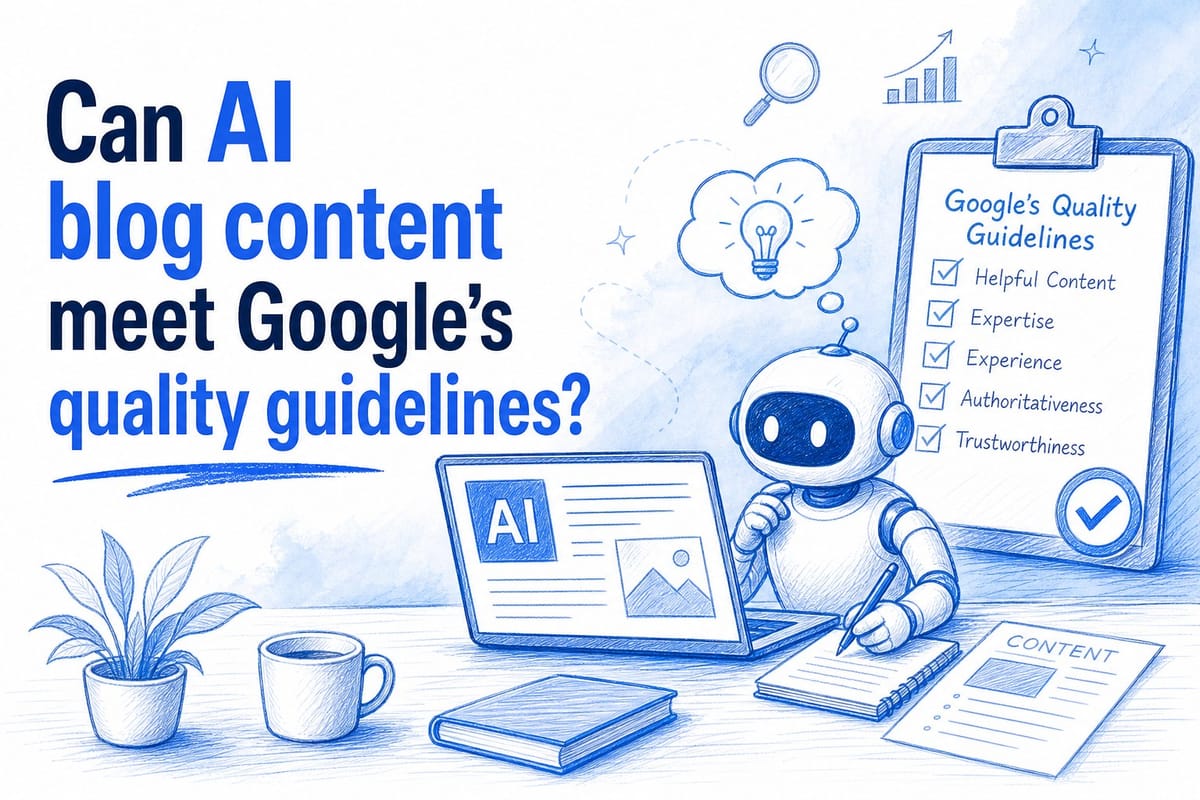
Table of contents
1. What Google's quality guidelines actually say about AI content
2. Where AI content fails quality standards and how to fix it
3. Building an AI content workflow that actually passes the quality test
The question comes up constantly in marketing circles right now: can AI blog content actually meet Google's quality guidelines, or does using AI to write articles put your site at risk? I want to give you a straight answer, because there is a lot of fear and misinformation floating around on both sides of this debate. The short version is that Google does not penalize content because a machine helped produce it. What Google penalizes is content that is unhelpful, thin, or clearly made to game rankings rather than serve readers. That distinction matters enormously if you are trying to build a sustainable content strategy with AI. In this article, I will walk through exactly what Google's quality standards require, how AI-generated content stacks up against those requirements, and what you need to do to make sure the content you publish with AI tools actually earns traffic instead of getting buried.
What Google's quality guidelines actually say about AI content
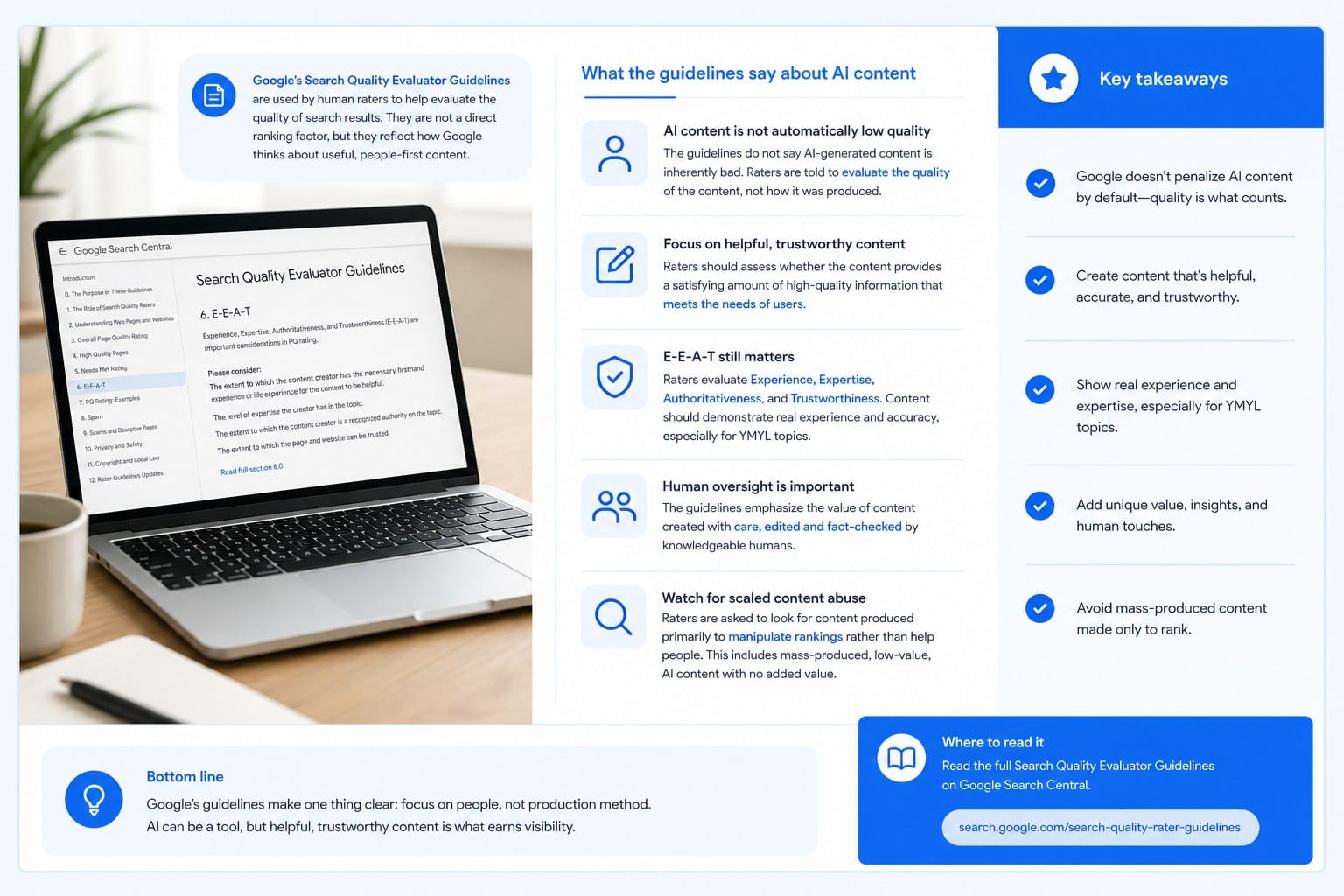
Google has been public about its stance on AI content, and it is worth reading carefully rather than relying on secondhand summaries. Google's Search Central documentation and its core Search Quality Rater Guidelines both point to one central idea: content should demonstrate Experience, Expertise, Authoritativeness, and Trustworthiness, commonly called E-E-A-T. The production method, whether human or AI, is not the deciding factor. The quality and usefulness of the output is.
Google's spam policies do call out auto-generated content used to manipulate rankings. That policy has been in place for years, long before modern large language models existed. It targeted low-effort article spinning and keyword-stuffed filler. The 2023 updates to that policy clarified that using AI to generate content is not inherently a violation. What remains a violation is producing content at scale with no regard for whether it actually helps anyone.
The helpful content system, which Google rolled out as a series of updates starting in 2022, added another layer. It looks at signals across an entire website, not just individual pages. If a large portion of a site's content appears to be written primarily for search engines rather than people, the whole site can see a ranking drop. This is a site-wide signal, which means one or two bad articles can drag down pages that would otherwise rank well.
So what does this mean practically? It means that ai blog content and google quality guidelines are not in conflict by default. They become a problem only when AI is used to churn out generic, surface-level content with no real editorial judgment applied. Google's quality raters are trained to evaluate whether a page makes the reader's life better after reading it. If your AI-generated article does that, it passes the test. If it just restates obvious information in slightly different words, it does not.
There is also the question of E-E-A-T signals specifically. Google's quality raters look for evidence that content comes from someone with real experience or credentials in the topic area. This is where purely automated AI content, with no human editorial layer, can run into trouble. An article about tax planning that carries no author byline, cites no real sources, and makes claims that cannot be verified will score low on trustworthiness regardless of whether a human or an AI wrote it. The medium is not the problem. The lack of credible sourcing and demonstrated expertise is.
One more thing worth understanding is the role of page experience signals. Core Web Vitals, mobile usability, and HTTPS are still ranking factors. These are technical, not content-related, but they interact with content quality in the sense that a slow, hard-to-read page will perform worse even if the content itself is excellent. If you are publishing AI content at volume, making sure the underlying site is technically sound is not optional.
The bottom line on policy is this: Google has given content creators a clear framework. Produce helpful, accurate, well-sourced content that reflects real expertise. If your AI content workflow does that, you are on solid ground. If it produces generic filler at scale, you are taking a real risk regardless of what tool created it.
Where AI content fails quality standards and how to fix it
Understanding the rules is step one. The harder part is looking honestly at where AI-generated content tends to fall short of those standards, because there are real failure modes. I have audited enough AI-generated articles to know the patterns, and they are predictable once you know what to look for.
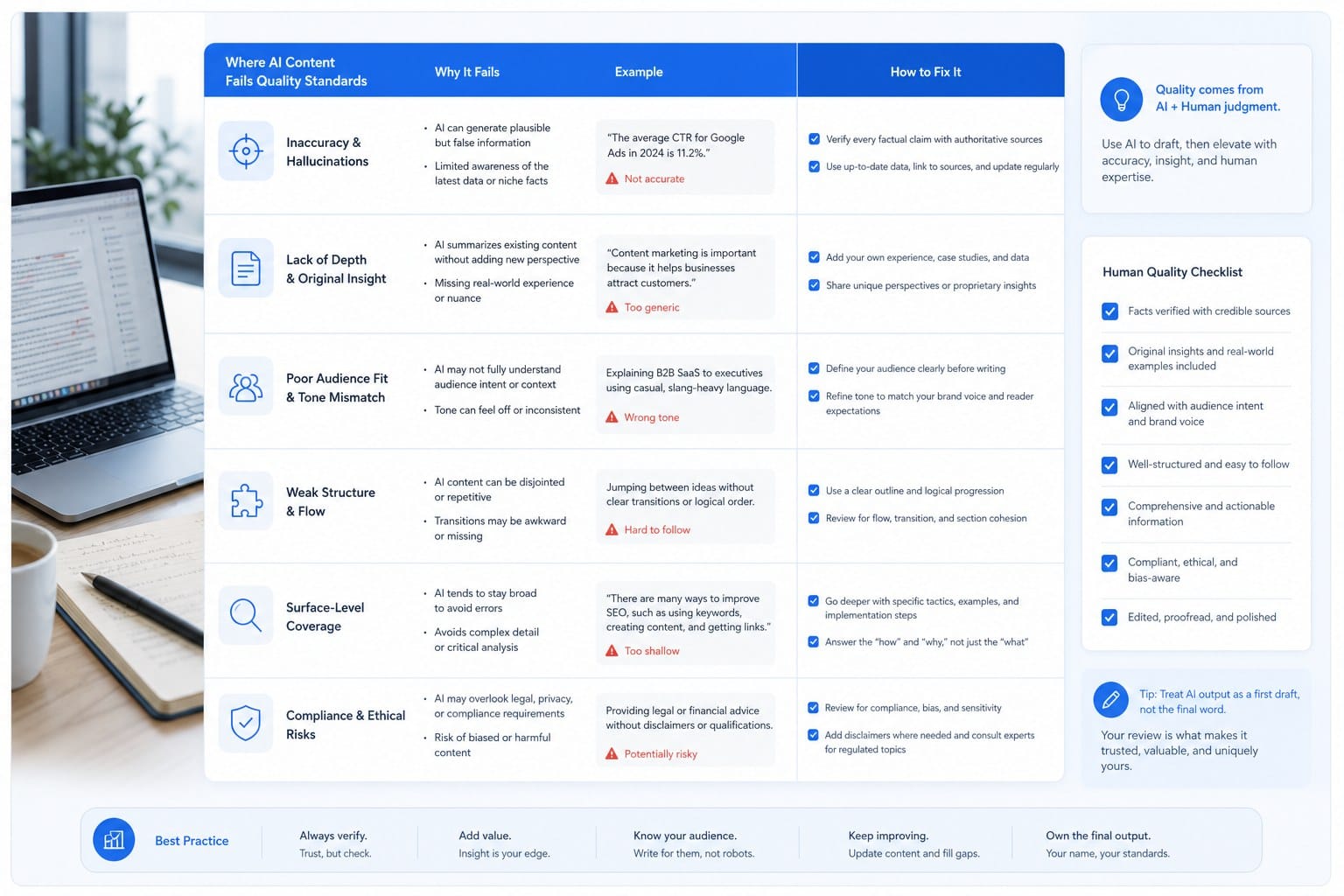
The first and most common problem is factual vagueness. AI language models generate text by predicting plausible next words based on patterns in training data. That process produces fluent, well-structured prose, but it does not guarantee accuracy. When an AI writes that a certain strategy is popular or effective, it is often making a statistical inference, not reporting a verified fact. Articles that are full of vague hedges like many experts believe or studies have shown without naming the experts or citing the studies are a red flag for Google's quality raters. They are also a red flag for readers who are actually trying to make a decision.
The fix here is straightforward but requires discipline. Every factual claim in an AI-generated article should be verified before publishing. Statistics need real sources. Quotes need attribution. If the AI generates a claim you cannot verify, cut it or rewrite it in a way that is honest about the limits of the information. This is not extra work so much as normal editorial practice applied to a new workflow.
The second common failure is thin coverage. AI models trained on web content tend to produce articles that look comprehensive at a glance but actually circle around a small set of obvious points. An article about content marketing strategy that talks about knowing your audience, publishing consistently, and measuring results is technically correct but adds nothing to the conversation. Anyone who has already read three other articles on the same topic will leave immediately, and Google's engagement signals will reflect that.
The way to fight this is to bring genuine depth to the research phase before you start generating content. If you know what specific questions your audience is actually asking, what nuances they are confused about, and what the first-person experience of solving their problem actually involves, you can feed that context into your AI workflow and get much more useful output. An article that answers a question your audience has actually been struggling with will outperform a generic overview every time, whether it was written by a human or an AI.
This connects directly to the idea of what makes a blog post rank on Google. It is not about word count or keyword density. It is about whether the article covers the topic better than what is already available. AI content that starts from real research and a clear editorial brief can absolutely achieve that. AI content that just rehashes the top-ranking pages will not.
The third failure mode is the absence of experience signals. Google's E-E-A-T framework added a second E for Experience in late 2022. This recognizes that content written by someone who has personally done the thing they are describing is inherently more trustworthy than content written by someone who has only read about it. First-hand examples, specific anecdotes, and concrete results from real situations are things AI cannot fabricate from nothing. It can create plausible-sounding examples, but they will often feel generic or slightly off to readers who know the subject.
The practical answer here is to build a human editorial layer into your workflow. This does not have to mean rewriting everything from scratch. It can mean adding a short section where a real person shares a specific experience, or having a subject matter expert review the article and add a quote or two. That layer of genuine human experience, added to an otherwise AI-generated draft, substantially closes the E-E-A-T gap.
Fourth, purely automated AI content often lacks a coherent point of view. The best blog content takes a position, argues for it, and gives the reader a reason to change the way they think about something. AI models tend to produce balanced, both-sides coverage by default because that is what the training data rewards. But content that carefully avoids any conclusion is not particularly useful, and it is not particularly shareable. Building a clear editorial voice and perspective into your content brief will push AI output in a more useful direction.
If you want to see where your existing content stands before adding more, how to audit your blog content in under an hour is a practical starting point. It helps you identify which articles already have these problems so you can fix the foundation before scaling output.
Building an AI content workflow that actually passes the quality test
Knowing what can go wrong is useful. Knowing how to build a workflow that avoids those problems from the start is what actually moves the needle. I want to walk through what a quality-first AI content workflow looks like, because it is different from just pointing an AI at a keyword and hitting generate.
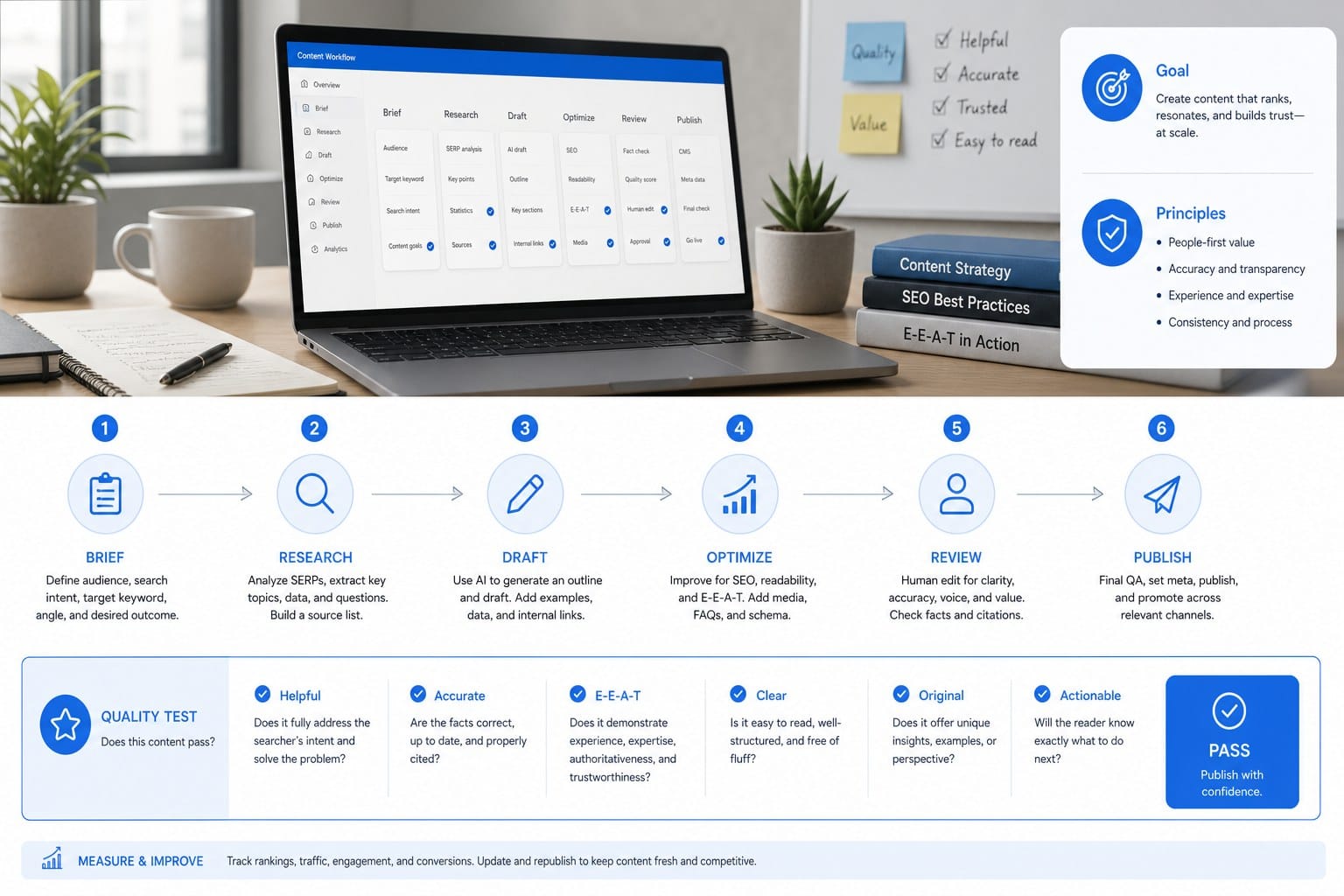
The first step is strategy before output. The single biggest mistake people make with AI content is treating it as a writing shortcut when it should be treated as a production shortcut. The thinking, the audience research, and the editorial judgment still need to come from somewhere. A 30-day content strategy built around real keyword research, audience intent mapping, and competitive gap analysis gives you the foundation that makes AI output genuinely useful rather than generic. Without that foundation, you are essentially asking the AI to make strategic decisions it is not equipped to make.
A well-structured content strategy identifies which topics your audience actually needs help with, which angles have not been covered well by existing content, and how each article connects to the others to build topical authority over time. That last point matters more than most people realize. Google's systems increasingly evaluate sites for depth of coverage on a topic, not just individual article quality. Publishing ten shallow articles on tangentially related subjects does far less for your authority than publishing five deeply interconnected articles that cover a topic from multiple angles. The compounding effect of consistent blogging on domain authority explains the long-term mechanics of this in detail.
The second step is research-first brief building. Before any content is generated, the brief for each article should include the specific questions the article needs to answer, any relevant statistics or data points from credible sources, the primary keyword and a handful of related terms used naturally, the intended reader's experience level, and at least one concrete example or case study the article should reference. This level of detail in the brief is what separates AI content that reads like research from AI content that reads like filler. The AI's job is to organize and articulate the ideas in the brief, not to invent the ideas from scratch.
When you build briefs this way, you are essentially doing the editorial work upfront and letting the AI handle the production work. That division of labor is sustainable and scalable in a way that trying to review and rewrite AI drafts after the fact is not.
The third step is a structured review process. Even with a strong brief, every AI-generated draft needs human review before it goes live. This review does not have to be exhaustive, but it needs to cover a few non-negotiable checkpoints. Are all factual claims accurate and sourced? Does the article take a clear position and actually argue for it? Does it add something that existing articles on this topic do not? Does the introduction make it immediately clear what the reader will get from the article? Is the conclusion specific and actionable?
If the answer to any of those questions is no, the article is not ready. That might sound strict, but it is the standard Google's quality raters are applying, and more importantly, it is the standard readers apply every time they bounce away from a page within thirty seconds.
The fourth step is technical and on-page optimization. Quality content that is technically broken will not reach its potential. Each article should have a well-written meta description, a properly structured heading hierarchy, internal links to related content on the site, and images with descriptive alt text. If you are publishing to a CMS like Ghost, these elements should be part of the publication checklist, not an afterthought.
On the topic of internal linking specifically: it is one of the most underused signals available to content teams. When your articles link to each other in a logical, contextual way, you help both readers and search engines understand the relationship between your content pieces. That structure is a signal of topical authority. It also keeps readers on your site longer, which is a positive engagement signal.
The fifth step is measuring and iterating. No content strategy is static. After you have been publishing AI-assisted content for 60 to 90 days, you should have enough data to see which articles are gaining traction and which are not. Articles that are ranking on page two or three for their target keyword often just need a targeted update, a stronger introduction, better internal links, or additional depth on a subtopic they covered too briefly. AI tools make that kind of iterative improvement faster and easier than the old approach of rewriting everything from scratch.
Finally, I want to address the concern about originality directly, because it comes up whenever AI content is discussed. Google does not require that every idea in an article is published for the first time in human history. It requires that content provides genuine value to the reader. An article that takes well-established information and explains it more clearly, applies it to a specific audience's situation, or organizes it in a way that makes it more actionable is original enough. What Google's systems penalize is content that is essentially a paraphrase of existing content with nothing added. That kind of content existed long before AI, and it has always ranked poorly.
The real question to ask about any piece of AI blog content is not whether a machine helped produce it. It is whether the person who needed this information would be genuinely glad they found it. That is the standard that aligns with Google's quality guidelines, and it is a standard a well-designed AI content workflow can absolutely meet.
At Blogtude, the workflow is built around exactly this approach. The platform generates a 30-day content strategy grounded in real SEO research, produces long-form articles that are designed for depth and usefulness rather than volume, pairs each article with on-brand visuals, and publishes directly to Ghost and other CMS platforms. The goal is not to replace editorial judgment but to remove the production bottleneck so that judgment can actually be applied consistently. Growing brands should not have to choose between content quality and content consistency. The right workflow makes both possible.
Ready to take the next step?
If you are ready to build a content workflow that produces articles Google actually wants to rank, Blogtude gives you the strategy, the research-driven content, and the automated publishing in one place. Visit blogtude.com to see how it works and start your first 30-day content plan.


