
The compounding effect of consistent blogging on domain authority

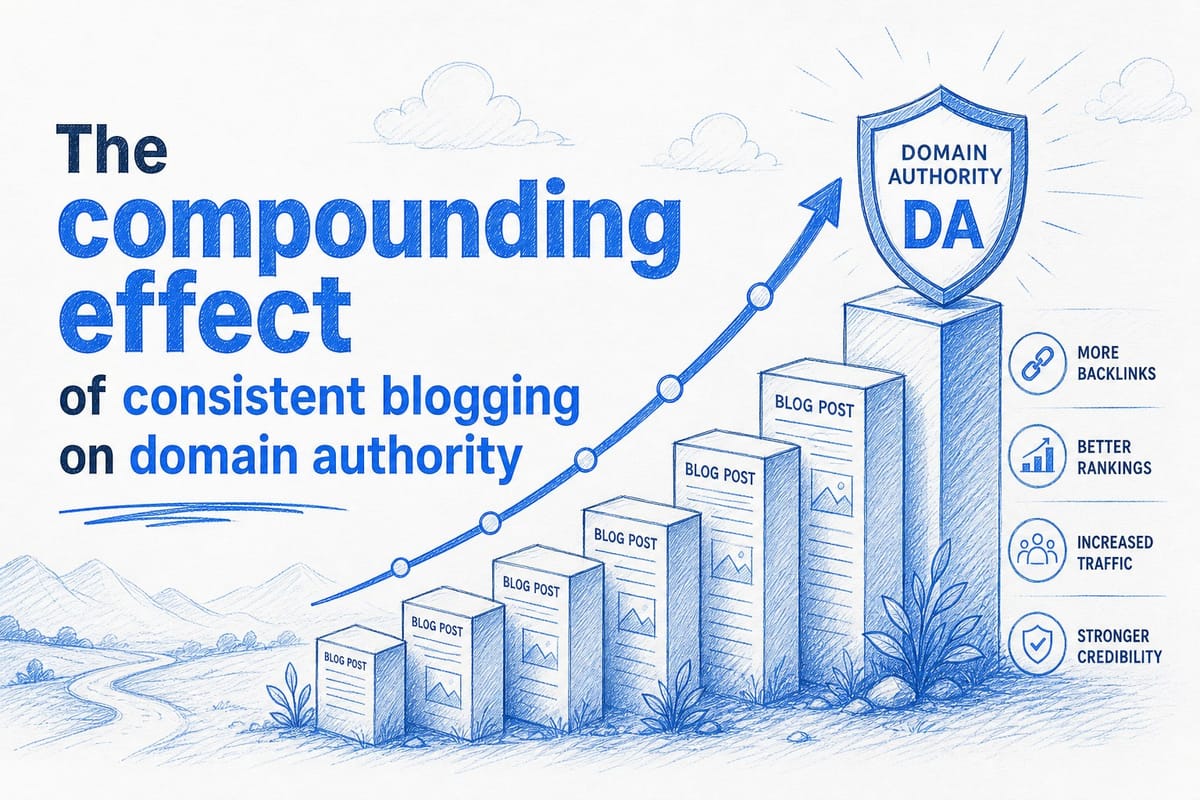
Table of contents
1. How domain authority actually builds over time
2. The practical compounding timeline and what to expect
3. Building a system that sustains consistent output
I want to tell you something that most content advice glosses over: domain authority does not spike. It climbs. It climbs slowly, steadily, and almost invisibly until one day your organic traffic looks completely different from what it was six months ago. That slow climb is the compounding effect of consistent blogging, and understanding how it works will change the way you think about your content calendar. If you have ever published a handful of posts, watched them sit quietly in search results, and wondered whether blogging is actually worth it, this article is for you. We are going to look at how consistent blogging domain authority growth really happens, what the mechanics look like under the hood, and what you can do right now to put that compounding effect to work for your site.
How domain authority actually builds over time
Domain authority is a score that search engines and SEO tools use as a shorthand for how trustworthy and relevant your website is in its topic area. Google does not publish its exact algorithm, but the research community broadly agrees on the inputs: the quantity and quality of backlinks pointing to your site, the depth and breadth of topical content you publish, the age and consistency of your publishing activity, and user engagement signals like click-through rate and dwell time.
Here is the part that most people miss. These inputs are not evaluated in isolation. They interact with each other. A single strong backlink matters more when it lands on a site that already has a library of relevant, well-structured content. A library of relevant content attracts more backlinks over time because there are more pages worth citing. More backlinks push more pages higher in search results. Higher-ranking pages attract more traffic. More traffic generates more engagement signals. Those engagement signals reinforce ranking positions. Each input feeds the next, which is exactly what compounding means.
The math here is worth taking seriously. Imagine you publish two posts per month for a year. That is 24 pieces of content. Now imagine each post earns an average of three backlinks over its lifetime. That is 72 backlinks pointed at a site with 24 topically relevant pages. Compare that to a site that published a burst of 24 posts in January and then went quiet. The quiet site has the same post count, but it stopped earning signals. It stopped adding new pages for internal linking. It stopped giving search crawlers a reason to come back regularly. After twelve months, those two sites look very different in the eyes of search engines, even though they published the same number of articles.
Consistency signals intent to search engines. When Googlebot crawls your site every two weeks and finds new, indexed content each time, it learns that your domain is active and maintained. When it crawls and finds nothing new for four months, it adjusts its crawl frequency downward. That adjustment is not catastrophic, but it is a compounding disadvantage that takes time to reverse.
Topical authority is the other piece of this puzzle, and it is one of the most powerful levers available to independent bloggers and small business sites. Topical authority means that your domain has covered a subject area thoroughly enough that Google treats it as a reliable source for queries in that area. You do not build topical authority with one excellent post. You build it with a structured library of posts that cover a topic from multiple angles, at multiple levels of depth, over a sustained period. That library only exists if you publish consistently.
Let me give you a concrete example. Suppose you run a SaaS product that helps freelancers invoice clients. If you publish one article about invoicing best practices and then nothing for three months, Google has very little evidence that your domain is a serious resource on that topic. But if you publish articles about invoicing best practices, late payment strategies, invoice templates by industry, how to handle disputed invoices, tax implications of invoice timing, and the psychology of payment terms over the course of six months, Google now has strong evidence that your domain understands this subject thoroughly. That evidence translates into rankings, and those rankings compound.
The same logic applies to backlinks. A website with a rich, consistently updated content library is far more likely to attract editorial backlinks than a site with a handful of posts. Journalists, bloggers, and content creators look for sources to cite. They prefer sources that are active, up to date, and comprehensive. Consistent publishing makes your site that kind of source. You can learn more about what signals actually influence ranking positions in this breakdown of what makes a blog post rank on Google, which walks through the on-page and off-page factors that matter most.
The practical compounding timeline and what to expect
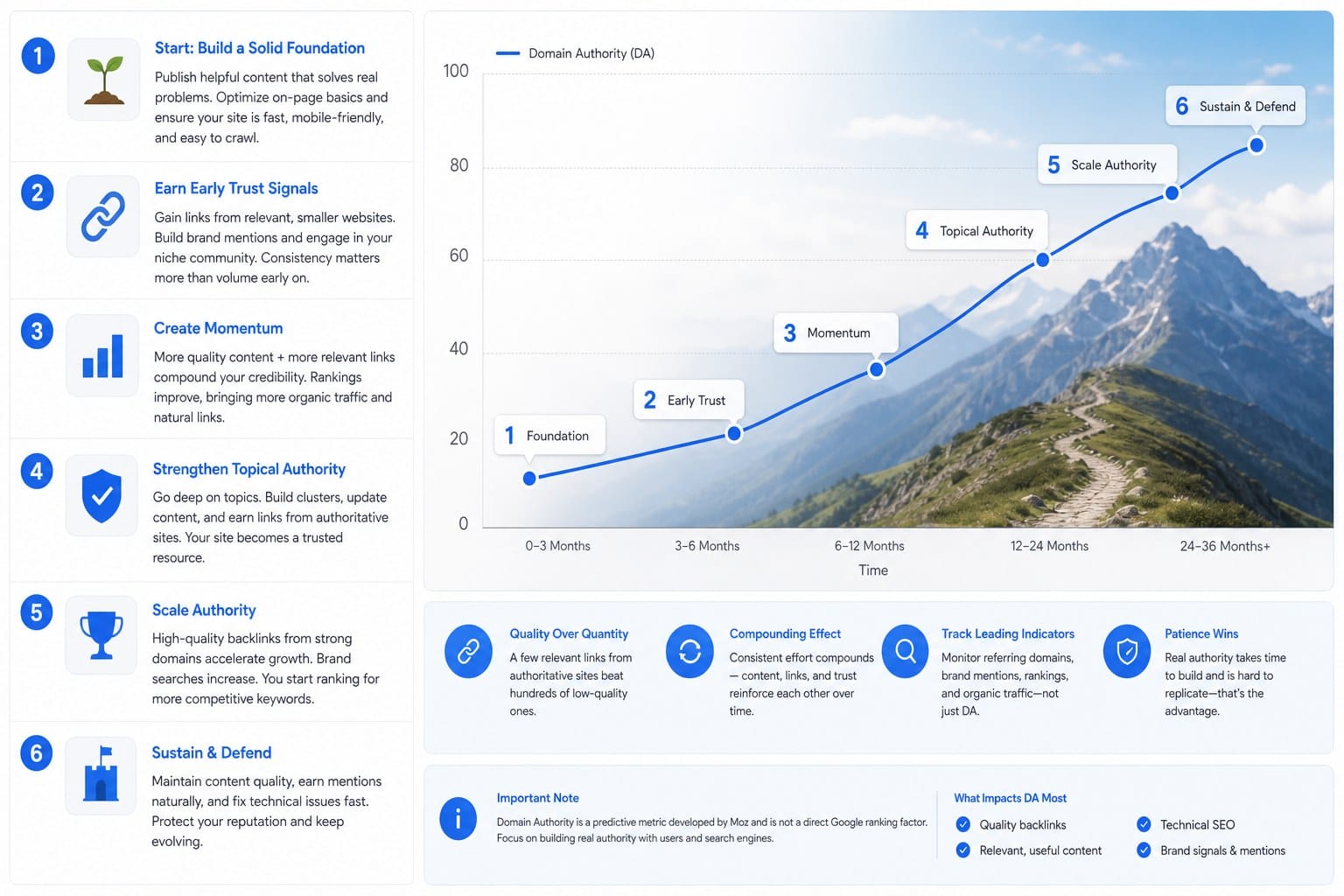
One of the reasons consistent blogging domain authority growth feels frustrating to people who are just starting out is that the early months produce very little visible reward. This is normal. It is also the reason most people quit before the compounding effect has a chance to kick in.
Let me walk you through a realistic timeline so you know what to expect and when.
Months one through three are what I think of as the foundation phase. During this period, you are publishing content, getting pages indexed, and building the basic architecture of your topic coverage. Organic traffic is minimal. Rankings, if they appear at all, are for low-competition long-tail queries. The temptation to pivot, change your strategy, or give up is highest here. Do not. The work you do in months one through three is the soil in which everything else grows.
Months four through six are when you start to see early signals. Individual posts begin appearing in search results for their target keywords, often somewhere between positions 15 and 40. Some posts climb faster than others. You start to notice that posts published in month one are now outperforming posts published in month five, not because they are better, but because they have had more time to accumulate signals. This is compounding becoming visible.
Months seven through twelve are when the slope of the curve changes. If you have published consistently and built a coherent topical library, your domain authority score in tools like Ahrefs or Moz starts moving. More importantly, your organic traffic starts moving. Posts that were ranking at position 20 in month four are now at position 8 or 9. Posts at position 8 are now at position 3 or 4. The backlinks you earned in months three and four are now fully indexed and passing authority. Your newer posts benefit immediately because they are published on a stronger domain.
After month twelve, if you have maintained consistency, you are in a fundamentally different position than you were at the start. Your domain has topical authority. Your older posts are well-established. Your newer posts rank faster because they launch on a stronger domain with a relevant content library behind them. Each new post you publish benefits from everything that came before it. That is the compounding effect in full operation.
The numbers shift depending on your niche, your competition level, and the quality of your content. A B2B SaaS blog in a competitive vertical will move more slowly than a niche hobbyist blog with less competition. But the shape of the curve is the same: slow at first, then steeper, then steep enough that consistent blogging becomes one of the highest-return activities in your marketing stack.
There are a few specific behaviors that either accelerate or kill this compounding effect, and they are worth naming directly.
Internal linking accelerates compounding. When you publish a new post and link it to three or four relevant older posts, you are passing authority from the new post's indexing activity to your established pages. You are also giving crawlers a map of your content library. Over time, a well-linked content library distributes authority efficiently across the whole domain. The structure of that library matters, which is why understanding the difference between pillar content and cluster content is genuinely useful. If you have not thought carefully about how your posts relate to each other, the guide on pillar page vs cluster content: a no-fluff guide for growing blogs is worth reading before you plan your next quarter of content.
Publishing gaps kill compounding. A two-week break does not do much damage. A two-month break can meaningfully slow your momentum. A six-month publishing gap followed by a sprint of new content does not equal six months of consistent publishing. Search engines and audiences both respond to patterns. Inconsistency is its own pattern, and it is one that works against you.
Content quality sets the ceiling. Consistent low-quality content will produce a lower ceiling than consistent high-quality content. This does not mean every post needs to be a 5,000-word masterpiece. It means that every post needs to genuinely answer the question it targets, be structured clearly, and offer something a reader could not get more easily somewhere else. Quality and consistency are not in competition. The goal is both.
Updating old content extends the compounding curve. Google gives freshness signals weight for certain query types, especially anything research-oriented or time-sensitive. If you published a post 18 months ago that still ranks well, refreshing it with updated data, new examples, and additional depth can push it back up the rankings and restart some of its compounding momentum. This is one of the most efficient uses of content time for a site that already has a content library. If you are not sure which posts are worth updating, the process for doing a how to audit your blog content in under an hour is a practical way to find the highest-leverage opportunities quickly.
I want to be direct about one more thing. Publishing frequency matters, but it is not an absolute number. A site that publishes one genuinely strong, well-researched article per week will outperform a site that publishes five thin posts per week over any meaningful time horizon. The compounding effect rewards quality-times-consistency, not volume alone. Find a publishing cadence you can actually maintain at the quality level your topic demands, and then protect that cadence.
Building a system that sustains consistent output
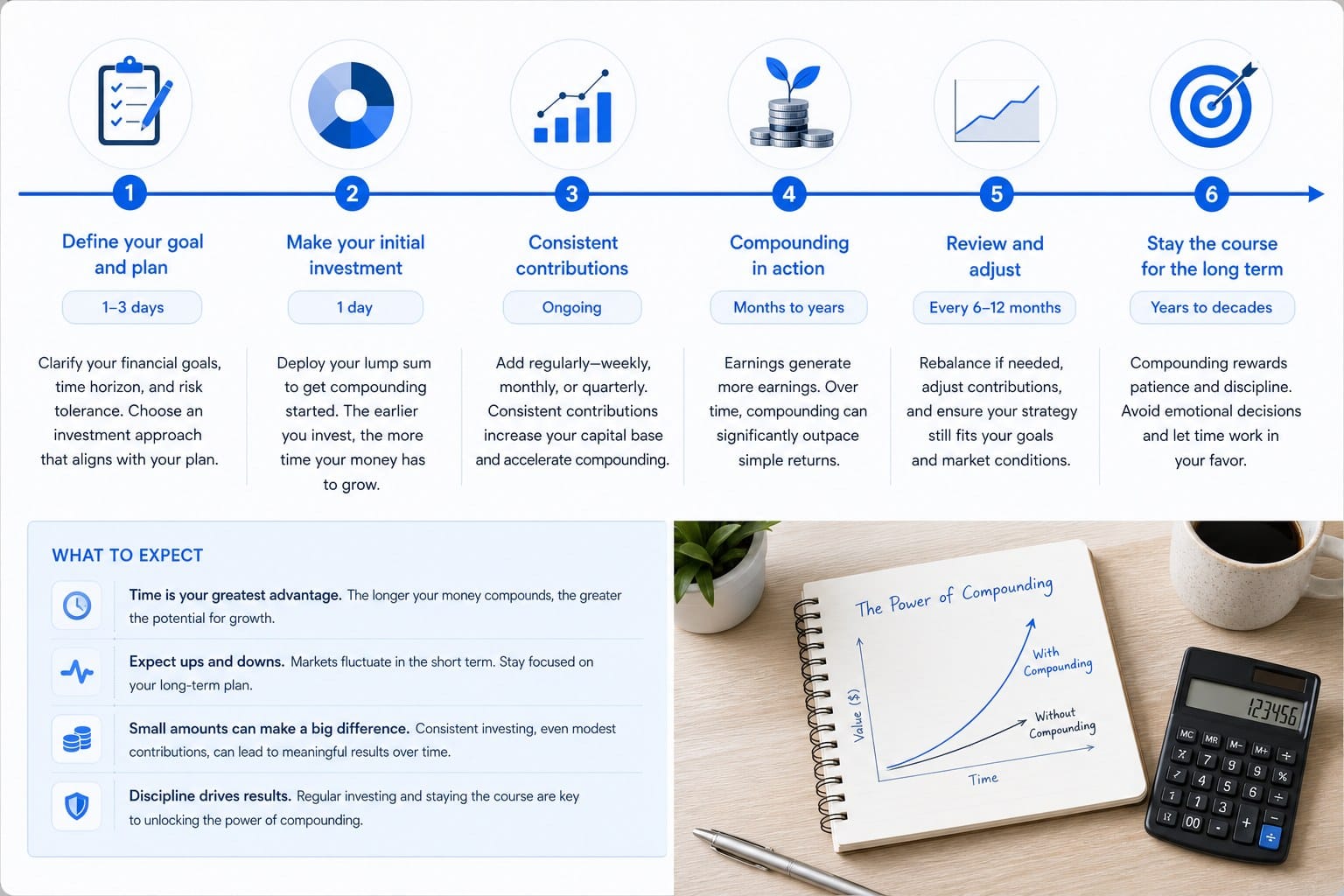
Understanding the compounding effect is one thing. Actually maintaining consistent blogging over 12 or 18 months is something else. For most independent bloggers, SaaS founders, and small business owners, the challenge is not motivation in month one. It is capacity in month seven when you are busy, your ideas feel exhausted, and the results are only just starting to show.
This is the systems problem, and it is where most consistent blogging domain authority strategies fall apart in practice. Let me walk through what a sustainable system actually looks like.
The first layer is a content strategy that extends far enough into the future that you are never deciding what to write about this week. A 30-day or 90-day content calendar, built around your core topic clusters and target keywords, eliminates the friction of the blank page. When you sit down to write, the question is already answered. You are not starting from zero each time. You are executing a plan.
A good content calendar is not just a list of post titles. It maps each post to a target keyword, a target audience stage (awareness, consideration, or decision), and a set of internal links to existing content. It identifies which posts are pillar content and which are cluster articles. It flags posts that will need visual assets, external data sources, or subject matter expertise. Building this calendar once, for a quarter at a time, is a much more efficient use of strategic thinking than making those decisions week by week.
The second layer is a research and drafting workflow that does not depend entirely on your individual inspiration. Many consistent bloggers work in batches. They spend one day researching three or four posts, building outlines and gathering sources, and then spend separate sessions drafting from those outlines. Batching reduces context-switching costs and makes it easier to protect writing time in a busy schedule.
For SaaS founders and small business owners specifically, the research phase is often the bottleneck. Understanding what a topic actually requires in terms of depth, what competitors have already covered, and what angles remain under-served takes time. This is where having a structured approach to topic research pays off. Going into a drafting session with a clear outline and solid notes is dramatically more efficient than trying to research and write simultaneously.
The third layer is a publishing infrastructure that removes manual steps from the process. If publishing a post requires logging into your CMS, formatting the content, adding meta descriptions, resizing images, scheduling social shares, and setting up internal links manually, each post costs far more time than the writing itself. That overhead accumulates across a year of consistent publishing, and it becomes one of the most common reasons people fall behind on their content calendar.
Ghost CMS users in particular often find that integrating their content strategy with their publishing workflow is the key to making consistency sustainable. When your editorial calendar is connected directly to your CMS, when articles arrive pre-formatted with relevant images and proper metadata, and when publishing is automated rather than manual, the time cost of each post drops dramatically. That lower time cost is what makes a cadence of weekly or twice-weekly publishing realistic for a founder or marketer who is not running a full content team.
Automation here does not mean cutting corners on quality. It means removing the low-value manual steps so that your limited time goes toward the parts of the process that require your judgment: strategy, angle selection, editing for brand voice, and identifying opportunities in your content data.
The fourth layer is measurement that actually informs decisions. Consistent publishing without feedback loops is just activity. Consistent publishing with clear metrics is a compounding growth strategy. The metrics worth tracking are organic traffic per month by post and by topic cluster, keyword ranking positions for your target terms across the content library, backlinks earned per quarter and which posts attracted them, and organic traffic share by content type or topic area.
Reviewing these metrics quarterly gives you the information you need to double down on what is working, update or redirect what is not, and make smarter decisions about what to cover next. Over time, your content library gets not just bigger but better-targeted, because you are learning from what your audience actually engages with and what search engines actually reward.
For digital marketers managing brand blogs, this measurement layer is also what makes it possible to report on content ROI in concrete terms. Showing that organic traffic grew 40 percent over a six-month period, that three specific cluster articles now drive 60 percent of that traffic, and that those articles cost a fraction of the equivalent paid traffic is a very different conversation from reporting post count.
Let me bring this back to the compounding frame one more time, because I think it is the most important mental model for anyone investing in blog content.
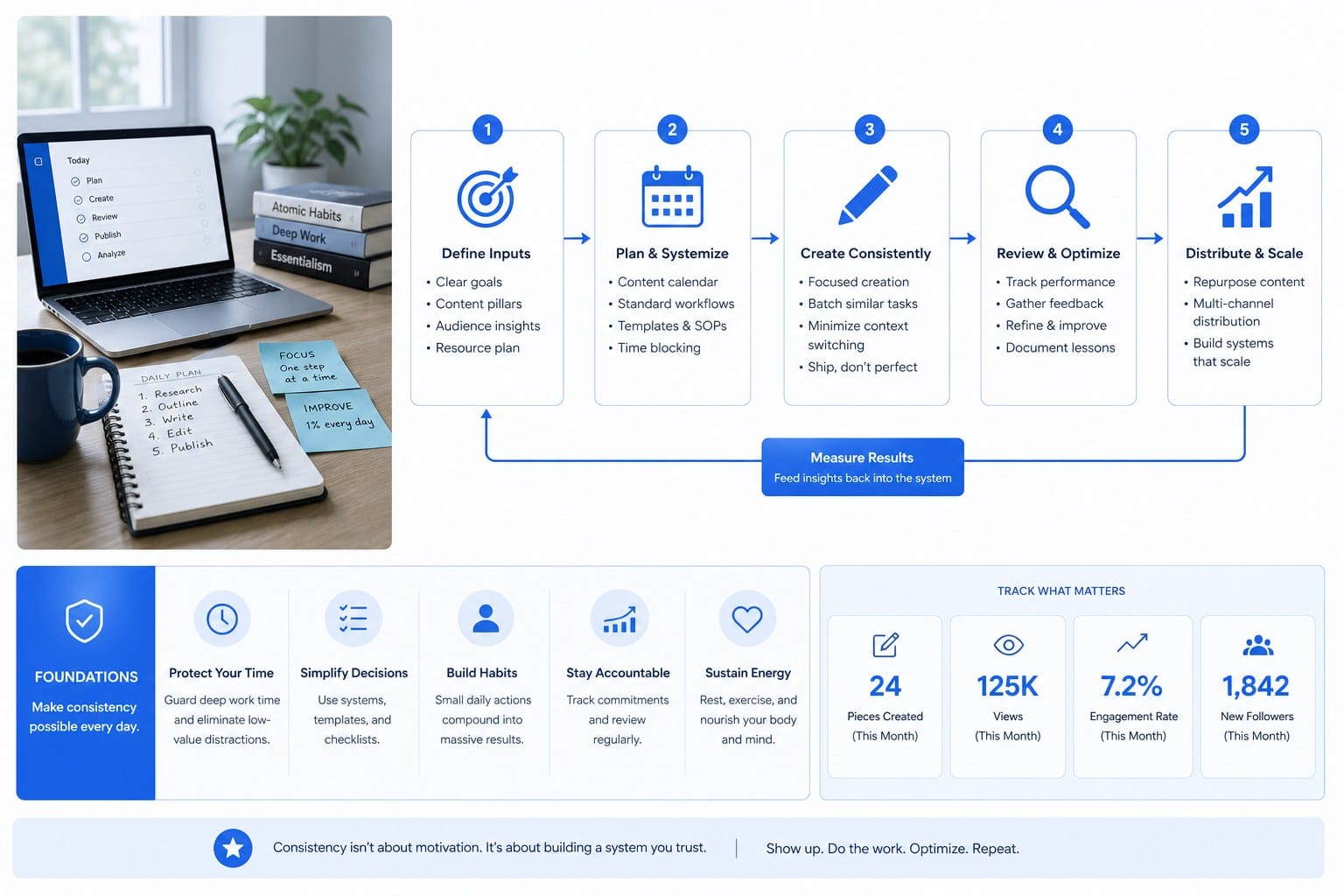
A post you publish today will not perform at its peak for six to twelve months. That means every post you publish today is an investment in future traffic, not a source of immediate traffic. A month in which you do not publish is a month in which you make no new investments. A month in which you publish three strong, well-structured posts is a month in which you make three investments that will compound for the next year or more.
When you look at it that way, the question is not whether you have time to blog consistently. The question is what the cost of not blogging consistently will look like 12 months from now, when your more disciplined competitors have 50 or 60 compounding posts in their library and you are still trying to catch up.
The brands that show up consistently in organic search are almost always the ones that made this choice early, held to a cadence when the results were not yet visible, and built a system that made consistency the default rather than the exception. That is what separates sites with growing domain authority from sites that plateau early and never move.
Building that system is a solvable problem. The strategy, the calendar, the workflow, and the publishing infrastructure all exist. The compounding effect will do the rest, as long as you give it the consistent input it needs to run.
Ready to take the next step?
If you are ready to put the compounding effect to work but do not have the bandwidth to research, write, and publish consistently on your own, Blogtude was built for exactly that situation. Blogtude generates a full 30-day content strategy, produces deeply researched long-form articles with on-brand visuals, and publishes directly to Ghost and other CMS platforms so your content calendar runs without the manual overhead. You get the compounding benefit of consistent publishing without spending your week writing blog posts. Visit blogtude.com to see how it works.


