
What makes a blog post rank on Google

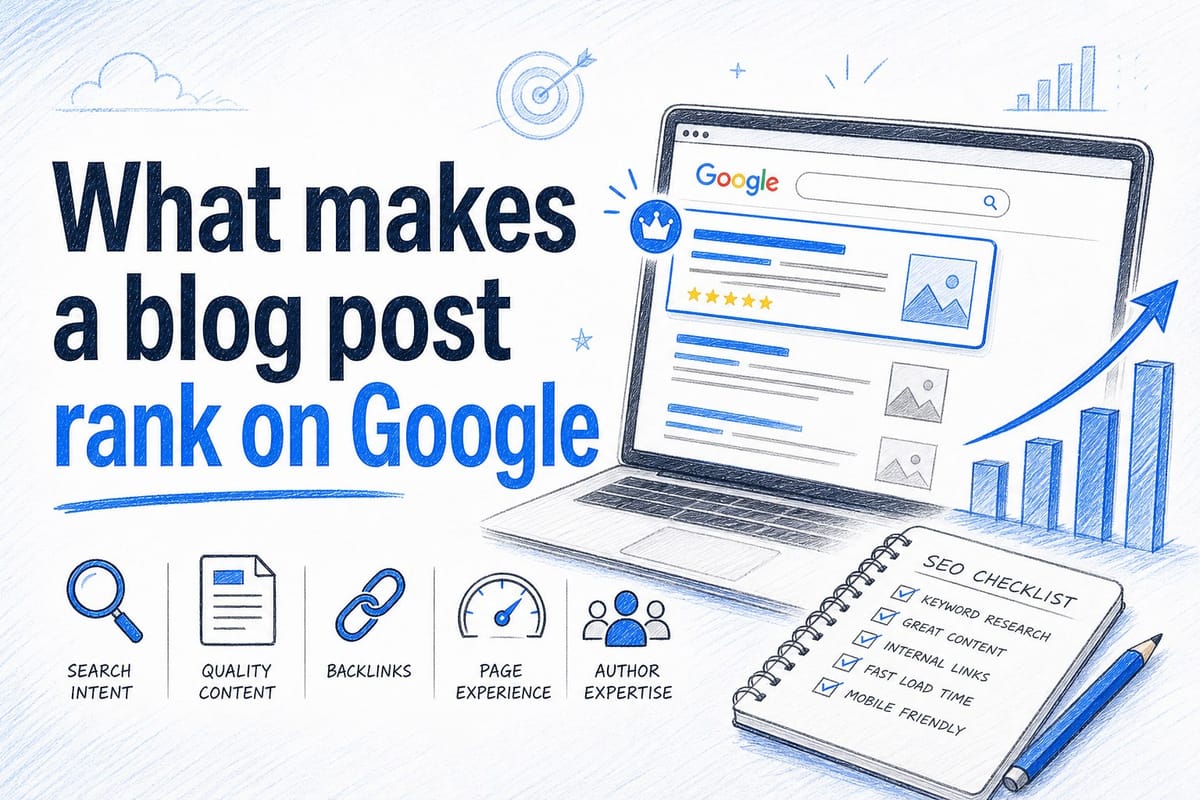
Table of contents
1. Content quality is still the foundation
2. On-page SEO signals Google actually uses
3. Authority, links, and consistency over time
I get asked this question a lot: what makes a blog post rank on Google when so many other posts on the same topic do not? The honest answer is that it is not one single thing. Google uses a mix of signals, and understanding how those signals work together is what separates posts that sit on page one from posts that never get seen. In this article, I am going to walk through the core factors that actually move the needle, broken into three areas you can act on right now: content quality, on-page SEO, and long-term authority. Apply all three consistently and your blog becomes a real traffic asset instead of a collection of posts that nobody finds.
Content quality is still the foundation
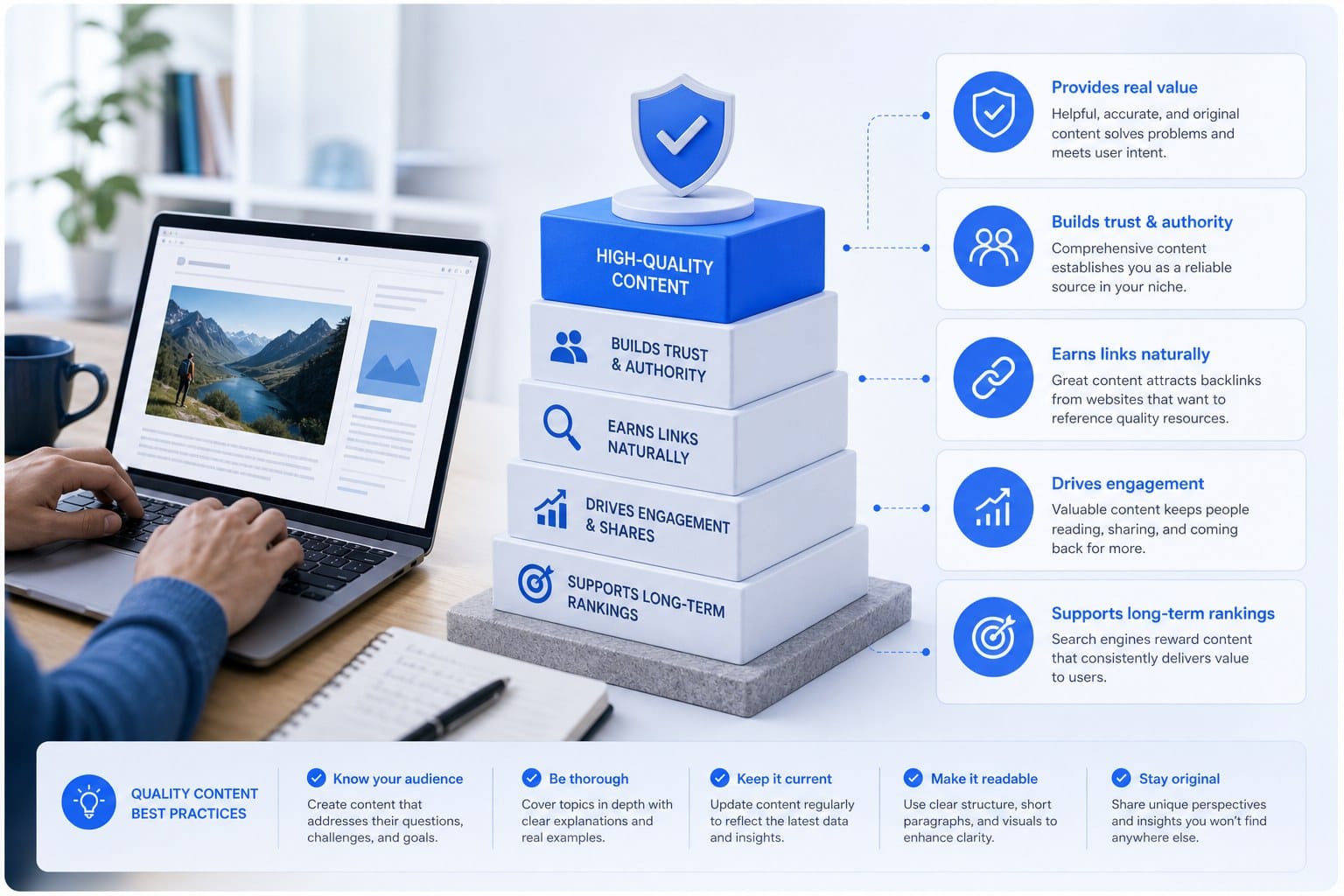
Before anything else, Google wants to show its users the most useful, accurate, and complete answer to their search query. That sounds simple, but it has real implications for how you write every single post.
Start with search intent, because everything flows from there. Every query has a specific intent behind it. Someone typing "how to rank a blog post" wants a practical, step-by-step guide, not a philosophical essay about SEO theory. Someone typing "best project management tools" wants a direct comparison with pros and cons, not a brand origin story. If your content does not match what the searcher actually wants to find, it will not rank regardless of how polished the writing is or how many keywords you stuffed into the title.
The simplest way to decode intent before you write a single word is to look at the posts already ranking for your target keyword. Are they listicles? How-to guides? Product comparisons? Opinion pieces backed by original data? The format of the top five results tells you exactly what Google has determined users want to see for that query. Match that format first, then figure out how to do it better than everyone already on page one.
Depth matters more than raw word count. A focused 600-word post that completely answers a narrow question can outrank a bloated 4,000-word post that wanders and leaves obvious gaps. That said, most competitive keywords reward longer, more comprehensive content because searchers at those queries tend to have layered needs. They are not looking for one quick answer. They are trying to understand a topic well enough to make a decision or take action. Your job is to cover the topic thoroughly enough that the reader has no reason to go back to Google to find something your post missed.
Here is the practical approach I use before I write anything. I write down every question a real reader might still have by the time they finish reading the post. Not questions I want to answer, but questions the reader would actually ask if they were sitting across from me. If I am writing about email marketing for small businesses, that list might include: how often should I send emails, what subject lines actually get opened, how do I grow a list from zero subscribers, what platform should I use if I have a limited budget, and how do I know if my emails are working. Then I make sure the post answers every single one of those questions before it ends. That approach naturally creates the kind of depth Google rewards, and it creates the kind of post readers actually bookmark and share.
Accuracy and trustworthiness are inseparable from quality. Google evaluates what it calls E-E-A-T, which stands for Experience, Expertise, Authoritativeness, and Trustworthiness. For topics that touch health, finances, legal decisions, or safety, Google holds content to a stricter standard. You need to cite credible sources, link to authoritative references, and ideally have an author bio that establishes real-world credentials relevant to the topic.
For most business and marketing topics, you build trust through specificity. Vague advice like "write great content" is not trustworthy and it is not useful. Specific advice like "place your primary keyword in the first 100 words, the last paragraph, and at least one subheading, and aim for a natural density of around one to two percent throughout the post" is both actionable and demonstrates that you actually know how this works. Specificity is the fastest way to signal expertise without needing a wall of credentials.
Fresh content plays a meaningful role for certain query types. Google tends to favor recently updated content for topics where information changes, such as software tutorials, regulatory guidance, industry statistics, or anything where searchers include a year in their query. If you published a post two years ago and it is starting to slip in rankings, updating it with new data, revised examples, and current information can push it back up without requiring you to start from scratch. In many cases, a thorough update to an existing post produces faster ranking gains than writing a brand-new post on the same topic, because the older post already has some authority built up.
Readability is part of quality too, and it affects rankings in ways that are easy to overlook. Short paragraphs, clear subheadings, and plain language make your content easier to consume. Readers who land on your page and struggle to follow it leave quickly. Readers who stay, scroll to the bottom, and engage with the content send a positive signal to Google that your post delivered what it promised. Writing in plain language is not dumbing things down. It is respecting your reader's time and making sure your ideas actually land.
If you want to go deeper on how to structure your blog so individual posts support each other and build topical authority over time, the guide on pillar page vs cluster content: a no-fluff guide for growing blogs explains exactly how to set that architecture up.
On-page SEO signals Google actually uses
Once your content is genuinely useful and well-structured, the next layer is making sure Google can read, understand, and categorize it correctly. This is what on-page SEO does. It is not a trick and it is not manipulation. It is clear communication between your content and the search engine so Google can put your post in front of the right people at the right moment.
Keyword research is where this layer starts, and getting it right matters more than most people realize. You need to know the exact phrase your target reader types into Google, not the phrase you assume they use. A founder might title a post "content marketing strategy for B2B companies," but the person actively searching might type "how to get blog traffic for a SaaS startup" or "B2B content ideas that actually generate leads." Those phrases are meaningfully different, and targeting the wrong one means your post never reaches the people it was written for. Keyword research tools help you find the actual language your audience uses, the monthly search volume behind each term, and how difficult it would be to rank given your current domain authority.
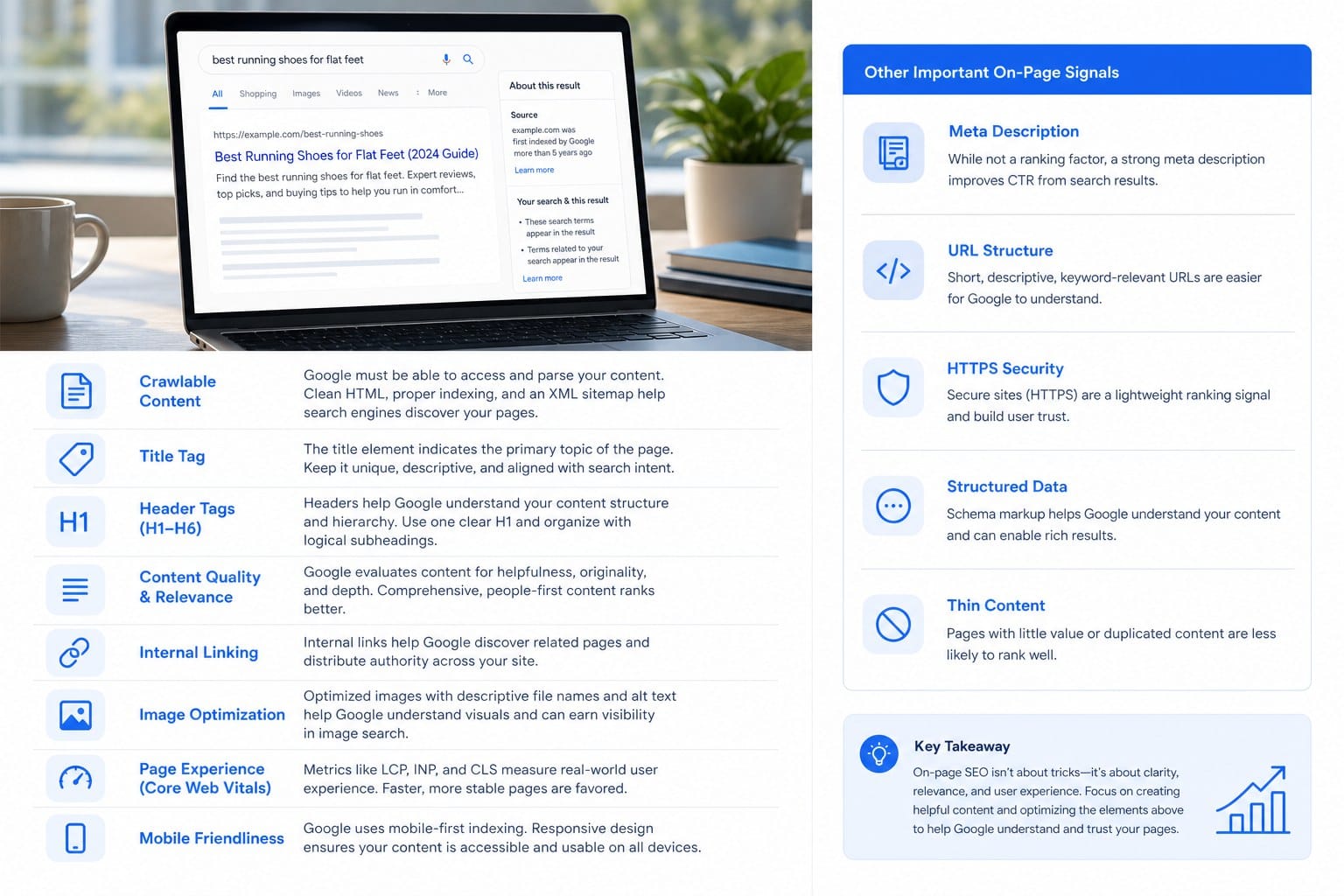
Once you have your primary keyword, place it naturally in five specific spots: the title tag, the opening paragraph, at least one H2 subheading, the meta description, and the URL slug. The word naturally matters here. If a sentence sounds forced or awkward with the keyword in it, rewrite the sentence until it flows. Google understands context and synonyms well enough that you do not need to repeat the exact phrase every few sentences. Variations and related terms count, and they make the post read like something a human actually wrote.
The title tag deserves more attention than most bloggers give it. It is the first thing a searcher sees in the results, and it directly determines whether they click. A weak title is vague or generic. A strong title is specific, leads with the primary keyword or something very close to it, and gives the reader a clear reason to click over every other result on the page. Compare "Blog SEO Tips" to "What makes a blog post rank: the factors Google actually measures." The second one sets sharper expectations, signals practical value, and is more likely to earn the click even if it ranks below the first result.
Meta descriptions do not directly influence rankings, but they influence click-through rate, and click-through rate does influence rankings over time. Write a meta description that summarizes the post's specific value in two short sentences and includes a natural version of your primary keyword. Think of it as a brief advertisement for the post. It should make the reader feel like clicking is obviously the right next move.
URL structure is a small signal that adds up across a whole blog. Use hyphens between words, keep the slug short and readable, and include your primary keyword. A URL like yourblog.com/what-makes-a-blog-post-rank is immediately clear to both Google and the reader. A URL like yourblog.com/post?id=4827 tells neither of them anything useful.
Headings create structure that helps both readers and search engines. Use H2 tags for your main sections and H3 tags for subsections within those sections. This hierarchy helps readers scan the post to find what they need, and it helps Google understand how your content is organized and what each section covers. Including secondary keywords and closely related phrases in your H2 and H3 headings, wherever they fit naturally, reinforces the topical coverage of the post.
Images need alt text, and most bloggers either skip it or write it lazily. Alt text is a short written description of what the image shows. It helps Google understand your visuals, and it makes your content accessible to readers who use screen readers. Write alt text that describes what is actually in the image with enough specificity to be useful: "bar chart showing monthly organic traffic growth over six months from SEO" is far more useful than "chart" or leaving the field blank.
Internal linking is one of the most consistently underused on-page tactics, and it costs you nothing to do well. When you link from one post to a related post on your blog, you pass authority between pages, help Google understand the relationship between your content, and give readers a natural path to explore more of your site. That last part keeps readers engaged longer, which sends positive signals back to Google.
For example, if you are writing a post about SEO and you mention content briefs, link directly to a relevant resource like this one on how to write a content brief that actually gets results. That kind of link is natural, genuinely useful to the reader, and tells Google that your blog covers a topic with real depth rather than isolated, disconnected posts.
Page speed and mobile performance are technical factors Google measures and uses directly in ranking. A post that loads slowly or breaks on a phone screen will rank below an equally strong post that loads in under two seconds and looks clean on any device. Compress your images before uploading them, avoid loading unnecessary scripts, and use Google's PageSpeed Insights tool to identify the specific problems slowing your pages down. Most of the common issues are fixable without a developer.
Schema markup is worth adding for blogs that use FAQ sections. Adding FAQ schema to a post that includes frequently asked questions can earn you rich results in the search page, which means your listing takes up more visual space and typically earns a higher click-through rate. It is not required, and it will not save a weak post, but for a strong post it is a legitimate edge that many competitors skip.
One pattern I see repeatedly with blogs that struggle to rank is that they skip the planning stage entirely. They open a blank document, pick a general topic, and start writing without a clear structure, a confirmed keyword, or a defined audience. The post ends up covering some of the right ground but missing critical pieces, which means it ranks for nothing. A solid brief written before you start fixes that problem at the source. It forces you to confirm the keyword, map the structure, define what questions the post needs to answer, and set a target reader before the first sentence is written.
Authority, links, and consistency over time
Content quality and on-page SEO get your posts ready to rank. But for competitive keywords, you also need authority, and authority is the one factor you cannot shortcut or manufacture quickly. It comes from two main sources: backlinks from other websites, and a track record of consistent, topically focused publishing over time.
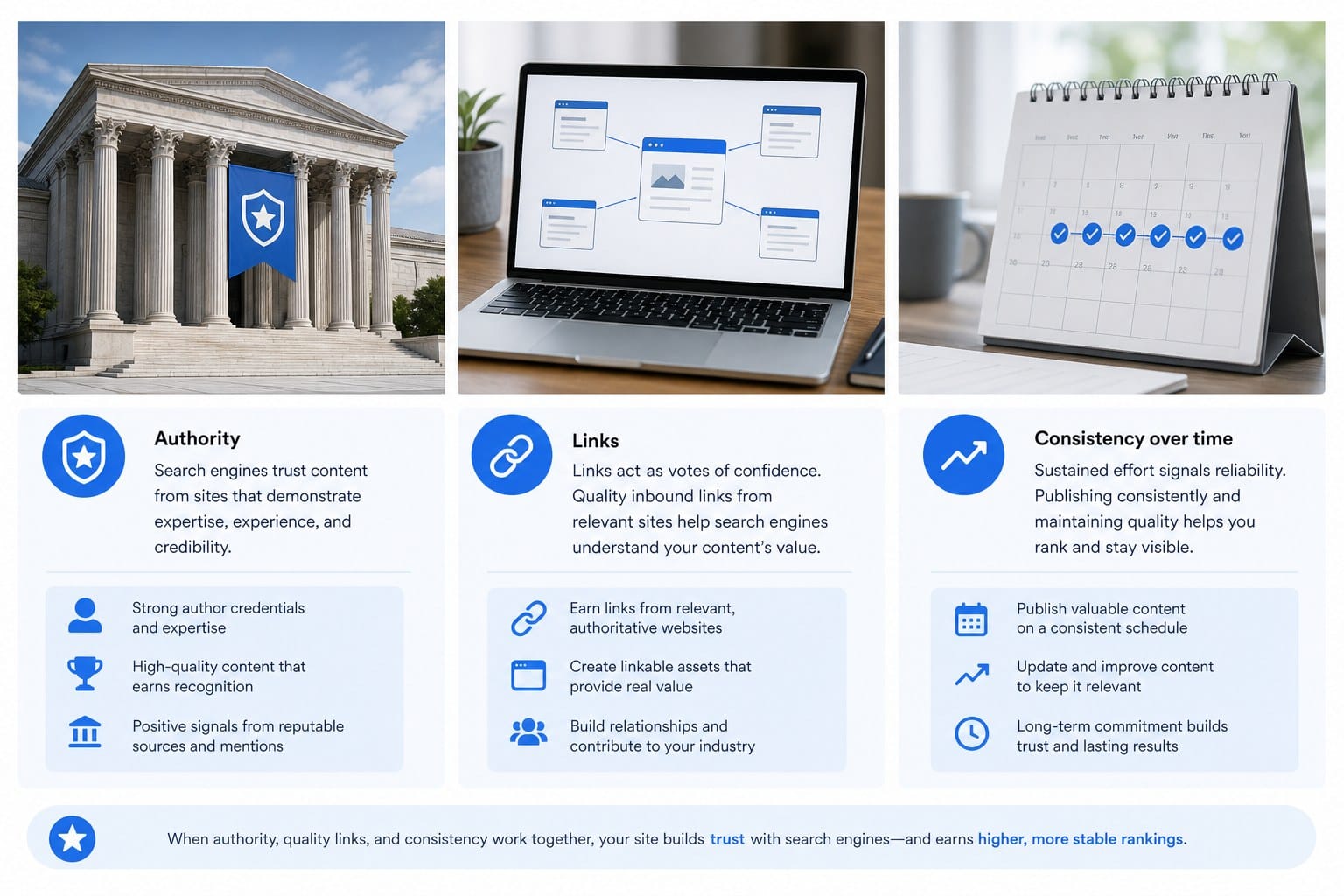
Backlinks are the closest thing SEO has to a voting system. When a reputable website links to your blog post, it signals to Google that your content is credible and worth referencing. Not all links carry the same weight. A single link from a well-known industry publication or a respected media outlet carries more authority than fifty links from low-traffic directories or irrelevant blogs. Quality beats quantity at every level of this, and chasing link volume at the expense of link quality is a mistake that can actually damage your rankings.
Building backlinks requires real effort and a clear strategy. The most effective methods that hold up over time include publishing original research or original data that other writers want to cite, creating genuinely useful tools, calculators, or templates that earn organic links without active outreach, writing guest posts for relevant publications in your niche with a contextual link back to your blog, and pitching your best content directly to journalists, newsletter writers, and content creators who cover your topic area. None of these methods produce results overnight, but each one builds the kind of link profile that compounds in value over months and years.
The good news for newer blogs is that you do not need hundreds of backlinks to rank for most long-tail keywords. Long-tail keywords are specific, lower-competition phrases that describe a more precise need. A post targeting "how to reduce churn for a bootstrapped SaaS startup" faces dramatically less competition than a post targeting "SaaS marketing." Long-tail keywords are where newer blogs and growing brands can win real rankings without a massive existing link profile. The traffic from any single long-tail keyword might be modest, but ten or twenty posts each ranking for their own long-tail phrases adds up to meaningful, compounding organic traffic.
Topical authority is the other side of the equation, and it works alongside your link profile rather than separately from it. Google rewards sites that demonstrate consistent, deep expertise in a specific subject area. If your blog publishes posts on ten unrelated topics, Google has difficulty categorizing you as an authority on any of them. The signals are scattered and hard to interpret. But if your blog consistently publishes thorough, interconnected content about one or two core topics, Google starts to recognize your site as a reliable source in that space. New posts you publish start to rank faster because Google already trusts your domain for that topic.
This is precisely why content strategy matters as much as individual post quality. Publishing one excellent post is not enough to build authority. You need a network of related posts that approach a topic from multiple angles, link to each other naturally, and collectively build a body of work that signals depth. That structure is what turns a blog from a collection of individual articles into a genuine traffic asset that grows in value over time.
Consistency of publishing contributes to this in a practical way. Search engines crawl and re-index sites more frequently when those sites publish new content on a regular schedule. A blog that publishes two or three posts a week gets crawled more often, which means new posts get indexed and start ranking faster. A blog that publishes sporadically trains search engines to crawl it less frequently and tends to build authority more slowly, even if individual posts are high quality.
This is the point where many small business owners and solo founders hit a real wall. They understand they should be publishing consistently and at volume. But research, writing, editing, optimizing, and publishing takes hours per post. Multiply that time requirement by the number of posts needed to build topical authority in a competitive niche, and it quickly exceeds what one person can manage alongside everything else running a business requires. The math simply does not work for most solo operators without a system.
I have seen founders solve this by building a workflow where tools handle the research and drafting stages, which frees them to focus on strategy, review, and final judgment rather than starting every post from a blank page. The article on how founders are using AI to publish 4x more blog content goes into how that approach works in practice and what kinds of results real founders are seeing when they shift their role from writer to editor and strategist.
Beyond links and publishing consistency, user engagement signals factor into rankings in ways that are easy to observe but harder to directly control. When someone clicks your post in the search results and stays on the page long enough to read it, that tells Google your content matched their intent and delivered value. When someone clicks and immediately hits the back button to return to the search results, that is a negative signal Google calls pogo-sticking. A high rate of that behavior tells Google your post did not actually answer the query, and rankings fall accordingly.
You prevent pogo-sticking by delivering on your title's promise immediately and without delay. Do not bury the lead under a long introductory section that restates the question. If your title promises to explain what makes a blog post rank, start explaining it in the first two paragraphs. Readers who land on your page and find exactly what they were looking for within seconds of arriving tend to read longer, scroll further, return to your site for future queries, and occasionally share or link to the post. All of those behaviors send positive signals that support your rankings.
Social sharing is a weaker and more indirect factor than backlinks, but the downstream effects are worth understanding. Content that gets shared on social platforms reaches more readers, which means more opportunities to earn organic links, more engagement signals, and broader brand recognition that brings readers back through direct search. It is not a direct ranking factor in the way that a backlink from an authoritative domain is, but the chain of effects is real and measurable over time.
Let me close this section with a realistic picture of what the ranking timeline actually looks like for a growing blog, because unrealistic expectations are one of the main reasons people give up before the strategy has time to work. In the first three months, you are unlikely to rank for competitive head terms in your niche. That is not failure. That is normal. During that phase, focus on long-tail keywords with clear intent and low competition, build out topical clusters that link to each other, and make sure every post you publish is genuinely more useful than what is currently ranking. Compete on quality where you cannot yet compete on authority.
Over six to twelve months of consistent publishing, deliberate internal linking, and gradual link acquisition through legitimate outreach and original content, you will start to see posts climb. Some will reach page one. As your domain authority grows, newer posts will begin ranking faster because Google has learned to trust your site for your topic area. That compounding effect is the entire point of the strategy.
The timeline is genuinely frustrating for people who want to see results in a few weeks. But it is also a significant competitive advantage for people who are willing to stay consistent. Most competitors give up before authority has time to compound. The blogs and brands that keep publishing, keep building links, and keep improving existing content are the ones that end up owning their niche in organic search while everyone else chases shortcuts that stopped working years ago.
Ready to take the next step?
If you are tired of trying to keep up with research, writing, and publishing on your own, Blogtude can handle the heavy lifting. It builds your 30-day content strategy, writes deeply researched long-form posts with on-brand visuals, and publishes directly to Ghost and other CMS platforms automatically. You stay in control of your brand voice while Blogtude keeps your blog consistent and growing. Visit blogtude.com to see how it works.


