
The hidden cost of inconsistent blogging and how automation fixes it

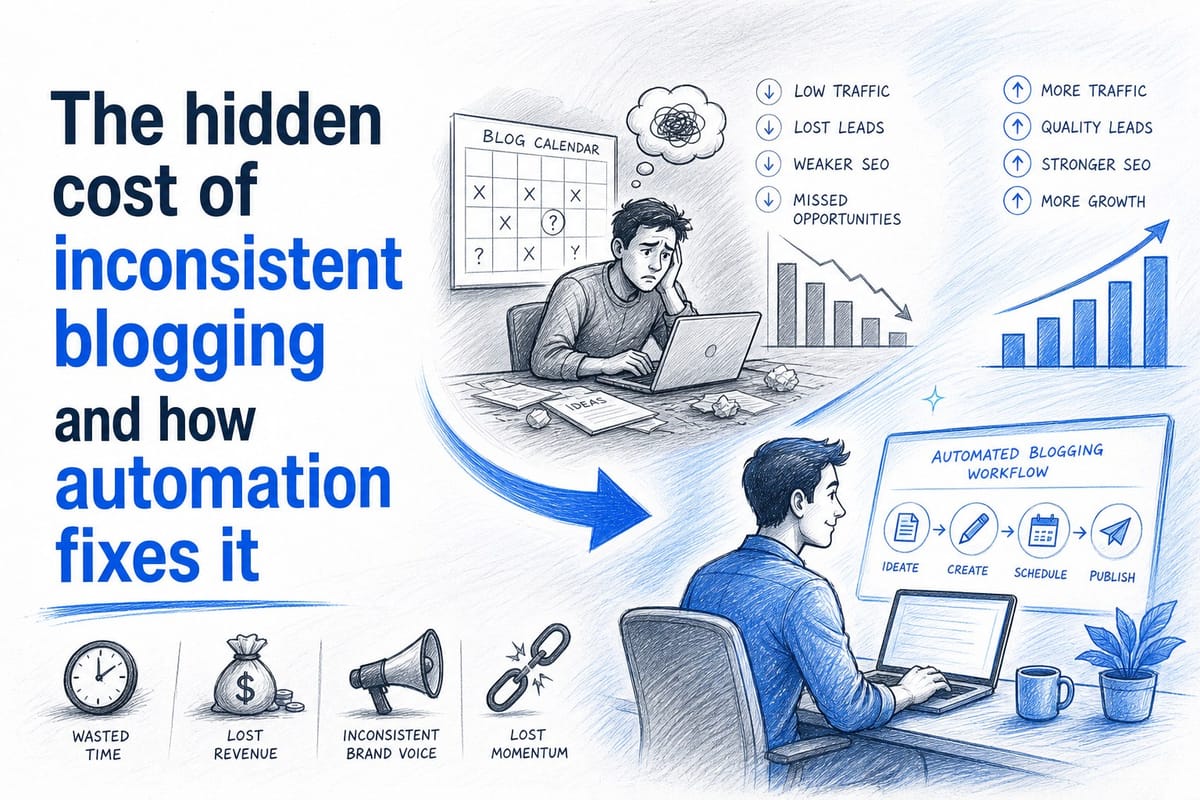
Table of contents
1. What inconsistent blogging actually costs you
2. Why consistency is so hard to maintain without a system
3. How automation changes what is possible for your blog
Most blog strategies do not fail because the writing is bad. They fail because the publishing stops. You start strong, post twice a week for a month, and then life gets in the way. A product launch, a hiring crunch, a slow week that turns into a slow month. Before you know it, your last post is four months old and the organic traffic you were building has quietly started sliding backward.
That is the real cost of inconsistent blogging, and it is more expensive than most business owners realize.
This is not about discipline or motivation. Plenty of driven, capable people start blogs with the best intentions and still end up with a graveyard of half-finished publishing schedules. The problem is structural, and structural problems need structural solutions.
This article walks through exactly what inconsistency costs you in dollars and rankings, why it keeps happening even when you genuinely care about content, and how automation changes the math entirely. By the end, you will have a clear picture of what a consistent content engine looks like and why building one is one of the highest-leverage investments a growing business can make.
What inconsistent blogging actually costs you
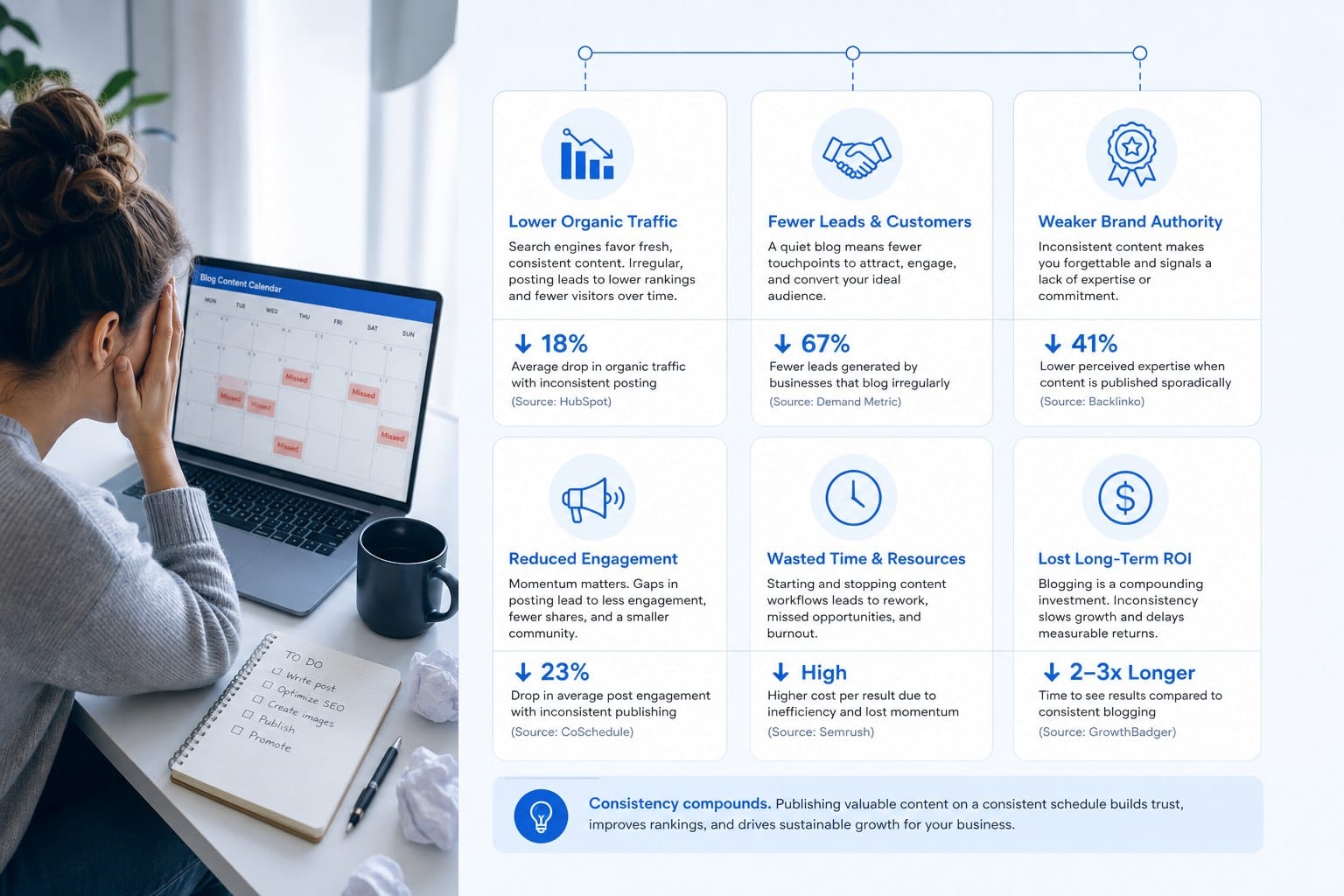
People tend to think about blog content in terms of time. How long does it take to write a post? How much does a freelancer charge per article? Those are real numbers, and they matter. But the cost of inconsistent blogging is mostly invisible, and that is what makes it so dangerous. It does not show up on an invoice. It shows up in a traffic graph that quietly flattens and then starts declining.
Let us start with search rankings, because this is where the damage appears first and where it compounds the most.
Google's crawlers visit your site on a schedule shaped by how often you publish. When you post regularly, crawlers come back more frequently. When you go quiet, they slow down. A site that publishes once a week trains search engines to expect fresh content on a reliable rhythm. A site that posts in bursts and then disappears sends a very different signal. It tells Google that this domain is not a dependable source of new information, and that affects how quickly new pages get indexed and how well existing pages hold their positions in results.
This is not a theory or a guess. It is a documented pattern that SEO professionals see play out across industries and business sizes. Sites that publish consistently over time accumulate what search marketers call topical authority. When you write enough posts around a specific subject area, search engines begin to treat your site as a trusted resource for that topic. A plumbing company that publishes two detailed articles per week about pipe maintenance, drain problems, and seasonal winterization will outperform a competitor with a better-designed website but an abandoned blog. Topical authority is earned through volume and consistency, not through a single viral post or a perfectly optimized page.
Here is a concrete example of how this plays out. Imagine you are a SaaS founder writing about project management software. You publish eight strong posts in January and February, covering scheduling workflows, team collaboration features, and integrations with other business tools. Traffic starts to grow. Search engines start to associate your domain with that subject cluster. You are building something real.
Then you get buried in a product update. You do not publish anything for six weeks. By the time you come back in April, some of those early posts have slipped in rankings. Competitors who kept publishing through February and March have moved into the gaps you left open. You are not starting from zero, but you are not building on the momentum you had either. That compounding growth curve you were on has been interrupted, and restarting it takes longer than most people expect.
The lost rankings translate directly into lost leads. For a small business or an early-stage SaaS company, organic search is often the most cost-efficient acquisition channel available. You are not paying per click the way you do with Google Ads or Meta campaigns. You are investing in content that can bring in qualified visitors for months or years after publication. But that investment only pays off if the content keeps coming at a consistent pace. A single great article rarely outranks a competitor who has published thirty connected pieces on the same topic over the same time period. Volume matters. Consistency matters more.
Then there is the trust problem, and this one affects people who actually do find your site.
When a potential customer lands on your blog and the most recent post is seven months old, they notice. It may not be a conscious, deliberate reaction. They may not say to themselves, "This company seems unreliable." But the impression forms anyway. Is this business still active? Are they still investing in this product? Are they still around to help me if I become a customer? A stale blog raises quiet doubts about credibility and commitment, and those doubts affect buying decisions even when the person cannot name them.
For small business owners trying to compete with larger brands on a limited marketing budget, that perception gap is especially costly. A regional law firm, a boutique e-commerce brand, or an independent financial advisor does not have a massive advertising spend to fall back on. Their blog is often one of their primary tools for demonstrating expertise and building trust before a prospect ever fills out a contact form. When the blog goes quiet, that trust-building mechanism shuts off.
The internal cost is real too, even though it never shows up in a spreadsheet.
Every time you fall behind on blogging, you spend mental energy feeling guilty about it, planning to catch up, and making rushed decisions about what to write next. That low-grade friction drains focus. It eats into the time and attention you need for the parts of your business that only you can do. A stalled blog is not just a missed marketing opportunity. It is a recurring source of stress that sits in the back of your mind during every week you are not publishing.
When you add it all together, the cost of inconsistent blogging includes lost rankings, lower organic traffic, fewer inbound leads, reduced trust with prospects, and a steady drain on your mental bandwidth. None of these costs are dramatic in any single week. That is the trap. The damage accumulates slowly and quietly until one day you pull up your analytics and realize that the traffic you built over six months of solid work has been quietly eroding for the past three.
The good news is that this is a solvable problem. But solving it requires understanding why consistency is so hard to maintain in the first place, which is not about effort or willpower. It is about structure.
Why consistency is so hard to maintain without a system
If you have ever launched a blog with genuine enthusiasm and then watched it quietly stall after a month or two, you already know that motivation is not the problem. Most people who stop publishing consistently are not lazy. They are busy, and they are operating without a system designed to keep content moving when life gets complicated.
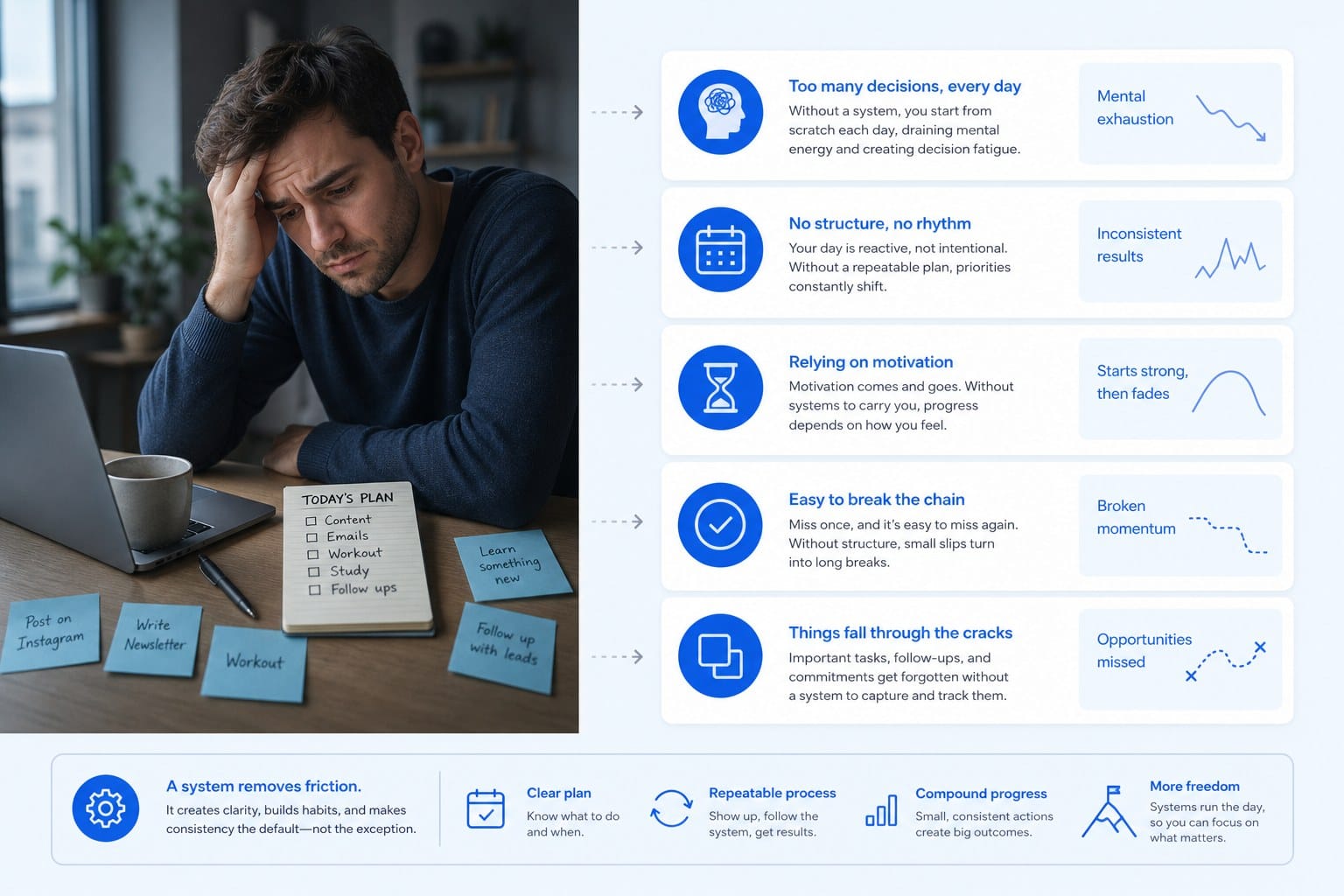
Blogging looks simple from the outside. Pick a topic, write about it, hit publish. But when you trace out the actual workflow, consistent blogging involves a long chain of decisions and tasks. You need to decide what to write about. Research the topic thoroughly enough to say something useful. Structure the piece so it is readable and organized. Write a full draft. Edit it for clarity and flow. Find or create visuals that match the post and your brand. Format everything for your CMS. Add the right metadata and tags for search optimization. Schedule or publish. Then start the whole process over for next week.
Each link in that chain is a place where things can break down.
Topic selection alone can eat an hour if you do not have a pre-built content plan. Research takes longer than expected, especially if you are covering a technical or competitive topic. Writing runs long and the editing bleeds into the next day, or gets delayed entirely. The image you planned to use needs resizing, licensing, or replacement. The CMS formatting takes longer than you remembered. By the time you finally publish, you are already behind on next week's post, which means the psychological weight of falling behind has already started building.
For independent bloggers and content creators, this pattern usually means publishing in bursts when inspiration and free time align, and going quiet when they do not. The blog becomes a fair-weather project instead of a business asset.
For SaaS founders and startup teams, blog posts are reliably the first thing cut when sprint priorities shift or a launch date moves. Content marketing is treated as optional in a way that engineering and sales are not, even though it feeds the top of the same funnel that sales depends on. The blog does not have a deadline the way a feature release does. So it waits, week after week, for a window of time that never quite opens.
For small business owners, blogging competes directly with running the actual business. When you are the person answering phones, managing employees, handling vendor relationships, and trying to close deals, the idea of sitting down to write a thousand-word article feels like a luxury. Most weeks, the business wins. The blog loses. This is not a failure of priorities. It is a rational response to real constraints.
Digital marketers who manage brand blogs face a different version of the same problem. They often have a workflow in place, but it depends on multiple people functioning smoothly at the same time: a writer, an editor, a designer, and sometimes an SEO specialist. When one person is sick, on vacation, or slammed with a higher-priority project, the whole chain stalls. The blog goes quiet not because anyone made a decision to stop, but because the system had too many single points of failure built into it.
There is also the ongoing cognitive load of deciding what to write about next. Without a pre-built content strategy that maps out topics, keywords, and how each piece connects to the others, every new post requires fresh strategic thinking on top of the actual writing. What does our audience need to read right now? What keyword should this target? How does this fit into our broader narrative? That decision fatigue compounds over time. It is one of the main reasons that bloggers who start with real energy and good intentions tend to produce a solid first dozen posts and then quietly lose steam.
The Ghost CMS community has its own specific version of this challenge. Ghost is a genuinely excellent publishing platform. It is fast, clean, and built with serious publishers in mind. But Ghost does not solve the content creation problem. It gives you a beautiful, capable place to publish, and then it waits for you to fill it. Many Ghost users put real time and care into setting up their publication, write a handful of posts during the launch burst, and then find themselves stuck. Either they do not know what to write next, or they simply do not have the time to keep up. The platform is not the bottleneck. The content production is.
All of these patterns point to the same underlying cause: consistent blogging requires a system that handles the entire workflow, not just one or two steps in the middle of it. When you rely entirely on human effort, motivation, and availability to keep content moving, you are one difficult week away from falling behind. And once you fall behind, restarting is harder than it sounds, because now you have the psychological pressure of catching up layered on top of keeping up.
This is the core insight behind using automation for blog content. It is not about cutting corners or replacing thoughtful writing with generic filler. It is about building a system that keeps content moving through all the steps of production and publishing even when the people involved are dealing with everything else a real business demands. When the system does not depend on perfect conditions, it keeps running through imperfect ones.
That is a fundamentally different relationship with your blog. Instead of something you tend to when you have spare capacity, it becomes something that runs whether or not capacity appears. That shift changes everything about how organic traffic grows and compounds over time.
How automation changes what is possible for your blog
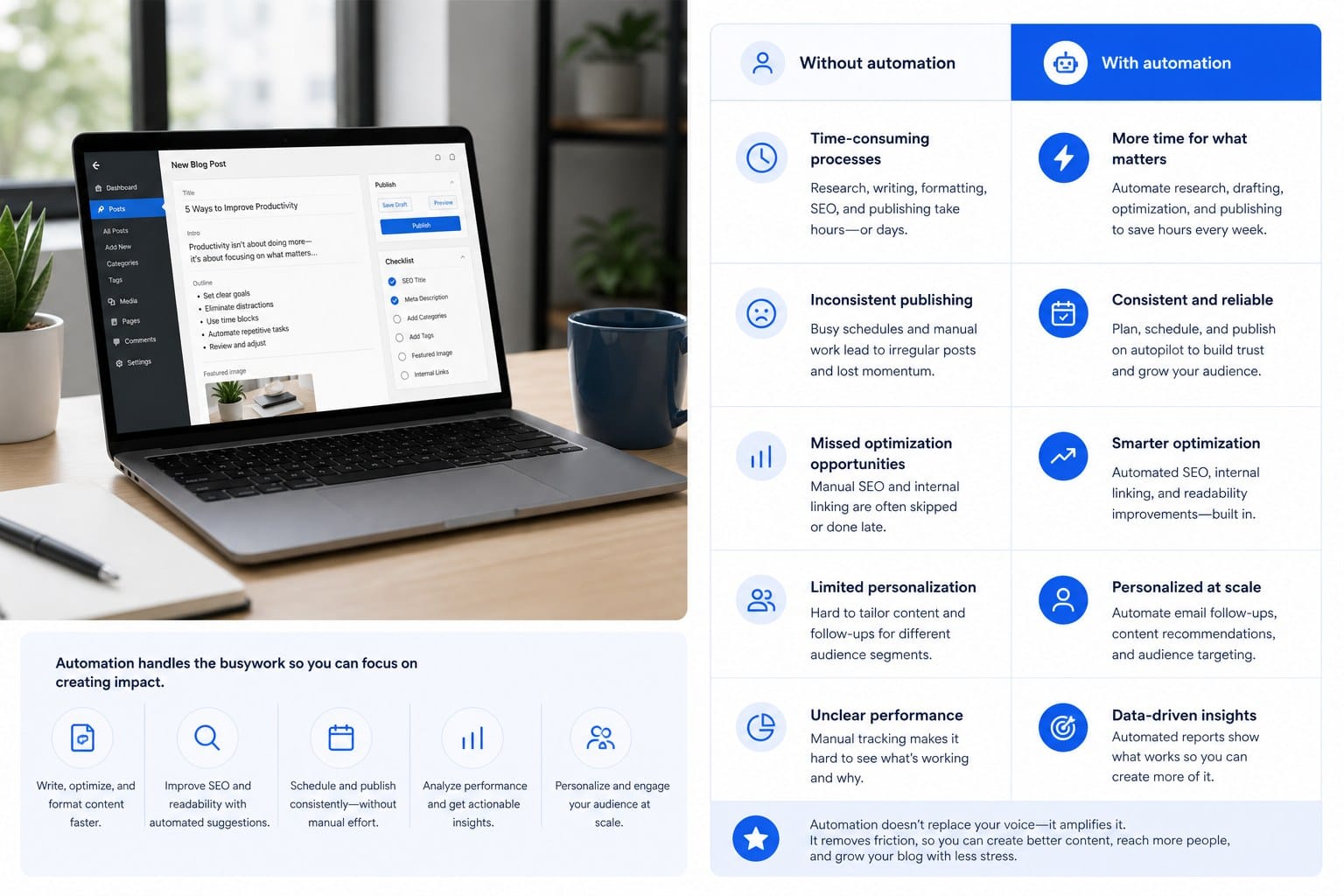
Automation in content marketing used to mean one thing: scheduling posts you had already written yourself. Set a publish date, walk away. That helped with a small slice of the problem, but it did nothing for research, writing, editing, visuals, or strategy. Today, AI-powered content systems can handle the entire production workflow, from planning to publishing, and that changes the math in a significant way.
The shift is not just about saving time, though it does that. It is about removing the conditions that cause inconsistency in the first place. When you understand what a fully automated content workflow actually looks like, you can see why the results are different from anything a manual process can reliably deliver.
Starting with strategy, not guesswork
The first step in a functional automated content system is building a real content strategy before any writing begins. Instead of sitting down every Monday morning and trying to figure out what this week's post should cover, you start with a 30-day content plan that maps out topics, target keywords, and how each piece connects to the others.
This is not a random list of post ideas pulled from a brainstorm session. It is a structured plan designed to build topical authority in your specific niche and drive organic traffic in a deliberate direction. Each piece in the plan supports the others. Internal links connect related articles. Topics cluster around the subjects your target audience searches for most. The plan is built to compound, not just to fill a calendar.
For a SaaS startup, this might look like a coordinated set of articles covering the core problem your software solves, specific use cases for different buyer types, honest comparison content for people doing research before a purchase decision, and practical how-to guides that attract readers at different stages of the buying journey. Each piece serves a purpose. Each piece connects to the others. That kind of strategic architecture is very difficult to build on the fly week after week, but it is exactly what a well-designed content engine produces automatically before the writing even starts.
This approach is especially valuable for early-stage companies that cannot afford to waste content budget on random topics that do not build toward anything. A coordinated content strategy does not just generate traffic. It generates traffic from the right people, which is what actually leads to conversions and revenue. If you are building out a content approach for an early-stage company, Startup content marketing: a blogging strategy for early-stage SaaS covers the specific considerations that make content strategy different when you are resource-constrained and need every piece to pull its weight.
Production that goes beyond a draft
Once the strategy is in place, the second step is content production. This is where AI tools have improved most dramatically over the past two years, and where the gap between early AI writing experiments and current capabilities is largest.
Modern AI content systems do not just generate a generic 800-word draft from a headline. They research the topic, pull in relevant information from credible sources, structure the article for both readability and search intent, and produce long-form content that covers a subject with enough depth to be genuinely useful. The difference between this and the AI writing tools of even two years ago is substantial. The output is not filler padded to a word count. It is structured, researched content that a reader can actually learn from and act on.
But research and writing are only part of production. Visuals matter more than most writers want to admit.
A well-formatted article with a strong featured image and clean visual presentation holds readers on the page longer. It looks professional. It builds the implicit credibility that comes from a publication that clearly cares about presentation. An AI content engine that generates on-brand visuals alongside articles removes yet another manual step from the chain. For teams without a dedicated designer, that capability alone changes what is possible without adding headcount.
The concern that comes up most often about AI-generated content is that it will sound generic, off-brand, or interchangeable with content from any other company using the same tools. That is a legitimate concern, and it deserves a direct answer. The issue is not AI content in principle. It is AI content generated without clear brand guidelines and without a system trained to match a specific voice. When those elements are in place, the output is consistent with the brand in the same way a well-briefed human writer would be. How to maintain brand voice when using AI to write blog content walks through exactly how to set this up so the content sounds like you, not like a committee of algorithms that have never read your previous work.
Publishing without the manual overhead
The third step is publishing, and this is the step that most people underestimate when they are calculating the true cost of a manual content workflow.
Even when you have a finished, edited, polished article, getting it into your CMS takes time. You need to format it correctly, add the featured image, write the meta description, assign the right categories and tags, set the URL slug, schedule the publish date, and check that everything looks right in preview. When you multiply that work across 50 or 100 posts per year, it adds up to many hours of mechanical, low-creativity work that does not require your judgment but still demands your focused attention.
Automatic publishing to platforms like Ghost removes this step from your plate entirely. The article moves from the content engine directly into your CMS, formatted and ready, on the schedule you set in advance. For Ghost users specifically, this kind of native integration is a significant unlock. The publishing cadence you planned becomes the publishing cadence that actually happens, without any manual intervention required. If you are running your publication on Ghost and want to understand how the integration works in practice, How to integrate an AI blog tool with Ghost CMS walks through the setup in concrete detail.
What the compounding effect actually looks like
When you put all three steps together into a single functioning system, strategy plus production plus publishing, you eliminate the conditions that cause inconsistency in the first place. You do not have to decide what to write each week because the strategy is already built. You do not have to carve out time to research and draft because the content engine handles that work. You do not have to remember to publish or format or schedule because the system does it automatically on the timeline you set.
For an independent blogger trying to scale without hiring, this means maintaining a publishing cadence that would normally require a full content team. Three posts per week, targeted at real keywords, with on-brand visuals, published on a consistent schedule. That is what a small editorial team costs in salaries and coordination overhead. With the right automated system, a solo operator can run the same cadence.
For a small business owner, it means the blog keeps working even during the weeks when operations are overwhelming and there is no time to think about content. The system does not know you are slammed. It publishes anyway.
For a digital marketer managing a brand blog, it means the workflow no longer breaks down when one person is unavailable. There are no single points of failure because the critical steps are handled by a system, not a person.
The compounding math here is what makes this genuinely powerful. When you publish consistently over six months, you accumulate 50 to 100 articles, each targeting a specific keyword, each building topical clusters, each linking to related pieces on your site. Search engines see a domain that publishes reliably on a coherent set of subjects and rewards that signal with higher rankings and faster indexing of new content. Organic traffic grows because the inputs that drive organic traffic, volume, consistency, topical depth, keep arriving at a predictable pace.
The cost of inconsistent blogging is not just the traffic you miss while you are quiet. It is also the momentum you lose and have to rebuild every time you restart. Automation does not just save time. It removes the stopping points that interrupt momentum in the first place. And when momentum stays intact, the compounding effect that makes content marketing so valuable has a chance to actually work.
Blogtude is built around exactly this model. It generates a 30-day content strategy tailored to your niche and goals, produces deeply researched long-form articles with on-brand visuals, and publishes directly to Ghost and other CMS platforms on your chosen schedule. The goal is to give growing brands the ability to maintain consistent blog output without manual effort, so the blog keeps working even during the weeks when every other part of the business is demanding your attention. You can learn more at Blogtude.
Ready to take the next step?
If your blog has been inconsistent and you want to fix that without adding more to your plate, Blogtude is worth a serious look. It handles the strategy, the writing, the visuals, and the publishing so your blog keeps working even when you are focused on everything else your business needs. Visit Blogtude to see how it works and get your first 30-day content plan.