
How often you should post on your blog for maximum SEO impact

Table of contents
1. What the data actually says about how often to post
2. How to choose a posting schedule that actually fits your situation
3. What happens when you cannot maintain a consistent posting schedule
One of the most common questions I hear from bloggers and brand owners is simple: how often should I post? The answer is less obvious than most people expect. Blog post frequency and SEO are connected, but not in the way many guides suggest. More posts do not automatically mean more traffic. Posting too rarely leaves your site stagnant. Posting too often without enough depth can actually hurt you. In this article, I want to walk through what the research and real-world experience actually show about blog post frequency SEO, so you can make a decision that fits your resources and your goals.
What the data actually says about how often to post
Let me start with the honest version of this conversation, because there is a lot of noise out there.
Google has never published a recommended posting schedule. What Google has said, repeatedly, is that it cares about quality, relevance, and the overall usefulness of a page to the person searching. Frequency is not a direct ranking factor in any confirmed sense. But frequency does have real, indirect effects on your SEO performance, and those effects matter a lot.
HubSpot's research, which covered thousands of their own blog posts over several years, found that companies publishing 16 or more blog posts per month got about 3.5 times more traffic than companies publishing four or fewer posts per month. That sounds like a strong case for posting constantly. But here is the part that often gets left out: HubSpot is a massive operation with dedicated writers, editors, and SEO strategists. They were not publishing 16 thin posts per month. They were publishing 16 researched, long-form, strategically targeted pieces.
For most independent bloggers, SaaS founders, or small business owners, hitting 16 quality posts per month is not realistic. And trying to force it often leads to low-quality content that Google's helpful content systems are designed to filter out.
So what does work for smaller operations?
A study from Orbit Media, which surveys hundreds of bloggers annually, has consistently found that bloggers who publish less frequently but invest more time per post tend to report stronger results. In their 2023 survey, bloggers who spent six or more hours on a single post were more than twice as likely to report strong results as those who spent less than an hour.
This tells us something important: depth beats velocity for most content creators.
That said, posting frequency still matters for a few specific reasons. First, it signals to Google that your site is actively maintained. A blog with the last post from two years ago does not look like a living, breathing resource. Second, more posts mean more entry points into your site from search. Every article you publish is a chance to rank for a different keyword cluster. Third, consistent publishing builds a content library over time. That library compounds. Older posts that have accumulated links and engagement continue to drive traffic long after you wrote them.
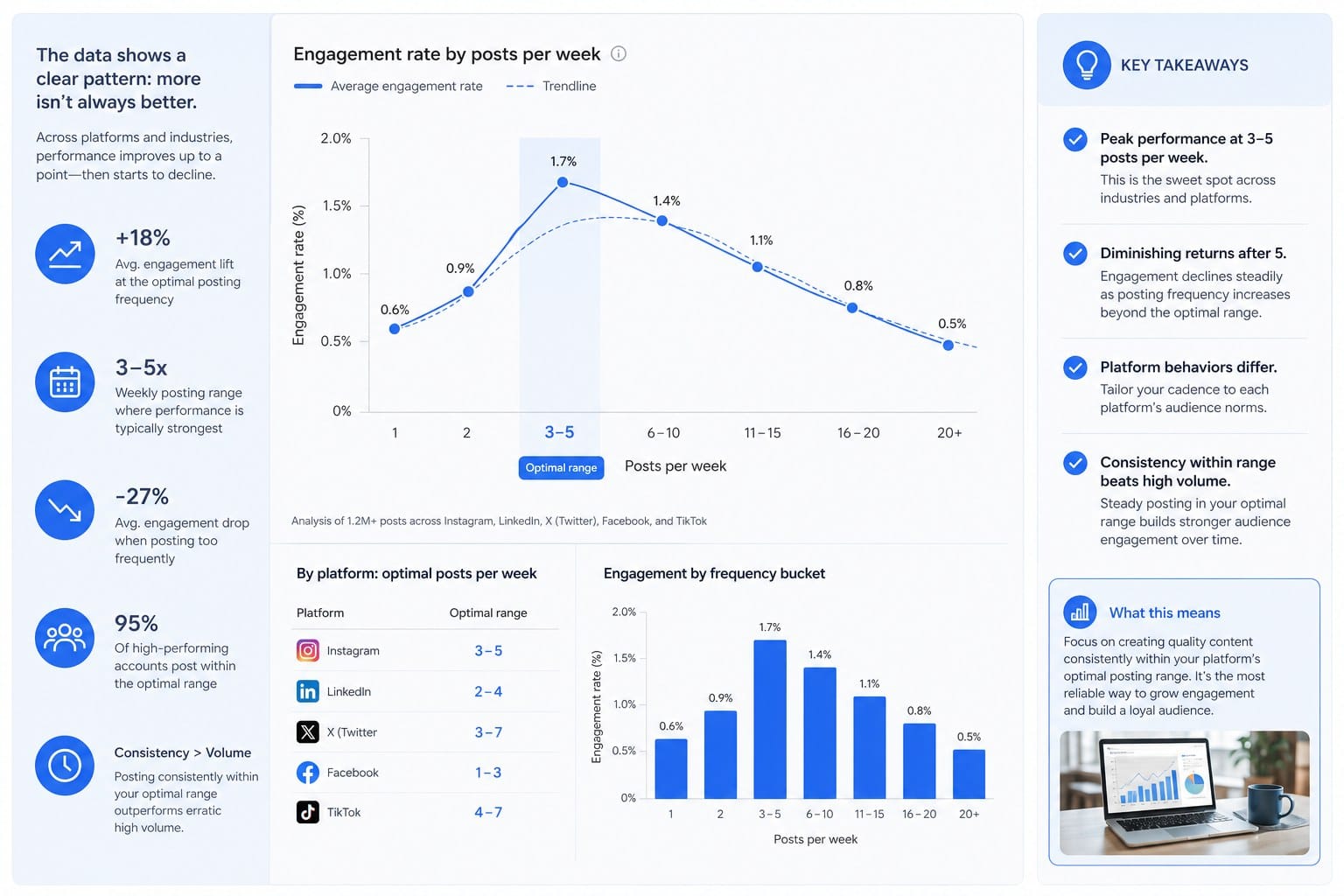
A reasonable baseline for most growing brands is one to two deeply researched posts per week. That gives you 50 to 100 new articles per year. If each one targets a real search intent and covers the topic thoroughly, that is a substantial content library building up over 12 months.
For sites that are brand new, I would actually suggest starting with a slightly higher cadence, maybe three posts per week for the first two or three months. The goal in the early days is to give Google enough content to understand what your site is about. Once you have that foundation, you can ease back to a sustainable rhythm.
For established sites with existing traffic, the priority often shifts from publishing new content to improving and updating existing posts. A site with 200 articles can often see bigger traffic gains from refreshing its top 20 pages than from adding 20 new ones.
The key insight here is that blog post frequency SEO is really about finding the intersection of two things: what your audience needs and what you can execute consistently at a high level. The right frequency for a solo creator is different from the right frequency for a marketing team, and both of those are different from what works for a news publisher.
How to choose a posting schedule that actually fits your situation
Now that we have established that quality matters more than raw volume, let me get practical about how you choose a schedule that works for your specific situation.
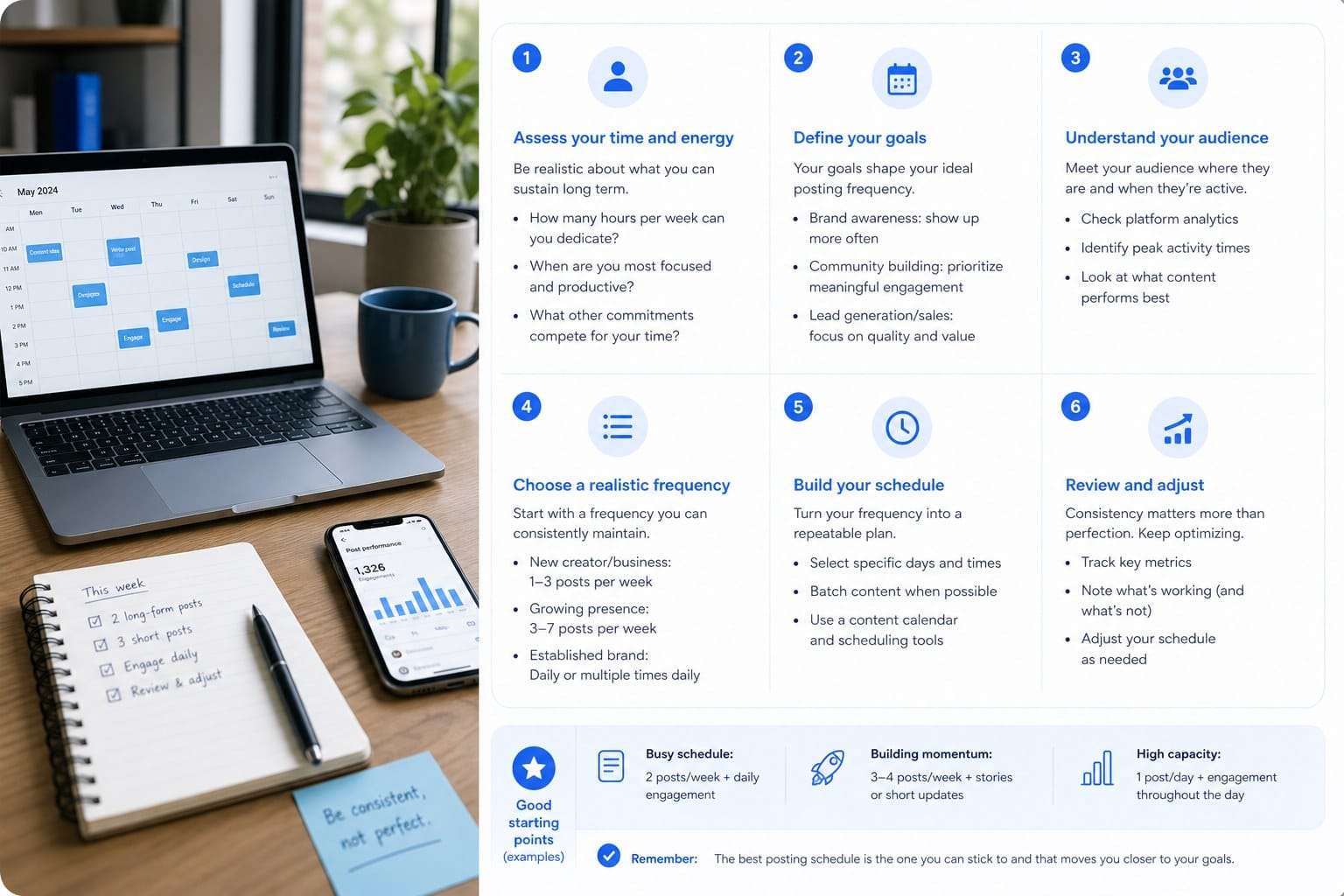
The first thing I always recommend is an honest audit of your available time and resources. If you are a solo blogger writing everything yourself, you need to be realistic. A well-researched, 2,000-word article that actually covers a topic in depth takes most people four to eight hours to produce. That includes research, outlining, writing, editing, sourcing images, and formatting for your CMS. If you have ten hours a week to devote to your blog, you can realistically produce one or two quality posts per week without burning out.
If you are a SaaS founder or small business owner, you probably have even less time than that. In that case, one genuinely good post per week is still a strong content strategy. Over a year, that is 52 indexed pages targeting real search queries.
The second thing to think about is your competitive landscape. If you are trying to rank for highly competitive keywords in a saturated niche, you will need a larger content library and stronger individual pieces. Frequency can help you get there faster, but only if quality stays high. If you are in a less competitive niche, you can build meaningful organic traffic with fewer, stronger pieces.
Here is a practical framework I find useful:
For sites with fewer than 50 published posts, the priority is building topic authority. You want to cover your core topic areas comprehensively. Aim for two to three posts per week if you can maintain quality, or one per week if that is what allows you to do thorough research and writing.
For sites with 50 to 200 published posts, the priority shifts to a mix of new content and content refreshes. You likely have some older posts that could be updated with new information, better internal linking, or improved on-page SEO. Budget roughly half your content time for new posts and half for improving what you already have.
For sites with 200 or more published posts, you are in a maintenance and optimization phase as much as a growth phase. New posts still matter, but your existing library is an asset worth protecting and improving. A single post-refresh project that takes an older article from page three to page one of Google can deliver more traffic than publishing ten new articles.
Another factor that does not get discussed enough is your content calendar strategy. Posting randomly whenever you feel like it, even if the individual posts are great, is less effective than a predictable schedule. When you publish on a consistent cadence, Googlebot tends to crawl your site more regularly. Readers who find your blog and like it know when to come back. Your internal linking becomes easier to plan because you know what is coming next.
I also want to address the question of pillar content versus supporting content. Many successful content strategies use a hub-and-spoke model. You write one comprehensive pillar page on a broad topic, then publish a series of more specific articles that link back to that pillar. This structure helps Google understand the topical authority of your site. When you are thinking about posting frequency, planning around this model means your posts are not random, they are building something. A pillar page on, say, content marketing strategy might be supported by ten or fifteen more specific articles covering individual tactics. That gives you a natural editorial calendar and a coherent site architecture at the same time.
For content creators who want to squeeze more value out of each piece they publish, it is also worth thinking about repurposing. A single well-researched blog post can fuel social media content, an email newsletter, a short video script, and more. I have written in detail about this approach in How to repurpose one blog post into 10 pieces of content, which is worth reading if you want to multiply your output without multiplying your workload.
Finally, pick a schedule you can actually sustain for at least six months without burning out. SEO results from blogging are slow to appear. Most new posts take three to six months to reach their peak ranking position. That means you need to keep publishing consistently during a period when you might not be seeing much traffic yet. A sustainable pace that you stick to will always outperform an ambitious pace that you abandon after eight weeks.
Consistency is the most underrated factor in blog post frequency SEO. Google rewards sites that publish regularly over long periods of time. It is not glamorous advice, but it is true.
What happens when you cannot maintain a consistent posting schedule
Let me be honest about something: most bloggers and brand owners struggle with consistency, not because they do not understand why it matters, but because life and business get in the way.
A content calendar does not survive contact with a product launch, a team restructuring, a slow quarter, or simply the reality that writing takes longer than you thought. This is the gap between what people know they should do and what they actually do.
When consistency breaks down, the SEO impact is real but not always immediate. Google does not penalize you the day you skip a post. But over time, an inconsistent publishing pace can signal to Googlebot that your site is not a priority. Crawl frequency may decrease. New content takes longer to get indexed. The compounding effect of a growing content library slows down.
The bigger problem is that gaps in publishing tend to snowball. You miss one week, then two, and then the blog has not been updated in three months. At that point, restarting feels hard, and the site starts to look neglected to both search engines and visitors.
So what do you do if you are in this situation?
First, do not try to make up for lost time by publishing a burst of mediocre content. Publishing ten thin posts in a week to catch up does more harm than good. It signals low quality and creates a boom-and-bust pattern that is worse than steady, slow publishing.
Instead, recommit to a realistic schedule. If one post per week is more achievable than two, set your calendar to one per week and protect that time. A slow and steady publishing pace beats an erratic one every time.
Second, use the time between posts to improve your existing content. If you cannot write something new this week, pick one of your top ten existing pages and improve it. Add a section that addresses a related question. Update outdated statistics. Strengthen the internal linking by connecting it to newer posts. Improve the meta title and description. These updates signal to Google that your site is actively maintained, even if you are not adding brand-new URLs.
Third, consider whether your process is the problem. Many people struggle to publish consistently because producing a post from scratch, every time, is an exhausting process. If you have to start completely fresh for every article, including researching the topic, identifying the right keyword angle, outlining the structure, sourcing data, writing the draft, editing, and then formatting and scheduling it in your CMS, the friction is high enough that it is easy to put it off.
This is where having a 30-day content strategy mapped out in advance changes the game. When you sit down to write, you already know the topic, the target keyword, the outline structure, and how it connects to your other content. You go from staring at a blank page to executing a plan. That reduction in friction makes a huge difference to how consistently you publish.
For Ghost CMS users in particular, the publishing workflow is one of the cleaner ones available, but you still have to produce the content and get it into the editor. I have covered what Ghost offers for serious bloggers in detail in the Ghost CMS review: is it the right platform for serious bloggers post, which is useful reading if you are weighing your platform options.
Fourth, think about what your blog post frequency SEO strategy looks like in the context of your overall business goals. If you are a SaaS company trying to drive inbound leads, every week that your blog goes dark is a week you are not building the organic traffic channel you said you wanted. Framing it that way makes it easier to prioritize. Your blog is not a hobby project you get to when you have spare time. It is a business asset that requires regular investment to grow.
For digital marketers managing brand blogs, this is where reliable workflows matter enormously. You likely have multiple stakeholders, approval processes, and shifting priorities. Building a workflow that can survive those pressures, including batch writing and scheduling content weeks in advance, is the only way to maintain a consistent publishing pace when the business around you is unpredictable.
Something that often gets overlooked is the value of having a small content buffer. If you write three posts ahead of where you are publishing, a single bad week does not break your schedule. Your buffer post goes out on time, and you catch up the following week. Building a two-to-four week buffer is one of the best structural decisions you can make for your content program.
The sites that win in organic search over a two-to-three year horizon are almost always the ones that found a sustainable rhythm and stuck with it. They are not always the ones that published the most. They are the ones that published consistently, updated their best content regularly, and built topical authority over time through patient, persistent effort.
If you are looking at your own blog right now and feeling like the manual effort of researching, writing, and scheduling everything is what is holding you back, that is exactly the problem that Blogtude is built to solve. It generates a 30-day content strategy, produces deeply researched long-form articles, and publishes them automatically to Ghost and other platforms, so you maintain a consistent posting pace without the manual grind that causes most content programs to stall out. You can also read more about how it compares to other tools in Clearpost alternative: why Blogtude might be the better fit if you are evaluating your options.
The bottom line on blog post frequency SEO is this: the best posting schedule is the one that produces genuinely useful content at a pace you can sustain without compromising quality. For most people, that is somewhere between one and four posts per week. The exact number matters far less than the commitment to keep showing up, keep writing well, and keep building something worth finding.

Ready to take the next step?
Ready to stop guessing at your content schedule and start publishing consistently? Blogtude builds your 30-day content strategy, writes the articles, and publishes them automatically so your blog keeps growing even when you are focused on everything else. Visit blogtude.com to see how it works.


