
How to choose a blog niche for long-term SEO growth


Table of contents
1. Start with what you actually know, then check if people are searching for it
2. Understand competition and find the gaps your content can fill
3. Test your niche with a small content batch before committing fully
Picking a blog niche feels like a big decision, and it is. The niche you choose shapes every piece of content you write, every keyword you chase, and every reader you attract. Get it right, and your blog builds compounding authority over time. Get it wrong, and you spend months publishing content that never quite gains traction. This guide walks you through a practical, honest process for figuring out how to choose a blog niche for SEO so that your content investment pays off for years, not just weeks. This is not about following trends or copying whoever seems to be winning right now. It is about finding a space where your expertise, your audience's real needs, and search demand all line up at the same time.
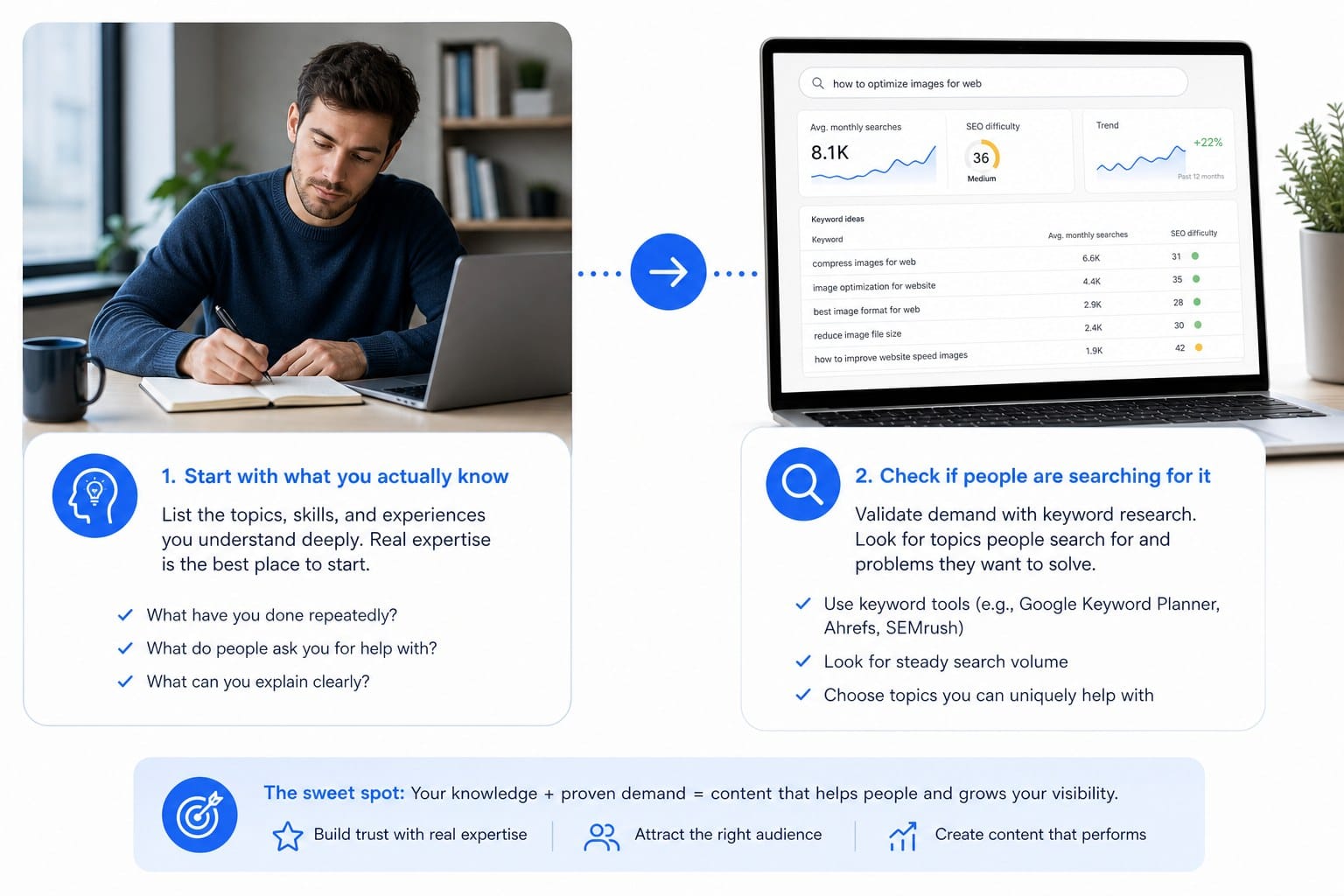
Start with what you actually know, then check if people are searching for it
A lot of niche advice starts with keyword research, but that puts the cart before the horse. Before you open a keyword tool, write down every topic you can speak about with real depth. Not surface-level depth that comes from reading a few articles last month, but the kind of depth that comes from years of doing something, solving something, or living inside a particular industry or community.
Think about your work history, your hobbies, problems you have solved repeatedly, industries you have worked in, or communities you have been part of for a long time. These are your credibility assets. Google's helpful content guidance explicitly rewards content written by people with first-hand experience and demonstrated expertise. When you write about topics you genuinely understand, that quality shows up in the writing itself. Readers notice it. Search engines respond to it.
Once you have a list of five to ten broad topic areas, start layering in search data. The goal at this stage is not to find the highest-volume keywords. The goal is to check whether your topic areas have any search demand at all, and to get a rough sense of how competitive each space is.
Free tools give you a surprisingly clear picture without spending anything. Google's autocomplete suggestions show you what real people are typing in real time. The People Also Ask boxes in search results reveal the specific follow-up questions readers have after their first search. Google Trends shows you whether interest in a topic is growing, shrinking, or holding steady. If you already have a site with Google Search Console connected, that data is even more valuable because it shows you what searches are already surfacing your content.
Paid tools like Ahrefs, Semrush, and Moz give you more precise numbers on monthly search volume and keyword difficulty scores, but the core logic is the same whether you use a free or paid tool. You are looking for topic areas where real people type real questions into search engines on a regular basis, not just once in a while.
Here is a concrete example. Say you spent six years managing social media for restaurants. You know content calendars inside out. You understand the visual side of food marketing. You have strong, tested opinions about what actually drives reservations versus what just gets likes and comments. That is a legitimate niche with real depth behind it. A quick autocomplete search on Google for phrases like "restaurant social media" or "how to market a small restaurant" surfaces dozens of specific, recurring questions. People are searching consistently. That is your green light to dig deeper.
Now compare that to a topic you are mildly interested in because you read a few articles about it recently. You can write about it, but you would be working from the same surface-level knowledge as thousands of other writers. In a competitive search landscape, surface-level knowledge produces surface-level content. That kind of content either never ranks or ranks briefly and then fades as more authoritative resources push it down the page.
The niche sweet spot is where your genuine expertise intersects with consistent search demand. Neither factor alone is enough. Expertise without demand means you are writing for an audience that does not exist in search. Demand without expertise means you are competing against writers and brands who have years of depth on you, and that is a very hard race to win from a standing start.
One more thing worth mentioning at this stage: search demand does not have to be enormous to support a successful blog. Many of the most profitable and authoritative blogs are built around relatively narrow topics with moderate monthly search volumes. A blog that covers a specific niche thoroughly will almost always outperform a blog that loosely touches a huge topic. Consistent depth beats occasional breadth every time, and that is not just a content philosophy. It is how Google's ranking systems are increasingly designed to work.
When you look at your list of potential niches through the lens of both genuine expertise and search demand, you will usually be able to narrow it down to two or three real candidates. Those are the niches worth evaluating more closely. Everything else, the topics you find interesting but do not know deeply, and the topics you know deeply but that no one searches for, can be set aside for now.
A practical exercise at this point: for each of your top two or three candidates, spend thirty minutes searching like a reader would. Type in the questions someone new to this topic would ask. Type in the questions an experienced practitioner would ask. Look at what comes up. Look at where the results feel thin or outdated or generic. That gap between what readers are asking and what current content is actually delivering is exactly where opportunity lives. You are not just checking whether a niche has demand. You are starting to understand whether that demand is being well served, which takes you directly into the next stage of the process.
Understand competition and find the gaps your content can fill
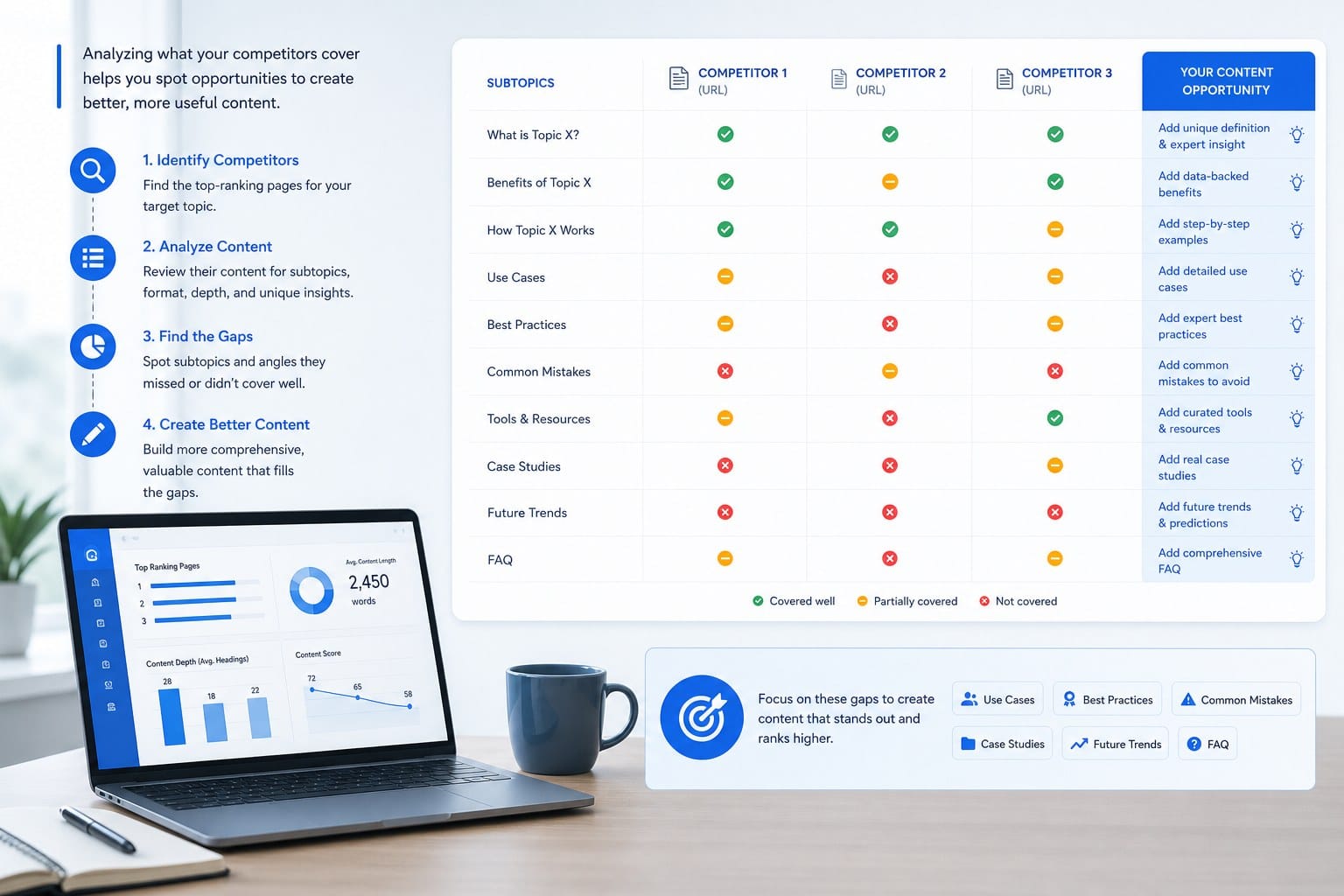
Once you have identified two or three niche candidates that combine real expertise with real search demand, the next step is to look honestly at who is already publishing in that space. This is where a lot of new bloggers make one of two opposite mistakes. They see competition and give up immediately, or they ignore competition entirely and walk in blind. Both approaches lead to the same outcome: wasted time.
Competition is not a reason to avoid a niche. It is information. A niche with zero competition almost always means zero audience. A niche dominated by well-funded media brands and established authorities with thousands of backlinks means you need a very specific angle to get any foothold at all. What you are actually looking for is a niche where existing content has real gaps, and those gaps are something your specific knowledge and perspective can fill.
To evaluate competition, search your main topic phrases and study the first page of results carefully. Ask yourself a few specific questions as you go. Are the top-ranking pages from massive general publications with enormous domain authority, or are some of them from individual blogs and small brands? How thorough and current is the content? Are the articles genuinely answering the reader's full question, or do they answer part of it and leave the rest vague? Are there audience segments within this topic that the current top results are clearly ignoring?
That last question is where real opportunity lives. Back to the restaurant marketing example. A search for "restaurant marketing" surfaces broad articles from large marketing publications covering every type of restaurant and every type of marketing in a single piece. But a search for "restaurant marketing for family-owned diners" or "how to use Instagram for a food truck business" might show weaker, older content from smaller sites that have not been updated in years. Those specific angles are gap opportunities. You can build authority much faster in a well-defined sub-niche than in a broad category where you are fighting everyone from national media brands to university marketing departments.
This is also where topical authority becomes one of the most important concepts for how to choose a blog niche for SEO. Google's ranking systems increasingly reward sites that cover a topic comprehensively and consistently, not sites that publish one or two strong articles and then drift to unrelated subjects. When you choose a tight niche and commit to covering it thoroughly over time, you build topical authority. Every new article you publish reinforces your site's relevance for that subject area. Over time, your rankings improve across an entire cluster of related keywords, not just the individual pages you have optimized. That is compounding in action.
I have written about this in more detail in the compounding effect of consistent blogging on domain authority, but the core idea is that focused, consistent publishing creates SEO momentum that scattered publishing never can. Your niche choice is what makes that focus possible in the first place.
Another useful exercise at this stage is to spend time in the communities where your potential audience actually gathers. Forums, Reddit threads, Facebook groups, LinkedIn communities, and niche Slack groups are full of the real questions real people are asking right now. These questions often do not appear in keyword tools at all because they are phrased in natural language or contain very specific context. But they are exactly what your audience is struggling with, and they are often underserved by existing blog content because most content creators are optimizing for search volume metrics rather than actual reader intent.
For the personal finance for freelancers example, broad personal finance is dominated by well-funded media brands with decades of SEO history behind them. But spend an hour reading posts in freelancer communities on Reddit or in independent contractor groups on Facebook, and you will find the same specific frustrations coming up again and again. How do you budget when your income is unpredictable month to month? How do you handle quarterly estimated taxes when you are first starting out? How do you separate business and personal expenses as a sole proprietor without creating a bookkeeping nightmare? Those are real, specific, underserved questions. They are your content roadmap. They are also your competitive angle, because the big personal finance sites are writing for a salaried audience with predictable paychecks, not for people whose income varies by thousands of dollars from one month to the next.
When you find that kind of gap, the content almost writes itself. You know who you are writing for. You know what they are actually struggling with. You know what the existing top results are failing to address. That combination of audience clarity and content clarity is what makes a niche viable long-term, not just in the first few months when any new content can get a brief bump in impressions.
Finally, think carefully about the long-term trajectory of your niche before you commit. A niche built around a specific software product that might be discontinued, a regulatory environment that is about to shift dramatically, or a trend that peaked two years ago carries real risk that a stable niche does not. Evergreen topics, topics that stay relevant because the underlying human need does not change, give your content a longer shelf life and make your SEO investment more durable. Tax planning for self-employed people, parenting toddlers, home maintenance for first-time homeowners, strength training for people over forty: these topics have consistent demand year after year because the underlying need never goes away. Contrast that with content built around a specific app version or a platform feature that changes constantly, and the durability difference becomes obvious.
Niche selection is not just about where you can win in the short term. It is about where you can build something that keeps paying off two, three, and five years from now. The competitive analysis phase is where you stress-test that durability before you invest months of work into a direction that might not hold.
Test your niche with a small content batch before committing fully
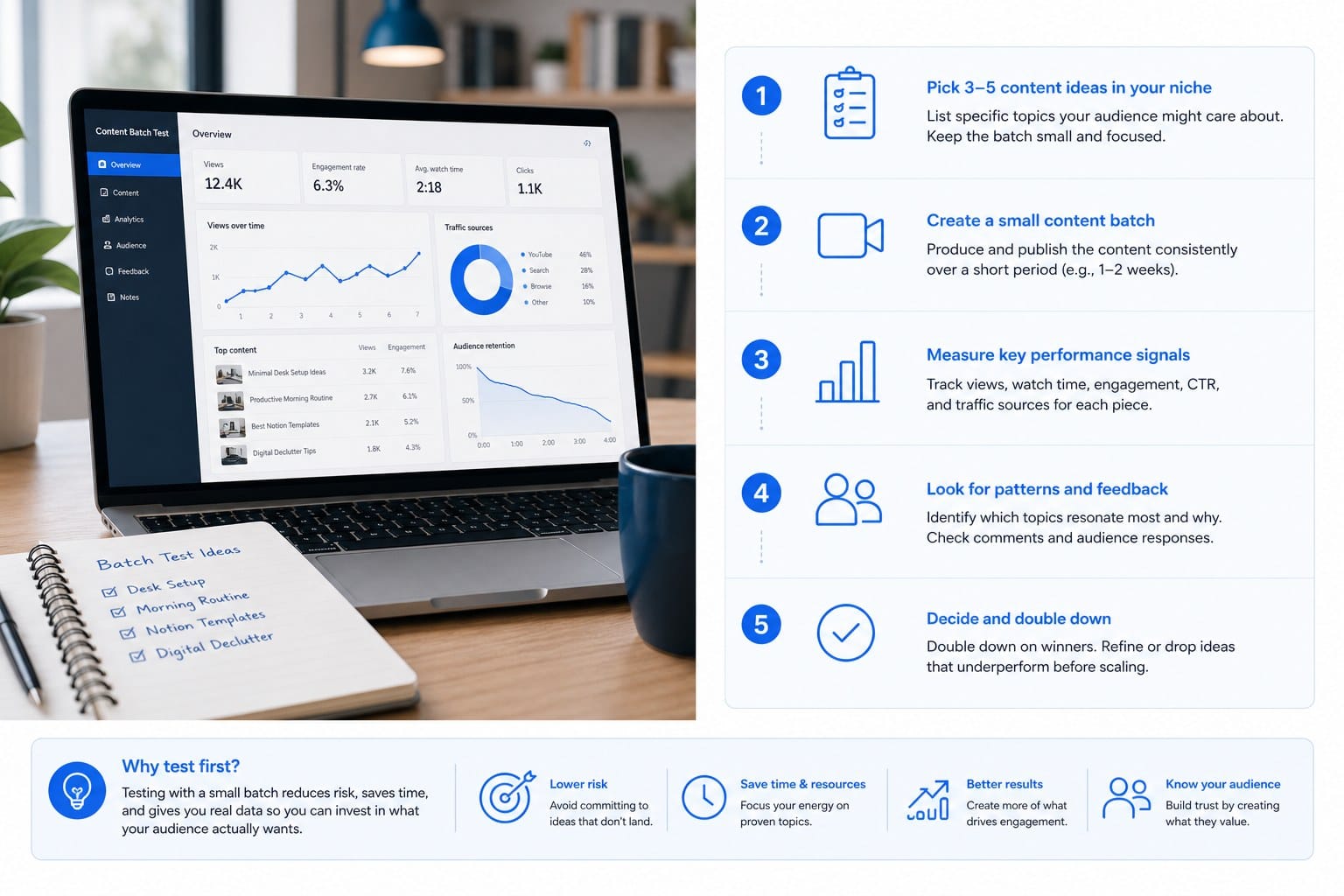
Choosing a niche does not have to be a permanent, irreversible decision made in one sitting. But you do need enough commitment to generate real data. The most reliable way to validate a niche before building a year-long content strategy around it is to publish a focused batch of articles, ideally ten to fifteen pieces that cover the core questions in your niche from multiple angles, and then watch carefully what happens.
Ten to fifteen articles might sound like a lot of work before you have proven anything. But a niche cannot show you its SEO potential from one or two posts. Google needs enough signal to understand what your site is about and which searches your content should appear in. A small batch of focused, high-quality articles gives Google that signal and starts the process of surfacing your content to relevant audiences. One post gives you almost nothing to work with. Ten posts give you enough data to make real decisions.
During this test phase, track a few specific things in Google Search Console. Which articles are generating impressions? That tells you which topics Google considers you relevant for, even before you are ranking in positions that drive clicks. Which articles are earning actual clicks? That tells you which topics have enough search demand and enough relevance to move traffic when you do rank. Are any external sites linking to your content? Even early backlinks from small sites signal that your content is useful enough that others want to reference it. How long are readers spending on your articles, and are they visiting other pages on your site after the first one? This tells you whether your content is genuinely meeting reader expectations or just attracting accidental traffic that bounces immediately.
After three to four months of consistent publishing in a niche, you will have real data instead of educated guesses. You will know which topics are gaining traction, which specific angles resonate with your audience, and where you have the clearest opportunities to go deeper. You will also know something that no upfront research can tell you: whether you can sustain writing in this space without running out of things to say or burning out on the subject. That practical sustainability question matters enormously for long-term success, and it only reveals itself through actual publishing.
If your test batch shows that certain sub-topics within your niche are gaining impressions and clicks faster than others, that is your data telling you where to focus your next phase of publishing. If specific articles are earning backlinks early, that tells you which angles your audience and other publishers in the space find most valuable. If certain articles are getting impressions but almost no clicks, that tells you either the topic has demand but your title is not compelling enough to earn the click, or you are ranking for adjacent searches that are not quite right for your content. All of that is actionable information you simply cannot get from a spreadsheet of keyword data before you start publishing.
One honest challenge with this approach is the volume of work it requires upfront. Writing ten to fifteen well-researched, genuinely useful articles is not a weekend project. If you are running a business, managing clients, or working a full-time job alongside your blog, producing that volume of quality content in a reasonable time frame is a real logistical challenge. This is exactly where tools built for consistent content output can remove a major bottleneck without sacrificing the quality that makes the content worth publishing in the first place.
At Blogtude, we build a 30-day content strategy for your blog based on your niche, produce thoroughly researched long-form articles with on-brand visuals, and publish them automatically to Ghost and other CMS platforms. That kind of infrastructure lets you run a proper niche test without burning out or hiring a full content team before you have any revenue to support it.
The quality question is one I hear from bloggers regularly, and it is a fair one. If AI-assisted content is doing heavy lifting in the production process, can it still meet Google's standards for helpful, high-quality content? I have addressed this directly in can AI blog content meet Google's quality guidelines, but the short answer is yes, when the process involves genuine research, clear editorial direction, and human oversight to ensure accuracy and relevance. The output needs to be useful to a real reader, not just optimized for a crawler, and when that standard is held consistently, the results hold up.
Once your test phase gives you real data, you are in a position to make a confident, informed decision about your niche rather than relying on instinct and keyword spreadsheets. You might find that your first instinct was correct and the niche has genuine legs. You might find that you need to narrow your focus to a specific sub-topic where you are gaining the most traction fastest. Or you might find that the niche is either too competitive to break into without significant resources or too small to support the traffic growth you are aiming for, and you need to pivot to a stronger candidate. All three of those outcomes are useful. None of them are failures. They are data, and data makes your next move smarter.
After you commit to a niche based on real performance data, the work shifts from exploration to execution. You need a consistent publishing cadence, a growing library of content that covers your topic from multiple angles and at multiple levels of reader knowledge, and a system for tracking what is working so you can double down on your strongest topics. At this stage, it is also worth doing periodic audits of your existing content to make sure older articles are still accurate, still ranking where you expect them to, and still genuinely serving the reader's current intent. I recommend how to audit your blog content in under an hour for a practical process to keep your content library in good shape as it grows and ages.
Let me address a common fear directly before wrapping up: what if you choose the wrong niche? The truth is that choosing a niche and publishing consistently in it will always teach you more than waiting until you feel certain. You will learn things from real traffic data, real reader behavior, and real search performance that no amount of upfront research can replicate. The cost of choosing imperfectly and then adjusting is almost always lower than the cost of waiting months or years to start.
The bloggers and brands that build genuine long-term SEO growth are not the ones who found the perfect niche on their first try. They are the ones who chose a direction with reasonable confidence, published consistently, paid close attention to what their data was telling them, and refined their focus as the evidence accumulated. That combination of initial commitment and ongoing adaptability is what separates blogs that compound in authority from blogs that plateau after a few months and never recover their momentum.
The practical process from start to finish looks like this. You begin by mapping your genuine areas of expertise and checking which of those topics have real, consistent search demand from actual readers. You then evaluate competition in your shortlisted niches to find the specific angles and audience segments that existing content is underserving. You publish a focused batch of ten to fifteen articles to test your niche with real data rather than assumptions. And you use that data to commit fully to the niche that shows the strongest combination of traction, sustainability, and long-term durability. Throughout every stage, you are building toward the kind of topical authority that makes SEO growth compound over time instead of plateauing after the initial burst of new-content visibility.
Ready to take the next step?
If you are ready to test a blog niche but do not want to spend months writing dozens of articles by hand, Blogtude can help you move faster without sacrificing quality. We generate a full 30-day content strategy tailored to your niche, produce deeply researched long-form articles with on-brand visuals, and publish them directly to Ghost and other CMS platforms automatically. Visit blogtude.com to see how it works and start building your niche authority today.


