
How to set realistic SEO goals for a brand-new blog


Table of contents
1. Why most new bloggers set the wrong SEO goals
2. How to build a realistic SEO goal framework for your first year
3. The specific metrics that actually matter for a new blog's SEO progress
Starting a new blog is exciting. You pick a niche, choose a name, set up your site, and then comes the question that trips up almost every new blogger: what should I actually be trying to achieve with SEO right now? Setting the wrong targets early on leads to burnout, wasted effort, and a lot of confusion about why nothing seems to be working. Setting the right SEO goals for a new blog means understanding where you are in the journey and what realistic progress actually looks like in the first six to twelve months. I want to walk you through how to think about this clearly, so you can build momentum instead of chasing numbers that do not make sense yet.
Why most new bloggers set the wrong SEO goals
When people launch a blog, the first instinct is usually to aim for big traffic numbers. I see it all the time: someone sets a goal of ten thousand monthly visitors by month three, or they want to rank on page one of Google within sixty days. These targets feel motivating, but they almost always lead to disappointment because they ignore how search engines actually work.
Google and other search engines take time to trust a new domain. This is not a myth or a scare tactic. It is a well-documented pattern that SEO practitioners call the sandbox effect. Even if you publish excellent content on day one, Google needs to crawl it, index it, evaluate the site's overall authority, and observe how real users interact with it. That process takes months, not weeks.
A new domain typically has zero backlinks, no domain authority, and no search history. Competing against established sites that have been publishing and earning links for years is genuinely difficult. That does not mean you cannot make progress. It means your early SEO goals for a new blog need to reflect where you are starting from.
Another common mistake is measuring the wrong things. New bloggers often track keyword rankings obsessively in the first few weeks, but rankings for a brand-new site are extremely volatile. A post might show up at position sixty-two one day and position forty the next, then drop back to seventy. That volatility does not mean your strategy is broken. It means Google is still figuring out what your site is about and how to categorize it.
The smarter approach is to shift your early metrics toward inputs and process goals, not just outcomes. Things like how many quality articles you publish per week, whether you are targeting low-competition keywords, whether your on-page SEO is clean and consistent, and whether you are building internal links properly. These are the things you can actually control in months one through three. The organic traffic growth comes later, as a result of doing those foundational things well.
It also helps to understand what a realistic timeline looks like. Most SEO professionals agree that a new site needs six to twelve months of consistent publishing and optimization before it starts seeing meaningful organic traffic. Some niches move faster. Very competitive niches can take even longer. If you go into blogging with that expectation set clearly, you will not panic and abandon your strategy at month two when the traffic graph still looks flat.
One more thing worth addressing here: the pressure to do everything at once. New bloggers often try to run social media, build an email list, do keyword research, write long articles, build backlinks, and optimize for Core Web Vitals all at the same time. That approach leads to burnout. I think it is much better to sequence your priorities. In the first three months, your SEO goals should be almost entirely focused on content and on-page fundamentals. Everything else can come later once your foundation is solid.
If you are curious about how different content tools compare when it comes to actually growing a brand through SEO, I found this breakdown of SurferSEO vs AI blog tools: which one actually grows your brand genuinely useful for understanding what matters in a workflow.

How to build a realistic SEO goal framework for your first year
Now that we understand why unrealistic goals cause problems, let me walk through how to actually structure your SEO goals for a new blog in a way that creates steady progress and keeps you moving forward.
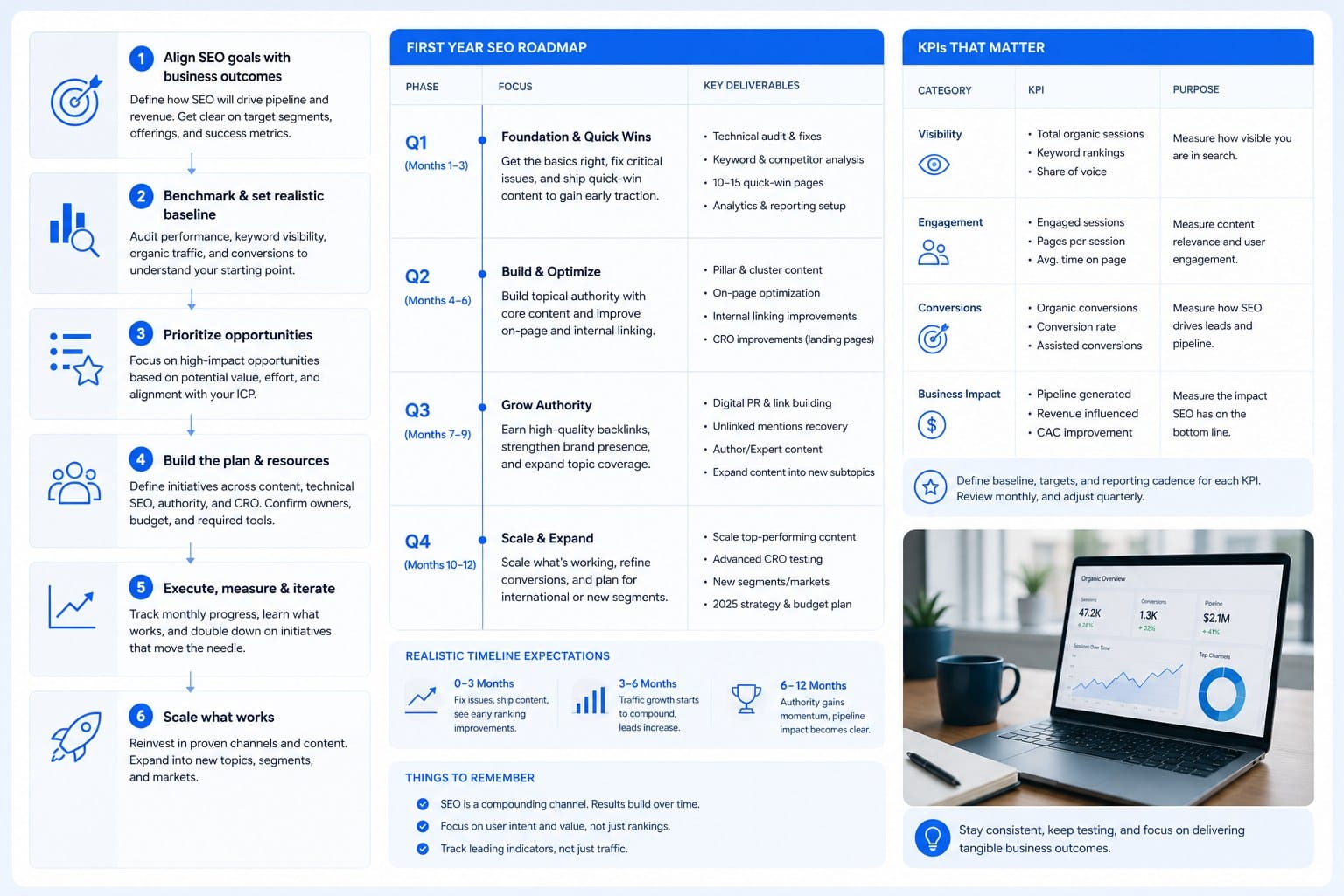
I like to break the first year into three distinct phases: foundation, growth, and optimization. Each phase has its own set of appropriate goals, and understanding which phase you are in prevents you from applying the wrong expectations at the wrong time.
Phase one is months one through three. The goal in this phase is not traffic. The goal is to build a site that Google can understand and that readers would genuinely find valuable. That means a few specific things.
First, pick a focused niche and stick to it. Google rewards topical authority. If your blog covers ten different topics with no clear through-line, it is harder for search engines to understand what your site is an expert on. A blog that consistently publishes about personal finance for freelancers, for example, builds topical authority much faster than one that mixes personal finance with travel tips and book reviews.
Second, do real keyword research before you write anything. The biggest lever a new blog has in this phase is targeting low-competition keywords. These are search queries where the pages currently ranking on page one have low domain authority and are not particularly comprehensive. Tools like Google Search Console, Ahrefs, or Semrush can show you keyword difficulty scores. For a brand-new site, I would aim for keywords with a difficulty score below thirty, ideally below twenty. These are the gaps where a well-written, thorough article can realistically compete.
A concrete example: instead of trying to rank for "best productivity apps" which has enormous competition, a new blog might target "best productivity apps for freelance designers" or "how to track time as a freelance designer." The search volume is lower, but the competition is also much more manageable, and the people searching are very specific, which often means they convert better too.
Third, establish a publishing cadence you can sustain. Consistency matters more than volume in this phase. Publishing two well-researched, properly optimized articles per week is much better than publishing ten articles in the first two weeks and then burning out and going silent for a month. Search engines notice publishing frequency, and readers cannot build a habit around content that disappears.
Your measurable goals for phase one might look like this: publish at least twenty-four articles by the end of month three, ensure every article targets a specific low-competition keyword, include a proper meta title and meta description on every post, build a logical internal link structure between related articles, and submit your sitemap to Google Search Console. These are process goals you can control completely.
Phase two is months four through eight. By this point, your site should be getting indexed regularly and you might start seeing some early traffic from long-tail keyword searches. The goals shift a bit here.
Now it makes sense to start tracking keyword rankings for your most important articles, because there is actually something to track. You should also start monitoring which pages are receiving impressions in Google Search Console, even if the clicks are low. Impressions are a leading indicator. They tell you that Google is showing your page for certain queries, which means you are on the right track even before the clicks start flowing.
In this phase, you can also start thinking about content clusters. A content cluster is a group of articles that all relate to a central topic, with one comprehensive pillar article at the center and multiple supporting articles that link back to it. For example, if your blog is about remote work, your pillar article might be a comprehensive guide to setting up a home office. Supporting articles might cover topics like the best desk chairs for back pain, how to manage distractions when working from home, or how to set work hours when you work for yourself. These articles link to the pillar and to each other, which strengthens the entire cluster's authority.
Realistic traffic goals for this phase depend heavily on your niche, but I would suggest aiming for at least five hundred to one thousand monthly organic visitors by month six if you have been publishing consistently and targeting low-competition keywords. Some sites hit this earlier. Some take a bit longer. The key is that you should be seeing clear upward trends in Google Search Console, even if the absolute numbers are still modest.
Phase three is months nine through twelve. This is where the work from earlier starts to pay off more visibly. Your domain has some age and history now. You have published a substantial body of content. Some of your articles have earned backlinks organically because other writers found them useful. This is when it becomes appropriate to set goals around organic traffic growth percentages month over month, to start updating older articles that are ranking on pages two and three to push them up to page one, and to expand into slightly more competitive keywords.
A useful goal framework for this phase is what some SEO professionals call the ten percent monthly growth target. If you have one thousand organic visitors in month nine, your goal is eleven hundred in month ten, twelve hundred and ten in month eleven, and so on. This compounds nicely over time and gives you a clear benchmark to work toward without setting arbitrary absolute numbers that might not reflect your niche's actual search volume.
I also want to mention something that often gets overlooked in SEO goal-setting conversations: the relationship between SEO and monetization. Some bloggers think they need to wait until they have tens of thousands of readers before they can earn anything. That is not true, and setting an early revenue goal alongside your SEO goals can actually keep you motivated through the slow early months. If you want to understand this better, I found this article on how to monetize a blog before you have 10,000 monthly readers really eye-opening in terms of what is actually possible early on.
The specific metrics that actually matter for a new blog's SEO progress
One of the most practical things I can share about setting SEO goals for a new blog is helping you understand which numbers to pay attention to and which ones to ignore, at least in the beginning.
Let me start with the metrics that often distract new bloggers but that do not tell you much during the first few months.
Domain Authority, or DA, is a score developed by Moz that tries to predict how well a site might rank. It is a useful benchmark for comparing established sites, but for a new blog, your DA is going to be very low, often between one and ten, for a long time. That is normal and expected. Tracking DA week to week as a new blogger will just make you feel bad, because it moves slowly and sometimes erratically. I would check it quarterly at most.
Similarly, bounce rate is not a useful early metric. A new blog with low traffic will have highly variable bounce rate data because the sample sizes are too small to be meaningful. One day you might have twenty visitors and a forty percent bounce rate. The next day you might have fifteen visitors and an eighty percent bounce rate. Neither number tells you anything reliable.
Now let me walk through the metrics that actually matter.
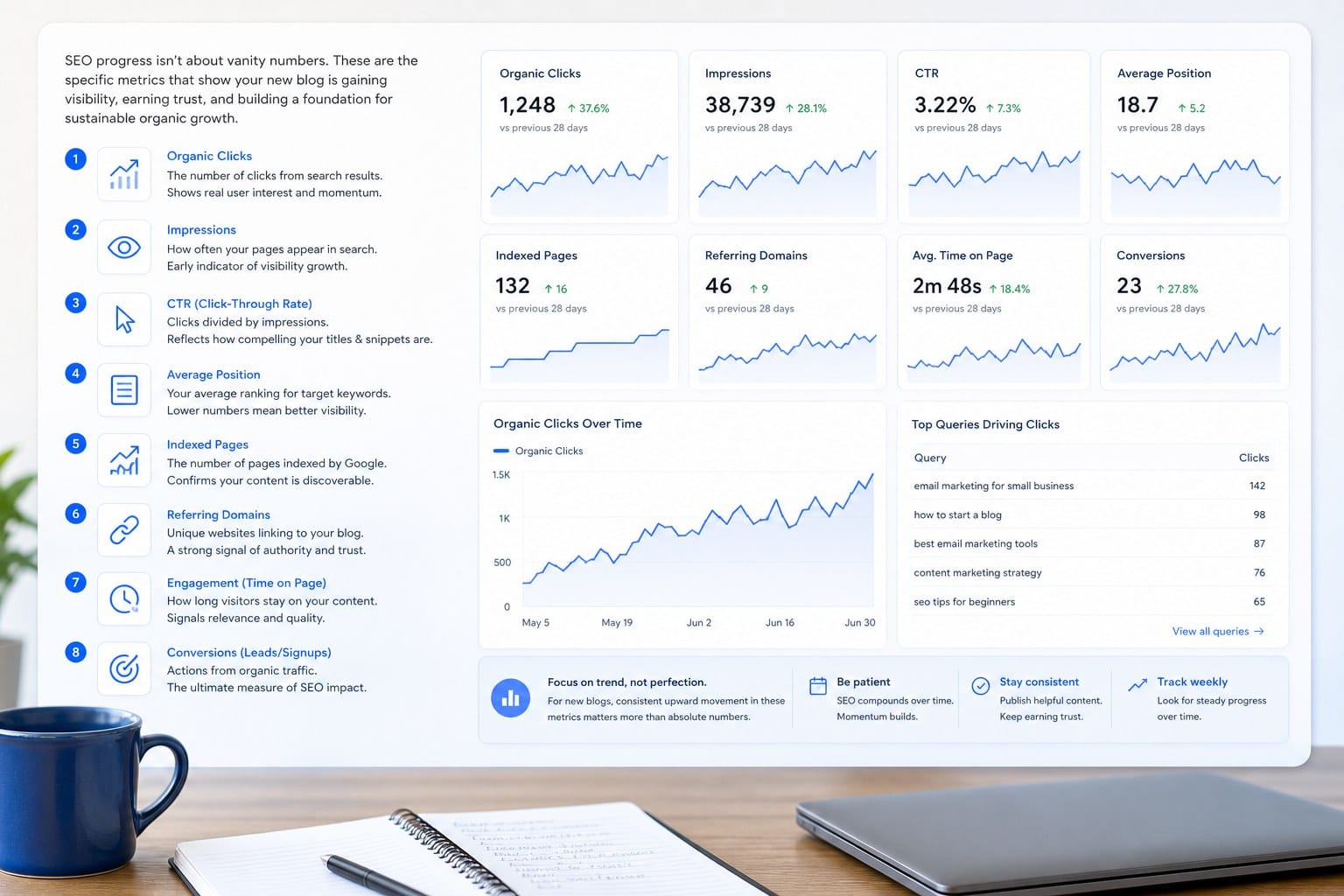
Indexed pages is the first one I always look at with a new blog. Go to Google and search for site:yourblogname.com. The results that show up are the pages Google has indexed. If you have published thirty articles and only fifteen are indexed, something is wrong. Maybe your robots.txt is blocking crawlers. Maybe your internal linking is poor and Google's crawlers are not finding all your pages. Maybe some of your articles are too thin or too similar to other pages and Google decided not to index them. Tracking your indexed pages tells you whether your content is even in the game.
Google Search Console impressions are the second metric I care about early on. An impression happens when your page appears in a search result, even if nobody clicks on it. Rising impressions over time is a strong early signal that your content is being discovered and evaluated by Google. Even if your click-through rate is low, growing impressions mean you are on the right track. I would set a goal to see impressions increasing month over month by at least ten to fifteen percent during months three through six.
Click-through rate, or CTR, is worth watching once you have enough impressions to make the data meaningful. If your pages are showing up but nobody is clicking, that tells you something important about your titles and meta descriptions. A good meta title clearly tells the reader what they will get from the article and makes them want to click. If your average CTR from Google is below one percent for most pages, that is a signal to work on how you are writing your titles and descriptions.
Keyword ranking positions are worth tracking, but only for the specific keywords you deliberately targeted in each article. I would not obsess over overall ranking averages. Instead, pick your ten most important articles, note which keyword each one is targeting, and check that keyword's ranking once a week. Watch for the trend over time. An article that moves from position eighty-five to position forty over two months is making good progress, even though it is not on page one yet.
Organic traffic from Google Analytics or your CMS dashboard is the big one everyone wants to watch. This is legitimate to track, but I want to set realistic expectations. For many new blogs, the first meaningful organic traffic does not arrive until month four or five at the earliest. Before that, most of your visitors will come from your own promotion on social media, newsletters, or personal networks. That is fine. It is part of the process. Set a monthly organic traffic goal starting at month four, something modest like two hundred visitors, and then set targets for growth from there.
One area that significantly affects your SEO goals but that new bloggers often underestimate is content quality as it relates to E-E-A-T. This stands for Experience, Expertise, Authoritativeness, and Trustworthiness, and it is how Google evaluates whether a piece of content is worth ranking. If you are writing about topics where you have genuine knowledge, citing real sources, covering topics thoroughly, and presenting accurate information, you are building E-E-A-T. If you are publishing thin content that skims the surface of topics, you are not. I would recommend reading up on what is E-E-A-T and how bloggers can apply it in 2025 because it changed how I think about content quality as an SEO factor.
Backlinks are worth mentioning here too, though I want to be careful about how I frame the goal. For a brand-new blog, you should not set aggressive backlink-building targets. Trying to build lots of backlinks quickly through sketchy methods can actually hurt your site. Instead, your goal in year one should be to publish content that is genuinely worth linking to, to reach out personally to a small number of relevant bloggers and journalists when you have something they might find useful, and to build a handful of authentic relationships in your niche. If you earn even ten to twenty quality backlinks in your first year from relevant, real sites, that is a genuinely good result for a new blog.
Finally, I want to talk about publishing consistency as a measurable SEO goal because I think it is underrated. Search engines notice when sites publish regularly. Regular publishing also gives you more opportunities to rank for more keywords, more content to build internal links from, and a larger body of work that establishes your topical authority. Setting a goal of publishing a minimum number of well-researched articles per month and then actually meeting that goal consistently is one of the most powerful SEO levers available to a new blogger. The challenge, of course, is that researching, writing, optimizing, and publishing long-form content takes a lot of time, especially if you are doing it alone without a team.
This is exactly the problem that tools like Blogtude are designed to solve. Blogtude generates a full thirty-day content strategy, produces deeply researched long-form articles with on-brand visuals, and publishes them automatically to Ghost and other CMS platforms. For independent bloggers, startups, and small business owners who know they need consistent, SEO-driven content but do not have hours every week to produce it, that kind of automated workflow can be the difference between building real organic momentum and stalling out at fifty visitors a month forever.
Setting the right SEO goals for a new blog comes down to aligning your expectations with the reality of how search engines work, measuring the right things at each stage, and showing up consistently with quality content over a sustained period of time. It is not glamorous advice. But it is the kind of advice that actually leads to blogs that grow.
Ready to take the next step?
If you are ready to stop guessing and start building a consistent content strategy that actually supports your SEO goals, Blogtude can handle the research, writing, and publishing for you so you can focus on growing your brand. Visit blogtude.com to see how it works.


