
SurferSEO vs AI blog tools: which one actually grows your brand


Table of contents
1. What SurferSEO actually does well (and where it stops)
2. What AI blog tools bring to the table that optimizers can't
3. How to decide which approach fits your brand's growth goal
If you've spent any time researching content tools, you've probably run into the same debate: SurferSEO vs AI blog tool options that promise to handle everything automatically. It's a fair question. SurferSEO is well established and respected in the SEO world. A growing wave of AI-powered blog engines has entered the space promising to cover research, writing, and publishing in one workflow. So which approach actually grows your brand? This article breaks down how both sides of this comparison work in practice, what each one is genuinely good at, and where each one falls short. By the end, you'll have a clear picture of which tool fits your situation.
What SurferSEO actually does well (and where it stops)
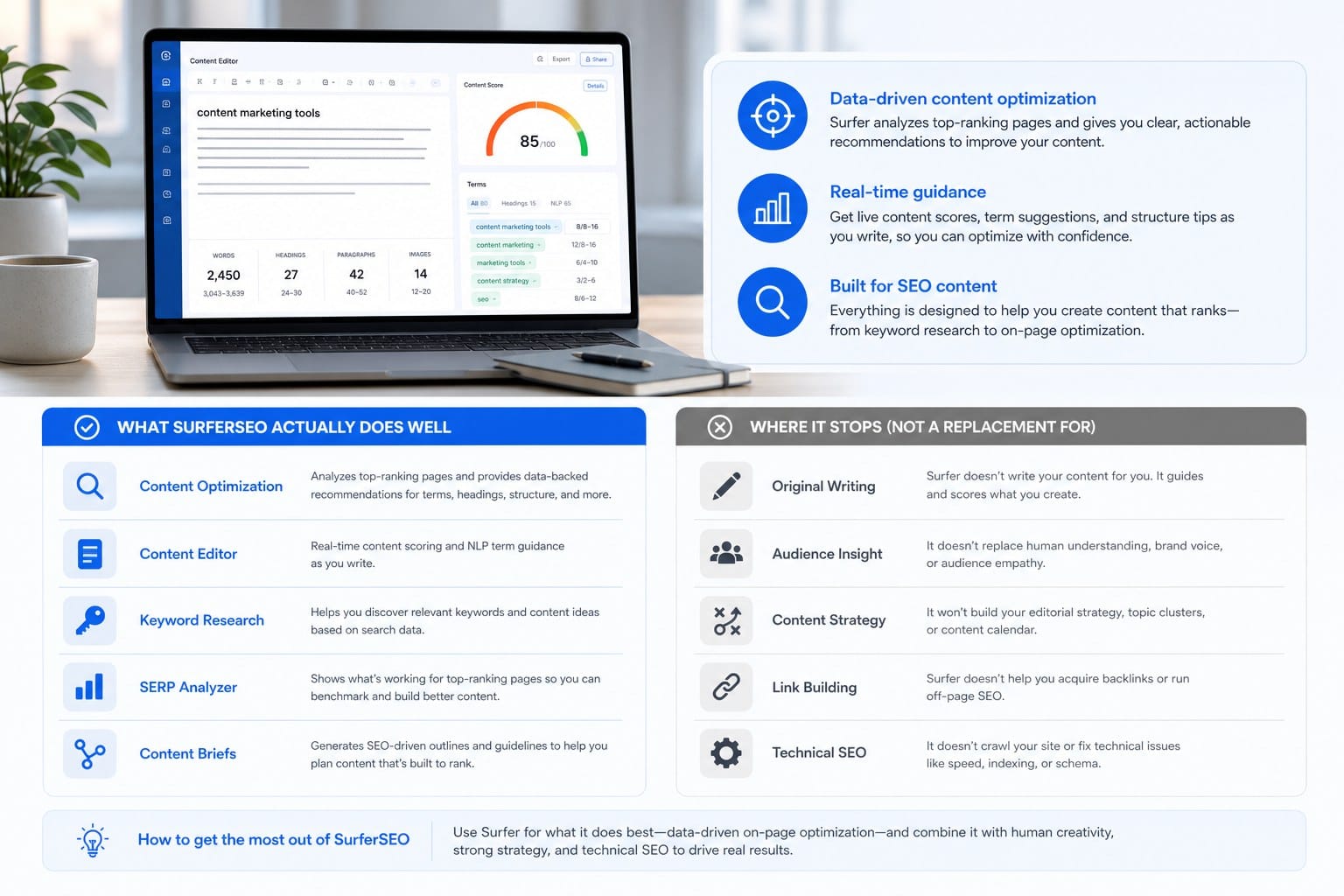
SurferSEO built its reputation as a content optimization tool. The core idea is straightforward: you write a draft, run it through Surfer's Content Editor, and it shows you how your article compares to the top-ranking pages for your target keyword. It measures word count, keyword density, heading structure, and NLP terms that appear frequently in competitor content. For people who already know how to write and just want guidance on hitting SEO benchmarks, it's genuinely useful.
Surfer also introduced an AI writing feature called Surfer AI. It generates article drafts that are pre-optimized around the content scores the platform tracks. This is where comparisons in the SurferSEO vs AI blog tool space start to get interesting. Surfer AI is not a standalone content engine. It is an optimizer first, and the AI writing feature exists to support the optimization workflow. That distinction matters a great deal depending on what you're trying to accomplish.
Here's where SurferSEO runs into real limitations for growing brands.
First, it doesn't generate a content calendar or strategy. You still have to decide what to write about, do your keyword research separately or within Surfer's keyword research tool, and manage your publishing schedule on your own. If you're a solo blogger or a small team, that planning overhead adds up fast.
Second, Surfer doesn't publish your content anywhere. Once your article hits a good content score, you export it and paste it into your CMS yourself. For someone managing a blog alongside a business, that manual step breaks the workflow constantly. It sounds minor until you're staring at a finished draft at 10 p.m. and still have to format, tag, add a featured image, set a URL slug, and schedule the post before you're done.
Third, Surfer's strength is on-page optimization against existing SERPs. It looks at what's already ranking and tells you to match those patterns. That's valuable, but it's a reactive strategy. It doesn't help you identify content gaps before your competitors do, build topical authority over time with a structured plan, or create content that reflects your brand voice in a consistent way.
Fourth, Surfer requires you to bring your own visuals. Articles with relevant images and diagrams perform better in terms of time-on-page and reader engagement, and Surfer leaves that entirely up to you. For content creators who care about how their blog looks to actual readers, that gap becomes noticeable quickly. A well-structured article with no visual breaks is harder to read, and harder-to-read content gets abandoned.
To be fair, SurferSEO is not trying to be a full content engine. It's a focused optimization tool, and it does that job well. If you work at an agency or on a larger content team where writers produce drafts and an editor reviews them before publishing, Surfer fits neatly into that workflow as a quality-control layer.
But if you're trying to grow a brand through consistent, high-quality blog output without building a full content team, you need more than an optimizer. You need a system that handles strategy, writing, visuals, and publishing together. Surfer handles one piece of that puzzle well. It leaves the other pieces entirely to you.
That's not a criticism. It's just a constraint worth understanding before you decide whether Surfer is the right tool for your specific situation. The question isn't whether Surfer is good at what it does. The question is whether what it does matches what you actually need.
For brands that are already publishing consistently and want to sharpen their on-page performance, Surfer adds real value. For brands that are struggling to publish at all, Surfer's optimization layer won't solve the underlying problem. It's the equivalent of buying a high-performance fuel injector for a car that only gets driven twice a month. The gains are real, but they're limited by the constraint upstream.
Understanding that distinction is what makes the SurferSEO vs AI blog tool comparison useful rather than just a list of features. The right tool is the one that solves your actual bottleneck, not the one with the most impressive feature list.
What AI blog tools bring to the table that optimizers can't
The term 'AI blog tool' covers a wide range of products, and that range matters enormously when you're trying to make a decision. Some tools are little more than basic text generators that produce thin content that never ranks. Others are more sophisticated content engines that handle multiple stages of the blogging workflow from strategy through publishing. The difference between those two categories is not marginal. It's the difference between a tool that saves you thirty minutes and a tool that changes how your whole content operation works.
A basic AI writing tool generates text based on a prompt. You ask it to write an article about cold email outreach, and it produces something that sounds reasonable on the surface. But it lacks depth. It cites no real data. It reflects no specific brand voice. It requires heavy editing before it's usable in public. These tools save time on the actual typing but don't save time on the thinking, planning, editing, or publishing. That's why so many bloggers using simple AI generators still struggle to publish consistently or rank for anything meaningful. The tool removed one friction point but left all the others intact.
A more capable AI content engine operates differently, and the differences start before a single word gets written.
It starts with strategy. Instead of waiting for you to decide what to write, a capable engine builds a content plan based on your niche, your audience, your existing content gaps, and what search demand actually looks like in your space. That planning phase is what most individual bloggers and small business owners skip because it's time-consuming and requires real keyword research skills. Finding the right topics, clustering them by theme, sequencing them so they build on each other, and spacing them out over a realistic publishing calendar is a job that takes hours to do well. When a tool handles that layer, it removes one of the biggest bottlenecks in consistent publishing before you've written a single word.
From there, a capable engine handles the research. Good long-form content doesn't come from general knowledge. It comes from pulling in current information, understanding what readers actually want to know, and structuring that information in a way that serves both readers and search engines. Research-backed articles take significantly longer to write manually, which is exactly why so many blog posts end up thin, vague, and unable to hold a reader's attention past the first scroll.
Consider the difference between a 1,200-word article that summarizes common knowledge about a topic and a 2,800-word article that covers the same topic with specific examples, draws on real data, addresses the questions readers actually have, and anticipates the objections they're likely to raise. The second article earns links. The first one doesn't. The second article ranks because it's genuinely more useful. The first one competes with hundreds of other thin posts for scraps of traffic.
Then there's brand consistency. One article that sounds like you is easy to produce. Thirty articles that all sound like you, stay on topic, build on each other thematically, and present a coherent point of view is a completely different challenge. AI blog engines built for brand content handle this by learning your voice, your positioning, and your audience and applying that consistently across every article in a content calendar. That consistency is what makes a blog feel like a publication rather than a random collection of posts.
Visuals are another area where full content engines separate themselves from basic generators. Articles with relevant, on-brand visuals perform better with readers. Time-on-page increases. Scroll depth increases. Those behavioral signals feed back into how search engines evaluate the content. Producing custom images or finding appropriate stock photos for every post takes time, and that time is easy to underestimate when you're planning a consistent publishing schedule. Tools that generate or suggest on-brand visuals as part of the article workflow remove that friction without requiring you to spend time in a design tool or stock photo library for every post.
Auto-publishing is where the efficiency gains become most visible in everyday practice. If a tool can write a finished, SEO-structured article and push it directly to your Ghost blog or another CMS platform without you touching it, your publishing cadence can go from one or two posts a month to a consistent weekly or bi-weekly schedule. That consistency compounds over time in ways that are hard to overstate. Search engines reward sites that publish regularly in a focused topic area. Readers come back to blogs they can count on. Subscribers grow when there's a reason to subscribe.
This is the part of the SurferSEO vs AI blog tool comparison that often gets glossed over in feature-by-feature breakdowns. It's not really about which tool writes better sentences in isolation. It's about which approach fits into your actual workflow and helps you publish consistently at a quality level that builds your brand's authority over time.
Building that authority matters more than ever. Search engines now weigh topical depth, content consistency, and demonstrated expertise heavily in their rankings. A single well-optimized article can rank for one keyword. A blog with fifty deeply researched articles on interconnected topics in the same niche builds something harder to displace. It signals to search engines that this site knows its subject area thoroughly. It gives readers more reasons to stay, return, and share. That's what a content engine makes possible without requiring a team of writers, editors, and strategists.
If you want to understand how content expertise connects directly to search performance, it's worth reading What is E-E-A-T and how bloggers can apply it in 2025. The principles there explain exactly why consistent, researched content in a defined topic area outperforms one-off posts over time, regardless of how well optimized any single article is. The optimization layer matters, but it multiplies the results of a solid content foundation. Without that foundation, there's not much for it to amplify.

How to decide which approach fits your brand's growth goal
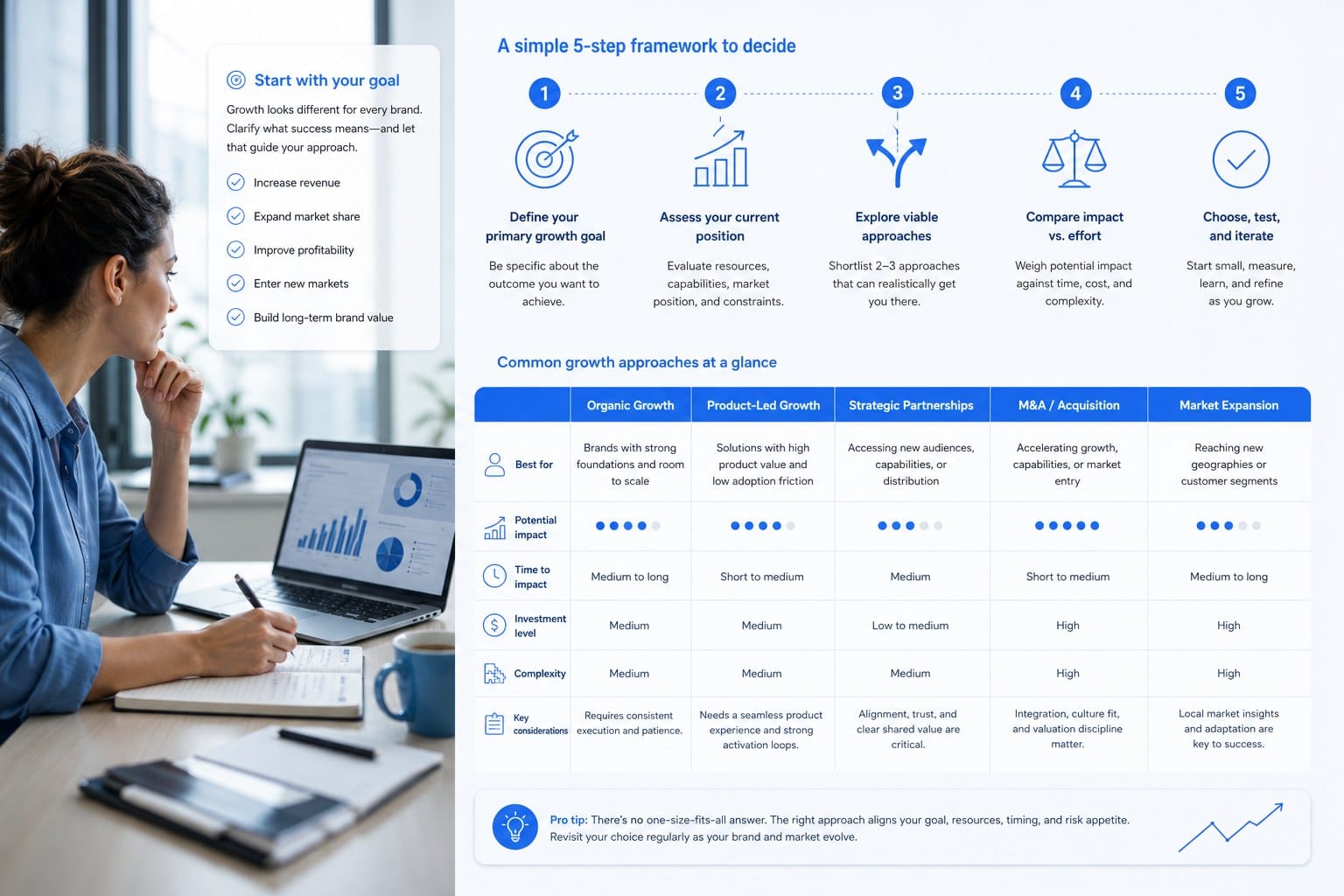
The honest answer to the SurferSEO vs AI blog tool question is that the right choice depends on what your actual constraint is. Not your theoretical constraint or the one that sounds most sophisticated. Your real, day-to-day bottleneck. Let me walk through the most common situations and what actually fits each one.
If your constraint is optimization quality and you already have writers, SurferSEO makes sense as part of your stack. If your team produces drafts and you want a systematic way to check that your content is competitive before publishing, Surfer's Content Editor gives you a clear benchmark. It won't replace your editorial judgment, but it adds a data-driven layer that helps your writers hit the right targets on keyword coverage, structure, and depth relative to what's already ranking. This setup works well for larger content teams where the bottleneck is quality control, not output volume.
If your constraint is time and your bottleneck is producing anything at all, an AI blog engine is a better fit. This is the situation most independent bloggers, SaaS founders, small business owners, and solo digital marketers face. You know blogging matters for organic growth. You've read enough about SEO to understand why consistent publishing in a focused topic area builds authority over time. But between running your business, serving clients, and managing everything else, the blog gets deprioritized. Weeks go by without a post. The content you do manage to publish is rushed and under-researched. That pattern doesn't build authority. It just maintains a barely-active presence that signals inconsistency to both readers and search engines.
An engine that generates a 30-day content strategy, writes deeply researched articles on a schedule, adds on-brand visuals, and auto-publishes directly to your CMS removes most of those friction points. You review and approve. The publishing actually happens. That consistency is what compounds into real organic traffic growth over six to twelve months.
The compounding effect is worth pausing on because it's not just a talking point. A blog that publishes two quality posts a week for six months has fifty-plus pieces of content, natural internal link opportunities, growing topical coverage, and a track record that search engines can evaluate. A blog that publishes sporadically has none of those things, regardless of how well each individual post is optimized. Consistency is the variable that separates blogs that plateau from ones that grow. If the tool you're using doesn't help you stay consistent, its other features matter less than they appear to.
If your constraint is budget, you need to think about cost per published article rather than monthly subscription price alone. SurferSEO at a mid-tier plan still requires you to write the content or hire someone to write it. When you factor in writer costs, editing time, and your own time managing the process, the total cost per published article is often much higher than the subscription price suggests. A content engine that handles the full workflow from strategy to publishing can be more cost-effective per article even at a higher subscription price, because it replaces multiple separate costs that you're currently paying in time, money, or both.
For Ghost CMS users specifically, the integration question carries extra weight. Ghost is a strong publishing platform for independent bloggers and brands that care about reader experience, but it doesn't come with a built-in content strategy layer. If you're managing a Ghost blog without a dedicated team, the gap between having a finished article and having it live on your site involves more steps than it looks like from the outside. Tools that connect directly to Ghost and push finished articles into the platform save a meaningful amount of time for anyone running a solo or small-team publishing operation.
It's also worth thinking about the downstream effects of consistent publishing on your site's overall structure. When you publish regularly on interconnected topics, you create natural opportunities for internal links that help readers move through your content and help search engines understand your site's architecture. That structural depth is one of the factors that separates blogs that plateau at a few hundred monthly visitors from ones that grow steadily. If you want to understand how to make the most of that structure, Internal linking best practices for blogs that want to rank breaks down how to approach it in a way that works at scale, not just for a handful of posts.
Another angle worth considering for small business owners and SaaS founders is how blogging connects to your revenue picture, not just your traffic numbers. Building organic traffic takes time, but it doesn't have to stay disconnected from revenue until you hit some arbitrary milestone. The topics you choose, the audience you target, and how you structure your calls to action can drive real business results earlier than most people expect. How to monetize a blog before you have 10,000 monthly readers covers that in practical terms if you're building a blog alongside a product or service business and can't afford to treat it as a long-term-only investment.
One thing worth being direct about: neither SurferSEO nor any AI tool is a shortcut that removes the need for good judgment. SurferSEO tells you what patterns appear in top-ranking content, but it doesn't do the strategic thinking that decides what your brand stands for and what topics you should build authority in. Basic AI writers produce volume without quality or brand consistency. The tools that actually move the needle are the ones that bring strategy, research, voice consistency, and reliable publishing together in one workflow.
For brands that want to grow organic traffic without hiring a full content team, the ceiling on what SurferSEO alone can accomplish is real. It's a valuable optimization layer. But optimization without consistent, strategic content production is like tuning an engine on a car that only gets driven once a month. The tuning is real. The gains are limited by how rarely the car runs.
A content engine built for consistent brand publishing solves the volume and strategy problem first. When that's working, adding optimization thinking on top of it accelerates results further. But if you had to choose one problem to solve first, solve the consistency problem. A well-researched, clearly written, regularly published blog in a focused niche will outperform an occasionally published, carefully optimized blog in the same niche over a twelve-month window. That's not an opinion. It's what the data on organic traffic growth consistently shows across industries and blog sizes.
Blogtude is built specifically for this workflow. It generates a 30-day content strategy tailored to your niche and audience, produces deeply researched long-form articles, includes on-brand visuals, and auto-publishes directly to Ghost and other CMS platforms. If you're a founder, a solo blogger, a small business owner, or a digital marketer who needs consistent blog output without building a manual content operation from scratch, it's designed to solve exactly that problem without requiring you to become a content strategist, copywriter, and project manager on top of everything else you're already managing.
Ready to take the next step?
Ready to see what a consistent, research-backed content engine looks like for your brand? Visit Blogtude to explore how the platform builds your 30-day content strategy and publishes deeply researched articles directly to your blog, without the manual effort.


