
What is E-E-A-T and how bloggers can apply it in 2025


Table of contents
1. What E-E-A-T means and why Google cares about it
2. Practical ways bloggers can build E-E-A-T signals in 2025
3. How to scale E-E-A-T content without burning out
If you have been blogging for a while, you have probably heard the acronym E-E-A-T floating around SEO conversations. Maybe you dismissed it as another Google buzzword, or maybe you tried to apply it but were not sure whether you actually got it right. Either way, understanding E-E-A-T matters more in 2025 than it ever has before. Google's search algorithms have grown sharper at spotting thin, generic content, and the bar for ranking trustworthy articles keeps rising. This guide breaks down what E-E-A-T actually means, why it directly affects your blog's visibility, and exactly how you can put it to work without burning out or blowing your budget. Whether you run a niche hobby blog or a growing content site for your SaaS brand, these principles apply to you. Let me walk you through the whole picture so you can leave with a clear action plan.
What E-E-A-T means and why Google cares about it
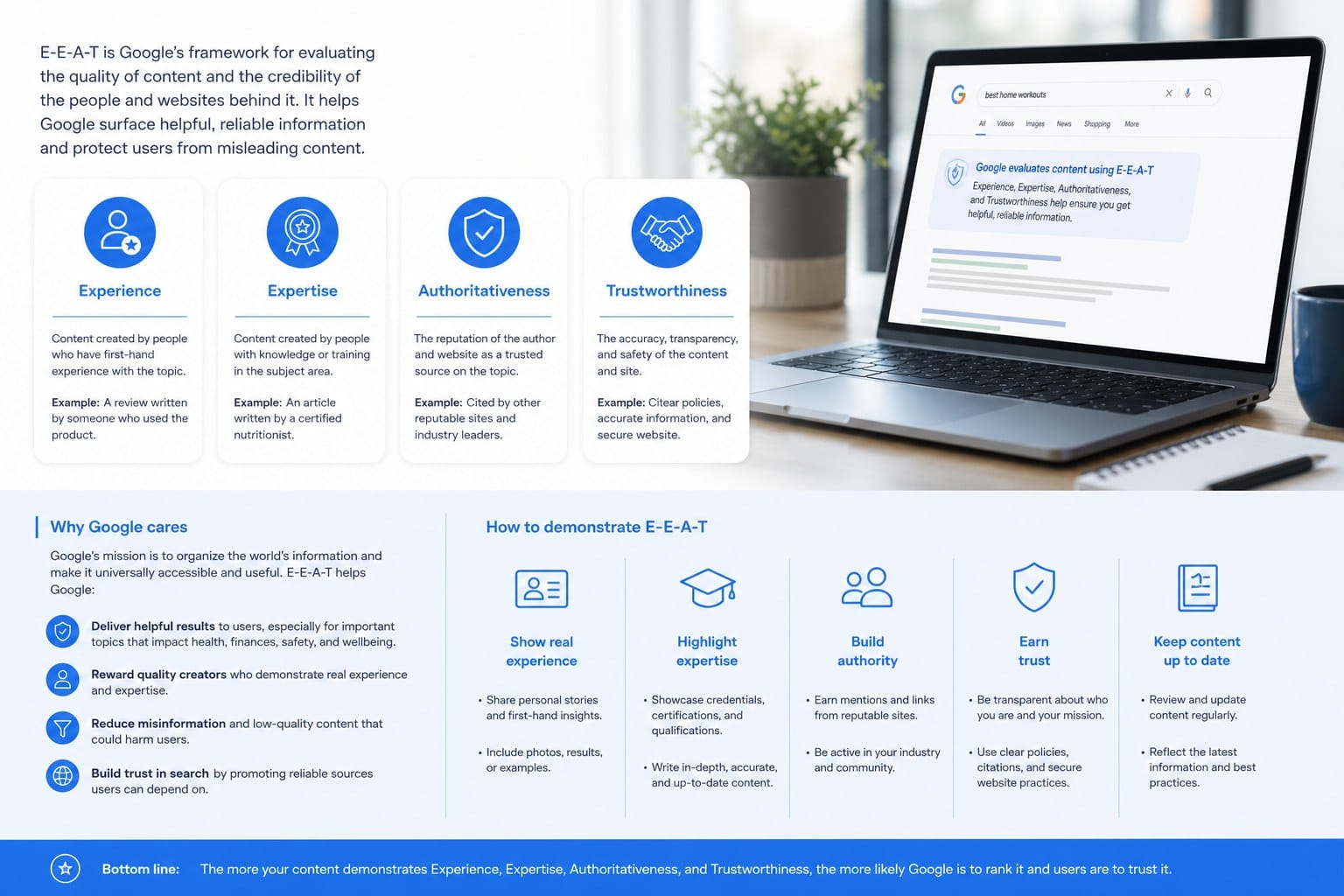
E-E-A-T stands for Experience, Expertise, Authoritativeness, and Trustworthiness. Google introduced the original E-A-T framework years ago in its Search Quality Evaluator Guidelines, and then added the extra E for Experience in December 2022. That second E was not a small tweak. It shifted the entire conversation from credentials on paper to real-world, first-hand knowledge.
Here is what each letter actually means in plain terms.
Experience means you have personally done the thing you are writing about. If you publish a review of a product, have you actually used it? If you write about hiking a specific trail, have your boots actually touched that dirt? Google wants signals that the person behind the content has lived the topic, not just researched it from a distance.
Expertise means you have a meaningful depth of knowledge in your subject area. This does not always require a formal degree. A mechanic who has spent fifteen years rebuilding engines has genuine expertise, even without an engineering diploma. What matters is that your content reflects a level of understanding that goes beyond surface-level summaries.
Authoritativeness means others in your space recognize you as a credible source. Backlinks from respected publications, mentions in industry conversations, author bylines on well-known sites, and even social proof all contribute. Authority is largely built over time, but there are concrete steps you can take to accelerate it.
Trustworthiness ties everything together. Google considers your site's technical signals, such as HTTPS security and accurate contact information, alongside content-level signals like citing sources, being transparent about who you are, and correcting mistakes when they happen. A site that hides its authors or makes it impossible to verify claims scores poorly on trust, regardless of how well the content reads.
So why does Google care so much about all this? The short answer is that Google's business depends on sending users to content that genuinely helps them. When a searcher clicks a result and finds something vague, copied, or just plain wrong, that is a bad experience. Over time, enough bad experiences damage Google's reputation as a search engine. E-E-A-T is Google's way of rewarding content that actually serves people.
It is also worth noting that E-E-A-T is not a direct ranking factor in the sense of a single score you can look up in Google Search Console. It is a framework that human quality raters use to evaluate search results, and those evaluations feed into how Google trains and refines its algorithms. The practical effect is real, even if the mechanism is indirect.
For bloggers specifically, the experience signal is the freshest and most actionable of the four. You already have real-life experience with the topics you choose to write about. The challenge is making that experience visible to both readers and search engines. That is something we will dig into in the next section.
One more thing worth understanding: E-E-A-T is applied differently depending on the topic. A post about your favorite pasta recipe carries less scrutiny than a post about managing blood sugar or choosing a mortgage. Google calls the high-stakes categories YMYL, which stands for Your Money or Your Life. These include finance, health, legal advice, and anything that could significantly harm someone if the information is wrong. If your blog touches YMYL topics, E-E-A-T signals matter even more, and you should treat author credentials and source citations as non-negotiable.
For everyone else, E-E-A-T still matters, but you have a bit more room to establish credibility through demonstrated experience rather than formal qualifications alone. That is genuinely good news for independent bloggers who bring real-world perspective to their content.
Practical ways bloggers can build E-E-A-T signals in 2025
Knowing what E-E-A-T means is one thing. Translating it into daily blogging habits is another. Here are the most effective strategies I have seen work for bloggers who want to build genuine authority without pretending to be something they are not.
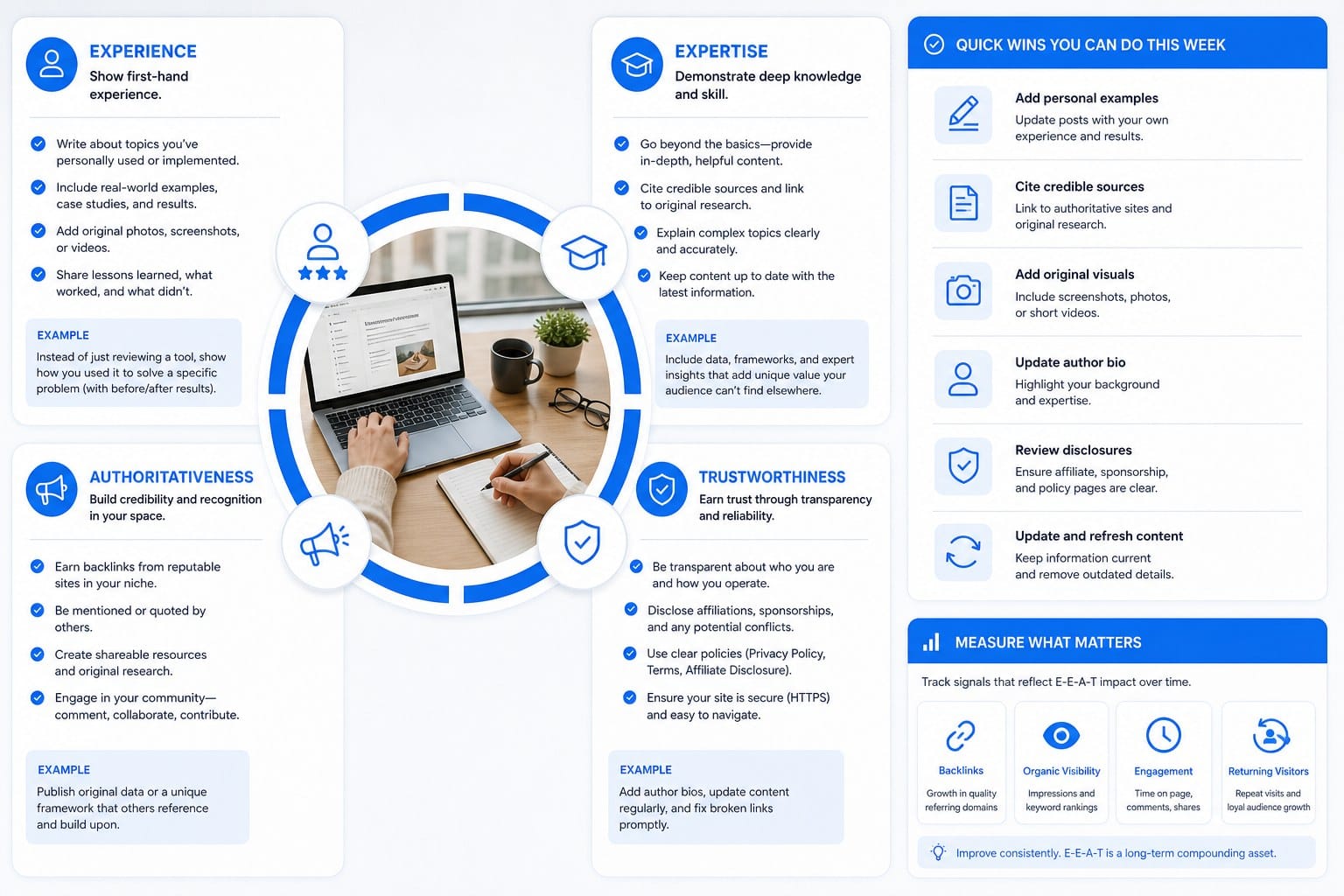
Start with a strong author bio on every post. This sounds basic, but a surprising number of blogs still publish articles with no author information at all. Your bio should say who you are, what you have done, and why you are qualified to write about this topic. Link to your LinkedIn profile, your social accounts, or any published work elsewhere. If you have credentials, mention them. If your authority comes from lived experience, say that plainly. Something like "I have been brewing my own kombucha at home for six years" is a legitimate signal for a fermentation blog.
Add a dedicated author page that expands on your bio. Google's quality raters look for author pages, and a well-built author page gives you more space to demonstrate depth. List your relevant background, link to your best articles, include a photo, and mention any external publications or speaking engagements. Over time, this page becomes a trust anchor for your entire site.
Cite your sources consistently. Whenever you reference a study, a statistic, or an expert claim, link to the original source. Do not just say "research shows that." Say which organization conducted the research and link directly to the paper or report. This signals to both readers and Google that you did the work to verify what you are claiming, rather than just repeating something you saw in another blog post.
Use first-person experience throughout your content, not just in the intro. Describing a specific moment where you faced the problem your reader is now facing makes your content stand out in a sea of generic advice. It also gives Google clear language signals that a real person with real experience wrote this piece. Phrases like "when I tested this" or "based on what I observed" are simple but meaningful.
Add original visuals wherever they make sense. Screenshots from your own tools, photos you took yourself, and charts you built from your own data all send strong experience signals. Stock photos do not do this. An original screenshot of your Google Analytics dashboard inside an article about traffic growth tells a much richer story than a generic image of a laptop.
Build topical authority by covering your subject in depth. A blog that has fifty well-researched articles about sustainable personal finance is going to outrank a blog that has five hundred scattered posts across random topics. Depth beats breadth when it comes to E-E-A-T. Pick your lane and go deep. Create content that covers a topic from multiple angles: beginner guides, intermediate strategies, case studies, comparisons, and FAQ-style posts that address the specific questions your audience types into search.
Good internal linking best practices for blogs that want to rank play a role here too. When you link your newer posts back to older cornerstone content, you signal to Google that your site has depth on a subject. You also help readers find related information, which increases time on site and lowers bounce rate. Both of those are positive signals.
Get mentioned outside your own site. This is the authoritativeness piece, and it is the hardest to manufacture. The best approach is to do something genuinely useful: write original research, publish a data-driven study, or put together a comprehensive resource that other writers in your niche actually want to link to. Guest posting on reputable sites in your space is another legitimate path. Avoid link schemes and paid placements, because Google has gotten quite good at spotting them, and the penalties are not worth the short-term gains.
Maintain accuracy over time. Publishing accurate content once is not enough. Facts change, tools update, laws get revised, and best practices evolve. Set a schedule to audit your older posts and update them when the information shifts. Include a "last updated" date prominently on each post. This is a trust signal that tells readers you are paying attention, and it tells Google your content is fresh and actively maintained.
Be transparent about any commercial relationships. If you earn affiliate commissions from products you recommend, say so clearly at the top of the post. If a brand sponsored a piece of content, disclose it. Transparency is a direct trust signal, and hiding commercial relationships is the kind of thing that erodes credibility fast when readers notice it.
Finally, make your site technically trustworthy. Use HTTPS. Include a real About page with contact information. Have a clear privacy policy if you collect any user data. List a physical location or at minimum a professional email address. These might feel like administrative details, but they contribute to the overall trust picture that Google and your readers form about your site.
The bloggers who struggle with eeat for bloggers 2025 are often the ones who try to game it with superficial changes, like slapping a fake bio on their posts or citing sources they did not actually read. The ones who succeed treat E-E-A-T as a genuine philosophy: write about what you know, show your work, be honest, and keep improving. It takes longer, but it compounds.
How to scale E-E-A-T content without burning out
Here is the tension that every serious blogger eventually runs into. Building real E-E-A-T takes time, effort, and consistency. But consistency is exactly what breaks down when you are managing a blog on top of everything else in your life or business. You cannot build authority with three posts and then disappear for two months. You need to show up regularly.
So how do you maintain quality and volume at the same time, especially when you are not a full-time content team?
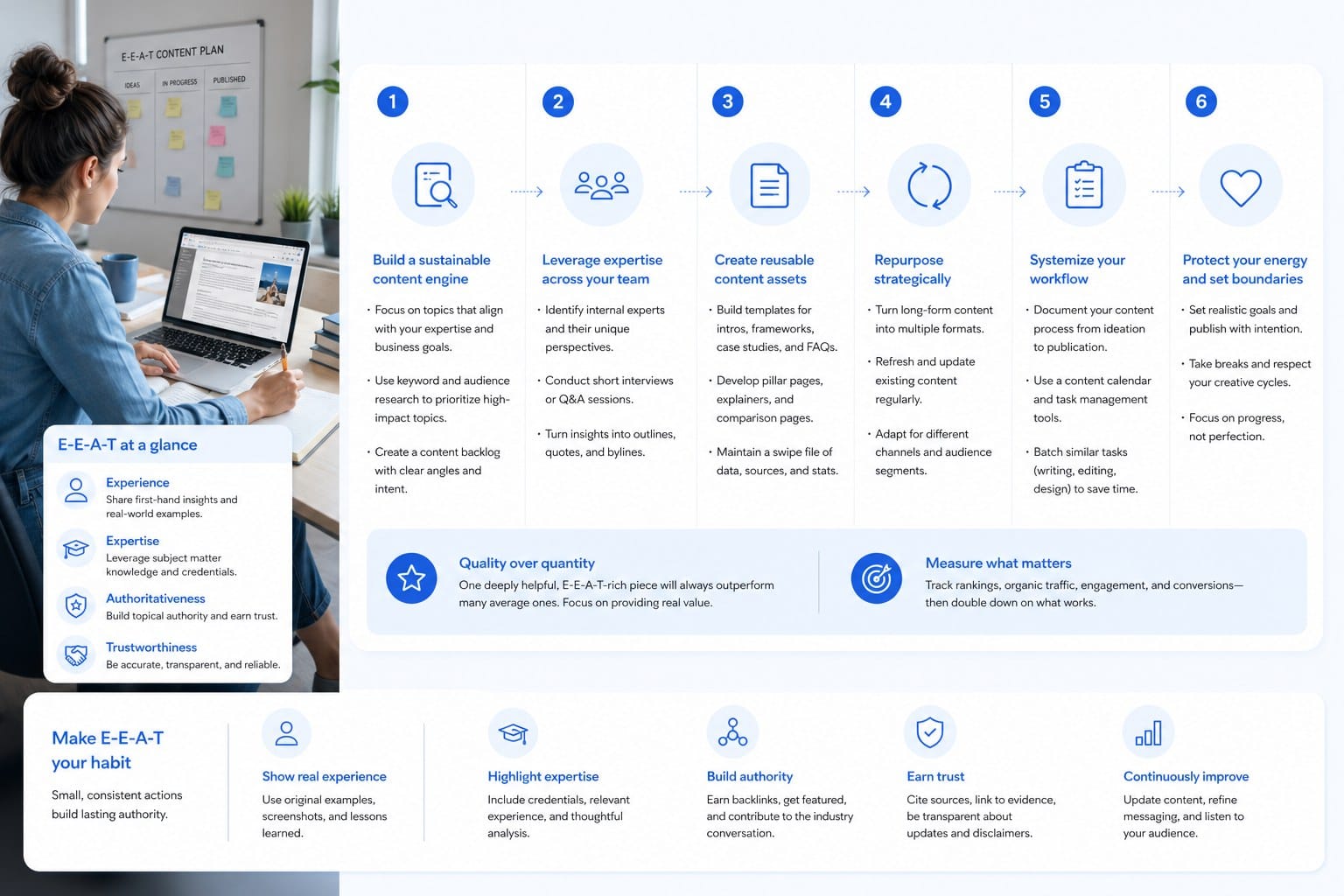
The first step is getting your content strategy right before you write a single word. A lot of bloggers publish reactively, chasing whatever topic feels relevant that week. That approach leads to scattered content that never builds topical authority. Instead, plan your content in advance around a focused set of themes that connect to your core expertise. Map out what you want to cover for the next 30 to 90 days, identify the angles that are underserved in your niche, and sequence your posts so they support each other through internal links.
SERP analysis is one of the best tools for finding those underserved angles. When you study what is already ranking for a keyword, you can spot the gaps: the questions that existing posts do not answer, the depth that competitors skip, the specific user intent that nobody is fully addressing. Learning how to use SERP analysis to uncover blog topics your competitors missed can shift your entire content strategy from reactive to strategic.
Once your strategy is mapped, the writing itself is where most bloggers hit a wall. The options have traditionally been to write everything yourself, which is slow, or to hire freelancers, which is expensive and introduces its own quality control headaches. Before you assume hiring is the answer, it is worth understanding the true cost of outsourcing blog writing to a freelancer. Between briefing, revision rounds, fact-checking, and formatting, the actual time investment is often much higher than bloggers expect.
AI-assisted content workflows have changed this calculation significantly. The key word is assisted. Using AI as a starting point for research, structure, and drafting, then layering in your real experience and editorial judgment, lets you move faster without sacrificing the authenticity that E-E-A-T requires. The experience signals still need to come from you. The first-person anecdotes, the specific examples, the original screenshots, and the genuine expert commentary are things only you can add. But the heavy lifting of research and structure can be accelerated.
This is exactly the problem that tools like Blogtude are built to solve. Blogtude is an AI-powered blog content engine that generates a 30-day content strategy, produces deeply researched long-form articles with on-brand visuals, and automatically publishes to Ghost and other CMS platforms. For independent bloggers, SaaS founders, and small business owners who need consistent blog output without building a full content team, that kind of automated workflow removes the biggest friction point: getting from strategy to published post without dropping the ball on quality.
What makes an AI-powered content engine relevant to E-E-A-T specifically is the research depth it can bring to each post. Shallow content fails the expertise test. Long-form, well-structured content that covers a topic thoroughly from multiple angles passes it. When your workflow produces deeply researched articles by default, you start every post from a stronger baseline than most of your competitors.
That said, AI-generated content still needs your editorial fingerprint to hit the experience and trust signals. Review every draft before it publishes. Add a section where you share a personal example or a specific result you have seen. Check that every cited source is accurate and still active. Update the author bio to reflect your real background. These finishing touches are what separate content that ranks from content that sits.
Consistency compounds in a way that sporadic effort never does. A blog that publishes two well-researched posts every week for a year will almost always outperform a blog that publishes twenty posts in one burst and then goes quiet. Google notices publishing patterns, readers develop habits around them, and your topical authority deepens with every post you add. Any system that helps you maintain that consistency without exhausting yourself is worth serious consideration.
For Ghost CMS users in particular, an integrated solution that handles strategy, content, visuals, and publishing in one workflow means you spend your time on the creative and editorial decisions that actually require your judgment, not on the logistics of getting content from a Google Doc into your CMS with the right formatting and metadata.
Applying eeat for bloggers 2025 is not about tricking Google. It is about becoming the kind of source that genuinely deserves to rank. When you combine a clear topical focus, real first-hand experience woven into your writing, accurate and well-cited information, and consistent publishing over time, you build something that algorithms reward because readers reward it first.
The bloggers who will do well in the next few years are not the ones who chase every algorithm update with surface-level fixes. They are the ones who invest in depth, authenticity, and systems that let them show up reliably. That combination is hard to fake and hard to compete with.
Ready to take the next step?
If you want to build a consistent, high-quality blog without spending every weekend writing, Blogtude handles your 30-day content strategy, long-form articles, and publishing automatically. Visit Blogtude to see how it works and start producing content that actually earns trust.


