
How to use SERP analysis to uncover blog topics your competitors missed

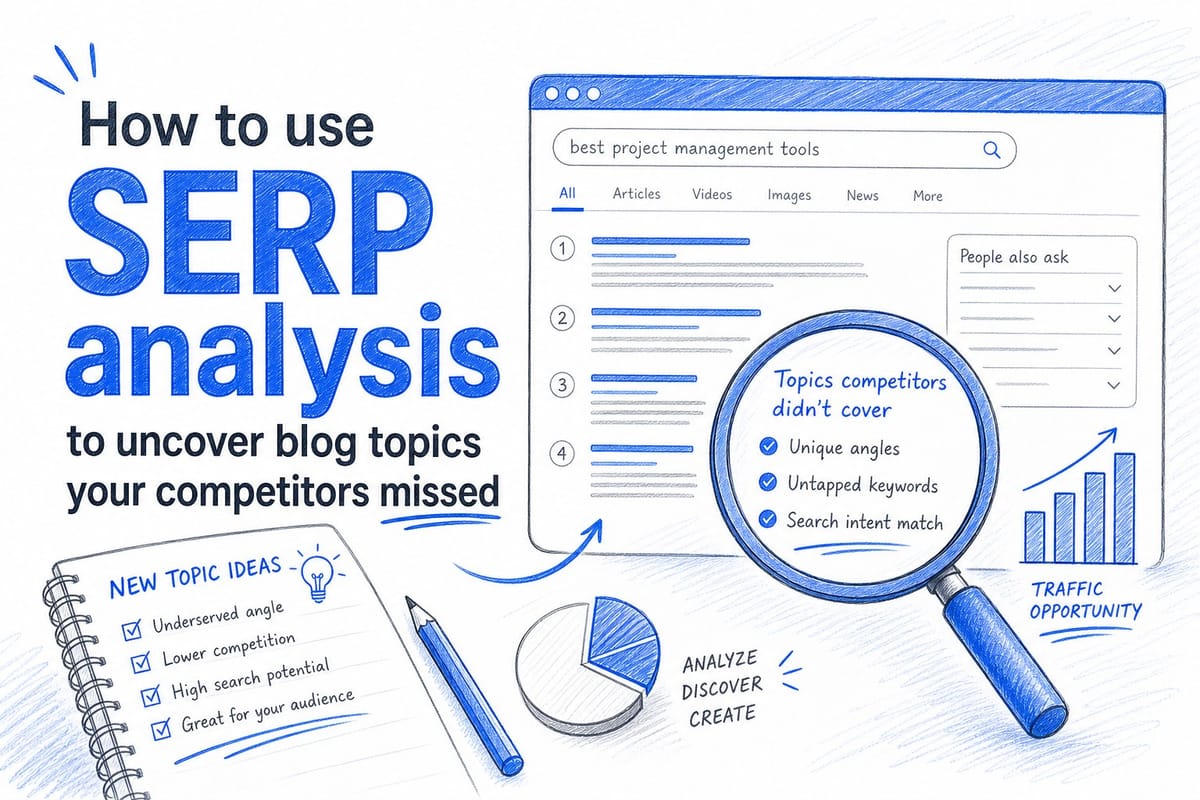
Table of contents
1. What SERP analysis actually tells you about blog opportunities
2. A practical process for finding the gaps competitors left behind
3. Turning your SERP findings into a consistent content pipeline
Finding blog topics that actually rank is harder than most people think. You can brainstorm for hours, plug keywords into a tool, and still end up publishing posts that compete head-to-head with authoritative sites on topics they have covered for years. There is a smarter starting point: the search engine results page itself. When I look at the SERP before I write a single word, I stop guessing and start spotting real gaps. SERP analysis for blog topics is the practice of reading the results Google already shows for a keyword and using what you see to find angles, formats, and subtopics that the ranking pages have left uncovered. This article walks through exactly how to do that, step by step, so you can consistently find topics your competitors missed and turn them into content that earns traffic.
What SERP analysis actually tells you about blog opportunities
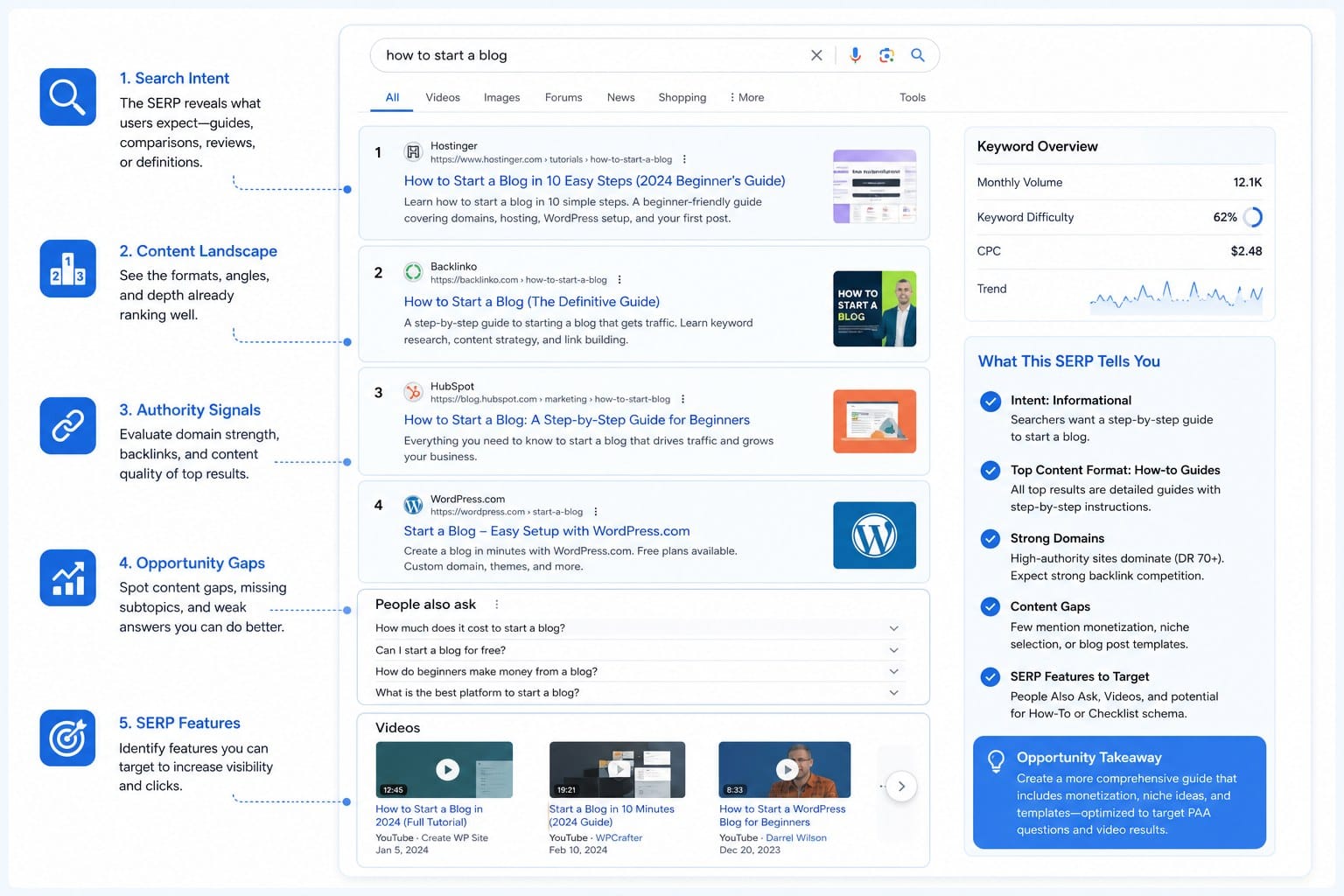
Before you can use SERP analysis for blog topics, you need to understand what the search results page is communicating. Google is not just showing you a list of links. Every element on that page is a signal about what searchers want, what content Google trusts, and where gaps might exist.
Start by looking at the top ten organic results for a keyword you are considering. Ask yourself a few questions as you read through them. What format dominates? If eight of the ten results are listicles, Google has decided that format matches what people expect for this query. If the top results are mostly how-to guides or in-depth explainers, that tells you something different. Matching format matters, but it also means that a well-executed alternative format can stand out if you have a clear reason for using it.
Next, look at the titles. Most titles will cluster around a handful of angles. For a keyword like "best project management tools for freelancers," you will likely see results focused on reviews, comparisons, and top-ten lists. That cluster tells you what the majority of content creators assumed the searcher wanted. But it also reveals what no one bothered to write: the specific case of a solo developer managing client projects, or a freelancer who needs a tool that integrates directly with invoicing software. Those are gaps.
Pay close attention to the featured snippet if one appears. The snippet shows you the exact answer Google pulled from a page to satisfy a quick query. If that snippet is thin, generic, or incomplete, it is an open invitation. Writing a more thorough, better-structured answer to the same question can earn you that snippet position, which typically sits above all other organic results.
Look at the "People also ask" section carefully. These questions are real searches that Google has determined are related to the main query. Each one is a potential subtopic. More importantly, when you click a question and expand it, Google loads additional related questions. You can keep expanding that list almost indefinitely, which gives you a genuine picture of the broader conversation happening around any topic.
Finally, scroll to the bottom of the page and look at the related searches section. These eight to ten phrases represent what searchers commonly look for after conducting the original search. They are often more specific, more actionable, or more niche than the head keyword. That specificity is exactly where smaller blogs and newer sites can compete.
One thing I want to be clear about: SERP analysis is not about copying what ranks. It is about understanding why something ranks and then finding the part of the topic that nobody has addressed well yet. Those two things are completely different activities, and confusing them is the reason so much blog content ends up feeling redundant.
The metadata on ranking pages tells its own story too. If you look at the publication or update dates on the top results, you may find that the majority of content was written three or four years ago. Outdated content is one of the easiest gaps to exploit. A fresher, more current take on the same topic, one that reflects how tools, practices, or industry standards have changed, often outranks older posts even when those posts come from bigger sites.
You do not need a paid tool to do this analysis at a basic level. Open an incognito browser window, search for your keyword, and read the page. Take notes. Look at what the top results cover and start listing what they do not cover. That list becomes your content opportunity map.
A practical process for finding the gaps competitors left behind
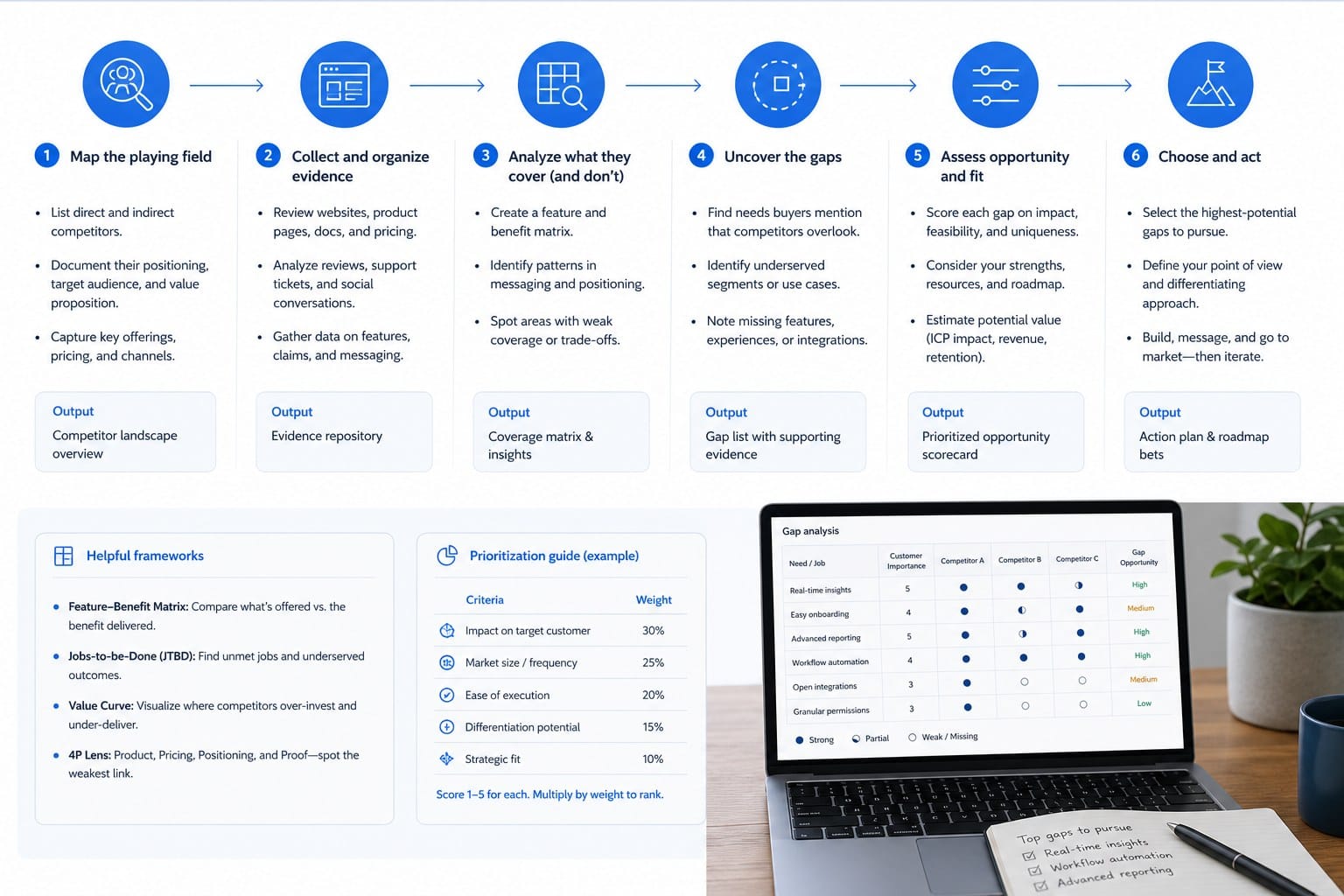
Understanding what to look for is one thing. Having a repeatable process for doing it efficiently is another. Here is the workflow I use to go from a seed keyword to a list of high-opportunity blog topics that have real gap potential.
Step one is keyword clustering before you open a single SERP. Start with a broad topic that matters to your audience. Break it into related subtopics by thinking about the different stages a person goes through when they engage with that topic. Someone interested in "email marketing" might be a complete beginner, or they might be an experienced marketer trying to improve deliverability, or they might be a SaaS founder looking to set up automated onboarding sequences. Each of those is a different cluster with different keywords and different SERPs to analyze. Grouping your seed keywords by intent before you start analyzing saves time and keeps your research focused.
Step two is opening each SERP with a specific analytical mindset. For each keyword cluster, search for the two or three most important terms and read the results with these specific questions in mind.
First: what is the level of specificity on the page? Most content tends toward the general because general content is easier to write and appeals to a wider audience. But general content is also less useful for people who have a specific problem. If you are searching for "how to reduce churn for SaaS" and every result talks about churn in broad strokes, there is almost certainly a gap for a post specifically about churn in the first ninety days after signup, or churn among annual subscribers versus monthly subscribers.
Second: what audience is the content actually written for? A lot of blog content claims to target small businesses but is actually written for enterprise teams with dedicated marketing departments. If you are serving independent bloggers, solo founders, or resource-limited teams, there is frequently a gap for the same information presented in a way that fits how those people actually work.
Third: what questions does the content leave unanswered? I often open the top three or four results on a SERP and read through them looking for sentences like "it depends" or "consult a professional" or "this varies by situation." Those are places where the author ran out of specific knowledge. If I can answer what it depends on, give the specific factors, and walk through a real example, I have a better post.
Step three is cross-referencing with community conversations. Once you have a shortlist of potential gaps from your SERP reading, spend twenty minutes searching for the same topics on Reddit, Quora, and any niche forums or communities your audience uses. If people are asking questions in those communities that the top SERP results do not answer clearly, that confirms the gap is real. It also gives you the exact language your audience uses, which makes your writing more natural and more searchable.
Step four is checking content format gaps separately from topic gaps. Sometimes the topic is covered but the format is wrong. For example, a keyword might be dominated by long written guides when the information would actually be clearer as a structured checklist or a step-by-step walkthrough with specific examples at each step. Format gaps are easier to exploit because you do not need to discover a new angle, you just need to present existing information in a more useful way.
Step five is prioritizing by competition level and your own authority. A gap that exists on a SERP full of results from high-authority domains is a much harder gap to fill than one where the existing results are from mid-sized blogs or newer sites. You can estimate this roughly by looking at the sites that rank. If you see results from Wikipedia, Forbes, and major industry publications dominating the first page, you are dealing with a tough SERP. If the results are from niche blogs and smaller brand sites, you have a real shot at competing.
For growing blogs and early-stage content programs, I recommend focusing your first wave of content on long-tail keywords where the SERP is either dominated by outdated content or by content that only partially addresses the query. These topics build your authority faster because the competition is lower, and they tend to attract readers who are closer to taking a specific action, which makes them more valuable even with lower traffic volume.
One useful test I apply is what I call the "complete answer" check. After reading the top results for a keyword, I ask: if someone read every single one of these articles, would they have a complete, actionable answer to their question? If the answer is no, then writing the post that actually completes the picture is almost always a strong opportunity. That post becomes the one that synthesizes, extends, and goes deeper than anything else on the page.
Searchers who have a problem often read multiple posts trying to piece together a solution. If your post is the one that gives them the complete picture without requiring them to look elsewhere, they remember it. They bookmark it, share it, and link to it. That behavior sends signals to Google that your content is the most satisfying result for that query, which is exactly what drives rankings up over time.
Understanding search intent is a foundational part of this process. If you want to go deeper on how to structure your content once you have identified the gap, how to write a blog post outline around search intent explains how to map your outline directly to what the searcher is actually trying to accomplish.
Turning your SERP findings into a consistent content pipeline
Finding gaps through SERP analysis is only valuable if you can consistently act on what you find. One of the most common problems I see with content programs is that the research phase produces good ideas that never get turned into published posts because writing, editing, formatting, and publishing takes more time than the team has available.
This is where having a system matters as much as having a process.
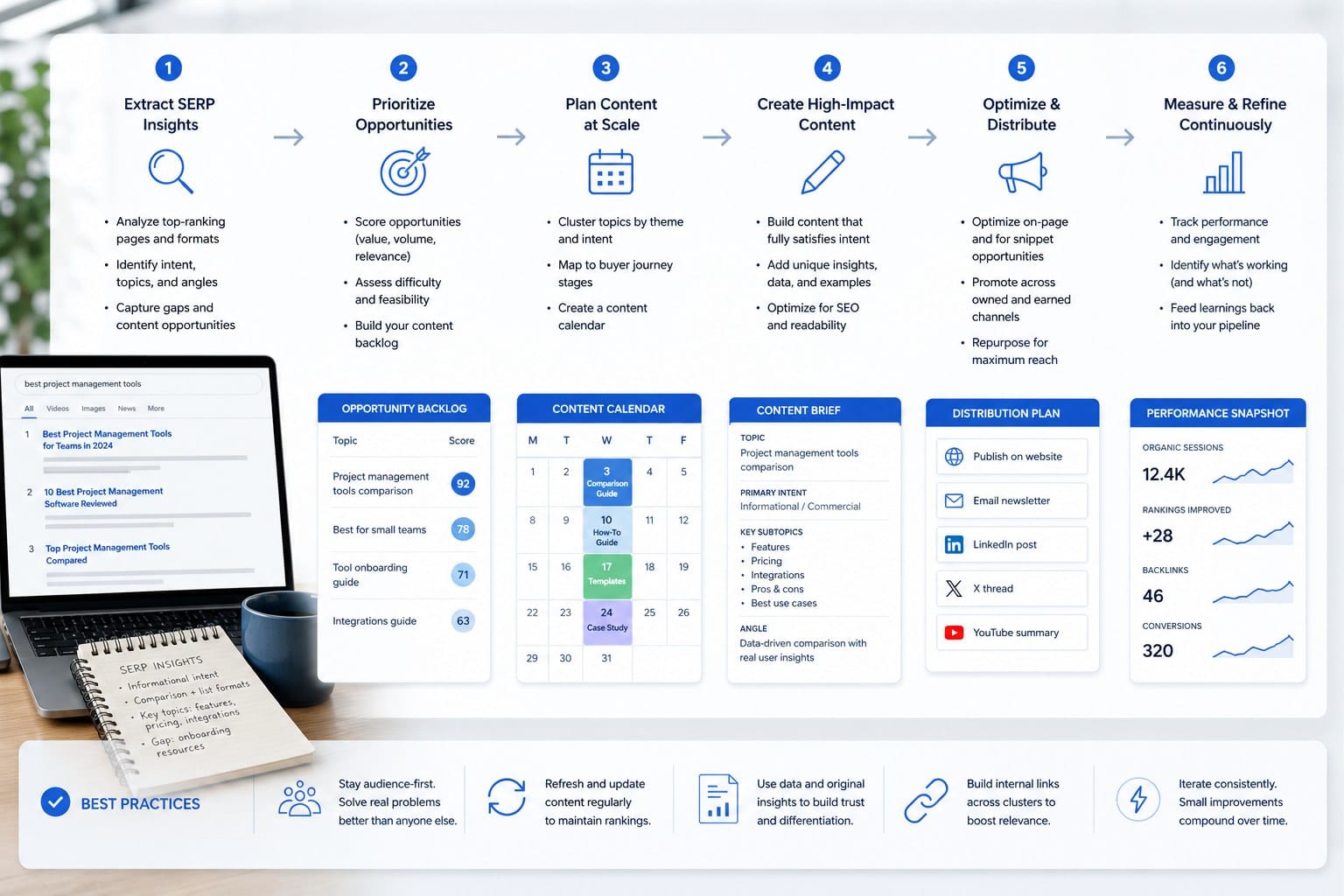
The first part of that system is documentation. Every time you complete a round of SERP analysis, record your findings in a structured format. For each potential topic, note the keyword, the gap you identified, the format you plan to use, the audience it is written for, and why the existing content is insufficient. That structured record becomes your editorial backlog. When you sit down to plan the next month of content, you are not starting from scratch. You are pulling from a documented list of validated opportunities.
The second part is batching your research. SERP analysis done in scattered ten-minute windows is less effective than a focused two-hour session where you move through a whole keyword cluster systematically. I find that batching research by topic cluster once or twice a month gives me enough material to plan a full content calendar without spending time every day trying to figure out what to write next.
The third part is understanding the relationship between your content topics. Blog posts that link to each other around related topics build what SEOs call topical authority. When you do your SERP analysis, look not just for individual topic gaps but for clusters of related gaps. If you can publish five or six posts that all address different angles of the same broad topic, each one pointing to the others where relevant, you give Google a much clearer signal that your site is a genuine authority in that area. That signal lifts all of the related posts over time.
For example, if your niche is productivity for freelancers, your SERP analysis might reveal gaps around time tracking for project-based billing, setting client expectations to avoid scope creep, tools for managing multiple clients simultaneously, and techniques for protecting deep work time. Each of those is a separate post targeting a different keyword. But together, they form a cluster that establishes your blog as a serious resource on freelancer productivity. Internal linking ties them together and helps both readers and search engines navigate the cluster.
The fourth part of a sustainable system is honest about time and capacity. Most independent bloggers, small business owners, and lean marketing teams run into the same wall: research and writing take far more time than expected, consistency breaks down, and the content program stalls. I have seen this happen even when the strategy is solid and the keyword research is done well. The execution gap is real.
This is part of why tools that automate parts of the research and production workflow have become genuinely useful for content programs that need to stay consistent. When you can spend your time on the strategic layer, the SERP analysis and gap identification, and hand off the drafting and publishing to a reliable automated process, you get consistent output without burning through your own time or the true cost of outsourcing blog writing to a freelancer.
Blogtude is built specifically for this workflow. You bring the strategic direction, the audience knowledge, and the competitive insight you get from your own SERP analysis, and Blogtude handles the production layer: generating deeply researched long-form articles, producing on-brand visuals, and publishing directly to Ghost and other CMS platforms on a consistent schedule. It is designed for growing brands that need a 30-day content strategy executed reliably, without requiring a full content team to make it happen.
The fifth part of the system is measuring what works and feeding that back into your research. Not every gap you identify will produce a winner. Some gaps exist because the topic does not have enough search volume to drive meaningful traffic. Others exist because the audience is satisfied by content in a different format you did not consider. Tracking which posts gain impressions, clicks, and rankings over time tells you what kind of gap analysis is producing real results for your specific audience and niche. That feedback loop makes each round of SERP analysis more accurate than the last.
One metric worth watching closely is click-through rate from search results. A post that appears in search results but gets low clicks is usually a signal that the title and meta description are not resonating, not necessarily that the topic was wrong. A post that gets clicks but has high bounce rates is often a signal that the content did not match what the reader expected based on the search result. Both of these are fixable, and spotting them early lets you update the post before it loses too much ground.
Finally, keep revisiting SERPs for your best-performing topics every six months. Search results change. New competitors enter the space. Featured snippets shift. People also ask questions evolve as search behavior changes. A SERP that showed a clear gap eighteen months ago may now be well-covered, while a different angle on the same topic has opened up. Regular re-analysis keeps your content strategy current and ensures you are always working on the opportunities that actually exist right now rather than the ones that existed when you first mapped the space.
If your content is getting organic traffic but not converting that traffic into email subscribers, leads, or customers, the gap might not be in your topic selection at all. It might be in how your content is structured and what it asks readers to do. Why your blog content isn't converting (and how to fix it) goes into specific detail on that problem and how to address it without starting over from scratch.
SERP analysis for blog topics is one of the most underused research methods available to content creators, precisely because it requires you to read carefully and think critically rather than just pulling numbers from a keyword tool. The time you invest in it compounds. Each gap you identify and fill makes your site more authoritative, more complete, and more useful than the alternatives. That is the foundation of a blog that builds organic traffic over time rather than chasing it.
Ready to take the next step?
If you are ready to turn your SERP research into a consistent stream of published, SEO-driven content without doing all the writing and publishing yourself, Blogtude can handle the production layer for you. Visit blogtude.com to see how the 30-day content strategy and automated publishing workflow can keep your blog moving forward every week.


