
How to write a blog post outline around search intent

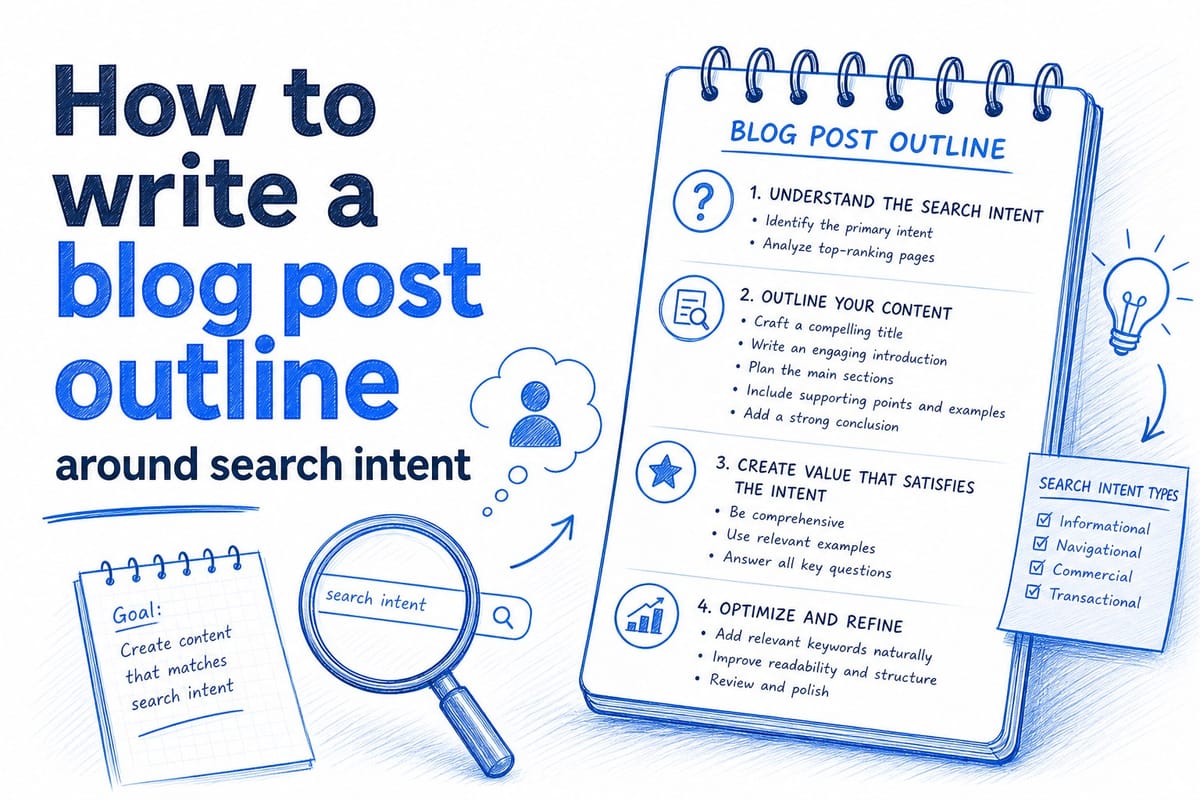
Table of contents
1. Understanding search intent before you write a single heading
2. How to structure your outline so it serves the searcher at every stage
3. Writing section headings that do real work for both readers and search engines
Most blog posts fail before a single word gets written. The problem usually isn't the writing itself. It's the outline. More specifically, it's an outline built around what the writer wants to say instead of what the reader actually needs. When I build a blog post outline around search intent, the whole process changes. The post gets easier to write, the structure makes more sense, and the finished article tends to rank because it genuinely answers what someone searched for. In this guide, I'll walk through exactly how to approach blog post outline search intent the right way, from figuring out what a searcher actually wants to organizing your sections so they deliver it.
Understanding search intent before you write a single heading
Search intent is the reason someone types a query into Google. It sounds simple, but most writers skip this step entirely. They pick a keyword, open a blank document, and start brainstorming sections based on what they know about the topic. That approach produces content that's technically accurate but structurally wrong for the person searching.
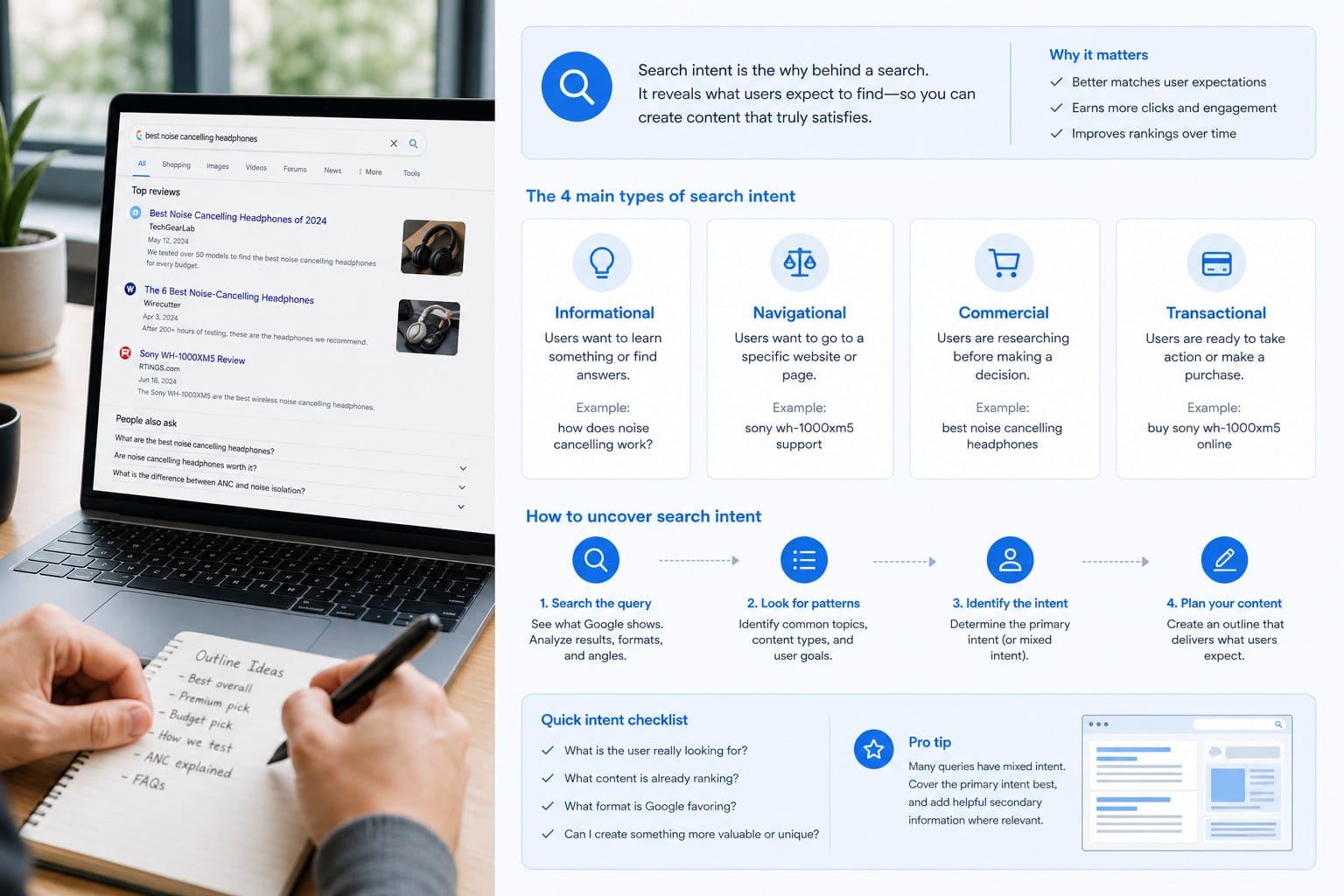
There are four main types of search intent, and knowing which one applies to your keyword shapes everything about your outline.
Informational intent means the searcher wants to learn something. Queries like "how does compound interest work" or "what is search intent" fall here. The person isn't ready to buy. They want a clear explanation.
Navigational intent means the searcher wants to find a specific page or site. These queries usually include a brand name or product name. You don't need to build content around navigational queries most of the time, because the person already knows where they're going.
Commercial investigation intent means the searcher is comparing options before making a decision. Queries like "best project management tools for small teams" or "Notion vs Obsidian" fall here. The person wants enough detail to make a smart choice.
Transactional intent means the searcher is ready to take action. Queries like "buy noise-canceling headphones" or "sign up for email marketing software" fall here. The content needs to support a decision, not explain a concept from scratch.
Once you identify the intent behind your target keyword, you can build an outline that matches what the reader expects to find. Google is very good at detecting mismatched intent. If you write a transactional product page for a keyword that's clearly informational, it won't rank well, no matter how well-written the copy is.
Here's a practical way to identify intent without overthinking it. Search your keyword in Google and look at the top five results. Ask yourself: Are these articles or product pages? Are they long guides or short listicles? Do they include prices and calls to action, or do they focus on definitions and explanations? The pages Google already ranks are the clearest signal you have about what type of content it wants to serve for that query.
For a keyword like "blog post outline search intent," the top results are almost certainly guides or tutorials. The searcher wants to understand how to do something, which puts this squarely in informational territory. That tells me the outline should teach, step by step, rather than sell.
Another useful signal is the People Also Ask box. Those questions represent real related searches, and they often reveal sub-topics the searcher cares about. If "what is search intent" and "how do I find search intent" both appear as related questions, those topics deserve their own sections or at least clear coverage inside the outline.
One mistake I see often is confusing keyword intent with topic breadth. A keyword can be narrow but still require a fairly long article to satisfy intent fully. The outline isn't just about matching intent in a general sense. It's about covering the topic deeply enough that the reader doesn't need to go back to Google and search again. When a reader finishes your post and has everything they came for, that's the goal.
It also helps to think about who is searching. A SaaS founder researching content strategy has different background knowledge than an independent blogger just starting out. Both might search similar keywords, but the depth and tone of the content they need differs. If your target audience skews toward beginners, your outline needs more foundational explanations. If they're experienced marketers, you can skip the basics and move faster into practical technique.
Once you know the intent and the audience, you have the two foundational inputs your outline needs. Everything else builds from there.
How to structure your outline so it serves the searcher at every stage
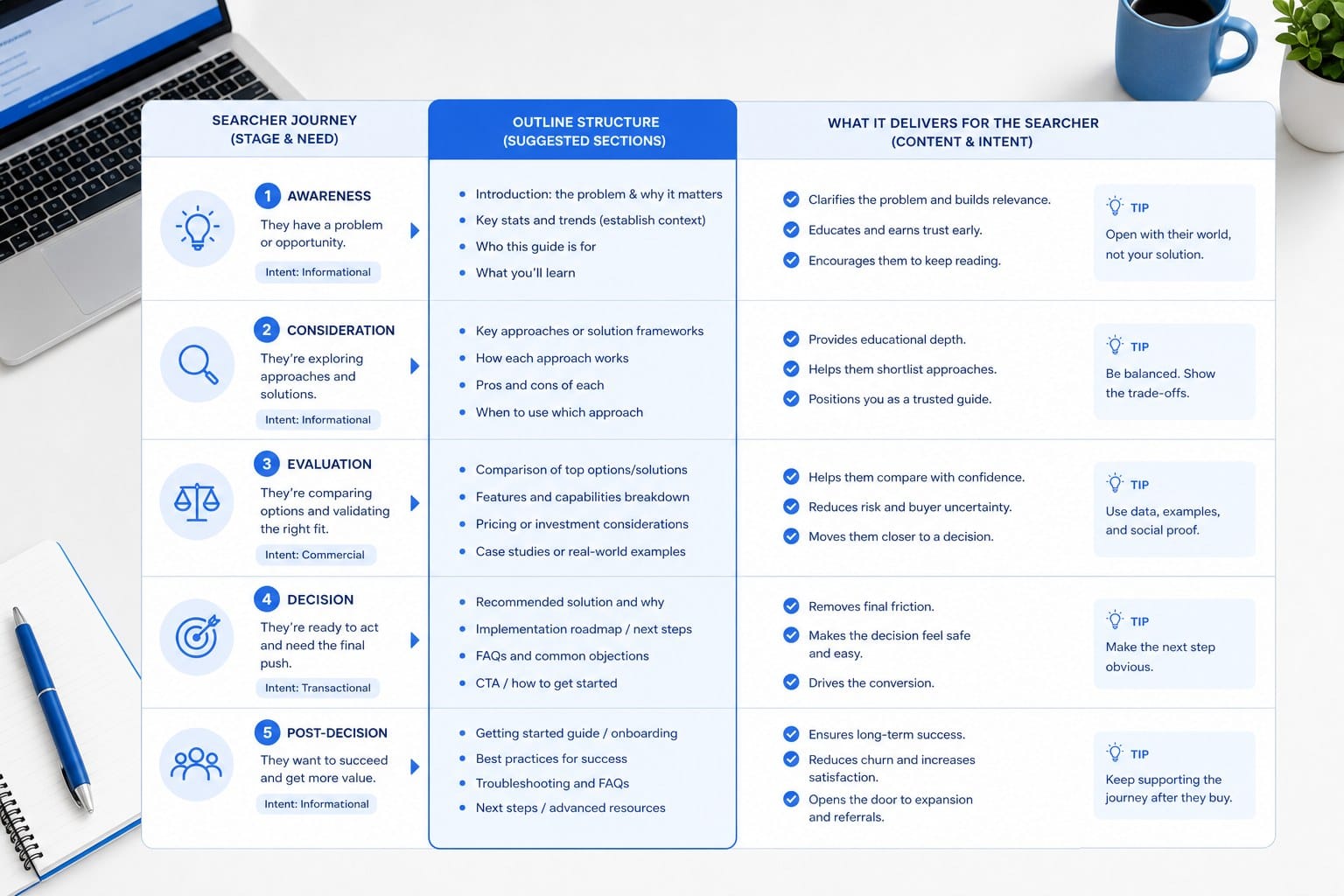
A good outline is not just a list of sections. It's a logical path that takes the reader from the question they arrived with to a clear answer they can use. The structure should mirror how a real person thinks through the problem, not how a writer organizes a topic for their own convenience.
I structure my outlines in three layers: the hook and context, the core instruction or argument, and the actionable takeaway. Not every post uses all three explicitly, but every good post addresses them in some form.
The hook and context layer is where the intro and the first major section live. Its job is to confirm to the reader that they're in the right place. This is especially important for informational content. The searcher has a question. They clicked your link from several options. Within the first two or three paragraphs, they need to feel confident they found a credible answer. If your opening paragraphs are vague or spend too much time on background the reader doesn't need, they'll leave.
For a post targeting blog post outline search intent, the hook should acknowledge the problem directly. Most people who search that phrase have tried building outlines that didn't work. They've written posts that didn't rank. They want a process that solves that. Starting with that pain point builds immediate relevance.
The core instruction layer is where most of your sections live. This is the part of the post that does the actual teaching, explaining, or comparing, depending on intent. Each section should have a clear job. If a section doesn't serve the reader's primary question, it doesn't belong in the outline.
Here's a reliable test I use: read each section heading and ask, "If this section were missing, would the reader still get what they came for?" If the answer is yes, cut the section or fold its content into a section that does matter. Padding an outline with tangential sections hurts the post. It dilutes the most important content and frustrates readers who are scanning for specific answers.
Let me give you a concrete example. If I'm outlining a post on blog post outline search intent, here's what the core sections might look like:
Section one covers what search intent is and how to identify which type applies to a keyword. This is foundational knowledge the reader needs before they can build a useful outline.
Section two covers how to translate that intent into a logical structure, including how to decide on the number of sections, the order of ideas, and how to handle related subtopics that show up in SERP features like People Also Ask.
Section three covers the actual writing of section headings, how to make them descriptive enough to guide both the reader and the writer, and how to avoid vague headings that don't signal clear value.
That structure works because it mirrors the order of thinking a reader would naturally follow. You can't structure an outline until you understand intent. You can't write strong headings until you have a structure. Each section earns its place.
The actionable takeaway layer is where the post closes. This is where you give the reader something they can do immediately. For informational posts, this might be a checklist, a template, a decision framework, or a clear next step. The reader should finish the post knowing exactly what to do next. If they finish reading and feel uncertain about how to apply what they learned, the outline didn't do its job.
A few structural principles I follow across almost every outline:
Front-load value. Don't bury the most useful information at the bottom of a long introduction. Readers scan. They hit the back button fast. Put something genuinely useful early.
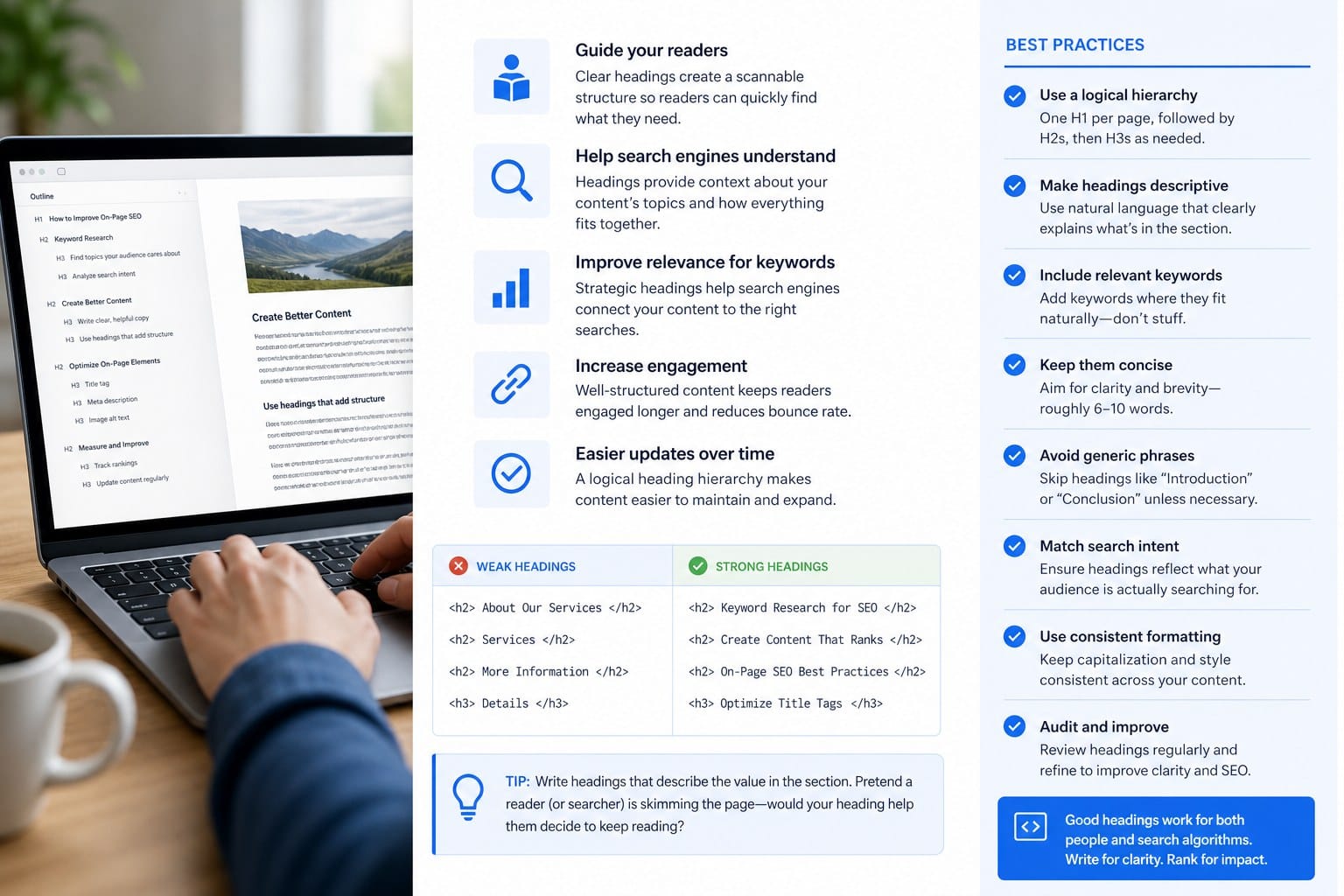
Use H2 headings for major sections and H3s for subsections within those sections. This hierarchy matters for accessibility, for SEO, and for scanability. A reader should be able to read only the headings and come away with a rough sense of the article's argument.
Keep section lengths proportional to their importance. If one section covers the most critical step in a process, it should be the longest and most detailed section. A section that covers a secondary point should be shorter. Uniform section lengths often signal that the writer filled space rather than prioritizing the reader's needs.
Address objections and follow-up questions inside the outline. When I search a keyword and find related questions in the SERP, I add the most relevant ones to the outline as subsections or as explicit callouts within existing sections. This increases the chance that my post satisfies the full range of questions the reader might have, which keeps them on the page longer and signals quality to Google.
Choosing the right blog niche is part of this same strategic thinking. If your blog lacks a focused niche, your outline decisions become harder because you're trying to serve too many audiences at once. I'd recommend reading How to choose a blog niche for long-term SEO growth if you're still in the early stages of defining what your blog is about. A clear niche makes intent-matching much more straightforward.
Finally, think about reading level and density as you outline. A post targeting experienced developers can assume more background knowledge and move through concepts faster. A post targeting small business owners who are new to content marketing needs more context, more plain-language definitions, and shorter sections. Your outline should reflect those expectations because they affect how much content belongs in each section, not just what content to include.
Writing section headings that do real work for both readers and search engines
The headings in your outline are more important than most writers realize. They're not placeholders you fill in before you start drafting. They're the skeleton of the post, and if the skeleton is weak, the whole structure collapses.
A good section heading does three things at once. It tells the reader what they'll learn in that section. It guides the writer on exactly what to cover and what to leave out. And it signals relevance to search engines without sounding like it was written for a robot.
The most common mistake I see in outlines is vague headings. Something like "What is search intent?" is passable, but "Understanding search intent before you write a single heading" is better because it adds context about when this knowledge matters and why. Specificity makes headings more useful.
Here's a pattern that helps: write your heading as a promise. If the heading says "How to identify the type of intent behind any keyword in under five minutes," the reader knows exactly what they're getting and can decide if they need that section. The writer knows exactly what the section has to deliver to fulfill that promise. A vague heading like "Keyword intent basics" makes neither commitment.
Let me walk through a few real examples of weak headings turned into stronger ones.
Weak: "Introduction to outlines." Stronger: "Why your outline structure determines whether a post ranks or gets ignored."
Weak: "Types of search intent." Stronger: "The four types of search intent and how each one changes what your outline needs to include."
Weak: "Tips for better content." Stronger: "Three things every section heading needs to do for the reader and the search engine at the same time."
Notice that the stronger versions are longer but also clearer. They cost the reader one extra second to read and save them the confusion of wondering whether the section is relevant to their question.
For SEO purposes, your H2 and H3 headings should naturally include relevant language from the topic, but don't force keywords into headings where they don't fit. Google reads headings as context signals. If the heading accurately describes what the section covers and the section covers something searchers care about, the SEO value takes care of itself.
One approach I find useful is to write the headings first, then step back and read only the headings in sequence. They should tell a coherent story on their own. If reading just the headings makes the article's argument clear, the structure is strong. If the headings feel disconnected or jump around, the outline needs reorganization before you write a single paragraph.
This heading-first approach also helps with a common content marketing problem: articles that cover a topic but don't have a point of view. A post that just lists information without a perspective is forgettable. When you write headings as promises and organize them to build toward a conclusion, the post naturally develops an argument. That argument is what makes readers trust you and come back.
For content created or assisted by AI tools, this structural clarity becomes even more important. AI-generated drafts can produce fluent prose, but if the outline feeding the AI is weak, the output will be padded and unfocused. Google's quality guidelines care about whether content demonstrates genuine expertise and actually helps the reader, which is why a strong intent-driven outline is the foundation of quality content, regardless of who or what does the writing. If you're thinking about using AI for blog content and wondering whether it can meet Google's standards, Can AI blog content meet Google's quality guidelines covers that question in detail.
Another heading-related decision that comes up in outlining is whether to use question-format headings. Questions work well when the keyword itself is a question or when the section directly answers a common reader question. "What does search intent mean for my outline?" is a natural question-format heading that works. But not every heading needs to be a question. Mixing formats based on what fits the content is better than forcing every heading into the same mold.
Once your headings are written and your sections are ordered, do one final check against the original search intent. Read the keyword again. Read your heading sequence. Ask: if a real person searched this keyword and landed on a post with this structure, would they find what they were looking for? Would they need to search again after reading it? If the answer to the first question is yes and the second is no, the outline is ready.
Publishing consistently matters too. A single well-structured post won't build organic traffic on its own. The brands and bloggers I see succeed with SEO are the ones publishing multiple intent-matched posts every month, building topical authority over time. That's a hard output to sustain manually, which is exactly why tools that handle the strategy and production layer exist. If you're running on Ghost CMS and thinking about how to maintain consistent publishing without burning out, Ghost CMS for startups: what to know before you commit is worth reading before you set up your workflow.
The outline is where your content strategy becomes real. Get the intent right. Build a structure that serves the reader's full question. Write headings that make promises worth keeping. Do those three things and the writing that follows will be faster, cleaner, and more likely to earn the rankings you're working toward.
Ready to take the next step?
Building outlines manually for every post is one of the most time-consuming parts of content production. Blogtude handles the entire process, from identifying search intent for your target keywords to generating structured, deeply researched long-form articles and publishing them directly to your CMS. If you want consistent, intent-driven blog content without the manual effort, visit Blogtude to see how the platform works.


