
Why your blog content isn't converting (and how to fix it)

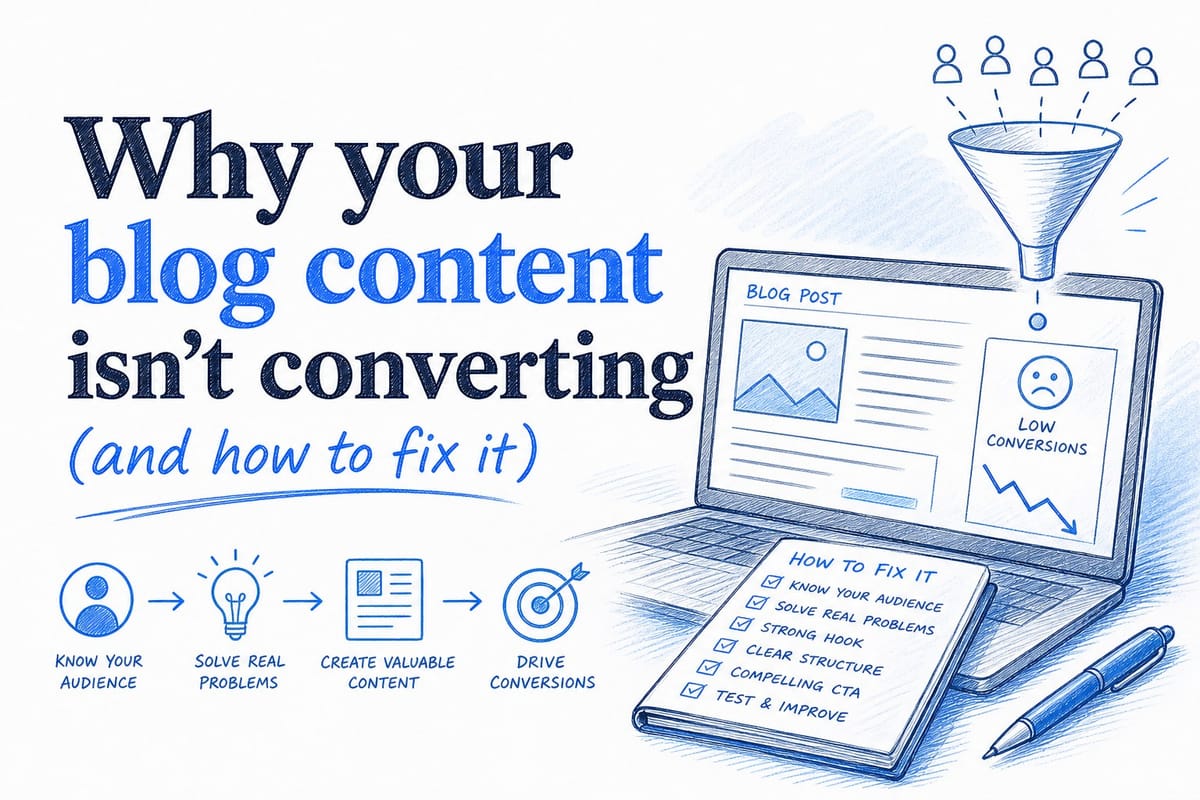
Table of contents
1. The real reasons your blog content is not converting
2. How to diagnose where your conversion problem actually lives
3. Practical fixes that actually move conversion rates
You put real effort into your blog. You research topics, write the posts, hit publish, and then wait. Traffic trickles in, people land on your pages, and then they leave without doing anything. No email sign-ups, no demo requests, no purchases. If that sounds familiar, you are not alone, and the problem is almost never about writing quality. Blog content not converting is one of the most common frustrations I hear from founders, marketers, and independent creators alike. The good news is that the causes are specific and fixable. Let me walk you through what is actually going wrong and what to do about it.
The real reasons your blog content is not converting
Most people assume low conversions mean bad writing. In reality, the writing is usually the last thing that needs fixing. The bigger problems live upstream, in the strategy, the audience targeting, and the structure of the content itself.
You are attracting the wrong readers
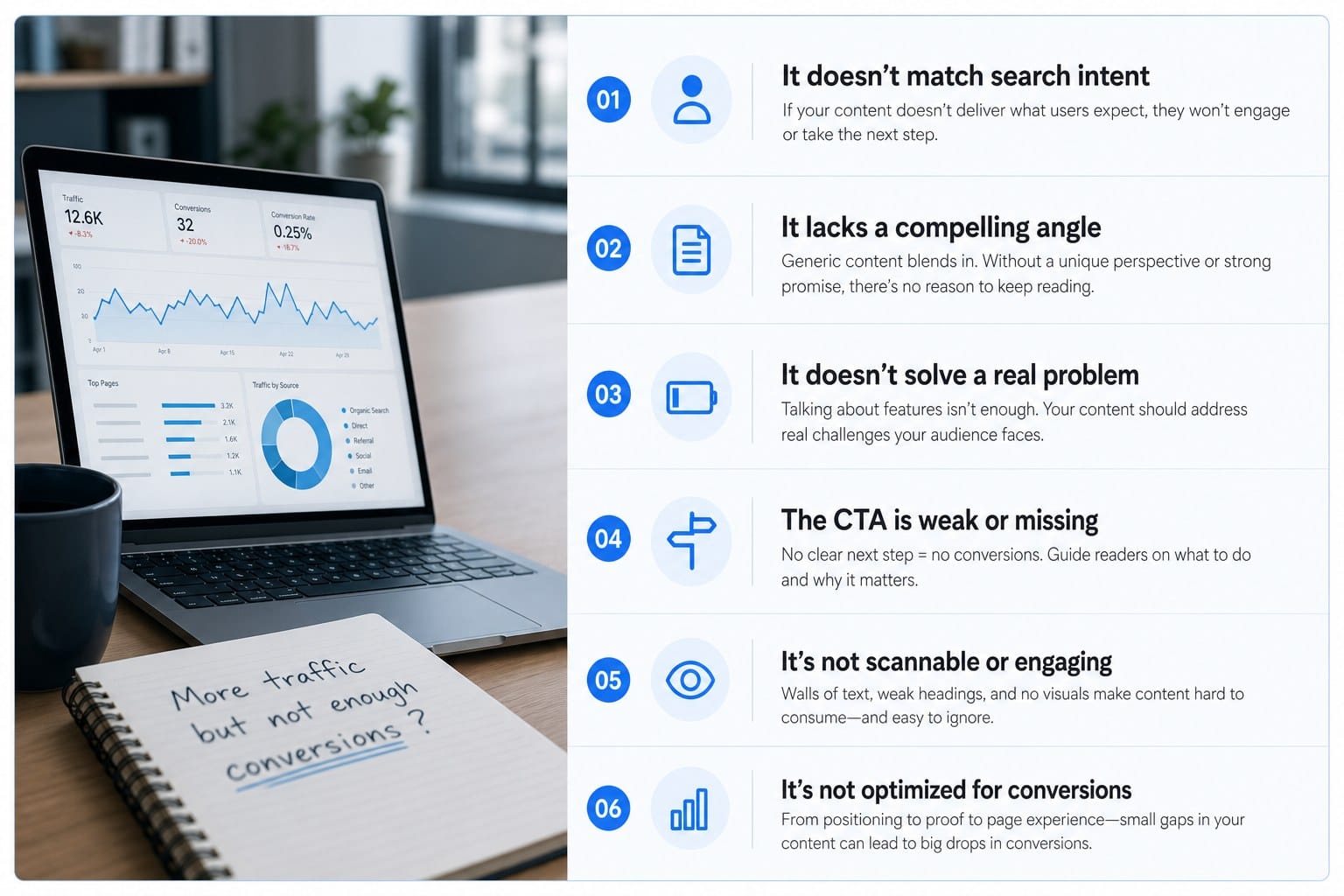
This is the most common culprit. If you write a post titled 'What is email marketing?' and you are trying to sell an advanced email automation tool, you are pulling in beginners who are nowhere near ready to buy. They read the post, get what they need, and leave. Your traffic numbers look fine, but conversions stay flat.
The mismatch between reader intent and your offer kills conversions before a person even finishes the introduction. Every blog post lives at a specific point in the buyer journey. Informational posts attract people who are just learning. Comparison posts attract people who are actively evaluating options. Bottom-of-funnel posts, like case studies, reviews, and 'best X for Y' posts, attract people who are close to making a decision.
If you want conversions, you need more content that matches the intent of someone ready to act, not just someone curious about a topic.
You are writing about yourself, not your reader
I see this constantly. A blog post opens with a company announcement, spends three paragraphs on features, and ends with a generic 'learn more' link. The reader feels like they stumbled into a sales brochure rather than a resource that helps them.
People do not convert because they like your company. They convert because they believe your product or service will solve a specific problem they have right now. Every sentence in your post should connect back to that problem. What is keeping your reader up at night? What do they need to understand before they can move forward? Lead with that, and your offer becomes a natural next step instead of an interruption.
Your content lacks a clear next step
Here is a scenario I run into often. Someone publishes a genuinely helpful 2,000-word post. The information is solid. The reader finishes it, thinks 'that was useful,' and closes the tab. Why? Because the post never told them what to do next.
A blog post without a clear call to action is a conversation with no conclusion. You spent all that time earning the reader's attention and trust, and then you let them walk away without giving them a path forward. That path does not have to be aggressive. It can be as simple as pointing them to a related article, inviting them to a free trial, or asking them to subscribe to your newsletter. The point is that you have to ask.
Research consistently shows that readers follow instructions when those instructions are specific. 'Click here' performs worse than 'Download the free checklist.' 'Learn more' performs worse than 'See how we helped this startup double their organic traffic in 90 days.' Be direct about what you want the reader to do and why it benefits them.
Your content is not consistent enough to build trust
One well-written post does not build an audience. Trust comes from repeated, reliable contact over time. When a reader finds your blog, one of the first things they do is scroll through your archives to see if you publish regularly. If they find a burst of posts from eight months ago and nothing since, they assume you are not actively running the business. That assumption kills conversions.
Consistency also matters for SEO. Search engines reward sites that publish fresh, relevant content on a regular schedule. A single strong post can rank for a while, but a consistent publishing schedule compounds over time, bringing in more organic readers who are already warmed up by your content before they ever reach your offer.
This is where a lot of small teams and solo founders hit a wall. Writing one post a month is manageable. Writing four or more per month, while also running the rest of the business, is not. That gap between what is needed and what is humanly possible is exactly why blog content not converting is such a persistent problem for growing brands.
Your content does not match search intent at a structural level
Even when you choose the right keywords, you can still get the structure wrong. Search intent is not just about the topic. It is about the format, depth, and angle a reader expects when they type a query.
If someone searches 'how to reduce churn for SaaS,' they expect a how-to guide with actionable steps. If you publish a thought leadership essay on the philosophy of customer retention instead, your bounce rate will be high because the content does not match what they came looking for.
I wrote more about how to get this right in How to write a blog post outline around search intent, which walks through how to align your post structure with what readers actually expect to find. Getting this right is one of the highest-leverage things you can do to improve both rankings and conversions at the same time.
How to diagnose where your conversion problem actually lives
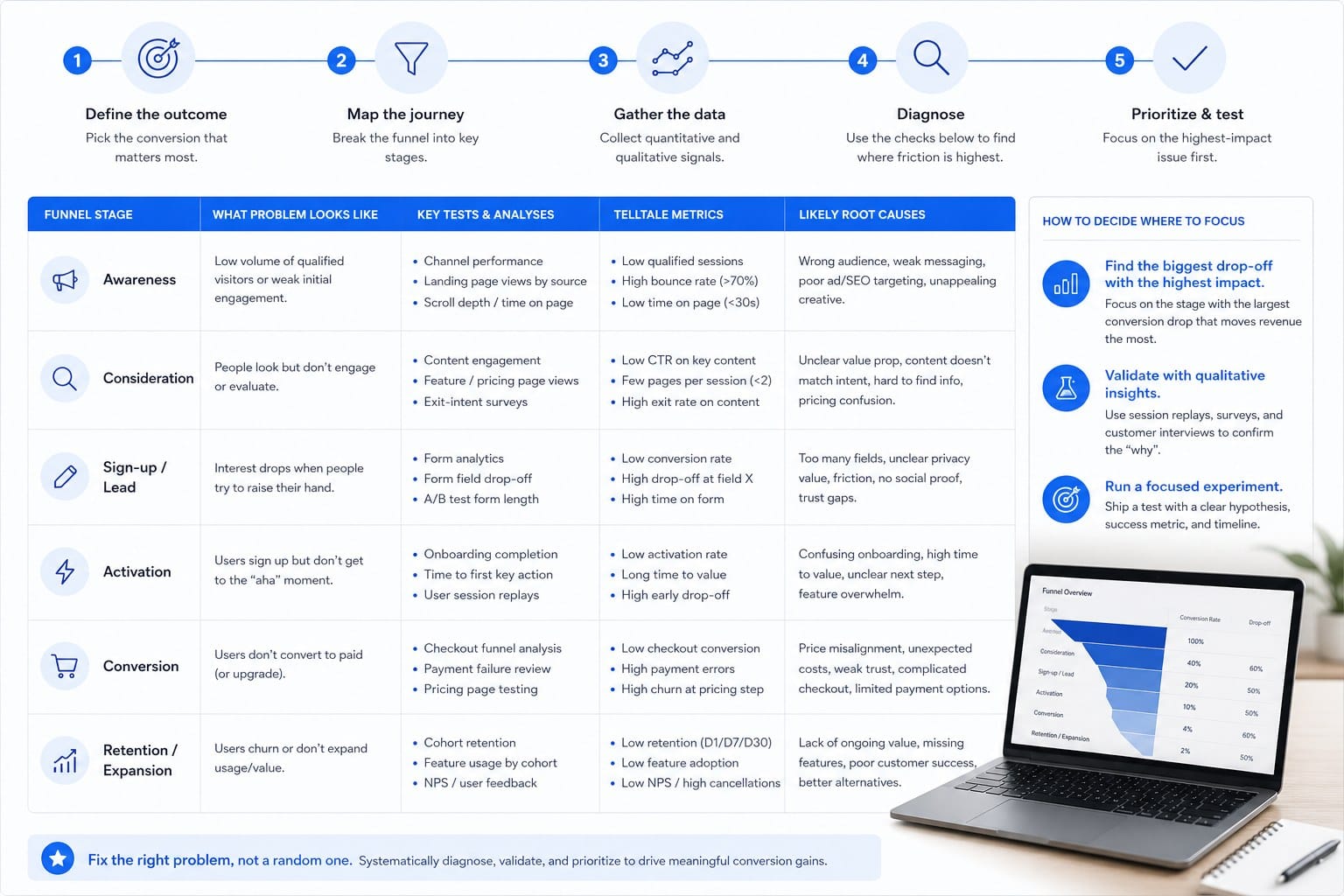
Before you start rewriting posts or overhauling your CTA strategy, you need to figure out where exactly things are breaking down. Fixing the wrong thing wastes time and can make the situation worse.
Start with your analytics data
Open up Google Analytics or whatever analytics tool your CMS uses and look at a few specific numbers for each blog post:
- Average time on page - Bounce rate - Scroll depth (if you have it set up) - Click-through rate on any links or CTAs within the post
High bounce rates combined with low time on page usually mean one of two things. Either the post is attracting readers who are not a good fit for your offer, or the introduction is not compelling enough to make them stay. High time on page with low conversion rates is a different problem. It usually means the reader is engaged but not sure what to do next, which points to a weak or missing call to action.
Scroll depth tells you where people stop reading. If most readers drop off at 30 percent of the page, your post may be losing momentum early, or the topic may not be as interesting to your audience as you thought.
Check which posts are already converting
If you have any conversions happening at all, find out which posts are driving them. Look at the content, the structure, the topic, and the CTA placement. You are looking for patterns. Are they all comparison posts? Are they all posts that target a very specific problem? Do they all have a lead magnet or a free tool offer?
Once you spot the pattern, replicate it. Write more posts that look like your winners. This is one of the fastest ways to improve conversion rates without spending hours guessing.
Audit your existing CTAs
Go through your most-trafficked posts and read every call to action. Ask yourself:
- Is this CTA relevant to the topic of this post? - Is it specific about what happens when I click? - Does it connect the reader's problem to the solution I am offering? - Is it placed where a reader who is engaged would naturally see it?
A lot of blogs use the same generic CTA on every post, something like 'Want to grow your business? Contact us today.' That kind of CTA has no connection to what the reader just spent ten minutes reading. It feels like an interruption rather than a natural next step.
The best CTAs feel like a logical continuation of the post. If your post is about choosing a blogging niche, your CTA might point to a free niche research checklist or to your content strategy tool. If your post is about Ghost CMS, your CTA might invite the reader to see how your platform integrates with Ghost directly. The more closely the CTA connects to the specific problem the post addresses, the higher the conversion rate.
Look at your traffic sources
Not all traffic converts at the same rate. Organic search traffic tends to convert better than social media traffic because search visitors are actively looking for something specific. Social visitors often land on a post by accident or out of curiosity, which means they have lower intent.
If most of your blog traffic comes from social shares and very little comes from organic search, that alone can explain low conversions. The fix is to build out a stronger SEO strategy so that more of your readers are people who went looking for what you offer. Picking the right niche and building authority in that space over time is a foundational part of that strategy. I covered this in more depth in How to choose a blog niche for long-term SEO growth.
Check your page speed and user experience
This one surprises people. A post can have great writing, a clear CTA, and the right audience, and still not convert if the page loads slowly or looks broken on mobile. Research from multiple sources points to page load time as a significant factor in bounce rate. A page that takes more than three seconds to load will lose a meaningful portion of its visitors before they even read the first sentence.
Check your blog on a phone. Can you read it easily? Are the CTAs tappable without zooming in? Does the text run edge to edge on a small screen? If you are using a CMS like Ghost, the built-in themes are generally well optimized, but heavy images and third-party scripts can still slow things down.
Map your content to the buyer journey
Take a list of your ten most-trafficked posts and label each one: awareness, consideration, or decision. Awareness posts educate people who are new to a topic. Consideration posts help people evaluate their options. Decision posts help people make a final choice.
Now look at where your conversions are happening. If you have all awareness content and very little consideration or decision content, that is your problem. You are building a wide top of funnel with nothing to catch readers as they move toward a buying decision. You need posts at every stage, but especially at the consideration and decision stages where conversion intent is highest.
Practical fixes that actually move conversion rates
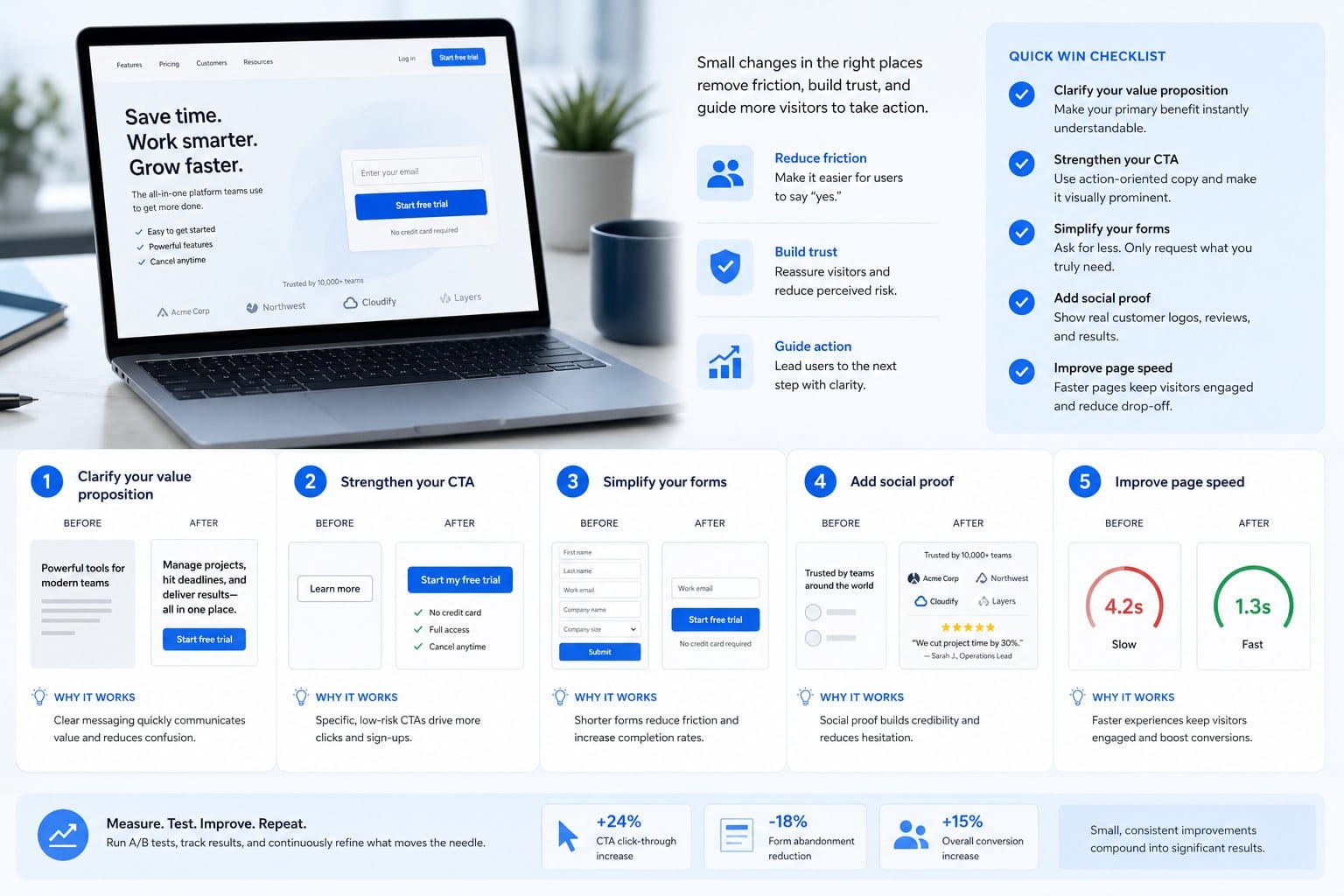
Now that you know where the problems are, here is how to fix them. These are not abstract recommendations. These are specific changes you can make to existing content and to your publishing process going forward.
Rewrite your introductions
Most blog introductions bury the lead. They start with background information or a broad statement and take three to five sentences to get to the point. By then, a significant portion of your readers have already left.
A strong introduction does two things immediately. It tells the reader that you understand their problem, and it promises to give them something useful. You can often rewrite just the first three sentences of an underperforming post and see measurable improvement in time on page.
Avoid starting with 'In today's digital landscape' or any variation of that phrase. It signals nothing. Start with the problem your reader is actively experiencing right now.
Add or update calls to action within the body of the post
Do not just put a CTA at the bottom and call it done. Most readers never make it to the bottom, especially on long posts. Place a relevant CTA within the first third of the post, one in the middle, and one at the end. Each one can be slightly different depending on where the reader is in the post.
For example, if your post is about automating your content workflow, you might:
- Add a link to a related guide in the first section - Include an inline CTA offering a free content calendar template at the midpoint - Close with a direct invitation to try your tool or book a demo
This approach gives readers multiple natural opportunities to take action without feeling like the post is constantly interrupting them.
Use internal links strategically to keep readers moving
Internal linking is one of the most underused conversion levers in blogging. When you link to another post that goes deeper on a related topic, you keep the reader on your site longer. More time on site means more exposure to your brand, your offer, and your expertise. That builds the kind of trust that leads to conversions.
Be intentional about where you link. Link to posts that move the reader closer to a buying decision. If your awareness post links to a comparison post, and that comparison post links to a case study, you have built a content funnel inside your blog itself. Readers who follow that path are warming themselves up as they go.
Write more content that targets buying-intent keywords
This is a long-term fix but one of the most important ones. Look at the keywords you are currently targeting and honestly assess the intent behind them. Are they mostly informational? If so, you need to balance them with more transactional and commercial intent keywords.
Examples of buying-intent keywords include:
- 'Best [product category] for [specific use case]' - '[Your product] vs [alternative]' - '[Your product] review' - 'How to choose [product category]' - '[Problem] solution'
These terms attract readers who are actively comparing options and ready to make a decision. The competition can be higher, but the conversion rate for readers who find these posts is significantly better than for purely informational content.
Build a content calendar that balances all funnel stages
Randomly publishing whatever topic seems interesting leads to a blog that is heavy on awareness content and light on everything else. A deliberate content calendar plans for a mix of awareness, consideration, and decision posts across every month.
A simple version of this looks like:
- Two awareness posts per month on broad educational topics in your niche - One consideration post comparing approaches or tools - One decision post with a case study, detailed review, or use-case walkthrough
This balance means your blog is always adding new top-of-funnel readers while also nurturing the ones who are closer to converting.
The challenge is that building and sticking to a content calendar requires planning time that most small teams and founders simply do not have. Researching topics, writing at the depth that ranks, formatting, adding visuals, and publishing consistently is genuinely a full-time job. That is the problem Blogtude was built to solve. The platform generates a 30-day content strategy based on your niche and goals, produces deeply researched long-form articles with on-brand visuals, and publishes automatically to Ghost and other CMS platforms. If you are a Ghost user specifically, Ghost CMS for startups: what to know before you commit is worth reading before you set up your publishing workflow.
Match your content format to what ranks for each query
If you search your target keyword and every result in the top five is a listicle, write a listicle. If every result is a step-by-step tutorial, write a step-by-step tutorial. Google's top results reflect what searchers want to find. Going against that format, even with better information, makes it harder to rank and harder to satisfy reader expectations once they arrive.
Format matching is a quick win. You can often take an existing post that is not ranking well and restructure it to match the dominant format in the search results without rewriting the core content.
Follow up with email subscribers
If you are not capturing email addresses from your blog readers, you are leaving a large portion of your potential conversions on the table. Most readers will not convert on their first visit. But if you get their email address, you can bring them back with follow-up content that continues to build trust and nudge them toward a decision.
Offer something genuinely useful in exchange for the email. A template, a checklist, a short course, or exclusive content that extends what they just read. Make the value obvious and the sign-up frictionless.
Once they are on your list, your follow-up emails should connect back to your blog content. Share new posts that match their interests, offer deeper resources on the topics they already engaged with, and introduce your offer naturally as a solution to the problem your content addresses.
Be patient but deliberate about consistency
I want to be direct about this because it is easy to underestimate. Content marketing is not a quick fix. Even if you implement every change I have described here, conversions from blog content take time to build. SEO rankings take time. Trust takes time.
What you can control is showing up consistently with content that is well-targeted, well-structured, and connected to a clear path forward for the reader. Brands that do this over months and years build compounding organic traffic that converts at rates that paid advertising rarely matches.
The teams that give up after three months of low conversions are the ones who never get to see that payoff. The ones who stick with a deliberate, consistent strategy are the ones who eventually look at their analytics and see the inflection point where everything started working.
If your blog content not converting has felt like a permanent state of frustration, the chances are good that it is not a talent problem or a writing problem. It is a strategy problem. And strategy problems are very solvable once you know what to look for.
Ready to take the next step?
If you are tired of publishing content that does not move the needle, Blogtude can help you fix the root problem. The platform builds your 30-day content strategy, writes deeply researched long-form articles, and publishes them directly to Ghost and other CMS platforms without manual effort on your part. Visit blogtude.com to see how it works and start building a blog that actually converts.


