
Rankyak alternative options that actually do more for less

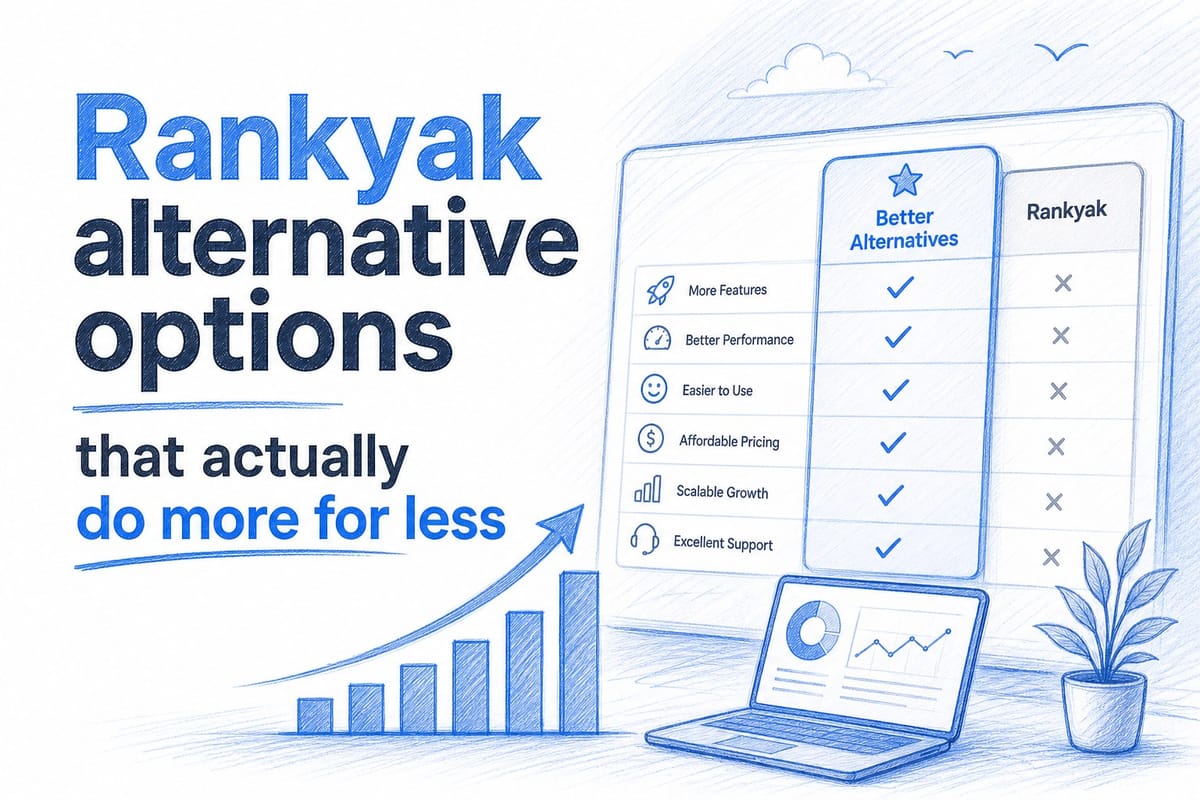
Table of contents
1. What RankYak does and where it tends to leave people wanting more
2. What to actually look for in a rankyak alternative
3. Blogtude in practice: what the workflow actually looks like
I went looking for a rankyak alternative because the pitch sounded familiar: automated keyword research, AI-written articles, hands-off publishing. Pay a monthly fee, watch content appear, rank higher. Simple enough. But after digging into how these platforms actually work, I kept running into the same friction points. Volume without strategy. Articles without brand voice. Publishing pipelines that stop at a WordPress export and call it done. If you have been circling the same comparison pages and still feel unsure, this article is for you. I want to break down what RankYak actually does, where it falls short for certain users, and what to look for instead, including why Blogtude has become my recommendation for anyone who needs a complete, automated content engine rather than just a content generator.
What RankYak does and where it tends to leave people wanting more
RankYak positions itself as a set-it-and-forget-it content automation platform. The core idea is that you connect your website, the tool discovers keywords relevant to your niche, and it produces articles on a recurring schedule without you having to do much between setup and review. For some users, that is genuinely useful. If you run a simple affiliate site and you want a steady stream of keyword-targeted posts without hiring writers, RankYak gives you a working pipeline.
But the more I looked at how it performs in practice, the more specific its ideal use case became. Third-party comparisons describe RankYak as a reasonable low-cost option for volume-focused automation. The emphasis tends to fall on the word volume. You get articles. You get keywords matched to those articles. You get a degree of backlink building bundled in. What you do not necessarily get is a content strategy that thinks past the individual post.
That distinction matters more than it sounds. A content strategy is not just a list of keywords. It is a plan that accounts for topic clusters, internal linking, publishing frequency, audience intent at different stages of the funnel, and how each article connects to the next. When a tool focuses purely on generating articles from a keyword list, those articles tend to sit in isolation. They rank for individual terms but they do not build topical authority in a coherent way over time.
The brand voice issue comes up repeatedly in user discussions. RankYak produces content that reads as competent and SEO-aware, but users who care about a distinctive tone, a specific editorial perspective, or content that sounds like a real person wrote it tend to find the output feels generic. For a personal brand, a SaaS blog, or any business where voice is part of the product, that matters.
There is also the publishing side. RankYak can help you create content, but the path from generated article to published, formatted post on your actual site requires additional steps depending on your CMS. For Ghost users in particular, the integration is not seamless. If you are managing a Ghost publication and you want articles to appear fully formatted, with images, on a schedule, without you touching each one manually, RankYak is not built with that workflow in mind.
None of this makes RankYak a bad tool. It makes it a specific tool. And the question worth asking is whether the specific thing it does matches the specific problem you are trying to solve. For a lot of the people I talk to, including independent bloggers, SaaS founders, small business owners, and digital marketers, the answer is that they need more than article generation. They need a system.
Understanding how often you should post on your blog for maximum SEO impact is one part of that system. But frequency only helps if the content itself is strategic, well-researched, and published without creating a manual bottleneck every single time.

What to actually look for in a rankyak alternative
Before you pick any replacement tool, it helps to be clear on which specific problem you are solving. The rankyak alternative space includes tools that span very different functions. Some focus on keyword research and rank tracking. Some focus on writing assistance. Some focus on publishing automation. Very few bring all of those things together in a single workflow that does not require you to manually connect the pieces.
Here are the criteria I think matter most when evaluating alternatives.
First, does it produce a strategy, not just content? There is a real difference between a tool that generates articles from your keyword list and a tool that builds a 30-day or 90-day content plan based on your niche, your existing content, and the topics where you have the best chance to build authority. A strategy-first approach means each piece of content has a reason to exist and a relationship to everything else you are publishing.
Second, does it research the article or just write it? A lot of AI writing tools produce text that sounds informed but is not actually grounded in current, accurate information about your topic. Deeply researched articles, meaning articles where the tool actually gathers and synthesizes real information before writing, tend to perform better in search and provide more genuine value to readers. This is especially important for technical topics, product categories, or any niche where your audience will notice if the details are wrong.
Third, does it handle visuals? Content that gets shared and earns backlinks tends to include relevant images. If your workflow requires you to source, create, and insert images manually after the article is generated, you are adding a significant time cost that offsets some of the automation benefit. On-brand visuals that are produced as part of the content pipeline, not as an afterthought, make a meaningful difference.
Fourth, does it publish directly to your CMS? This is where a lot of automation tools fall short. They generate a document. They might export it. But they stop before the content actually appears on your site. True publishing automation means the article goes from strategy to draft to published post on your platform, formatted correctly, without you moving files around or logging into your CMS to paste and adjust.
Fifth, does it support your specific platform? If you use Ghost, this matters a lot. Ghost has a distinct content structure and API. Tools built primarily for WordPress may claim Ghost compatibility but deliver a frustrating experience in practice. An integrated solution built with Ghost publishing in mind is a different product than a tool that added Ghost as a secondary export option.
Sixth, what does the pricing actually include? Some tools advertise a low monthly fee but charge separately for the features you actually need. Keyword research, publishing integrations, image generation, and strategy planning can each carry additional costs. When you add those up, the apparent savings over a more complete platform often disappear.
If you are also thinking about getting more reach from each article you produce, it is worth reading about how to repurpose one blog post into 10 pieces of content. A tool that helps you build a strong content base makes repurposing much more effective because you have genuinely good source material to work from.
With those criteria in mind, let me explain why Blogtude addresses each of them in a way that most rankyak alternatives do not.
Blogtude starts with strategy. When you set up your account, the platform generates a 30-day content plan for your specific niche and audience. That plan is not a random keyword list. It is a structured roadmap that accounts for topic relationships, publishing cadence, and the kind of authority-building that compounds over time. You are not just getting articles. You are getting a system for how those articles work together.
The articles themselves are produced through a deep research process. Blogtude gathers real information about each topic before writing, which means the output reads like something written by someone who actually understands the subject rather than a tool that learned to sound like it does. For technical audiences, for SaaS users, and for any niche where credibility matters, that research layer is what separates content that earns trust from content that fills space.
On-brand visuals are included in the content production process, not bolted on separately. Each article comes with images that fit the visual identity of your brand, produced as part of the same workflow that writes the text. You do not have to source stock photos, commission graphics, or use a separate tool to add images before publishing.
Publishing is automatic. Blogtude integrates directly with Ghost and other CMS platforms, which means the content goes from plan to published without you acting as the middleman. For Ghost users specifically, this is a meaningful advantage. The integration is built for Ghost, not adapted from a WordPress-first pipeline. Articles appear formatted and ready, on schedule, without manual intervention.
For independent bloggers who want to grow without hiring a team, for SaaS founders who need consistent organic traffic, for small business owners who cannot afford to spend hours each week on content, and for digital marketers who need a reliable automated workflow, Blogtude is designed to solve the whole problem rather than one slice of it.
That completeness is what makes it a genuine alternative rather than a lateral move. You are not trading one limitation for another. You are moving to a system that handles strategy, research, writing, visuals, and publishing in one integrated pipeline.

Blogtude in practice: what the workflow actually looks like
I want to be specific about what using Blogtude actually involves because one of the things that gets lost in tool comparisons is the day-to-day experience. Abstract feature lists do not tell you what it feels like to use something every week.
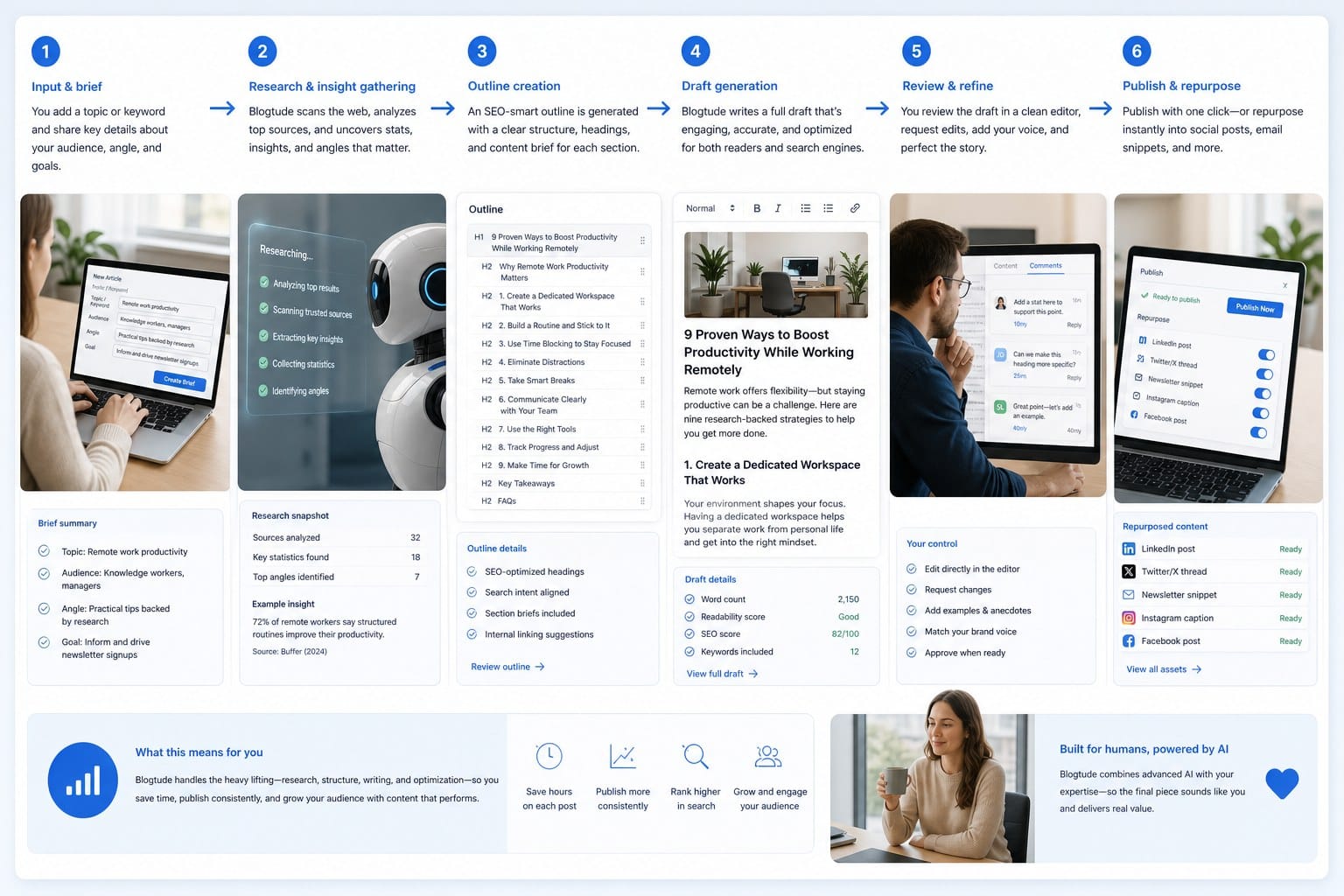
When you start with Blogtude, you tell the platform about your business, your audience, and your goals. From that input, it generates a 30-day content strategy. That strategy is not a vague collection of topic ideas. It is a structured plan with specific article titles, the keywords each piece targets, the publishing schedule, and the logic for how the articles relate to each other. You can review it, adjust it if something does not fit your direction, and then let it run.
Once the strategy is set, Blogtude researches and writes each article. The research phase is real. The platform gathers current, relevant information about each topic rather than generating text from training data alone. The resulting articles are long-form, which matters for SEO. Short posts of 400 to 600 words rarely rank for competitive terms. Long-form content that covers a topic thoroughly is what earns position in search results over time. The articles Blogtude produces are built to compete, not just to exist.
Each article also comes with on-brand visuals produced to match your site's aesthetic. This removes one of the most time-consuming manual steps in content production. You do not have to find images, resize them, check licensing, or insert them one by one. They are part of the article when it arrives.
Then the article publishes. If your site runs on Ghost, Blogtude connects directly and posts the content formatted and ready for readers. No copy-paste, no manual formatting, no logging in to check whether the images loaded correctly. The post appears on schedule.
For someone who has been managing a content workflow manually, this change in overhead is significant. Writing a single long-form article from scratch typically takes several hours. Research, drafting, editing, sourcing images, formatting, and publishing can easily add up to a full workday per post. If you are aiming to publish two or three articles per week to build real SEO momentum, that is most of your available time gone before you have done anything else in your business.
Blogtude reduces that overhead to the time it takes to review and approve. You stay involved enough to make sure the content fits your brand and direction. You stop being the bottleneck that determines whether the work gets done at all.
For SaaS founders, this is especially relevant. Organic content is one of the most cost-effective ways to drive traffic at scale, but it requires consistency over months. Most founders cannot write consistently because they are running a company. Blogtude gives you the consistency without requiring you to be the one producing the work.
For small business owners, the advantage is similar. You understand your business and your customers better than any tool does. What you often lack is the time to translate that understanding into published content every week. Blogtude handles the production so your knowledge can reach the people searching for what you offer.
For digital marketers managing brand blogs, the workflow question is usually about reliability. Can you count on this tool to deliver on time, every time, without surprises? A manual or semi-automated content process has failure points at every step. A fully integrated pipeline with a defined 30-day strategy reduces those failure points significantly.
It is also worth thinking about what happens as you scale. If you are publishing four articles a month now and you want to move to twelve, a manual workflow requires you to hire writers, manage them, edit their work, and handle publishing for each piece. That is a real operational lift. With Blogtude, scaling the content output does not require scaling the team or the effort in the same way. The system handles more without demanding more from you.
If you are weighing different platforms and want to understand the decision in a broader context, the article on Clearpost alternative: why Blogtude might be the better fit walks through a similar comparison from a different angle and may answer questions that apply here as well.
One more thing I want to address directly: price. It is tempting to pick the cheapest option when you are evaluating tools, especially when several platforms seem to offer similar functions at different price points. But the cost of a content tool is not just the monthly fee. It is the monthly fee plus the time you spend filling the gaps the tool leaves open. If a cheaper tool generates articles but does not build a strategy, you spend time on strategy. If it does not include visuals, you spend time sourcing them. If it does not publish automatically, you spend time on publishing. When you add those hours up at any reasonable estimate of your time's value, the cheaper tool frequently costs more in total.
Blogtude is designed to close those gaps rather than leave them for you to fill. The value proposition is not the lowest sticker price. It is the lowest total cost when you count your time as part of the equation.
For anyone who has been running a content operation manually, or who has tried a partial automation tool and found themselves still doing most of the work, that framing changes the comparison significantly. You are not choosing between features on a spreadsheet. You are choosing between systems. And a complete system that handles strategy, research, writing, visuals, and publishing is a different category of tool than one that handles writing alone.
If the goal is consistent, high-quality blog content that builds organic traffic over time without consuming your team's hours or requiring you to hire writers, Blogtude is the direction I point people. It is not just a rankyak alternative. It is a different approach to the whole problem of content at scale.
Ready to take the next step?
If you are ready to stop patching together a content workflow and start running one that actually works end to end, Blogtude is built for exactly that. Visit https://blogtude.com to see how the 30-day content strategy, deep research writing, on-brand visuals, and automated publishing come together in a single platform designed for growing brands.


