
Pillar page vs cluster content: a no-fluff guide for growing blogs

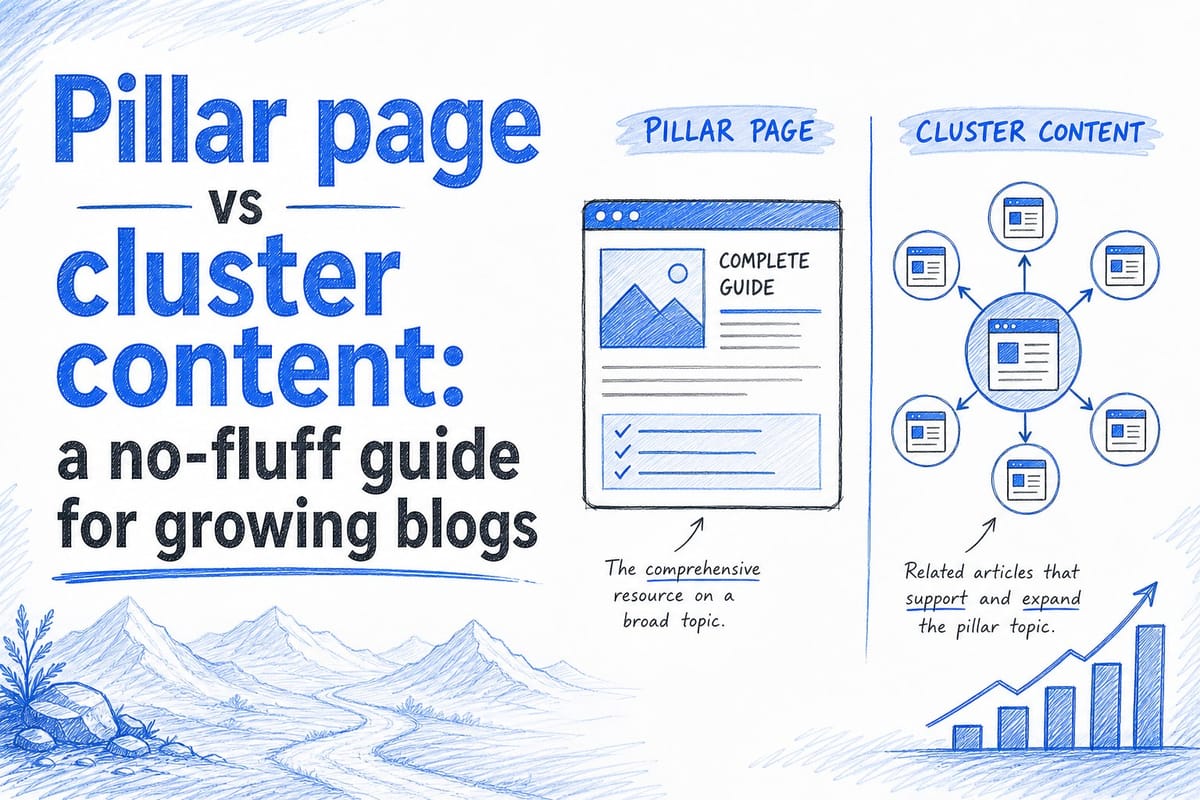
Table of contents
1. What a pillar page actually is (and what it is not)
2. How cluster content supports and strengthens your pillar page
3. Building your first topic cluster without getting overwhelmed
If you have spent any time reading about SEO strategy, you have probably come across the terms pillar page and cluster content. They sound technical, maybe even a little intimidating, but the idea behind them is actually pretty simple. Together, they form a content structure that helps search engines understand what your blog is really about and helps readers find exactly what they need. In this guide, I am going to break down what each piece means, how they work together, and how you can build this structure without burning yourself out in the process. By the end, you will have a clear plan you can act on immediately, whether your blog is brand new or already has dozens of posts sitting in your archive.
What a pillar page actually is (and what it is not)
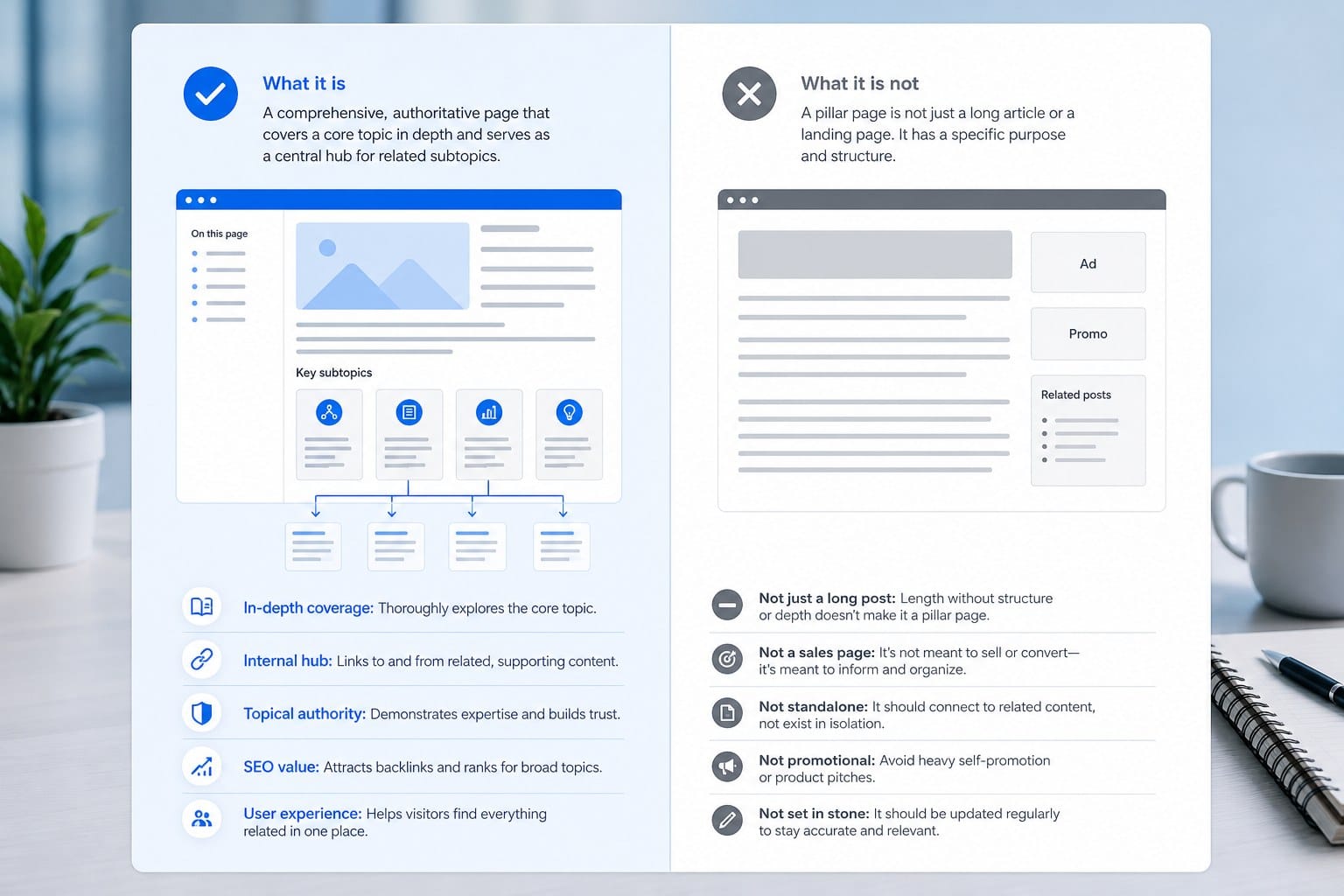
A pillar page is a long, comprehensive piece of content that covers a broad topic in enough depth to serve as the authoritative home base for that subject on your blog. Think of it as the trunk of a tree. Everything else on that topic branches out from it.
If you run a blog about personal finance, a pillar page might be titled something like 'The complete guide to budgeting for beginners.' That page covers the topic broadly. It explains what budgeting is, why it matters, the major methods people use, common mistakes, and tools that help. It does not try to go ten levels deep on every single point, but it gives readers a solid foundation and signals to Google that your site takes this topic seriously.
A pillar page is typically long, often between 2,000 and 5,000 words, sometimes more depending on how complex the topic is. But length alone does not make it a pillar page. What makes it a pillar page is its job: to anchor a topic and link outward to more specific content that lives elsewhere on your blog. That outward-linking structure is what separates a pillar page from just a thorough, well-researched article.
Here is what a pillar page is not. It is not just a really long blog post. A regular blog post tends to go narrow and deep on one specific angle. A pillar page goes wide across a full topic area. It is also not a category page or a tag archive. Those are navigation tools built into your CMS. A pillar page is a piece of real, readable content that delivers genuine value entirely on its own, even if the reader never clicks a single internal link.
One mistake I see bloggers make repeatedly is writing a pillar page that is just a table of contents with thin summaries underneath each heading. That does not work. The page needs real substance. Each section should give the reader something genuinely useful, even if the supporting cluster posts go significantly deeper on each individual point. If someone reads your pillar page and still feels like they got nothing concrete, you have written an outline, not a pillar page.
Another common mistake is treating pillar pages as a one-time effort. The best pillar pages get updated regularly as the topic evolves, new tools enter the market, or the search intent behind the main keyword shifts. They are living documents, not monuments you build once and forget. A personal finance blogger who wrote a pillar page on budgeting in 2020 and never touched it again is now missing references to apps, economic conditions, and reader questions that have emerged since then. Updating the page regularly keeps it competitive and signals to Google that the content is being actively maintained.
So how do you pick a topic for a pillar page? Start with a broad keyword that your audience genuinely searches for and that connects naturally to several more specific questions. If you can think of at least five to eight related subtopics that each deserve their own standalone post, you probably have a solid pillar topic. A broad keyword like 'email marketing' works. A narrow one like 'how to write a subject line for a cart abandonment email' does not. The narrow one might become a great cluster post, but it is too specific to anchor a whole topic cluster.
It also helps to think about the reader experience. When someone lands on your pillar page from a Google search for the broad keyword, what do they already know? What do they want to understand by the time they leave? Your pillar page should answer those core questions while making it obvious that your blog has much more depth available on every subtopic they care about. That combination of breadth and clear pathways deeper into the content is what turns a pillar page into an actual SEO asset.
One more thing worth noting: a strong pillar page earns backlinks more readily than a narrow post does, because it serves as a comprehensive reference. When another blogger or journalist writes about budgeting and wants to point their readers somewhere useful for an overview, your well-structured pillar page is a natural destination. That kind of organic link acquisition compounds your authority over time in ways that a single focused post rarely achieves on its own.
A good pillar page is not about impressing Google with word count. It is about being the most genuinely useful resource on a broad topic that exists on your blog. If you write it with that goal in mind and build the cluster around it thoughtfully, the SEO benefits follow as a result.
How cluster content supports and strengthens your pillar page
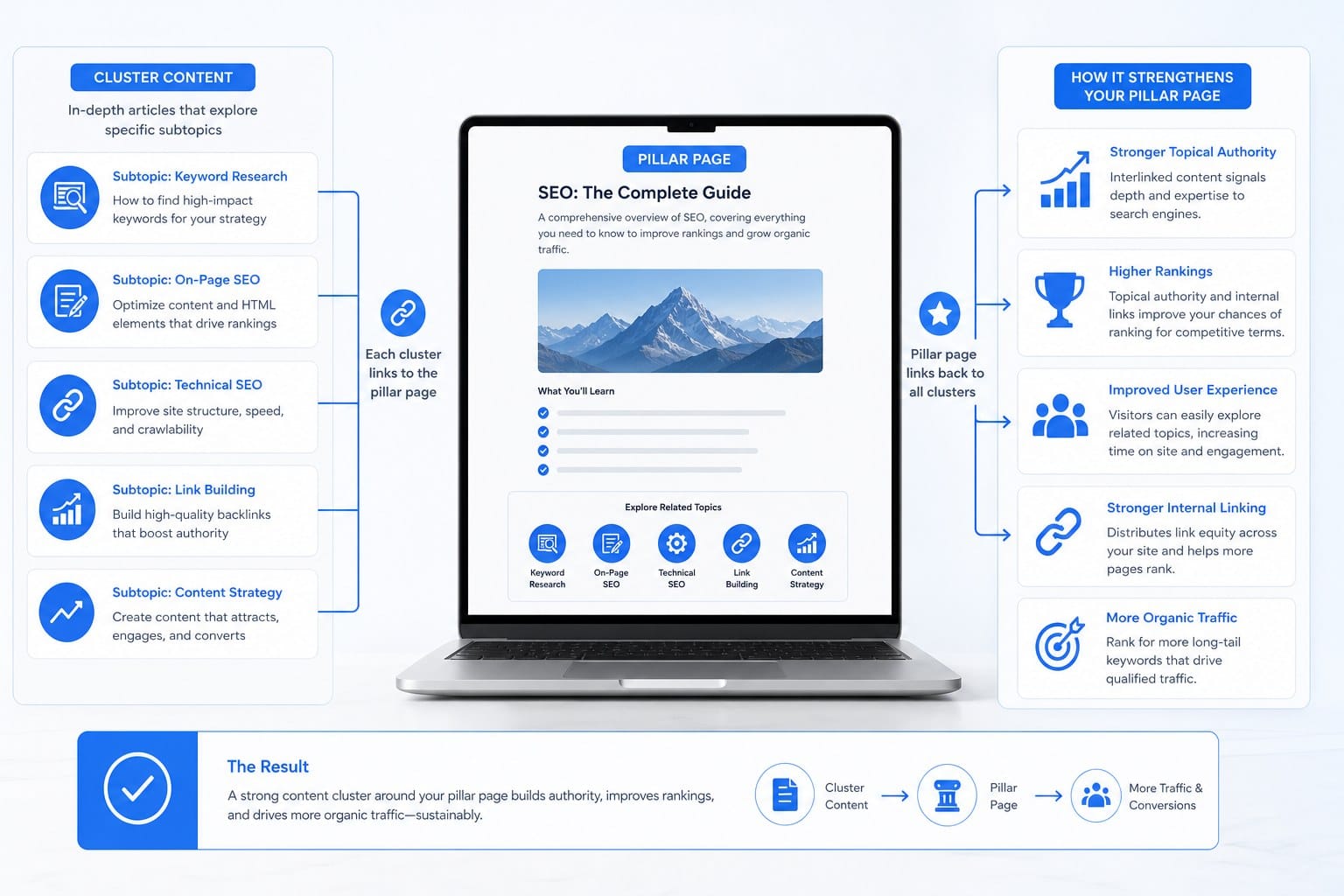
Cluster content, sometimes called cluster posts or supporting content, consists of the individual blog posts that dig deeper into specific subtopics related to your pillar page. If the pillar page is the trunk of the tree, cluster posts are the branches. Each one extends outward from the core topic, covers its own specific angle in real depth, and connects back to the pillar through internal links.
Using the budgeting example from earlier, your cluster posts might cover things like how to use the 50/30/20 budgeting rule, the best free budgeting apps compared side by side, how to budget on a variable or irregular income, what to do when you blow your budget mid-month, how to budget for unpredictable expenses like car repairs or medical bills, and how to get a reluctant partner on board with a household budget. Each of those posts is specific, tightly focused, and fully capable of ranking on its own for a more targeted long-tail keyword. But each one also links back to the main pillar page, and the pillar page links out to each of them. That network of internal links is what makes the topic cluster model so effective for SEO.
Here is the logic behind it. When Google crawls your site and sees that your pillar page links to ten detailed posts on budgeting subtopics, and each of those posts links back to the pillar, it builds a clear picture that your blog has serious depth and authority on that subject. You are not just writing one random post about budgeting and hoping it ranks. You are building a whole interconnected ecosystem around the topic, and Google has gotten very good at recognizing that kind of deliberate, structured coverage.
This matters because Google has been moving away from ranking individual pages in isolation and toward evaluating the topical authority of a website as a whole. If your blog covers a topic thoroughly, consistently, and in an organized way, you are more likely to rank across multiple related keywords, not just one or two. That is a fundamentally different model from the old approach of writing isolated posts and hoping each one finds its audience independently. I go deeper on this concept in why topical depth is the smarter SEO strategy for growing brands, which is worth reading alongside this guide if you want to understand the underlying reasoning.
Cluster posts also help you serve different readers at different stages of their journey. Someone new to budgeting might land on your pillar page first from a broad search and get the full picture. Someone who already understands budgeting basics but wants practical advice on handling a variable income might land directly on that specific cluster post from a more targeted search. Both readers find what they need. Both get exposed to more of your content through internal links. That is a much better experience than a blog that covers topics randomly and leaves readers hunting for the next useful thing to read.
The number of cluster posts you need per pillar page depends on the topic and how competitive the space is, but as a general benchmark, I like to aim for at least five to eight supporting posts before I consider a topic cluster reasonably built out. Some clusters grow to fifteen or twenty posts over time as new angles, new tools, and new reader questions emerge. The important thing is that each new cluster post adds something distinct, not just rephrased versions of what you have already covered.
That leads to a practical point: when you write a cluster post, make sure it does not simply repeat what the pillar page already covers. Each cluster post should go meaningfully deeper on its specific subtopic. If the pillar page explains what the 50/30/20 rule is in two paragraphs, the cluster post on that topic should walk through exactly how to implement it, what to do when the percentages do not fit your real-life situation, what happens if you try it and the math does not work out, and examples of what it actually looks like for different income levels. The pillar gives the overview. The cluster post delivers the depth.
Also pay close attention to your anchor text when linking between cluster posts and the pillar page. Use descriptive, natural phrases that reflect the actual topic rather than generic placeholders like 'click here' or 'read more.' If you are linking from a cluster post back to your pillar page on budgeting, an anchor like 'our complete guide to budgeting for beginners' gives Google useful information about what the linked page covers. Generic anchor text throws that context away.
Cluster content also makes editorial planning dramatically easier. Once you decide on a pillar topic and map out the cluster, you have an immediate list of potential posts to write. That is a much stronger starting point than staring at a blank screen wondering what to publish next. You already know what fits your strategy, what your audience needs, and how each piece connects to the larger structure. If you want a structured approach to planning each cluster post before you write it, how to write a content brief that actually gets results walks through exactly how that process works in practice.
One thing to watch for as your cluster grows is overlap between posts. If two cluster posts are covering very similar ground and competing with each other for the same keyword, one of them is probably too broad or not differentiated enough. Either narrow the focus of one post to make it clearly distinct, or consider merging the two into a single stronger piece. Google will typically choose one page to rank and suppress the other, so duplication within your cluster works against you.
Finally, the linking within a cluster does not have to be limited to cluster-to-pillar connections. Related cluster posts can and should link to each other where the context makes sense. If your post on variable income budgeting naturally references the 50/30/20 rule at some point, that is a genuine reason to link to the cluster post that covers it in depth. Cross-linking within the cluster strengthens the whole network and gives readers more pathways to explore.
Building your first topic cluster without getting overwhelmed
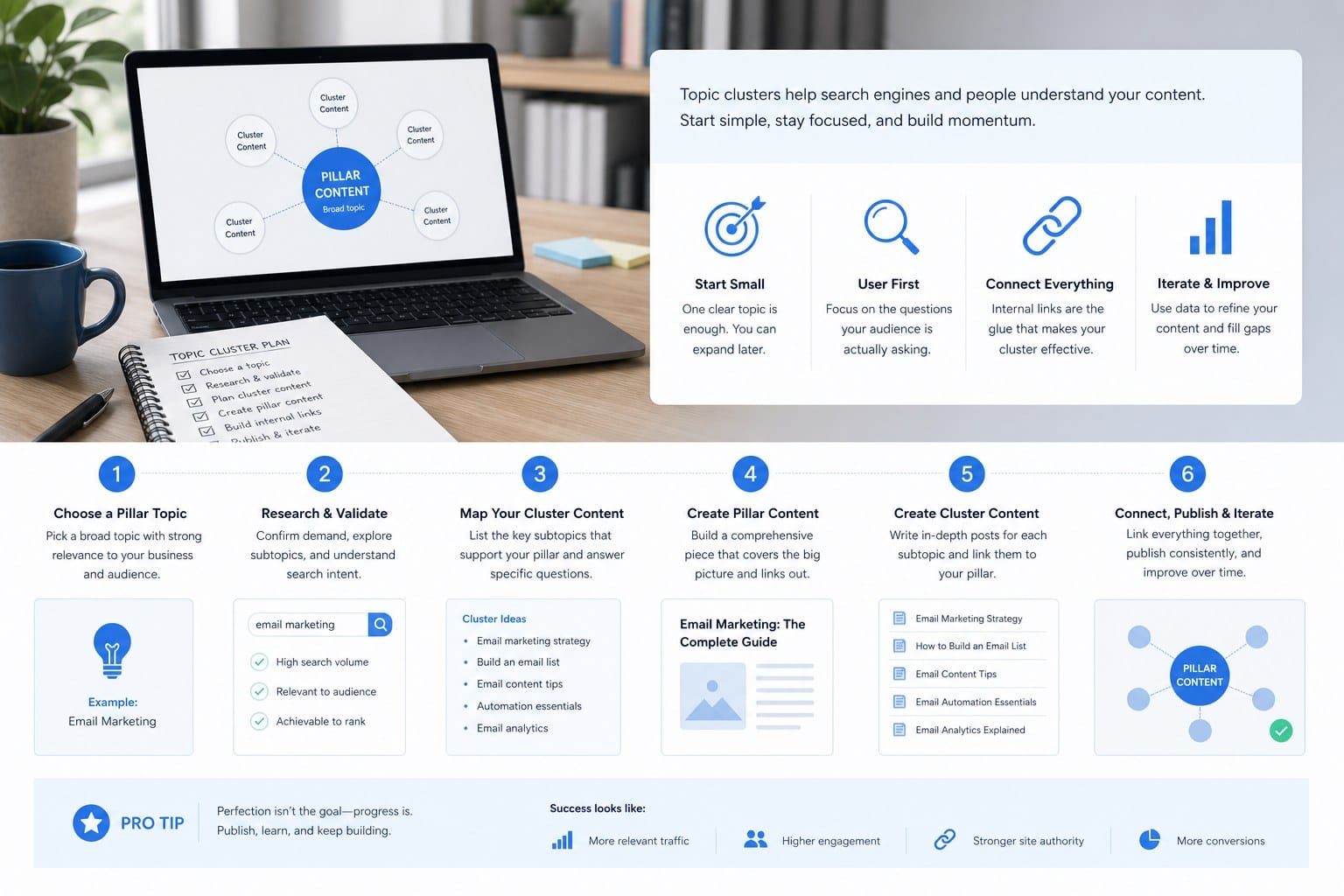
Understanding the difference between pillar pages and cluster content is one thing. Actually building the structure is another. A lot of bloggers understand the concept but stall because they do not know where to start, or they feel like they have to produce everything at once before the cluster counts for anything. You do not. Here is a realistic, step-by-step approach that works whether you are just starting out or retrofitting an existing blog that already has posts sitting in it.
Step one: choose your first pillar topic carefully.
Pick a topic that sits at the core of what your blog is about. It should be broad enough to spawn multiple supporting posts but specific enough that it is realistic for your site to become genuinely authoritative on it. A personal finance blog might build topic clusters around budgeting, investing, debt payoff, and side income. A SaaS marketing blog might build clusters around onboarding, product analytics, customer retention, and pricing strategy. Each of those is a realistic territory for a focused blog to own. 'Business' or 'marketing' as a pillar topic is too broad to anchor effectively.
The topic also needs real search demand. Use a keyword research tool to confirm that people are actively searching for that broad topic and its related subtopics. If the search volume is essentially zero across the cluster, structural elegance will not save you. Traffic follows demand, so make sure the demand is there before you invest heavily in building the cluster.
Step two: audit what you already have.
If your blog is not brand new, you may already have posts that could function as cluster content for a new pillar page. Before writing anything, look at your existing posts and identify which ones cluster naturally around a common theme. Sometimes the pillar page is the missing piece that ties together posts you wrote months apart without thinking about how they connected.
In that situation, you can build the pillar page first, then update each existing cluster post to add a contextual link back to it. This is one of the fastest ways to see real results from the topic cluster model because you are not starting from scratch. You are organizing and linking content that already exists. Google does not know those posts were written without a cluster strategy in mind. It only sees the current structure, and a well-linked cluster is a well-linked cluster regardless of when the individual posts were written.
Step three: map the cluster before you write the pillar page.
Even if you do not plan to write all the cluster posts right away, mapping the full cluster before writing the pillar helps you build a better pillar page. Knowing which subtopics the cluster will eventually cover tells you which sections to treat at a high level in the pillar and where to leave room for the deeper dives that will come later in cluster posts. You will write a more coherent, well-proportioned pillar page if you already know what surrounds it.
Once the map is done, write the pillar page and publish it even if some of the cluster posts are not live yet. You can add internal links as each cluster post goes live. There is no rule that says the cluster has to be complete before you publish the pillar. A published pillar page that links to two cluster posts today is better than an unpublished pillar page waiting for a complete cluster that might take six months to finish.
Step four: publish cluster posts consistently over time.
This is where a lot of bloggers struggle. Writing one solid pillar page and then going quiet for two months is not a content strategy. Cluster content needs to be built at a steady pace. Aim for one to two cluster posts per week if you are actively building out a topic area. That pace keeps your publishing consistent, gives Google regular signals that your site is active, and gets the cluster built in a reasonable timeframe rather than dragging it out indefinitely.
Consistency is genuinely difficult when you are running a business, serving clients, or juggling multiple priorities. That gap between knowing what you should publish and actually getting it done is exactly the problem that Blogtude was built to close. Instead of manually researching, outlining, writing, and scheduling every post, Blogtude generates a full 30-day content strategy, produces deeply researched long-form articles with on-brand visuals, and publishes directly to Ghost and other CMS platforms automatically. For bloggers and founders who understand that a consistent content engine is non-negotiable but do not have the time to operate one manually, that kind of automated workflow can be the difference between a topic cluster that actually gets built and one that stalls at the pillar page stage and never goes anywhere.
For a deeper look at how real teams are scaling their content output without adding headcount, how founders are using AI to publish 4x more blog content covers specific examples worth reading.
Step five: measure what is happening and adjust based on what you see.
Once your cluster has several posts live and indexed, start tracking a few things. Look at which cluster posts are pulling organic traffic and which ones are sitting flat. See whether your pillar page is ranking for the broad keyword and whether readers are clicking through to cluster posts from it. Check Google Search Console for impressions on keywords related to the cluster topic as a whole. Impressions tell you how often your content is appearing in searches, even if it is not yet ranking high enough to collect consistent clicks. A rising impression count on cluster-related keywords is a good early signal that Google is beginning to associate your site with the topic.
Do not expect overnight results. Topic clusters typically take three to six months to show significant organic gains, and in more competitive niches the timeline can stretch longer than that. But the compounding effect is real. As each cluster post builds authority and passes link equity back to the pillar, and as the pillar distributes authority outward to the cluster, the whole structure becomes stronger together in a way that isolated posts simply cannot replicate.
A few additional things worth keeping in mind as you build:
Avoid keyword cannibalization. This happens when two posts on your blog are too similar in focus and end up competing with each other in search results instead of complementing each other. In a well-built topic cluster, each post should target a distinct keyword and cover a clearly distinct angle. If two posts are overlapping significantly in topic and keyword focus, consolidate them into one stronger piece or sharpen the differentiation so Google can tell them apart.
Make your internal links earn their place. Do not just drop a link to the pillar page at the bottom of every cluster post and call it done. Weave links in where they are contextually relevant to what the reader is already thinking about at that moment in the post. If you are writing a cluster post about budgeting apps and you mention that readers should have a clear budget methodology before they choose an app, that is the natural place to link back to the section of the pillar page that covers methodology options. The link should feel helpful to the reader, not tacked on for SEO purposes.
Update your pillar page as the cluster grows. Every time you publish a new cluster post, go back to the pillar page and add a contextual link to it in the relevant section. Keep the pillar current by refreshing statistics, replacing outdated examples, and adding new subtopics as they become relevant. A pillar page that was comprehensive in 2022 may be missing important ground by 2025.
Do not spread yourself across too many clusters at once. It is tempting to start four or five topic clusters simultaneously, especially if your blog covers multiple subject areas. In practice, it is almost always more effective to build one cluster to a solid baseline of eight to ten posts before moving heavily into the next. A complete, well-linked cluster of ten posts will outperform five half-built clusters of two posts each, and it will do so by a wide margin. Depth and coherence within a cluster matter more than the sheer number of clusters you have started.
Think about the reader experience as much as you think about the algorithm. The best topic clusters are the ones where a reader could land on any post in the cluster and immediately feel like they are inside a well-organized, trustworthy resource on that subject. Every link should feel like a genuinely useful next step. Every post should feel like it belongs in the same family as the others. When the structure serves the reader that well, it tends to serve the search engine well at the same time, because Google is trying to surface exactly the kind of experience your reader is looking for.
Building a topic cluster takes real effort and real time. There is no shortcut that eliminates that reality. But it is one of the highest-leverage content investments you can make for a growing blog, because once a cluster is established and gaining traction, it continues building authority without you having to restart from zero with every new post you publish. Each new piece of cluster content joins an existing structure that already has weight behind it. That compounding dynamic is why serious bloggers and content teams have moved toward building this way, and why blogs that publish random isolated posts keep wondering why their traffic is not growing.
Ready to take the next step?
If you are ready to stop publishing random posts and start building a real content structure that compounds over time, Blogtude can help you get there faster. Blogtude builds your 30-day content strategy, writes deeply researched long-form articles, and publishes them automatically to Ghost and other platforms so your topic clusters get built consistently without the manual grind. Visit blogtude.com to see how it works.


