How to maintain brand voice when using AI to write blog content

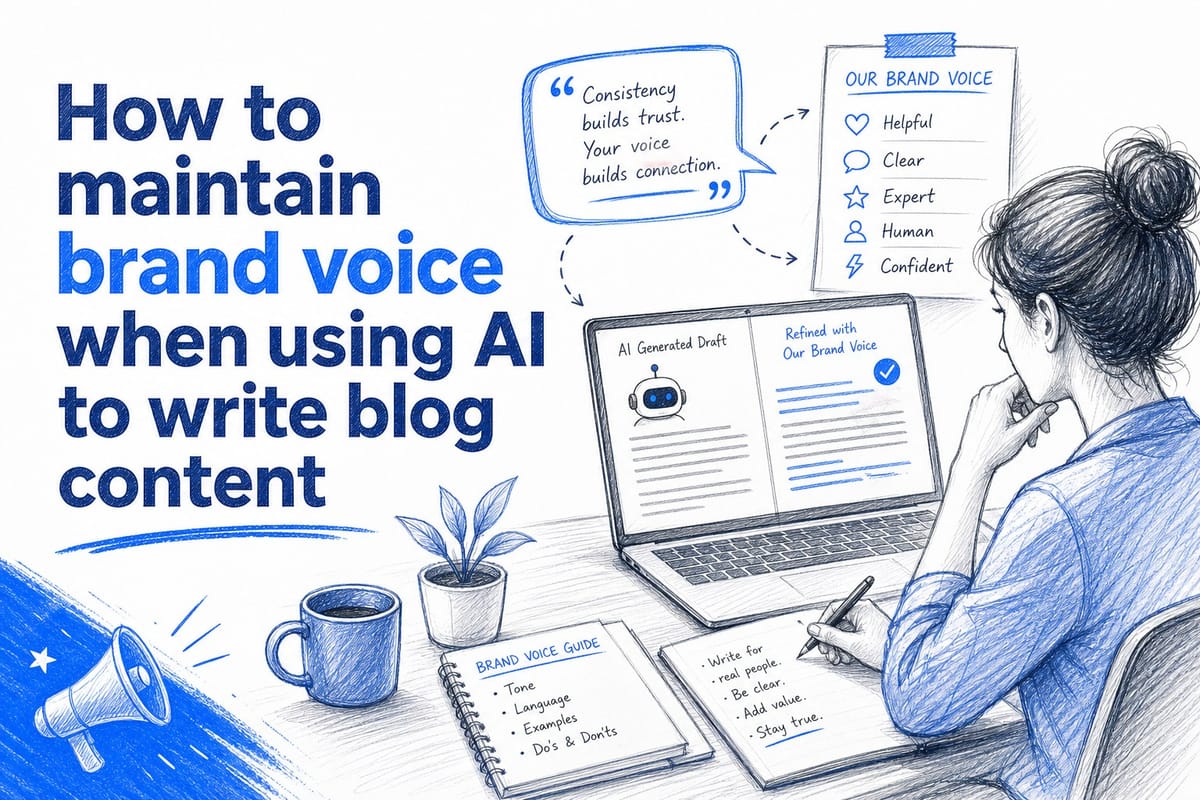
Table of contents
1. Start with a written brand voice guide your AI tool can actually use
2. Structure your AI workflow so brand voice is built in, not bolted on
3. Scale your publishing output without letting voice drift over time
One of the biggest fears I hear from marketers and founders when they start using AI for blog content is this: 'What if it sounds like everyone else?' That fear makes sense. Your brand voice is one of the few things competitors cannot copy directly. It reflects how you think, what you care about, and how you talk to your audience. Losing that in a flood of AI-generated paragraphs would be a real problem.
But here is the good news: you do not have to lose it. When you set things up correctly, AI can help you publish more content while keeping your brand voice sharp and consistent. The key word there is 'set things up.' Most voice problems with AI content are not technology problems. They are setup problems. The AI does not know what your brand sounds like unless you tell it, and most people never do that with enough specificity.
In this article, I will walk you through how to do exactly that. We will start with building a voice reference document your AI tool can actually use. Then we will look at how to structure your editorial workflow so voice is baked in from the start, not corrected at the end. Finally, we will cover how to keep quality from drifting as your publishing volume grows. Each of these steps is practical and something you can start on this week.
Start with a written brand voice guide your AI tool can actually use
Most brands have a vague sense of their voice. 'We are friendly but professional.' 'We keep things simple.' 'We do not use jargon.' That is a decent start, but it is not enough when you are trying to maintain brand voice across AI-generated blog content at scale. A vague description leaves too much room for interpretation, and AI tools will fill that room with generic output. You will get content that is technically correct and completely forgettable.
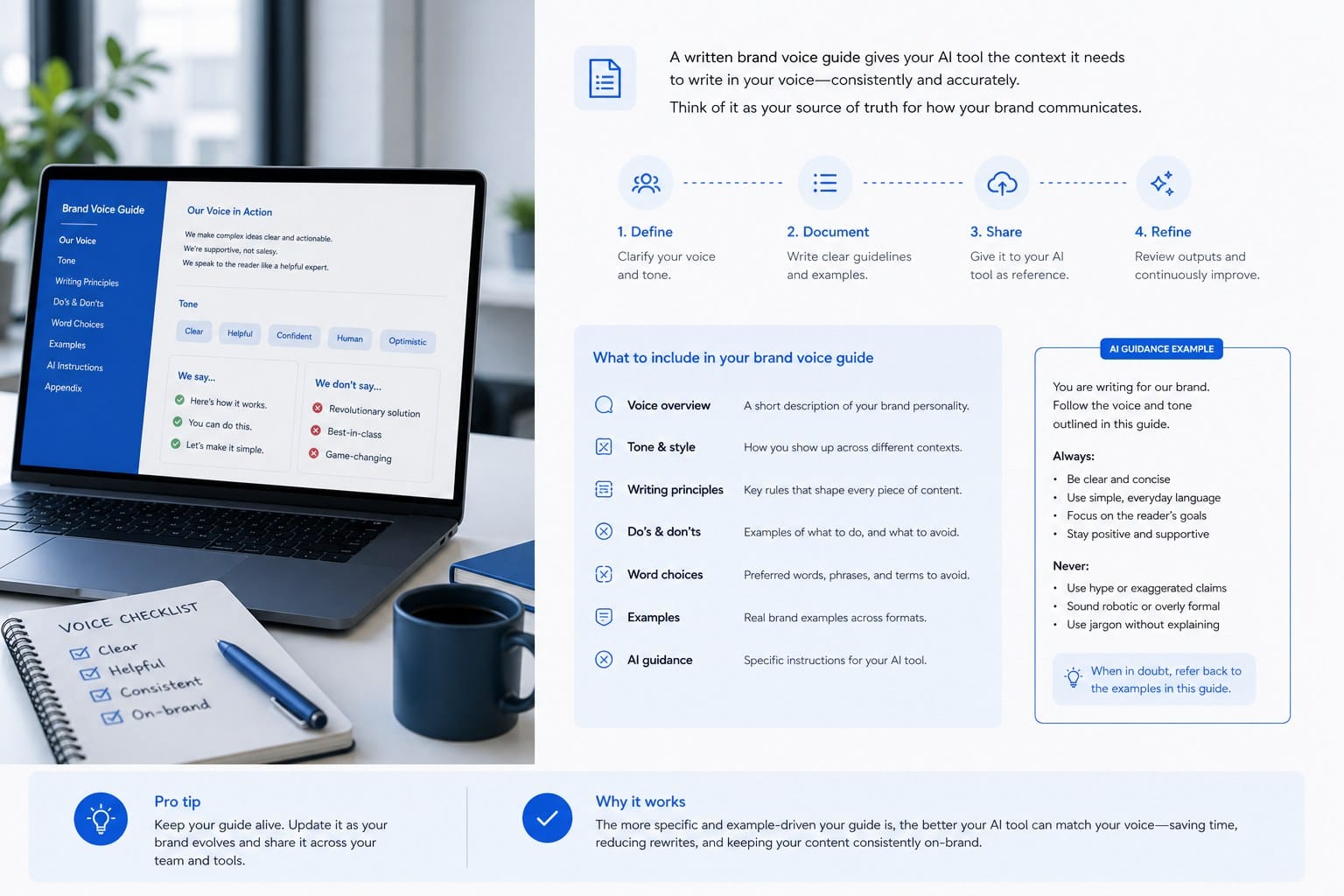
The fix is a written brand voice guide that is specific enough to be actionable. Think of it as a style sheet for your personality. It is not a manifesto about your values. It is a practical document that tells anyone, human or AI, exactly how your brand sounds and why.
Here is what it should include.
Define your tone with real examples, not adjectives.
Do not just say 'conversational.' Show what conversational means for your brand. Pull two or three sentences from your best-performing blog posts or your About page. Note what makes them feel like you. Is it the sentence length? The use of direct address? The way you ask rhetorical questions, or avoid them entirely? The way you open paragraphs with a claim instead of a setup? Write that down.
For example, if your best articles tend to open paragraphs with a direct statement and then explain it, say that. 'We lead with the point, then support it. We do not build to a conclusion.' That single instruction changes how an AI structures paragraphs and makes a noticeable difference in how the output reads.
List words and phrases you use and ones you never use.
Every brand has verbal fingerprints. Maybe you always say 'build' instead of 'leverage.' Maybe you never say 'synergy' or 'empower.' Maybe you prefer 'reader' over 'user.' Maybe you say 'here is the thing' when you are about to make a direct point, or maybe that phrase would never appear in anything you publish. These small choices add up fast across dozens of articles.
When your AI tool sees a list of preferred and forbidden vocabulary, it can match your patterns much more reliably. The forbidden list is especially important. AI tools default to a kind of corporate-neutral language that sounds polished but hollow. Telling the tool explicitly what to avoid is often more effective than telling it what to do.
Some examples worth including in a forbidden phrases list: 'in today's digital landscape,' 'it's important to note,' 'at the end of the day,' 'dive deep,' 'leverage synergies,' 'unlock your potential.' These phrases show up constantly in AI output because they appear constantly in the training data. Blocking them forces the tool toward more specific, original language.
Describe your audience relationship explicitly.
Are you a peer talking to equals? A mentor guiding beginners? A straight-talking expert cutting through noise? The relationship shapes everything from how you open a paragraph to how you give a recommendation. A peer relationship sounds different from a teacher relationship, even when the information is identical.
Write out one or two sentences that capture this. 'We write as experienced practitioners talking to other practitioners. We do not over-explain basics. We assume the reader has tried things and hit real problems.' Or: 'We write for people who are new to this and need clear explanations without condescension. We define terms the first time we use them.' Either of those gives the AI a social context to work within that shapes the entire register of the output.
Note your structural preferences.
Some brands love short punchy paragraphs, two or three sentences maximum. Others build longer flowing arguments that develop an idea across six or seven sentences before moving on. Some use bullet lists constantly. Others almost never do, because lists break the reading momentum they want to maintain. Some brands use subheadings every three paragraphs. Others let long sections breathe without interruption.
If you have a preference, state it. Structure is part of voice. A reader who knows your blog can often tell from the visual rhythm of the page whether an article is going to sound like you before they read a single word.
Include examples of what you dislike.
This is the most underused part of any voice guide. If you have ever read a draft and thought 'this does not sound like us at all,' save that draft. Mark what bothered you. Was it the passive constructions? The hedging language? The way every paragraph ended with a summary sentence restating what the paragraph just said? Those negative examples are just as useful as positive ones.
You can even include a short before-and-after section in your voice guide. Show a paragraph that does not sound right and then show how you rewrote it. That comparison communicates the difference more clearly than any description could.
Use the guide in two ways.
Once you have this document, you use it in two distinct ways. First, you feed the key points into your AI tool as part of the prompt or system context every time you generate content. Most AI writing platforms give you a way to set persistent instructions or a style context. Put your voice parameters there. Second, you use the guide as a checklist during editorial review. Having it written down means you are not relying on memory or gut feeling to catch voice drift. You have a measurable standard.
This matters especially for teams where multiple people touch content. When a marketer, a founder, and a freelance editor all have the same written guide, they make consistent decisions. Without it, everyone applies their own interpretation of 'brand voice' and the result is articles that feel subtly different from each other in ways readers can sense even if they cannot name.
A reader who visits your blog regularly builds an expectation of how you sound. When that expectation is violated, they feel it as a small friction even if they do not consciously identify it. Enough of that friction and they stop coming back.
Treat the guide as a living document.
Your brand voice guide is not a one-time document. It should evolve. Every six months or so, pull your top-performing articles from that period and ask whether the guide still reflects how those pieces sound. If your brand has matured, if you have gotten more confident and direct, if your audience has shifted, update the guide before you generate another batch of content.
A voice guide that describes where you were two years ago is worse than no guide at all, because it will push your content toward a version of your brand that no longer exists.
Structure your AI workflow so brand voice is built in, not bolted on
A lot of people treat brand voice as something you fix after the AI writes a draft. You read it, you spot the places that sound off, and you rewrite them. That approach works, but it is slow and exhausting at scale. If you are publishing four or more articles a month, editing for voice on every single draft becomes a significant time commitment. And the more tired you are when you do it, the more voice problems slip through.
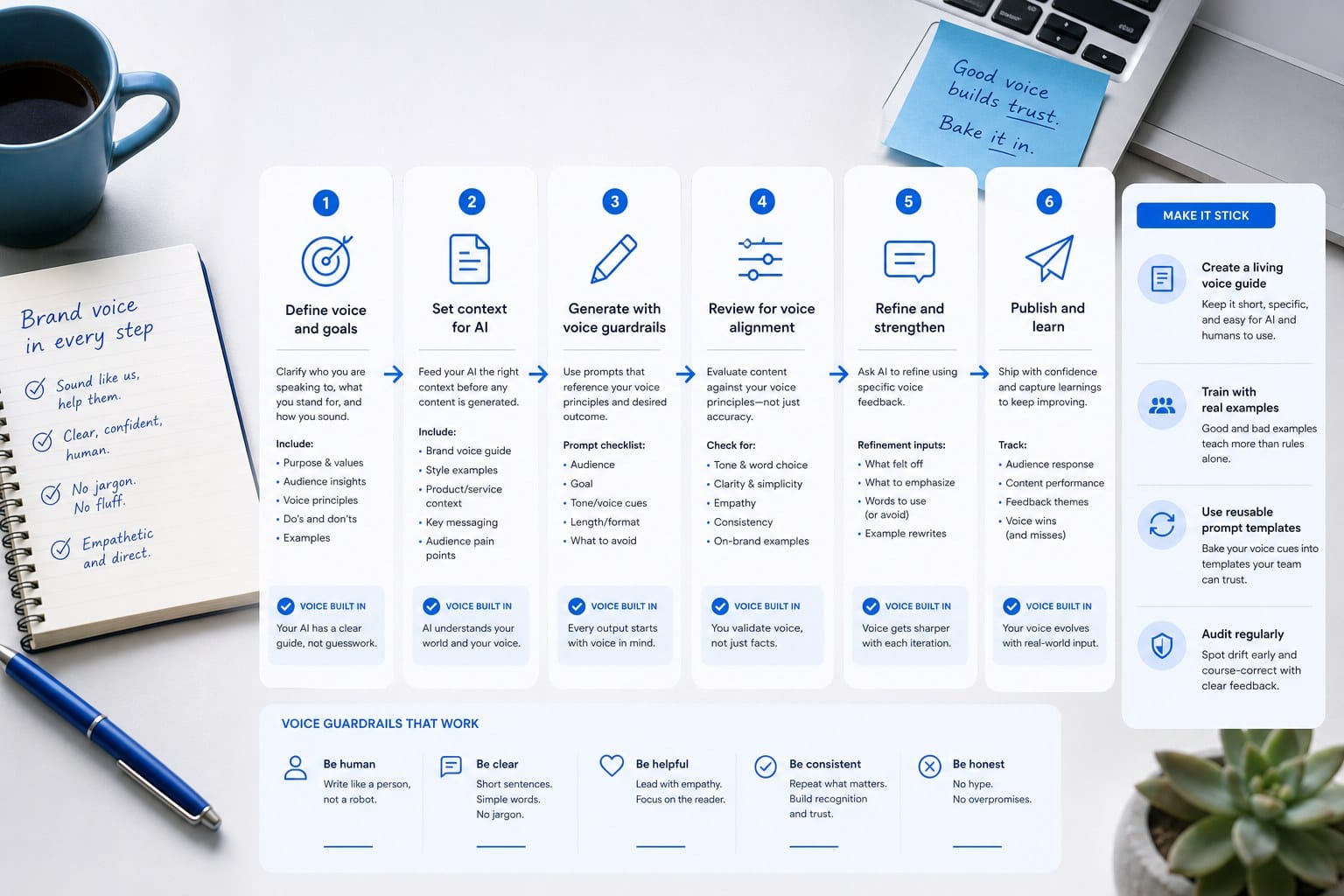
The smarter approach is to build brand voice into your content workflow from the beginning, so the AI produces output that is already much closer to your standard before you ever open the draft. Fixing problems upstream is always faster than fixing them downstream.
Here is how that looks in practice.
Start with a strong content brief.
Before the AI writes anything, give it a structured brief that includes more than just the topic and target keyword. A brief that only tells the AI what the article is about will get you an article that covers the topic without sounding like you.
A voice-aware brief also includes: the target reader and what they already know, the angle you want to take on the topic, the key argument or single takeaway you want the reader to leave with, the tone for this specific article, and two or three things the piece should never do.
That last element is underused. Telling an AI 'do not use passive voice in this article,' 'do not hedge every claim with qualifiers,' or 'do not open with a rhetorical question' shapes the output significantly. Constraints are instructions. The more specific your constraints, the more the output reflects your actual standards.
For teams using a platform like Blogtude, this brief-building step is part of a structured content strategy phase that happens before writing begins. The strategy is not just a list of topics. It captures the angle, audience, and voice parameters for each article. That front-loaded work pays off because you are not correcting the same voice problems over and over in every draft. The corrections compound into better prompts and better briefs over time.
Use a consistent prompt structure.
If you are working directly with an AI writing tool, your prompts should be templates, not improvised from scratch each time. When you improvise prompts, the output varies in ways that are hard to predict and hard to correct systematically. When you use a stable template that includes your voice parameters, the output is much more consistent.
Your prompt template should include: a reference to your brand voice guide or a condensed version of it, the content brief for this specific article, any formatting preferences, and the forbidden phrases or patterns. Save your best-performing prompt as a template and refine it over time rather than rebuilding it from memory every time you sit down to write.
This sounds like a small operational detail, but it makes a real difference. The prompt is where your instructions meet the AI's capabilities. Treating it as disposable means you are leaving a lot of control on the table.
Review for voice separately from reviewing for accuracy.
Many editors try to do everything in one pass. They read a draft and correct facts, fix structure, add links, adjust tone, and catch typos all at once. That is a recipe for missing things, especially voice problems, which require a different kind of attention than factual accuracy.
I recommend two passes. In the first pass, focus only on whether the content is factually accurate, logically structured, and covers the brief. Do not touch the language. In the second pass, read purely for voice. Does this sound like us? Read it out loud if you need to. Your ear catches voice problems faster than your eye does. The places where you stumble or where you would never actually say something that way are the places to rewrite.
If you are reviewing someone else's work or reviewing AI output that you did not prompt yourself, the two-pass approach is even more valuable. It keeps you from getting distracted by content issues when you should be listening for voice, and vice versa.
Create a short voice checklist for your review pass.
A checklist makes the voice review faster and more consistent. You do not have to hold all your brand voice criteria in your head while you read. You check the draft against a short list of specific questions.
A useful voice checklist might include questions like: Are the sentences mostly short and direct, or have they gotten long and tangled? Did we avoid passive constructions, or are they showing up in more than one paragraph? Does the opening hook match our style, or does it feel like a generic blog introduction? Did we use any phrases from the forbidden list? Does the conclusion feel like us, or does it trail off into a generic summary?
Running through a checklist like that takes about three minutes and catches most of the common drift patterns. It also makes the review process trainable. If a new team member is taking over editorial review, you can hand them the checklist and they know exactly what to look for.
Track voice feedback over time.
When you rewrite a section because it does not sound right, note what the AI produced and what you changed it to. Keep a simple running document of these edits. After a few months, you will see patterns.
Maybe the AI consistently writes overly formal conclusions that wrap up with a summary instead of a forward-looking statement. Maybe it adds hedging language, 'it is worth noting,' 'it is important to consider,' that you always strip out. Maybe it opens too many paragraphs with 'Additionally' or 'Furthermore.' Those patterns tell you exactly what to add to your prompt template or your brand voice guide.
This feedback loop is what makes each generation cycle better than the last. You are not correcting the same problems in perpetuity. You are systematically eliminating them by adjusting your inputs. After six months of doing this, the drafts coming out of your workflow should need significantly less editing than the drafts you were getting at the start.
For more on what makes AI-generated content genuinely useful rather than just technically correct, the piece on what makes a blog article deeply researched: a quality framework for scale covers research depth and quality standards in a way that connects directly to editorial decisions you will face during review.
Build the workflow around human judgment, not around automation.
The goal of structuring your workflow this way is not to remove humans from the content process. It is to put human judgment where it matters most: at the brief-writing stage, where you define what the article should say and how it should sound, and at the review stage, where you confirm that it actually does. The AI handles the drafting in between.
That division of labor is what makes AI-assisted content sustainable. The humans are doing the work that requires taste, strategic thinking, and brand knowledge. The AI is doing the work that requires stamina and speed. When those roles get blurred, either because humans stop investing in briefs or because reviews get skipped, voice quality drops fast.
Scale your publishing output without letting voice drift over time
Here is the challenge that most brands hit around month three or four of publishing AI-assisted content: the early articles feel sharp and on-brand, but the newer ones start to drift. They are not bad exactly. They just feel a little generic, a little flat. The voice that made the early pieces feel like you has faded and nobody is quite sure when it happened.
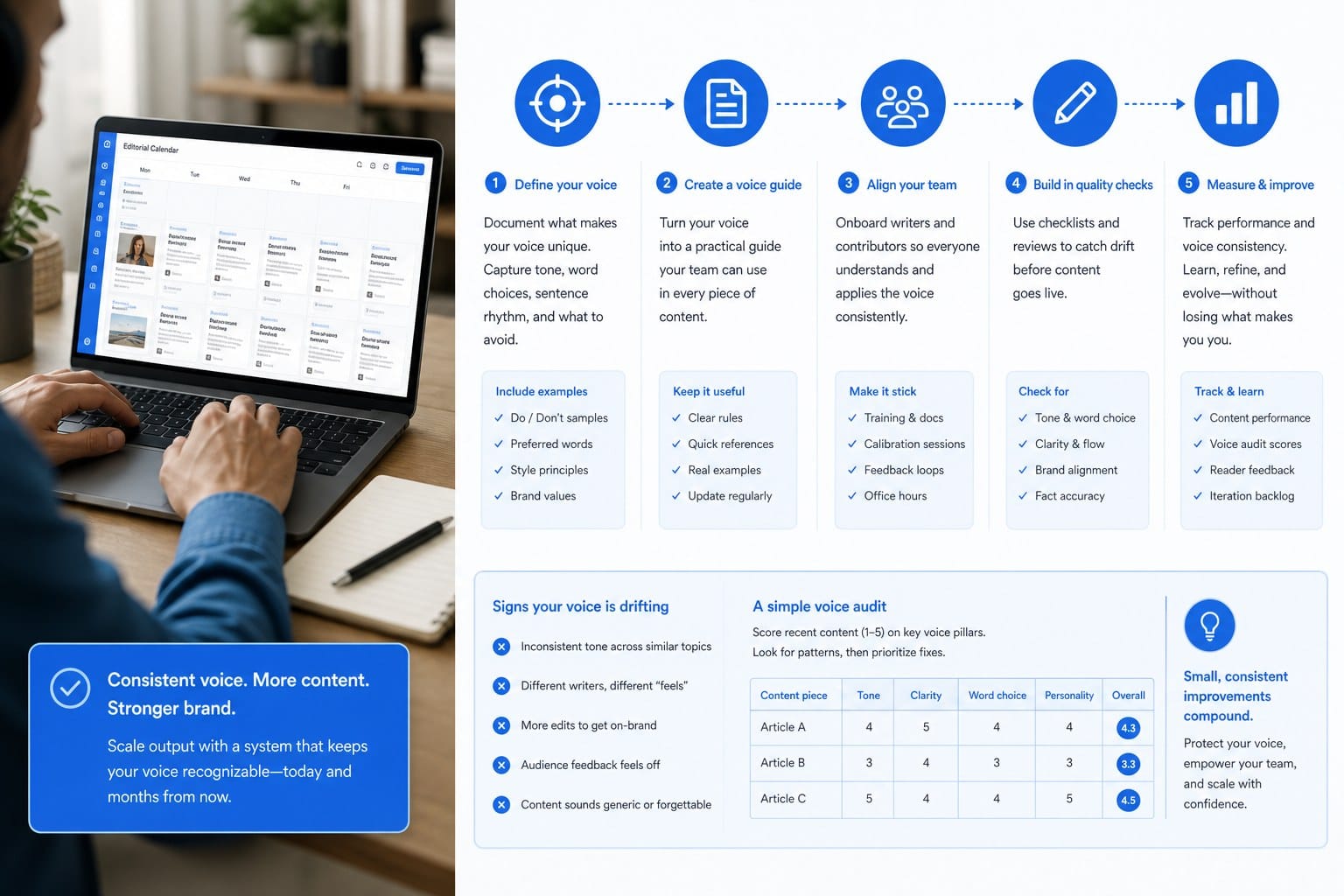
Voice drift is normal when you are producing content at volume. It happens even with human writers, especially when a team is growing or editorial oversight is inconsistent. But it is easier to catch and correct with AI content if you build in a few specific habits from the start.
Do periodic voice audits.
Every quarter, pull five recent articles and compare them side by side with five older articles that you consider your strongest work. Read them in sequence and pay attention to the small differences. Are the recent ones as specific in their examples? As direct in their claims? As characteristic in their sentence rhythm?
Look for patterns in how the voice has shifted. Are the paragraphs getting longer? Is the opening structure becoming formulaic, with every article starting the same way? Are you seeing the same transitional phrases showing up in piece after piece? Are the conclusions all starting to sound like the same generic wrap-up? Those are signs that the prompts or the review process has gotten lazy, or that the brand voice guide has not been updated to reflect how your brand actually sounds now.
A voice audit does not have to take a long time. Ninety minutes every three months is enough to spot the main drift patterns and make corrections before they become entrenched habits. The point is not to do a full content analysis. It is to recalibrate your ear so you know what to look for in the next quarter's review passes.
Update your brand voice guide when your business evolves.
If you launched as a scrappy early-stage startup and you are now a growing company with a larger, more established audience, your voice has probably matured. Maybe you are more confident and authoritative now. Maybe your audience has shifted from solo founders to marketing teams or department heads. Maybe you have developed stronger opinions on topics you used to address cautiously.
If your brand voice guide still describes where you were two years ago, the AI is going to produce content for an audience you no longer serve in a register that no longer fits who you are. That is a subtle but real problem. The content will be technically accurate and strategically sound, but it will feel slightly off to readers who know your brand, and it will fail to connect with the audience you are actually trying to reach.
Set a calendar reminder to review and update your voice guide at least once every six months. Treat it the same way you would treat updating your buyer personas or your messaging framework. It is a living document that should reflect your current reality, not your founding story.
Build a content calendar that includes voice-intensive pieces.
Not every article needs to be a deeply personal, high-craft piece. Most of your content can and should be practical, keyword-driven, useful articles that answer real questions your audience is searching for. AI handles that type of content well when the workflow is set up correctly.
But if every article is purely functional, your brand starts to feel like a content machine rather than a voice people trust. Readers can sense when a blog is being produced rather than written. They do not necessarily stop reading, but they stop feeling a connection to the brand behind it.
Schedule some pieces each quarter where the brand personality gets to come through more fully. Strong opinions on contested topics in your niche. A behind-the-scenes look at a decision you made and why. A direct response to a common piece of advice in your industry that you think is wrong. These pieces are harder to delegate fully to AI, and that is the point. They are the ones that anchor the voice of your blog and make the standard pieces feel more credible by association.
Think of your content calendar as having two types of articles. High-volume practical pieces that drive search traffic and answer questions, and lower-volume voice pieces that remind readers why they trust you specifically, not just the category of content you produce. Both are necessary. Neither works as well without the other.
Automate publishing without giving up editorial control.
Tools that automate the pipeline from strategy to draft to published post save enormous amounts of time. That time saving is the whole point of building an AI-assisted content operation. But the biggest risk in a fully automated pipeline is clicking publish without a human review step.
Even a fifteen-minute review is enough to catch the most obvious voice problems before they go live. Read the headline and the first two paragraphs. Read the conclusion. Scan the subheadings. Check the piece against your voice checklist. That is not a thorough edit, but it will catch the drafts that are noticeably off before they become published articles you have to correct later.
Build that review into your workflow as a non-negotiable step rather than something you skip when the calendar is full. The articles that get published without review are almost always the ones that come back to haunt you, either because a reader points out a voice problem or because you read it three months later and it does not feel like yours.
For Ghost CMS users, the integration between an AI content engine and your publishing platform makes this workflow considerably smoother. The guide on how to integrate an AI blog tool with Ghost CMS covers the technical side in plain language and is worth reading if you have not set that up yet.
Write some content yourself even when you do not have to.
This is the most underrated habit on the list. The whole point of AI content tools is to reduce how much you personally write. That is a legitimate goal. But publishing one or two articles a quarter that come entirely from your own voice and perspective does something important that automation cannot replicate.
It keeps your brand voice sharp in your own mind. It gives your audience a touchstone for what you actually sound like. And it gives you fresh material to reference when you update your brand voice guide. When you write something yourself and it feels right, that piece is evidence of where your voice is right now. It becomes the standard you measure AI output against.
Think of it the way a band thinks about live performances versus studio albums. The studio album is polished and scalable. The live show is where the real voice comes through. Both serve a purpose, and both make each other better. A band that only releases studio albums eventually stops sounding like a band. A blog that only publishes AI-generated articles eventually stops sounding like a person.
For startups and early-stage SaaS companies especially, maintaining a recognizable brand voice is a competitive advantage that compounds over time. Readers who trust your voice come back. They share articles. They become customers. They refer other people. A blog that sounds like it was produced by an algorithm, even a sophisticated one, does not build that kind of loyalty. The goal is to use AI to scale the volume and consistency of your publishing while protecting the voice that makes readers want to keep reading.
If you are building a content strategy from the ground up and trying to figure out what that looks like structurally, the article on startup content marketing: a blogging strategy for early-stage SaaS covers the strategic layer in a way that connects directly to the voice and quality questions we have been working through here.
The core principle behind all of these habits.
Maintaining brand voice at scale is not about fighting the technology. It is about being intentional with how you use it. Voice drift does not happen because AI is bad at writing. It happens because the humans running the process stopped being specific about what they wanted.
When you put real thought into your voice guide, your brief templates, your review process, and your quarterly audits, the AI has something genuine to work with. The output it produces is closer to your standard from the first draft. The editing is faster. The published content is more consistent. And the brand that readers encounter in article twelve looks and sounds like the brand they met in article one.
That consistency, built systematically and maintained intentionally, is what turns a blog from a content checkbox into a real growth channel. It is what makes readers bookmark your site, share your articles, and come back when they have a new problem to solve. It is also what makes SEO work over time, because search engines increasingly reward the kind of depth, specificity, and consistent perspective that a recognizable brand voice produces.
You do not have to choose between publishing enough content and publishing content that sounds like you. Build the system correctly and you get both.
Ready to take the next step?
If you want to publish more blog content without losing the voice that makes your brand distinct, Blogtude is built to help you do both. The platform generates a 30-day content strategy, writes deeply researched long-form articles, and publishes directly to Ghost and other CMS platforms, while keeping your brand voice parameters at the center of every piece. See what a structured AI content operation looks like at blogtude.com.