
Copy.ai alternatives for full blog automation


Table of contents
1. What most Copy.ai alternatives still get wrong
2. The features that actually move the needle for blog automation
3. How Blogtude fits into this picture
If you have used Copy.ai for a while, you know what it does well. It is fast, the interface is clean, and it can knock out short-form content in seconds. But the moment you want a full blog running on autopilot, the gaps start to show. Copy.ai is built around generating copy, not running an entire content operation. You still have to research topics, build a publishing calendar, write complete long-form articles, source visuals, and push everything live to your site. That is a lot of manual work left on the table.
This guide walks through what actually separates a great Copy.ai alternative from just another AI writing tool, and then shows you what a fully automated blog workflow really looks like in practice. Whether you are a solo creator, a SaaS founder trying to grow organic traffic, or a digital marketer juggling multiple brands, understanding that distinction will save you a lot of time and frustration before you commit to a new tool.
What most Copy.ai alternatives still get wrong
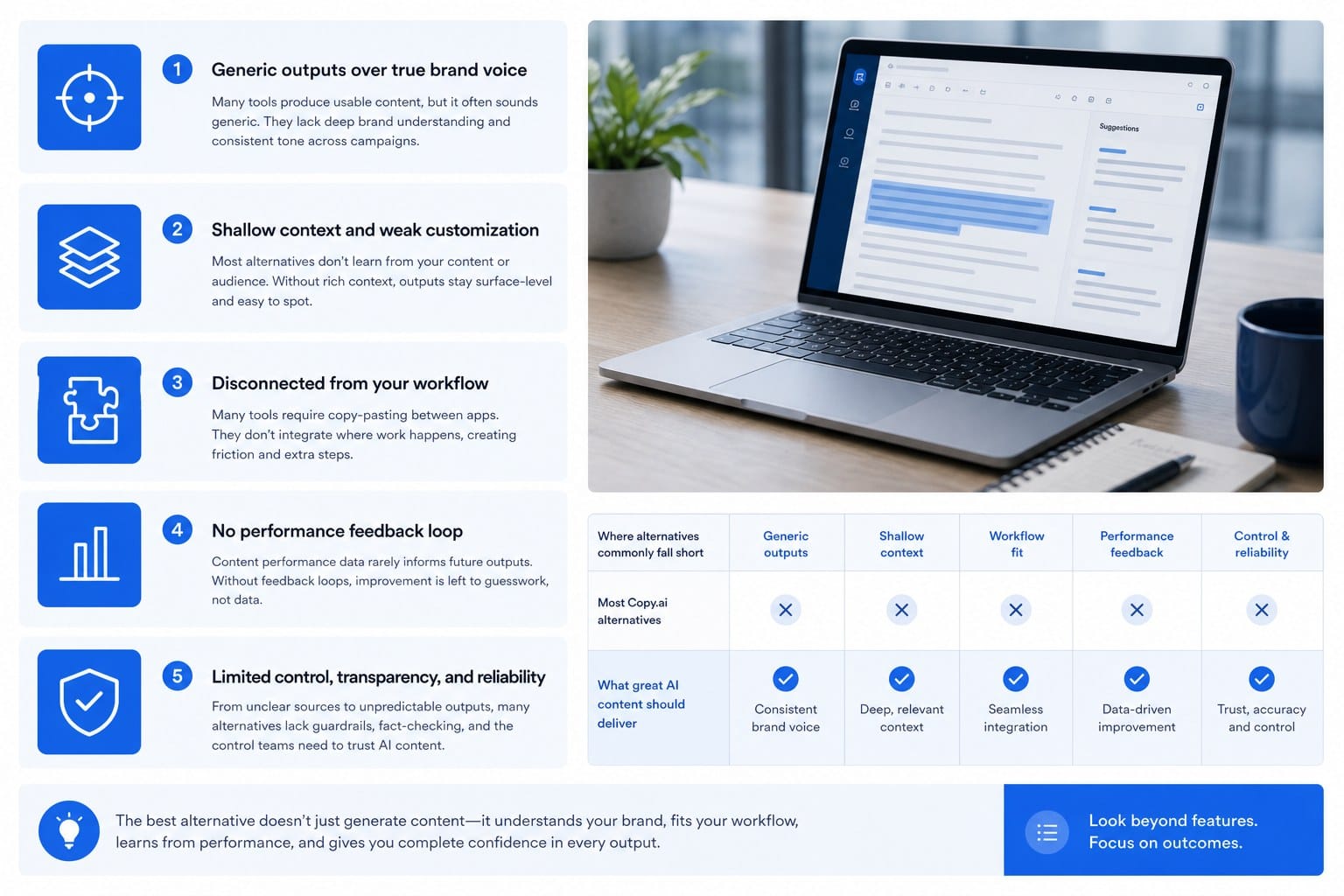
When people go searching for Copy.ai alternatives, they usually have one of two problems. The first is quality. They want longer, more researched output that actually ranks in search. The second is workflow. They are tired of doing all the surrounding work themselves — the keyword research, the content outline, the editing pass, the image sourcing, the scheduling, and the final publishing step.
Most tools out there solve one of those problems. Almost none solve both.
Here is what that looks like in practice. You decide to try a popular AI writing assistant. You type in a topic, pick a tone, and hit generate. You get a 1,200-word draft in about 90 seconds. It is decent. But now you notice the article has no internal links, the headers are generic, there are no images, and the whole thing is sitting in an editor with no connection to your website. You have to copy it into your CMS, reformat it manually, upload a featured image, fill in the meta description, set a publish date, and repeat that same process for every single post. Multiply that by four posts a week and you have a part-time job.
That is the core problem with most tools that position themselves as Copy.ai alternatives. They automate the writing step and leave everything else to you. That might be acceptable if you have a content team to handle the downstream work. But for independent bloggers, small business owners, and lean SaaS teams, it just shifts the bottleneck rather than removing it. The writing gets faster. The workload stays roughly the same.
There is also a depth problem that is worth naming clearly. Copy.ai and tools like it are optimized for conversion copy and short-form content — product descriptions, email subject lines, ad copy, social captions. That is their native habitat, and they do it well. When you ask them to write a 2,500-word blog post on a competitive SEO topic, the output tends to be surface-level. You get broad statements, thin paragraphs, and lots of generalities that do not give search engines or readers much to work with.
Google has gotten very good at identifying content that does not say anything new or useful. A 1,500-word article that skims across a topic without going deep on any part of it is increasingly a liability rather than an asset. Search engines reward specificity, genuine depth, and content that answers follow-up questions before the reader thinks to ask them. Generic AI writing rarely clears that bar.
So when you are evaluating Copy.ai alternatives, the right questions are not just about writing quality in isolation. You should be asking a broader set of things. Does this tool build a content strategy for me, or do I still have to come up with topics myself? Does it produce articles that are long enough and specific enough to compete in search? Does it handle images, or do I need to source those separately? Can it publish directly to my CMS, or is publishing still a manual step? And does it do all of this on a schedule, without me having to log in and kick off each piece?
If the answer to most of those questions is no, you have found a better AI writer, not a better content system. For people who want to scale a blog without scaling their workload, that distinction matters a great deal.
It is also worth acknowledging that the market for AI writing tools has gotten extremely crowded. A lot of products have launched promising full automation but deliver something much closer to a guided writing assistant. You type, it helps. You prompt, it responds. The human is still the engine driving every step.
This pattern shows up consistently across the category. Tools that lead with AI writing as the headline feature rarely solve the full workflow problem. They solve the drafting problem, which is real, but it is only one piece of a much larger operational challenge. I have covered this same gap in related contexts, including Jasper AI alternatives for bloggers who want full autopilot publishing and RightBlogger alternatives for brands that need more than a writing assistant. The conclusion is the same each time: better writing output is a meaningful upgrade, but it does not make the blog run itself.
For someone who is content to write most posts manually but wants help speeding up drafts, a standard AI writing tool might be all they need. But for someone who wants a blog that publishes consistently without requiring their constant attention, the tool category most people are comparing is simply not built for that goal. That is not a criticism of any specific product. It is a category-level limitation that matters a lot once you understand what you actually need.
The frustration tends to compound over time. You adopt a new AI writing tool, feel excited about the speed gains for the first few weeks, and then slowly realize that the bottlenecks you wanted to eliminate are still there. The writing is faster. The strategy work is still on you. The publishing is still manual. The image sourcing is still a separate task. And the consistency you wanted — four posts a week, every week, without it taking over your schedule — is still out of reach.
That is the actual problem worth solving. And solving it requires a different kind of tool than most people are currently evaluating.
The features that actually move the needle for blog automation
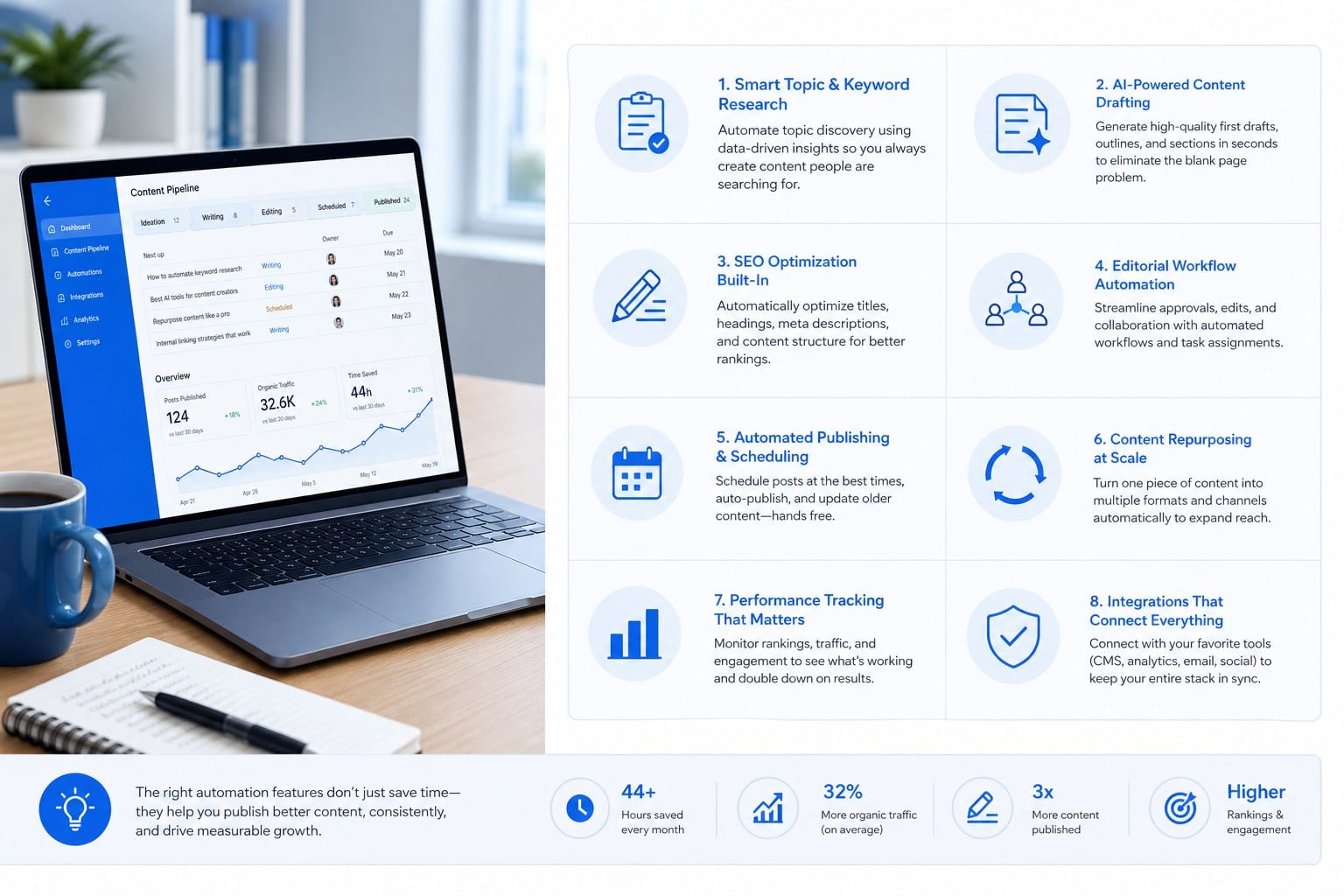
Let me get specific about what a genuinely automated blog workflow looks like, because it is easy to throw around the word automation without it meaning much. There are six capabilities that separate a real content engine from a glorified text generator. Understanding each one will help you evaluate any tool you are considering, including whether it actually closes the loop or just moves the bottleneck.
The first capability is strategic content planning. A real blog automation system does not just write what you ask it to write. It figures out what you should be publishing in the first place. That means analyzing your niche, identifying keyword opportunities that match your site's current authority level, and building out a content calendar that creates topical depth over time.
This matters because publishing 30 random articles is far less effective than publishing 30 articles that build on each other thematically. Search engines reward sites that demonstrate genuine expertise across a topic cluster, not sites that publish isolated posts on loosely related subjects. If a tool cannot help you build that kind of strategy, you are still the strategist. You have just outsourced the typing. That is a marginal improvement, not a system.
The second capability is long-form depth. The articles that rank well in competitive niches are not 800 words long. They are detailed, structured, and they go genuinely deep on the subject. They answer follow-up questions. They include concrete examples. They explain nuance and reference specifics rather than speaking in generalities.
Generating that kind of content requires more than a prompt and a fast language model. It requires a research step that gathers real information about the topic before the writing begins. Tools that skip the research step almost always produce content that feels hollow, regardless of how fluent the prose sounds. The sentences are grammatically correct. The structure is logical. But there is nothing there that a reader could not have found in the first paragraph of a Wikipedia article. That is not content that earns rankings or keeps readers on the page.
The third capability is on-brand visual generation. A blog post without images is at a disadvantage for time on page, social sharing, and basic reader experience. But sourcing or creating images for every article is time-consuming, and stock photos often feel generic and completely disconnected from the content. An automated content system should be able to generate or source relevant visuals that match the article's topic and the brand's visual identity, without requiring you to open a separate design tool or stock photo library for every post.
The fourth capability is CMS integration and direct publishing. This is the step that most tools skip entirely, and it is one of the most significant sources of friction in any content workflow. Even if you have a perfect article sitting in a third-party editor, you still have to get it onto your site. For Ghost CMS users specifically, the workflow of copying content from an external tool into Ghost, reformatting it, adding tags, setting the meta description, uploading the featured image, and scheduling the publish time is a meaningful and repetitive friction point.
A true blog automation system has to close that loop. The article should go from generation to live on your site with no manual intervention required. If the tool stops at the editor and hands the publishing work back to you, it has not automated your blog. It has automated your drafting, which is a smaller win.
Ghost is a powerful platform with a clean API, and it is genuinely well-suited to automated content workflows. But almost none of the mainstream AI writing tools have built a native Ghost integration that handles the full publish step, including featured images, tags, metadata, and scheduling. That gap is real, and it is one of the main reasons Ghost bloggers tend to end up with fragmented workflows that require multiple tools and a lot of manual coordination.
The fifth capability is scheduling and consistency. One of the hardest things about maintaining a blog is not writing one good article. It is showing up every week without fail, week after week, regardless of how busy everything else gets. Search engines reward consistent publishing. Audiences come to expect a cadence. But manual publishing schedules slip when life gets busy, and a blog that publishes in bursts and then goes quiet for three weeks is not building the kind of steady authority that drives organic growth.
An automated content system should be able to execute a publishing cadence reliably, pushing articles live on a schedule you set, without requiring you to log in and manually trigger each one. That consistency is one of the most underrated advantages of a true automation system. The blog runs the same whether you are deep in a product launch, traveling, or just having a week where content is not your priority.
The sixth capability is brand voice alignment. This one is subtle but important. If you have been blogging for a while, your content has a voice. A particular way of explaining things, a certain tone, a recognizable style that readers have come to associate with your site. Generic AI writing tends to flatten that out into a kind of smooth, inoffensive, interchangeable prose that could have come from anyone.
A system that is actually useful for brand blogs has to learn and apply your voice consistently, so that automated content feels like it came from you rather than from a machine. Without that, every post reads like it was written by a committee, and the brand identity you have built up over time starts to erode.
When you look at the Copy.ai alternatives market through this lens, the field narrows considerably. Most tools handle one or two of these six capabilities. A handful handle three or four. Very few handle all six in a coherent, integrated way. I covered this same pattern when writing about Narrato alternatives that include full publishing automation, and the conclusion held: the tools that get the most attention are often solving the easiest part of the problem, not the most valuable part.
It is also worth thinking about what happens when you get the full workflow right. The compounding effect of consistent, well-researched, properly structured blog content on organic traffic is well documented. Sites that publish regularly in a topically coherent way tend to see steady, cumulative growth in search visibility over months and years. Each article reinforces the ones around it. Each new piece of content adds to the site's topical authority in a way that random publishing does not.
The challenge has always been execution. Finding the time to research, write, design, and publish consistently is genuinely hard for small teams and solo creators. When a system handles all of that reliably, the compounding starts working in your favor without requiring a proportional increase in your time or headcount. That is the actual opportunity that most AI writing tools leave on the table.
How Blogtude fits into this picture
I want to be direct about what Blogtude is designed to do, because comparing it honestly against typical Copy.ai alternatives requires being clear about the category difference.
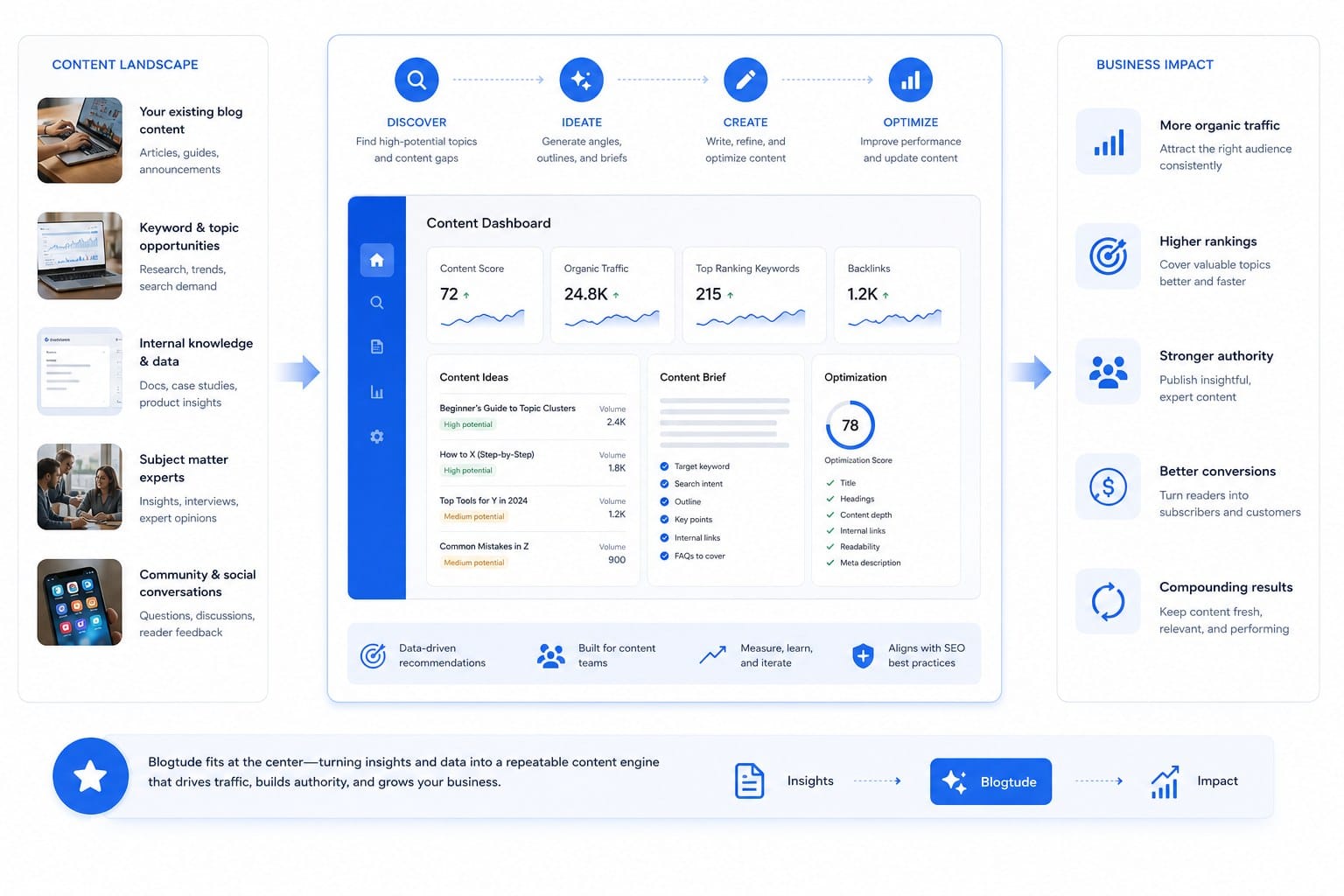
Blogtude is not a writing assistant. You do not open it, type a prompt, and get a draft back that you then edit and publish yourself. It is a content engine, and the model is different from the ground up. You connect it to your brand, describe your audience and goals, and it builds a 30-day content strategy for you. That strategy is not a list of generic topic suggestions. It is a mapped-out publishing plan built around keyword opportunities that match where your site is right now, structured to build topical authority over time rather than publishing a random assortment of loosely related posts.
From there, Blogtude produces the articles. These are not 800-word summaries or surface-level overviews. They are deeply researched long-form pieces that go into real depth on the subject. The research step happens before the writing step, so the content is grounded in actual information rather than generated purely from a language model's training data. That difference shows up clearly in the specificity and usefulness of the output. The articles cover the topic the way a knowledgeable writer who actually looked into it would cover it, not the way a system guessing at what sounds plausible would cover it.
Each article comes with on-brand visuals. You do not need to open a design tool, browse a stock library, or coordinate with a designer. The visuals are matched to the article content and to your brand identity, and they are included automatically as part of the same workflow.
And then, critically, Blogtude publishes directly to your CMS. For Ghost users, this means the article goes live on your site fully formatted, with the featured image attached, tags applied, the meta description set, and the publish time matching your content calendar. The manual publishing step is gone. The entire pipeline — strategy, research, writing, visuals, publishing — runs without you having to touch it.
This is the gap that most Copy.ai alternatives do not fill. They make the writing faster. Blogtude makes the blog run.
For an independent blogger who wants to publish four times a week without spending 20 hours doing it, that distinction is the difference between a tool and a solution. For a SaaS founder who wants consistent SEO-driven content but cannot justify a full-time content hire, it means the blog runs reliably in the background while the team focuses on the product. For a digital marketer managing multiple brand blogs, it means dependable output across all of them without the constant coordination overhead that comes from assembling a workflow from five separate tools.
The clearest way to explain the value is to map out what consistent blogging actually requires. Strategy takes time. Research takes time. Writing takes time. Editing takes time. Sourcing images takes time. Publishing takes time. Scheduling takes time. If a tool removes one of those steps, you have made your life a little easier. If a system removes all of them and handles each step reliably on its own, you have freed up a substantial block of time every single week, and you get a blog that runs regardless of how busy everything else gets.
Blogtude is designed specifically for that second scenario. The 30-day content strategy gives you a coherent publishing plan rather than a random assortment of posts. The long-form, research-backed articles give you content that can actually compete in search and hold a reader's attention. The on-brand visuals give you professional-looking posts without the design overhead. And the direct CMS publishing, including native Ghost integration, means the whole pipeline closes without manual intervention at any step.
One thing that is easy to underestimate until you experience it is the psychological weight of a blog that is running on its own. When you are managing a business, a product, a team, or even just a busy schedule, the constant low-level pressure of knowing your blog is falling behind is a real drain. Posts that did not go out, topics that never got researched, the publishing cadence that slipped two weeks ago and never recovered. That background noise has a cost, even if it is hard to quantify.
When the system is handling it reliably, that pressure disappears. The blog publishes on schedule. The strategy is being executed. The content is showing up in search over time and doing its compounding work. You can check in on it rather than managing it.
That shift — from managing a blog to simply having one that works — is what Blogtude is built to deliver. It is not a marginal improvement on AI-assisted writing. It is a different approach to the problem of consistent, high-quality content production at a scale that small teams and independent creators can actually sustain.
If you have been piecing together a workflow from multiple tools, or if you have been frustrated with Copy.ai alternatives that handle the writing but leave the rest of the work entirely to you, it is worth seeing how Blogtude approaches the problem differently. The goal is not better AI writing in isolation. The goal is a blog that works for you consistently, every week, so you can focus on everything else that matters.
You can learn more and start building your automated content system at Blogtude.
Ready to take the next step?
Ready to stop piecing together a blog workflow from tools that only solve half the problem? Blogtude builds your content strategy, writes deeply researched long-form articles, adds on-brand visuals, and publishes everything directly to Ghost and other CMS platforms on a schedule you set. You focus on your business. The blog runs itself. Visit Blogtude to get started.


