
RightBlogger alternatives for brands that need more than a writing assistant


Table of contents
1. What RightBlogger does well and where it stops short
2. What to actually look for in a RightBlogger alternative
3. How Blogtude fills the gaps that RightBlogger leaves open
RightBlogger is a solid toolkit for bloggers who want AI help with individual writing tasks. It covers keyword research, blog post drafting, title generation, and a handful of other content jobs. For solo writers who need a quick AI hand, it works fine. But brands that need more than a writing assistant start to feel its limits fast. If you are managing a blog for a SaaS product, running content for a small business, or trying to build consistent organic traffic, you quickly realize that generating a draft is only one small piece of the puzzle. You still have to plan a content calendar, do deep research, source or create visuals, format the post, and then actually publish it somewhere. RightBlogger does not close that loop. That gap is exactly why so many teams are searching for RightBlogger alternatives that handle the full workflow, not just the writing part. This article walks through what RightBlogger does well, where it falls short for growth-focused brands, and what to look for in a tool that actually takes blog content off your plate from strategy all the way through to a live published post.
What RightBlogger does well and where it stops short
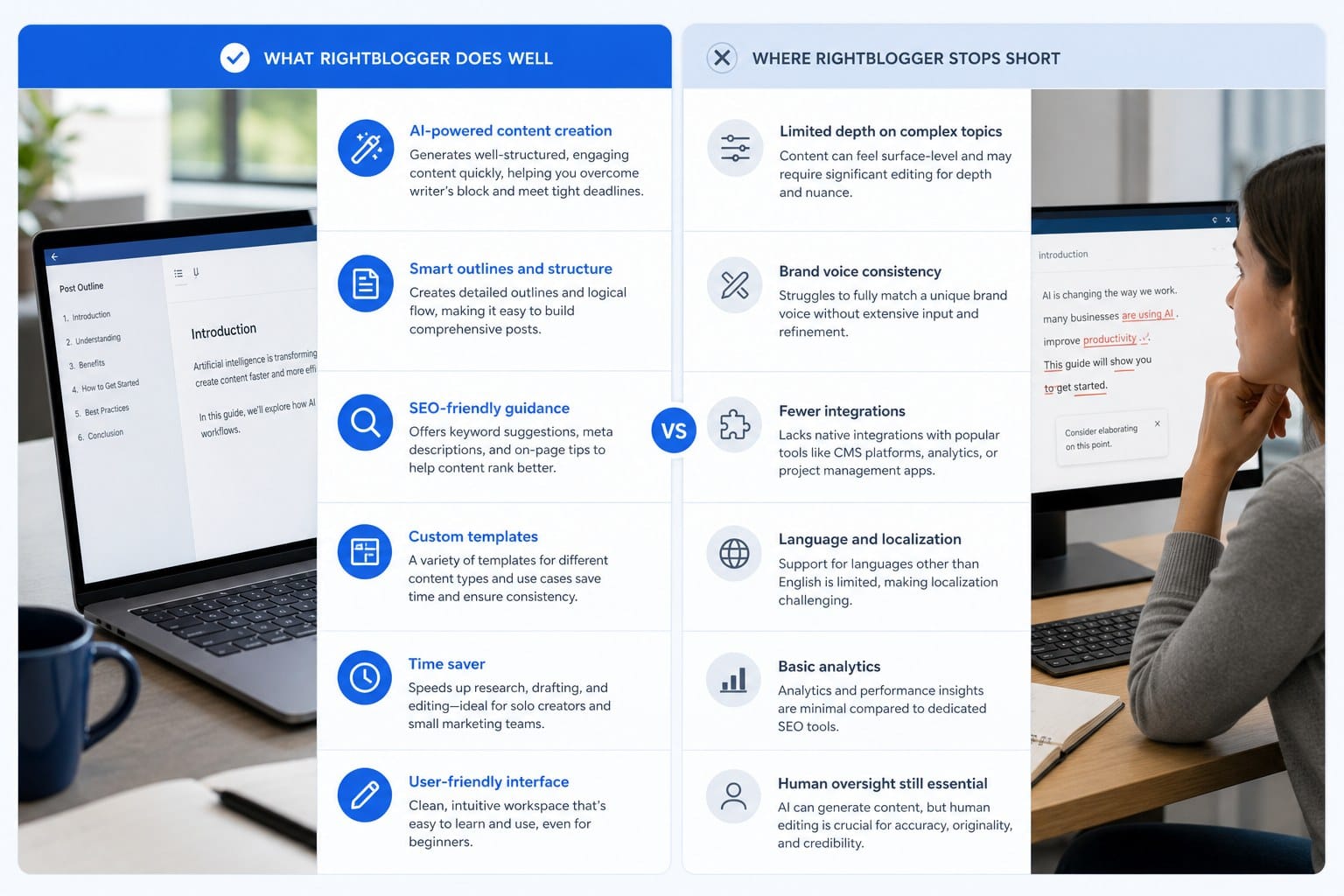
RightBlogger markets itself as a toolkit for bloggers. It bundles together more than 80 AI-powered tools inside one dashboard. You get a blog post writer, a keyword research tool, a title generator, a meta description writer, a content repurposing tool, and more. For a solo blogger who mostly needs help beating writer's block or speeding up first drafts, that breadth is genuinely useful.
The platform is easy to pick up. You fill in a topic or a keyword, adjust a few settings, and the AI returns a usable draft in a short amount of time. The keyword research feature pulls data so you can at least see search volume and competition level before you commit to a topic. If you are a freelance writer or a one-person operation, tools like these can meaningfully cut down your production time. That is a real benefit, and it explains why RightBlogger has built a following among individual creators.
But when brands start scaling, the cracks appear quickly.
The first problem is strategy. RightBlogger is a generation tool, not a strategy tool. It will write a post if you give it a topic, but it will not build you a coherent 30-day or 90-day content plan based on your niche, your competitors, or your audience's search intent. You have to show up every day with new prompts and new ideas. You are still responsible for deciding what to write, in what order, for what audience, and toward what goal. That manual overhead adds up fast when you are trying to publish two or three times a week. The editorial thinking that should drive a blog stays entirely on your shoulders.
The second problem is research depth. AI writing tools that rely on a simple prompt-to-output model tend to produce content that sounds right but lacks the specific details, statistics, and examples that make an article genuinely useful to a reader. Google's helpful content guidance rewards articles that demonstrate real expertise and depth. A draft that is grammatically clean but thin on substance does not rank well and does not build trust with your audience. When a reader clicks through from search and finds a post full of vague generalities, they leave. That behavior signals to search engines that the content did not satisfy the query, which hurts your rankings over time. Good research has to happen before the writing starts, and RightBlogger does not build that layer into its process.
The third problem is visuals. Modern blog posts perform better when they include relevant images, diagrams, or branded graphics. A post with a strong featured image looks more professional, earns more clicks in search results, and performs better when someone shares it on social media. RightBlogger does not generate or source visuals, so that job stays on your to-do list. For every post you produce, you are still opening a separate tool, finding or creating an image, downloading it, and importing it into your CMS. That step is small in isolation but significant in volume.
The fourth problem, and the most critical one for teams that want to automate, is publishing. Every post RightBlogger generates has to be copied out of the platform, formatted in your CMS, given a featured image, tagged, categorized, assigned a slug, given an SEO title and meta description, and then manually published or scheduled. If you use Ghost, WordPress, or Webflow, that manual step happens every single time, for every single post. At low volume, it is annoying. At the volume needed to build meaningful SEO traction over months, it becomes a genuine bottleneck that limits how much content you can actually ship.
This is the core problem that sends people searching for RightBlogger alternatives. They do not necessarily want a better AI writer. They want a system that handles content from strategy all the way through to a live published post, without requiring them to stitch together five different tools and do the final mile manually.
This pattern shows up consistently across the AI content tool category. I have written about similar gaps in Narrato alternatives that include full publishing automation and in Outrank.so alternatives: the best AI blog tools to replace it. The feedback from readers was consistent across both. The missing piece is almost always the last mile. Tools that help you create content but stop short of publishing it leave a manual burden that grows with every post you produce. At ten posts a month, it is manageable. At thirty, it starts to cost real time. At the volume you need to compound SEO results over a full year, it becomes a structural problem that no amount of faster drafting can fix.
RightBlogger is not a bad tool. For the use case it was built for, it delivers. The issue is that the use case it was built for, helping individual bloggers write faster, is different from what growth-focused brands and content-driven businesses actually need. Those teams need a content operation, not a writing aid. That distinction matters a lot when you are deciding where to invest your time and your budget.
What to actually look for in a RightBlogger alternative
Before you evaluate any tool, it helps to get clear on what your actual workflow needs look like. Most growing brands have three distinct problems, and a true RightBlogger alternative should solve all three, not just one.
The first problem is content planning. You need a steady pipeline of topics that match what your audience is actually searching for, that fit your brand's focus, and that hang together as a coherent content strategy. This is not just a keyword list. It is a prioritized calendar that considers search intent, competition level, internal linking opportunities, and content gaps in your niche. Building this manually takes significant research time every single week. You have to look at what competitors are ranking for, identify the questions your audience is asking, assess how difficult individual keywords are to compete for, and then sequence everything in an order that makes strategic sense. A good RightBlogger alternative generates this plan for you based on your niche and goals, so you are not starting from scratch every Monday morning.
The second problem is content quality. The internet is not short on generic AI content. What is rare is long-form content that is genuinely well-researched, includes specific examples and data points, matches your brand voice, and answers reader questions thoroughly enough to earn real trust. Length alone does not create quality. A 3,000-word article stuffed with vague generalities will not outrank a focused 1,500-word piece that actually covers the topic well and gives the reader something concrete to take away. The best alternatives do deeper research before drafting. They pull in real context, relevant details, and accurate framing before a single sentence is written. That research is what separates content that ranks and builds authority from content that gets ignored.
Search engines have gotten significantly better at identifying content that is statistically fluent but substantively thin. If a tool is simply turning your prompt into plausible-sounding paragraphs without understanding the topic deeply, the resulting content will reflect that. It may pass a quick read, but it will not satisfy a reader who actually knows the subject, and it will not earn the links and engagement signals that push rankings up over time.
The third problem is publishing. This is where most AI content tools completely drop the ball, and it is the problem that creates the most friction at scale. Even platforms that produce genuinely good content leave you with a document that still needs to be turned into a live post. You take that document and spend 20 to 40 minutes per post formatting it in your CMS, adding a featured image, writing the SEO title and meta description, setting the slug, choosing categories and tags, and scheduling or publishing. Multiply that by three posts a week and you are looking at two hours or more of pure administrative work every week. That is time that has nothing to do with the quality or strategy of your content. It is just production overhead, and it scales directly with your publishing volume.
So when you evaluate RightBlogger alternatives, here are the specific questions worth asking before you commit to anything.
Does the platform generate a content strategy, not just individual posts? Can it produce a multi-week calendar based on your niche and target audience, so you always have a prioritized queue of topics ready to go, without you having to build it from scratch?
How does it handle research? Does it rely purely on the prompt you provide, or does it pull in external context, real examples, relevant data, and competitive information before it writes? This distinction matters more than most people realize when they are evaluating tools. A tool that researches before it writes produces fundamentally different content from a tool that simply generates based on a prompt.
Does it include visuals? Can it create or source branded images, featured photos, or diagrams that are ready to include in the post without you having to find them separately? For brands that care about how their blog looks and how their content performs on social media, this is not a minor detail.
Does it publish directly to your CMS? Ghost users in particular benefit enormously from a tool that connects to the Ghost API and can push a fully formatted post, with metadata, images, and formatting, directly to their site on a schedule. The same applies to WordPress and other platforms. If the answer is no, you are still stuck with that manual last-mile step every single time.
Can it maintain brand voice consistently? One-off AI drafts often feel generic, like they could have been written for any company in any industry. A tool that learns your tone, your audience, and your preferred style will produce content that sounds like you, not like a committee. That consistency matters for reader trust and for brand recognition over time.
Does it handle the full workflow inside one platform? Every time you export from one tool, paste into another, and manually upload to a third, you create friction and risk. A formatting error, a missed meta description, a featured image that did not transfer correctly: these small problems compound when you are moving content between systems manually. Tools that keep the entire process inside one system are dramatically easier to maintain and dramatically less likely to introduce production errors.
I looked at similar criteria when writing about Arvow alternatives: AI blog platforms that actually publish for you. The pattern holds across the category. The most valuable tools are the ones that eliminate the gaps between steps, not the ones that make any single step slightly faster. A tool that speeds up drafting by 30 percent but still leaves publishing manual has not actually reduced your workload in proportion to its cost. A tool that removes the publishing step entirely, while also handling strategy and research, has changed the economics of running a blog.
The brands that benefit most from a comprehensive alternative tend to fall into a few clear groups. SaaS founders trying to build organic search traffic around product-adjacent keywords. Small business owners who do not have time to manage a content calendar on top of everything else they are running. Digital marketers managing blog content for multiple brands or clients. Ghost CMS users who want automated publishing without sacrificing quality. For all of these users, a writing assistant is a small piece of the answer. What they actually need is a content engine, something that runs the operation rather than just helping with one task inside it.

How Blogtude fills the gaps that RightBlogger leaves open
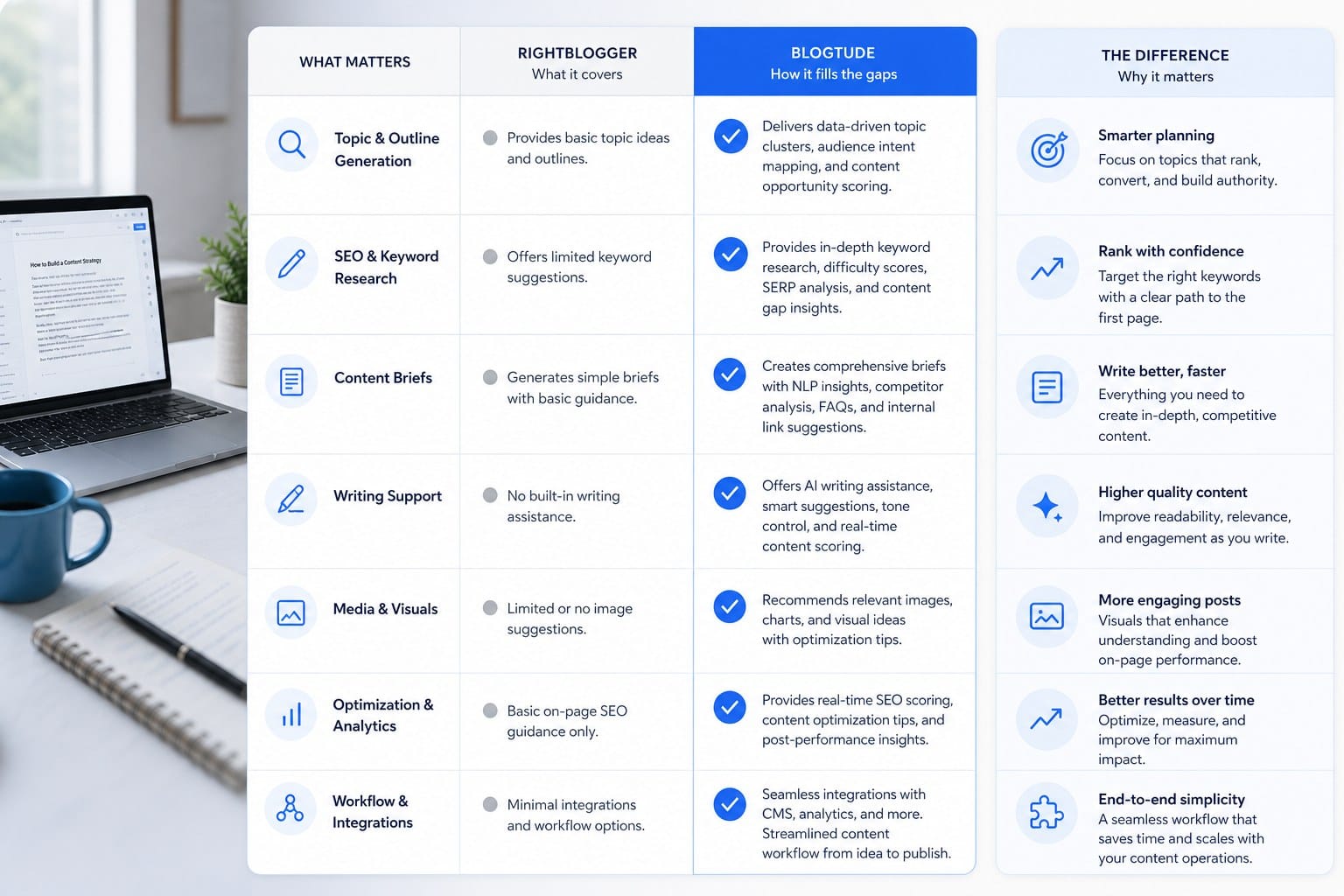
Blogtude is built specifically for the brands and creators who have outgrown writing assistants. Instead of helping you write one post at a time, it runs the entire blog content operation: strategy, research, writing, visuals, and publishing. The goal is a live, high-quality blog post that appears on your site without you having to manage each production step manually.
Here is how each piece of that works in practice.
Content strategy comes first. When you set up Blogtude, it builds a 30-day content strategy tailored to your niche, your audience, and your goals. This is not a generic list of topics assembled by an AI with no context about your business. It is a prioritized plan that considers what your readers are actually searching for, where the content gaps are in your space, how competitive individual topics are, and how individual posts can support each other through internal linking. For a SaaS founder trying to rank for product-adjacent keywords, that strategic layer is what makes the difference between publishing content that gradually builds authority and publishing content that disappears into the void. For a small business owner who needs local and category content to show up in search, having that roadmap ready changes the entire dynamic. You are not waking up Monday morning wondering what to write about. You have a queue of prioritized topics, ordered by impact, ready to execute.
Research happens before the writing starts. This is a meaningful structural difference from tools that simply turn your prompt into a draft. Blogtude does deep research on each topic before the article is written. That research informs the structure, the specific claims, the examples, and the depth of coverage in the finished piece. The result is long-form content that reads like it was written by someone who actually understands the subject, not content that sounds fluent on the surface but collapses under a reader's close attention.
For SEO purposes, this matters significantly. Search engines have gotten much better at distinguishing genuinely helpful content from text that is statistically plausible but thin on substance. A post that covers a topic in real depth, with accurate details and specific examples, earns more time-on-page, more return visits, and more links from other sites. Those signals compound over time into ranking improvements that a blog full of generic AI drafts simply cannot achieve.
Visuals are included in every post. Each article comes with on-brand visuals, so you are not scrambling to find a featured image or build a graphic separately after the writing is done. For brands that care about how their blog looks and how their content performs when shared on social media, this removes a step that most writing tools leave entirely unaddressed. A post with a strong visual earns more clicks in search results, looks more professional to a first-time reader, and creates a better impression when someone shares it on LinkedIn or Twitter. These are not marginal differences in performance. Visual quality affects how readers perceive your brand from their first interaction with your content.
Publishing is automated. This is the part that makes Blogtude genuinely different in the category. The platform publishes directly to Ghost and other CMS platforms. That means the article, the metadata, the featured image, and the formatting arrive on your site on schedule without you opening a dashboard and doing it manually. For Ghost CMS users in particular, this integration is a significant operational advantage. Ghost is a powerful publishing platform that a growing number of independent creators, newsletters, and content-driven businesses have moved to. But Ghost does not have a native content planning or AI writing layer. Blogtude adds that layer and closes the loop by pushing finished content directly to Ghost via the API, on the schedule you set.
For WordPress users and teams on other platforms, the same principle applies. The post does not sit in an export queue waiting for someone to do the final upload. It gets published according to the plan, and you can get on with the rest of your work. The manual steps that used to consume two or more hours a week, formatting, image importing, slug setting, metadata writing, scheduling, simply do not happen anymore. That time goes back to you.
Consistency is built into the system, not dependent on your personal bandwidth. One of the most common patterns in content marketing is that output surges when someone has time and energy, then drops off when other priorities take over. The blog goes quiet for a few weeks. That inconsistency hurts SEO because search engines reward sites that publish regularly and notice when sites go dormant. It also hurts audience trust. When readers find a blog they like and come back to find it has not been updated in six weeks, they do not bookmark it and return. They move on.
Blogtude removes the dependency on your availability. The 30-day strategy runs regardless of whether you are slammed with a product launch, a client crisis, or a week of travel. Posts go live on schedule. The blog stays active. Over time, that consistency compounds in a way that irregular publishing never can. Each new post builds on the existing content. Internal links support each other. The site accumulates the kind of topical authority that drives steady organic traffic growth, not because you got lucky with one post but because the whole operation ran consistently for months.
For digital marketers managing content across multiple brands or clients, this is especially valuable. Instead of project-managing writers, chasing deadlines, reviewing drafts, and spending hours each week on editing and publishing logistics, you have a system that handles the production workflow and delivers finished posts. Your job shifts from doing the content work to overseeing the strategy and reviewing results. That is a meaningfully different role, and it scales in a way that manual content management does not.
For independent bloggers and creators who want to scale without hiring, Blogtude replaces what would otherwise require a small team. A content strategist, a researcher, a writer, a designer, and someone handling CMS publishing are all functions the platform absorbs into one workflow. For someone trying to grow a blog without the budget or the appetite to manage multiple contractors, that consolidation is not a minor convenience. It is what makes the whole operation viable.
It is worth being specific about who Blogtude is not for, because not every use case calls for a full content engine. If you write every post yourself and want AI help with phrasing, structure, or beating blank-page moments, a lightweight writing assistant might actually serve you better. The strength of Blogtude is in automation, consistency, and volume. It is designed for brands and creators who need a content operation running in the background, not a tool that speeds up one step in a process they are still managing manually.
For brands that have already looked at tools in this category and found them lacking, the core question to ask any candidate is whether it handles the whole workflow or just one piece of it. A tool that writes but does not publish still requires significant manual effort at scale. A tool that publishes but does not research produces thin content that struggles to rank and does not hold a reader's attention. A tool that does both but generates content without a strategic plan leaves you directing traffic manually every day, deciding what to write and when, with no roadmap to follow.
Blogtude is built to handle all three layers: strategy, production, and publishing. That is the distinction worth paying close attention to when you are comparing RightBlogger alternatives and trying to decide which one actually solves the whole problem rather than just making one part of it slightly more convenient.
Ready to take the next step?
If you are ready to move from a writing assistant to a full content engine, Blogtude is worth a close look. It handles strategy, research, writing, visuals, and publishing in one system, so your blog stays active and your time stays free. Visit blogtude.com to see how it works and get started.


