
Jasper AI alternatives for bloggers who want full autopilot publishing


Table of contents
1. What bloggers actually need that Jasper does not fully deliver
2. What full autopilot publishing actually looks like
3. How Blogtude fits into this picture for bloggers who want less manual work
If you have used Jasper AI for any length of time, you already know the drill. You open a blank document, type a prompt, and then spend the next hour editing, fact-checking, reformatting, and finally copy-pasting everything into your CMS before you can hit publish. That is a lot of manual work for a tool that is supposed to save you time. When bloggers go looking for jasper ai alternatives for bloggers, they are usually not just looking for a different writing assistant. They are looking for something that handles the whole job, from content planning all the way through to a live published post. This article breaks down what is actually missing from most AI writing tools, what full autopilot publishing really means in practice, and how to find a platform that fits the way bloggers actually work.
What bloggers actually need that Jasper does not fully deliver
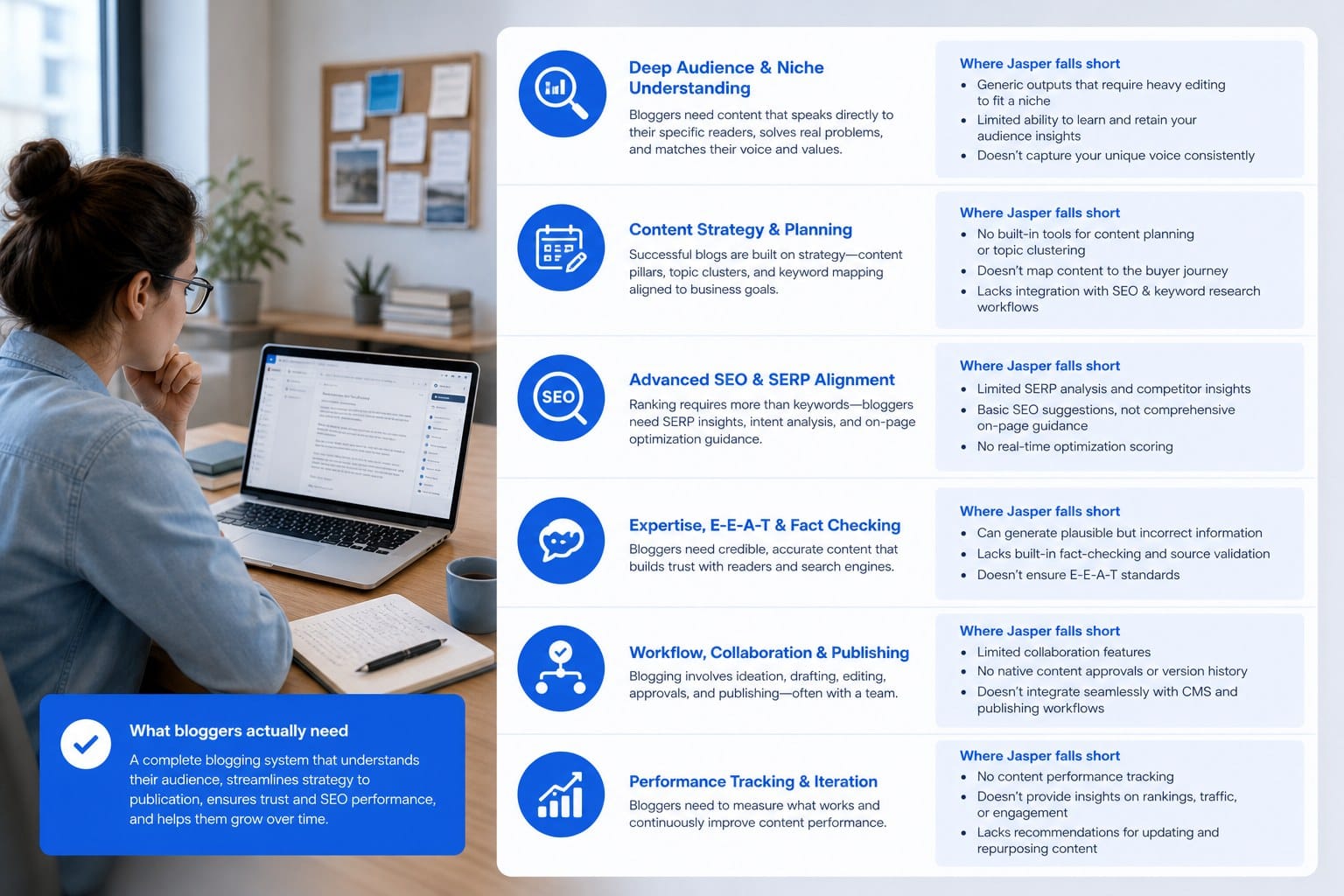
Jasper is a capable AI writing assistant. It can help you draft a blog post faster than writing from scratch, and it has a decent library of templates for different content formats. But if you are running a blog as a growth channel, whether for a personal brand, a startup, or a small business, writing is only one piece of the puzzle. The bigger challenge is building a system that keeps content moving week after week without burning you out or forcing you to hire a team.
Here is where Jasper tends to fall short for bloggers who want a more automated workflow.
First, there is no content strategy built in. Jasper does not look at your niche, analyze what topics your audience is searching for, or give you a 30-day calendar of posts mapped to real keyword opportunities. You have to bring all of that yourself. That means hours of keyword research, competitor analysis, and editorial planning before you even open the writing interface.
Second, Jasper is a writing tool, not a publishing tool. Once you have a draft you are happy with, you still need to format it for your CMS, add featured images, insert internal links, set metadata, and schedule or publish the post. If you are on Ghost, WordPress, or another platform, none of that happens automatically. You are the one doing it every single time.
Third, the content Jasper produces often needs significant editing to feel deeply researched. It can produce fluent, readable prose, but fluent is not the same as authoritative. For SEO-driven blog content, readers and search engines both reward posts that go deep, cite real examples, and show genuine expertise. Getting Jasper to produce that level of depth requires a lot of back-and-forth prompting.
Fourth, there are no on-brand visuals. Blog posts without images tend to perform worse on social shares and in search, and yet Jasper does not generate or suggest images to accompany your content. You are sourcing those yourself from stock sites or other AI image tools.
None of this is a knock on Jasper specifically. Most AI writing assistants share these same gaps. They are built as writing aids, not as publishing engines. When bloggers start looking for alternatives, the ones who want to actually scale their output need to look beyond writing features and ask a bigger question: does this tool handle the whole workflow, or just one part of it?
This distinction matters a lot depending on your situation. If you are a solo blogger trying to publish four posts a month on top of a full-time job, spending three to four hours per post on research, writing, editing, formatting, and publishing is simply not sustainable. If you are a SaaS founder who knows that consistent blog content drives organic traffic but has no time to manage it personally, handing off individual writing tasks to a tool still leaves you as the project manager. The gap between AI writing assistant and AI content engine is wide, and it shows up most clearly when you try to run a real publishing schedule.
There is also the question of research quality. Good blog posts for SEO purposes need to cover a topic thoroughly. They need to address the questions readers are actually asking, include relevant examples, and demonstrate that the writer understands the subject. Shallow AI content is increasingly easy for readers to spot, and search engines are getting better at rewarding depth over volume. So any tool you use as a Jasper alternative needs to produce content that holds up to scrutiny, not just content that looks like a blog post on the surface.
Another issue worth naming is consistency. One of the hardest things about blogging as a marketing channel is staying consistent over months and years. Most bloggers start strong, hit a dry spell, and then go quiet for weeks. That inconsistency hurts your SEO, hurts your audience trust, and makes it hard to ever build momentum. A tool that reduces the friction of every single post makes consistency much more achievable. That is why the best Jasper alternatives for bloggers are the ones that build consistency into the system itself, not just the ones that make individual posts slightly easier to write.
What full autopilot publishing actually looks like
The phrase autopilot publishing gets used loosely, so it is worth being specific about what it actually involves when done well. True autopilot publishing is not just AI-generated text. It is a connected workflow that starts with strategy and ends with a live post, with as little manual intervention as possible in between.
Here is what that workflow looks like in practice when it is working properly.
It starts with a content strategy layer. The platform looks at your niche, your website, your audience, and your SEO goals, and it produces a content calendar with specific topics and keywords for each post. This is not a generic list of blog ideas. It is a prioritized plan based on what your audience is searching for and where you have a realistic shot at ranking. For bloggers and small business owners who do not have an SEO background, this alone is a massive time saver. For experienced content marketers, it removes the planning overhead that eats into time that could go toward other work.
Next comes research and writing. The platform does not just spin up generic content based on a headline. It researches the topic, pulls in relevant context, and produces a long-form post that covers the subject with actual depth. The output should read like something a knowledgeable human writer produced after spending real time on the topic, not like a padded draft that hits a word count without saying much.
Then come the visuals. Good blog posts need images. Not just decorative stock photos, but visuals that are relevant to the content and consistent with your brand. An autopilot publishing system handles this too, generating or sourcing on-brand images so the post looks complete when it goes live.
After that comes formatting and metadata. The post needs a proper structure with heading tags, a readable layout, a meta title, a meta description, and any other SEO details your CMS needs. Doing this manually every time is tedious but important. A proper autopilot system handles it automatically.
Finally, there is the actual publishing step. The platform connects to your CMS, whether that is Ghost, WordPress, or another platform, and publishes the post directly, either immediately or on a schedule you set. You do not log in, copy-paste, reformat, or troubleshoot. The post is just there, live on your blog, ready to index.
When all of these steps are connected in a single platform, the experience is genuinely different from using a writing assistant. You are not managing a workflow. You are setting parameters and letting the system run. That is the difference between a tool that helps you write faster and a tool that actually handles publishing for you.
For Ghost CMS users specifically, this kind of native integration is particularly valuable. Ghost is a clean, fast, SEO-friendly platform that a lot of independent bloggers and startups use, but it does not have a native content planning or AI writing layer. A platform that integrates directly with Ghost and handles everything from strategy to published post fills a real gap that Ghost users have been working around with a patchwork of separate tools.
It is also worth noting what good autopilot publishing does not mean. It does not mean you lose control of your content. The best systems give you review and editing options before anything goes live. You can read the draft, make changes, adjust the tone, or swap out a visual if you want to. The automation handles the work, but you stay in control of your brand voice and content standards. Some bloggers want to review every post. Others want to approve the content calendar and then let everything run on its own. A well-built system supports both approaches.
For digital marketers managing brand blogs, this kind of flexibility is important. You need to be able to set brand guidelines, editorial standards, and publishing schedules, and then trust the system to follow them. You do not want to micromanage every post, but you also cannot afford to publish content that is off-brand or factually shaky. The balance between automation and oversight is something the best platforms get right.
If you have been exploring this space for a while, you have probably looked at tools in adjacent categories that promise parts of this workflow. I have written about some of those comparisons before, including RightBlogger alternatives for brands that need more than a writing assistant and Narrato alternatives that include full publishing automation, and the pattern is consistent. Most tools handle one or two pieces of the puzzle well but leave the rest to you. The search for a true end-to-end solution usually leads bloggers to narrow their criteria pretty quickly once they realize how many steps the full workflow actually involves.
Speaking practically, here is what to look for when you are evaluating any platform as a Jasper alternative:
Does it generate a content strategy, not just individual posts? A topic calendar tied to real keyword data is a sign that the platform is thinking about your growth, not just your next draft.
Does it produce deeply researched long-form content? Ask for a sample post on a specific topic in your niche and read it critically. Does it say something substantive, or does it pad a few ideas into a lot of words?
Does it handle visuals? This is a step that gets overlooked in comparisons, but it matters for the finished quality of your blog and for the time you save.
Does it publish directly to your CMS? If the answer is that you download a file or copy content into your CMS yourself, the tool is not really offering autopilot publishing. It is offering a shortcut on one step of a longer process.
Does it support your specific CMS? If you are on Ghost, that matters. If you are on a less common platform, check integration support before committing.
What does the review and approval process look like? You want automation with oversight, not automation with no visibility into what is being published on your behalf.

How Blogtude fits into this picture for bloggers who want less manual work
Blogtude is built specifically around the problem this article has been describing. It is not an AI writing assistant that helps you draft faster. It is an AI-powered blog content engine that handles the full publishing workflow, from strategy through to a live post on your blog.
Here is how the core workflow works.
Blogtude starts by building a 30-day content strategy for your blog. That means it analyzes your niche and audience and produces a prioritized calendar of topics mapped to real keyword opportunities. If you are a startup trying to grow organic traffic, that calendar is focused on the terms your potential customers are actually searching for. If you are an independent blogger building an audience in a specific niche, it reflects what readers in that space are looking for. The strategy layer is not a generic content brainstorm. It is a plan built around your specific growth goals.
From there, Blogtude produces long-form articles for each planned post. These are not thin AI drafts. The platform is designed to produce deeply researched content that covers topics with the kind of depth that both readers and search engines respond to. The articles are written to be substantive, not just fluent. For bloggers who have tried other AI tools and found the output too shallow to publish without major editing, this is a meaningful difference.
Each article comes with on-brand visuals. You do not need to source images separately or worry about visual consistency across your blog. The platform handles that as part of the content production process.
Once an article is ready, Blogtude publishes it directly to your CMS. It has native integration with Ghost, which makes it a particularly strong fit for Ghost users who have been piecing together their own workflow with separate tools. The post goes live with proper formatting, metadata, and structure already in place. You do not log into Ghost to do anything unless you want to.
For bloggers who want to review content before it goes live, that option is there. You can read drafts, make edits, and approve posts before they publish. For those who want a more hands-off experience after setting up their strategy and preferences, the system can run on its own schedule. The platform is flexible enough to support different levels of involvement depending on how much control you want to maintain.
This makes Blogtude a practical solution across several different blogger profiles. Independent bloggers and content creators who want to scale output without hiring writers get a system that keeps their blog moving without requiring their time on every post. SaaS founders and startups who need consistent SEO content get a strategy-driven approach that ties posts to actual keyword opportunities and publishes on a regular schedule. Small business owners who do not have time to research, write, and format content themselves get a workflow that handles all of it. Digital marketers managing brand blogs get a reliable, automated pipeline that follows editorial standards without constant oversight.
For Ghost CMS users specifically, the native integration closes a gap that has existed for a while. Ghost is a strong platform for blogging, but it does not have its own AI content layer. Bloggers on Ghost have typically had to use multiple separate tools and do the final publishing step manually. Blogtude eliminates that last step and ties the whole workflow together natively.
If you have been evaluating platforms in this space, it is also worth reading about Arvow alternatives: AI blog platforms that actually publish for you, which covers a similar question from a slightly different angle. The consistent theme across all of these comparisons is that the platforms that actually reduce your workload in a meaningful way are the ones that handle publishing as a first-class feature, not an afterthought.
One thing worth being direct about: no AI platform produces content that is completely hands-off if you care about quality. Even with a well-designed autopilot system, the best practice is to review your content calendar, spot-check articles periodically, and update your brand guidelines as your positioning evolves. What autopilot publishing does is remove the repetitive, time-consuming mechanical work of research, writing, formatting, and publishing so that the time you do spend on your blog is focused on decisions that actually require your judgment.
For bloggers who have been burning hours every week on content that is not driving the results they want, that trade-off is worth taking seriously. The goal is not to remove yourself completely from your blog. The goal is to stop spending your time on tasks that do not require you personally, and to use a system that handles those tasks reliably so your blog stays consistent, your content stays strong, and your time stays focused on the parts of your business that actually need you.
If you are evaluating jasper ai alternatives for bloggers and the thing you are really looking for is a system that handles the full workflow instead of just one piece of it, Blogtude is designed around exactly that problem. The platform exists because the gap between AI writing tool and AI publishing engine is real, and it matters a lot once you try to run a serious content operation without a team behind you.

Ready to take the next step?
If you are ready to stop managing every step of your blog publishing workflow and want a system that handles content strategy, writing, visuals, and publishing in one place, Blogtude is built for exactly that. Visit https://blogtude.com to see how it works and get started with your 30-day content strategy.


