
Narrato alternatives that include full publishing automation

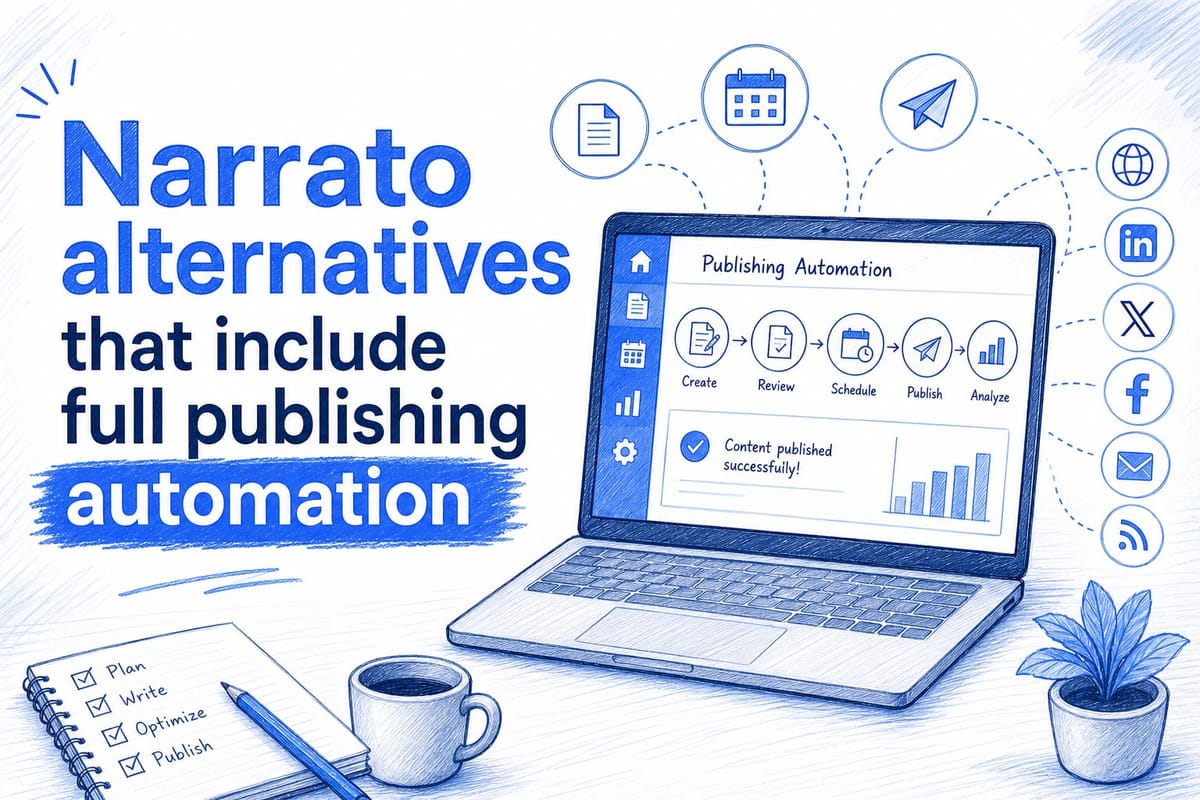
Table of contents
1. What Narrato does well and where it falls short
2. The strongest Narrato alternatives with built-in publishing automation
3. How to decide which Narrato alternative is right for your situation
If you have been using Narrato and feel like something is missing, you are not alone. Narrato is a solid content workspace, but it stops short of one thing a lot of teams really need: automatic publishing. You still have to copy, format, and push content to your blog yourself. For independent bloggers, SaaS founders, and small business owners who are already stretched thin, that manual step defeats the purpose of using an AI tool in the first place. This article looks at the best Narrato alternatives that go further — specifically tools that handle not just writing but the full publishing workflow so your blog actually gets updated without you doing it by hand.
What Narrato does well and where it falls short
Narrato is a content operations platform. It gives you a workspace where you can brief writers, use AI to generate drafts, manage approvals, and organize content in one place. If you work with a team of freelancers or have an in-house editorial process, it covers a lot of ground. The AI writing tools are competent, the project management features are useful, and the content calendar gives you a visual view of what is coming.
But here is the catch. Narrato is built around the assumption that a human is going to handle the final mile. Someone still has to take the finished article, log into WordPress or Ghost or whatever CMS your team uses, paste the content in, add the images, set the SEO fields, and hit publish. For teams with a dedicated content manager, that is a reasonable workflow. For everyone else, it is a bottleneck that shows up every single week.
This is not a small inconvenience. When you factor in formatting, image sourcing, metadata entry, internal linking, and scheduling, publishing one article manually can take 30 to 60 minutes even after the writing is done. Multiply that by 12 to 15 articles a month and you are looking at a significant chunk of time spent on logistics rather than strategy or growth.
Several common complaints about Narrato point to the same frustrations. The platform can feel like it adds process without removing work. You still need to know what to write about. You still need to research topics. You still need to handle publishing. And you still need to maintain a consistent schedule over months and years without losing momentum. The AI helps you write faster, but it does not think strategically for you or take anything fully off your plate.
This is not a criticism unique to Narrato. Most AI writing tools share this limitation. They are designed to accelerate drafting, not to replace the full content operation. That distinction matters enormously depending on what your actual problem is.
If your problem is that writing takes too long, Narrato is a reasonable answer. But if your problem is that running a blog consistently is taking up time you do not have, you need something different. You need a tool that handles strategy, production, and distribution without requiring manual handoffs at every step.
There is also a subtler issue worth naming. When a tool requires you to review and act on every article before it moves forward, it creates a dependency on your attention. The blog only moves as fast as you do. For founders and business owners who have unpredictable weeks, that dependency means publishing schedules slip. And inconsistent publishing is one of the fastest ways to stall organic search growth, because search engines reward sites that publish on a regular cadence, not ones that publish in bursts when the owner finds time.
The best Narrato alternatives are not just trying to write content a little better. They are rethinking the entire workflow so that strategy, research, writing, and publishing all happen in one connected loop. The goal is a system where the blog runs whether or not you have bandwidth that week. The options below approach that goal in different ways and suit different types of users, but they all take publishing more seriously than Narrato does.

The strongest Narrato alternatives with built-in publishing automation
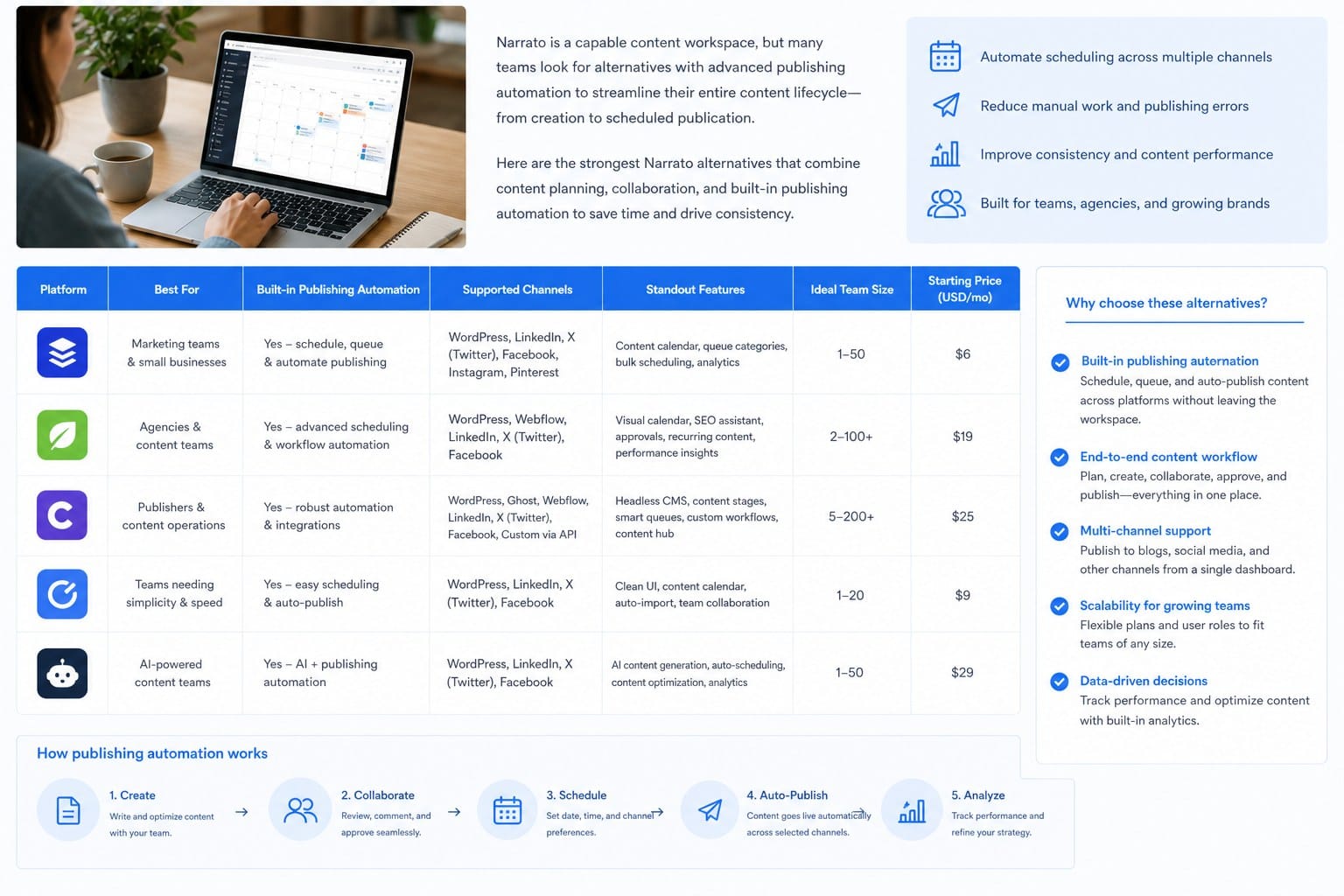
When you evaluate Narrato alternatives, the first question to ask is not which one writes the best content. It is which one actually gets that content onto your site without you acting as the middleman. Here is a detailed breakdown of tools and approaches that take publishing seriously.
Blogtude
Blogtude is the most complete option if publishing automation is your top priority. It was built specifically for this use case: you connect it to your Ghost CMS or another supported platform, and it handles everything from strategy to publication automatically.
The process starts with a 30-day content strategy. Blogtude analyzes your niche and builds out a full month of article topics, all chosen to target SEO opportunities that make sense for your brand and competitive landscape. You are not staring at a blank calendar trying to decide what to write next. The plan is already there, grounded in real keyword data rather than guesswork.
From there, Blogtude researches and writes each article at a long-form level. These are not short 500-word posts designed to fill a quota. They are deeply researched pieces built to compete in search results, with proper structure, sufficient depth, and on-brand visuals included. When an article is ready, it publishes directly to your CMS. No copy-pasting. No formatting adjustments. No manual image uploads. No metadata entry.
This makes Blogtude a genuinely different category of tool compared to Narrato. Narrato helps you produce content. Blogtude runs your blog. That is not a marketing distinction — it reflects a real difference in what the tool does and what it expects from you.
For Ghost CMS users in particular, the native integration is a major advantage. Ghost is a fast, clean publishing platform, and pairing it with a tool that publishes directly — with correct formatting, metadata, and visuals already in place — removes almost all of the remaining friction from the content process. You can see what a structured, automated approach looks like in practice by reading how Cabin Plus structures its blog for maximum SEO impact, which walks through how this kind of system produces consistent results over time.
Who Blogtude works best for: Ghost CMS users who want their blog to run on a consistent schedule, SaaS founders who need steady organic traffic without hiring a content team, and small business owners who cannot afford to spend hours each week managing publishing logistics.
The broader category of automated AI content platforms
Beyond Blogtude, there is a growing category of AI platforms that offer at least some degree of publishing automation. Understanding how much of the pipeline each one actually covers is important, because there is a wide range and the marketing language across these tools is not always precise.
Some tools generate articles with AI and then give you a one-click publish button that pushes content to WordPress. That is better than copy-pasting, but it still requires you to initiate each publish, choose the right article, check the formatting, and manage the cadence yourself. It is automation in the loose sense of the word — you are removing one mechanical step, not removing your involvement from the process.
Other platforms go further and handle scheduling. You set a publishing frequency, and the tool queues up articles automatically on a calendar. This is a meaningful step up. You are not making decisions for each individual post. You are setting a system once and letting it execute. The difference in day-to-day experience is significant.
The platforms that are genuinely impressive combine all three layers: strategy (deciding what to write and why), production (researching and writing the article to a publishable standard), and distribution (delivering the article to your CMS on a schedule with correct formatting and metadata). Very few tools do all three well. Most specialize in one or two and expect you to handle the rest.
When you are comparing tools in this space, it helps to understand what criteria actually matter for getting consistent results. The article on Arvow alternatives: AI blog platforms that actually publish for you walks through what to look for when you need a tool that completes the full publishing loop, and many of the same criteria apply directly to evaluating Narrato replacements.
The specific capabilities worth checking before you commit
If you are actively evaluating Narrato alternatives with publishing automation, here are the capabilities you should verify before spending money on any subscription.
First, does the tool integrate directly with your CMS? Not through a workaround like a Zapier connection that requires maintenance, but through a native integration that reliably posts formatted content in the right structure. This matters more than it sounds. Formatting issues, missing metadata, broken image references, and incorrect slug structures are all common problems with workaround integrations. They are small issues individually, but at scale they create ongoing cleanup work that cancels out your time savings.
Second, does the tool handle on-page SEO automatically? That means setting the meta title, meta description, slug, canonical URL, and header hierarchy without you having to touch each article individually. If you are publishing 10 to 15 articles a month, doing this manually adds up quickly and introduces inconsistency. Good SEO hygiene at the article level has a real impact on how well your content ranks, so this is not an optional feature.
Third, does the tool produce original visual content? Articles without images look unfinished and perform worse in terms of time on page and social sharing. Some platforms include AI-generated featured images or pull from curated stock libraries automatically. Others leave you to source images separately for every article, which is another manual step that adds up. Know which category a tool falls into before you assume images are handled.
Fourth, does the tool handle content strategy or just drafting? A tool that writes on-demand when you give it a topic is useful but fundamentally different from a tool that builds a strategy and executes it without waiting for your input each time. The first type saves you writing time. The second type saves you management time. If your goal is a blog that runs on its own, you need the second type.
Fifth, what does the output quality look like at scale over a full month? Generating one polished article is straightforward for most AI tools. Generating 30 articles a month that all meet a consistent standard of depth, accuracy, factual grounding, and brand voice is much harder. Ask for examples that represent typical output, not showcase pieces. Request trial access and test the tool with real topics from your niche before you commit to a subscription.
For a broader look at how different tools approach the question of automated content creation and what distinguishes meaningful automation from surface-level features, the comparison in Outrank.so alternatives: the best AI blog tools to replace it covers several of the same decision points and is worth reading alongside your evaluation process.
How to decide which Narrato alternative is right for your situation
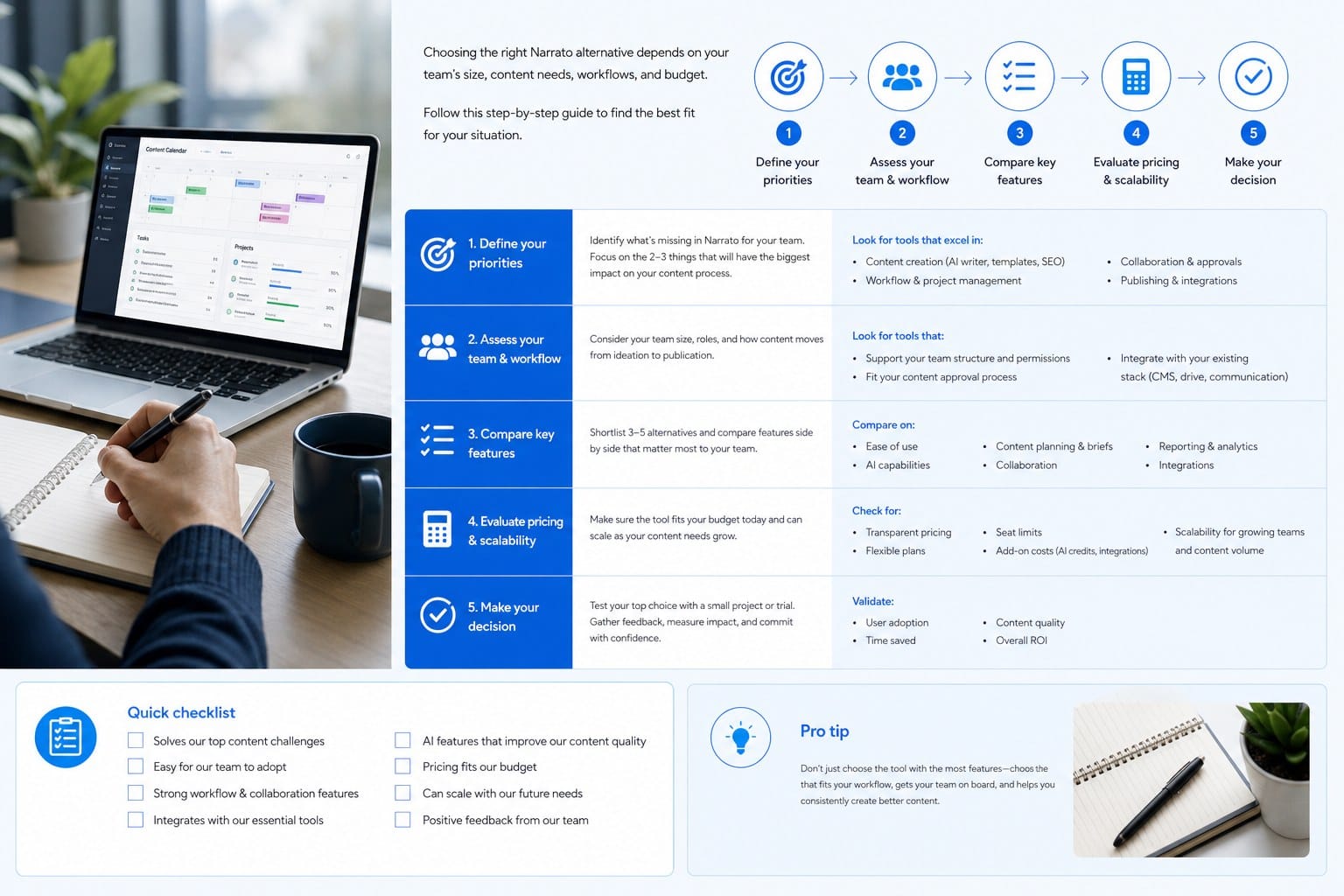
Choosing between Narrato alternatives is not just a feature comparison exercise. It is about identifying what your actual problem is and how much of the content operation you want the tool to own. The right answer depends on your situation, your team size, your CMS, and how much time you realistically have available each week.
If your biggest frustration is content quality
If you are mostly satisfied with Narrato's workflow but want longer, more accurate, better-researched articles, the problem is likely with how the AI is generating content rather than with the publishing workflow. Some newer tools use retrieval-augmented generation, which means they pull real information from the web before drafting, rather than generating content purely from training data. This produces more specific, more accurate, and more useful articles because the tool is working with current information rather than relying entirely on what it learned during training.
For SEO purposes, depth and accuracy both matter. Search engines have consistently rewarded content that covers a topic thoroughly, answers real questions, and demonstrates genuine understanding of the subject. Short AI-generated articles that skim the surface do not hold rankings over time. If your current tool is producing thin content that does not convert organic visitors or hold its position in search results, switching to a tool that prioritizes research before writing will make a real and measurable difference.
In practical terms, this means looking for tools that cite sources, pull data from real web research, and structure articles around the full set of questions a reader might have — not just the most obvious angle on a topic.
If your biggest frustration is manual work
If the content itself is acceptable but you are spending too much time managing the publishing process, you need automation rather than better writing quality. This is the situation for most independent bloggers and small business owners who are already handling sales, customer service, product development, and a dozen other responsibilities. Even if an AI writes a solid article draft in two minutes, if publishing that article takes another 30 to 45 minutes of formatting, image work, metadata entry, and uploading, the time savings are limited and the process still requires your attention every week.
For this group, the priority is finding a tool with a native CMS integration that publishes on a defined schedule without requiring your approval for each article. You set the system up once — connect the CMS, set the publishing frequency, define the content categories — and articles appear on your blog without requiring your attention each time. That is the meaningful shift, and it is what allows a small team or a solo operator to maintain a publishing cadence that would otherwise require a full-time content manager.
If you need both better quality and less manual work
For SaaS founders and digital marketers who need consistent, high-quality content to build organic traffic over time, the answer is usually that you need both: better output and less manual involvement. The good news is that tools in this category have matured considerably. Full-pipeline automation that includes strategy, research, writing, visuals, and publishing is no longer a theoretical product. It exists, it works, and it is accessible to teams without large content budgets.
The thing to watch out for is tools that promise full automation but quietly require you to review and approve every article before it goes live. Some teams genuinely prefer that level of control, and there is nothing wrong with that approach if it fits your process. But if your goal is truly hands-off publishing — a blog that updates on schedule regardless of what else is happening in your business that week — make sure the tool you choose can run without mandatory approval checkpoints. Read the documentation carefully, and test this during your trial period rather than assuming it works as described.
How to think about budget and real cost
Most tools in this space price by volume, either by the number of articles generated per month or by a flat subscription that includes a set publishing cadence. Narrato's pricing is structured around seats and feature tiers, which works well for editorial teams but can feel expensive for solo operators who just want their blog to run consistently.
When you compare pricing across Narrato alternatives, calculate the real cost per published article rather than just comparing monthly subscription prices. A tool that costs twice as much per month but requires zero manual effort may actually be cheaper when you account for your own time. If publishing one article manually takes you 45 minutes, and you are publishing 12 articles a month, that is nine hours of your time each month spent on logistics. At any reasonable hourly value of your time, that cost exceeds most subscription fees for automated tools.
This calculation shifts the framing from "how do I minimize my software spend" to "how do I minimize the total time and cost of maintaining a consistent blog." That is the right question to ask, and it usually leads to a different answer than a simple feature-price comparison would.
How to test a new tool without disrupting what works
If you already have a blog with some existing traffic and established brand voice, switching tools is not entirely risk-free. Your tone, internal link structure, content categories, and formatting standards all need to carry over to the new system in a way that feels consistent to returning readers and does not confuse search engines.
Before committing to any Narrato alternative, test it seriously with a small batch of real content. Publish three to five articles through the new system and check that the formatting is correct, the metadata is set properly, the images look right, and the overall quality meets the standard you would actually publish under your brand. Do not just test whether the tool can generate a coherent article. Test whether it can generate an article that you would be comfortable putting your name on and driving traffic to.
Most platforms offer a trial period or a money-back window. Use it to run this exact test rather than spending the trial period on a superficial feature tour. The things that break or disappoint you during a trial are almost always the things that will cost you time and frustration at scale.
Also check how the tool handles brand voice specifically. Some platforms let you upload sample articles so the AI can analyze and match your tone and style. Others use a written brief or style guide as input. The more context you can give the tool upfront, the more consistent the output will be across a full month of articles. Consistency matters because readers notice when a blog sounds different from post to post, and that inconsistency can undermine trust even when the content itself is accurate and useful.
The long-term case for switching
The case for switching from Narrato to a more automated alternative is not just about saving time this week. It is about whether you can sustain consistent publishing over months and years without burning out, without hiring a large team, and without letting the blog slide when other priorities take over.
Content marketing compounds over time in a way that most other marketing channels do not. An article you publish today might generate qualified leads 18 months from now if it earns a strong search ranking and stays there. But compounding only works if you keep publishing. The brands that see real organic growth from content are almost always the ones that maintain a consistent cadence — not the ones that publish intensely for two months and then go quiet because managing the blog became too demanding.
Tools that automate the full publishing pipeline make it structurally possible to maintain that cadence indefinitely. The effort does not scale with the volume. You set the system up, and it runs. That is what allows a two-person SaaS team to have the same publishing consistency as a company with a full content department.
For Ghost CMS users specifically, this integration story is particularly compelling. Ghost is designed for performance, clean delivery, and minimal overhead. Pairing it with a tool that publishes directly — with proper formatting, SEO setup, and visuals already in place — means you get the full benefit of Ghost's performance without spending your time managing the content operations manually.
The case study on how Cabin Plus structures its blog for maximum SEO impact is a concrete example of this approach working in practice. It shows what happens when strategy, production, and publishing are connected in a single system rather than treated as separate tasks requiring separate tools and manual coordination.
The best Narrato alternatives for most growing brands are the ones that do not stop at writing. They publish. They schedule. They handle the details that eat your time. And they make it possible to build a consistent content presence without that consistency depending entirely on your bandwidth in any given week.
Ready to take the next step?
If you are ready to stop managing your blog manually and want a system that handles strategy, writing, visuals, and publishing in one place, Blogtude is built for exactly that. It connects directly to Ghost and other CMS platforms, generates a full 30-day content strategy based on real SEO data, and publishes deeply researched articles automatically without requiring your sign-off each time. Visit blogtude.com to see how it works and get started.


