
How founders are using AI to publish 4x more blog content


Table of contents
1. Why founders struggle to publish consistently in the first place
2. How founders are actually using AI to publish four times more content
3. What this looks like when you build it into a real workflow
Most founders I talk to know that consistent blogging drives organic traffic. They know it compounds over time, that Google rewards fresh content, and that a well-written article can bring in leads for years. But knowing that and actually publishing four articles a month, every month, without burning out or blowing the budget on freelancers are two completely different things. That gap between knowing and doing is exactly where AI blog content for founders is changing the game. Founders are not just using AI to write faster. They are using it to build entire content systems that run with minimal manual effort, and the results are showing up in their traffic reports.
Why founders struggle to publish consistently in the first place
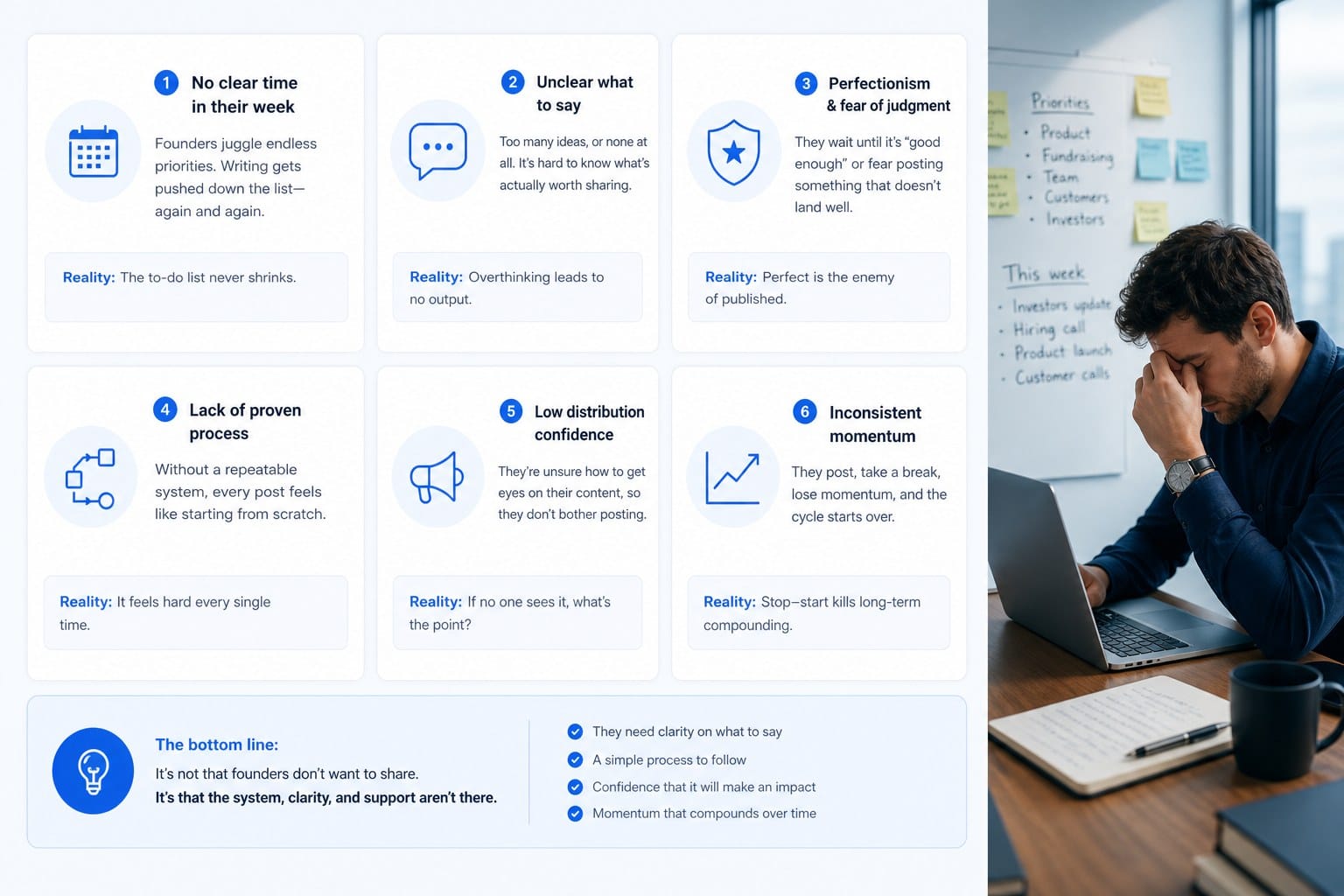
Let me be honest about something. The blogging advice most founders receive is written for people who have a dedicated content team. Post three times a week. Build topical authority. Publish pillar pages and cluster articles. That all sounds reasonable until you remember that most early-stage founders are also handling sales calls, product decisions, customer support, and investor updates in the same week.
The result is a blog that looks like a ghost town. A handful of posts from the launch month, a gap of six months, then a couple of posts written in a burst of motivation, then nothing again. This pattern is more common than most founders admit publicly.
There are three real reasons this happens, and none of them are laziness.
First, research takes forever. Writing a useful 2,000-word article on a specific topic means spending hours reading competitor content, pulling together data points, understanding what questions your target reader actually has, and then organizing all of that into something coherent. For a founder who already has too many tabs open, that research phase alone can eat half a day.
Second, consistency requires a system, not willpower. Publishing once is easy. Publishing every single week for twelve months requires a documented workflow, a content calendar, and enough buffer that a busy product sprint does not kill the whole operation. Most founders do not have that system, so they rely on willpower, and willpower always runs out.
Third, the feedback loop is slow and discouraging. You write a post, publish it, and then wait three to six months to see if it even shows up in search. When you are juggling everything else, it is very hard to keep investing time into something that feels invisible. Many founders quit before the compounding effect kicks in.
This is the environment that AI content tools were built for. Not to replace strategic thinking, but to eliminate the mechanical work that makes consistent publishing feel impossible.
And here is something worth understanding before we go further: publishing more is not just about volume. The way you structure your content strategy matters enormously. Why topical depth is the smarter SEO strategy for growing brands is a concept that separates founders who get search traction from those who publish randomly and wonder why nothing ranks. AI makes it possible to actually execute that depth, not just understand it in theory.
How founders are actually using AI to publish four times more content
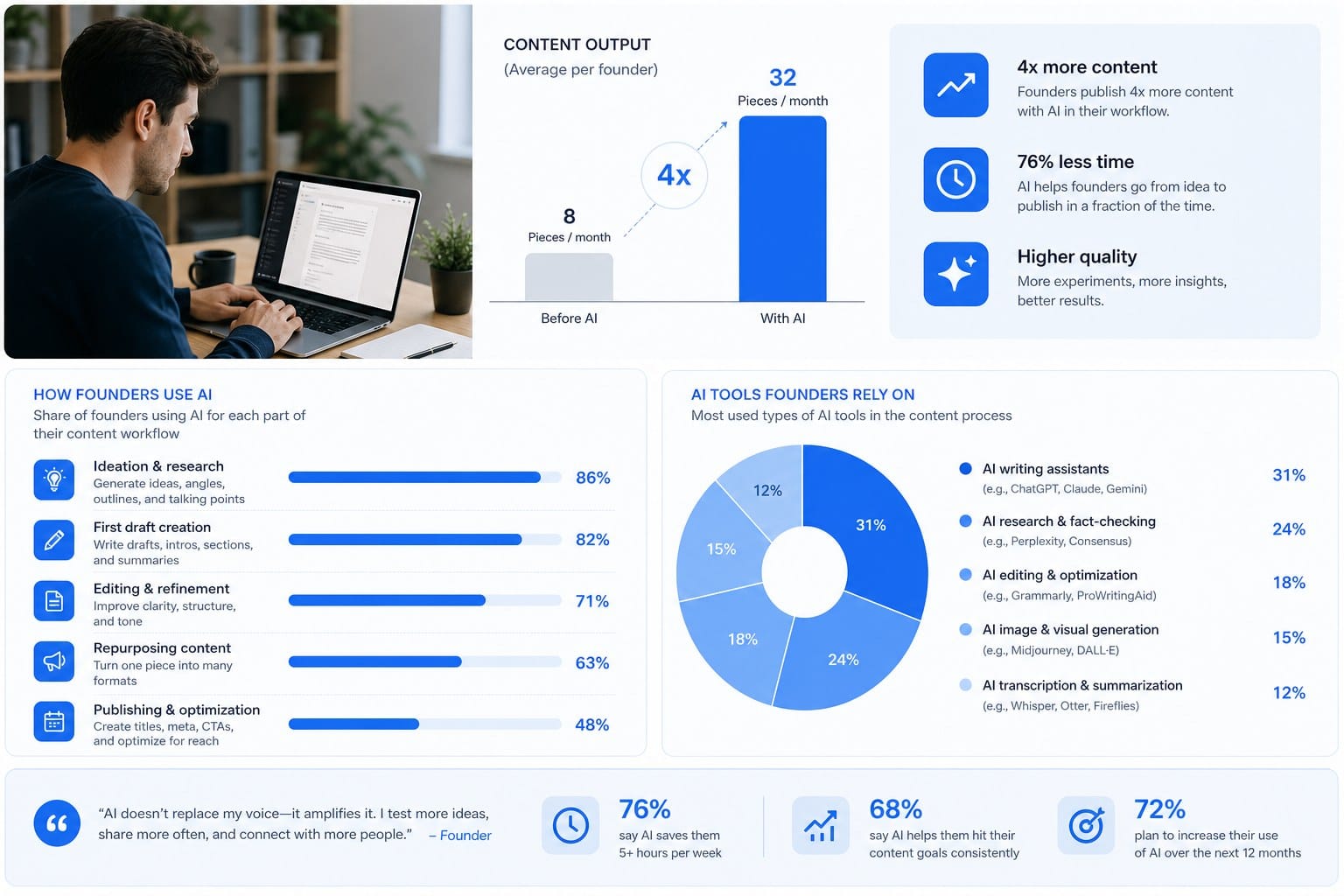
The founders who are seeing real results with AI blog content are not just using a chatbot to spit out generic articles. They are using AI as infrastructure. There is a meaningful difference between those two approaches, and it explains why some people dismiss AI writing as low-quality noise while others are building organic traffic machines with it.
Here is what the more sophisticated approach looks like in practice.
Starting with a structured content strategy, not just a list of topics
The first thing that separates high-output founders from low-output ones is having a 30-day or even 90-day content plan before writing a single word. Instead of waking up on Monday and trying to figure out what to write, they already know exactly which article is due, what keyword it targets, what questions it needs to answer, and how it connects to other content on the site.
AI tools that generate this kind of content strategy save founders several hours of planning work every month. The strategy becomes the skeleton, and the writing fills it in. That is a much more scalable approach than trying to think of topics on the fly.
Using AI for research scaffolding, not just drafting
One of the most underrated uses of AI in content production is not the writing itself. It is the research layer. Good AI content tools do not just generate text. They pull together relevant angles, identify common reader questions, surface related subtopics, and structure an outline before the first word of the article is written.
This research scaffolding is what allows a founder to go from a keyword to a fully structured draft in a fraction of the usual time. The founder still reviews, edits, and adds their own expertise and voice. But they are not starting from a blank page, and they are not spending four hours reading competitor articles just to understand the landscape of a topic.
This is especially valuable for founders who are not natural writers. The outline removes the hardest part, which is knowing what to say and in what order. Once that structure exists, filling it in feels manageable instead of overwhelming.
Producing long-form content that actually covers the topic
There is a temptation to think that AI content means short, shallow content. In practice, the best AI-assisted workflows produce the opposite. Because the research and structuring work is handled automatically, founders can actually afford to go deep on topics instead of writing thin 500-word posts just to check a box.
Google has made it increasingly clear that surface-level content does not rank well for competitive keywords. What ranks is content that thoroughly answers a question, covers related angles, and signals to the algorithm that this is a resource worth surfacing. Founders who are using AI effectively are publishing articles in the 1,500 to 3,000 word range consistently, because the AI handles the heavy lifting of making those longer pieces coherent and well-organized.
Automating publication so the content actually goes live
Here is a thing that does not get talked about enough: a lot of founder content never gets published. It sits in a Google Doc, or a Notion page, or a Drafts folder in their CMS. Writing the article is step one. Formatting it, adding images, tagging it properly, scheduling it, and actually hitting publish are steps two through seven, and those steps kill momentum.
Some AI content systems connect directly to publishing platforms like Ghost and handle the entire publish workflow automatically. The article gets written, formatted, given appropriate visuals, and pushed live without the founder needing to log into their CMS at all. That automation is what makes four times the output realistic. Removing the friction at every stage of the process adds up to an enormous amount of saved time over the course of a year.
Maintaining a publishing frequency that search engines can reward
This point is worth its own emphasis. The SEO benefit of consistent publishing is not just about having more articles. It is about signaling to Google that your site is actively maintained and regularly producing new value. A site that publishes one article every six months looks very different to search algorithms than a site that publishes weekly.
If you want to understand exactly how frequency affects your rankings, how often you should post on your blog for maximum SEO impact walks through the data on this in a straightforward way. The short version is that more frequent, consistent publishing beats sporadic publishing every time, as long as the content quality stays high. AI makes both the frequency and the quality possible at the same time.
What this looks like when you build it into a real workflow
I want to get concrete here, because the abstract case for AI blog content for founders is easy to make. The more useful question is what this actually looks like when someone implements it inside a real business.
Let me walk through a realistic example.
Imagine a SaaS founder running a project management tool for small agencies. She has a blog, but she has published maybe eight posts in the past year, most of them written in a rush with no real keyword research behind them. Her organic traffic is flat. She is spending money on paid ads that stops working the moment she turns off the budget.
She decides to build a proper content system using an AI-powered content engine. Here is what the workflow looks like once it is set up.
Week one: the content strategy is generated
Instead of brainstorming topics herself, she inputs her product category, her target audience, and her main competitors into the system. The AI generates a 30-day content plan covering twelve articles. Each article has a primary keyword, a suggested angle, a set of reader questions to answer, and an estimated search volume. She reviews the plan, adjusts two topics that do not feel right for her audience, and approves the rest.
This entire process takes her about ninety minutes. Previously, she would have spent that time just trying to figure out where to start.
Week two through four: articles are produced and published
Three articles per week go into production. The AI handles the research, drafting, and structuring. She receives each draft in her inbox, spends twenty to thirty minutes reviewing it, adds a specific example from her own product experience, and approves it. The article is then automatically formatted and published to her Ghost blog with a relevant image. She does not touch her CMS at all.
By the end of the month, she has published twelve articles. The previous month she published one.
Months two through six: the compounding begins
Search rankings do not move overnight. But around month three, she starts seeing articles appear on page two and three for their target keywords. By month five, three articles are on page one. Her organic traffic has doubled from where it was when she started. More importantly, the blog is now a consistent lead source rather than a project she feels guilty about ignoring.
The reason this works is not just that she published more. It is that she published consistently, on topics that had real search demand, with enough depth to be genuinely useful. The AI handled the consistency and the depth. She handled the strategy review and the occasional personal insight that made the content feel like it came from a real person with real expertise.
What founders need to review, even with AI doing the heavy lifting
I want to be straightforward about this: AI content is not a set-it-and-forget-it solution where you never read what goes out under your name. The best founders using AI blogging tools treat the output as a strong first draft that needs a human pass before it goes live.
What that review looks like in practice is checking for accuracy, adding any product-specific examples or customer stories that the AI cannot know about, adjusting the tone so it sounds like you rather than a generic content template, and making sure the article actually says something useful rather than just covering the topic at a surface level.
This review step is what separates AI blog content that builds authority from AI blog content that adds to the noise. The founders who do this well end up with articles that are indistinguishable from carefully written human content, but produced at four to five times the speed and a fraction of the cost of hiring writers.
The cost comparison matters for early-stage founders
Hiring a good freelance content writer who can do real research and produce well-optimized long-form articles costs between $200 and $500 per article, depending on the niche and the writer's experience. Publishing twelve articles a month with human writers would cost $2,400 to $6,000 per month. For an early-stage founder, that is a significant line item that is hard to justify before organic traffic is generating real revenue.
AI-powered content systems change that math dramatically. The cost per article drops by a large multiple, and the speed goes up. That means founders can start building their content library earlier in the company's life, which means the compounding SEO effect starts sooner, which means organic traffic starts contributing to growth at a stage when every new channel matters.
For founders who have looked at the cost of content creation and decided they cannot afford it, AI changes the calculation. And for founders who have tried to do it themselves and burned out, AI removes the friction that made consistency impossible.
Where Ghost CMS users have an additional advantage
If you are running your blog on Ghost, the integration possibilities with AI content tools are particularly clean. Ghost has a solid API, a straightforward publishing structure, and a native membership and newsletter system that makes content distribution easier. AI content engines that publish directly to Ghost remove the entire manual publishing layer, which on Ghost specifically includes formatting, tagging, feature image assignment, and scheduling.
For Ghost users who have been looking for a way to automate their content workflow without switching platforms, tools like Blogtude are worth looking at closely. The integration is designed for exactly this use case, and the workflow maps naturally onto how Ghost is built to handle content.
If you have been evaluating tools in this space and trying to understand what the real differences are between options, Rankyak alternative options that actually do more for less is a useful comparison to read. Understanding what different tools actually offer helps you make a choice that fits your specific workflow rather than picking the most well-known name and hoping it works.
The bottom line on what makes this approach work
Foungers who are publishing four times more content with AI are doing a few specific things right. They start with a documented strategy instead of improvising. They use AI for both the research and the drafting, not just the writing. They review every piece before it goes live and add their own perspective. They automate the publishing step so nothing sits unpublished in a queue. And they stay consistent month after month instead of publishing in bursts.
The technology makes all of this possible. But the mindset shift is just as important as the tools. Founders who see content as infrastructure, as something that pays dividends over time rather than something they need to squeeze into a free afternoon, are the ones who stick with it long enough to see the results. AI makes that mindset practical instead of just aspirational.

Ready to take the next step?
If you are a founder who knows consistent blogging should be part of your growth strategy but you have never been able to make it stick, Blogtude is worth a look. It generates your content strategy, produces deeply researched long-form articles, adds on-brand visuals, and publishes directly to Ghost and other platforms automatically. The whole system is designed around one goal: making consistent, high-quality blog output possible for founders who do not have time to do it manually. Head to blogtude.com to see how it works.


