
Why topical depth is the smarter SEO strategy for growing brands

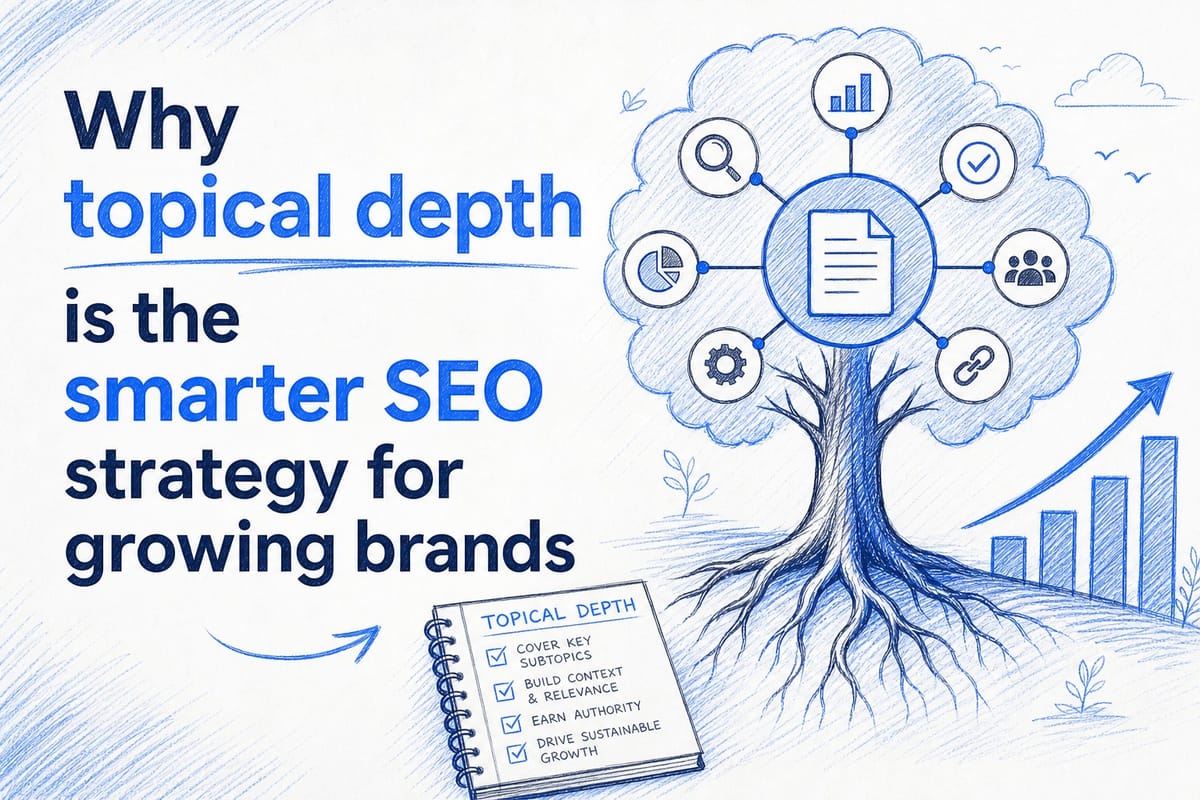
Table of contents
1. What topical depth actually means and why it beats chasing single keywords
2. How to plan and execute a topical depth SEO strategy without overwhelming your team
3. Why growing brands in particular benefit most from committing to topical depth
Most growing brands chase keywords one at a time. They pick a high-volume term, write a single article, and wait for traffic that never quite arrives. I get it. It feels productive. But that approach leaves a lot of organic growth on the table, and it almost always stalls out before it gains real momentum. There is a smarter path, and it centers on something called a topical depth SEO strategy. Instead of scattering your content across random keywords, you build dense, interconnected coverage around a focused subject area. You go deep rather than wide. When you do that consistently, search engines start to recognize your site as a genuine authority on that topic, and your rankings lift across the board, not just for one or two pages. In this article, I want to walk through exactly why topical depth works, how it differs from the keyword-by-keyword tactics most brands still rely on, and what it actually takes to execute it without burning out your team or your budget.
What topical depth actually means and why it beats chasing single keywords
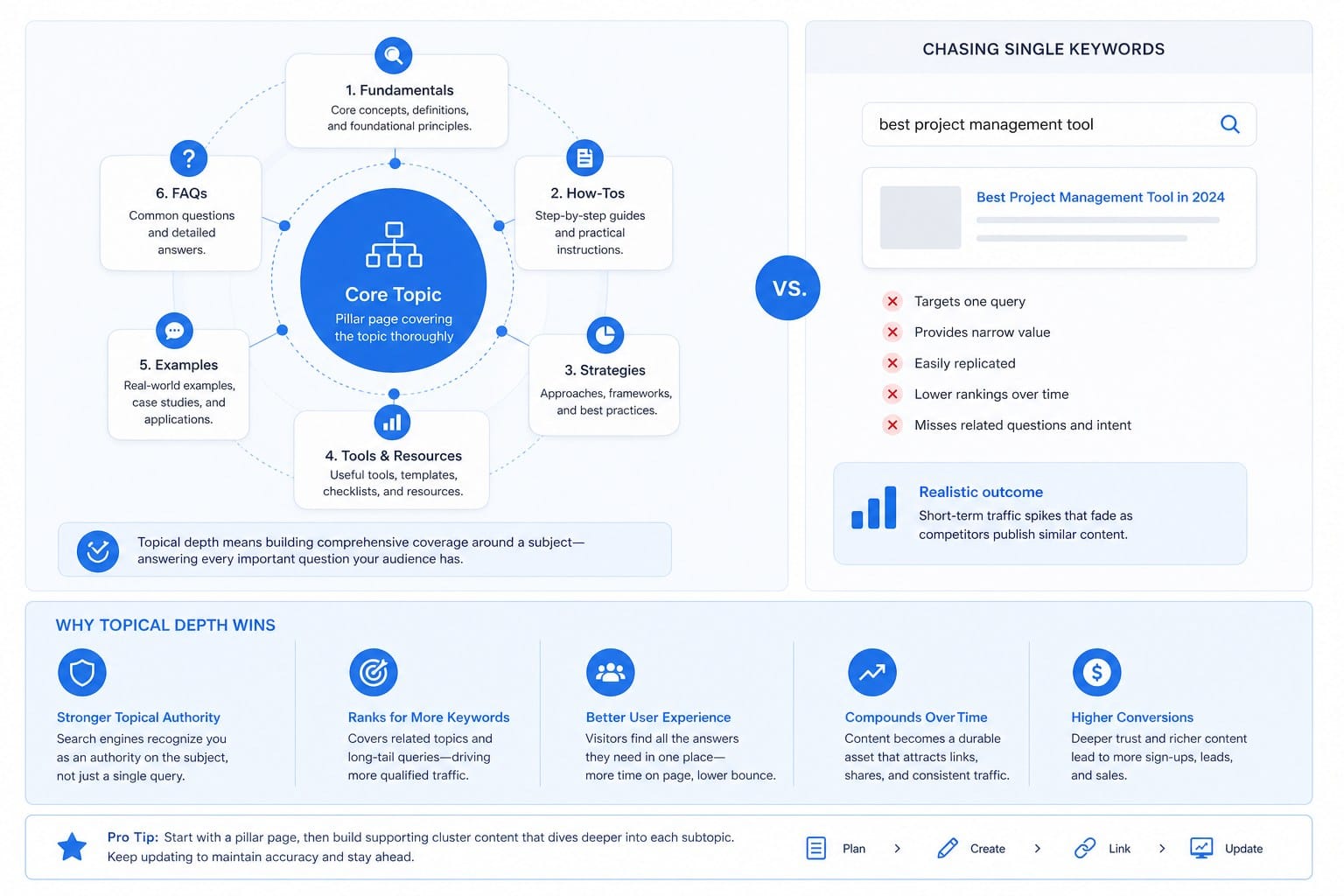
Let me start with a clear definition, because this term gets thrown around loosely. Topical depth is the practice of covering a subject area so thoroughly that every meaningful question a reader might have is answered somewhere on your site. It is not about writing one very long article. It is about building a network of related articles, each one going deep on a specific angle, all of them linking together in a way that creates a coherent body of knowledge.
To understand why that matters, you need to think about how search engines evaluate content today. Google has been moving toward a topic-based understanding of websites for years. Its systems try to figure out whether a site genuinely knows a subject or whether it is just inserting keywords into thin content. When your site has twenty well-researched articles covering different facets of the same topic, and those articles connect to each other logically, Google sees a pattern. It starts to trust your site as a reliable source on that subject. That trust translates into higher rankings, broader keyword coverage, and more consistent traffic over time.
The contrast with single-keyword targeting is sharp. When you write one article optimized for one keyword, you get one shot at ranking for one query. If that article does not hit page one, you earn almost nothing. If it does rank, it still only captures the people searching that exact phrase. You miss everyone who asks the same question slightly differently, everyone who is a step earlier or later in their research journey, and everyone who wants a more detailed answer on a subtopic your article only glanced at.
Topical depth fixes all of that. A well-built topic cluster answers the beginner's question, the intermediate question, and the advanced question. It covers the how, the why, the what-if, and the what-next. Every one of those articles has a chance to rank independently, and they all reinforce each other through internal links. The result is that you capture traffic at every stage of the funnel and from a much wider pool of search queries.
Here is a concrete example. Imagine you run a small business selling project management software for creative agencies. If you write one article targeting the keyword "project management for agencies," you have one page trying to do everything. But if you build out a topic cluster, you might have a pillar article on project management for agencies, supported by articles on how to track creative revisions, how to set client deadlines without conflict, how to onboard new agency clients, how to manage scope creep, and how to build a project brief that actually works. Each of those is a real question real people type into search engines. Each one can rank. Each one links back to the pillar and to each other. Together, they tell Google that your site really understands project management for agencies, not just the surface level of the topic.
This is why topical depth is not just a tactic. It is a structural approach to how you build your entire content library. Brands that commit to it early tend to see compounding returns over time. Each new article adds to an existing foundation of authority rather than starting from scratch.
One more thing worth noting: topical depth also helps with something called semantic search. Modern search engines do not just match keywords. They try to understand the intent and meaning behind a query. When your content covers a topic from many angles using natural language, you naturally incorporate the related terms, synonyms, and concepts that search engines associate with that topic. You do not have to stuff keywords. The depth itself creates the semantic richness that algorithms reward.
For growing brands with limited time and resources, this matters a lot. Building topical depth means every piece of content you create has a longer shelf life and a bigger cumulative impact. You are not on a treadmill producing content that goes nowhere. You are building something that compounds.
How to plan and execute a topical depth SEO strategy without overwhelming your team
Knowing that topical depth works is one thing. Actually building it out is another. This is where a lot of brands stall. The planning process feels daunting, especially when you are a small team or a solo founder who already has a full plate. But with the right structure, it is very manageable.
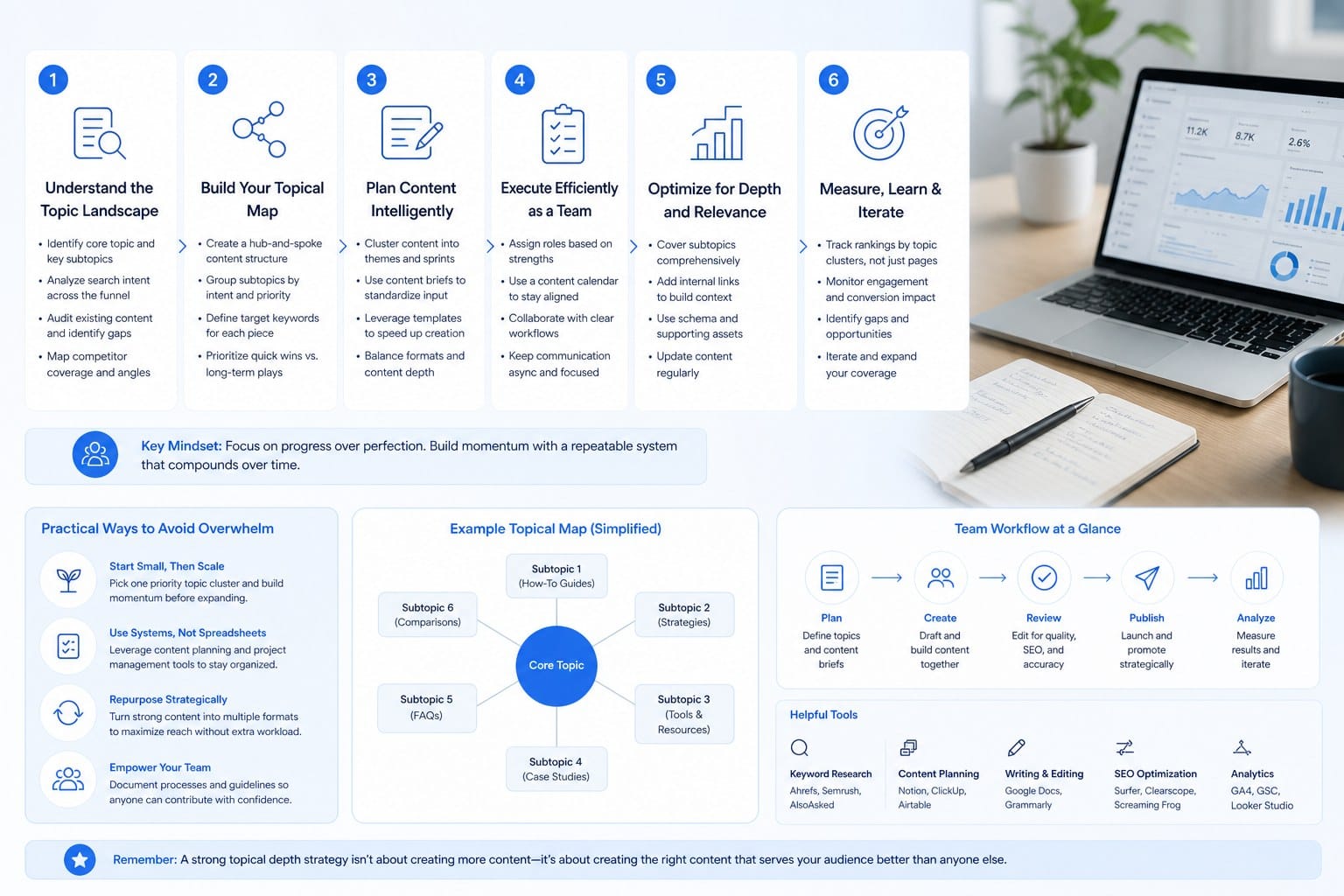
The first step is to pick a core topic area, not a keyword. Think about the subject matter your business genuinely knows better than most. What do your customers ask you about constantly? What problems does your product or service solve at a fundamental level? That core topic becomes the center of your content universe. Everything you build will orbit around it.
Once you have your core topic, map out the major subtopics that live inside it. These are the big categories of questions someone might have when exploring that subject. For a brand in the content marketing space, those subtopics might include content strategy, SEO writing, content distribution, analytics, and content operations. Each of those subtopics can support several individual articles.
From there, you go one level deeper and identify the specific questions, use cases, comparisons, and how-to angles within each subtopic. This is where your actual article ideas come from. A useful exercise is to think like a reader at different stages of awareness. Some readers are brand new to the topic and need basics explained. Some know the basics and want intermediate guidance. Some are advanced and want nuanced, specific answers. Your content library should serve all three.
Now here is where most teams hit a wall. Generating this kind of structured content plan takes real research and editorial judgment. Writing each article to the depth and quality that actually ranks takes time. Publishing consistently enough to build momentum requires a workflow that does not depend on sporadic bursts of effort. For a small business owner or a startup founder who is also running every other part of the company, maintaining that output manually is genuinely difficult.
I want to be direct about something: the biggest reason most brands fail at topical depth is not that they lack the strategy. It is that they lack the execution capacity. They plan a great content cluster, write three articles, get busy with other priorities, and the cluster sits unfinished for six months. An incomplete cluster does not deliver the same authority signal as a complete one. Gaps in coverage mean gaps in your rankings.
This is exactly why having a systematic, repeatable content production process matters so much. Whether that comes from a dedicated content team, a reliable freelancer network, or an automated content engine, you need a way to produce articles consistently without it depending entirely on your personal bandwidth at any given moment. I have written more about the frequency question specifically in this post on how often you should post on your blog for maximum SEO impact, which goes into the research on publishing cadence and what actually moves the needle for organic growth.
Beyond frequency, quality and structure matter. Each article in your cluster needs to do its own job well. That means a clear focus on a specific question or subtopic, enough depth to actually satisfy the reader, proper use of headings and formatting for readability, and internal links that connect it to related articles in your cluster. An article that superficially covers ten things is less useful than an article that thoroughly covers one thing.
You also want to pay attention to how your articles link to each other. Internal linking is not just good for user experience. It is a signal to search engines about how your content relates. Your pillar article should link out to all the supporting articles. Each supporting article should link back to the pillar and to other closely related supporting articles. This creates the web of connections that makes a topic cluster work as a system rather than just a collection of separate posts.
For practical execution, I recommend breaking the process into phases. Start by publishing your pillar article and two or three supporting articles. That is enough to establish the basic cluster structure. Then add articles systematically over the following weeks, filling in the remaining subtopics and question angles you identified in your planning phase. Set a realistic publishing schedule you can actually maintain and stick to it. Consistency matters more than speed.
If you are managing a brand blog for a client or overseeing content across multiple channels, this phased approach also makes it easier to report progress. You can show the growth of a topic cluster over time, track how rankings improve as you add more coverage, and demonstrate the compound effect of topical depth in a way that single-article strategies simply cannot match.
Finally, do not forget to revisit and update articles as your cluster grows. If a supporting article you published early on does not link to a newer article on a closely related topic, add that link. If your pillar article has grown stale as the topic evolved, refresh it. A living, interconnected content cluster performs better than a static one.
Why growing brands in particular benefit most from committing to topical depth
I want to spend some time on why this strategy is especially well-suited for growing brands, because the benefits look different depending on where you are in your growth curve.
Established brands with large content libraries and high domain authority can rank for competitive keywords even with thin content. They have accumulated trust over years, and that trust carries new pages. Growing brands do not have that luxury. When you are starting with a relatively young domain and modest authority, competing directly for high-volume, high-competition keywords is an uphill battle. You can pour resources into targeting those keywords and still end up buried on page four.
Topical depth gives growing brands a smarter entry point. Instead of competing head-to-head for the biggest keywords in your space, you build authority from the ground up by thoroughly covering a subject area. You target more specific, lower-competition queries first. You earn rankings for those. You build internal links that strengthen your pillar content. Over time, as your domain authority grows alongside your topic coverage, you start ranking for the harder keywords too. It is a path that actually works for brands that do not yet have the domain strength to brute-force their way to the top.
There is also a trust dimension that matters beyond search rankings. When a potential customer lands on your site and finds a rich library of content that genuinely answers their questions at every level of depth they need, they perceive your brand differently. You do not just look like a business trying to sell something. You look like people who really know their subject. That perception builds credibility, and credibility shortens the sales cycle. It makes people more likely to sign up, subscribe, or reach out.
For SaaS founders and startup teams, this is particularly relevant. Your early organic traffic is not just about volume. It is about attracting the right readers who will eventually convert into users. Topical depth helps you attract readers who are genuinely engaged with the problems your product solves, because your content meets them wherever they are in their thinking, not just at the moment of high purchase intent.
For independent bloggers and content creators, topical depth is the difference between a scattered collection of posts and a destination that people come back to. If a reader finds one of your articles genuinely useful and discovers that your site has a dozen more articles that go equally deep on related questions, they are far more likely to bookmark your site, follow your newsletter, or share your content. Depth creates the kind of reader experience that earns loyal audiences.
For small business owners who are already stretched thin, the strategic clarity that comes with topical depth is itself a relief. Instead of wondering what to write next or chasing whatever keyword looks promising this week, you have a roadmap. You know which subtopics still need coverage. You know how each new article fits into the larger structure. That clarity reduces the mental overhead of content planning considerably.
I also want to address the automation angle here, because it is directly relevant to how growing brands can realistically execute a topical depth strategy. Building out a full topic cluster manually is a substantial project. Research, outlining, writing, editing, formatting, internal linking, publishing -- for a single article, that process takes hours. For a twenty-article cluster, it takes weeks or months, and that is before you account for everything else competing for your attention.
This is where tools that handle content strategy and production systematically start to make a real difference. Blogtude, for example, is built specifically to address this execution gap. It generates a 30-day content strategy, produces deeply researched long-form articles with on-brand visuals, and publishes directly to Ghost and other CMS platforms without requiring manual effort at each step. For a growing brand that wants to pursue a genuine topical depth SEO strategy but cannot afford to hire a full editorial team, that kind of systematic automation is not a shortcut. It is what makes consistent execution actually possible.
If you are exploring your options for content tools and want to understand how different solutions compare in terms of what they actually deliver, I recommend reading through Rankyak alternative options that actually do more for less and Clearpost alternative: why Blogtude might be the better fit. Both posts look honestly at what different tools offer and help you think through what your specific situation actually needs.
The underlying point I want to leave you with is this: topical depth is not a trendy tactic or a short-term hack. It is a durable, compounding approach to building organic presence that rewards brands willing to think in systems rather than individual posts. The brands that are winning at SEO three to five years from now will mostly be the ones that committed to deep, structured coverage of their core subject areas early. The ones still chasing single keywords one at a time will still be wondering why their traffic never compounds.
Growing brands that make this commitment now, and find ways to execute it consistently without depending entirely on manual effort, are setting themselves up for organic growth that is genuinely sustainable. That is the promise of a real topical depth SEO strategy, and it is absolutely within reach if you approach it with the right structure and the right tools.

Ready to take the next step?
If you are ready to stop guessing what to publish next and start building content that actually compounds, Blogtude can generate your 30-day topic cluster strategy, write the articles, and publish them automatically. Visit blogtude.com to see how it works and get started.


