
How Ghost blog automation keeps your content publishing on autopilot


Table of contents
1. What ghost blog automation actually means and why it matters
2. How a ghost blog automation workflow is structured from strategy to publish
3. How Blogtude makes ghost blog automation practical for growing brands
If you run a Ghost blog, you already know the platform is clean, fast, and built for serious publishers. What it is not built for is doing the writing, researching, scheduling, and publishing for you. That is where ghost blog automation steps in. Automation tools can handle the repetitive parts of running a content operation so you can focus on growing your audience instead of grinding through a content calendar every week. In this article, I want to walk through exactly how automation works for Ghost users, why it matters for SEO and organic growth, and what a fully automated Ghost publishing workflow actually looks like in practice.
What ghost blog automation actually means and why it matters
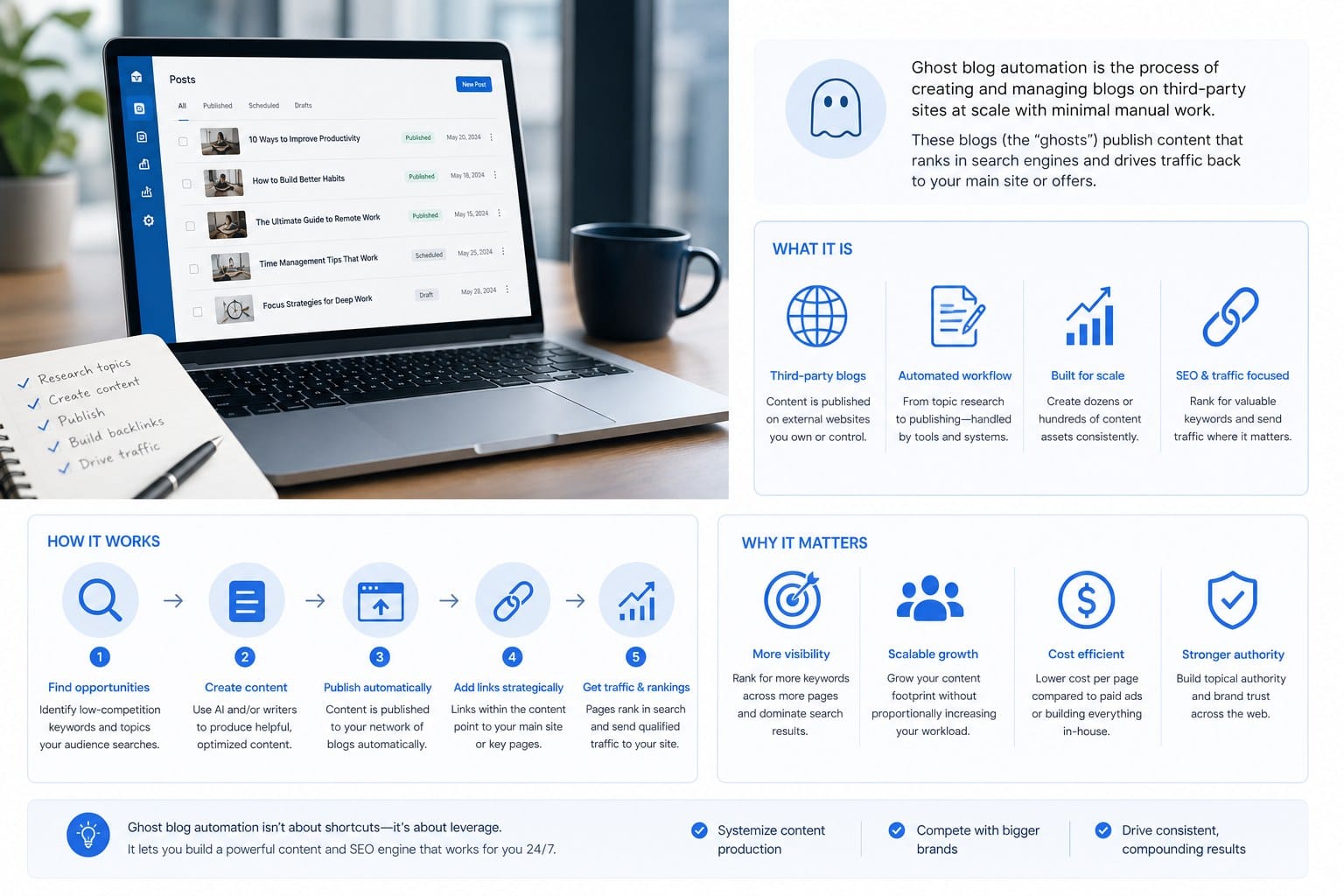
Ghost blog automation is not about hitting a single button and watching a blog magically appear. It is a connected system of tools and workflows that handle the research, writing, formatting, visual creation, scheduling, and publishing that would otherwise eat up hours of your week.
Let me break that down with a real example. Imagine you run a SaaS product for project managers. You know your audience searches for things like 'best project management templates,' 'how to manage remote teams,' and 'agile vs. scrum for small teams.' Without automation, you or someone on your team has to:
- Research which topics are worth targeting - Outline the article - Write a 1,500 to 3,000 word draft - Find or create images and graphics - Format everything inside Ghost - Set a publish date and hit go - Repeat this process week after week
For a solo founder or a small marketing team, that workflow is exhausting. It is also the reason so many business blogs publish three posts in January and then go silent until March.
Ghost blog automation replaces the repetitive and time-consuming parts of that workflow. A good automation system connects to Ghost through its API, handles content creation upstream, and pushes finished, formatted articles directly into your Ghost dashboard or publishes them on your behalf based on a schedule you set.
The word 'automation' sometimes makes people nervous about quality. That concern is fair, especially since the internet is already full of thin, low-effort AI content. But the key difference between useful ghost blog automation and spammy AI content is research depth and editorial control. The best systems do not just spin up generic text. They research your niche, match your brand voice, and produce articles that actually answer the questions your readers are typing into Google.
For Ghost users specifically, automation matters for another reason. Ghost is a platform favored by independent bloggers, digital publications, and SaaS companies that care about performance and control. These are exactly the audiences who need a reliable, repeatable content engine. Ghost gives you a beautiful front end. Automation fills it with content consistently, which is what actually drives organic traffic over time.
Consistency is one of the most underrated factors in SEO. Search engines reward websites that publish regularly and cover a topic in depth. A blog that publishes one article a month will almost always grow slower than a blog publishing four or eight well-researched articles per month. Automation is the most practical way to close that gap without hiring a full content team.
I also want to address something that comes up often: whether autopilot publishing is safe for SEO. The short answer is yes, if the content is genuinely useful and well-researched. I cover this in more detail in what is autopilot blogging and is it safe for SEO, but the core idea is that automation does not hurt your SEO. Thin, unhelpful content hurts your SEO. The automation itself is neutral. What matters is what it produces.
So if you have been hesitant about setting up ghost blog automation because you worry about Google penalties or quality control, the right move is to look carefully at what the automation system actually generates, not to avoid automation altogether.
How a ghost blog automation workflow is structured from strategy to publish
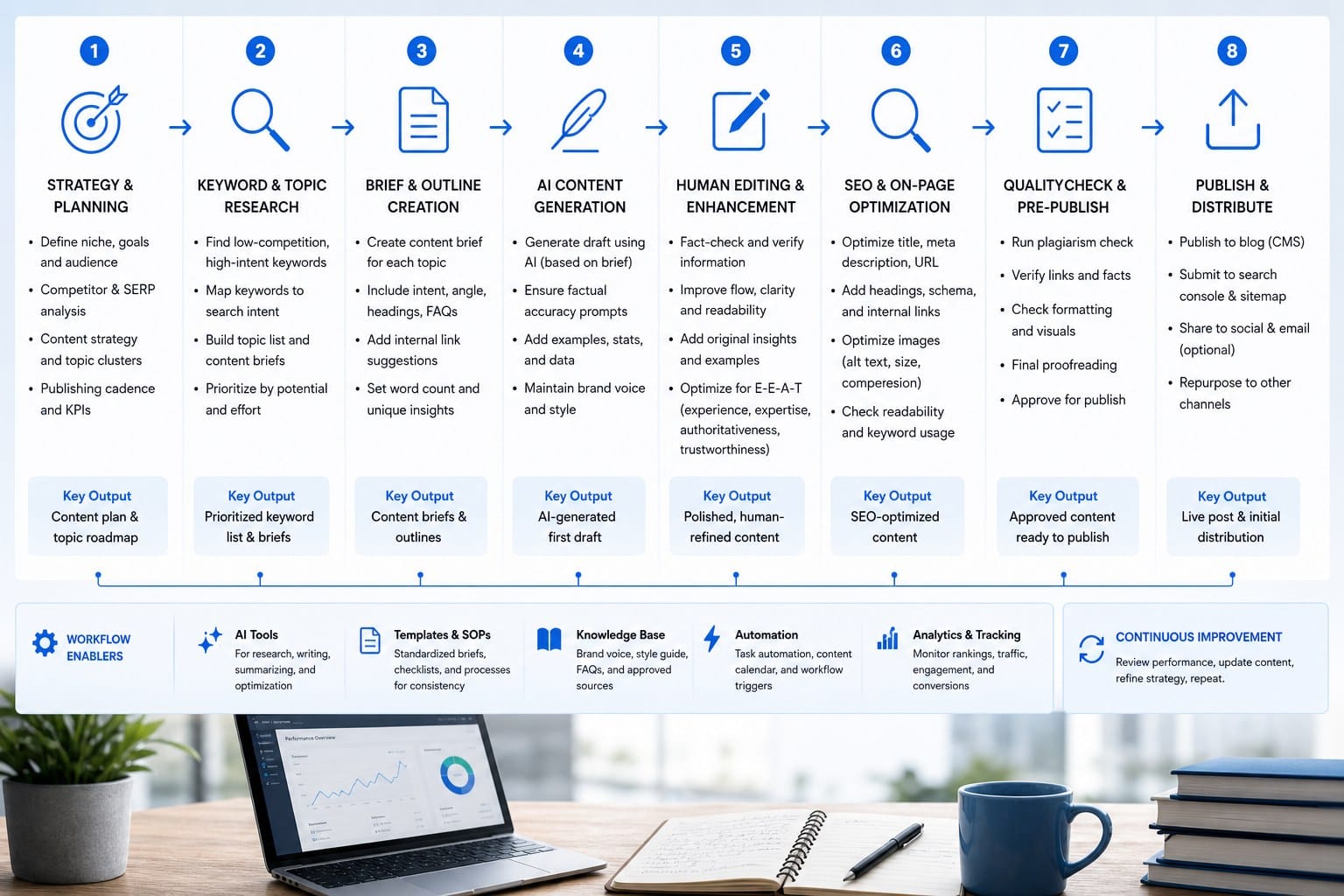
A complete ghost blog automation workflow has several layers, and understanding each one helps you evaluate whether a particular tool or system will actually work for your goals. Let me walk through each stage.
Stage one: Content strategy and topic research
This is where most DIY automation setups fall apart. People grab a keyword list, feed it into an AI writer, and call it a content strategy. That is not a strategy. That is a list of prompts.
A real content strategy starts with understanding what your audience is searching for, what questions they have at different stages of the buyer journey, and what topics your competitors are ranking for that you are not. It looks at search intent, not just search volume. It thinks about topical clusters and how articles can support each other through internal linking.
For Ghost users building a blog for organic traffic, this stage is critical. You could automate the publishing of fifty articles and still get no traffic if those articles are not targeting real search demand or are not organized around topics Google can understand as a coherent subject area.
A proper ghost blog automation system builds a content calendar based on actual keyword research and topic modeling. It should produce a 30-day or 90-day plan that maps out which articles to publish, in what order, and why. That plan becomes the foundation everything else is built on.
Stage two: Article research and long-form writing
Once you have a content plan, the next stage is producing the actual articles. This is where AI writing tools have improved dramatically over the past two years. The best systems today do not just generate text from a prompt. They pull in context from credible sources, understand the semantic relationships between topics, and produce articles that are detailed enough to genuinely help the reader.
For SEO purposes, article length matters when it reflects depth of coverage, not just word count for its own sake. A 2,500-word article that fully addresses a topic will outperform a 500-word article that skims the surface. Automation systems that produce long-form content should be generating articles that cover the topic thoroughly, with logical structure, useful examples, and answers to the follow-up questions a reader might have.
One thing I always look for in an automated content system is whether it handles internal linking intelligently. Good internal linking helps both readers and search engines understand how your content fits together. If your automation tool just drops links randomly or not at all, you are leaving SEO value on the table.
I go deeper into how to evaluate AI writing tools in how to evaluate AI blog tools: a checklist for founders and marketers, which is worth reading if you are comparing options right now.
Stage three: Visuals and formatting
This is a stage most people forget when they think about ghost blog automation. Ghost is a visually clean platform, and articles that go up without a header image or any visual breaks look unfinished. Good automation systems handle visual creation as part of the pipeline, not as an afterthought.
On-brand visuals can mean different things depending on your blog. For some brands, it is clean header images with consistent typography. For others, it means charts, diagrams, or featured images that match the article topic. The important thing is that visuals should be part of the automated workflow, not something you have to manually add after the fact.
Formatting inside Ghost is also worth thinking about. Ghost uses its own editor and supports cards for different types of content. An automation system that integrates directly with Ghost through the API can push articles with proper formatting already applied, including headings, subheadings, bullet points, and image placement. This saves the manual reformatting step that plagues a lot of content teams.
Stage four: Scheduling and autopilot publishing
This is the stage where automation earns its name. Once an article is researched, written, formatted, and ready to publish, the automation system should be able to schedule it and push it live without any manual action from you.
Ghost has a native API that allows third-party tools to create, update, and publish posts. A well-built ghost blog automation system uses this API to push content directly to your Ghost instance on a defined schedule. You set the cadence, whether that is two posts per week, five posts per week, or a custom schedule around product launches or seasonal topics, and the system handles the rest.
This is where the 'autopilot' part becomes real. Your blog keeps publishing even when you are traveling, focused on a product launch, or just taking a break. The content calendar keeps moving forward without you manually pushing each article through the process.
Why each stage needs to connect
The reason a lot of DIY ghost blog automation setups underperform is that the stages are disconnected. Someone uses one tool for keyword research, another for writing, another for scheduling, and manually handles visuals themselves. Every handoff between tools is a point where things break, get skipped, or create extra work.
A unified system that handles strategy through publishing in one place eliminates those friction points. It also gives you a consistent data trail. You can see what articles are in the pipeline, when they publish, and how they perform, all without toggling between five different tools.
For most small business owners, SaaS founders, and independent bloggers, the time cost of managing disconnected tools is nearly as high as just writing the content yourself. The real value of ghost blog automation comes from having a single system that handles the entire workflow.
How Blogtude makes ghost blog automation practical for growing brands
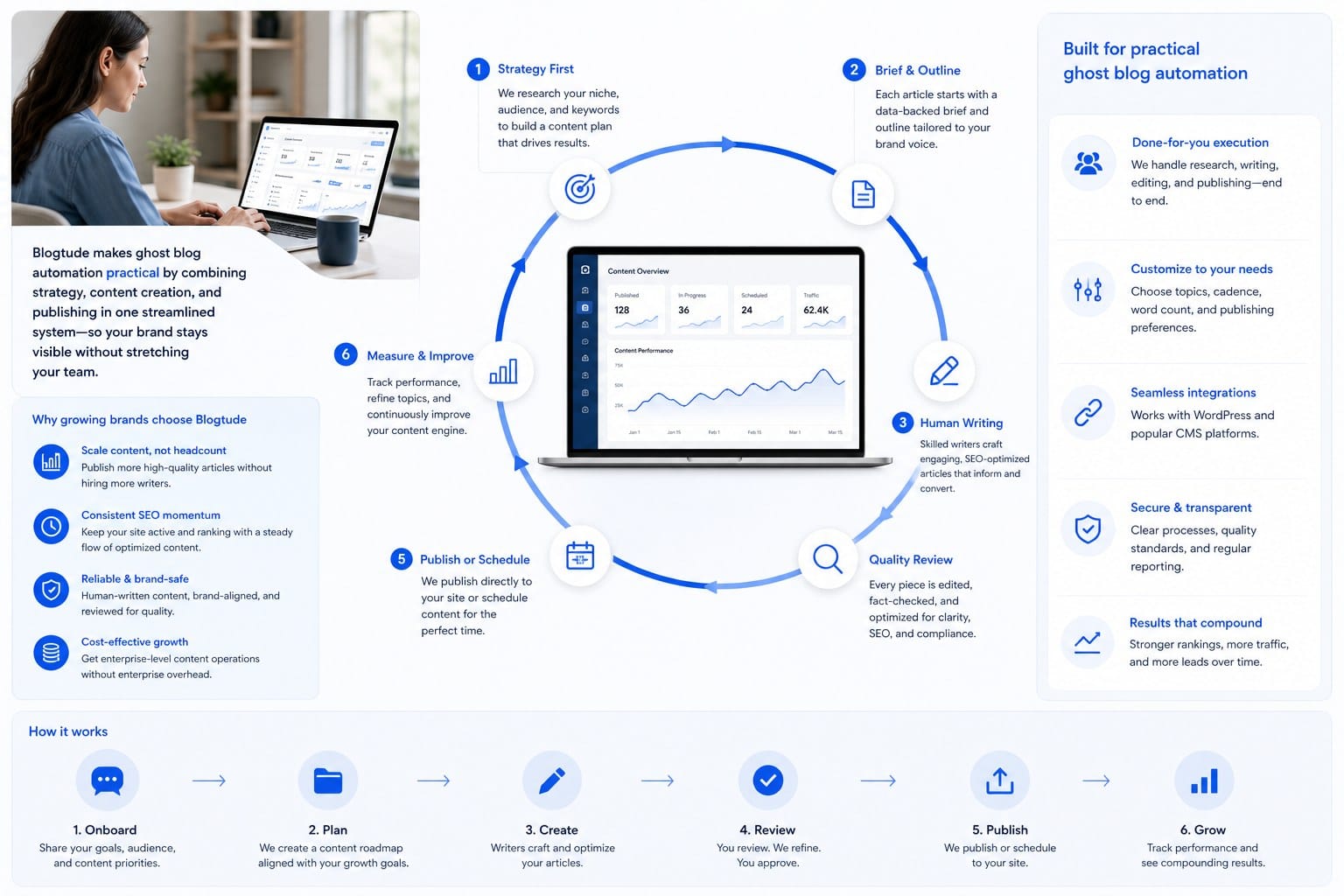
Blogtude was built specifically to solve the problem I just described: the gap between having a Ghost blog and consistently filling it with high-quality, SEO-optimized content.
Here is how the system works in practice.
The 30-day content strategy
When you start with Blogtude, the first thing the system produces is a 30-day content strategy tailored to your niche, audience, and SEO goals. This is not a generic list of blog topics. It is a researched content plan that identifies the specific questions your target readers are searching for, maps out topical clusters that build your authority in a subject area, and sequences articles in a way that supports both reader journeys and internal linking.
For a SaaS company, this might mean a cluster of articles around a core feature, supporting articles that address related pain points, and comparison or evaluation content that captures mid-funnel search traffic. For an independent blogger in a specific niche, it might mean covering the foundational topics first and then going deeper into subtopics as the library grows.
This strategy phase is what separates Blogtude from tools that just generate random articles. Random content does not build SEO authority. A coordinated content strategy does.
Deeply researched long-form articles
Once the strategy is in place, Blogtude produces the articles. These are long-form pieces, typically running 1,500 to 3,500 words depending on the topic, and they are written to genuinely cover the subject rather than just hit a word count.
The research process pulls in relevant context from credible sources and uses it to produce content that has real depth. Articles cover the main topic, address related questions, and include the kind of specifics that make a post useful rather than generic. Blogtude also handles internal linking, weaving in links to other articles in your content strategy so that as your library grows, your articles support each other in the way Google rewards.
The writing matches your brand voice. This matters more than most people realize. A blog that sounds like it could belong to anyone ranks and converts worse than one that has a clear, consistent perspective. When you set up your Blogtude account, you define your brand's tone and voice, and the system applies that throughout every article it produces.
On-brand visuals included
Every article Blogtude produces comes with on-brand visuals. This is not stock photography slapped on top of an article. The visuals are created to match the article topic and your brand's visual identity, so your Ghost blog looks polished and consistent from the first post to the fiftieth.
For Ghost users, this matters because Ghost is a platform where design quality is part of the appeal. A beautiful Ghost theme paired with generic or mismatched visuals undercuts the experience. Having visuals handled automatically as part of the content pipeline means your blog looks professional without you spending time hunting for images or creating graphics yourself.
Automated publishing directly to Ghost
This is the piece that makes ghost blog automation real for Blogtude users. The system connects to your Ghost instance through the Ghost API and publishes articles on your schedule. You can set a publishing cadence, review the content before it goes live if you want that extra step, or let the system publish fully automatically.
This means your Ghost blog keeps publishing on schedule even when you are deep in product development, running a campaign, or simply focused on other parts of your business. The content calendar moves forward without your manual involvement.
For digital marketers managing brand blogs, this is especially valuable. Managing a client's or employer's blog manually is one of the most time-consuming parts of content marketing. Having a system that generates the strategy, produces the articles, and publishes them to Ghost without you chasing every deadline changes what is possible for a small team.
Who this is for
Blogtude works best for a few specific types of users.
Independent bloggers and content creators who want to grow their blog without hiring writers or spending all their time creating content. If you have a Ghost blog and you know consistent publishing would grow your audience, but you cannot keep up with the volume manually, Blogtude handles the production so you can focus on community, monetization, or creating the occasional high-touch piece yourself.
SaaS founders and startups who understand that organic search traffic compounds over time but cannot dedicate engineering or marketing resources to a full content operation. Blogtude gives you a professional content engine without the headcount.
Small business owners who have a Ghost blog set up because they know blogging builds trust and drives traffic, but who do not have the time to write consistently. Blogtude keeps the blog active without pulling you away from running your business.
Digital marketers managing brand blogs who need a reliable, repeatable workflow. Instead of manually managing every piece from brief to publish, Blogtude becomes the automated backend of your content operation.
What to look for when evaluating any ghost blog automation tool
If you are comparing options before committing to a system, I want to share a few things that matter more than most tools advertise.
First, look at the quality of the research process. Does the tool actually research your niche and your competitors, or does it generate text from a generic prompt? Research depth is the biggest differentiator between automation that drives traffic and automation that produces noise.
Second, look at how the tool handles SEO at the article level. Does it optimize for target keywords without stuffing them? Does it structure articles with proper heading hierarchy? Does it handle meta descriptions and SEO titles? These details add up across a library of articles.
Third, think about the strategy layer. A tool that produces articles without a strategic plan is like a car with an engine but no steering wheel. The content might be decent in isolation, but it will not build the kind of topical authority that moves the needle in organic search. I have more on evaluating these tools specifically in how to evaluate AI blog tools: a checklist for founders and marketers.
Fourth, check whether the tool integrates directly with Ghost or requires manual export and import. Direct API integration is what makes true automation possible. If you are copying and pasting articles from a document into Ghost, you have a writing tool, not an automation system.
Finally, think about SEO tooling more broadly. Ghost blog automation sits inside a larger SEO ecosystem that includes keyword research, site auditing, backlink tracking, and performance monitoring. If you are also evaluating or reconsidering your SEO tools, SEO tools like WooRank and what to use instead gives you a practical comparison to work from.
The goal of ghost blog automation is not to remove you from your blog entirely. It is to remove the parts of content production that do not require your expertise, so you can spend your time on the things only you can do. Strategy review, audience relationships, product expertise, unique perspective. Blogtude handles the rest.
Consistent publishing on Ghost is one of the highest-leverage things a growing brand can do for long-term organic traffic. The brands that figure out how to publish at scale without burning out their team are the ones that build durable search traffic over months and years. Ghost blog automation, done well, is how you get there.
Ready to take the next step?
Ready to put your Ghost blog on autopilot? Blogtude generates your 30-day content strategy, writes deeply researched long-form articles, creates on-brand visuals, and publishes everything directly to Ghost on your schedule. Visit https://blogtude.com to see how it works and get your content engine running.


