
SEO tools like WooRank and what to use instead

Table of contents
1. What WooRank does and why people look for alternatives
2. The best alternatives to WooRank for different use cases
3. Why the real problem is not finding the right audit tool
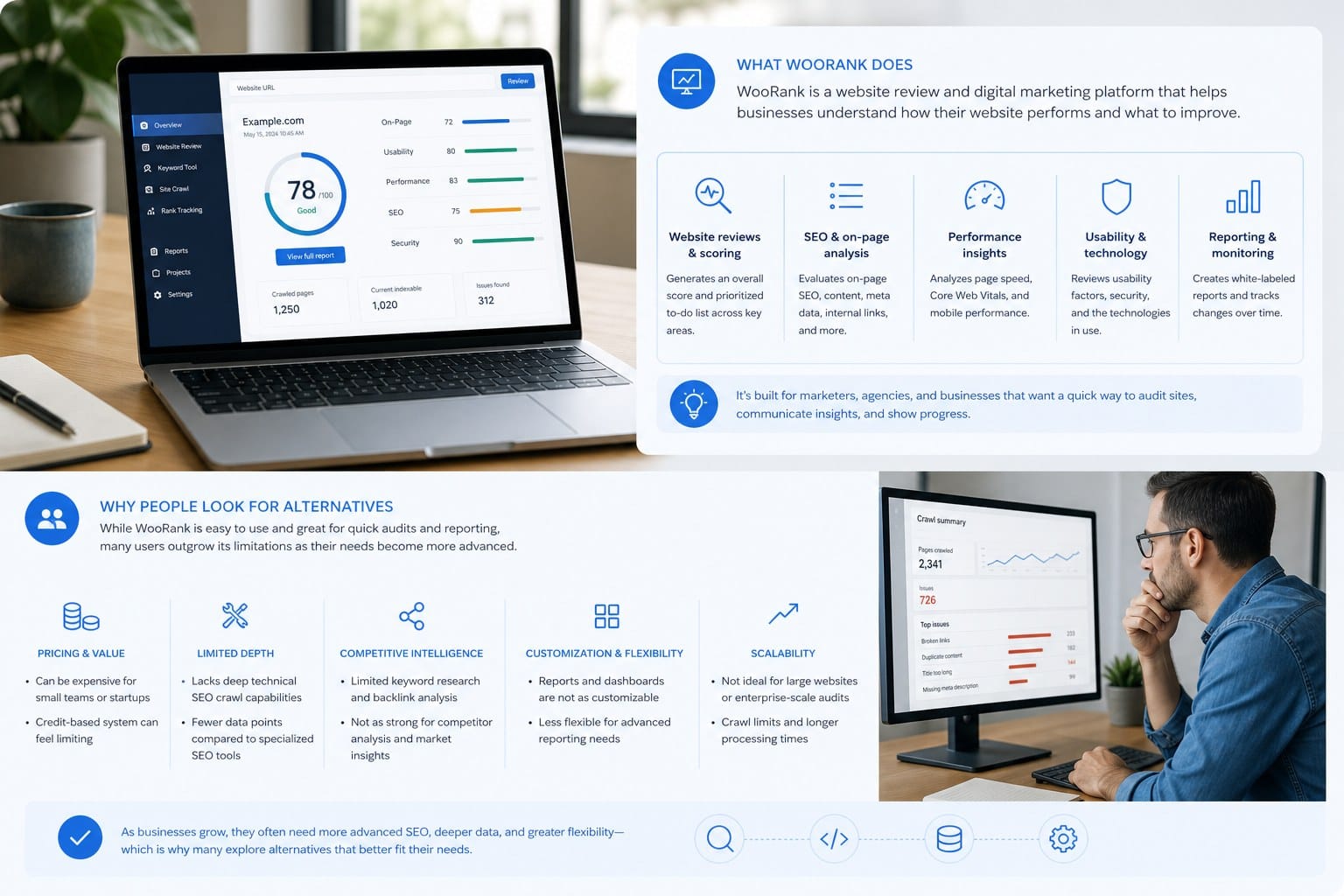
If you have spent any time hunting for SEO audit tools, you have probably come across WooRank. It is a website review platform that scores your site across categories like technical SEO, mobile usability, and backlinks. For years it was a popular starting point for bloggers and small business owners who wanted a quick health check on their site. But a lot has changed in the SEO tools landscape, and many people searching for tools like WooRank are finding that their needs have grown beyond what a basic site grader can offer. In this article, I want to walk through what WooRank actually does well, where it falls short, what you should consider using instead depending on your specific goals, and why the biggest obstacle most growing brands face has nothing to do with picking the right audit tool in the first place.
What WooRank does and why people look for alternatives
WooRank has been around since 2011, and its core product is a website review tool that generates a score out of 100 for any domain you enter. It checks things like title tags, meta descriptions, heading structure, page speed indicators, mobile friendliness, social signals, and some basic backlink data. You can generate a PDF report and share it with clients or use it as a personal audit checklist.
For a long time, that was genuinely useful. If you were a freelance web designer or a small agency, handing a client a branded PDF with a score and a list of issues was a fast way to demonstrate value. The visual report format made it easy for non-technical people to understand what was wrong with their site. A client who had never thought about title tags before could look at the report and immediately see that something needed fixing. That clarity had real value, especially in the early days of the SEO tools market when most alternatives required significantly more technical knowledge to operate.
But here is where the problems start. WooRank's data is often shallow. The backlink analysis pulls from limited sources and does not come close to matching the depth you get from dedicated link analysis tools. If you are trying to understand your link profile in any serious way — identifying toxic links, finding competitor backlink opportunities, or tracking new links over time — WooRank's backlink data will leave you working with an incomplete picture.
The keyword tracking features have the same problem. They are basic enough to give you a general sense of where you stand, but they do not give you the competitive insight you need to actually build an SEO strategy. You cannot use WooRank's keyword data to find content gaps, benchmark yourself against specific competitors, or identify high-opportunity keywords that your audience is searching for but that you have not yet targeted.
The site crawler is limited compared to more specialized crawling tools. WooRank will catch obvious technical issues, but it does not go deep enough to surface the kinds of structural problems that can quietly hold back a site's performance. Things like internal linking gaps, duplicate content at scale, pagination issues, or hreflang errors often require a more capable crawler to identify reliably.
And the recommendations, while formatted nicely, often read like generic best-practice reminders rather than specific, actionable guidance tailored to your actual site situation. You get told to add a meta description to a page, but you do not get help understanding what that meta description should say to improve click-through rates. You get flagged for missing alt text, but you do not get guidance on how to write alt text that is both accessible and useful for search. The gap between knowing an issue exists and knowing how to fix it in a way that actually moves the needle is where most audit tools, including WooRank, fall short.
Pricing has also been a point of friction. Historically, WooRank's paid plans have sat in a mid-range price bracket that felt hard to justify when more powerful tools were available at comparable or lower price points. For solo bloggers, early-stage founders, and small business owners who are watching every dollar in their tool budget, paying a monthly fee for a report that tells you your meta descriptions need work is a tough sell.
That combination of shallow data, generic recommendations, and pricing that is hard to justify relative to alternatives is why so many people end up searching for tools like WooRank. They want the convenience of a site audit tool but with better data, smarter recommendations, or features that actually connect to their content and publishing workflow.
Before I get into alternatives, I want to be clear about something. SEO tools are only as useful as what you do with the information they give you. A score or a report does not grow your traffic. The work you do after running the audit is what matters. I will come back to that point in the final section, because it connects directly to the bigger challenge most bloggers and small business owners face — and it is a challenge that no audit tool, no matter how good, actually solves.
The best alternatives to WooRank for different use cases
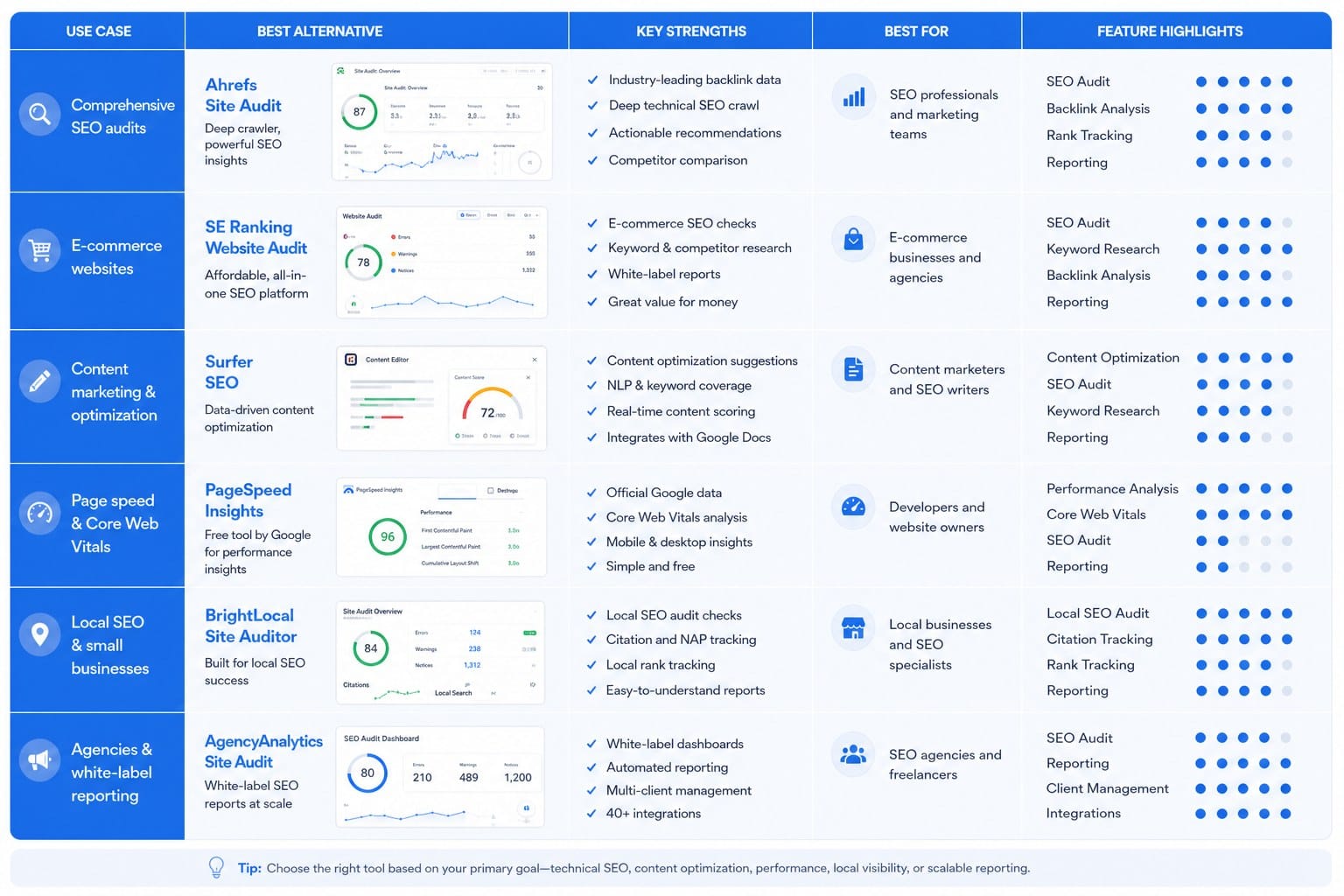
There is no single tool that is the best replacement for WooRank across every situation. The right alternative depends on whether you are a blogger doing your own SEO, a SaaS founder trying to build organic traffic, a digital marketer managing multiple brand blogs, or a small business owner who just wants things to work without spending hours learning new software. Let me break this down by use case, because treating every person looking for a WooRank alternative as if they have the same needs leads to recommendations that do not actually help.
If you want serious SEO data and research capabilities
For anyone who is serious about keyword research, competitor analysis, and backlink auditing, tools like Ahrefs and Semrush are the industry standard. Ahrefs has one of the most comprehensive backlink indexes available, a keyword explorer that shows real search volumes with useful difficulty scores, and a site audit tool that actually crawls your pages properly and surfaces issues with enough detail to act on. Their Content Explorer feature lets you find which pieces of content in any niche are earning the most backlinks and social engagement, which is genuinely useful for building a content strategy rather than just reacting to audit findings.
Semrush is similarly powerful and adds competitive traffic analysis and position tracking features that are useful for benchmarking your progress against specific competitors. If you want to know which keywords a competitor is ranking for that you are not, Semrush's gap analysis tools make that straightforward. Their site audit is also solid, and the platform covers enough use cases that many marketers use it as their primary research and monitoring hub.
These are not beginner tools. There is a learning curve, and the pricing reflects that, with both platforms sitting at monthly costs that are meaningfully higher than WooRank. But if you are building an SEO strategy meant to drive significant organic traffic over time, the data quality from these platforms is in a different league compared to what tools like WooRank offer. For any brand that is serious about organic growth as a channel, the investment tends to pay off quickly.
For keyword research specifically, Google Search Console deserves a mention here because it is free and gives you real data about what searches are already bringing people to your site. If you are not using Search Console as a regular part of your workflow, start there before paying for anything else. It will show you which queries are generating impressions and clicks, which pages are getting search traffic, and where you have keywords ranking in positions that could realistically be improved with targeted content updates. That is actionable intelligence that no paid tool can replicate because it comes directly from Google.
If you want a lightweight, budget-friendly site audit tool
If what you liked about WooRank was the simplicity of entering a URL and getting a clear list of issues, there are free and low-cost tools that do this well without asking you to commit to a premium monthly plan.
Google's PageSpeed Insights gives you detailed technical performance data for free, including Core Web Vitals scores, server response time analysis, and specific recommendations for improving load speed on both mobile and desktop. For a free tool, the depth of the performance data is impressive, and because it comes from Google directly, you know the data reflects how the search engine actually evaluates your pages.
Screaming Frog's free plan lets you crawl up to 500 URLs and surfaces technical SEO issues in a way that is much more detailed than WooRank's reports. It will show you missing meta descriptions, duplicate title tags, broken links, redirect chains, pages blocked from indexing, and a lot more. If your site has fewer than 500 pages, the free plan is enough to run a thorough technical audit. The paid version lifts the crawl limit and adds features like JavaScript rendering, custom extraction, and scheduled crawls, but the free version is a strong starting point.
For a broader free audit experience, tools like Ubersuggest offer site grading features at lower price points, with keyword research features bundled in. The data quality at the lower tiers is not at the level of Ahrefs or Semrush, but for someone who wants a single dashboard that covers basic audit findings alongside keyword tracking, it is a reasonable option at a lower monthly cost.
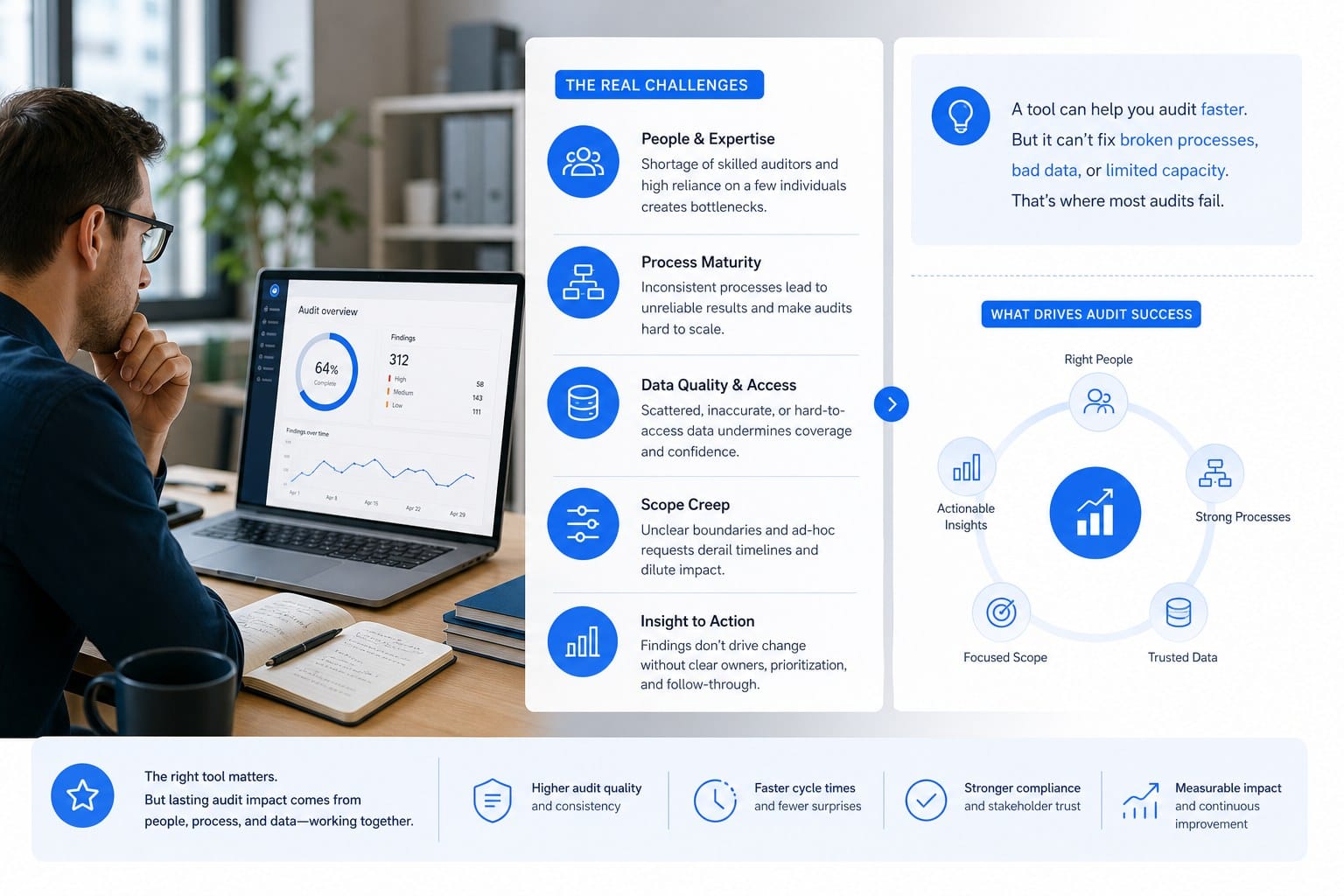
The important thing to understand about all of these tools is that they are diagnostic. They tell you what is broken. They do not tell you what content to create, which topics to prioritize, or how to build an audience that grows over time. That distinction matters a lot, and I want to come back to it.
If you are a Ghost CMS user
This is worth calling out specifically because Ghost users have a particular workflow challenge that most general-purpose SEO tools do not account for. Ghost is a clean, fast publishing platform that handles technical SEO basics well out of the box. Canonical tags, structured data, sitemap generation, and clean URL structures are all handled natively. That means Ghost users are often starting from a stronger technical baseline than sites running on older or more bloated CMS platforms.
But most general-purpose SEO tools were built with WordPress in mind, and the integrations and publishing workflows often do not translate cleanly to Ghost. You can still use Ahrefs, Semrush, or Screaming Frog to audit a Ghost site — the crawlers do not care what CMS you are using — but if you are thinking about tools that help you plan, write, and publish content, Ghost users need to think carefully about what actually integrates with their workflow.
For Ghost users specifically, the bottleneck is rarely the audit tool. It is the content creation and publishing workflow itself. A Ghost site that is technically healthy but publishing infrequently is not going to grow on search regardless of which audit tool you use to check it.
If you are a blogger or content creator trying to compete in a crowded niche
This is where I think the conversation about tools like WooRank needs to shift in a meaningful way. Site audit scores matter, and you should fix technical issues on your site. But the gap between a mediocre SEO audit score and a highly trafficked blog is not closed by technical fixes alone. It is closed by consistently publishing well-researched, genuinely useful content on topics your audience is actively searching for.
Solo creators and independent bloggers can absolutely win on search against much larger competitors when they focus their effort on content quality and consistency rather than obsessing over audit scores. I wrote more about this in a piece on how independent bloggers can compete with big media using AI tools, but the core argument is simple: big media sites have scale advantages, but they often sacrifice depth and specificity to cover broad audiences. A focused independent blogger who goes deep on a specific topic and publishes consistently can outrank much larger sites on the specific queries that matter most to their audience.
The audit tools in this section will help you stay technically clean. But the real competitive work happens in the content.
A note on AI-powered SEO tools
A newer category of tools promises to combine SEO analysis with content generation. Some are genuinely useful and worth evaluating seriously. Others produce thin, generic content that can actually hurt your search performance if you publish it without careful editing. A piece of content that does not genuinely help the person reading it will not earn links, will not generate return visits, and over time will signal to search engines that your site is not worth prioritizing.
If you are evaluating tools in this space, I recommend going through a structured checklist rather than taking marketing claims at face value. The article on how to evaluate AI blog tools: a checklist for founders and marketers walks through exactly what to look for when comparing these platforms.
The short version is this: look at the quality of the actual output, not the feature list on the pricing page. Ask whether the tool does real research or just rephrases existing content that already ranks. Ask how it handles publishing workflows and whether it integrates with your CMS without requiring manual reformatting. Ask what kind of editorial control you retain over what gets published, and whether the tool supports your voice or flattens it into generic prose. Those questions will separate the tools that are worth paying for from the ones that look impressive in a demo but produce content you would be embarrassed to publish.
Why the real problem is not finding the right audit tool
Here is something worth being honest about. Most people who go looking for tools like WooRank are not stuck because they have the wrong audit tool. They are stuck because they are not publishing enough content, or the content they are publishing is not well-researched enough, or they are not being consistent enough for search engines to treat their site as a reliable, authoritative source in their niche.
A site audit is useful. Fixing broken links, improving page speed, writing better title tags, adding structured data, getting your site properly indexed — all of that matters, and none of it should be ignored. But it is table stakes. Every site competing for search traffic in a non-trivial niche has these basics covered. Once your site is technically sound, the variable that separates blogs that grow from blogs that flatline is content output and quality. The audit tool got you to the starting line. The content is the race.
This is where the math gets challenging for independent bloggers, SaaS founders, small business owners, and marketers managing brand blogs. A well-researched long-form article — the kind that actually stands a chance of ranking and earning backlinks — takes real time. Real research, not just skimming a few top-ranking pages and rewriting them in different words, can take several hours before you even start writing. Producing a finished article that is genuinely more useful than what currently ranks takes more hours still. Doing that consistently, week after week, while also running a business, managing a team, handling customer relationships, and dealing with everything else that comes with growth, is genuinely hard. Most people either fall behind on publishing or start cutting corners on quality to keep up with a schedule.
Both of those outcomes hurt you on search. Inconsistency in publishing signals to search engines that your site is not a priority. If you published eight articles in January and two in February and none in March, the crawl frequency and traffic patterns that follow reflect that irregularity. Low-quality content that does not actually help readers does not earn links, does not generate social sharing, and does not produce the kind of engagement signals that tell search engines a piece of content is worth ranking.
The cruel irony is that the brands that need the most help growing their content output are often the ones with the least time to do it. Founders are building product. Small business owners are serving customers. Independent bloggers are doing everything themselves. Sitting down to write 2,000 words of carefully researched content at the end of a full workday is hard, and it gets harder the more responsibility you carry.
This is the problem that actually needs solving, and it is why I think the conversation about alternative tools should not stop at audit tools. The bottleneck for most growing brands is not knowing what is wrong with their site. They usually know. The bottleneck is having enough good content going out the door on a schedule that actually compounds over time.
What autopilot content actually means and when it works
When people hear the phrase autopilot blogging, they often picture one of two things: either a feed of low-quality AI-generated spam, or a magical system that produces perfect content with no human involvement whatsoever. Neither of those is accurate, and neither is what good content automation actually looks like in practice.
There is a longer and more nuanced conversation to have about what autopilot blogging actually means and whether it is safe for SEO, because there are right ways and wrong ways to approach content automation. The piece on what is autopilot blogging and is it safe for SEO covers the tradeoffs honestly and is worth reading if you are thinking about how to scale your content output.
The short version is this: automation works when it is built around genuine research and meaningful editorial oversight, and it fails when it is just templated content generation with no real thought behind it. The goal of a good content workflow is not to remove the human from the process entirely. It is to remove the parts of the process that do not require human judgment — scheduling, formatting, publishing, keyword mapping, research aggregation — so that human effort can go toward the things that actually require thought, expertise, and voice.
A founder who spends four hours writing a mediocre article because they ran out of time to do proper research is not getting a good return on those four hours. A founder who spends forty-five minutes reviewing and refining a well-researched draft that was built on solid keyword data and published on a consistent schedule is getting much more leverage from their time. That is what a smarter content workflow is supposed to produce.
What a smarter content workflow actually looks like
For most of the people reading this, the ideal workflow has a few key components that work together rather than operating in isolation.
First, a content strategy that is built around keywords your audience is actually searching for, not just topics that seem interesting or that you feel like writing about this week. Keyword intent matters here. A topic with 5,000 monthly searches from people who are actively trying to solve the problem your business addresses is worth more than a topic with 50,000 monthly searches from people who are casually browsing. Understanding the difference requires real keyword research, not guesswork.
Second, a research process that goes deep enough to produce content that is genuinely more useful than what already ranks. If the top-ranking article on a topic is a 1,200-word overview, you do not automatically win by writing 2,400 words that cover the same ground. You win by going deeper, adding examples, addressing questions that the existing articles ignore, and giving readers something they cannot get from the content that is already there.
Third, consistent publishing on a schedule that search engines can depend on. Consistency compounds. A site that publishes two well-researched articles per week for twelve months will build significantly more topical authority than a site that publishes sporadically regardless of average article quality. Crawl frequency, internal linking opportunities, and topical depth all improve as your content library grows systematically.
Fourth, proper on-page formatting so that your content is readable and structured in a way that both human readers and search engines can parse efficiently. Clear headings, short paragraphs, logical structure, descriptive anchor text, and optimized title tags are all part of this. None of them are complicated, but all of them require attention.
And fifth, a way to do all of that without it consuming your entire week, because if the workflow is not sustainable, it will not be consistent, and consistency is the thing that actually compounds over time.
That is the workflow problem that most SEO audit tools, including tools like WooRank, do not address. They tell you what is wrong with the pages you have already published. They do not help you produce the content that makes the difference between a site that grows and a site that stagnates.
At Blogtude, that is exactly the problem the platform is built to solve. The core product generates a 30-day content strategy based on real keyword research, produces long-form articles with on-brand visuals, and publishes directly to Ghost and other CMS platforms on a consistent schedule. The goal is to give growing brands a content output that compounds over time without requiring manual effort at every step of the research-to-publish pipeline.
That does not mean every brand should fully automate their content without any involvement. Some niches require a strong personal voice, and that voice should come through in the writing. Some topics require firsthand expertise that no automated system can replicate. But for brands that are publishing informational content, educational content, or content designed to capture search traffic on specific topics in a competitive niche, the research-to-publish pipeline can be made dramatically more efficient without sacrificing the quality that actually earns rankings.
How to decide what you actually need right now
If you are currently using WooRank or looking for something like it, here is a practical framework for figuring out where to focus your energy and your budget.
Start by asking whether your site has any serious technical issues that are actually blocking search performance. If you have pages that are not being indexed, if your site loads slowly on mobile, if you have significant crawl errors or broken internal links, those issues need to be addressed. Any of the free tools mentioned earlier in this article can help you identify them without spending money on a premium audit platform. Google Search Console and PageSpeed Insights together cover most of what matters for free.
Once your site is technically healthy, shift your attention to content. Look at your publishing cadence over the last three months. Are you publishing consistently? Are the articles you are publishing long enough and detailed enough to compete with what ranks in your niche? Are you targeting keywords with real search volume, or are you writing about topics that nobody is searching for? Are you building topical depth in a specific area, or are you spreading content across topics that do not reinforce each other?
If the answers to those questions reveal a content gap rather than a technical gap, that is where your energy and your tool budget should go. More audit data will not solve a content volume problem. Better content strategy and a more sustainable publishing workflow will.
Finally, think honestly about your workflow. If you are spending significant time every week on research, writing, and publishing, ask whether that time is being used at the highest-value parts of the process or whether you are spending hours on mechanical work that could be handled more efficiently. The goal is not to replace good thinking with automation. It is to make sure that your good thinking is going toward the things that actually move the needle, and that the rest of the process is handled as efficiently as possible so you can keep showing up week after week.
Ready to take the next step?
If you are ready to move beyond one-time audits and build a consistent content engine for your brand, Blogtude handles the research, writing, and publishing so you can focus on growing your business. Visit blogtude.com to see how the platform works and get started with your 30-day content strategy.


