
What is a blog content strategy and why every brand needs one

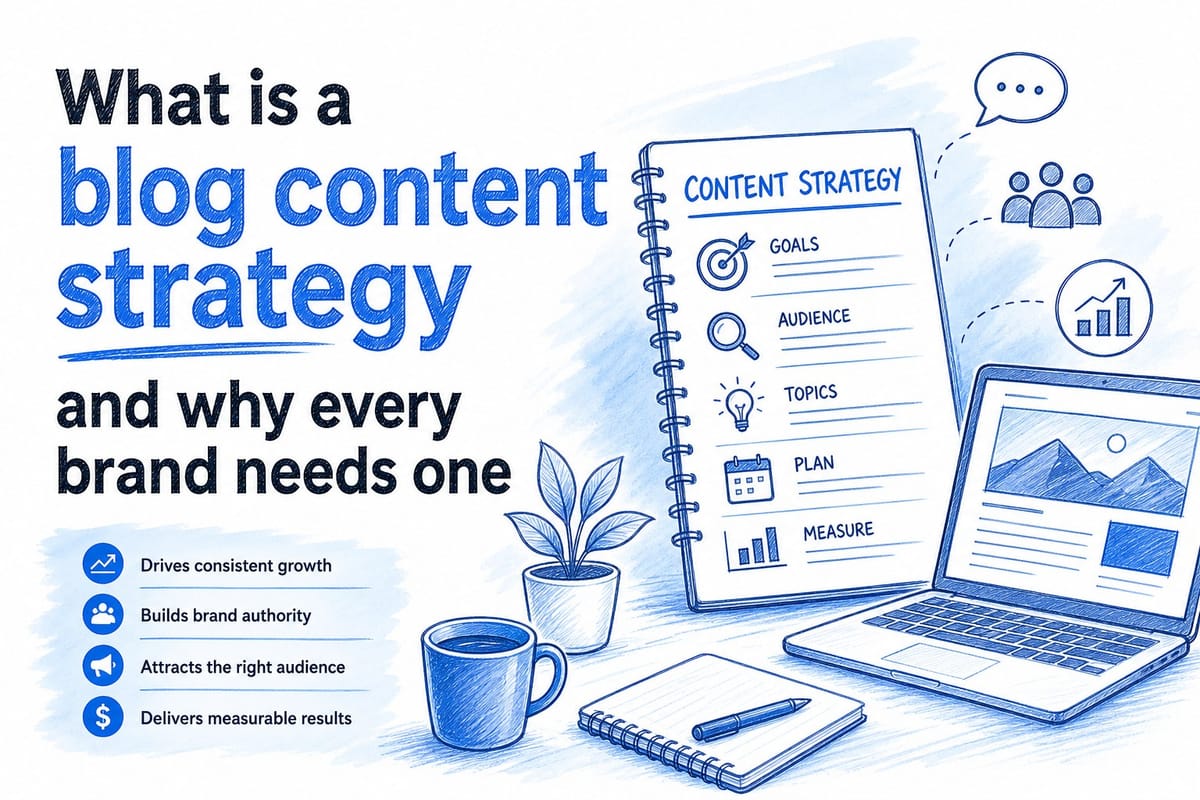
Table of contents
1. What is a blog content strategy, really?
2. Why every brand needs a blog content strategy before they publish another post
3. How to build a blog content strategy that actually gets executed
If you have ever stared at a blank editorial calendar and wondered what to publish next, you are not alone. Most brands start a blog with good intentions, post a handful of articles, and then go quiet for weeks. The problem is rarely a lack of ideas. It is a lack of a plan. Understanding what is a blog content strategy, and actually building one, is what separates brands that grow steady organic traffic from brands that spin their wheels. In this article I want to break down what a blog content strategy really means, why it matters more in 2025 than ever before, and how to put one together without it becoming a second full-time job.
What is a blog content strategy, really?
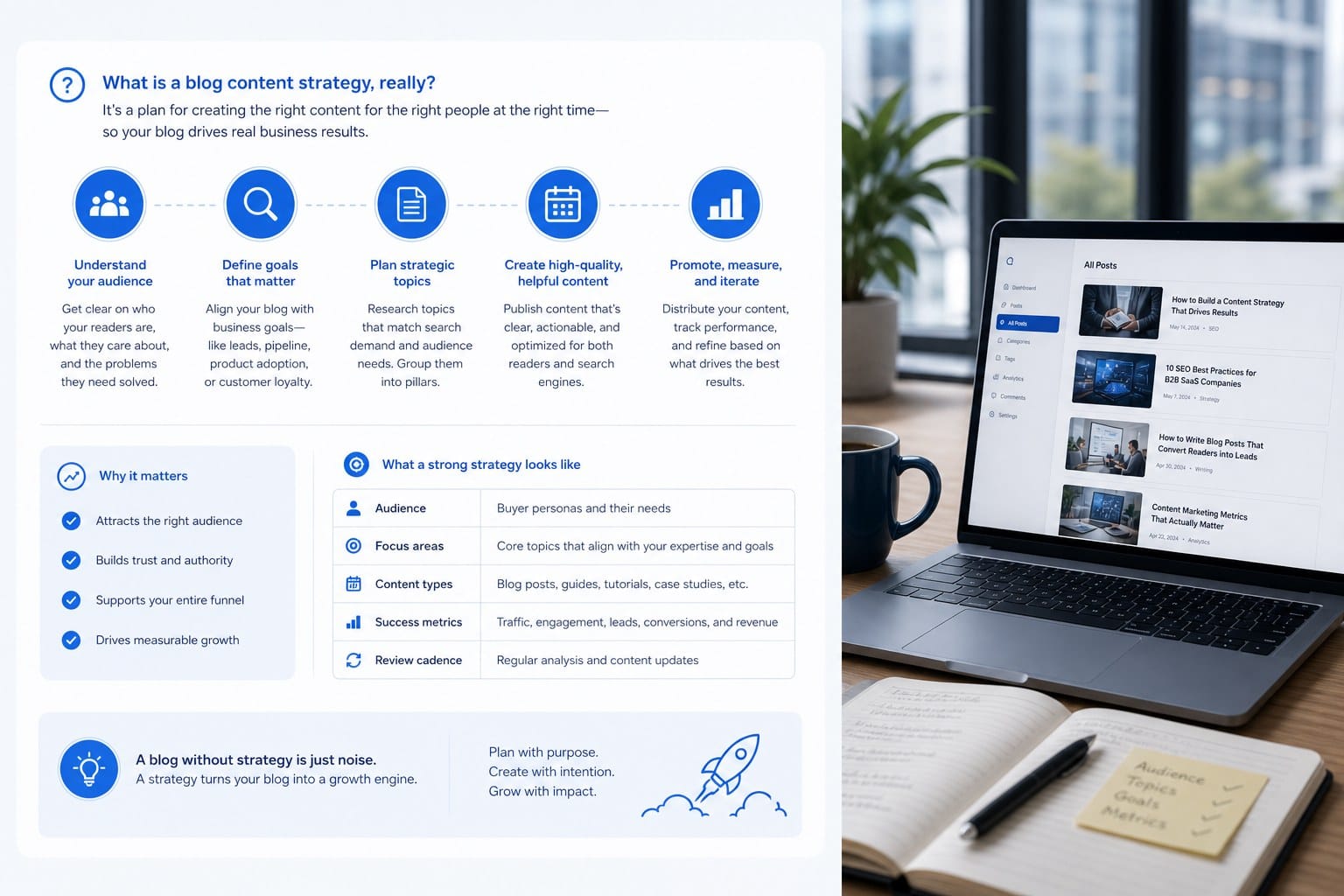
A blog content strategy is a documented plan that answers four core questions: who you are writing for, what topics you will cover, how often you will publish, and what you want each piece of content to accomplish. It is not a list of random blog post ideas. It is a connected system where every article you publish moves a reader one step closer to trusting your brand and taking action.
Think of it like a road map. If you know your destination, you can choose the fastest route, avoid dead ends, and measure how far you have traveled. Without a map, you might still arrive somewhere, but it probably will not be where you intended to go.
A strong blog content strategy usually has five core components.
The first is a clear audience definition. You need to know exactly who you are writing for. That means more than a vague description like 'small business owners.' It means understanding what problems they are actively trying to solve, what questions they type into Google, what level of knowledge they already have, and what format they prefer to consume information in.
The second component is keyword and topic research. Every article in your strategy should be anchored to a keyword or search query that real people use. This is not about stuffing a phrase into every paragraph. It is about choosing topics that have real search demand so your articles have a chance of being discovered organically over time.
The third component is a content calendar. A calendar is simply a schedule that tells you what to publish and when. It removes the daily decision fatigue of figuring out what to write next. A good calendar looks at least 30 days ahead and accounts for seasonal trends, product launches, and audience behavior.
The fourth component is a publishing process. This covers how an article moves from idea to live post. Who writes it? Who edits it? Who handles images and formatting? Who publishes it? Even if you are a solo blogger, you need a repeatable process, because without one, every article becomes a custom project and custom projects take forever.
The fifth component is a measurement framework. You need to define what success looks like. Is it monthly organic traffic? Email subscribers? Leads? Conversion rate from blog to product page? Defining your metrics before you start gives you something concrete to optimize toward.
Here is a real-world example of how these five components work together. Imagine you run a project management SaaS tool for small agencies. Your audience is agency owners who struggle with client communication and missed deadlines. Your keyword research reveals that phrases like 'how to manage client projects' and 'agency project management tips' get thousands of searches per month. Your content calendar maps out 12 articles over 30 days, covering topics your audience is actively searching for. Your publishing process includes a brief template, a writing step, a light editorial review, and automatic publishing to your blog. Your success metric is the number of free trial signups that originate from blog posts.
That is a blog content strategy. It is not complicated, but it does require intentional thinking before you write a single word.
One thing I want to be clear about: a blog content strategy is not a one-time document you create and forget. It should evolve. As you learn which topics drive traffic, which articles convert readers into customers, and which keywords your site can realistically rank for, you adjust the plan. The strategy is a living system, not a static spreadsheet.
It is also worth separating blog content strategy from general content marketing strategy, because people use these terms interchangeably and they are not the same thing. A content marketing strategy covers every channel, including social media, video, podcasts, newsletters, and webinars. A blog content strategy focuses specifically on written long-form content published to your blog. The two should be aligned, but the blog strategy is narrower and more execution-focused.
One more important point: a blog content strategy is not just for large companies with dedicated marketing teams. Independent bloggers, SaaS startups, local service businesses, and solo creators all benefit from having a structured plan. In fact, smaller brands benefit even more, because they cannot afford to waste time and resources publishing content that never reaches anyone.
Why every brand needs a blog content strategy before they publish another post
Here is a scenario I see constantly. A founder decides their brand needs a blog. They hire a freelance writer, publish four or five articles in the first month, and then things get busy. The blog goes quiet for two months. They come back, publish two more articles on completely different topics, and then disappear again. Six months later, the blog has eight posts, inconsistent topics, zero backlinks, and almost no organic traffic. They conclude that blogging does not work for their business.
Blogging did not fail them. The absence of a strategy did.
Here is why having a strategy in place before you publish makes such a significant difference.
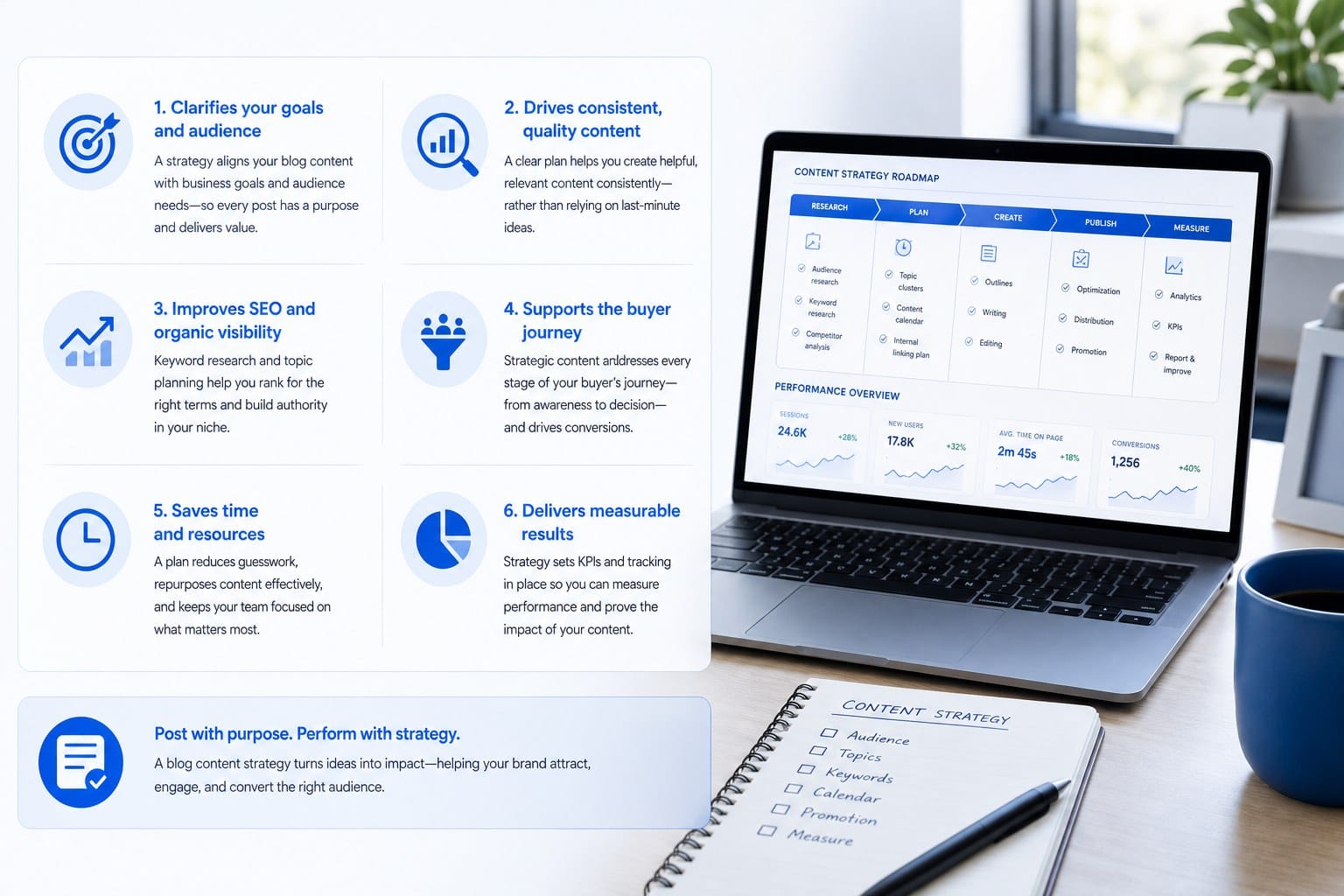
Consistency compounds over time. Search engines reward sites that publish quality content on a regular schedule. When you publish sporadically, you lose momentum. When you publish consistently, even at a modest pace like two to four articles per month, you build a body of work that keeps attracting traffic long after each article goes live. A well-written blog post can generate traffic for years. But only if you wrote it strategically, optimized it for a real search query, and published it on a site that Google has learned to trust.
Topic clusters build authority. One of the most effective approaches in modern SEO is building topic clusters. This means writing one comprehensive pillar article on a broad topic, and then writing several supporting articles that go deeper into specific subtopics. All of these articles link to each other. This signals to search engines that your site has real depth and expertise on the subject. Without a strategy, you end up with a random collection of articles that share no thematic relationship, which makes it much harder for any of them to rank.
A real example: if you run a blog about personal finance for freelancers, your pillar article might be a comprehensive guide to taxes for self-employed people. Your cluster articles might cover estimated quarterly taxes, deductible home office expenses, retirement accounts for the self-employed, and invoicing tools that simplify bookkeeping. Each article is useful on its own, but together they signal to Google that your site is a serious resource on this topic. That kind of topical authority is very difficult to build by accident.
Content serves multiple goals at once. When you have a strategy, every article you publish can serve more than one purpose. A well-written tutorial can rank on Google, be shared in a newsletter, be repurposed as a social post, and serve as a resource that your sales team sends to prospects. Without a strategy, most articles serve exactly one purpose and then sit unused.
It reduces wasted effort. Research from multiple content marketing studies consistently shows that a large percentage of blog content published by brands receives almost no organic traffic. The main reasons are always the same: the topic had no search demand, the article was too thin, or it competed with far stronger pages on the same keyword. A strategy forces you to do the keyword and audience research upfront so you are not writing into a void.
It makes hiring and delegation easier. If you plan to bring in writers, editors, or virtual assistants to help with your blog, a documented strategy makes onboarding them dramatically faster. Instead of explaining the brand voice and content goals every single time you assign an article, you hand them the strategy. They understand the audience, the tone, the topic priorities, and the publishing process from day one.
It keeps you focused during busy periods. Every brand goes through seasons when things get hectic. Product launches, hiring surges, busy client periods. When those happen, the blog is usually the first thing to get deprioritized. If your content calendar is mapped out 30 days in advance, you have articles already in progress or ready to publish even when you are stretched thin. Without a strategy, you either miss weeks of publishing or scramble to produce something low-quality just to maintain a presence.
SEO results take time, and strategy protects that investment. Blogging as a marketing channel typically takes three to six months before you start seeing meaningful organic traffic growth. That means you are investing time and resources now for results that arrive later. If you are going to make that investment, it is worth making it strategically. Publishing well-planned content that targets real keywords and genuinely serves your audience means the effort you put in today keeps paying off months and years from now. Publishing random, unresearched articles means you are spending the same time and energy with a much lower chance of return.
I want to highlight one thing that often gets overlooked: a blog content strategy is as much about your audience as it is about search engines. Yes, keyword research matters. Yes, on-page optimization matters. But the articles that perform best over the long term are ones that genuinely answer a question someone was searching for. The strategy should always start with the reader, not the algorithm. When you understand your audience deeply, the SEO tends to follow naturally.
For brands that are just getting started, the good news is that you do not need to have everything figured out before you launch your strategy. You need a clear audience definition, a prioritized list of 10 to 20 target topics, a realistic publishing schedule, and a simple process for getting articles live. That is enough to get started and build from there. You can learn more about structuring that process in this guide on how to build a blog content workflow that runs without you.
How to build a blog content strategy that actually gets executed
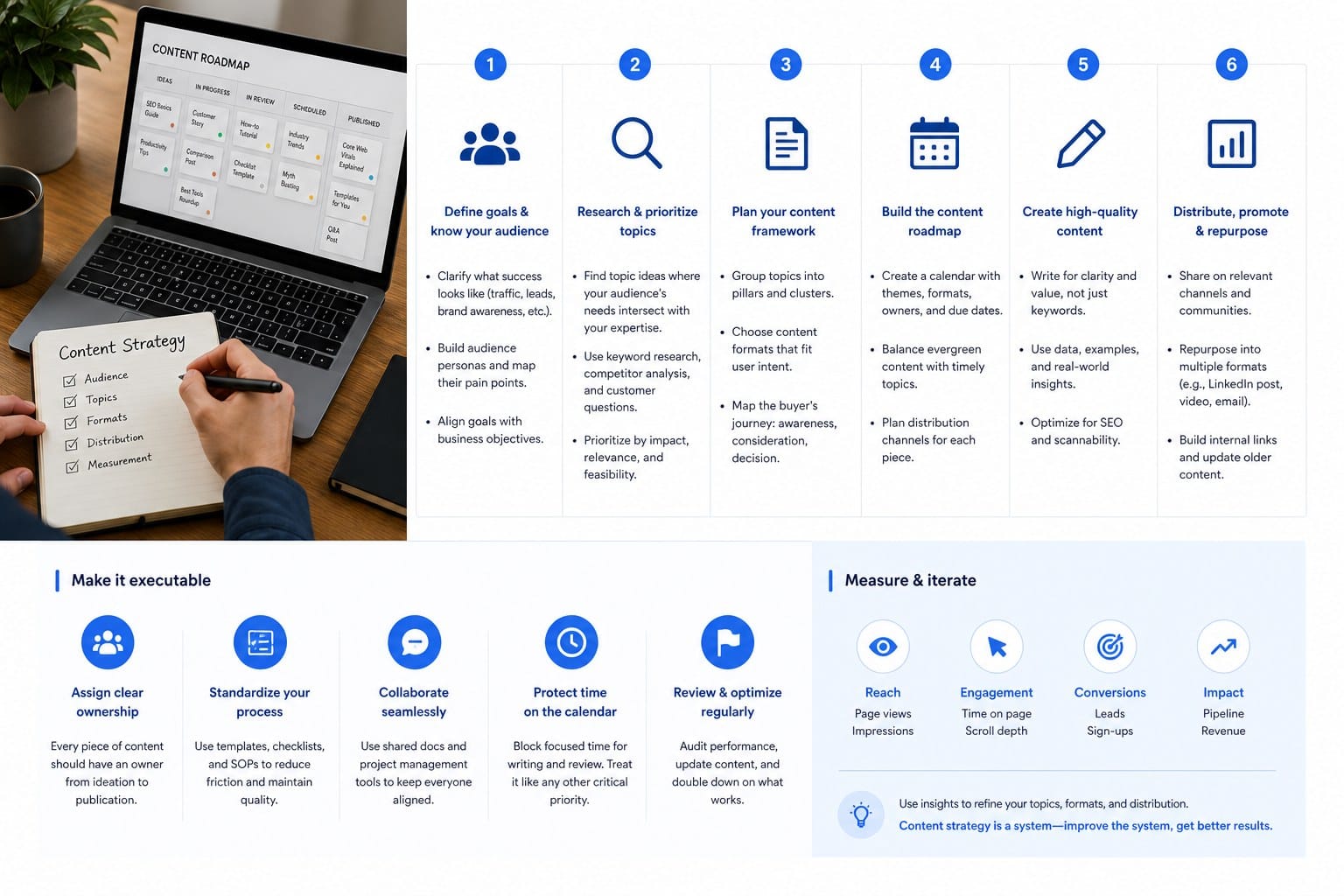
Understanding what a blog content strategy is and knowing why you need one is the easy part. The harder part is building one that your team, or just you, will actually follow through on. Here is a practical framework you can apply right now.
Step one: define your audience with precision.
Do not just write down a job title. Write down the specific problem your ideal reader is facing right now. What are they frustrated by? What do they search for when they need help? What do they already know, and where are the gaps in their knowledge? If you have existing customers, talk to them. Read reviews of competing products. Browse forums and communities where your audience hangs out. The more specific you are here, the more relevant your content will be.
For example, 'digital marketers' is too broad. 'Digital marketers at B2B SaaS companies who manage a blog but struggle to produce consistent content without a full-time writer' is much more useful. That level of specificity shapes every topic choice, every headline, and every example you use in your articles.
Step two: do real keyword research.
Keyword research does not have to be complicated, but it does have to happen. Use a tool like Google Search Console, Ahrefs, Semrush, or even Google's autocomplete and 'People Also Ask' feature to find the phrases your audience actually types into search engines. Look for keywords that have genuine search volume and are realistic for your site to rank for given its current domain authority.
Focus on informational keywords early on. These are queries where someone is looking to learn something, like 'how to write a content brief' or 'what is a blog content strategy.' They are easier to rank for than commercial keywords, and they build trust with readers before asking anything of them.
Group your keywords by theme. That grouping will become the foundation of your topic clusters.
Step three: build a 30-day content calendar.
Take your prioritized keyword list and assign articles to specific publish dates over the next 30 days. Be realistic about your capacity. If you can only produce four quality articles per month, plan for four. Four well-researched, well-written articles will outperform twelve thin ones every time.
For each article slot in your calendar, record the target keyword, the intended audience, the goal of the article (drive organic traffic, capture email subscribers, support a sales conversation), and the rough word count. This information makes briefing a writer or starting a draft much faster.
Step four: create a simple publishing workflow.
Map out every step from idea to live post. A basic workflow might look like this: keyword confirmed, brief written, first draft produced, light edit completed, images sourced or created, article formatted in CMS, internal links added, article published, social share and newsletter mention scheduled.
Every step should have a clear owner and a realistic time estimate. If you are running the blog solo, you are the owner of every step, which is why automation and tools matter so much. Spending hours each week on formatting and publishing is time you are not spending on strategy or audience growth.
This is exactly the kind of challenge that tools like Blogtude are built to solve. Blogtude generates a 30-day content strategy, writes deeply researched long-form articles, adds on-brand visuals, and publishes directly to Ghost and other CMS platforms automatically. For founders, independent bloggers, and digital marketers who need consistent output without the manual overhead, that kind of end-to-end automation removes the most time-consuming parts of the publishing workflow. If you are evaluating tools that go beyond SEO writing assistance into full publishing automation, this comparison of Surfer SEO alternatives for bloggers who want an all-in-one writing and publishing tool is a helpful starting point.
Step five: set a measurement cadence.
Decide in advance how often you will review your blog's performance and what you will look at. A monthly review is usually sufficient. The key metrics to track are organic sessions per month, number of keywords your blog ranks for in the top 10, average time on page, bounce rate, and conversion actions like email signups or product page visits originating from blog content.
Do not get distracted by vanity metrics like total page views if page views are not tied to a business outcome. Focus on the numbers that connect directly to your goals.
After 90 days, you will have enough data to start making meaningful decisions. Which topics drove the most traffic? Which articles had the highest engagement? Which keywords are you ranking on page two for and could move up with a few improvements? Use those insights to refine the next 30-day plan.
Step six: build in a content refresh cycle.
Publishing new content is only part of the job. Existing articles that already have some ranking history are some of your most valuable assets. A content refresh involves updating outdated information, adding new examples, strengthening internal links, and sometimes rewriting sections that underperform. Setting aside time every quarter to refresh your top 10 performing articles can produce significant traffic gains without the effort of writing from scratch.
Step seven: plan your distribution, not just your publishing.
A published article that nobody knows about drives no traffic. Your strategy should include at least a basic distribution plan. This might mean sending new articles to your email list, sharing excerpts on LinkedIn or Twitter, adding internal links to the new article from older relevant posts, or submitting your best content to relevant newsletters or communities.
Distribution amplifies the return on every article you produce. Without it, even well-written, well-optimized content can sit undiscovered for months waiting for search engines to index and rank it.
One thing I find helps a lot of brands get out of their own way is simplifying the entire process down to a single weekly commitment. On Monday, you review last week's published article and note any updates needed. On Tuesday and Wednesday, you work on the current article in your calendar. On Thursday, you finalize and publish. On Friday, you handle distribution and promotion. That rhythm is not glamorous, but it is executable. And execution is what separates brands with growing blogs from brands with abandoned ones.
If you are exploring automation tools that can handle more of this workflow for you, this breakdown of Copy.ai alternatives for full blog automation covers what different tools offer beyond basic AI writing, including strategy, visuals, and CMS publishing.
The bottom line is this: a blog content strategy does not need to be a 50-page document. It needs to be clear enough that you can follow it on a Monday morning when you are busy and distracted. Keep it simple, keep it documented, and revisit it regularly. The brands that treat their blog like a strategic asset, not a checkbox, are the ones that build real organic traffic over time.
Ready to take the next step?
If you are ready to stop guessing and start publishing with a real plan behind every article, Blogtude can help. It builds your 30-day content strategy, writes the articles, creates on-brand visuals, and publishes everything directly to your CMS automatically. Visit blogtude.com to see how it works and start building a blog that grows your brand on autopilot.


