
How to build a blogging system that runs without you

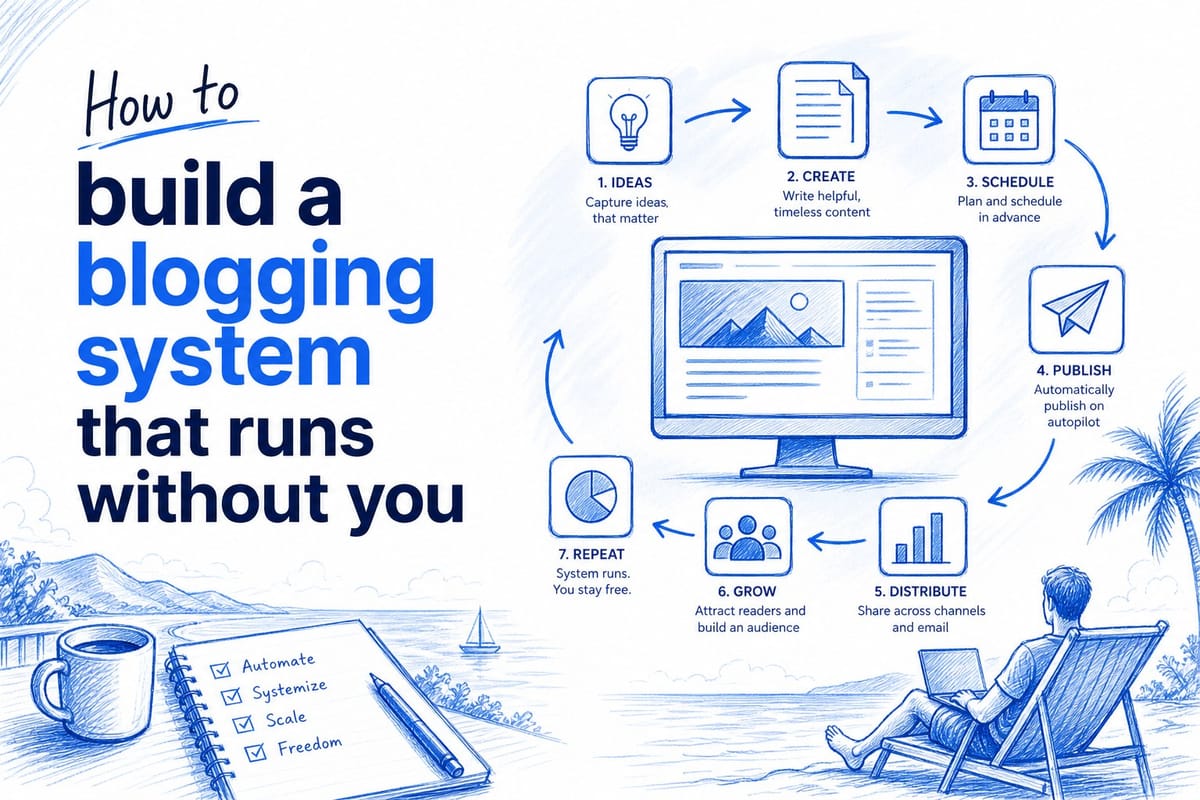
Table of contents
1. Why most blogging efforts fall apart before they gain traction
2. How to build the actual workflow, step by step
3. What a fully automated content engine looks like in practice
I want to be honest about something most content advice skips over: writing a great blog post is not the hard part. The hard part is doing it again next week, and the week after that, and every week for the next two years without burning out or letting the calendar slip. Most bloggers and small business owners I talk to do not have a content problem. They have a consistency problem. They start strong, miss a few weeks when life gets busy, and then feel too far behind to restart. That cycle kills momentum and stalls organic growth before it ever gets a chance to build. Blogging system automation is the answer to that cycle, and in this article I am going to walk you through exactly how to build one that keeps publishing even when you are not at your desk. We will cover how to structure your strategy so you are not improvising every month, how to use AI tools and workflows to handle research, writing, and visuals without a full team, and how to connect everything to your CMS so articles actually go live on schedule. By the end, you will have a clear picture of what a self-running content engine looks like and the practical steps to build one for your own brand.
Why most blogging efforts fall apart before they gain traction
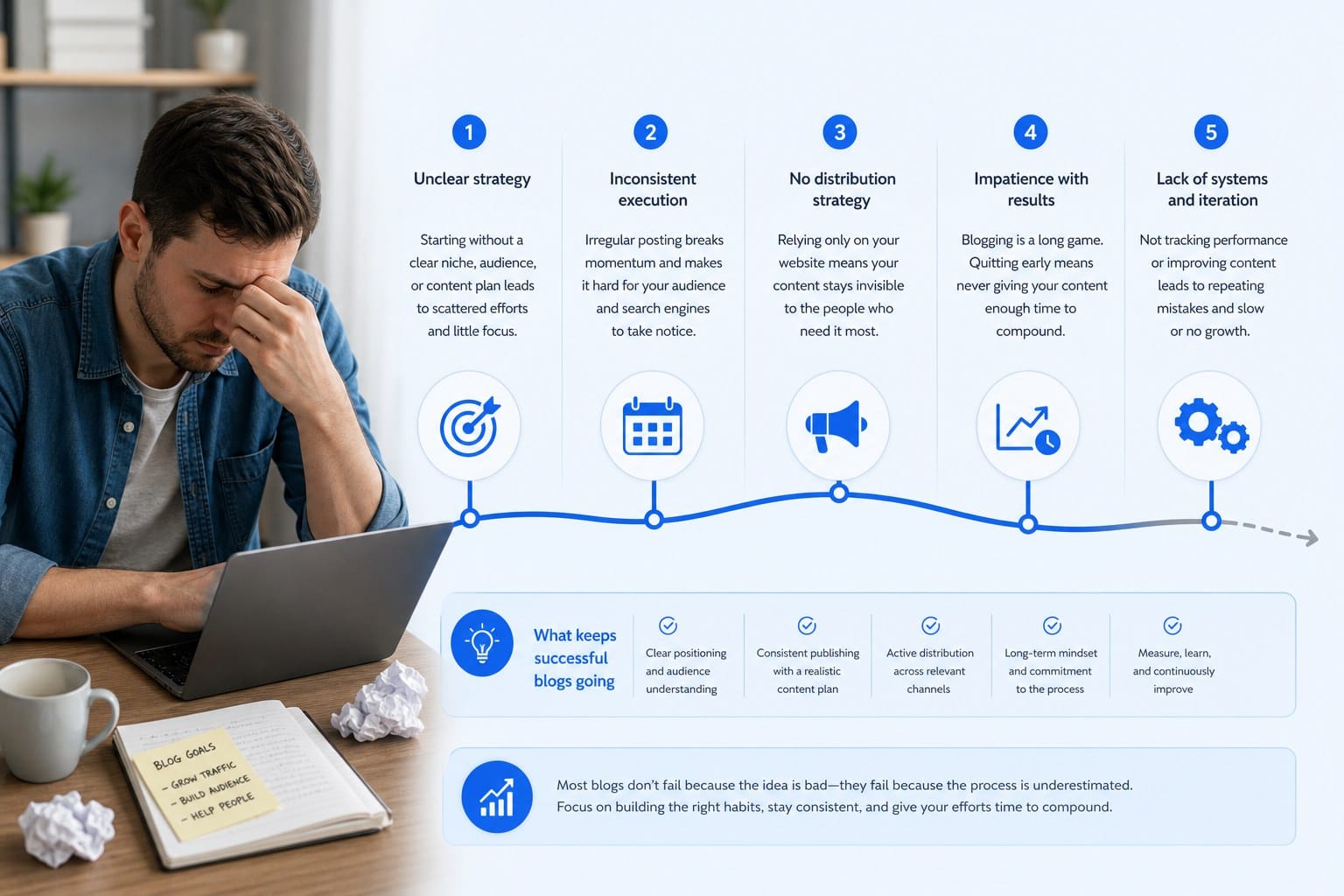
Let me paint a picture you might recognize. A founder or small business owner decides their brand needs a blog. They write three or four articles in the first month, feel good about it, and then a product launch or client deadline pulls their attention away. The blog sits untouched for six weeks. When they come back to it, starting again feels harder than it did the first time because now there is guilt attached to the silence.
This is not a motivation problem. It is a systems problem.
Search engines reward sites that publish consistently over time. A blog that puts out one article every week for a year will almost always outrank a blog that published thirty articles in one month and then went quiet. Google is looking for signals that a site is actively maintained and that there is ongoing expertise being added to it. Consistency is a ranking signal in that sense, even if it is not listed as a direct factor.
Beyond search, consistency builds trust with readers. When someone finds your blog through a search result and likes what they read, they might bookmark it or subscribe. If they check back and see that the last post was four months ago, they move on. That subscriber relationship never forms.
The other failure point is strategy drift. Without a plan that stretches at least thirty days into the future, most bloggers end up writing about whatever feels urgent or interesting that week. That produces an inconsistent mix of topics that does not build topical authority in any one area. Topical authority matters because it tells search engines that your site is a reliable source on a specific subject, which lifts rankings across your entire content library, not just on individual posts.
So the problem has three layers. There is the execution gap, where good intentions do not translate into published articles. There is the consistency gap, where publishing happens in bursts rather than on a reliable schedule. And there is the strategy gap, where individual posts do not connect into a coherent body of work that compounds over time.
A blogging system automation approach solves all three of these at once, but only if it is built correctly from the start. That means thinking about strategy before tools, and thinking about workflow before output.
Let me walk through what that looks like in practice.
The first thing to recognize is that you need a content calendar that exists independently of your mood or availability. This sounds obvious, but most people skip it. They treat their blog like a project they will get to when they have time, rather than a system that runs on a schedule whether or not they are engaged with it that day.
A real content calendar for a self-running system has articles planned out at least thirty days in advance. Each article has a target keyword, a working title, a rough outline of the angle, and a publish date. That level of structure means that when it is time to produce an article, the thinking work is already done. You are not starting from scratch; you are executing a plan.
Research is the second component that slows most bloggers down. Finding credible sources, checking what competitors have covered, identifying gaps in existing content, and then synthesizing all of that into something original takes hours. For a single article, that research phase can eat up as much time as the writing itself.
When I look at the brands that publish consistently at scale, they have almost always found a way to systematize that research step. Some do it by batching, where they spend one day per month doing research for all upcoming articles at once. Others use tools that pull in source material automatically based on the topic and keyword. The goal either way is to make sure research does not become a blocker that delays publishing.
Visuals are another overlooked bottleneck. Most blog articles need at least a cover image and often an in-article graphic or two. If you are sourcing stock photos manually or waiting on a designer, that creates delays. A content system that handles visuals automatically as part of the publishing workflow removes that friction entirely.
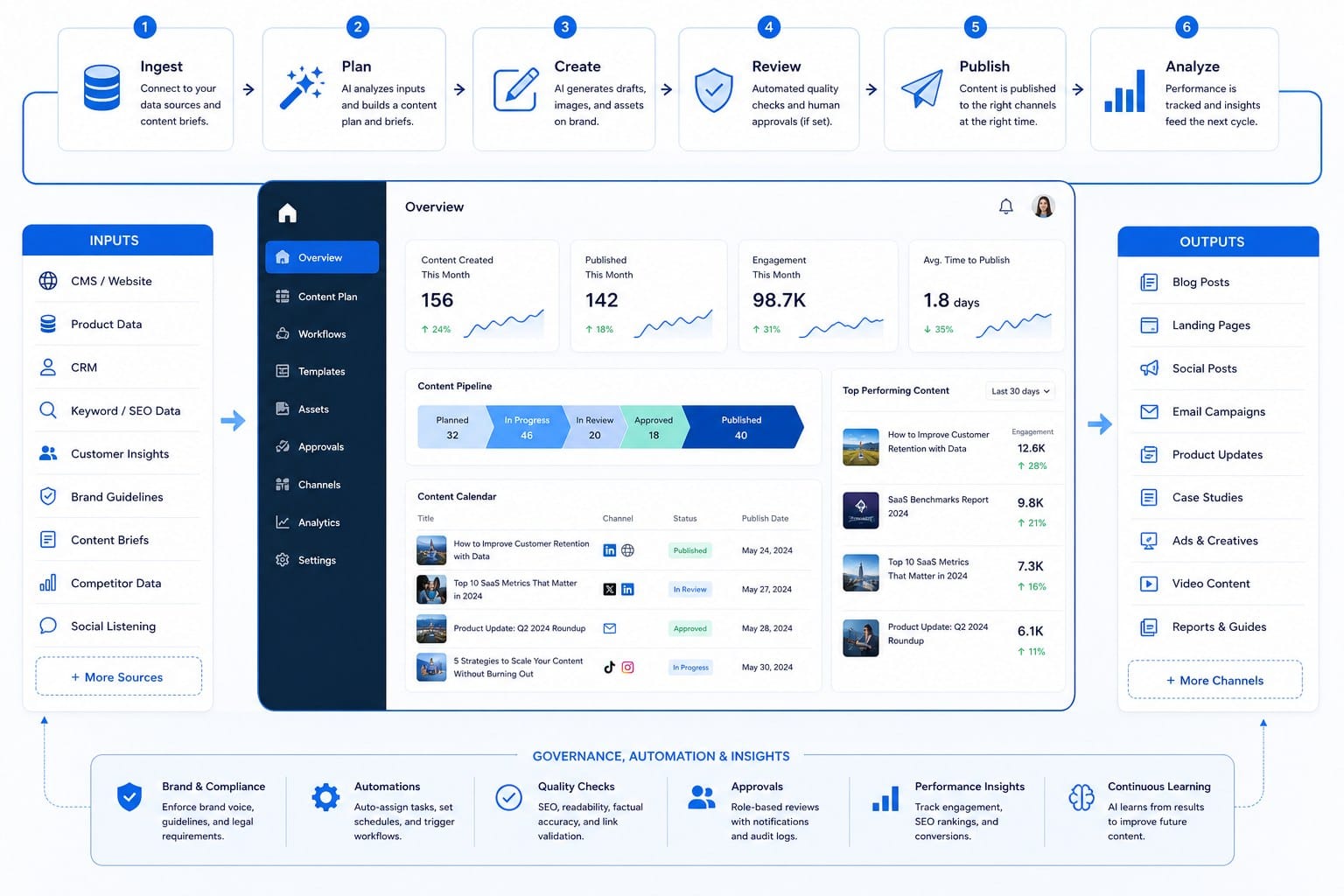
All of these pieces, strategy, research, writing, visuals, and publishing, need to connect into a single pipeline. When any one of them requires manual intervention every time, the system is fragile. The goal is to reduce the number of touch points where something can get dropped.
How to build the actual workflow, step by step
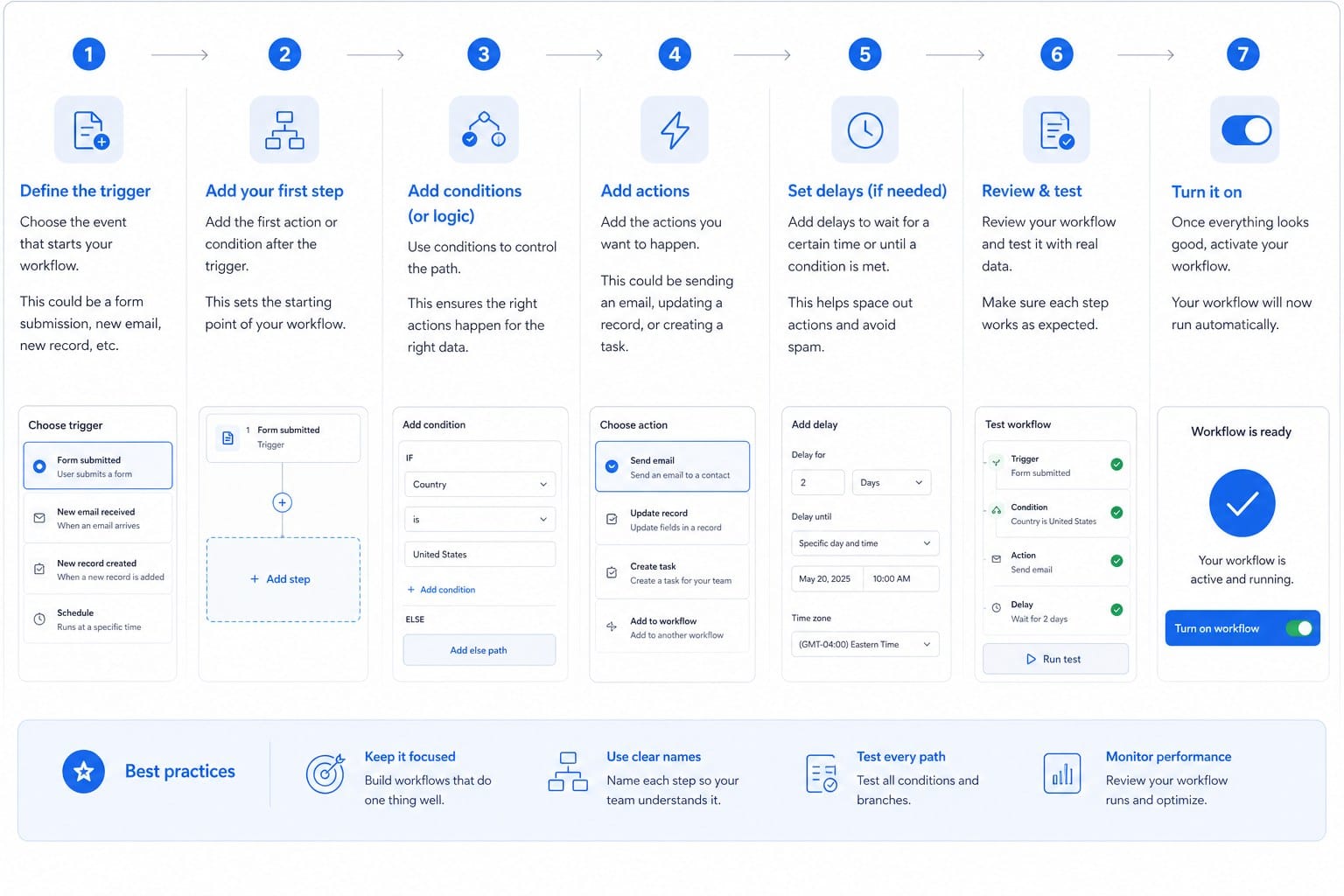
Building a blogging system that runs without you is not about finding one magic tool. It is about designing a workflow where each step feeds cleanly into the next. Let me walk through how to structure that.
Step one is keyword and topic planning. Before you write a single word, you need to know what topics your blog will cover and in what order. This is where blogging system automation starts delivering value because the planning itself can be systematized.
Start by defining your core topic cluster. If you run a project management SaaS, your core topic might be team productivity. From that core, you can branch out into subtopics like async communication, meeting reduction, task prioritization, and remote team management. Each subtopic becomes a content pillar, and each pillar generates multiple article ideas.
A thirty-day content strategy maps out which articles you will publish each week and how they connect to each other. Ideally, you publish a mix of informational articles that target question-based searches, comparison articles that target buyers who are evaluating options, and case study or example articles that show your expertise in action. That mix builds topical authority while also capturing traffic at different stages of the buyer journey.
Once your topics are mapped, you assign a primary keyword to each article. The keyword should have enough search volume to be worth targeting but specific enough that you can actually rank for it. Tools like Google Search Console, Ahrefs, and Semrush can help with this research step. If you want a broader look at how to evaluate the SEO side of your content operation, this piece on SEO tools like WooRank and what to use instead is a useful reference for understanding what to look for without getting lost in feature bloat.
Step two is content production. This is where most people spend the majority of their time, and it is also where AI tools have made the biggest difference in recent years.
I want to be specific about what good AI-assisted content production actually looks like, because there is a lot of low-quality output being passed off as AI content right now. An article that is simply dumped from a prompt into a CMS without editing or fact-checking is obvious to readers and increasingly visible to search engines. That approach does not build authority; it dilutes it.
What works is using AI to accelerate the parts of writing that are slow and labor-intensive, while keeping human judgment in the loop for the parts that require nuance. Research synthesis is a good example. Pulling together ten sources on a topic and identifying the key points takes a skilled human a long time. AI can do that part quickly, and then a human editor can review the synthesis for accuracy and add original perspective. The output is faster to produce without sacrificing quality.
Long-form articles are particularly well-suited to this kind of AI-assisted workflow. A 2,000-word article that is well-researched, properly structured, and targeted to a specific keyword takes most writers four to six hours from blank page to publish-ready draft. With a good AI content workflow, that same article can be in draft form in under an hour, leaving time for a human pass that catches any errors and adds the brand voice that makes it feel original.
When you are evaluating AI tools for your content workflow, pay attention to whether the tool is doing surface-level text generation or genuine research. Surface-level tools pull from patterns in their training data and produce plausible-sounding text that may or may not be accurate. Research-based tools pull in current source material and synthesize from it, which produces more reliable output and reduces the risk of factual errors. This checklist on how to evaluate AI blog tools: a checklist for founders and marketers is a practical guide for working through that evaluation.
Step three is visual production. Every article needs a cover image at minimum, and a brand-consistent one at that. If you are running a manual workflow, this means going to a stock photo site, finding something that fits, downloading it, resizing it, and uploading it. That step takes maybe fifteen minutes per article, which does not sound like much until you are publishing twice a week and suddenly you are spending two hours a month on cover images alone.
An automated system handles this either by generating on-brand visuals using AI image tools or by pulling from a curated library of approved visual assets. The key is that the visual is produced and attached to the article without requiring a manual step from the writer or editor.
Step four is publishing. This is where a lot of content systems break down because the connection between where content is drafted and where it actually lives on your site requires manual steps. Someone has to copy the text into the CMS, format it correctly, add the meta description, set the featured image, and schedule the publish date. That is not hard work, but it is tedious, and it is one more step where something can be forgotten or delayed.
Automated publishing integrations solve this. If your CMS is Ghost, for example, the Ghost API allows external tools to push fully formatted articles directly into the platform, complete with metadata, featured images, and scheduled publish dates. The article goes from draft to scheduled without anyone opening the Ghost editor. That is a meaningful reduction in manual effort, especially if you are publishing multiple times per week.
I have written more about how this specific workflow functions in practice over at How Ghost blog automation keeps your content publishing on autopilot, which covers the technical side of connecting an automated content pipeline to Ghost without needing developer support.
Step five is quality control. A fully automated system still needs a feedback loop. You need to know which articles are driving traffic, which ones are ranking, and which ones are not performing so you can adjust your strategy going forward. Most CMS platforms have basic analytics, and connecting them to Google Search Console gives you keyword-level performance data. Set aside thirty minutes each month to review what is working and use that to inform the next month's content plan.
The key principle across all five steps is that the system should require your input at the planning level, not at the execution level. You decide the strategy. The system handles the execution.
What a fully automated content engine looks like in practice
Let me make this concrete with a realistic example. Imagine you run a small SaaS product that helps freelancers manage client invoices. You have a blog, but it has been inconsistent for the past year because you are the only one writing it and you are also doing sales, support, and product development.
Here is what a self-running content engine looks like for that business.
At the start of each month, you or your content tool generates a thirty-day content plan based on your core topic cluster. For an invoicing SaaS, that cluster might include articles on freelance finances, client payment terms, how to handle late payments, tax prep for freelancers, and pricing strategies. Each article is assigned a keyword, a working title, and a publish date.
The content tool then produces a fully researched draft for each article. This is not a five-hundred-word summary; it is a complete, long-form article of 1,500 to 2,500 words that covers the topic in depth. The draft includes a clear structure with subheadings, internal linking suggestions, a meta description, and a suggested cover image.
You or a part-time editor reviews the drafts. This review might take thirty minutes per article, which is a fraction of the time it would take to write from scratch. You check for accuracy, add any specific brand voice or product references that need to be there, and approve it.
The approved article is then automatically published to your Ghost site on the scheduled date, with the cover image attached and the meta description filled in. No one has to log into the CMS. No one has to remember to hit publish.
At the end of the month, you spend thirty minutes reviewing performance data. You note that the article on handling late payment emails ranked faster than expected and generated three email sign-ups. You add that to your notes for next month's planning session.
Over the course of a year, this system produces somewhere between fifty and one hundred articles, all targeted to keywords your ideal customers are searching for. That content library compounds. Older articles accumulate backlinks and authority. New articles fill in gaps. Your site becomes a reliable resource for freelancers thinking about their finances, and a portion of that audience finds your invoicing product.
This is not a hypothetical. This is how content-driven SaaS companies grow organic traffic without massive content teams. The difference between the ones that succeed and the ones that stall is usually the presence or absence of a system.
Now let me address the most common objection I hear, which is that automated content will sound generic. This concern is understandable because a lot of early AI content did sound generic. But the quality gap has closed significantly, and the remaining gap is mostly a workflow design problem rather than a tool limitation.
Generic content comes from generic inputs. If you give an AI tool a keyword and nothing else, you will get a generic article. But if you give it your brand voice guidelines, your target audience profile, your product differentiators, and your existing content to match the tone of, the output is much closer to what a human writer would produce with the same brief. The tool is only as good as the instructions it receives.
This is why the strategy layer of a blogging system matters so much. A well-designed content strategy tells the system not just what to write but how to write it, who it is for, and what it should accomplish. That context shapes the output in ways that generic prompts simply cannot.
Another thing worth addressing is the question of expertise. Some topics require genuine subject matter expertise that an AI tool cannot fabricate. A medical blog or a legal blog, for example, needs to reflect real professional knowledge. In those cases, the system still works, but the review step carries more weight. The AI handles the structure and the research synthesis; the expert reviews and edits for accuracy and adds the judgment calls that require real experience.
For most small business blogs and SaaS content programs, the topic range is well within what a research-based AI content tool can handle reliably. Productivity tools, marketing software, financial services, e-commerce, real estate, health and wellness products, professional services: these categories all have enough publicly available information that a well-designed content tool can produce accurate, useful articles with a light editorial pass.
The other practical reality is that building this kind of system in-house is genuinely difficult. You need content strategy expertise, AI prompt engineering, CMS integration knowledge, and someone to maintain it all. For a team that is already stretched thin, that is not a realistic option. This is why purpose-built tools that bundle strategy, content production, visuals, and CMS publishing into a single workflow are genuinely useful, not just convenient. They compress weeks of setup into a workflow that is ready to run.
If you are evaluating whether to build your own workflow or use a dedicated platform, the honest question to ask is whether the time you would spend building and maintaining a custom system is worth more or less than the time a ready-built system saves you. For most small teams, the math strongly favors using a platform that has already solved the integration and quality problems.
What I want you to take away from this is a clear mental model: a blogging system automation approach is not about replacing human creativity. It is about removing the friction and repetition that prevents good ideas from ever becoming published content. The creativity still comes from you. The system just makes sure it actually gets out into the world on a consistent schedule.
Consistency is what builds search rankings over time. Consistency is what builds audience trust. And consistency is almost impossible to maintain manually when you are also running a business, managing clients, or building a product. The system is what makes consistency achievable without burning out or hiring a full content team.
Building that system does not have to take months. With the right workflow and tools, you can have a thirty-day content plan, a production pipeline, and an automated publishing connection set up in a matter of days. The key is starting with strategy, designing the workflow before you pick the tools, and making sure every step connects to the next without manual handoffs.
Ready to take the next step?
If you want to see what a self-running content engine looks like for your specific business, Blogtude is built exactly for this. It generates your thirty-day content strategy, produces deeply researched long-form articles with on-brand visuals, and publishes directly to Ghost and other CMS platforms on your schedule. You do not need a team. You do not need to carve out hours every week. You just need a system that works. Visit Blogtude to see how it works and get your content pipeline running.


