
How to write a content brief that actually gets results

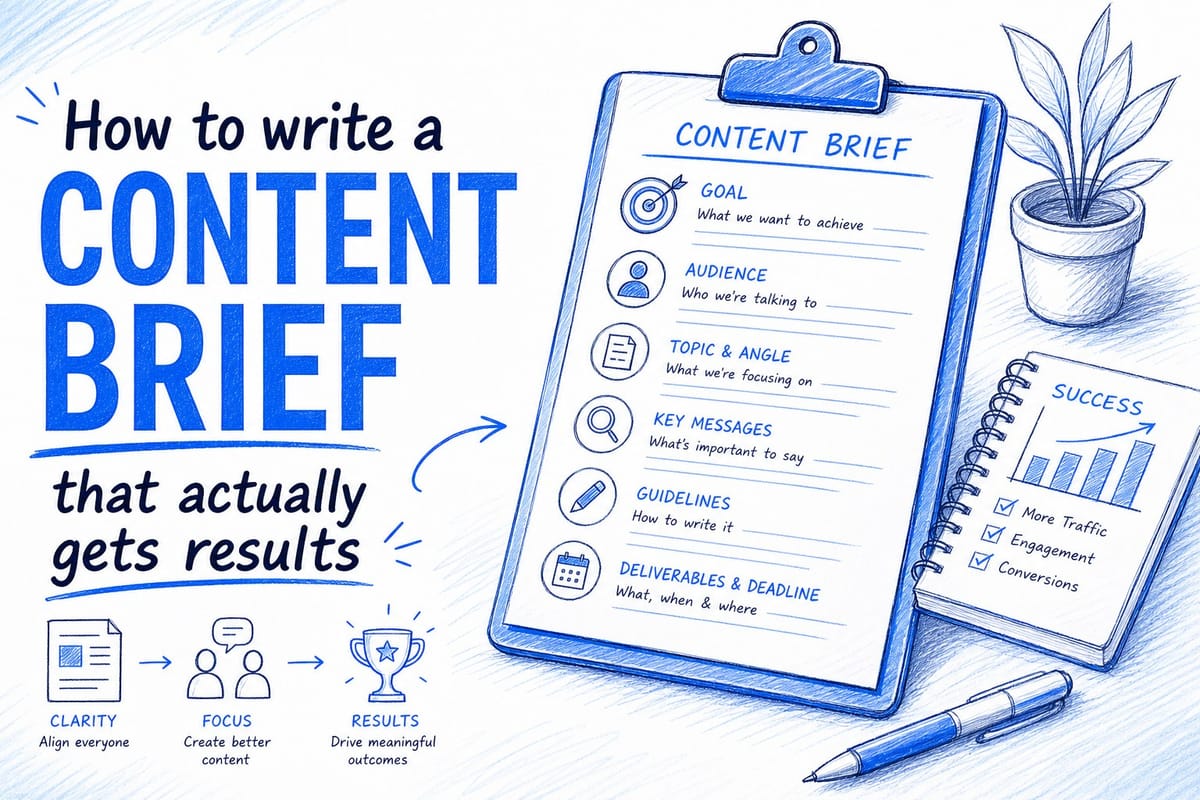
Table of contents
1. Why content briefs fail and what a good one actually contains
2. How to build your brief from research, not from assumptions
3. Turning your brief into a repeatable system that scales
I have watched a lot of content projects fall apart before a single word got written. The writer goes in one direction. The editor pulls it another way. The final piece misses the keyword, buries the main point, and somehow manages to be 1,800 words of nothing useful. Nine times out of ten, the problem is not the writer. It is the absence of a clear content brief.
A content brief is a short document that tells your writer exactly what to create, who it is for, what goal it serves, and how success gets measured. When it is built well, it removes guesswork and keeps everyone aligned from the first draft to publication. When it is built poorly, or skipped entirely, you end up rewriting articles from scratch, running extra revision rounds, and publishing content that quietly underperforms.
Knowing how to write a content brief that actually gets results is one of the highest-leverage skills in content marketing. It is not glamorous. It does not get talked about as much as headline formulas or link-building tactics. But it is the foundation everything else rests on. This guide walks through the full process, step by step, so you can build briefs that your writers love to use and your audience actually responds to.
Why content briefs fail and what a good one actually contains
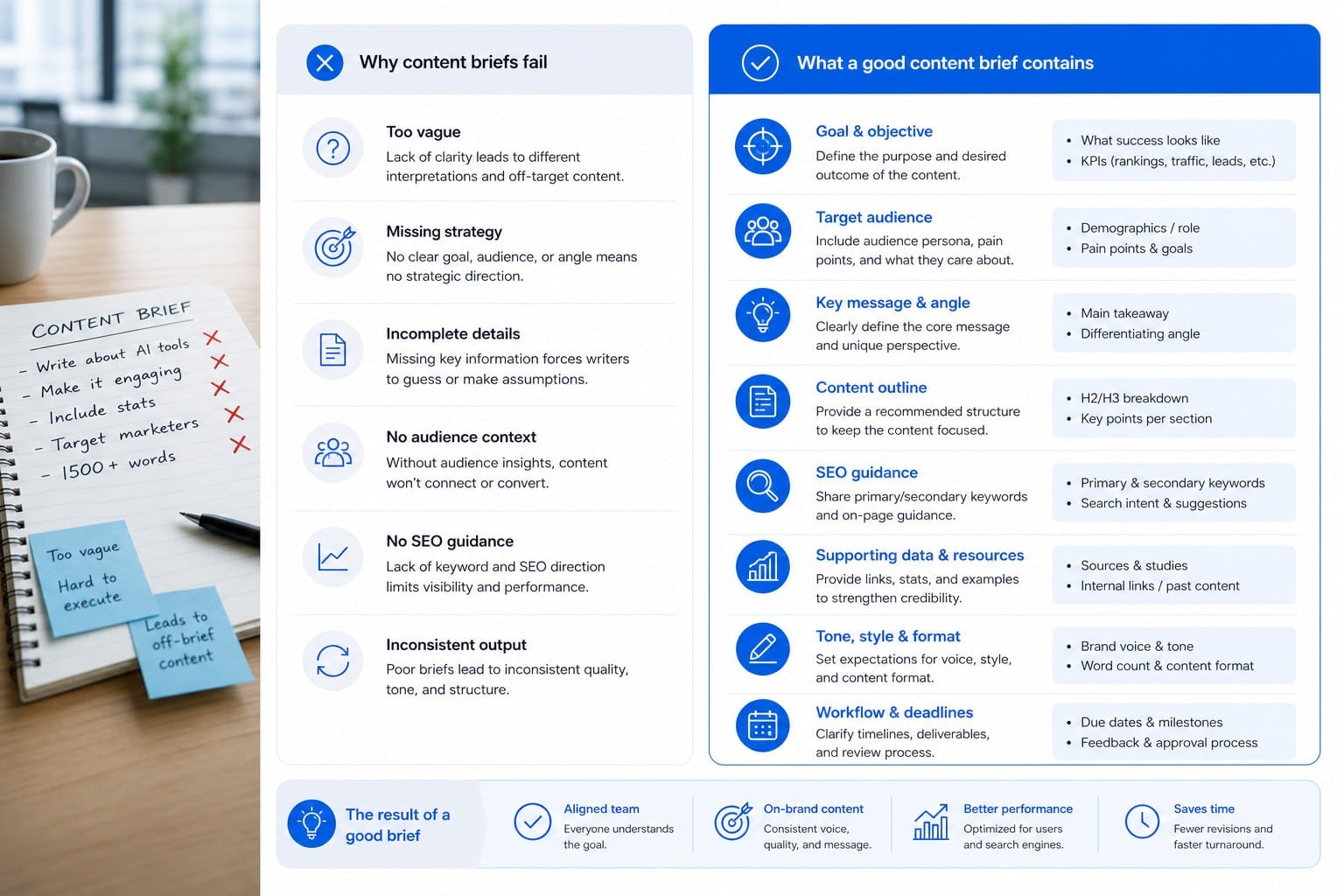
Most content briefs fail for one of three reasons. They are too vague to be useful, too long to be read, or they focus on what the writer should say without explaining why the piece exists in the first place. I have seen briefs that were nothing more than a keyword and a word count. I have also seen 12-page documents so packed with competing instructions that writers had no idea where to start. Neither extreme helps.
A strong content brief sits in the middle. It gives a writer every piece of context they need to produce a focused, well-structured article, and it stops there. Here is what every effective brief should include.
A clear working title and the target keyword
Start with a working title. It does not need to be the final headline, but it should capture the angle of the piece clearly. Underneath that, list the primary keyword the article is targeting. Just one. Secondary keywords can be listed as supporting terms, but the writer should never have to wonder what the article is really about.
For example, if I am writing a piece aimed at startup founders who want to build a blog strategy, my working title might be something like "A 30-day blog strategy for early-stage SaaS teams" and my primary keyword might be "blog strategy for startups." That alone orients the writer before they read another word of the brief.
A one-paragraph summary of the article
Write two to four sentences explaining what the article covers, what question it answers, and what the reader should be able to do or understand by the end. This summary does more than explain the content. It forces you, as the brief writer, to clarify your own thinking before handing the work off to someone else.
If you cannot summarize the article in a short paragraph, the brief is not ready yet.
The target audience
Describe who is reading this piece. Be specific. "Marketers" is not useful. "Digital marketers at B2B SaaS companies who are managing a brand blog without a dedicated editorial team" is useful. The more clearly you define the reader, the more clearly the writer can speak to that reader's actual situation, language, and concerns.
Audience clarity also affects tone. An article aimed at independent bloggers reads differently than one aimed at SaaS founders, even if the topic is the same.
The search intent
Search intent describes what someone actually wants when they type a query into Google. There are four broad types: informational (they want to learn something), navigational (they are looking for a specific site), commercial (they are comparing options), and transactional (they are ready to buy or sign up).
For most blog content, you are dealing with informational or commercial intent. Your brief should state which one applies and explain the implication. An informational piece should educate without pushing a sale. A commercial piece can make comparisons and mention specific solutions more directly.
This single detail shapes the entire structure of the article.
Recommended structure or outline
Provide a suggested outline. It does not need to be exhaustive, but it should map the main sections the article needs to cover. If there are specific questions the article must answer, list them. If there are sections the article should not cover because they are out of scope or handled in another post, say so.
A good outline does two things. It saves the writer time they would otherwise spend deciding how to organize the piece. And it ensures the content covers what you actually need it to cover, not just what the writer finds most interesting.
Word count range
Give a range, not an exact number. If the topic is narrow and specific, a shorter article of 800 to 1,200 words might be appropriate. If the topic is broad and competitive, you might need 2,000 to 3,500 words to cover it properly. The word count should be driven by what the topic actually requires, not by an arbitrary standard.
Internal and external linking notes
List any internal articles the piece should link to. This is important for SEO and for keeping readers engaged across your site. If there are high-authority external sources worth citing, list those too. Do not leave the writer to make all these decisions independently. Strategic linking is part of your content plan, and the brief is where that plan gets communicated.
The call to action
Every piece of content should have a clear next step for the reader. What do you want them to do after reading? Sign up for a trial, read another article, subscribe to a newsletter, book a demo? State this in the brief so the writer knows how to close the piece.
This is especially important when you are publishing content to grow organic traffic. A reader who finishes an article and clicks away without taking any action is a missed opportunity. The call to action turns a passive reading experience into a conversion moment.
How to build your brief from research, not from assumptions
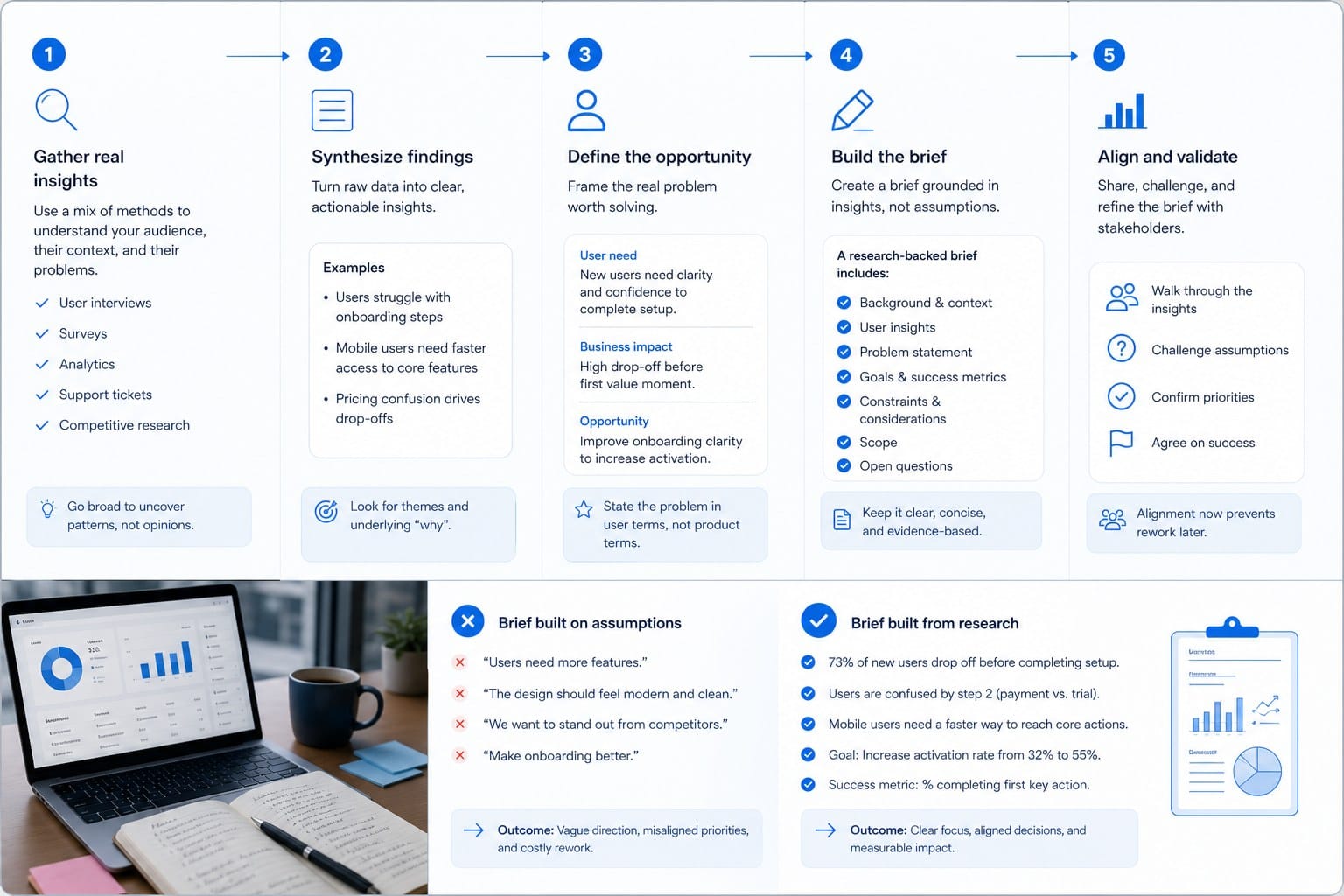
The difference between a brief that gets results and one that does not usually comes down to research. A lot of briefs are built on assumptions. The writer assumes they know what the reader wants. The strategist assumes the topic is underserved. The founder assumes the keyword is the right one to target. When those assumptions are wrong, the whole piece misses.
Building your brief from actual research does not have to take hours. But it does require a few deliberate steps before you start filling in the template.
Start with the search results, not your instincts
Before you write a single line of your brief, search for the target keyword yourself. Look at the top five to ten organic results. Ask yourself: what format do most of these articles use? Are they listicles, how-to guides, comparison posts, opinion pieces? The format that dominates the results page is usually a strong signal about what search intent looks like for that query.
Also look at the depth of the existing content. Are the top-ranking articles shallow and generic? That is an opportunity to go deeper and earn rankings by being more comprehensive. Are they already detailed and well-sourced? Then your brief needs to plan for a piece that either finds a different angle or covers a specific subtopic better than anyone else has.
Check the People Also Ask section
Google's People Also Ask box shows you the specific questions real users are asking around your target keyword. These questions are research gold. Add the most relevant ones to your brief as sub-questions the article should address. This helps the article naturally target related long-tail searches without forcing awkward keyword insertions.
For a brief on how to write a content brief, People Also Ask might surface questions like "what should be included in a content brief" or "how long should a content brief be." Both of those are worth addressing in the article itself.
Look at what competitors are missing
Read the top-ranking articles with a critical eye. What did they skip? What did they explain poorly? What questions did they raise but never actually answer? The gaps in existing content are where you can add the most value. Your brief should explicitly call out those gaps and instruct the writer to fill them.
This approach is also part of a broader SEO strategy focused on topical depth rather than keyword volume alone. If you want to understand that strategy more, the article on why topical depth is the smarter SEO strategy for growing brands goes into this in detail.
Define the unique angle before writing the outline
Every brief should include a single sentence that describes the unique angle of the piece. This is sometimes called the content hook or the editorial thesis. It answers the question: why does this article exist when other articles on this topic already exist?
Maybe your angle is a specific audience perspective that other articles ignore. Maybe you are going to challenge a widely held assumption. Maybe you are going to use real data or a specific case study that adds something the generic posts do not have. Define that angle clearly in the brief, and the writer will use it to make every section sharper.
Match the tone to the audience and the platform
Tone is often the last thing that goes into a brief and the first thing that causes problems when it is wrong. If your brand voice is conversational and direct, say so. If your audience is technical and prefers precision over warmth, say that. If the article lives on a founder's personal blog and should sound like a real person wrote it, spell that out.
Tone guidance does not need to be long. A sentence or two is enough. But without it, you are leaving the writer to guess, and guesses about tone are often wrong.
Collect your source material ahead of time
If you want the article to cite specific research, include links to that research in the brief. Do not expect the writer to find the same sources you found. If a particular statistic or study is important to the argument, include it. This saves revision time and ensures the article makes the claims you actually want it to make.
For teams or individuals publishing a high volume of content, this research step is often where the process breaks down. It takes time, and when you are trying to publish consistently, research can become the bottleneck. This is one reason why more brands are moving toward AI-assisted workflows. Tools that handle the research and brief-generation layer can compress the time between ideation and publication significantly. The article on how founders are using AI to publish 4x more blog content is worth reading if that challenge sounds familiar.
Turning your brief into a repeatable system that scales
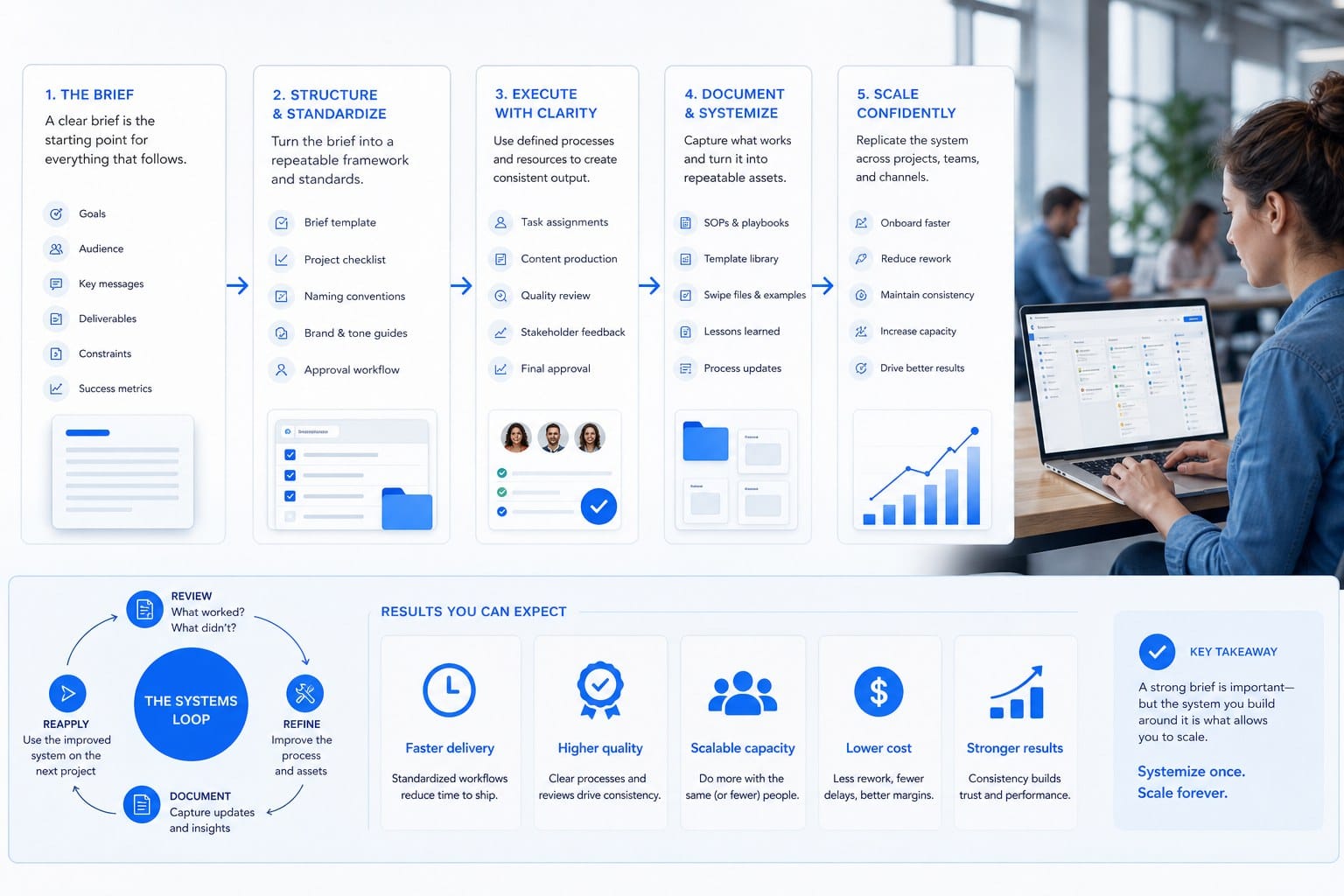
A single well-written content brief is useful. A repeatable system for producing content briefs consistently is where real scaling happens. If every piece of content you publish starts with a strong brief, your entire content operation gets more efficient: fewer revision cycles, faster approvals, more predictable output quality.
Here is how to build that system, whether you are a solo creator, a small team, or a growing brand trying to compete on organic search.
Create a brief template you actually use
The fastest way to make briefs part of your workflow is to build a template and keep it somewhere accessible. A shared Google Doc, a Notion page, an Airtable form, whatever fits your existing workflow. The template should include all the sections I described earlier: working title, keyword, article summary, audience, search intent, outline, word count, linking notes, tone guidance, and call to action.
Each time you start a new article, duplicate the template and fill it in. Over time, filling in the template gets faster because the thinking becomes habitual. You start instinctively asking the right questions before you begin any piece.
Build a brief review step into your content calendar
Do not skip the brief review. Before any brief goes to a writer, read it back with one question in mind: if I were a writer seeing this topic for the first time, would this document give me everything I need to write a great article without asking follow-up questions?
If the answer is no, identify exactly what is missing and add it. This step takes five minutes and eliminates most revision problems before they start.
Use briefs to manage a content calendar, not just individual articles
Content briefs are most powerful when they are part of a larger content strategy rather than isolated documents. When your briefs connect to a content calendar that maps topics to business goals, seasonal events, and SEO clusters, each individual piece does more work.
For example, if you are building topical authority in a specific category, your content calendar might include five to eight articles that all cover different aspects of that topic. Each brief should reference the broader cluster so the writer understands how this article fits into the bigger picture. That context changes how they frame transitions, what they cross-link to, and how they close the piece.
Audit your briefs when articles underperform
When an article does not rank, does not generate traffic, or gets poor engagement, look at the brief before you look at the writer. Was the keyword actually achievable given your domain authority? Was the search intent misread? Was the outline too shallow? Was the audience definition too broad?
Using briefs as part of your performance audit creates a feedback loop that makes your whole process smarter over time. You start to see patterns. Maybe your briefs consistently skip tone guidance and the result is articles that feel off-brand. Maybe your outlines are too rigid and the articles feel mechanical. Every pattern is fixable once you can see it.
Adapt your brief depth to the content type
Not every piece of content needs the same level of brief detail. A short news-style update might only need a few lines. A long-form pillar article covering a competitive keyword might need a full-page brief with a detailed outline, specific data sources, and explicit notes on angle and positioning.
Knowing when to go deep and when to keep it short is part of building an efficient system. The mistake most content operations make is applying the same brief format to every content type, which means either under-briefing complex pieces or over-briefing simple ones. Let the content type and competitive context guide how much detail the brief needs.
Brief quality compounds over time
Here is something I have noticed over years of working with content teams and solo creators: brief quality compounds. When you invest in a strong brief, the resulting article is better. A better article ranks higher. Higher rankings bring more traffic. More traffic gives you data about what topics and formats your audience responds to. That data feeds back into better briefs.
The reverse is also true. Skipping briefs leads to inconsistent quality, which leads to poor performance, which creates pressure to publish more to compensate, which leads to more rushed work, which leads to more poor performance. The brief is where you break that cycle.
When automation helps and when it does not
There is a growing category of tools that generate content briefs automatically, pulling keyword data, analyzing competitors, and suggesting outlines with minimal manual input. For brands publishing at high volume, these tools can be a genuine time-saver at the brief-generation layer.
But automation works best when it handles the research and structure steps, not the strategic thinking. You still need a human deciding what angle to take, what audience to write for, and how this piece fits into the larger content plan. A tool that generates a generic outline based on keyword data alone is not doing the real work of a content brief.
If you are exploring how AI fits into your content workflow, the question is always what stays human and what gets automated. Research, formatting, structural suggestions, and even drafting can all be accelerated with the right tools. Strategy, angle selection, and audience understanding stay with you.
For brands that want consistent, SEO-driven blog output without building a full content team, tools that handle the research-to-publication pipeline end to end, including brief generation, article production, and CMS publishing, are increasingly worth evaluating. If you are curious about what that kind of workflow looks like in practice, the comparison article on Rankyak alternative options that actually do more for less gives a useful breakdown.
Build the habit before you optimize the system
If you are just starting out with content briefs, do not try to build the perfect system on day one. Start with a simple template. Use it consistently for a month. See where it saves you time and where it creates friction. Then refine it.
The goal is not a perfect brief. The goal is a brief that reliably produces articles that serve your audience and support your SEO goals. Once that is happening consistently, you can layer in more sophisticated research steps, automation tools, and workflow integrations.
Content briefs are not the most exciting part of content marketing. But they are probably the most leveraged. Every hour you spend building a strong brief saves multiple hours downstream in revisions, rewrites, and redirections. That is a trade worth making every time.
Ready to take the next step?
If you are tired of content that takes too long to produce and underperforms after you publish it, Blogtude is built to fix that problem end to end. It generates a 30-day content strategy, produces deeply researched long-form articles, and publishes directly to Ghost and other CMS platforms automatically. You do not have to give up quality to scale your output. Visit blogtude.com to see how it works.


