
Surfer SEO alternatives for bloggers who want an all-in-one writing and publishing tool


Table of contents
1. Why bloggers outgrow Surfer SEO and what they need instead
2. The main categories of Surfer SEO alternatives and what each one solves
3. How to pick the right alternative for your actual workflow
If you have used Surfer SEO for any length of time, you already know what it does well. It scores your content against top-ranking pages, gives you a keyword density target, and tells you which headings to include. For a writer who is comfortable living inside a Google Doc and manually acting on every suggestion, that workflow makes sense. But a lot of bloggers and content teams have started asking a fair question: is Surfer actually solving the whole problem, or is it just one piece of a much bigger puzzle? The honest answer is that Surfer is an on-page optimization layer. It does not research your topic from scratch, it does not write the article for you, it does not source or generate visuals, and it definitely does not hit publish on your CMS. You still have to do most of the work yourself. That gap is exactly why so many people are searching for surfer seo alternatives right now. They want something that handles more of the content workflow end to end, not just the scoring step. In this article, I want to walk through what those alternatives look like, what categories they fall into, and how to figure out which one actually fits the way you work.
Why bloggers outgrow Surfer SEO and what they need instead
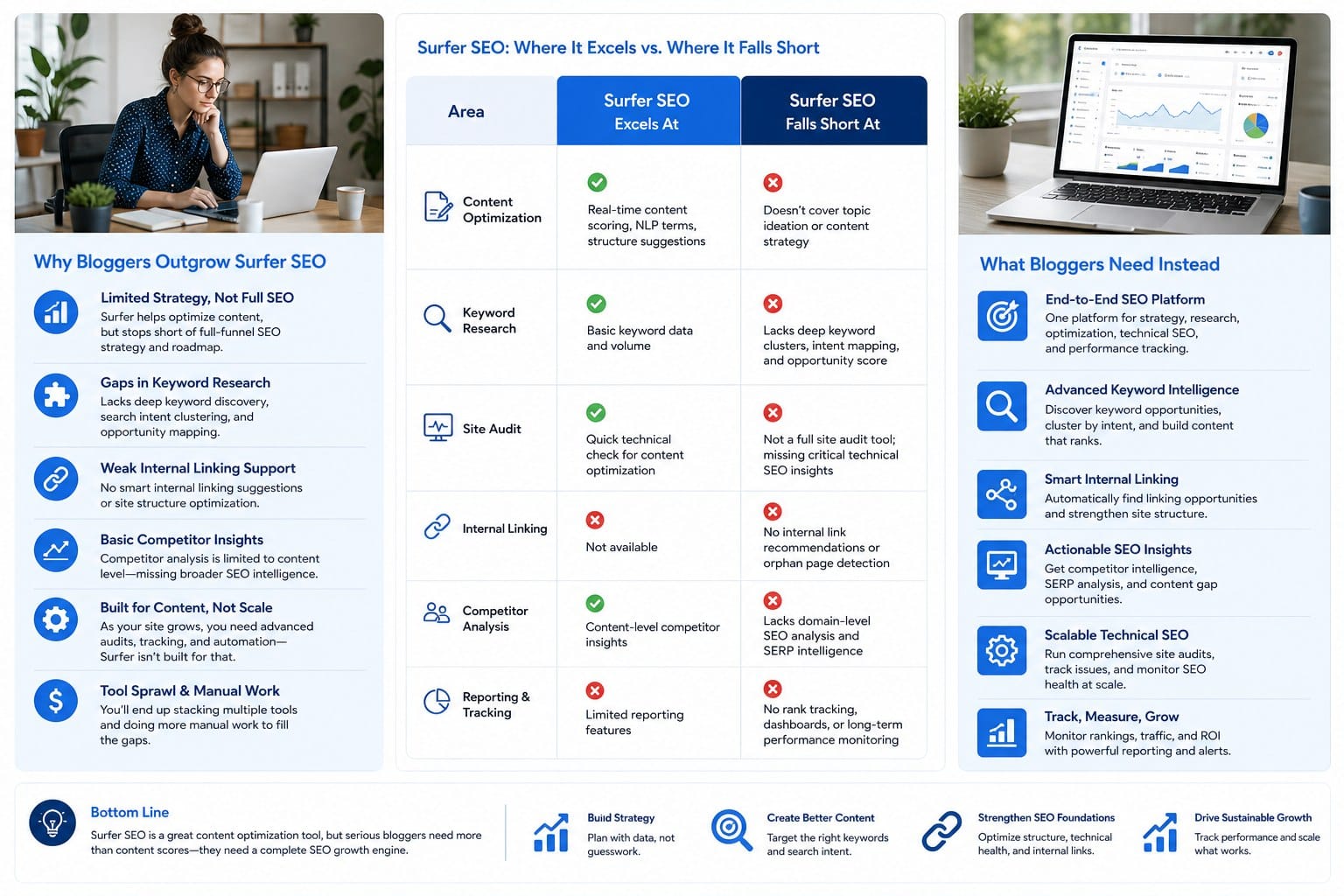
Surfer SEO was built for a specific job. You bring a finished or in-progress draft, you run it through the content editor, and you adjust your writing until the score improves. That is a useful thing to do if you already have a draft and you already know which keyword you are targeting. The problem is that most bloggers do not start their week with a polished draft waiting to be optimized. They start with a blank calendar, a vague sense of the topics they should cover, and a long list of other responsibilities competing for their attention.
That means before Surfer is even useful, you have already spent time doing keyword research, picking a topic, outlining the article, writing a full draft, and finding images or visuals to go with it. After Surfer, you still need to format the post, add internal links, write a meta description, and publish it to your CMS. Surfer sits in the middle of that chain and helps with one step. Everything before and after it is still manual.
For a solo blogger or a small team trying to publish consistently, that manual load adds up fast. Publishing one well-optimized post a week sounds reasonable until you map out all the steps involved and realize it takes the better part of a full work day per post. At two or three posts a week, that becomes a part-time job on its own.
This is the core reason people go looking for surfer seo alternatives. They are not necessarily unhappy with the optimization scoring itself. They are unhappy with how much surrounding work they still have to do. What they actually want is a tool that handles the research, the writing, the visuals, and the publishing, ideally with built-in SEO thinking throughout the whole process rather than bolted on at the end.
The tools that exist today fall into a few different categories. Some are writing assistants that add SEO suggestions on top of AI-generated text. Some are research tools that help you outline and brief your content before you write it. Some focus on automating the publishing workflow once the content is ready. And a smaller number try to do all of it together, from strategy through to published post. Understanding which category a tool belongs to is the most important thing to figure out before you commit to a subscription.
One thing worth saying plainly: if what you need is specifically the ability to score an existing draft against SERP competitors and get granular on-page optimization feedback, Surfer does that job well. No point in replacing a tool that is working for you. But if you are spending more time on the steps outside Surfer than you are inside it, that is a signal that your bottleneck is not optimization, it is the whole content operation.
For independent bloggers scaling their output without a team, SaaS founders who need consistent organic content, and small business owners without dedicated writers on staff, the problem is almost always the full workflow, not just the scoring step. The right alternative depends on which part of that workflow is slowing you down the most.
The main categories of Surfer SEO alternatives and what each one solves
When you start looking at surfer seo alternatives seriously, the market feels overwhelming. There are dozens of tools, and almost all of them have overlapping feature lists. The easiest way to cut through the noise is to group them by what problem they primarily solve and then ask yourself honestly which of those problems is your biggest constraint.
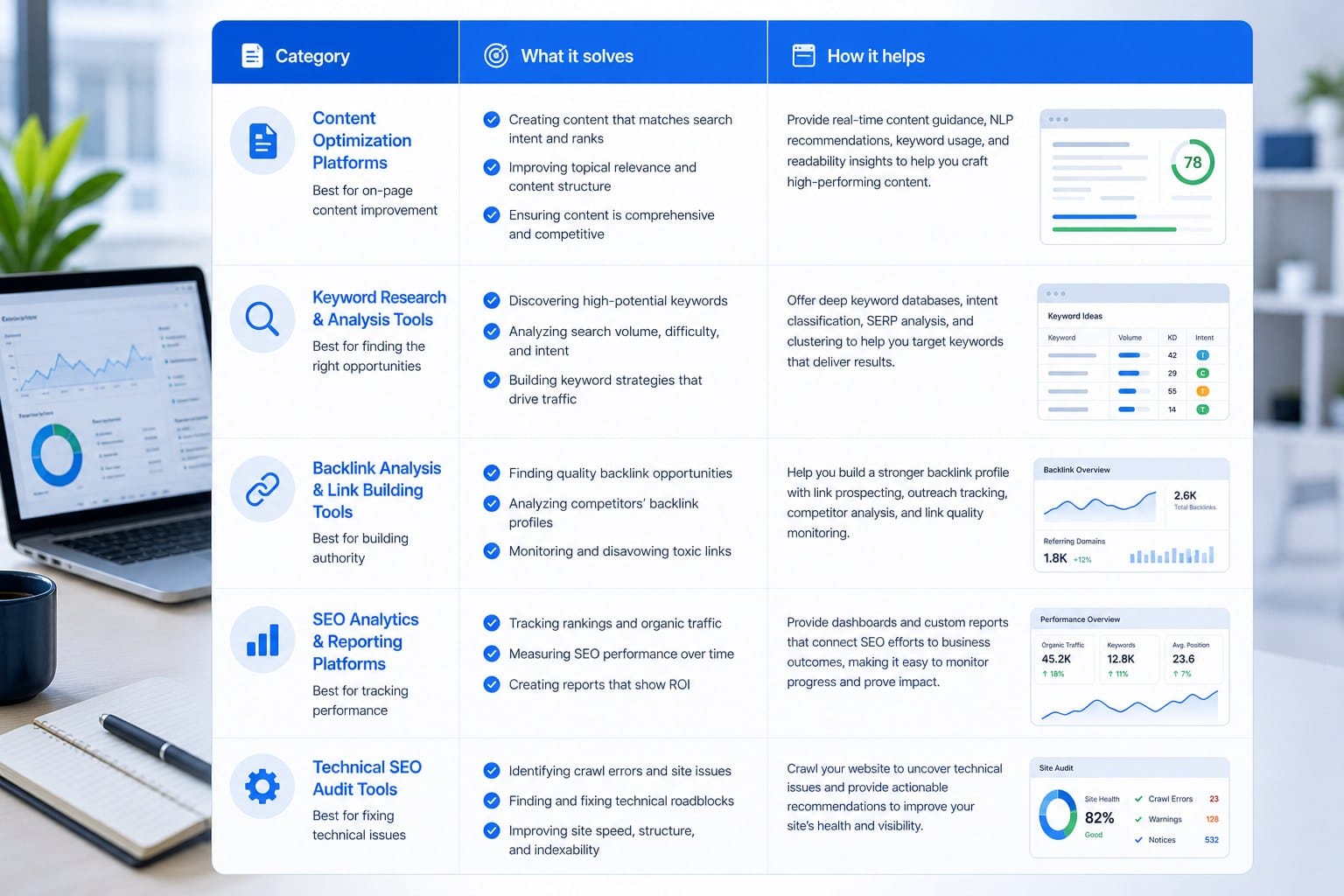
The first category is AI writing assistants with SEO features layered on top. These tools start with a text generation engine and add keyword guidance, heading suggestions, and sometimes a content score. The idea is that you can go from keyword to draft faster because the AI handles the actual writing. The limitation is that the SEO layer is usually fairly shallow. You get suggestions, but the tool is not deeply researching the competitive landscape for your specific keyword before it writes. The output often needs significant editing before it is ready to publish, and the tool still does not handle publishing for you. If you have looked at this space before, you have probably already explored tools in this category. For a comparison of what that landscape looks like beyond the most well-known names, the article on Copy.ai alternatives for full blog automation breaks down how those tools differ from each other and where they fall short for bloggers who need more than a writing assistant.
The second category is SEO research and briefing tools. These focus heavily on the pre-writing phase. They help you understand what a top-ranking article on a given topic looks like, what questions your article should answer, what headings are common, and what related terms you need to include. They are genuinely useful for writers who want to do their own writing but want better input going in. The gap here is that you still have to do the writing, and you still have to handle publishing. If your bottleneck is knowing what to write about, these tools help. If your bottleneck is actually producing and publishing the content, they do not move the needle much.
The third category is content workflow and automation tools. These sit closer to the publishing end of the chain. They help you schedule content, manage approvals, distribute posts to multiple channels, and sometimes connect to your CMS. They are most useful for teams that already have writers producing content and need a system to manage the flow. For a solo blogger or small brand, these tools often have more overhead than value because you do not have a team to coordinate.
The fourth category, and the one that is most relevant to this article, is all-in-one content engines. These tools try to handle the full workflow: generating a content strategy, researching and writing long-form posts, adding visuals, and publishing directly to your CMS. The pitch is that you can maintain consistent publishing output without manually touching every step. The tradeoff is that you give up some granular control over each individual post in exchange for speed and consistency across your whole content calendar.
This last category is where Blogtude sits. It is designed specifically for the scenario where the problem is not one step in the workflow but the whole chain. You get a 30-day content strategy, deeply researched long-form articles, on-brand visuals, and automatic publishing to Ghost and other CMS platforms. The goal is that a growing brand or a solo blogger can maintain consistent output without it consuming their entire week.
For people who have already worked through the AI writing assistant category and found it lacking, the article on Jasper AI alternatives for bloggers who want full autopilot publishing is worth reading. It covers why the gap between assisted writing and fully automated publishing matters and what tools are actually trying to close that gap.
The question of which category is right for you comes down to one practical test. Write out every step you take from deciding to publish a blog post to that post being live on your site with a meta description and an image. Count how many of those steps the tool you are considering actually handles. If it handles two steps in a ten-step process, it is not really changing your workflow in a meaningful way. If it handles eight of those ten steps, it probably is.
For Ghost CMS users specifically, the category question has an extra layer. Ghost has a clean publishing experience and a strong reputation for performance, but it does not have a native content planning or AI writing feature. That means Ghost users are almost always stitching together multiple tools: a keyword research tool, an AI writer, an image source, and then manual publishing. An alternative that integrates directly with Ghost and handles the steps before and after writing is genuinely solving a different problem than a standalone SEO scorer.
Digital marketers managing brand blogs face a similar issue. The content brief gets written somewhere, the article gets written somewhere else, images come from a third place, and then someone has to log into the CMS and put it all together. The workflow works, but it is fragile because it depends on every step happening on schedule. An automated content engine removes most of those dependencies.
It is also worth being honest about what all-in-one tools give up compared to Surfer's focused approach. If you are running a highly technical SEO campaign where you need to analyze a specific competitor's exact heading structure and match your content score precisely to their word count, a dedicated tool built purely for that job will give you more granular control. The tradeoff with an all-in-one approach is that the SEO thinking is baked into the content production process rather than surfaced as a separate scoring layer you interact with manually. For most bloggers and small brands, that baked-in approach is actually better because it reduces the number of decisions you have to make. But for very advanced SEO work, the tradeoff is real and worth knowing about.
How to pick the right alternative for your actual workflow
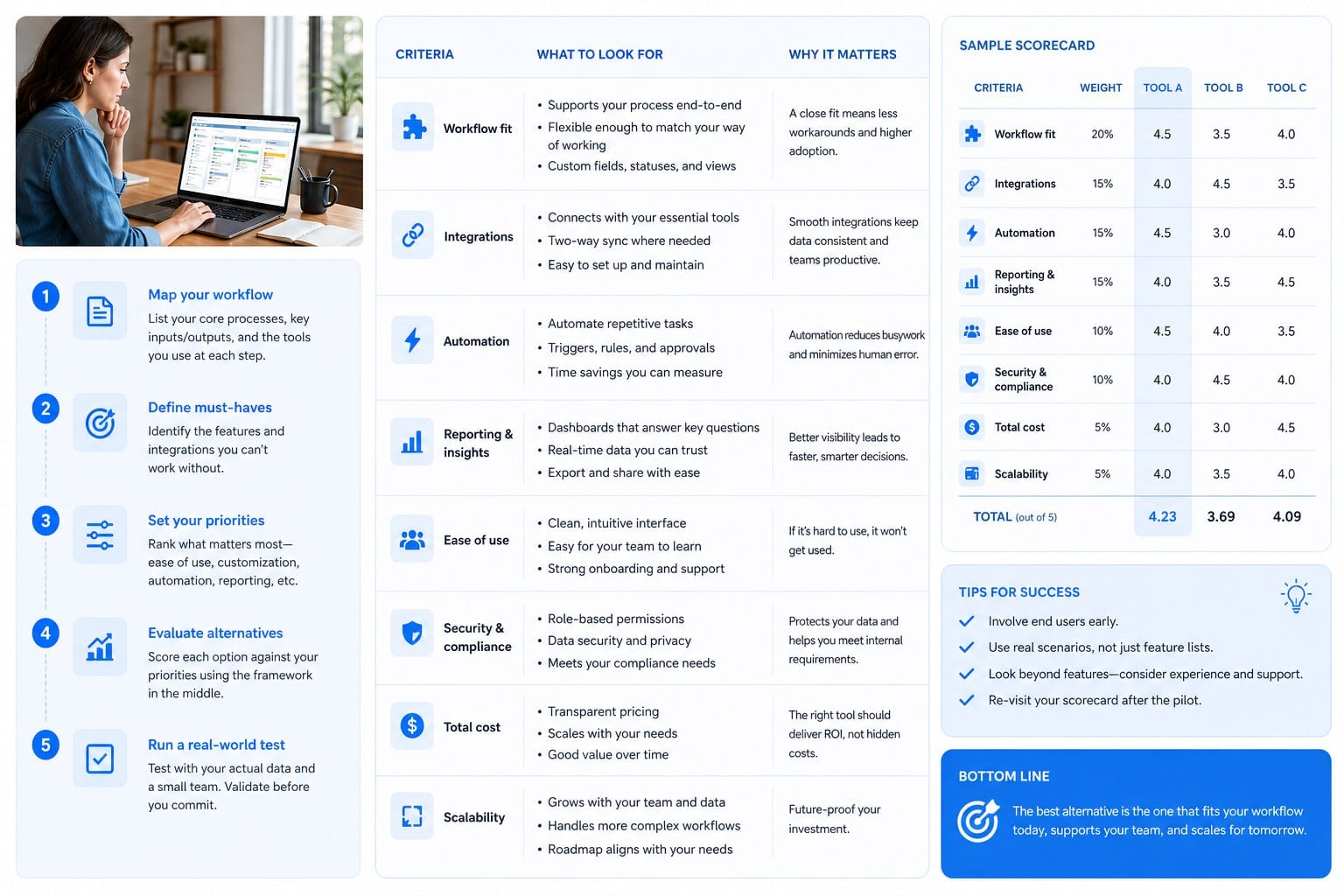
The mistake most people make when evaluating surfer seo alternatives is leading with features instead of leading with workflow. They look at a comparison chart and ask which tool has the most features, or which one is most highly rated, or which one is the cheapest per month. Those are all reasonable things to look at, but they come second. The first question is always: what does my content workflow actually look like right now, and which step is costing me the most time?
If you are a solo blogger who publishes once a week and your biggest frustration is that you spend two days per post and still feel like your content is not ranking, your problem might actually be two separate problems. One is production time. The other is SEO effectiveness. Those two problems do not always have the same solution. A tool that speeds up production but adds no SEO thinking will not fix your ranking problem. A tool that improves your SEO score but does not speed up production will not fix your time problem. What you actually need is something that handles both together.
If you are a SaaS founder or startup with no dedicated content person, the problem is usually more fundamental. The blog exists but nothing gets published because no one has time to research, write, edit, source images, and hit publish on a regular schedule. In that case, the right alternative is not a better SEO scorer. It is an automated publishing system that removes the manual overhead entirely and keeps the blog active without requiring someone to babysit the process every week.
Small business owners are often in a similar position. They know they should be blogging for SEO reasons, they have enough domain knowledge to have opinions about what should be on their blog, but they do not have the time or skill to execute it themselves at any kind of consistent pace. For this group, consistency matters more than perfection. A blog that publishes two solid posts a week every week for a year will almost always outperform a blog that publishes one exceptional post every few weeks whenever someone finds time to write it.
For digital marketers who manage brand blogs as part of a broader responsibility, the challenge is different again. The writing usually gets done, but the workflow is messy. Briefs live in one place, drafts in another, approvals somewhere else, and publishing is a manual step that gets delayed because someone is waiting on someone else. The right alternative for this group is usually something that centralizes the workflow and automates the handoff steps, so that content moves from brief to published post with less back-and-forth.
Once you have named your actual problem, the tool evaluation becomes much more straightforward. You are not comparing feature lists anymore. You are asking a direct question: does this tool solve the specific thing that is slowing me down?
Here are a few practical things to check when you are evaluating any alternative.
First, check whether the tool handles content strategy or just content production. There is a big difference between a tool that helps you write the article you already decided to write and a tool that helps you figure out what articles to write in the first place. For most bloggers, the content calendar planning step is one of the hardest parts because it requires keyword research, competitive analysis, and some judgment about what is worth writing. A tool that skips this step and just helps with drafting is solving a downstream problem while leaving the upstream problem untouched.
Second, check whether the tool produces content that is ready to publish or content that needs significant editing. Some AI writing tools produce a solid first draft that needs light editing and formatting. Others produce content that technically covers the topic but reads in a way that feels generic or misses the nuance your audience expects. The only way to know which category a tool falls into is to test it with a real topic from your niche and see whether the output actually sounds like something you would want to put your name on.
Third, check the CMS integration story. If the tool produces good content but does not connect to the platform you publish on, you have added a step to your workflow rather than removing one. For Ghost users, this is a particularly important check because not every tool supports Ghost natively. Having a tool that writes and then automatically publishes to Ghost is a genuinely different value proposition than a tool that produces a document you then have to copy and paste.
Fourth, think about how the tool handles visuals. Text is only part of a published blog post. Most posts need a featured image, sometimes diagrams or screenshots, and formatting choices that make the content readable on screen. If a tool handles writing but not visuals, you are still managing that step manually, and that step takes more time than most people budget for it.
Fifth, consider what the tool does about ongoing strategy versus one-off posts. If you need to publish consistently over months and years, a tool that helps you plan a 30-day content calendar is fundamentally more useful than a tool that is excellent at producing a single post. Consistency compounds over time in SEO. A content engine that keeps your publishing calendar full and on-strategy is worth more in the long run than a tool that makes any individual post slightly more optimized.
For people who have already spent time exploring tools in the writing assistant space and found that they still end up doing most of the work manually, the article on RightBlogger alternatives for brands that need more than a writing assistant is worth reading before you make a final decision. It covers the distinction between tools that assist your writing and tools that actually automate your content operation, which is a distinction that matters a lot once you have been through the trial-and-error phase.
The honest summary is this. Surfer SEO is a good tool for what it is: an on-page optimization scorer that helps you refine content that is already mostly written. If that is the step that is holding you back, it is a reasonable choice. But if the whole content production and publishing chain is what is slowing you down, then what you actually need is not a better optimizer. You need a system that handles the full chain, from figuring out what to write, to writing it well, to adding visuals, to publishing it on a schedule. That is a different kind of tool, and it solves a meaningfully different problem.
Blogtude is built for that second scenario. It is designed for bloggers, founders, marketers, and small business owners who need consistent content output without turning content production into a full-time job. The 30-day strategy layer means you are not starting from a blank calendar every month. The long-form article production means you are not staring at a blank document every week. The automatic publishing to Ghost and other platforms means the last mile is handled without manual copy-paste. If that description matches the workflow problem you are trying to solve, it is worth taking a closer look.
Ready to take the next step?
If you are ready to stop stitching together tools for every step of your content workflow, Blogtude is worth exploring. It handles strategy, research, writing, visuals, and publishing in one place so you can stay focused on running your business. Visit blogtude.com to see how it works and whether it fits the way you publish.


