
The real reason your blog is getting no organic traffic

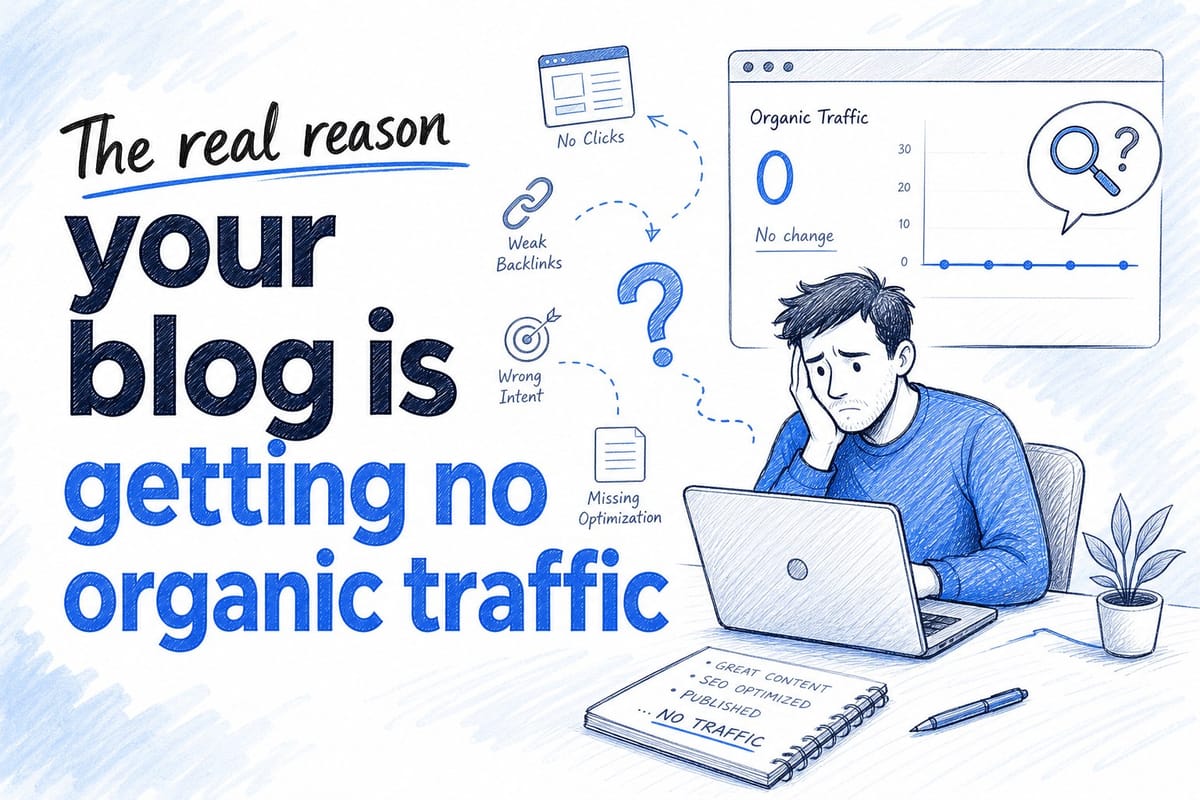
Table of contents
1. Your content is not built around how people actually search
2. Your blog does not have enough authority for Google to trust it yet
3. You are not playing the long game, and your workflow cannot support one
If your blog is getting no organic traffic, you are not alone. Most bloggers publish for weeks or even months and watch their analytics sit completely flat. No visitors from Google. No keyword rankings. Nothing. It feels like shouting into an empty room. The frustrating part is that most advice online tells you to 'just write more content' or 'be consistent.' That advice is not wrong, but it is incomplete. The real reasons your blog is stuck are more specific, more fixable, and more connected to strategy than most people realize. I want to walk you through what is actually happening and what you can do about it.
Your content is not built around how people actually search
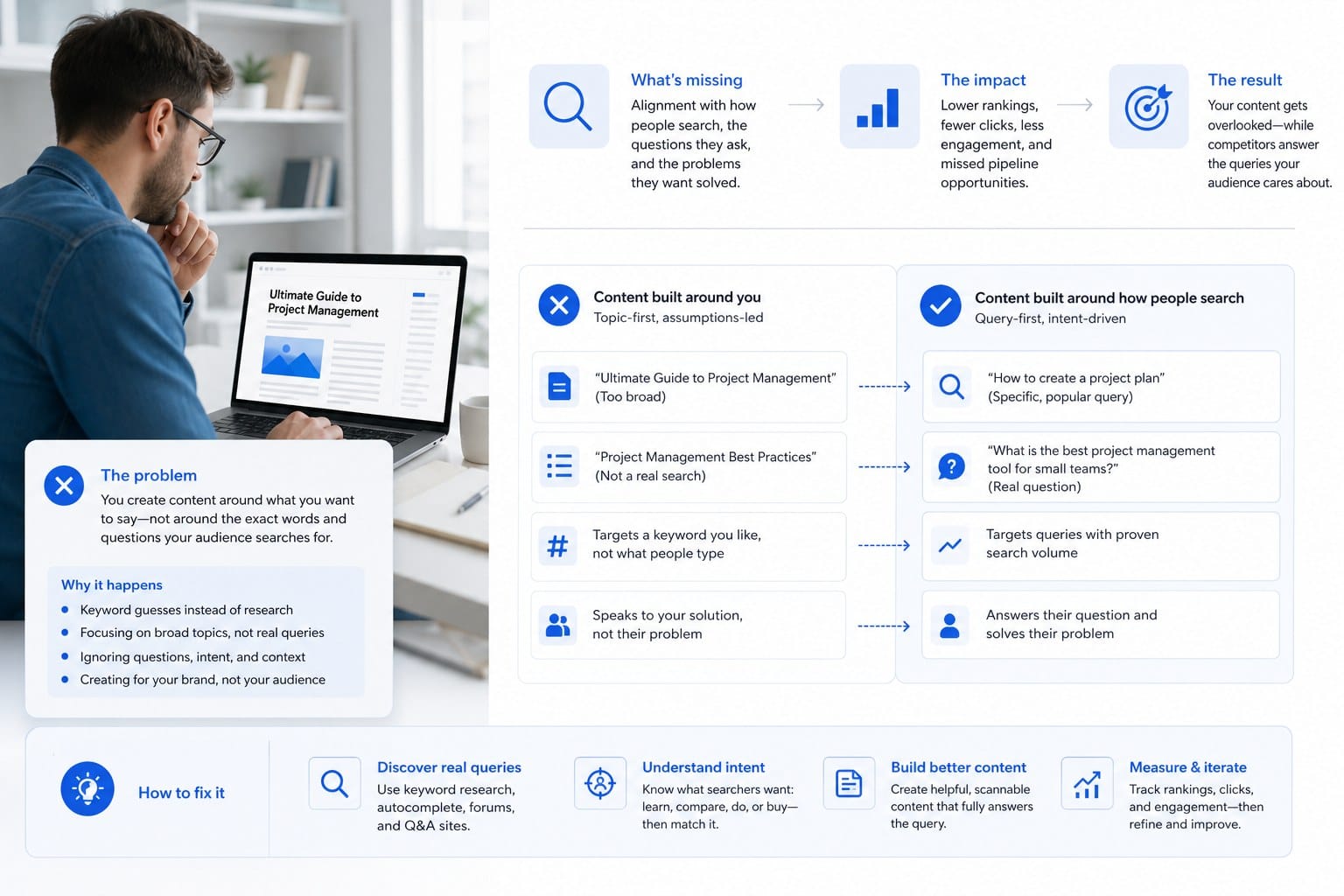
This is the number one reason blogs fail to get organic traffic. Writers tend to create content around topics they find interesting or topics they think their audience wants. But there is a critical difference between what feels relevant to you and what people are actually typing into Google.
When I say 'keyword intent,' I mean the reason behind a search. Someone typing 'how to start a blog' wants a beginner guide. Someone typing 'why is my blog getting no organic traffic' is troubleshooting a specific problem they already have. Google has gotten very good at matching content to intent, and if your article does not match the intent behind the keyword, it will not rank, even if the writing is excellent.
Here is a concrete example. Say you run a small business selling handmade candles. You write a post called 'Our Favorite Scents This Fall.' That title sounds nice, but almost nobody searches for it. A post called 'How to choose a soy candle that actually fills a room with scent' targets a real question people ask. One of those posts has a chance to rank. The other one does not.
The fix is keyword research, but not the kind where you just plug in a word and grab whatever has the highest volume. You need to find keywords where three things line up: real search volume, manageable competition, and a clear match between the keyword's intent and what you can actually deliver in the article.
Long-tail keywords, which are phrases with three or more words, are where most new and mid-size blogs find their first traction. A phrase like 'best email marketing tools for Shopify stores' is far easier to rank for than 'email marketing,' and the people searching for it are closer to making a decision. That specificity is what brings the right traffic.
Beyond keyword selection, your content structure has to match what Google sees in the top-ranking results. If every top result for your target keyword is a step-by-step how-to guide, and you wrote an opinion piece, you have a structure mismatch. Google reads that as a signal that your format does not serve the searcher well, and it will push your post down.
Another issue I see constantly is thin content. A 400-word post almost never ranks for a competitive keyword. Google rewards depth. Not word count for its own sake, but genuine coverage of the topic. If a competing article covers ten subtopics and you cover three, the competing article wins. Deeply researched long-form content, typically 1,500 words or more, performs significantly better in most niches.
There is also the question of topical authority. Google does not just evaluate individual articles. It looks at your site as a whole and asks whether you seem to be an expert on a given subject. A blog that publishes twenty tightly related articles about small business marketing will outperform a blog that publishes one article each about marketing, cooking, travel, and fitness. The scattered blog has no topical authority. The focused one does.
Building topical authority means creating content clusters. You start with a broad pillar article that covers a topic at a high level, and then you create supporting articles that dive into the subtopics in detail. Each supporting article links back to the pillar. Each pillar links out to its supporting articles. This internal linking structure signals to Google that your site covers the topic comprehensively, and it can dramatically accelerate how quickly your content ranks.
The reason most blogs never build this structure is time and planning. Writing one article is hard enough. Mapping out fifteen interconnected articles and executing them consistently is a different challenge entirely. That is where having a real content strategy, not just a content calendar, makes a measurable difference. A strategy tells you which topics to own, in which order, and how they connect. A calendar just tells you when to publish.
If you want to understand what a content engine actually looks like when it handles this kind of strategic planning, What is a content engine for your blog and do you need one is worth reading. It explains the difference between scattered publishing and a system that builds authority over time.
Your blog does not have enough authority for Google to trust it yet
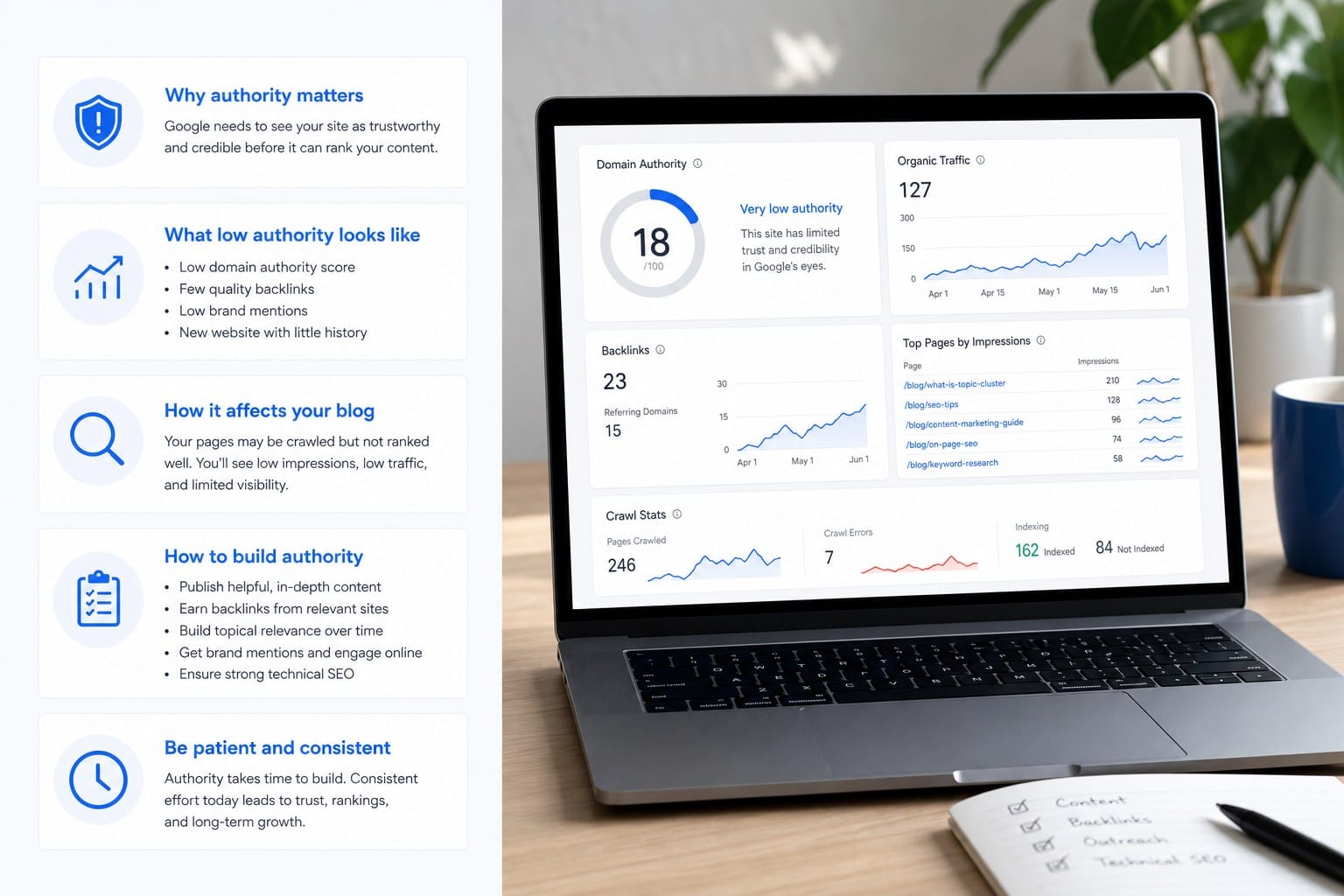
Even if your content is well-researched and properly targeted, there is a second major reason your blog may be getting no organic traffic: your domain simply does not have enough authority for Google to take a chance on it.
Domain authority is a concept worth understanding. When Google evaluates a new piece of content, it considers the reputation of the website it lives on. A new site with no backlinks, no traffic history, and no established trust signals is starting at zero. Google is cautious about surfacing content from unknown sources, especially for competitive queries. This is not a punishment. It is just how the system works.
Backlinks, which are links pointing to your site from other websites, remain one of the strongest signals Google uses to evaluate trust. Each quality backlink is essentially a vote of confidence from another site saying 'this content is credible enough that we want to reference it.' A blog with zero backlinks is competing against blogs that have hundreds or thousands of them, and it will lose on that dimension regardless of content quality.
Building backlinks takes time, but there are legitimate strategies that actually work. Guest posting on relevant websites in your niche puts your content in front of a new audience and earns a link. Creating genuinely useful resources, such as original research, detailed guides, or free tools, naturally attracts links because people want to reference them. Getting featured in roundup articles or expert quotes is another real approach.
What does not work is buying cheap links from link farms, using private blog networks, or any other shortcut that violates Google's guidelines. These tactics can result in a manual penalty that tanks your entire site. The only backlinks that matter are ones earned from real websites that have genuine audiences.
While you are building backlinks, internal linking matters more than most people give it credit for. Every time you publish a new article, you should go back to older articles and add links to the new one where they make sense. This distributes authority around your site and helps Google crawl and index your new content faster.
Technical SEO is another layer of authority that many bloggers overlook. Page speed is a ranking factor. If your site takes more than three seconds to load on mobile, you are losing both rankings and readers. Google's Core Web Vitals measure loading performance, interactivity, and visual stability. You can check your scores for free using Google Search Console or PageSpeed Insights.
Mobile optimization is non-negotiable. Google uses mobile-first indexing, meaning it primarily looks at the mobile version of your site when deciding how to rank it. If your blog looks fine on a desktop but is cluttered or hard to navigate on a phone, your rankings will reflect that.
Another technical factor that catches people off guard is indexing. Your blog posts need to actually be indexed by Google before they can rank for anything. You can check this by searching 'site:yourdomain.com' in Google. If posts are missing from the results, they are not indexed. This can happen for several reasons: a 'noindex' tag accidentally left in your settings, a sitemap that is not submitted to Search Console, or pages blocked in your robots.txt file. These are fixable issues, but you have to know to look for them.
Core content freshness also plays a role. Google tends to favor content that is current and updated. A blog post written three years ago about a topic that changes frequently, like software tools or tax regulations, will likely be outranked by more recent articles. Updating older posts with new information, a current date, and any relevant changes can give them a meaningful rankings boost without writing anything from scratch.
The authority gap between a brand-new blog and an established one is real, but it closes faster when you publish consistently, earn links methodically, and keep your technical foundation clean. Sporadic publishing, long gaps between articles, and a technically messy site all slow the process down significantly.
Consistency is genuinely hard to maintain without a system. Most bloggers publish in bursts when they have time and then go quiet for weeks. From Google's perspective, that inconsistency signals that the site is not a reliable source. Brands that publish on a regular, predictable schedule build authority faster because Google sees them as active and trustworthy.
If you are thinking about how to make consistent publishing sustainable without burning yourself out or hiring a full team, How to build a blogging system that runs without you lays out a practical approach to making that happen.
You are not playing the long game, and your workflow cannot support one
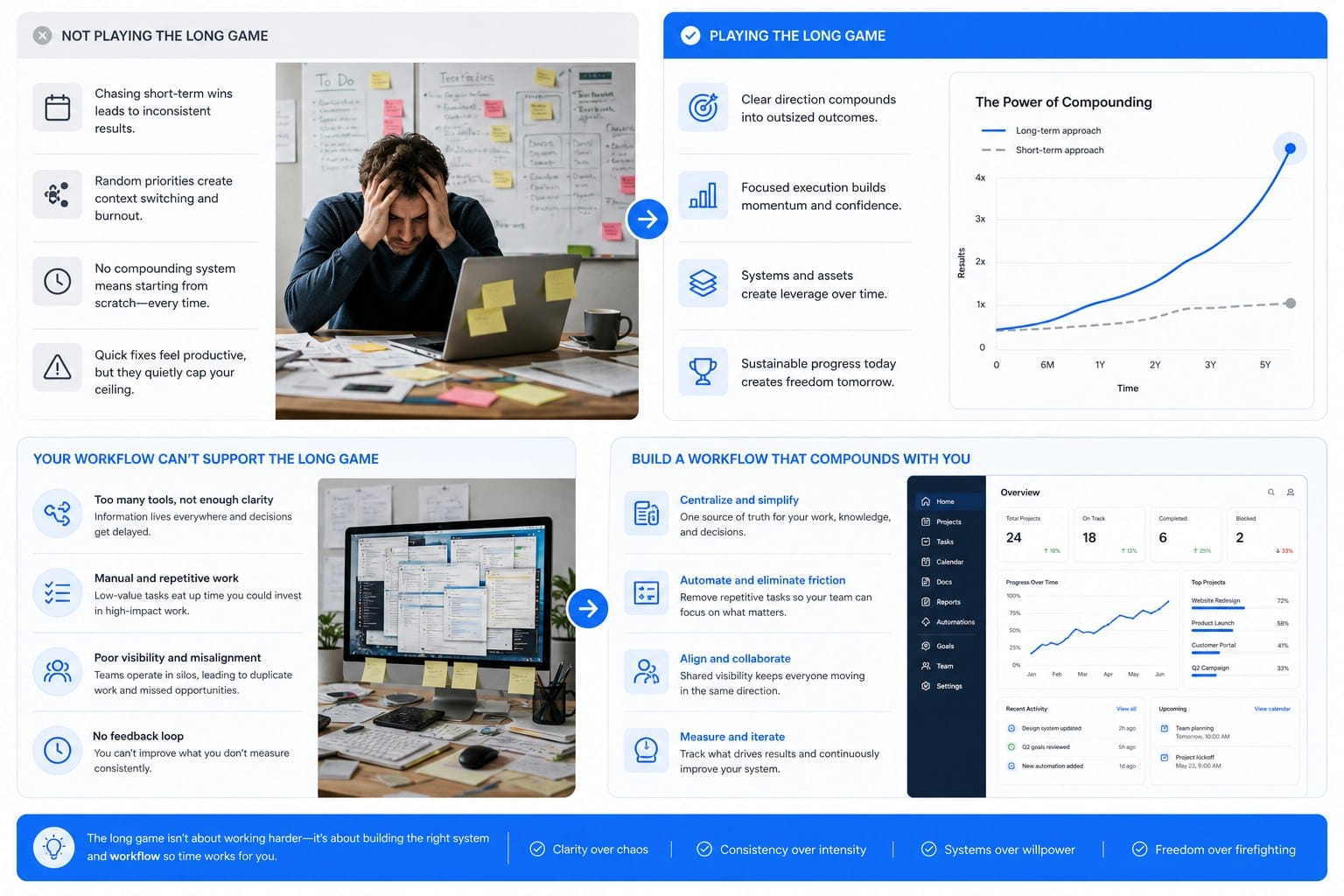
Here is the uncomfortable truth that most SEO advice dances around: organic traffic takes time. Not days. Not weeks. Realistically, a new blog in a moderately competitive niche can take four to twelve months to start seeing meaningful organic traffic, even when doing everything right. Most blogs give up before they reach that point.
I am not saying this to discourage you. I am saying it because understanding the timeline changes everything about how you approach your strategy. When you know that the payoff is months away, you stop making decisions based on short-term results. You stop abandoning topics because they did not rank in two weeks. You start building infrastructure that compounds over time instead of sprinting and burning out.
The blogs that eventually dominate organic search in their niche almost always share a few characteristics. They published consistently for an extended period. They chose a focused niche and went deep instead of broad. They updated their older content as it aged. And they had a workflow that made all of that sustainable.
That last point is the one most people skip. Strategy without execution is just a list. You can have the perfect content plan, the right keywords, and a strong understanding of SEO principles, but if your workflow breaks down after a few weeks because writing and publishing is too time-consuming, none of it matters.
This is where a lot of independent bloggers, SaaS founders, and small business owners get stuck. They understand that they need to publish regularly. They have topics they want to cover. But researching, outlining, writing, editing, formatting, sourcing images, and publishing a single well-optimized article can take six to ten hours. If you are running a business at the same time, that is simply not sustainable at the volume SEO requires.
The answer is not to lower your standards. Thin, poorly researched content does not rank, so cutting corners on quality is not a real solution. The answer is to build or use a system that removes the bottlenecks from your content workflow without compromising depth and accuracy.
Let me walk through what a functional content workflow actually needs to include. First, you need a strategy layer: a clear picture of which topics you are targeting, why you are targeting them, and how they connect to each other. This is your 30-day or 90-day content roadmap, not just a list of titles but a structured plan that builds topical authority deliberately.
Second, you need a research layer. Every article you publish should be based on actual information: what the top-ranking articles cover, what questions people are asking in forums and comments, what data or examples make the argument concrete. Skipping research is what produces generic content that adds nothing to the conversation and ranks nowhere.
Third, you need a production layer that handles writing, formatting, and visual assets. This is where most time gets lost. If you can systematize the production step, you free up enormous capacity to focus on strategy and growth instead of execution.
Fourth, you need a publishing layer that puts finished content onto your platform without additional friction. Manual copy-pasting, reformatting in your CMS, scheduling, and metadata setup are all tasks that eat time and introduce errors. An automated publishing workflow eliminates that friction entirely.
Fifth, and often forgotten, you need a maintenance layer. Your older posts need periodic updates. Your keyword performance needs monitoring. Your internal linking needs expansion as you publish new content. Without a maintenance plan, you are building a house and never doing repairs.
For Ghost CMS users specifically, there are real advantages to having publishing integrated into your content workflow so that articles move from research to live post without manual intervention at each stage. How Ghost blog automation keeps your content publishing on autopilot gets into the specifics of how that works in practice.
The brands and creators who figure out organic traffic are almost never the ones who write the most beautifully or have the most creative ideas. They are the ones who built a reliable, repeatable process and stuck with it long enough for compounding to kick in. Organic traffic compounds the same way interest compounds in a savings account. The first few months feel painfully slow. Then the curve starts to bend. Then you start getting traffic from articles you published six months ago, and that traffic keeps growing without you doing anything new.
But you have to survive long enough to reach that inflection point. That means your workflow has to be sustainable at the pace SEO requires. For most businesses and creators, that means some combination of smart tools, clear processes, and realistic expectations about the timeline.
If your blog is getting no organic traffic right now, the path forward is not mysterious. Audit your keyword strategy and make sure you are targeting phrases with real intent and realistic competition. Check your technical setup and make sure your content is actually being indexed. Build topical authority by covering your niche deeply and connecting your articles through internal linking. Start earning backlinks through guest posts and genuinely useful resources. And build a workflow that lets you publish consistently over months, not just when inspiration hits.
None of these steps are glamorous. But they are the actual reasons organic traffic grows, and they are the actual steps that fix a blog that has been sitting at zero.
The timeline is real, the effort is real, and the compounding payoff is real too. The blogs you see pulling thousands of visitors from Google every month were where you are now at some point. The difference is they kept going.
Ready to take the next step?
Blogtude handles the strategy, research, writing, and publishing so you can stop guessing and start building the kind of consistent content output that organic traffic actually rewards. If you are ready to run a blog that grows without consuming all of your time, visit Blogtude to see how it works.


