
What is a content engine for your blog and do you need one

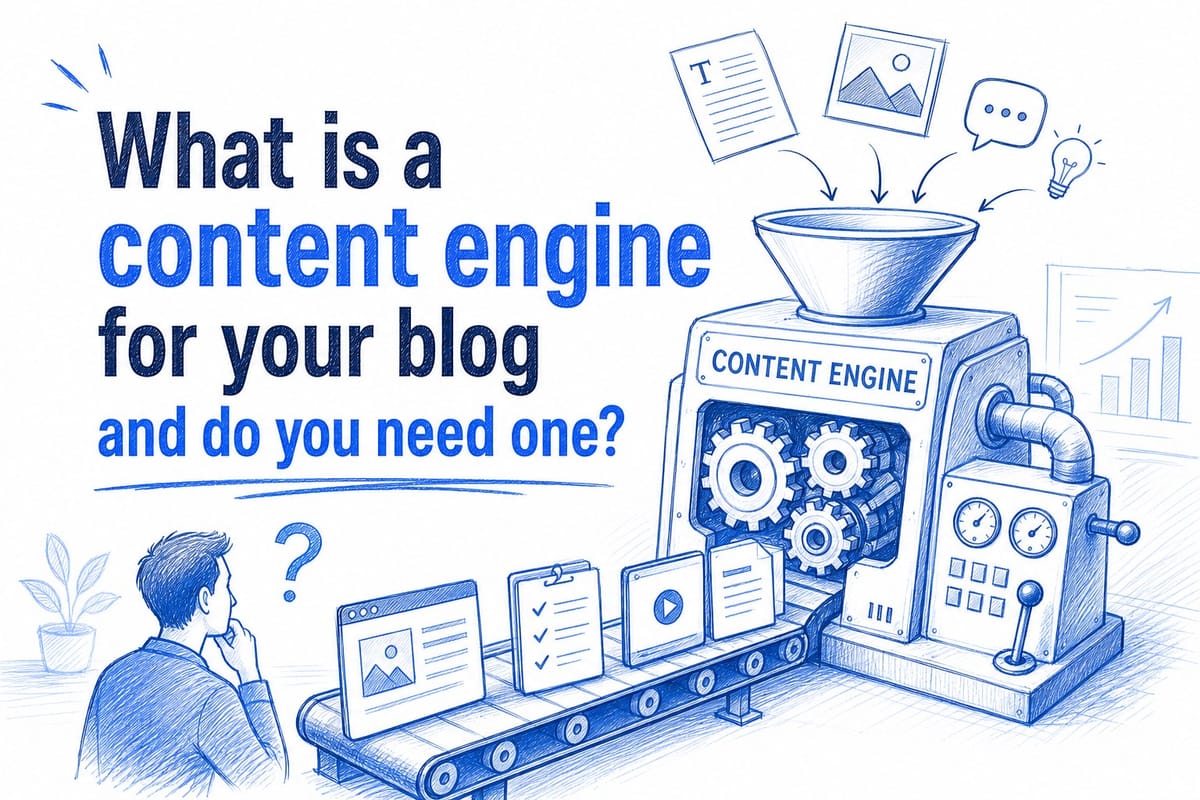
Table of contents
1. What a content engine for your blog actually is
2. Who actually needs a content engine and why the timing matters
3. How to evaluate and set up a content engine that actually works
If you run a blog, you have probably hit the same wall most writers and brand owners hit: you start strong, publish a few posts, and then life gets busy and the blog goes quiet for weeks. I have seen this happen to independent creators, SaaS founders, and small business owners alike. The content calendar falls apart, the organic traffic stalls, and the blog that was supposed to drive growth sits there doing nothing. A content engine for your blog is the answer to that cycle, but the term gets thrown around loosely enough that it is worth unpacking exactly what it means, how it works, and whether your situation actually calls for one. In this article, I will walk through the full picture so you can make a clear decision.
What a content engine for your blog actually is
A content engine is not a content calendar. It is not a spreadsheet with topic ideas or a list of headlines someone brainstormed on a slow afternoon. It is a repeatable, systematic process that keeps blog content moving from idea to published post without requiring you to restart from scratch every single time.
Think of it like a factory floor instead of a craft workshop. A craft workshop produces one beautiful item at a time with full manual attention at every stage. A factory floor produces consistent output through an organized sequence of steps where each station does its part reliably. A content engine does the same thing for your blog: it standardizes the research, writing, formatting, and publishing stages so content flows out on a schedule regardless of how busy you are on any given week.
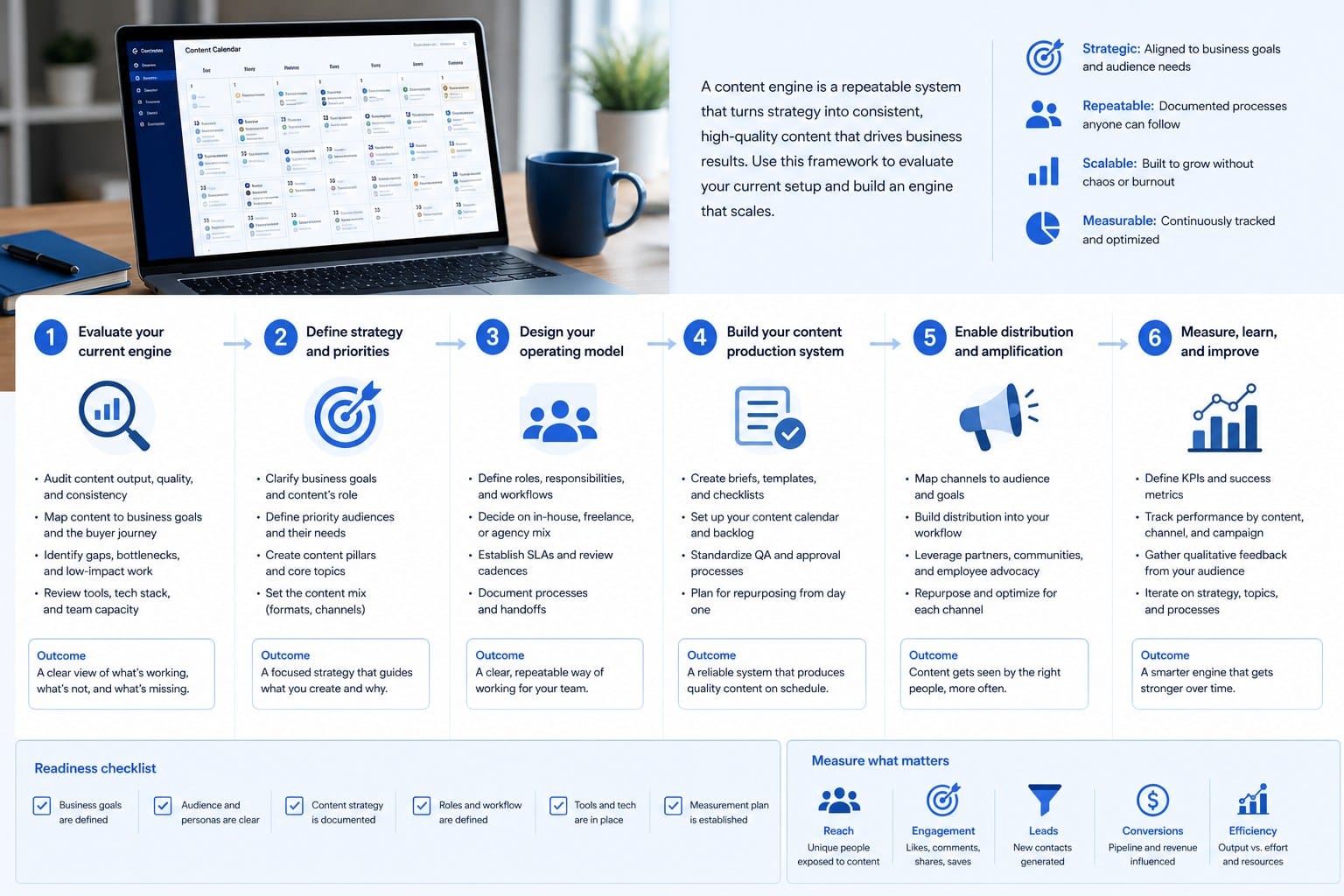
The engine typically has four moving parts working together, and understanding each one helps you see why removing any single part breaks the whole system.
First, there is strategy. This is where topics are chosen based on keyword research, audience intent, and business goals. Good strategy means you are not guessing what to write. You are picking subjects that have a real chance of ranking in search and attracting readers who are likely to become customers or subscribers. Without strategy, you end up with a collection of posts that nobody was searching for, which is one of the most common reasons blogs produce content for years without gaining meaningful traffic.
Second, there is research and writing. Every published post needs accurate information, a clear structure, and language that matches your brand voice. In a manual setup, this is where most of the time goes. A writer has to dig into sources, organize thoughts, draft, and revise before anything gets near the publish button. A well-built content engine either systematizes this process for a human writer with briefs, templates, and review checkpoints, or it uses an AI layer to handle the heavy lifting with enough quality controls that the output is actually usable without major rewrites.
Third, there is formatting and visual production. A blog post that reads well still needs to look right. That means proper headers, supporting images, descriptive alt text, meta descriptions, and the on-page SEO elements that tell search engines what a page is about. Skipping this step costs you rankings even if the writing is strong. A post with excellent prose but missing meta data and no internal link structure will consistently underperform a well-formatted post on a similar topic.
Fourth, there is publishing. Getting a finished article into your CMS, setting it to go live at the right time, and making sure all the technical pieces are in place is the last mile of the process. In a manual workflow, this step is easy to forget or delay. A writer sends a finished draft, the editor approves it, and then it sits in a shared document waiting for someone to log into the CMS and upload it. In a content engine, publishing is automated so the last mile actually gets covered.
When all four parts work together reliably, you get consistent output. Consistent output builds domain authority over time. Domain authority drives organic traffic. Organic traffic compounds. That is the core promise of a content engine for your blog, and it is a promise that holds up when you look at how search engines reward sites that publish regularly over sites that publish sporadically.
I want to be specific about what makes a content engine different from simply hiring a freelancer or using a basic AI writing tool, because those alternatives come up whenever someone starts thinking about scaling their blog.
A freelancer handles writing but not strategy, formatting, or publishing. You still have to brief them, review their work, format the posts, write the meta descriptions, add the images, and get everything into your CMS. That is four steps the freelancer does not touch. A basic AI writing tool generates text but leaves you to manage everything else. You prompt it, evaluate the output, rewrite the weak sections, format the post, find images, and publish it yourself. A true content engine covers the full pipeline so nothing falls through the cracks and so the output keeps coming even when you are not actively driving it.
If you want to see what this looks like at the systems level, How to build a blogging system that runs without you breaks down the architecture in useful detail and gives you a practical picture of how the parts fit together.
Who actually needs a content engine and why the timing matters
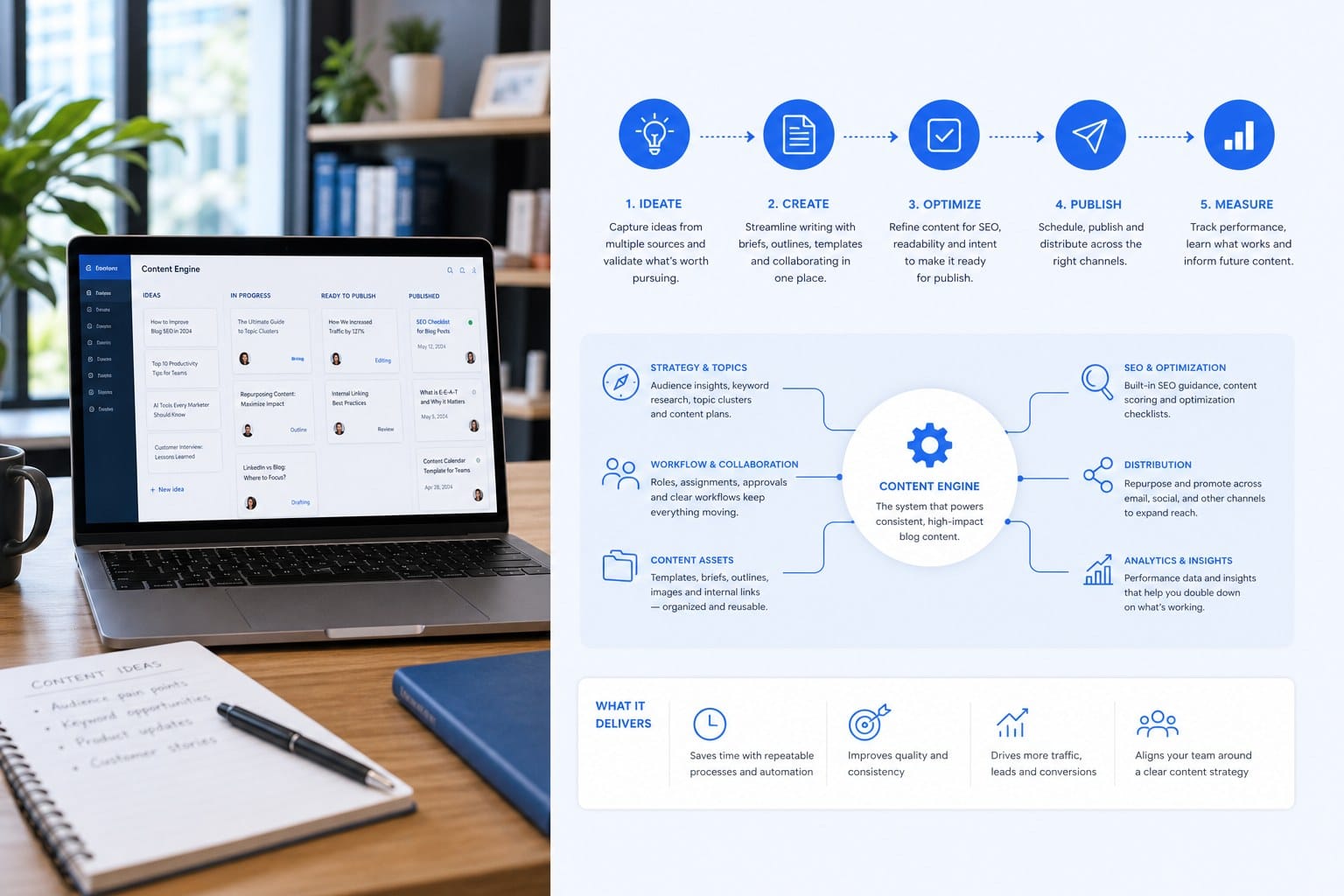
Not every blogger needs a content engine from day one. If you are writing a personal journal for a small audience and have no growth goals attached to it, a content engine is probably overkill. But if you are in any of the situations below, the case gets strong quickly, and the argument for building one sooner rather than later gets stronger the longer you think about how search traffic actually works.
You are an independent blogger trying to grow your audience and monetize your content. You have good ideas, but the time required to research, write, format, and publish regularly is eating into your ability to do anything else. You publish when inspiration strikes instead of on a consistent schedule, and your analytics reflect that inconsistency with flat or erratic traffic numbers. One good month is followed by a quiet stretch, and you never quite build the momentum that turns an audience into a reliable income source.
You are a SaaS founder or startup operator who knows that organic blog traffic is one of the best long-term acquisition channels available. You have watched competitors build audiences through content and you want the same result, but you do not have a content team and cannot justify hiring one yet. You need consistent output without adding headcount, and you need it to run without requiring your personal attention every week.
You are a small business owner with a service or product that people actively search for online. You understand that showing up in Google results for the right questions would bring you qualified customers who are already looking for what you offer. But research, writing, and publishing are not your core skills and not where you want your working hours going. You would rather be running your business than managing a blog workflow.
You are a digital marketer managing a brand blog. You have a workflow today, but it relies too heavily on you personally to coordinate writers, editors, and publishers. When one person drops a task, the whole schedule slips. You need a more reliable system that does not break every time someone goes on vacation or takes on a heavier workload.
You are a Ghost CMS user who chose Ghost specifically because it is a clean, fast, and focused publishing platform. You want to take full advantage of it but find that the content production side is still entirely manual. The publishing infrastructure is there; the production pipeline is not.
In all of these cases, the underlying problem is the same: the gap between knowing that consistent content drives growth and actually producing consistent content at the volume and quality required for search to reward you. That gap is exactly where a content engine lives and what it is designed to close.
The timing question matters more than most people realize because a lot of creators and business owners wait too long to build or adopt a content engine. They wait until they have more traffic, more resources, or more time. The problem is that organic content works on a lag. A post you publish today may not rank competitively for three to six months as Google indexes it, evaluates how users interact with it, and assesses the authority of the domain it lives on. That means the sooner you have a reliable system producing good content, the sooner the compounding effect starts working in your favor.
Every week without consistent output is a week your competitors' content is aging into authority while yours is not. A competitor who started publishing two years ago and never stopped has a head start that only gets harder to close the longer you wait. Building a content engine before you feel the full urgency of that gap is significantly better than building one after you have already lost ground.
I have found that the best time to build a content engine is before the pressure is acute, not after. If you are already feeling behind on your content, you are already paying the cost of not having one. Getting the system in place now means the lag time works for you rather than against you.
The question of whether to build the engine yourself or use a purpose-built tool comes down to resources and priorities. Building it yourself means stitching together keyword research tools, freelance writers, editors, image sources, formatters, and a scheduling system, then managing the handoffs between each. That takes real time to assemble and ongoing attention to maintain. Using a purpose-built solution means that infrastructure is already assembled and tested. For most small teams and solo operators, the latter makes more practical sense because the time saved building the system is time that can go into reviewing output, engaging with the audience, or running the business.
For Ghost users specifically, the integration question is worth thinking through carefully. Ghost is a well-built platform, but the content production pipeline outside it is still a manual problem unless you solve it deliberately. Automating the publishing step inside Ghost removes one of the biggest friction points in a manual workflow. How Ghost blog automation keeps your content publishing on autopilot covers how that kind of integration actually works at the platform level and what it takes to get consistent automated publishing running reliably.
How to evaluate and set up a content engine that actually works
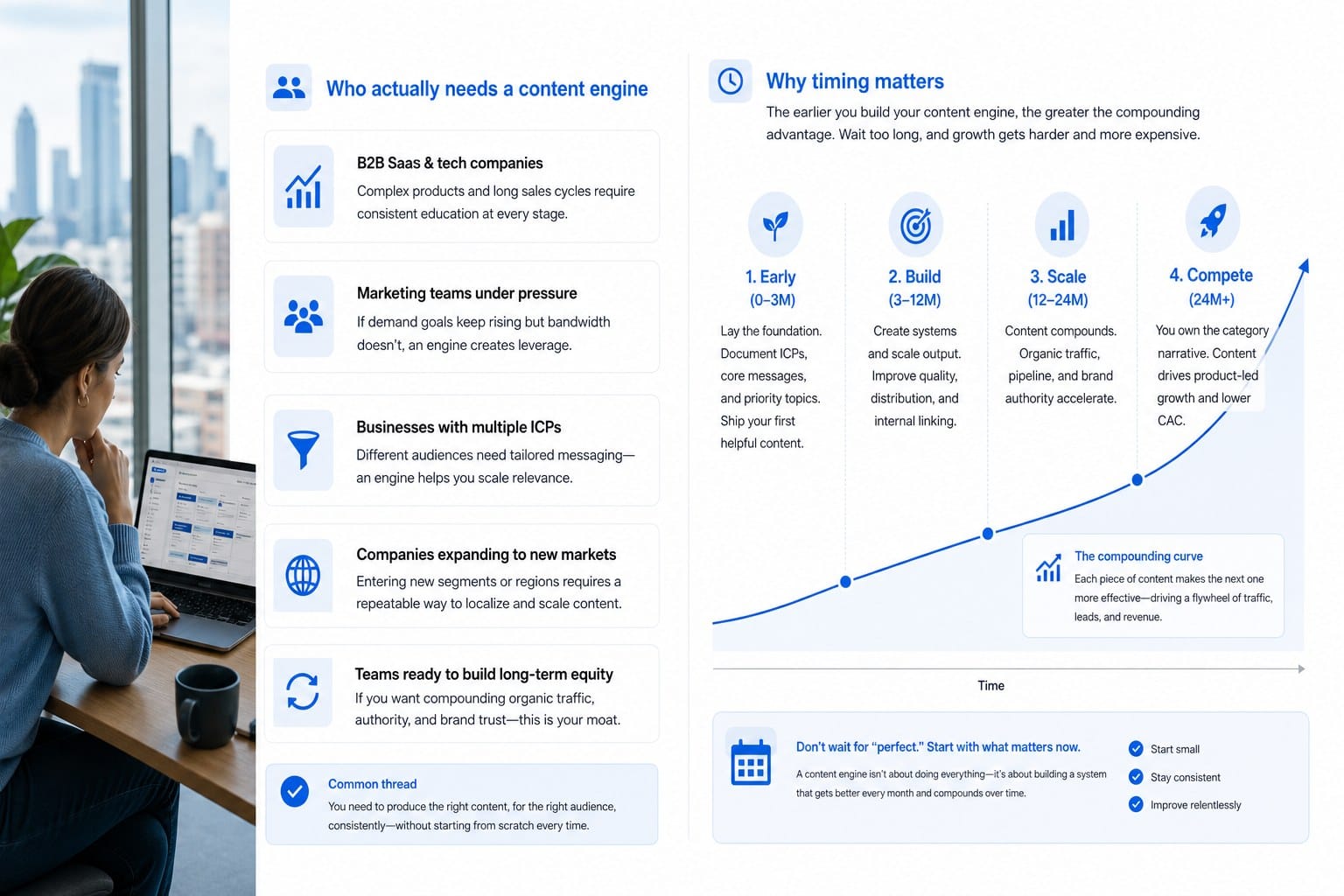
Once you decide a content engine makes sense for your blog, the next question is what to look for and how to get it running without creating a new set of problems to manage. There are enough tools and platforms in this space that the evaluation process is worth doing carefully before you commit time and money to any one approach.
Start with the strategy layer. Any content engine worth using has to produce a content strategy based on real keyword data and real audience intent, not generic topic ideas generated by pattern matching on broad categories. A 30-day content plan is a practical starting point because it gives you enough runway to see momentum without overwhelming you with a six-month queue you cannot verify or adjust before publishing. Look for a strategy output that shows you specific topics, the search intent behind each one, and how they connect to your business goals. A topic list without intent data is just a list. Intent data tells you whether someone searching that phrase is trying to learn something, compare options, or make a purchase, and that distinction shapes how you write the post.
Next, evaluate the research and writing quality, because this is where a lot of automated tools fall short in ways that are hard to spot until you look closely. They produce fluent text that says nothing useful, full of filler sentences, surface-level observations, and vague claims that sound informative but do not actually help the reader understand or do anything. A good content engine produces articles that are genuinely informative, accurate enough to hold up under a reader's scrutiny, and long enough to cover a topic properly rather than skimming the surface.
For SEO purposes, content length matters in a real way. Long-form content consistently outperforms short posts on competitive keywords when the length comes from substance rather than repetition. Articles in the 1,500 to 3,000 word range tend to rank better than posts under 800 words on most non-trivial topics, because covering a subject thoroughly signals relevance and earns more time on page from readers. The engine you use should be capable of producing in that range with genuine depth, not padding that inflates word count without adding value.
Brand voice is a detail that gets underestimated. Content that reads like it came from a different company than your website creates a jarring experience for readers and weakens trust. A reader who finds your post through search and then visits your homepage expects a consistent voice. If the blog sounds like one person and the rest of the site sounds like another, the disconnect registers even if the reader cannot name it. Before committing to any content engine, test whether it can match your tone across several pieces. If you write in a direct, first-person style, the output should reflect that register consistently. If your brand is more formal and measured, the content should hold that tone without slipping into casual phrasing.
Visual production is a detail that gets skipped more than it should, partly because it feels like a finishing touch and partly because it requires an additional capability that not all content tools have. A finished blog post without appropriate images or visual breaks looks unfinished and performs worse on social shares where the preview image is often the deciding factor for whether someone clicks. Look for whether the content engine handles visuals alongside the written content, and whether those visuals are on-brand rather than generic stock images that feel disconnected from the topic.
The publishing integration step is what separates a true content engine from a content creation tool, and it is the step most platforms skip or handle incompletely. Creating the post is only part of the job. Getting it into your CMS, formatted correctly with the right header hierarchy, populated with accurate metadata, assigned the right tags, and published on schedule is the other part. If you are using Ghost, WordPress, or another major CMS, check whether the engine integrates directly and whether that integration handles the full publish step. An export file you then have to upload manually is not automation; it is just a different format of the same manual task.
Here is a practical checklist to use when evaluating any content engine for your blog:
Does it produce a full content strategy, not just individual posts on demand? Does the strategy connect to real keyword research and search intent data? Can it produce long-form, well-researched articles that cover topics with genuine depth? Does it match your brand voice or allow you to define one that it holds consistently? Does it handle on-brand visuals alongside the written content? Does it integrate directly with your CMS and handle automated publishing on a schedule? Can you review and approve content before it goes live, so you maintain editorial control? Is the output consistent enough in quality and timing that you can actually rely on a publishing schedule?
If the answer to most of those questions is yes, you are looking at a real content engine. If most answers are no or partial, you are looking at a content creation tool that still requires significant manual effort to turn into a functioning publishing workflow. There is nothing wrong with content creation tools, but it is important to go in with accurate expectations about how much work remains after the tool does its part.
One more area worth thinking through is how your content engine connects to your SEO tooling more broadly. Your content engine does not operate in isolation from the rest of your marketing stack. You want to make sure the strategy layer is pulling from solid keyword data and that the content being produced is optimized correctly for on-page SEO signals like title tags, header structure, internal linking, and meta descriptions. If you are evaluating which SEO tools to use alongside your content engine, SEO tools like WooRank and what to use instead gives a useful breakdown of what different tools actually offer and where their limitations show up.
The setup process for a content engine should not take weeks. If you are building one manually, you are looking at assembling tools, writing creative briefs, hiring writers, setting up a review process, sourcing images, and getting a publishing workflow in place. That realistically stretches over a month or more before your first post goes live under the new system. If you are using a purpose-built platform like Blogtude, the setup is much faster because the infrastructure is already in place. You connect it to your blog, set your brand parameters, review the content strategy it generates from keyword data, and let the publishing pipeline run.
One thing worth being clear about regardless of which approach you take: do not treat a content engine as something that needs zero attention once it is running. Even a well-automated engine benefits from periodic review. Check which posts are gaining traction in search after three to six months. Look at which topics are resonating with your audience based on time on page and return visits. Assess whether the content strategy needs adjustment based on what you are learning from your analytics. A content engine removes the manual labor of production. It does not remove the need for periodic strategic thinking from someone who understands your business and your audience.
The goal is to reach a place where your blog publishes consistently on a schedule, your content is good enough to rank and hold rankings on competitive keywords, your brand voice comes through clearly across every post, and you are not spending your core working hours managing the production process manually. That is a realistic outcome with the right content engine in place. The organic traffic that results from consistent, quality publishing builds slowly at first and then compounds over months and years into one of the most durable and cost-effective traffic sources a brand can develop. Unlike paid advertising, which stops the moment you stop paying, organic content keeps working long after the initial publication date.
If you are tired of the start-and-stop cycle with your blog and ready to replace it with a system that keeps running, a content engine is the infrastructure that makes it possible.
Ready to take the next step?
Blogtude is built to be exactly that kind of content engine for your blog. It generates a 30-day content strategy from real keyword data, produces deeply researched long-form articles in your brand voice with on-brand visuals, and publishes directly to Ghost and other CMS platforms on a schedule. You do not need a writing team or a manual workflow to get consistent output. Visit blogtude.com to see how it works and start building a blog that keeps publishing without you having to drive every piece yourself.


