AI blog writing tools compared: which actually produces publish-ready content

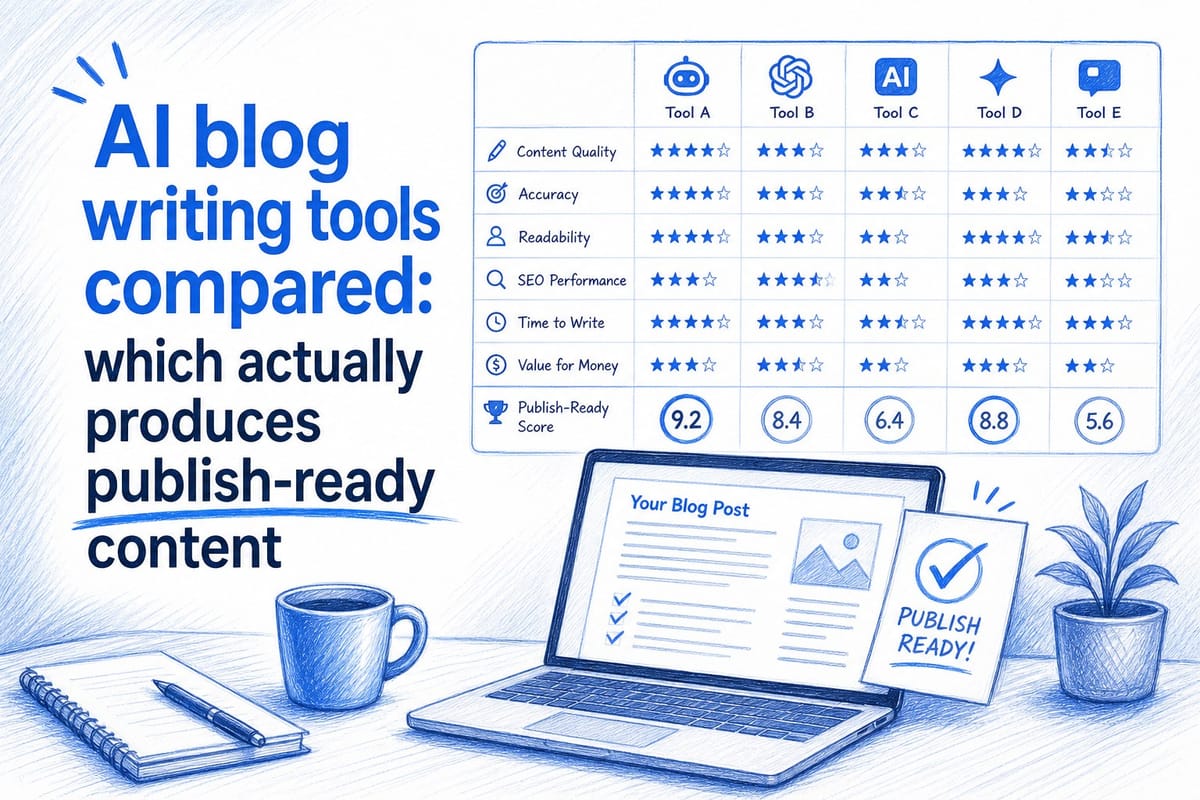
Table of contents
1. What separates a text generator from a publish-ready content tool
2. Why content strategy and research depth change everything about output quality
3. What full-pipeline automation looks like and why most tools stop too early
If you have spent any time searching for an ai blog writing tools comparison, you already know the market is crowded. There are dozens of tools promising to write better, faster, and smarter than whatever you used last month. Some of them deliver a usable first draft. Others produce something that reads like a press release written by a confused intern. Very few actually get you to the finish line, where the post is researched, formatted, on-brand, and live on your site without you spending half a day fixing it. That gap between 'generated text' and 'published content' is exactly what I want to dig into here. I have broken this down into three areas: what separates surface-level generators from tools that produce genuinely usable content, how strategy and research capabilities change the output quality, and what full-pipeline automation actually looks like for a blog that needs to stay consistent month after month. By the end, you will have a clear picture of what to look for, what to avoid, and why most tools stop short of the finish line.
What separates a text generator from a publish-ready content tool
Most AI writing tools share a common ancestor: a large language model that predicts the next word based on what came before it. That foundation is the same whether you are using a basic free tool or a premium platform with a polished dashboard. The difference is everything built on top of that foundation.
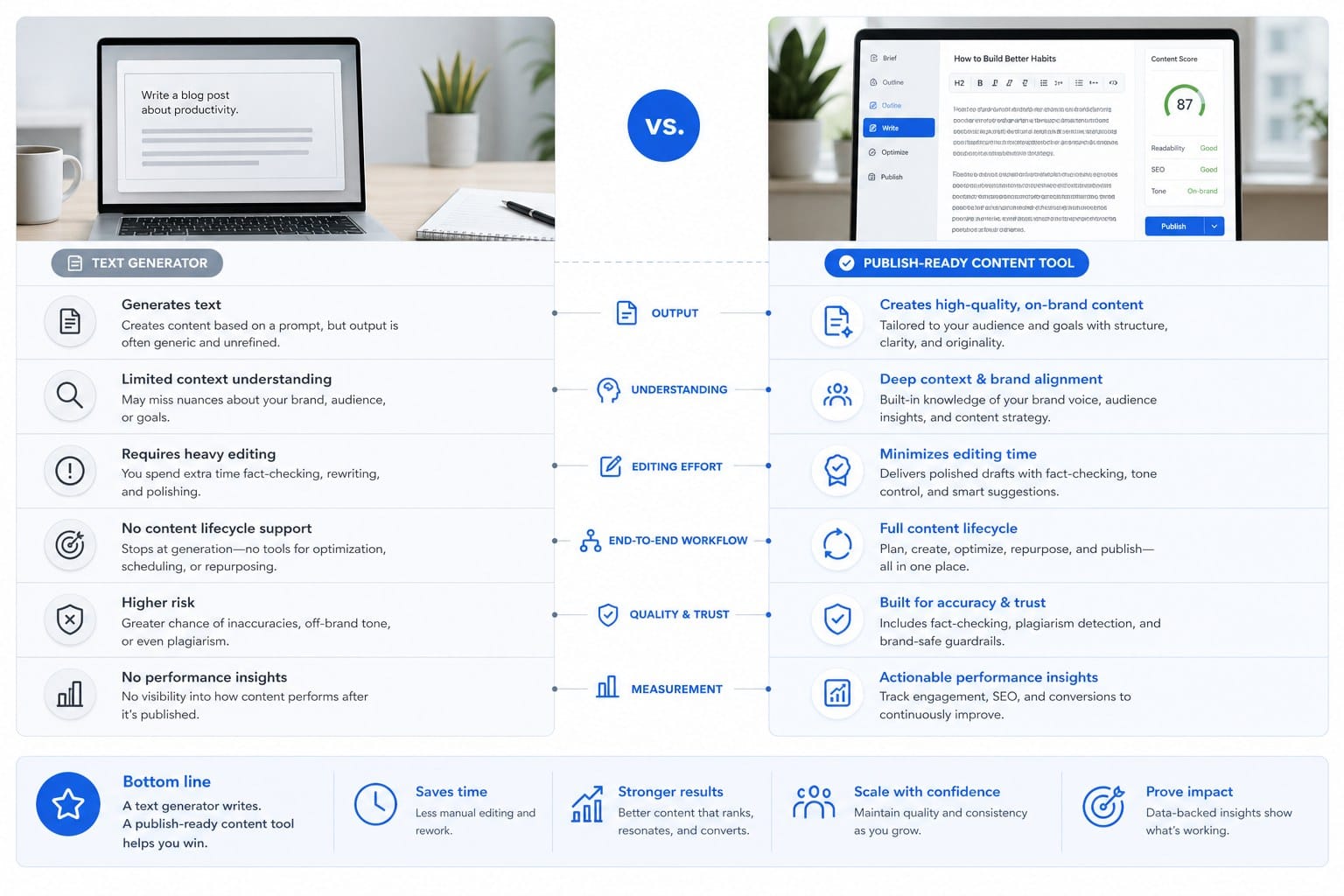
A basic text generator takes a prompt, produces paragraphs, and hands them back to you. You still have to fact-check every claim, restructure the outline, add relevant examples, match your brand voice, choose a featured image, format the headings, and then actually publish the thing. That is a lot of manual work, and it scales poorly. If you need four posts a week, a text generator gives you four first drafts that each need an hour or more of editing.
A content tool that aims for publish-ready output has to solve several distinct problems at once. It needs to understand what the post is actually supposed to accomplish, not just fill a word count. It needs to pull in accurate, specific information rather than generalizing its way through every paragraph. It needs to match a tone and style that fits the brand publishing it. And it needs to deliver something in a format that can go live without a formatting overhaul.
Let me be specific about what 'publish-ready' actually means in practice. A post is publish-ready when a human editor can read it once, make minor tweaks if needed, and hit publish with confidence. That means the structure makes sense for the topic, the claims are accurate and supported, the writing does not sound robotic or generic, the headings follow a logical hierarchy, the images or visuals fit the content, and the metadata like title tags and descriptions are already in place.
Very few tools in the current market hit all of those marks without significant human effort filling the gaps. Most tools are excellent at one or two parts and weak on the rest.
For example, some tools produce beautiful outlines with strong heading structures but then fill in the sections with vague, filler-heavy paragraphs that say nothing specific. Others write in a natural, readable voice but have no ability to connect to your CMS, so you still have to copy, paste, and reformat everything manually. Some tools offer great SEO keyword guidance but generate content that sounds so optimized it loses all personality.
When you do your own ai blog writing tools comparison, the most useful question to ask is not 'does this tool write well?' but 'how much work do I still have to do after the tool finishes?' The answer to that second question tells you a lot more about the real value of the platform.
Another dimension worth examining is how a tool handles topics it does not already know well. Generic tools trained only on broad internet data will confidently write about niche topics using surface-level information. That is where invented statistics, vague claims, and outdated information sneak into posts. A tool with genuine research capability, meaning one that actively pulls in relevant, current information about the topic before writing, produces significantly more credible output.
Brand voice is another area where most generators fall flat. A lifestyle brand that speaks in a warm, conversational tone and a SaaS company writing technical guides for developers need very different styles. Without a system for capturing and applying brand voice settings, every AI-generated post sounds like it came from the same anonymous writer, regardless of who is supposed to be publishing it.
Finally, there is the question of visuals. A blog post without images is functional, but images improve engagement, support the content, and often determine whether a social share looks appealing. Tools that generate only text leave you to find, license, and format images separately. That is another step in a process that already has too many steps.
The bottom line is that text generation is just the beginning. A tool that stops there is a word processor with extra features. A tool that handles research, voice, visuals, structure, and delivery is a content engine.
Why content strategy and research depth change everything about output quality
One of the biggest gaps I see in how people evaluate AI writing tools is that they focus almost entirely on the writing output. They paste a prompt in, read what comes back, and decide whether they like the sentences. But the quality of the output is determined long before any sentences are written. It is determined by the strategy and research that come first.
Think about how a skilled human writer approaches a blog post. They do not just sit down and start typing. They think about who the reader is, what problem the reader is trying to solve, what the reader already knows, and what would make this post genuinely useful rather than generic. They research the topic, look at what already exists, identify the gaps, and find specific examples, data points, or insights that make the post worth reading. Only then do they start drafting.
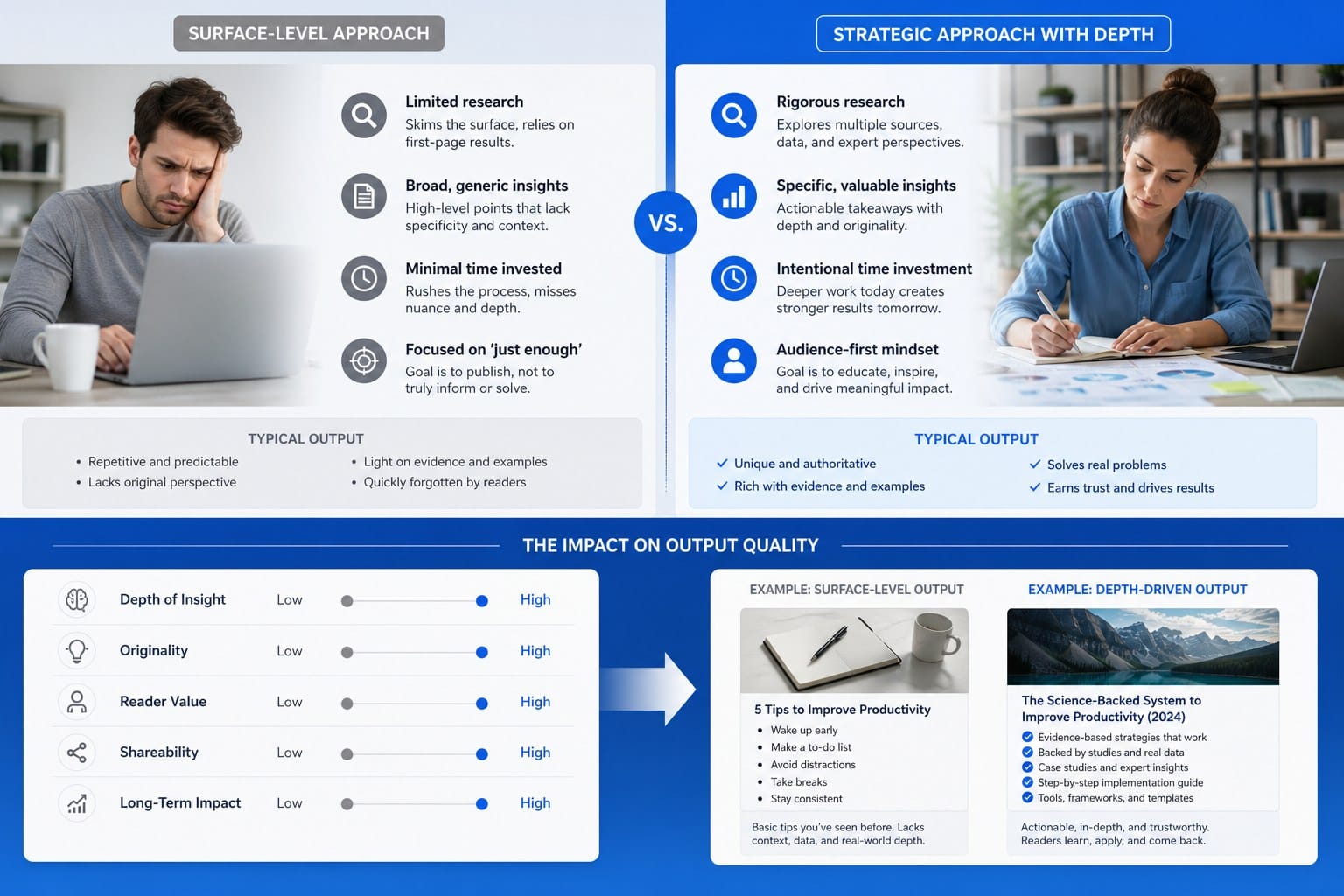
AI tools that skip this phase produce content that reads like it was written to fill space. It covers the topic in the broadest possible way, agrees with itself throughout, and leaves the reader without anything they did not already know. It is not wrong, exactly. It is just useless.
A tool with real strategy capability works differently. It starts by understanding the goal of the content. Is this post meant to rank for a specific search term? Introduce a product to a cold audience? Educate existing customers? Each goal calls for a different structure, a different depth of information, and a different call to action. Without clarity on the goal, the tool is guessing.
Content strategy at the blog level also means thinking beyond individual posts. A single post is rarely what drives meaningful organic traffic growth. What drives growth is a consistent publishing schedule built around a coherent set of topics that reinforce each other, target different stages of the buyer journey, and give search engines a clear picture of what the site is about.
I wrote more about this in How to build a 30-day blog content strategy without a marketing team, but the short version is that a 30-day plan built around connected topics outperforms 30 random posts on unrelated subjects every time. The question is whether the tool you are using can build and execute that kind of plan, or whether it just responds to whatever prompt you throw at it each day.
Research depth matters just as much. When I say research, I do not mean retrieving a few top-ranking articles on the same topic and paraphrasing them. That is what most AI tools do, and it is why so much AI content reads as interchangeable. Real research means finding specific, accurate information that makes the post more credible and more useful than what already exists.
For a post about small business marketing strategies, for example, shallow research produces a list of familiar tactics with no specific context. Deeper research produces the same tactics explained with concrete situations, realistic constraints, and honest acknowledgment of what works for whom. You can feel the difference when you read it.
This also matters enormously for SEO. Search engines have gotten much better at identifying thin content, meaning content that covers a topic at a surface level without adding genuine value. Posts built on shallow research tend to attract fewer backlinks, earn lower engagement, and rank poorly even when they are technically optimized for the right keywords. Depth is not optional if the goal is organic traffic.
For small business owners in particular, the research burden is one of the biggest barriers to consistent publishing. They often know their industry well but do not have time to sit down and pull together the specific facts, context, and examples a strong blog post requires. A tool that handles that research layer removes one of the most time-consuming parts of the process. I explored some of those constraints in more detail when looking at who small business owners really are and what drives them, and time is consistently the most limited resource.
When you compare AI blog writing tools, pay close attention to how each one handles the pre-writing phase. Does the tool ask clarifying questions about the audience and goal? Does it generate an outline before writing and let you review it? Does it pull in specific, relevant information, or does it generalize? Does it have any awareness of what you have already published, so it can build on that rather than repeat it?
These are not small features. They are the difference between a tool that accelerates your content production and one that produces more work for you under the guise of saving time.
Another thing worth examining is how a tool handles topic clusters and internal linking. A well-structured blog builds authority by grouping related posts together and linking between them in a way that guides readers deeper into the site. Tools that treat every post as an isolated document miss this entirely. Tools that understand the broader content ecosystem can suggest or automatically implement internal links that strengthen the whole blog, not just the individual post.
This is a level of sophistication that most tools in the current market simply do not offer. But it is exactly the kind of capability that moves the needle on organic traffic over time, which is the actual goal for most people investing in blog content.
What full-pipeline automation looks like and why most tools stop too early
Let me describe two scenarios. In the first, you use an AI writing tool to generate a draft. You spend 45 minutes editing it, another 20 minutes finding and resizing images, another 15 minutes formatting the post in your CMS, another 10 minutes filling in the SEO metadata, and then you hit publish. Total time saved compared to writing from scratch: maybe 90 minutes. That is useful, but it is not transformational.
In the second scenario, the tool generates the strategy, researches and writes the post, produces on-brand visuals, formats everything correctly, and publishes directly to your CMS on a schedule. You review a preview, approve it, and move on. Total active time on your part: 10 to 15 minutes per post. That is a fundamentally different proposition.
Most AI writing tools in the current market operate closer to the first scenario. They handle the draft, and you handle everything else. That is not a criticism of those tools for what they are. It is a description of what they are not: a complete content pipeline.
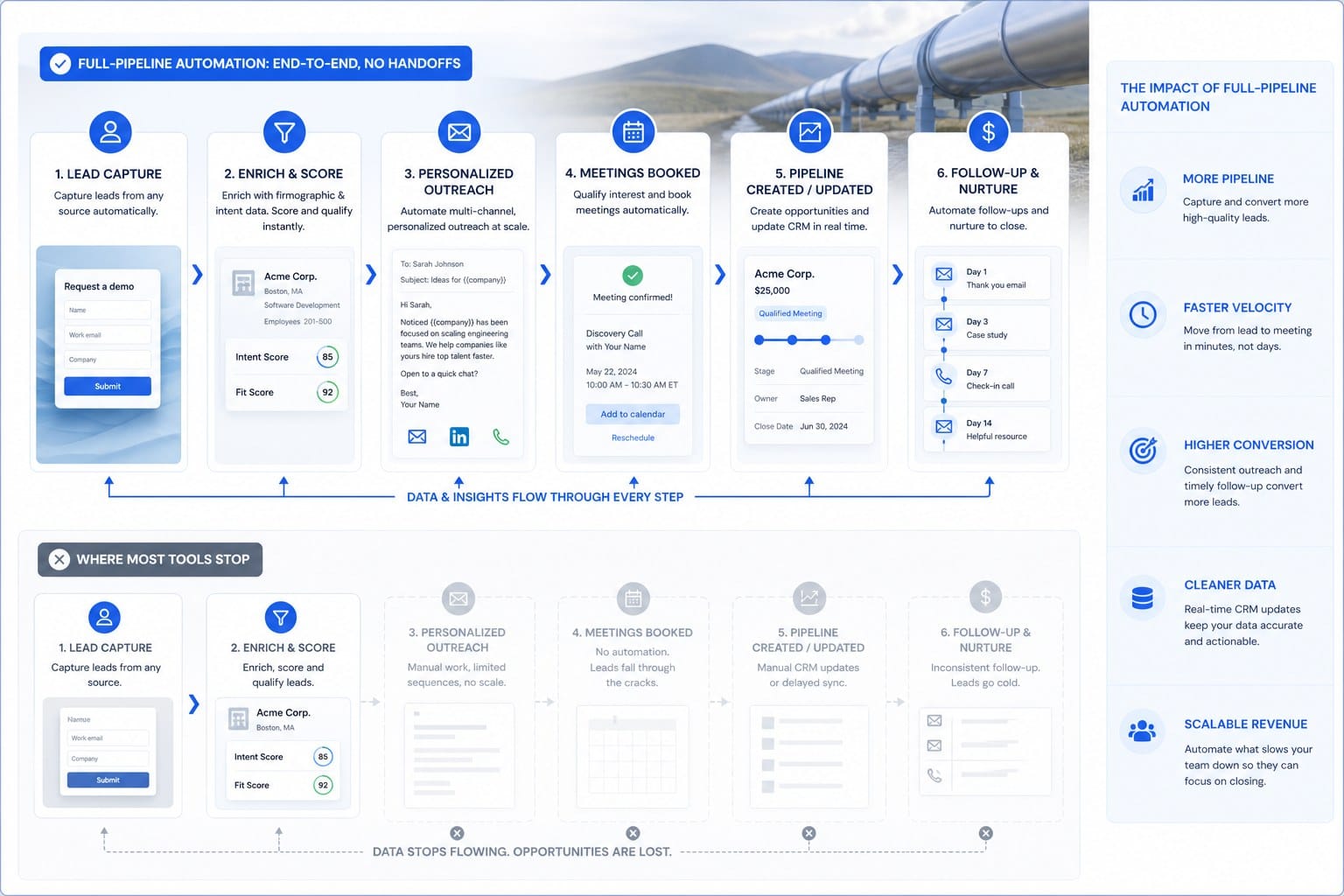
Full-pipeline automation means the tool manages the entire journey from content planning through publication without requiring you to manually bridge each stage. That includes the strategy layer, the research and writing layer, the visual layer, and the publishing layer. When all four work together, the output is genuinely publish-ready in the truest sense of the term.
The publishing layer is where most evaluations of AI tools go quiet, but it is one of the most practically important pieces. Generating a great post and then having to manually move it into your CMS is friction. It sounds minor until you multiply it across 20 posts a month. The copy-paste step, the image upload, the formatting fixes that happen because rich text does not transfer cleanly, the metadata entry: all of it adds up. For content teams or solo operators managing high publishing volume, automated CMS integration is not a luxury. It is a necessity.
For Ghost CMS users specifically, native integration with the publishing platform means posts can go live automatically on a set schedule, with the correct formatting already applied. I covered what that workflow can look like in detail in Ghost CMS automation: how to automatically publish blog posts. The short version is that when the writing tool and the publishing platform speak to each other directly, the human's role shifts from production worker to editor and approver. That is a much better use of time.
Visuals are another piece of the pipeline that most tools ignore entirely. A blog post without a strong featured image performs worse on social sharing and looks less professional in the CMS. Finding, licensing, and sizing images is tedious work that feels disconnected from writing but is part of every post's production process. Tools that generate on-brand visuals as part of the same workflow eliminate a task that most writers quietly dread.
Consistency is perhaps the most underrated benefit of full-pipeline automation. A lot of blogs start strong and then go quiet. The team publishes five posts in the first month, four in the second, two in the third, and then nothing for six weeks because something else took priority. Search engines notice inconsistent publishing. Audiences notice it too. Consistent output, even at a moderate pace, outperforms sporadic bursts of activity when the goal is building long-term organic traffic.
A tool that handles strategy, writing, visuals, and publishing can maintain a consistent schedule even when the human team is stretched thin. That is what makes it genuinely useful for growing brands rather than just individuals who have a few hours a week to spend on content.
Digital marketers managing brand blogs know this challenge well. They are often responsible for multiple channels simultaneously, and the blog is frequently the one that gets deprioritized when things get busy. An automated content pipeline does not replace their judgment, but it handles the execution so their judgment can focus on higher-level decisions about direction, positioning, and audience.
SaaS founders face a similar constraint from a different angle. They understand that organic content is one of the most cost-effective long-term growth channels, but they also know that building and maintaining a quality blog while also running a company is not realistic without significant help. A content engine that handles the entire pipeline from strategy to publication is the closest thing to having a full content team without the headcount.
When you are doing your own ai blog writing tools comparison, I would encourage you to map out your entire current publishing workflow from first idea to live post. Note every step, every decision point, every place where you or someone on your team has to do manual work. Then ask, for each tool you are evaluating, which of those steps does this tool actually eliminate? Not reduce. Eliminate.
That exercise tends to reveal pretty quickly that most tools eliminate one or two steps near the beginning of the workflow and leave everything else unchanged. A complete content pipeline should eliminate most of the steps in the middle and all of the steps at the end.
Blogtude was built with this in mind. The platform generates a 30-day content strategy, produces deeply researched long-form articles with on-brand visuals, and publishes directly to Ghost and other CMS platforms automatically. The goal is not to make content slightly easier to produce. It is to make consistent, high-quality content production possible for teams and individuals who do not have the bandwidth to run a full editorial operation manually.
That is what publish-ready actually means. Not a draft that is mostly okay. Not content that needs significant editing before anyone would be comfortable putting their name on it. Content that is researched, written, formatted, illustrated, and live, with the strategy behind it already mapped out for the next 30 days.
If you have been evaluating tools based only on the quality of the draft they produce, you have been asking the right question about the wrong part of the process. The draft is where it starts. Publication is where it ends. The distance between those two points is where most tools quietly drop the ball.
Ready to take the next step?
If you are ready to stop managing a content process and start running a content engine, Blogtude is built for exactly that. Visit blogtude.com to see how the platform handles strategy, research, writing, visuals, and publishing in one connected workflow. No large team required.