AI-powered content strategy and editorial calendar planning

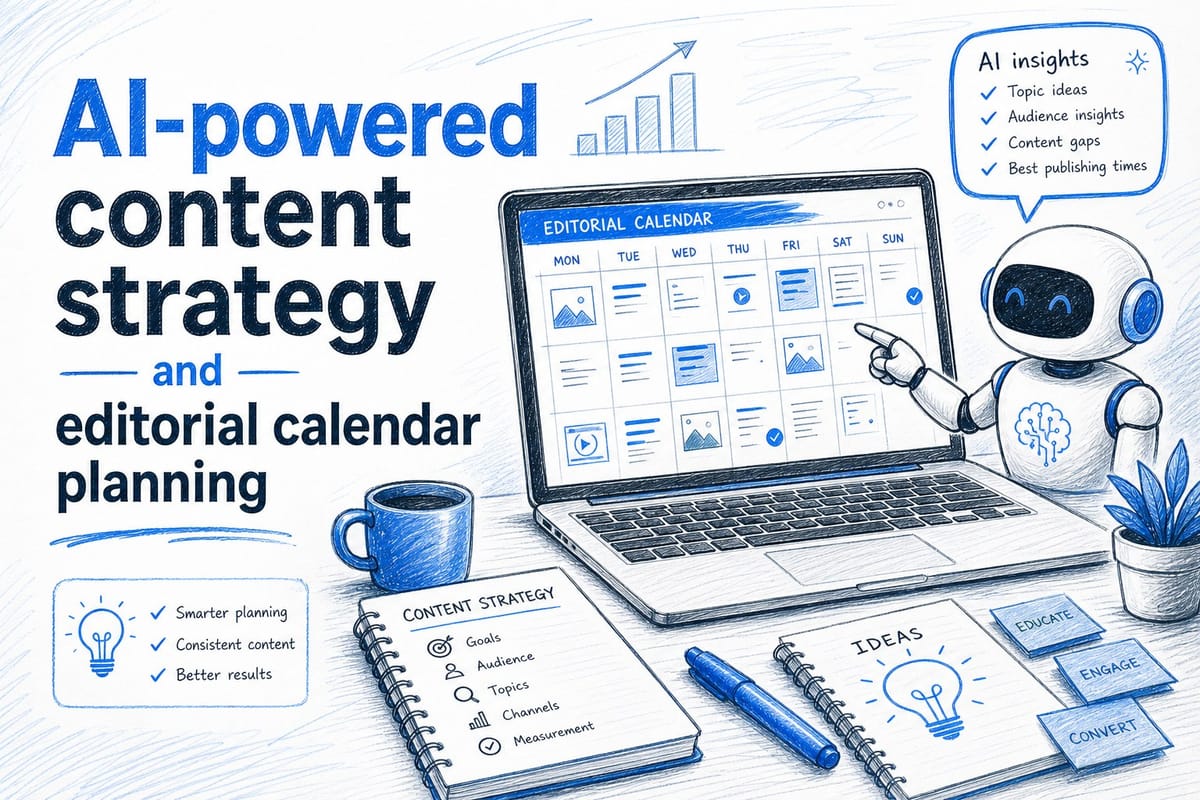
Table of contents
1. What an AI-powered content strategy actually looks like
2. Building an editorial calendar that actually gets used
3. How to move from planning to published content at scale
Planning content used to mean spreadsheets, sticky notes, and hours of research before a single word got written. Most bloggers and marketing teams describe the same bottleneck: they know they need a consistent publishing schedule, but the planning work alone eats up half the week. An AI-powered content strategy editorial calendar changes that equation. Instead of spending your best creative energy on logistics, you spend it on ideas and relationships while automation handles the heavy lifting. This article breaks down exactly how AI-driven planning works, why it outperforms manual calendars, and how to build a system that keeps your blog growing month after month.
What an AI-powered content strategy actually looks like
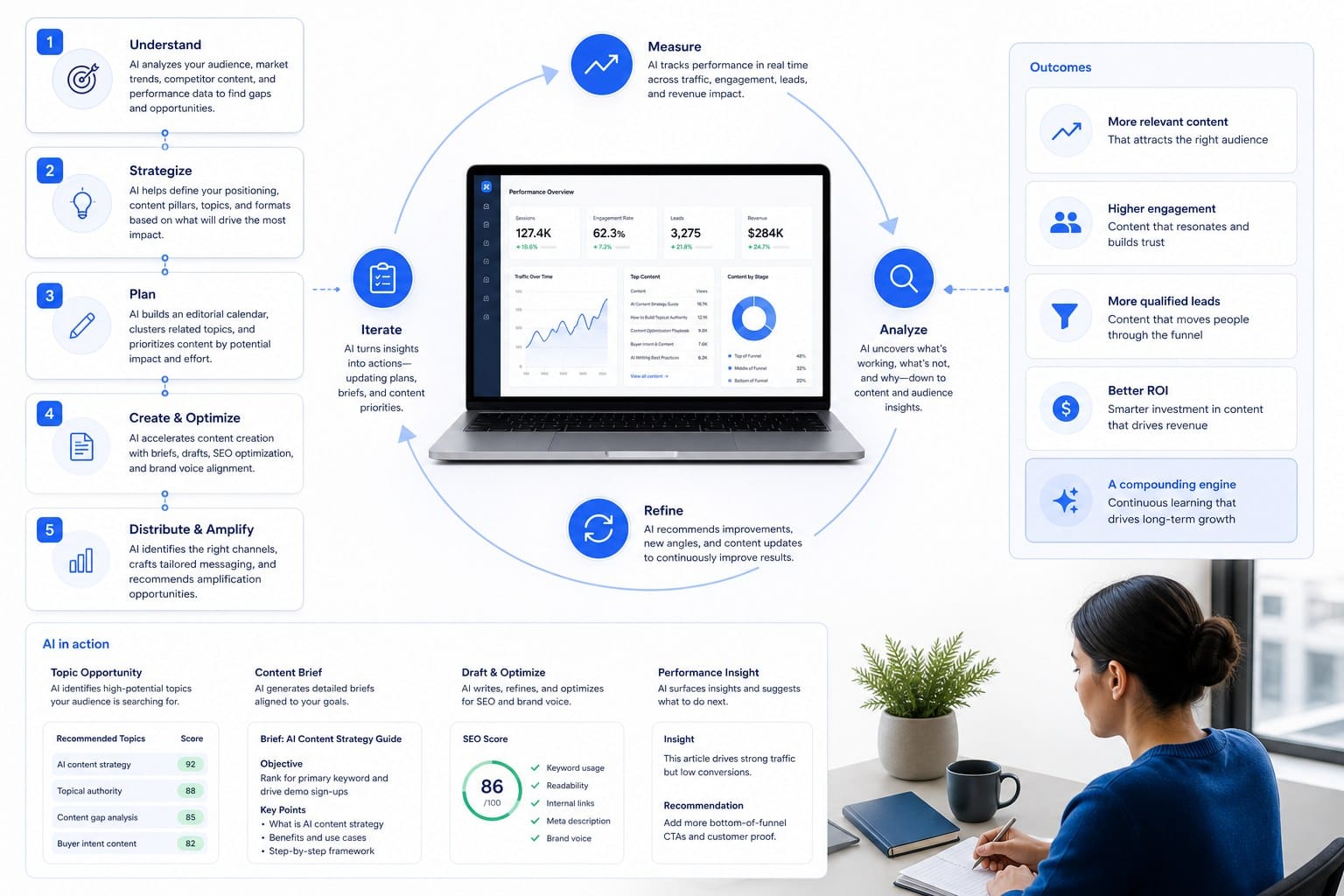
The term gets used loosely, so let me be specific. A real AI content strategy does more than generate a list of blog titles. It combines keyword research, audience intent analysis, competitive gap identification, and publishing cadence into a single connected plan.
Here is how the process typically unfolds.
First, the system analyzes your niche, your existing content if you have any, and the search landscape around your core topics. It identifies which keywords have realistic ranking potential for a site at your authority level. It also spots clusters of related topics so your content reinforces itself over time rather than sitting in isolation.
Second, it organizes those topics into a calendar. A good AI system does not just dump 30 ideas into a spreadsheet. It sequences them intentionally. A foundational pillar post might go live first, followed by supporting cluster articles that link back to it. That structure helps search engines understand your site's topical authority and rewards you with better rankings across the entire cluster, not just for a single article.
Third, it maps content to audience stages. Someone who just discovered your brand needs different content than someone who has been reading your blog for six months. An AI strategy accounts for that by mixing awareness-level posts with deeper how-to content and comparison articles. A healthy editorial calendar serves all three stages simultaneously rather than defaulting to one type indefinitely.
Some people assume AI just picks whatever keywords have the highest search volume. That approach backfires. High-volume keywords are usually dominated by established publishers with years of authority and hundreds of backlinks. A smarter strategy targets mid-range keywords with clear commercial or informational intent that your site can realistically compete for right now.
This is exactly the kind of nuanced thinking that keyword research for a blog content calendar requires. When AI handles that research layer, it applies consistent logic across hundreds of keyword variations at once, something that would take a human researcher days to complete manually and weeks to update when the search landscape shifts.
For a small business owner or an independent blogger, this matters enormously. You are not competing with the New York Times. You are competing with other niche sites in your space, and a well-structured AI-generated strategy gives you a real advantage because it is systematic rather than reactive. You are not chasing trends or writing about whatever feels interesting this week. You are executing a plan built around what your specific audience is actually searching for.
AI strategy is also not static, and that distinction matters more than most people realize. Good systems revisit the plan as new data comes in. If a particular article performs better than expected, the system identifies related angles to pursue. If a topic underperforms, it adjusts the priority ranking. That feedback loop is something a manually maintained spreadsheet almost never delivers in practice because updating it requires time that most teams simply do not have. The spreadsheet becomes a historical record rather than a living tool, which defeats its purpose entirely.
Here is a concrete example of what a well-built AI strategy looks like in practice. Imagine you run a SaaS product for project managers. Your AI strategy might identify a pillar post around remote team productivity, then build a cluster of supporting articles covering async communication tools, meeting-free work policies, and time zone management for distributed teams. Each article targets a specific keyword, links back to the pillar post, and collectively builds your site's authority in that topic area over 60 to 90 days.
That is a coherent strategy, not just a list of articles. The pillar post ranks for a broader keyword. The cluster articles rank for more specific queries and funnel readers toward the pillar. Over time, search engines see your site as a reliable source on remote team productivity and reward the entire cluster with better visibility. That outcome does not happen by accident. It happens because someone, or something, planned the architecture before the first article was written.
For content teams managing multiple writers, the AI strategy layer also serves as a coordination tool. Every writer knows exactly what they are writing, why that topic matters, how it connects to other content on the site, and what the article needs to accomplish. That clarity reduces revision cycles and improves output quality without adding management overhead.
The planning phase is also where most content strategies either succeed or fail before a single word is published. A strategy built around vague topic categories produces unfocused articles that do not rank and do not engage readers. A strategy built around specific keyword clusters, audience stages, and intentional sequencing produces content that compounds in value over time. AI makes the second approach accessible to teams that would otherwise lack the research capacity to build it manually.
Building an editorial calendar that actually gets used
The best content strategy in the world fails if the calendar behind it is ignored. This happens repeatedly across teams of every size: a significant effort goes into planning, a detailed spreadsheet gets created, and within three weeks the calendar is two months out of date and nobody looks at it anymore. The problem is almost always maintenance friction, not lack of intention.
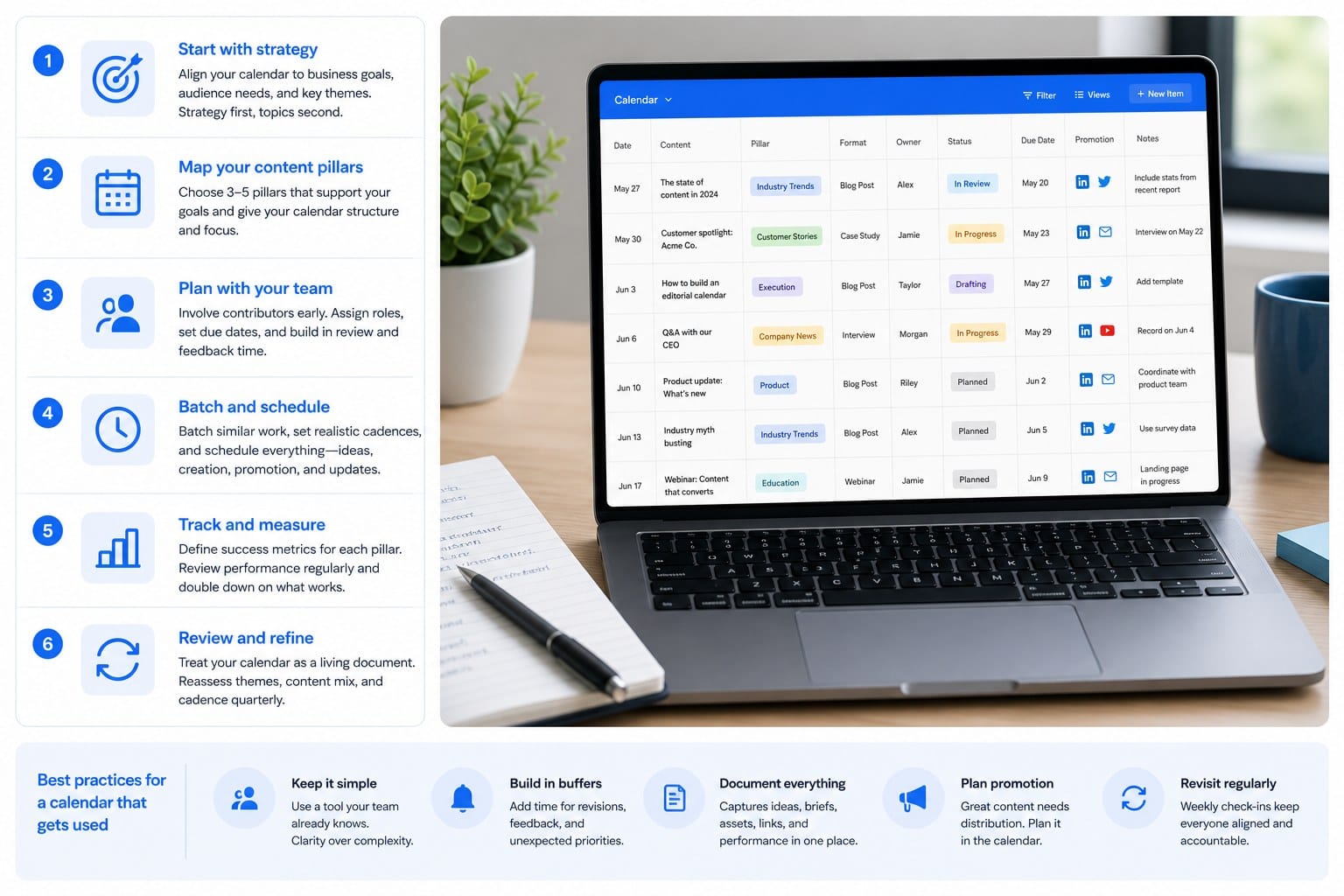
An AI-powered editorial calendar solves the maintenance problem by handling updates automatically. When a publishing date shifts, the system adjusts downstream deadlines. When a new keyword opportunity appears, it slots a new article into the schedule without requiring you to manually reorganize everything around it. The calendar stays current because the system maintains it, not because someone on the team remembers to update it.
Here is what a functional AI editorial calendar includes.
Publication dates and deadlines. Each article has a target publish date. If you are running a solo blog, that might mean one post per week. If you are managing a brand blog with multiple contributors, it might mean three to five posts per week. The calendar reflects your realistic capacity, not an aspirational pace that collapses under the first busy stretch. Overambitious calendars fail predictably. A calendar built around what you can actually sustain delivers compounding results over time.
Keyword assignments. Every article on the calendar is tied to a primary keyword and a set of secondary keywords. This is not optional. Publishing without keyword assignments means you are producing content with no clear signal to search engines about what the article should rank for. You are essentially writing into the void and hoping the right people find it. Keyword assignments eliminate that ambiguity.
Content type and format. Not every post is a standard how-to article. Some weeks you might publish a listicle, a case study, a comparison post, a deep explainer, or an interview-based piece. The calendar should specify format so the writing approach and structure match the content type before the writer opens a blank document. A case study requires a different research process than a comparison post, and knowing that in advance prevents wasted effort.
Internal linking plans. This is one of the most consistently underused elements in most editorial calendars. Before an article goes live, you should know which existing posts it will link to and which future posts will link back to it. AI systems can map these relationships automatically based on topic clustering, saving the writer the mental overhead of cross-referencing the entire content library before every article.
Distribution notes. Where will each article be shared after publication? Email newsletter, LinkedIn, a niche community forum, a podcast mention? Including distribution in the calendar means you treat each article as the start of a traffic-building sequence rather than the end of a writing project. An article that gets published and immediately forgotten leaves most of its potential traffic on the table.
One genuinely useful aspect of AI-generated calendars is that they account for seasonality without requiring you to remember it. If your niche has seasonal search patterns, an AI system trained on search data surfaces those patterns and adjusts your content schedule accordingly. A personal finance blogger might see AI prioritize tax-related content in January through March and budgeting content in the fall when people start planning for the new year. A home improvement blogger might see outdoor project content pushed to late spring. These adjustments happen automatically rather than requiring someone to audit the calendar every quarter.
For digital marketers managing brand blogs, the editorial calendar also serves as a communication tool with stakeholders. When your calendar is structured, current, and tied to real keyword data, it is much easier to explain content decisions to a leadership team or a client. You can show exactly why you are publishing a specific article on a specific date and what metric it is designed to move. That transparency builds trust and reduces the endless approval cycles that slow down publishing schedules.
Consistency is the compounding factor that most people underestimate when they think about content marketing. The first few months of a new content strategy often look slow. Organic traffic builds gradually, sometimes imperceptibly. Then something shifts. Topic authority accumulates, older articles start ranking, and newer articles rank faster because the site has established credibility in the space. Consistent blog publishing delivers the highest ROI for growing brands precisely because of this compounding dynamic, and a calendar that runs on autopilot is what makes that consistency achievable over months rather than just weeks.
There is also a psychological dimension to calendar planning that deserves acknowledgment because it is real and it affects output quality. When you have a clear plan in front of you, writing becomes easier. Decision fatigue is a genuine productivity killer for content creators. When you sit down to write and have to decide what to write about, choose a keyword, think through an angle, and figure out a structure all at once, you burn creative energy before you type a single sentence. A pre-built calendar eliminates that friction entirely. You open your calendar, see what is scheduled for today, and start writing. The strategic work is already done.
For teams using Ghost CMS, the integration between calendar planning and actual publishing becomes particularly powerful. When your editorial calendar connects directly to your CMS, scheduled articles move from draft to published without manual intervention. Writers and editors work in the content pipeline. The published post appears on the site on schedule. No manual copy-paste, no formatting cleanup, no risk of a post not going live because someone forgot to toggle a setting. That level of operational reliability is what separates a content operation that scales from one that stalls every time the team gets busy.
A well-maintained editorial calendar also creates an institutional memory that most content teams lack. When a team member leaves or a contractor wraps up a project, everything they worked on and planned is documented in the calendar. New contributors can orient themselves quickly, understand the strategic direction, and produce content that fits the existing architecture without a lengthy onboarding process. That knowledge transfer capability becomes more valuable as the content library grows.
How to move from planning to published content at scale
Planning and calendaring are valuable, but the real bottleneck for most bloggers and marketing teams is execution. Turning a keyword and a topic idea into a published, well-researched article takes time. For a thorough long-form post, you might spend two to four hours on research alone before writing begins. Multiply that across a 30-day calendar with 12 or 15 articles, and you can see why most content plans collapse under their own weight. The strategy is sound. The calendar is built. But nobody has the bandwidth to actually produce everything on it.
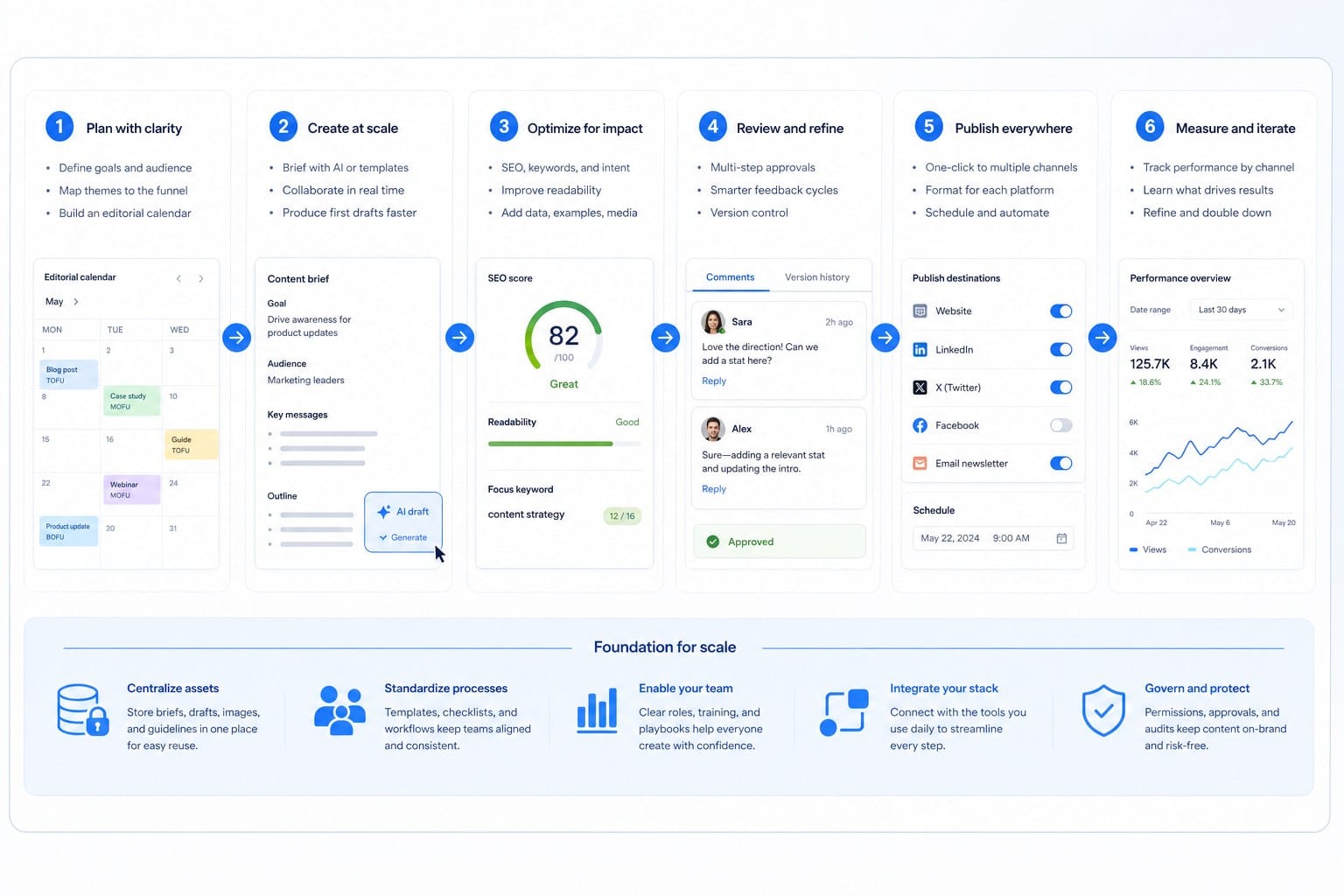
This is where the execution layer of an AI-powered content strategy editorial calendar makes the biggest difference. AI tools that handle research, drafting, and formatting allow you to move from calendar plan to published article in a fraction of the time it would take manually. Each step in the production process gets faster, and the cumulative time savings across a full month of content are substantial.
Here is what that execution process looks like in practice.
Research. AI content systems pull relevant information from across the web to build a research brief for each article. That brief typically includes the primary and secondary keywords, a suggested article structure based on what is currently ranking for that query, key points that should be covered to satisfy search intent, and relevant data points or statistics worth referencing. A writer reviewing a well-constructed AI research brief can get oriented in 10 minutes instead of spending an hour building that foundation from scratch. That time difference across 15 articles per month adds up to days of recovered capacity.
Drafting. AI drafts vary widely in quality depending on the system. The best ones produce content that reads naturally, follows the research brief closely, and includes specific examples rather than generic filler. Thin content does not rank well and does not keep readers engaged, so the quality of the initial draft matters beyond just speed. A solid AI draft cuts editing time dramatically compared to writing from scratch, and it gives the human reviewer something concrete to react to rather than a blank page to fill.
Formatting and structure. Long-form articles benefit from clear heading hierarchies, short paragraphs, and formatting elements that make the content easy to scan on both desktop and mobile. AI systems that understand on-page SEO apply proper heading tags, generate a meta description, and structure the article in a way that aligns with how search engines parse and evaluate content. Getting this right at the drafting stage means less cleanup before publishing.
Visuals. Many teams skip visuals entirely because sourcing or creating them takes time that is not always available. AI content engines that generate on-brand visuals automatically remove that barrier. A well-formatted article with relevant images consistently performs better in both engagement metrics and search rankings than the same article published without visual elements. Including visuals in the automated workflow means they happen by default rather than when someone gets around to it.
Publishing. For teams using Ghost or similar CMS platforms, automated publishing means the article moves from the content pipeline to the live site on schedule. No manual copy-paste between tools, no formatting degradation when content moves from a drafting environment to the CMS editor, no missed publish dates because someone was out of office. The content operation runs on schedule regardless of what else is happening on the team.
The platforms that handle this full workflow are worth distinguishing from standalone AI writing tools, because the difference is significant. There is a meaningful gap between a tool that helps you write faster and a platform that manages your entire content operation from strategy to publication. A comparison of Jasper, Writesonic, and full AI blog engines illustrates this distinction clearly. Writing assistance tools speed up the drafting step. Full content engines handle planning, research, drafting, formatting, and publishing as an integrated workflow that requires minimal ongoing management.
For a SaaS founder focused on growing organic traffic, the value of a full workflow engine is straightforward. You are not in the content business. You are in the software business. You need the content machine to run without requiring your constant attention. A platform that generates a 30-day content strategy, produces the articles, and publishes them to your blog on schedule means you can focus on your product and your customers while organic traffic builds in the background. That is a fundamentally different operating model than hiring a content team or trying to write everything yourself.
For an independent blogger trying to scale without hiring, the math points in the same direction. Hiring a content strategist, a researcher, a writer, and a designer is expensive and complicated to manage. An AI platform that handles those functions at a fraction of the cost changes what is possible for a solo creator. You can publish at a volume and quality level that previously required a team of four or five people.
For a small business owner who needs to compete online but does not have time to become a content marketing expert, the value proposition is different but the outcome is the same. You maintain a professional, consistent blog presence that builds trust with potential customers and drives organic search traffic, without making content creation a second full-time job. The business gets the SEO benefits of active publishing without the owner having to become a writer or a strategist.
Being honest about what AI content systems do not replace is equally important. They do not replace your expertise, your perspective, or your relationship with your audience. The best AI-assisted content operations treat AI as infrastructure rather than as the author. The human brings the insights, the brand voice, the original opinions, and the judgment calls about what the audience actually cares about. The AI handles the research, the structure, the drafting scaffolding, and the logistics. When those roles are clearly defined and respected, output quality is high and the publishing pace is sustainable over the long term.
Start with a 30-day plan rather than trying to map out six months at once. A 30-day calendar is specific enough to execute on and short enough to adjust based on what you learn. After the first month, you have real performance data: which articles are getting organic traffic, which topics are generating comments or shares, which keywords are beginning to move in Google Search Console. You use that data to refine the next 30-day plan. That iterative approach compounds in ways that a static six-month plan never does, because a static plan cannot incorporate what you learn from actual reader behavior.
Make internal linking part of your execution checklist, not an afterthought. Every article you publish should link to at least two or three relevant posts already on your site, and you should update older posts with links pointing to the new article. This practice strengthens topical authority faster than almost any other on-page tactic. AI systems that map these relationships before drafting and include them in the initial content automatically save considerable time and ensure the practice actually happens rather than getting skipped when publishing deadlines get tight.
Track the right metrics from the beginning. Page views are satisfying but not always meaningful as a measure of strategic progress. Focus on organic search impressions and clicks in Google Search Console, average position for your target keywords, time on page as an indicator of content quality, and conversion events relevant to your specific goals. These metrics tell you whether your content strategy is working as intended and give you the information you need to make each successive 30-day plan better than the last. A content operation that improves its strategy monthly based on real data will significantly outperform one that publishes consistently but never adjusts based on what the numbers show.
The teams and creators who get the most out of AI-powered content operations are the ones who treat the system as a long-term investment rather than a short-term experiment. Organic search authority builds over months and years. The compounding returns on consistent, well-planned publishing are real, but they require patience and persistence. An AI-powered editorial calendar makes that persistence manageable because it removes the planning overhead and execution friction that cause most content strategies to stall before they reach the point where compounding kicks in.
Ready to take the next step?
If you are ready to stop managing content planning by hand and start publishing consistently without the manual overhead, Blogtude handles the entire workflow for you. From a 30-day AI-powered content strategy to deeply researched articles and automatic publishing to Ghost and other CMS platforms, Blogtude is built for bloggers, founders, and marketers who need results without the busywork. Visit blogtude.com to see how it works and get your first 30-day content strategy started.