
Why consistent blog publishing delivers the highest ROI for growing brands

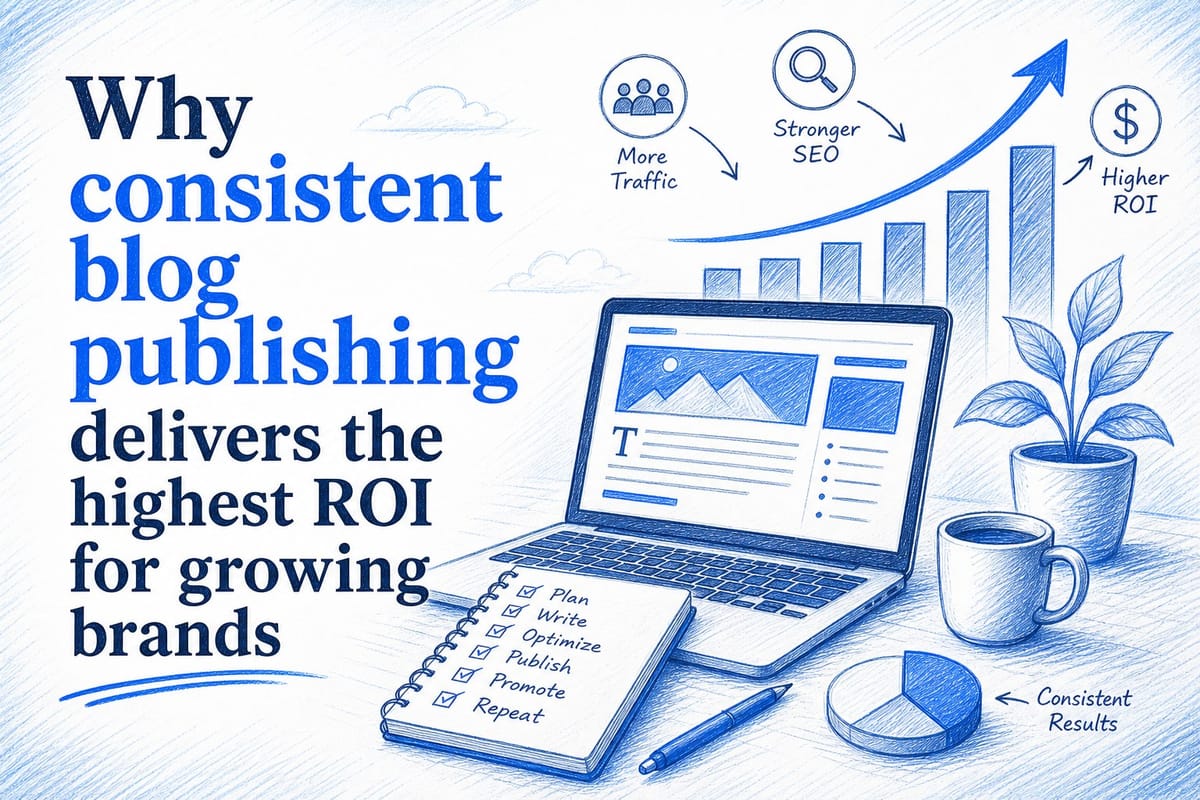
Table of contents
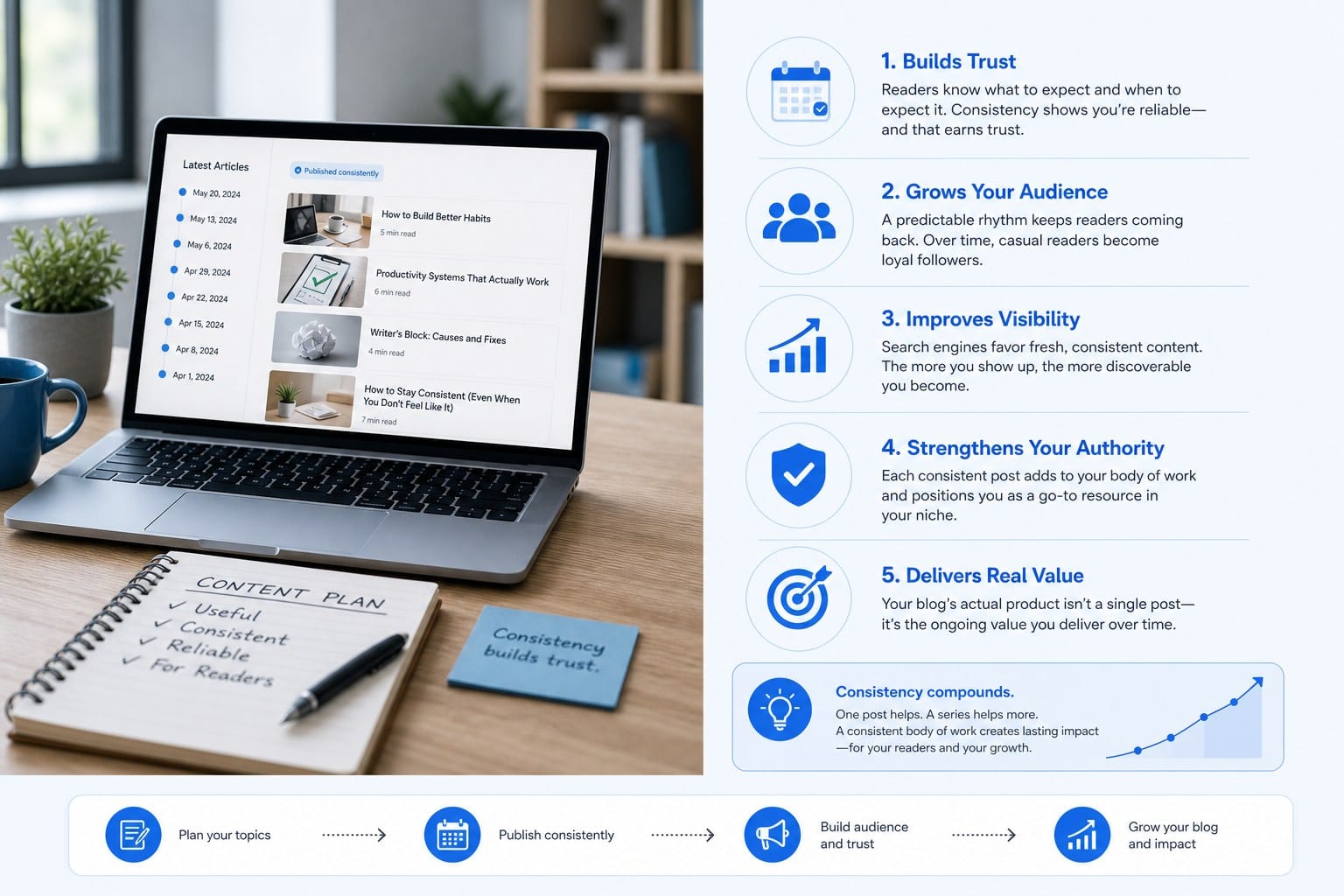
1. Why consistency is the actual product your blog delivers
2. How compounding content creates long-term brand assets
3. The real barrier to consistent publishing and how to remove it
Most growing brands treat their blog like a side project. They publish a few posts when time allows, go quiet for weeks, then scramble to push out something before a product launch. That stop-start rhythm feels productive in the moment, but it quietly kills organic growth. The brands that actually win with content do the opposite. They publish consistently, on a schedule, with a clear strategy behind every post. And the numbers back this up hard. Research cited by HubSpot shows that brands prioritizing blogging are 13 times more likely to see positive ROI than those that don't. That stat alone should reframe how you think about consistent blog publishing ROI for brands at every stage of growth. In this article, I'll walk through exactly why consistency is the engine behind that return, how compounding content creates an asset that keeps paying off, and what it takes to maintain that output without burning out your team.
Why consistency is the actual product your blog delivers
When people talk about blogging ROI, they often focus on individual posts. Did that article rank? Did it drive traffic? Did anyone share it? Those are fair questions, but they miss the bigger picture. The ROI from blogging does not come from one great article. It comes from a body of work that builds trust, topical authority, and search visibility over time. A single post is a drop of water. A consistent publishing schedule is a river.
Think about how search engines evaluate a website. Google looks at signals like how often a site publishes fresh content, how deeply it covers a topic, and how many authoritative sites link back to it. A brand that publishes two or three well-researched posts per week sends strong signals on all three fronts. A brand that publishes whenever the mood strikes sends weak, inconsistent signals that are hard for search engines to interpret.
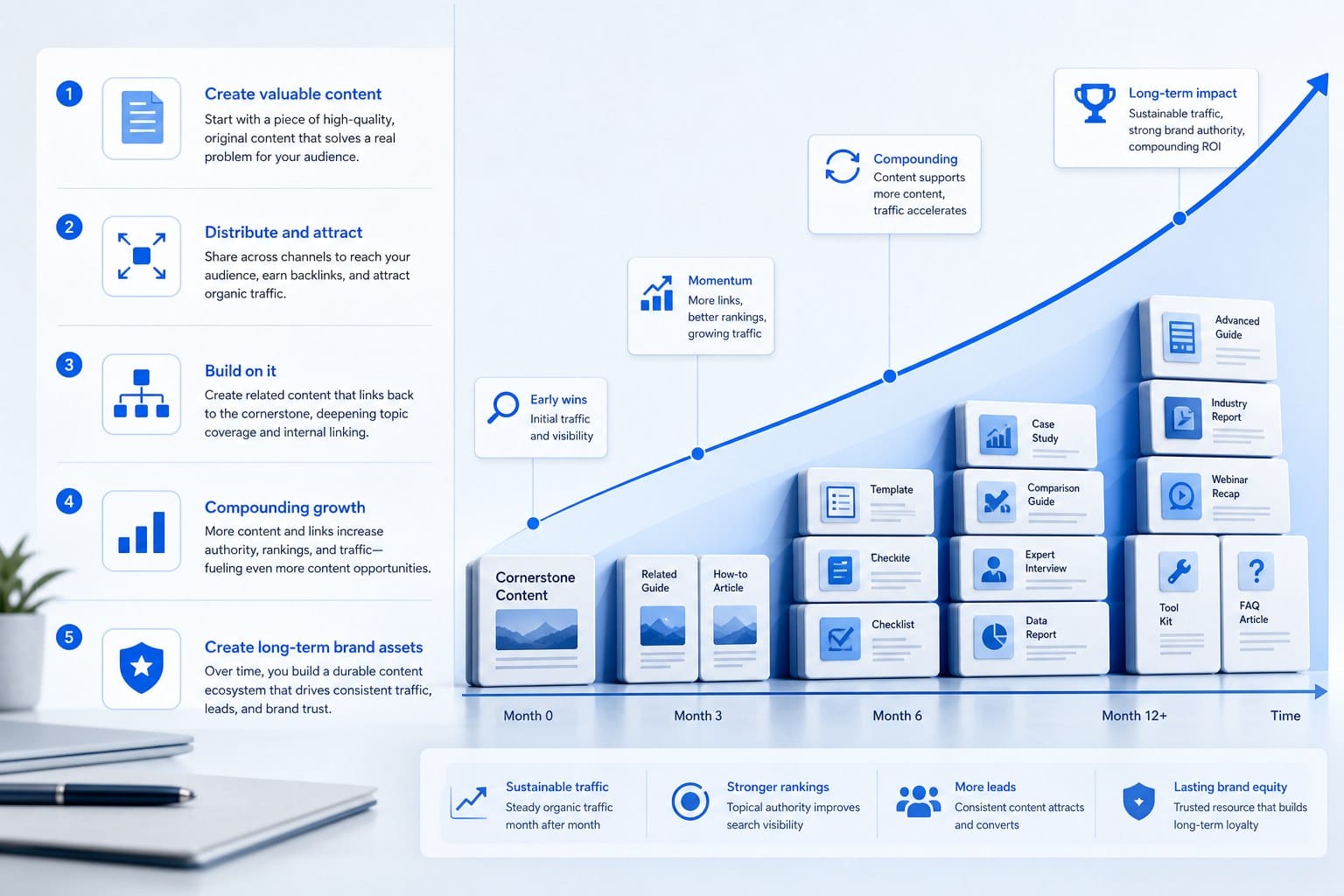
This is why domain authority and organic traffic tend to grow in a compounding pattern for consistent publishers. The first month of blogging produces modest results. Months three through six often show the first real traffic gains. By month twelve, a brand with a consistent publishing history typically has dozens of indexed articles pulling in long-tail search traffic across many different queries. Each new post adds to that network, and older posts continue to accumulate backlinks and social shares on their own.
Data from e-commerce research supports this pattern. Most brands that blog regularly start to see measurable traffic gains within three to six months, and domain authority keeps climbing as the content library grows. That trajectory is almost impossible to achieve with sporadic publishing because the momentum resets every time you go silent.
Consistency also does something that is harder to measure but just as important. It builds reader trust. When someone finds your blog and sees that you publish regularly on topics they care about, they are more likely to bookmark it, subscribe, and return. That repeat behavior signals quality to search engines and creates a direct relationship with an audience that is already interested in what you sell. A blog that publishes once in March and then again in July does not build that kind of relationship. It just creates disconnected content that has no narrative thread.
There is also a lead generation angle worth understanding. Research from multiple content marketing studies shows that companies with blogs generate around 67% more leads than companies without them. That gap widens further when you compare consistent bloggers against inconsistent ones. Businesses that publish between two and six times per week are significantly more likely to see higher lead quality and greater engagement than brands that publish less frequently. Frequency matters because it keeps your brand visible, positions you as an authority, and gives you more surface area to capture search intent at different stages of the buyer journey.
One way to think about it: every post you publish is a new entry point into your brand. A brand with 200 published articles has 200 potential doors that searchers can walk through. A brand with 20 articles has 20. The math is not complicated, but the discipline required to get to 200 articles is where most brands fall short. Consistency is not glamorous. It is a systems problem, and solving it is what separates brands that see compounding content ROI from brands that wonder why their blog is not working.
If you want to go deeper on how to structure your site around consistent output, the guide on how to turn your website into a content marketing engine lays out a practical framework for doing exactly that.
How compounding content creates long-term brand assets
One of the most underappreciated truths about blog content is that it does not expire the way paid ads do. When you run a paid search campaign, your traffic exists only as long as your budget does. The moment you stop spending, the traffic stops. Blog content works the opposite way. A well-optimized article can drive traffic and generate leads for years after it was published, often with minimal maintenance.
This is what people mean when they talk about compounding content. Each post you publish has its own lifecycle. It gets indexed, it starts to rank for relevant queries, it attracts backlinks from other sites, and it continues to pull in organic visitors month after month. When you multiply that lifecycle across dozens or hundreds of articles, the cumulative effect becomes a significant business asset. Websites with active blogs have been shown to generate 97% more inbound links than those without, which directly feeds domain authority and long-term search rankings.
Content pillars make this compounding effect even stronger. A content pillar is a long-form piece that covers a broad topic comprehensively, supported by a cluster of shorter posts that go deep on specific subtopics. When these articles link to each other intelligently, search engines can understand the topical structure of your site and reward you with stronger rankings across the entire cluster. Companies that use structured content strategies like this generate 67% more leads than those without a deliberate framework, according to research from content marketing analysts.
Here is a concrete example of how this works in practice. Imagine a SaaS brand that sells project management software. Their content pillar might be a definitive guide to project management for remote teams. Supporting posts might cover topics like async communication workflows, how to run effective standups, managing task dependencies across time zones, and tools for tracking team productivity. Each post links back to the pillar, and the pillar links out to the cluster. A visitor who lands on any one of those posts encounters a coherent, interconnected knowledge base. Search engines see a site that covers this topic with real depth, and they rank it accordingly.
For independent bloggers and small business owners, this compounding model is especially powerful because it allows them to compete with larger brands on a lower budget. A consistent publishing schedule over twelve to eighteen months can produce an article library that rivals what a much bigger competitor built with a full content team, especially when the content is well-researched and genuinely useful.
The key word there is genuinely useful. Compounding works when the content earns links, shares, and return visits on its own merits. Articles that are thin, poorly researched, or just keyword-stuffed do not compound. They sit in an index and do nothing. The compounding model only pays off when you are publishing content that people actually want to read and share. That requires real research, clear writing, and a consistent voice that readers recognize over time.
It also requires a long-term mindset. Most brands give up on blogging too early because they do not see immediate results and assume the strategy is not working. The reality is that the ROI from consistent blogging is backloaded. You do months of work before the compounding kicks in, and then it accelerates. Brands that stick with it through the early months are the ones that eventually look back and realize their blog is one of their highest-performing marketing channels.
For SaaS founders specifically, understanding how to build out that compounding structure from scratch is critical. The SEO content strategy for independent bloggers: a step-by-step playbook covers how to build a sustainable content structure that supports long-term growth without requiring a large team.
Another dimension of compounding content that is easy to overlook is the relationship between blog content and your other marketing channels. Blog posts give you source material for email newsletters, social media posts, short-form video scripts, podcast episodes, and sales enablement materials. A single well-researched 2,000-word article can be repurposed into five LinkedIn posts, a newsletter issue, and a handful of short social clips. When you publish consistently, you create a steady supply of this raw material. When you publish sporadically, your entire content operation stalls because there is nothing new to work with.
This is why the ROI of consistent blogging extends beyond just SEO. It feeds the whole marketing system. Brands that blog regularly tend to have more active social channels, stronger email engagement, and better sales conversations because their content is continuously educating and warming up their audience. The blog is not just a traffic source. It is the engine that keeps the rest of the content machine running.
The real barrier to consistent publishing and how to remove it
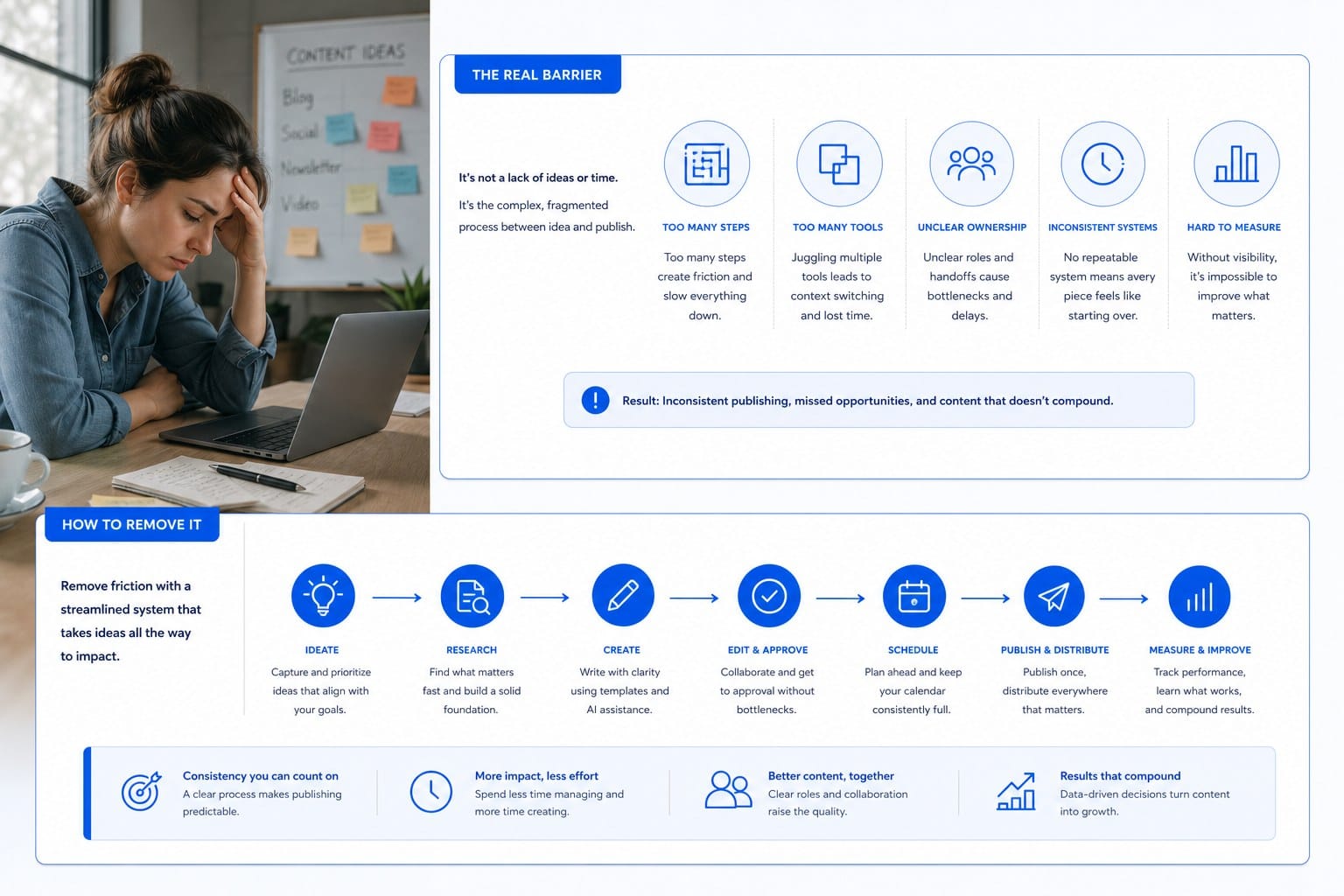
If consistent blog publishing ROI for brands is so clear, why do so many brands still struggle to maintain a regular schedule? The answer is almost never strategy. Most founders and marketers understand the value of blogging. The barrier is execution. Specifically, the time, resources, and systems required to consistently research, write, publish, and distribute high-quality content.
Let's be honest about what consistent blogging actually demands. A single well-researched blog post typically takes three to five hours to produce, sometimes more for technical topics. That includes keyword research, competitive analysis, outlining, drafting, editing, formatting, sourcing images, writing metadata, and scheduling the post. Multiply that by two or three posts per week, and you are looking at a part-time job on top of everything else you are already managing.
For a solo founder running a SaaS startup, that time does not exist. For a small business owner who is already managing operations, customer service, and sales, it is not realistic. Even for digital marketers managing a brand blog, the volume required to build real compounding authority can quickly outpace what a single person or small team can sustain. This is why most brands start a blog with good intentions, publish a dozen posts, and then quietly let it go dormant.
The gap between knowing that consistent publishing drives ROI and actually maintaining that consistency is where most brands lose. And closing that gap is a systems problem, not a motivation problem. The brands that sustain consistent output over years are not the ones with the most motivated writers. They are the ones with the most reliable systems.
There are a few ways to build those systems. You can hire a content team, which works well if you have the budget and the management bandwidth, but it is expensive and slow to scale. You can work with freelance writers, which offers flexibility but requires significant editorial oversight and coordination time. Or you can use an AI-powered content engine that handles the research, writing, and publishing workflow automatically, which is what Blogtude is built to do.
Blogtude generates a 30-day content strategy, produces deeply researched long-form articles with on-brand visuals, and automatically publishes to Ghost and other CMS platforms. For Ghost CMS users in particular, it offers a fully integrated workflow that removes the manual steps between content strategy and live publication. For SaaS founders, independent bloggers, and small business owners, it means you can maintain the publishing frequency that drives compounding growth without needing to hire a team or spend hours each week on content production.
The question worth asking is not whether AI content can replace human expertise. It cannot, and anyone claiming otherwise is overselling. The better question is whether AI tools can handle the repeatable, research-heavy parts of content production well enough to free up human attention for strategy, brand voice, and high-stakes creative decisions. For most growing brands, the answer is yes, and the productivity gains are substantial.
When you are evaluating tools for this kind of workflow, it is worth understanding the difference between tools that generate copy and tools that manage a full publishing workflow. Many AI writing tools produce text, but they stop there. You still need to handle research, structure, image sourcing, SEO optimization, and CMS publishing manually. A full publishing workflow tool handles all of those steps end to end, which is where the real time savings come from. The comparison between different AI content tools covered in this article on Jasper vs Writesonic vs AI blog engines: which handles full publishing workflows is worth reading if you are trying to make that distinction.
Beyond tools, building consistency also requires a few mindset shifts. The first is treating your blog like a product, not a project. Projects have start and end dates. Products get iterated, maintained, and improved continuously. When you see your blog as a long-running product, you stop treating sporadic publishing as acceptable and start building the systems and schedules that keep it moving.
The second shift is letting go of perfectionism at the individual post level. Many brands publish infrequently because they want every post to be flawless before it goes live. But a good post published on schedule consistently outperforms a perfect post published once every six weeks. The compounding effect comes from volume and consistency over time, not from any single piece of content being exceptional. You want every post to be genuinely useful and well-researched, but you do not need every post to be a magnum opus.
The third shift is thinking in quarters, not days. The ROI from consistent blogging is not visible in a day or a week. It builds over months. Brands that track content performance on a ninety-day cycle are much better positioned to see the compounding trajectory and stay the course than brands that check their analytics every morning looking for an immediate spike. Set publishing goals at the quarterly level, track domain authority and organic traffic trends, and give your content strategy enough time to compound before making dramatic changes.
For small business owners who have tried blogging and given up, the issue is almost always one of these three problems: the process was too time-consuming to sustain, the results were not visible fast enough to justify continued investment, or both. Solving the process problem with the right tools and systems is what makes it possible to stay consistent long enough to see the compounding results that make the ROI undeniable.
The brands that crack this are the ones that stop thinking about blogging as an occasional marketing tactic and start treating it as a core growth infrastructure. Once that shift happens, consistent publishing becomes something you protect and invest in rather than something you squeeze in when you have time. And that is when the ROI from your blog starts to look dramatically different from what you were seeing before.
Ready to take the next step?
If you are ready to stop publishing sporadically and start building a content engine that compounds over time, Blogtude gives you a complete solution. From 30-day content strategy to fully researched articles to automatic publishing on Ghost and other platforms, it handles the workflow so you can focus on growing your brand. Visit blogtude.com to see how it works.