
Jasper vs Writesonic vs AI blog engines: which handles full publishing workflows

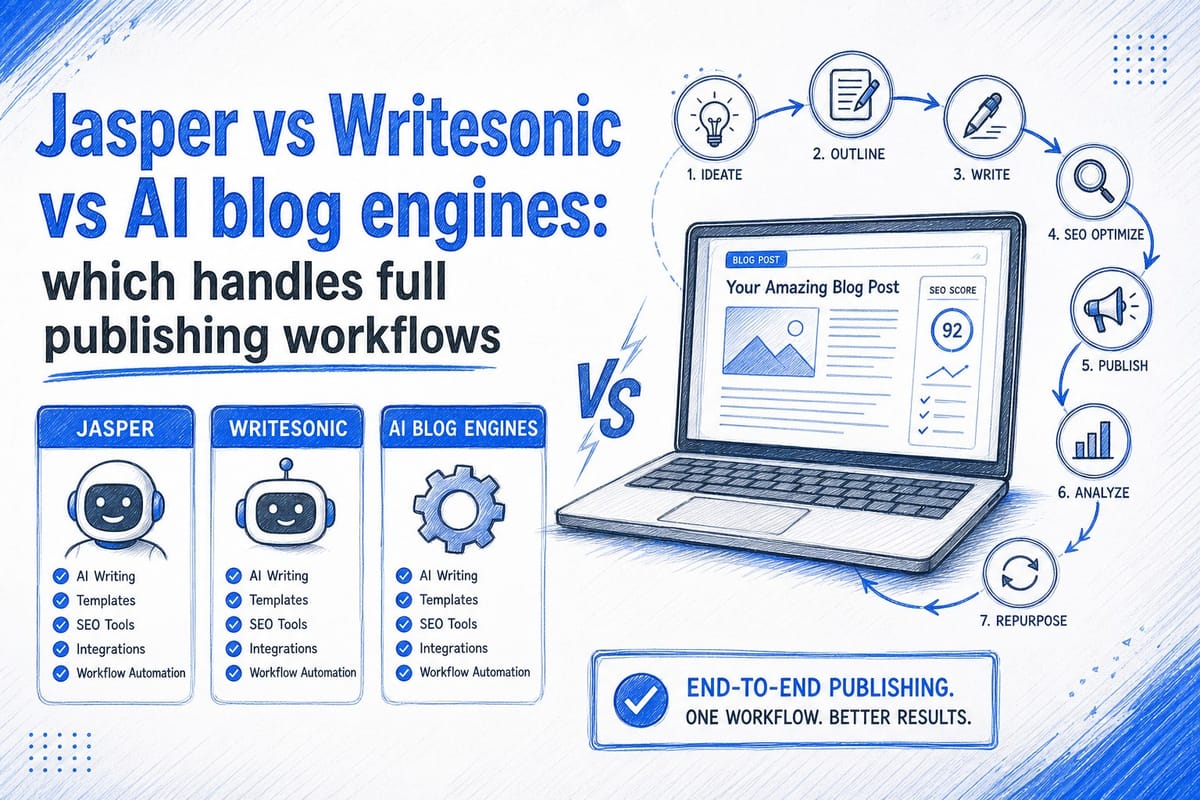
Table of contents
1. What Jasper and Writesonic are actually built to do
2. What a dedicated AI blog engine does differently
3. Choosing the right tool for your actual publishing situation
If you have spent any time researching AI writing tools, you have probably run into the jasper vs writesonic vs ai blog engine debate more than once. The three categories sound similar on the surface. They all use AI to produce written content, and they all promise to save you time. But they solve very different problems, and picking the wrong one can leave you with a folder full of drafts and still no published posts. In this article, I want to break down exactly what each option does well, where each one falls short, and which type of tool actually handles a full publishing workflow from strategy to live post.
What Jasper and Writesonic are actually built to do
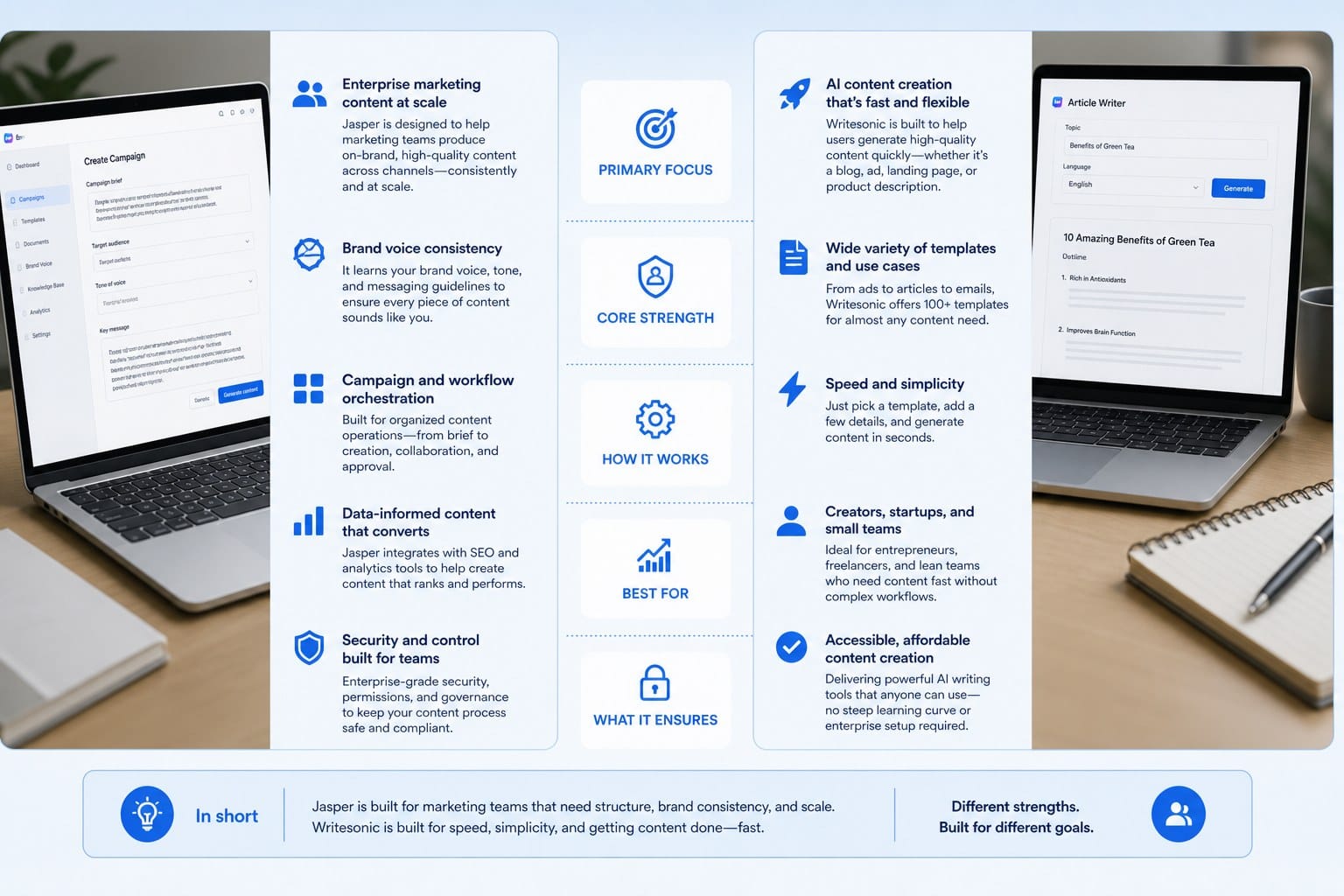
Jasper and Writesonic are AI writing assistants. That is an important distinction. They are built to help you write faster, not to manage the entire process of planning, producing, and publishing content at scale.
Jasper started as a long-form document editor powered by large language models. You give it a brief, a tone setting, and some context, and it generates text you can edit and refine. Over time, Jasper added templates for blog posts, ad copy, social captions, and more. It also added a feature called Jasper Chat, which lets you have a back-and-forth conversation with the AI to develop ideas. The tool is genuinely good at producing readable first drafts, especially when you feed it detailed instructions.
Writesonic works in a similar way. It has a blog article wizard that walks you through choosing a title, picking an outline, and generating sections one at a time. It also has a tool called Chatsonic that adds real-time web search so the AI can pull in current information rather than relying only on its training data. That is a real advantage for topics where freshness matters, like news-adjacent content or product comparisons.
Both tools are popular because they lower the barrier to writing. If you stare at a blank page and freeze, either of these tools will get words on the screen quickly. If you need to produce ad copy, email sequences, or short social posts alongside your blog content, both platforms cover that ground.
But here is where the limitations show up clearly.
Neither Jasper nor Writesonic plans your content calendar for you. You still have to decide what topics to cover, what keywords to target, and how your articles should connect to each other over time. The tools generate content on demand, but the strategy sits entirely with you.
Neither tool does deep research by default. They pull from training data or, in Writesonic's case, from live web searches. But they do not go out and synthesize multiple sources, check claims against primary data, or build the kind of depth that separates a genuinely useful long-form article from a surface-level summary. You can prompt them to do more, but that requires significant manual effort and a lot of back-and-forth.
And critically, neither tool publishes anything for you. After you generate your draft, you still have to copy it into your CMS, add images, format headings, add internal links, set your meta description, and hit publish. For someone publishing one or two posts a month, that is manageable. For someone trying to maintain a consistent content output of multiple posts per week, that workflow breaks down fast.
This is not a criticism of either platform. They are doing what they were designed to do. But if your goal is to run a complete content operation without hiring a team, an AI writing assistant is only one piece of the puzzle, and it is not the piece that automates the hard parts.
For independent bloggers and SaaS founders who want to build real organic traffic, the gap between generating a draft and having a published, optimized post on your site is often where the whole system collapses. You can read more about what a full content operation actually requires in this guide on how to turn your website into a content marketing engine.
So when people compare these writing tools to AI blog engines, they are not comparing apples to apples. They are comparing a power tool to a full production system. The next section covers what a purpose-built AI blog engine actually does differently.
What a dedicated AI blog engine does differently
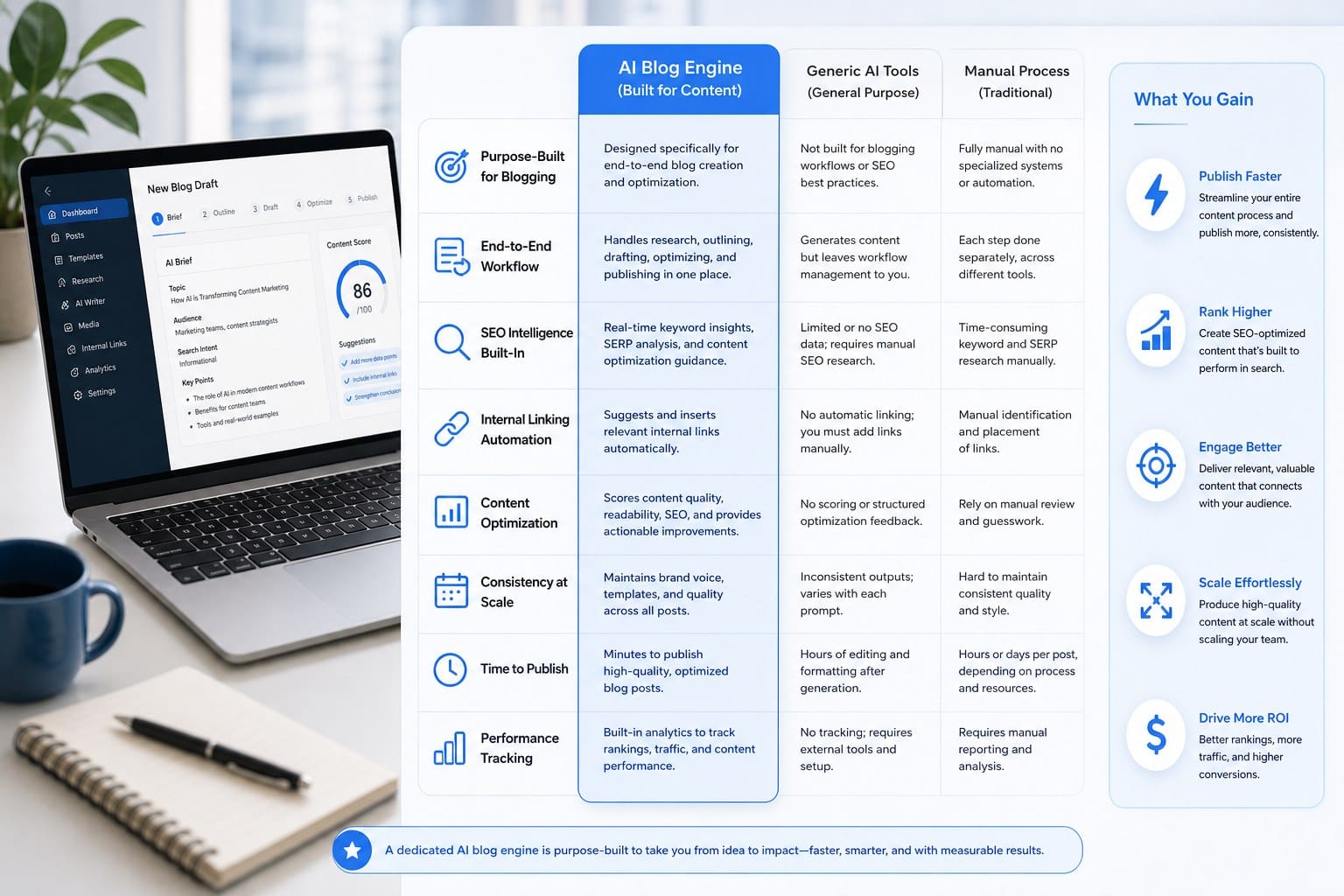
An AI blog engine is not just a faster way to write. It is a system that handles the full workflow: strategy, research, writing, visuals, and publishing. The difference matters a lot when you are trying to run a consistent content operation without a team behind you.
Let me walk through what that actually looks like in practice.
Start with strategy. A writing assistant waits for you to decide what to write. An AI blog engine generates a content strategy for you. That means analyzing your niche, identifying keyword opportunities, and mapping out a publishing plan, often covering 30 days of content at once. Instead of staring at a blank editorial calendar and wondering what to publish next week, you have a full schedule of topics that connect to your business goals and target real search intent. For a SaaS founder trying to grow organic traffic, or a small business owner who barely has time to run the business, that planning layer alone is a significant unlock.
Next comes research. This is where the quality gap between writing assistants and purpose-built blog engines becomes obvious. A writing assistant generates text. A blog engine that is built for quality goes deeper: it synthesizes information from multiple sources, checks for accuracy, builds genuine expertise into the article, and produces something that gives a reader real value rather than a padded summary of what they could already find on the first page of search results. Deeply researched articles perform better in search, earn more backlinks, and build more trust with readers over time. That research depth is hard to replicate when you are manually prompting a writing assistant one paragraph at a time.
Then there is the writing itself. A good AI blog engine produces long-form articles that are structured for both readers and search engines. That means proper heading hierarchies, naturally integrated keywords, internal link suggestions, and a reading experience that actually holds attention rather than rambling through generic paragraphs. The output is meant to be ready to publish, not a rough draft that needs another hour of editing.
Visuals are another piece that writing assistants skip entirely. Blog posts with relevant images perform better in engagement metrics, and sourcing or creating on-brand visuals for every post is time-consuming. An AI blog engine that handles visual generation as part of the workflow removes that step from your plate.
And then there is publishing. This is the step that most content creators underestimate when they first start using AI writing tools. You can have a perfectly written article, but if you still have to manually move it into your CMS, format everything, add images, set metadata, and schedule the post, you have not actually saved that much time. A tool that publishes directly to Ghost or another CMS closes that gap completely. Your content goes from strategy to live post without you touching every intermediate step.
Blogtude is built around this full-workflow model. It generates a 30-day content strategy, produces deeply researched long-form articles with on-brand visuals, and automatically publishes to Ghost and other CMS platforms. For Ghost CMS users in particular, that integration means you are not cobbling together separate tools and hoping they work together. The whole system is designed to run as one connected operation.
For digital marketers managing brand blogs, the value shows up differently than it does for solo bloggers. A marketer can set up the content system, review and approve the output, and let the engine handle the heavy lifting of research, writing, and publishing. That is a very different job than spending hours each week generating and editing drafts in a writing assistant. You can see how this kind of setup works in more detail in this guide on how digital marketers can automate brand blog workflows without losing quality.
The jasper vs writesonic vs ai blog engine comparison really comes down to this: are you looking for a better writing experience, or are you looking for a complete content system? Both are legitimate needs. But they call for very different tools.
If you publish occasionally and you enjoy the writing process, a writing assistant gives you a useful speed boost. If you are trying to maintain consistent output, build organic traffic systematically, and avoid spending your entire week on content production, a purpose-built blog engine is a fundamentally different category of solution.
Choosing the right tool for your actual publishing situation
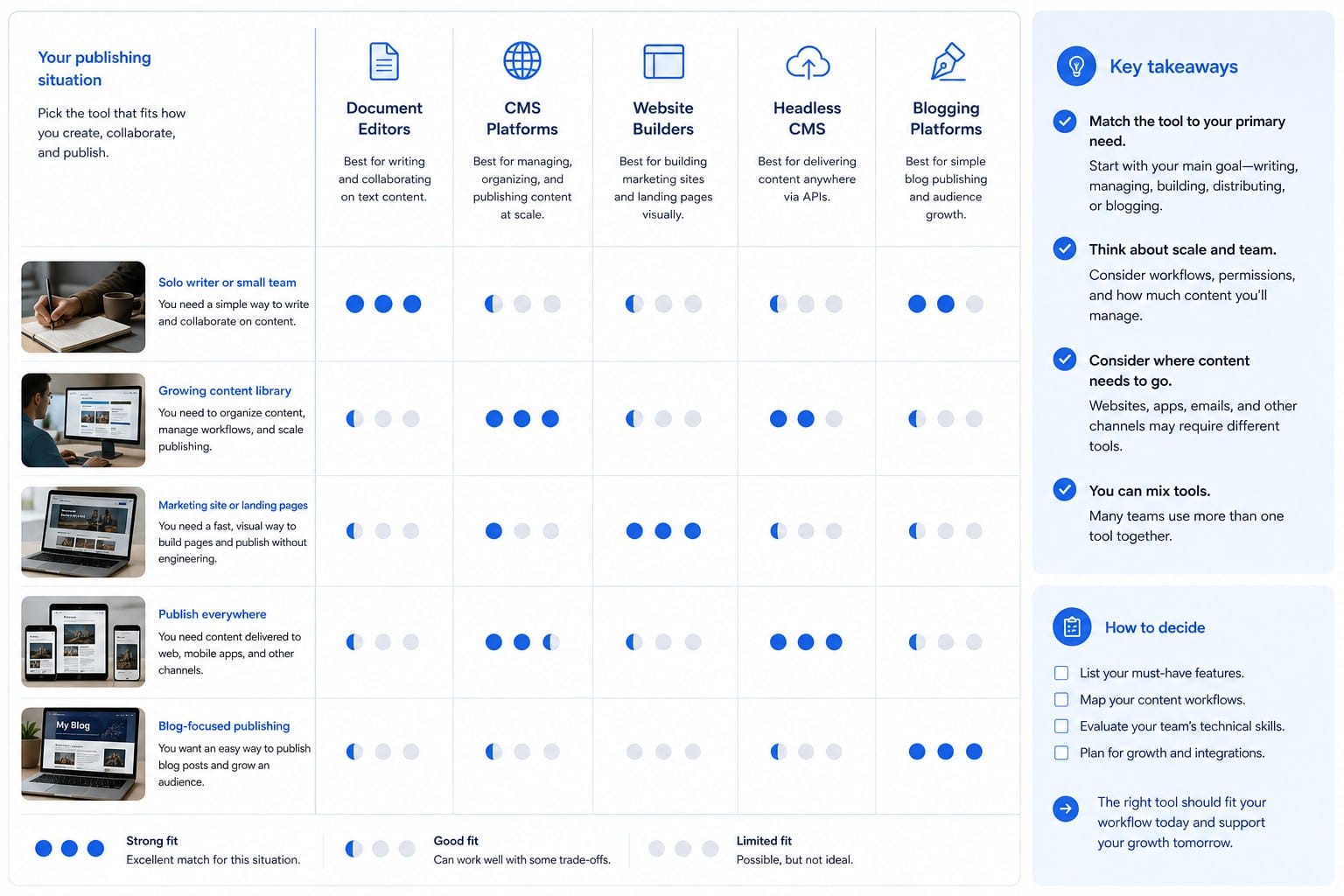
The practical question is not which tool has the most features on paper. It is which tool fits the way you actually work and what you are actually trying to accomplish. Let me walk through the most common situations and what tends to work best in each one.
If you are an independent blogger trying to grow a niche site, you probably do not have hours each week to spend on keyword research, outline building, draft editing, and CMS formatting. You need content to go out consistently because that consistency is what compounds into search traffic over time. A writing assistant can help you write faster, but it does not solve the planning or publishing problem. An AI blog engine that handles the full cycle, from topic selection through to a published post, is much closer to what you actually need. You can explore what that looks like from a strategy standpoint in this guide on SEO content strategy for independent bloggers: a step-by-step playbook.
If you are a SaaS founder or startup building organic search as a growth channel, content quality matters as much as volume. You need articles that cover topics your potential customers are actually searching for, that demonstrate expertise, and that earn rankings over time. A writing assistant can generate a lot of content quickly, but without a research layer and a strategic planning layer, you end up publishing a high volume of thin content that does not rank or convert. A blog engine with built-in research depth and a content strategy function is a much better fit for that goal.
If you are a small business owner who just wants to have an active blog without it consuming all of your time, the manual overhead of a writing assistant is still probably too high. You would need to prompt the tool, review the draft, find images, format the post, and publish it yourself. That is still a significant time investment per post. A system that handles all of those steps and just needs your occasional review is a better match for someone whose primary job is running the business, not producing content.
If you are a digital marketer managing a brand blog, you might have more capacity for review and editorial oversight, but you still want the production side to run without constant intervention. Writing assistants work well when you have a dedicated content writer using them to speed up their process. But if you are the only person touching the blog, and you also have campaigns, analytics, and other channels to manage, a more automated workflow saves you from letting the blog slide whenever something else demands your attention.
If you are a Ghost CMS user, the publishing integration question matters even more than it does for people using more common platforms. Ghost is powerful and flexible, but setting up reliable automated publishing from an external AI tool takes real technical work. A blog engine built with Ghost integration in mind removes that friction entirely.
A few practical factors worth thinking through when you are evaluating any tool in this space:
How much does the tool depend on your prompts? A writing assistant is only as good as the instructions you give it. If you are not experienced with prompting, you will spend a lot of time getting mediocre output and trying to figure out what to change. A blog engine that handles more of the decision-making internally is easier to run without deep expertise in AI prompting.
Does the tool understand your niche and voice? Generic AI output tends to read as generic. Tools that learn your brand voice, or that let you set clear style guidelines, produce content that sounds like you rather than like every other AI-generated blog on the internet. This matters for building an audience that returns to your blog.
What does the editing and review process look like? No AI tool produces perfect output every time. The question is how easy it is to review, edit, and approve content before it goes live. A workflow that puts you in control of final approval, without making you do all the heavy lifting, is the right balance.
What happens if you stop using the tool? Content published to your CMS lives on your site regardless of what happens with the tool you used to create it. But your editorial calendar, your topic clusters, and your internal linking structure should not be locked inside a proprietary system you cannot export. Think about how portable your content strategy is.
How does the tool handle publishing failures? Automated publishing sounds great until a scheduled post silently fails to go live. Reliable tools have logging, error notifications, and a clear process for reviewing what went out and what did not.
The jasper vs writesonic vs ai blog engine question ultimately comes down to scope. Writing assistants are tools you use inside a workflow you manage. Blog engines replace large parts of that workflow. Neither is inherently better in the abstract. They are better or worse depending on how much of the content production process you want to own personally versus how much you want to hand off to a system.
For most people reading this article, the bigger problem is not finding a way to write faster. It is finding a way to publish consistently without content production becoming a full-time job on top of everything else they are doing. A writing assistant gets you partway there. A purpose-built blog engine gets you the rest of the way.
Blogtude is designed specifically for that second group. It is not a writing assistant with a publish button tacked on. It is a content system that starts with strategy, builds research into the writing process, and delivers finished posts to your CMS on a schedule. If you are a Ghost user, an independent blogger, a SaaS founder, or a marketer who needs the blog to keep running even when other priorities take over, that full-workflow approach is worth serious consideration.
Ready to take the next step?
If you are ready to move beyond AI writing assistants and run a full content operation without the manual overhead, Blogtude can help. It handles your 30-day strategy, researches and writes your articles, pairs them with on-brand visuals, and publishes directly to Ghost and other CMS platforms. Visit https://blogtude.com to see how it works and get your content system running.