
How to do keyword research for a blog content calendar


Table of contents
1. Start with a clear picture of your audience and their search intent
2. Use tools and data to find the keywords worth scheduling
3. Build your calendar by organizing keywords into a publishing plan that makes sense
Most content calendars fail before they start. Writers pick topics based on gut feeling, publish a few posts, see little traffic, and quit. The missing piece is almost always keyword research. When you do keyword research for a blog content calendar the right way, every topic you schedule has a real reason to exist: someone is already searching for it, the competition is manageable, and the post can rank. This guide walks through the full process so you can build a calendar full of topics that actually drive organic traffic. No guesswork, no wasted publishing slots.
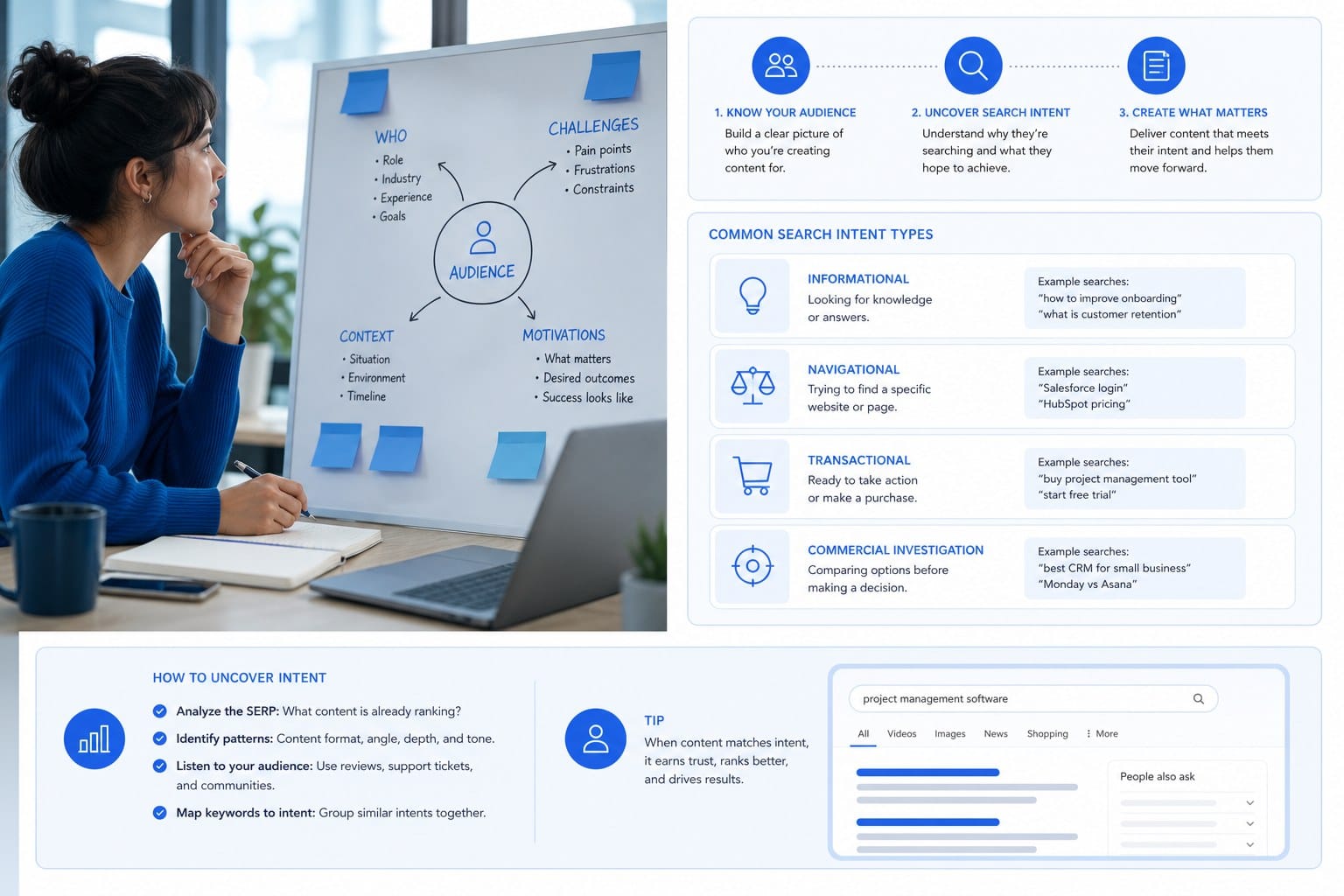
Start with a clear picture of your audience and their search intent
Before you open any keyword tool, you need to know who you are writing for and what problems they are trying to solve. This sounds obvious, but most bloggers skip it. They jump straight into tools, pull a list of high-volume keywords, and schedule posts without asking whether those keywords match what their readers actually need.
Start by listing three to five specific problems your audience faces every day. If you run a SaaS blog, your readers might be trying to reduce churn, improve onboarding, or figure out pricing. If you write for small business owners, they might be searching for ways to get more local customers without spending a lot on ads. Write these problems down in plain language — the way your audience would say them out loud, not the way a marketing deck would phrase them.
That plain language becomes your seed keyword list. A seed keyword is a short, broad phrase that describes a topic you want to cover. Examples include "content calendar," "blog SEO," "keyword research," or "email marketing for small business." You are not trying to rank for these yet. They are starting points you will expand in the next step. Think of them as doors you are about to open, not destinations.
Now think about search intent. Every keyword fits into one of four buckets: informational (the person wants to learn something), navigational (they are looking for a specific site or brand), commercial (they are comparing options before buying), and transactional (they are ready to buy or sign up). For a blog content calendar, you mostly want informational and commercial keywords. Informational posts build authority and pull in readers early in their journey. Commercial posts catch readers who are closer to making a decision and are actively weighing their options.
A quick way to check intent is to search the keyword in Google and look at the top results. If the first page is full of how-to articles and guides, the intent is informational. If you see comparison posts and review pages, it is commercial. Match your content to whatever Google is already showing for that keyword, because those results tell you what searchers actually want when they type those words. Google has already done the research. You just have to read what it is showing you.
You should also think about the gap between what your audience searches for and what your competitors have already covered well. If every major site in your niche has published a thorough, regularly updated guide on a topic, ranking for it will be very hard unless you can offer a meaningfully different angle — a different audience, a different format, a different level of depth, or newer data. Look for topics where the existing content is thin, outdated, or missing a perspective your readers care about. Those gaps are where a newer blog can gain traction fastest, because you are not fighting for space that is already claimed.
One more thing worth doing at this stage is talking to real people. Read comments on related YouTube videos. Scroll through Reddit threads in your niche. Look at questions asked on Quora. Check the "People also ask" boxes in Google search results. Pay attention to the exact words people use to describe their problems, because those words are the raw material of effective keyword research. Real questions from real people give you ideas that no tool will surface, and they help you write titles that feel immediately relevant rather than engineered.
For example, if you run a personal finance blog and you notice that dozens of Reddit comments in r/personalfinance use the phrase "paycheck to paycheck even with a good salary," that is a keyword idea and a content angle that your seed keyword list alone would never have given you. The phrase tells you the topic, the emotional context, and the specific reader all at once.
By the time you finish this step, you should have a list of ten to twenty seed keywords and a solid understanding of what your audience is trying to accomplish when they search those terms. You should also have notes from real conversations, comment sections, and forums that give you specific language to use in your titles and introductions. That foundation makes every step that follows faster and more accurate, because you are not guessing at what your readers want — you have seen them describe it in their own words.
Use tools and data to find the keywords worth scheduling
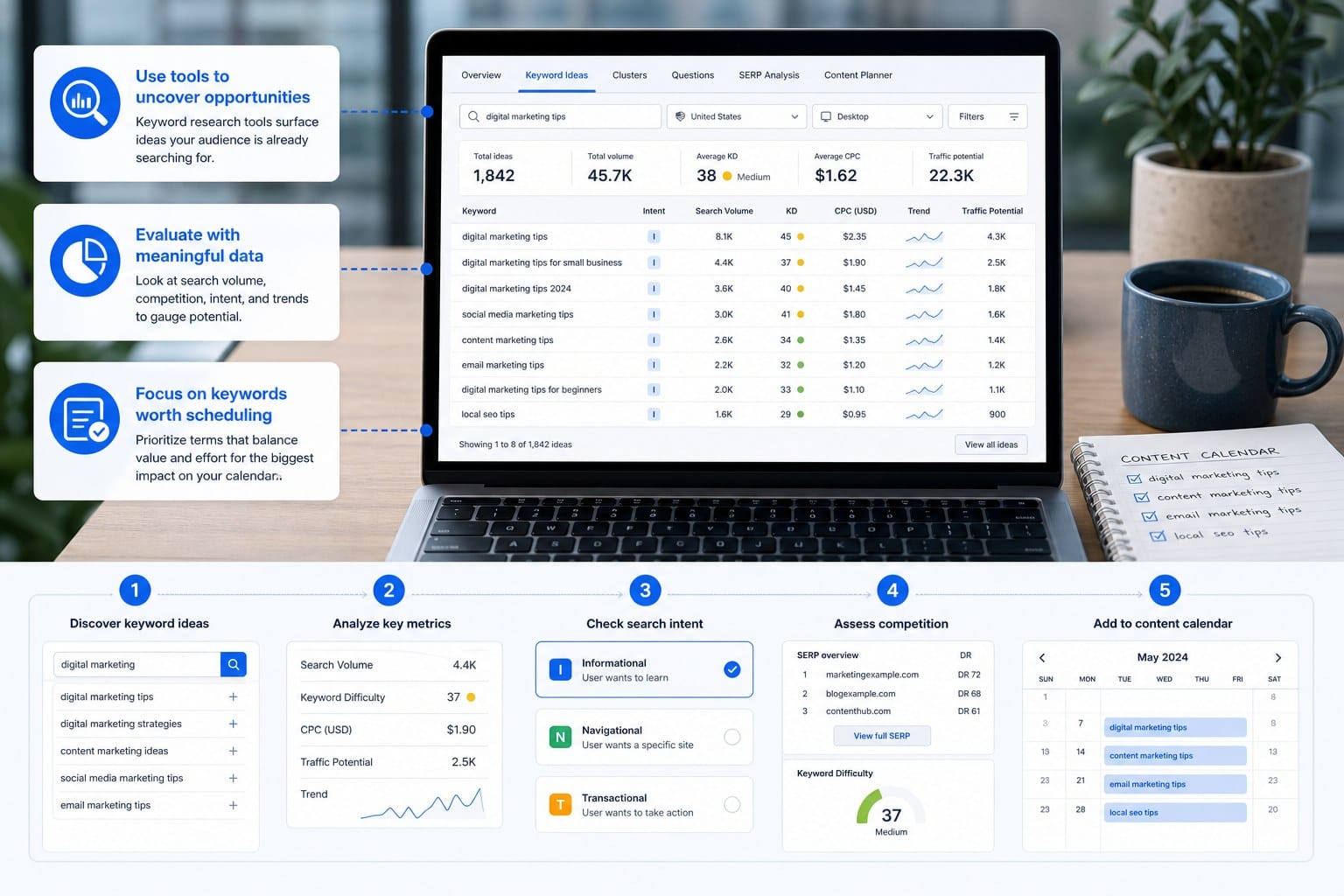
Now the tactical work begins. You have your seed keywords. The goal of this step is to expand them into a large pool of specific keyword ideas, then filter that pool down to the ones worth putting on your calendar. This is where intuition gives way to data, and where a lot of blogs start making better decisions.
Start with a free tool like Google Keyword Planner. Type in each seed keyword and look at the related terms it suggests. Pay attention to monthly search volume and competition level. For a new or mid-sized blog, target keywords with roughly 100 to 2,000 monthly searches. Keywords with very high search volume — 50,000 or more per month — are dominated by major publications with thousands of backlinks built up over years. You will not outrank them as a growing blog, at least not quickly. Keywords in the lower-to-mid range are much more winnable, and they add up fast when you publish consistently.
If you have a budget, tools like Ahrefs, Semrush, or Moz give you more detailed data. The most useful metric beyond search volume is keyword difficulty, sometimes called KD. This score tells you how hard it will be to rank on page one. A score under 30 is generally manageable for a blog that is still building authority. Anything above 50 requires significant domain authority and backlinks, which takes real time to earn. Do not let high-difficulty keywords crowd out your calendar in the early months. Bank them for later and focus on what you can actually win right now.
Another metric worth checking is traffic potential. Some keywords have lower search volume on paper but send a lot of traffic to the pages that rank for them, because searchers click through at a higher rate. Other keywords look popular in the data but generate very few clicks because the answer appears directly in the search results as a featured snippet or inside a "People also ask" box. Traffic potential gives you a more honest picture than raw volume alone. A keyword with 800 monthly searches and high click-through potential can outperform one with 3,000 searches where most people never click a result.
Long-tail keywords deserve special attention at this stage. A long-tail keyword is a phrase with three or more words that is more specific than a broad seed term. For example, "keyword research" is a seed keyword. "How to do keyword research for a new blog" is a long-tail version. Long-tail keywords have lower search volume, but they have much higher conversion intent, they are easier to rank for, and they often tell you exactly what format the post should take. A keyword like "step-by-step keyword research for a blog content calendar" almost writes its own outline. The specificity is a feature, not a limitation.
Search Google for each keyword you are considering and look at the top ten results. Read the titles and subheadings. Note the approximate word count. Ask yourself whether you can produce something more thorough, more current, or more useful than what is already there. If the answer is yes, add the keyword to your shortlist. If the answer is no, move on. You are not trying to collect every possible keyword — you are trying to find the ones where you have a realistic shot at earning a spot on page one.
Also check whether you have competing content on your own site. If you already published a post that targets a very similar keyword, scheduling another one can cause keyword cannibalization — where your two posts compete against each other in search results instead of one strong post owning the ranking. Before adding a new topic to your calendar, confirm that it covers enough distinct territory from anything you have already published. If two posts are covering the same ground, consider consolidating them into one stronger, more comprehensive piece rather than splitting your authority across both.
At the end of this step, sort your shortlist into three buckets.
The first bucket is quick wins: keywords with low difficulty and decent volume that you can realistically rank for within a few months of publishing. These posts build early momentum and show you that the system is working.
The second bucket is medium-term targets: keywords with moderate difficulty that will take six to twelve months to climb. These posts require patience, but they tend to bring in more traffic once they rank because the topics are more competitive and the search volume is higher.
The third bucket is long-term goals: competitive keywords you will eventually target once your domain authority grows. You are not ignoring these — you are building toward them. Every cluster post you publish in their general topic area is a step toward eventually being able to compete for the big keyword at the center.
A well-built content calendar draws from all three buckets so you see early wins while building toward bigger rankings over time. Filling your calendar only with low-difficulty keywords keeps your results small. Filling it only with high-difficulty keywords means months of effort with almost nothing to show. The mix is what makes it work.
Connecting your keyword strategy to your broader publishing consistency is important here. Publishing one post and waiting to see what happens will not tell you much. Publishing twenty posts over thirty days gives you enough data to see which topics are gaining traction and which need adjustment. Why consistent blog publishing delivers the highest ROI for growing brands explains this compounding effect in detail, and the logic applies directly to how aggressively you should be filling your keyword calendar in the early months. Consistency is not just about discipline — it is about generating enough signal to make better decisions about what to publish next.
Keep your filtered shortlist in a simple spreadsheet with columns for the keyword, estimated monthly search volume, keyword difficulty score, search intent, and which bucket it belongs to. That document becomes the master list your calendar draws from, and it should grow over time as you find new keyword ideas through publishing and reviewing your search performance data.
Build your calendar by organizing keywords into a publishing plan that makes sense
You have a shortlist of keywords sorted into buckets. Now you need to turn that list into an actual calendar with specific publish dates, post formats, and clear goals. This is where keyword research stops being an exercise and starts driving real results.
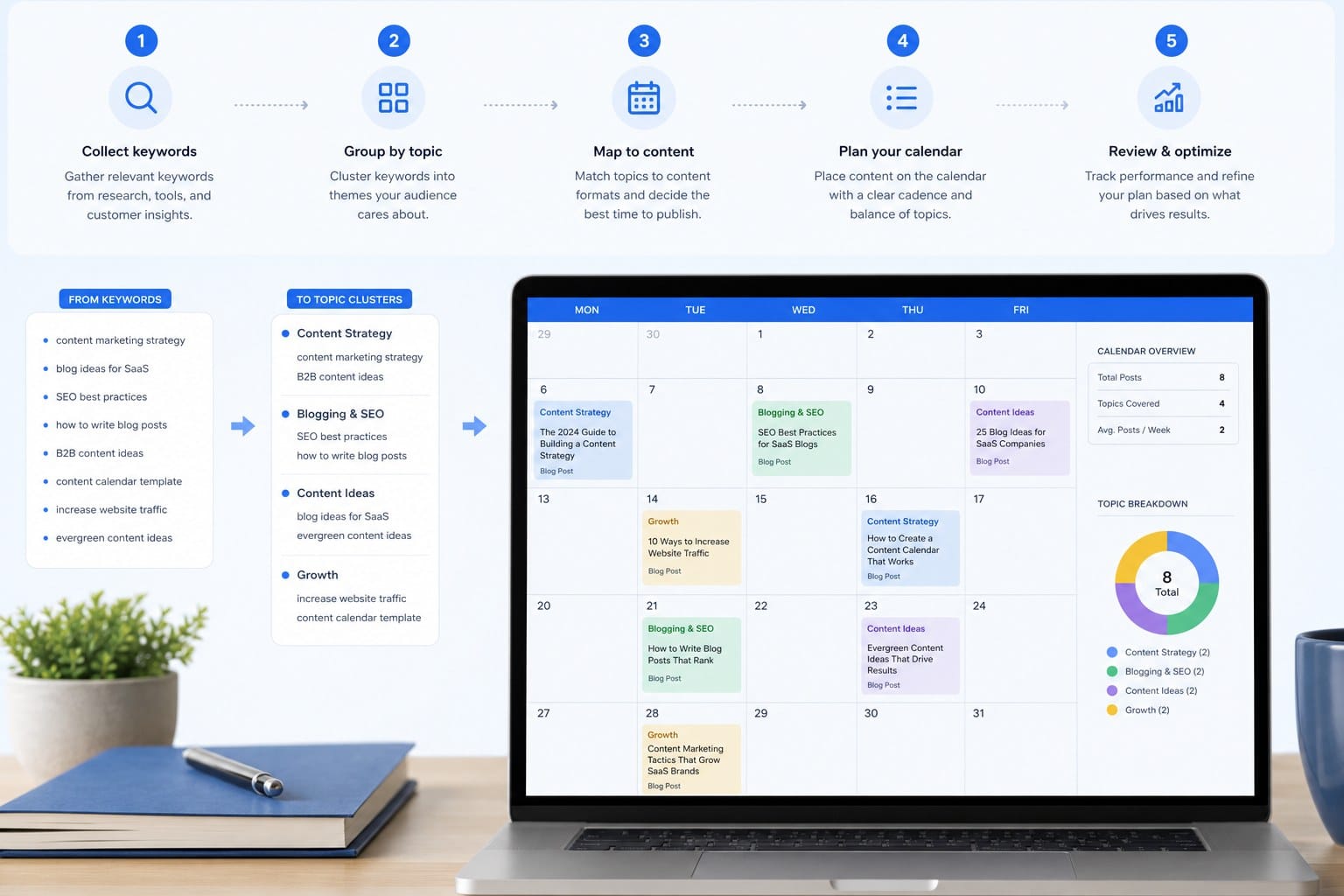
Begin by grouping your keywords into topic clusters. A topic cluster is a set of related keywords that all connect to one central theme. The central theme becomes your pillar post — a long, comprehensive guide on a broad topic. The related keywords become cluster posts, which are shorter, more focused articles that link back to the pillar and to each other. For example, if your pillar post is "The complete guide to blog SEO," your cluster posts might cover how to write meta descriptions, how to use internal links, how to find long-tail keywords, how to optimize images for search, and how to structure a post for featured snippets.
This structure works because Google rewards topical authority. When you publish multiple posts that all cover related aspects of one subject, Google sees your site as a reliable source on that topic and tends to rank your content higher than isolated articles from sites that only touch the subject once. You are not just publishing posts — you are building a body of knowledge around a theme, and search engines recognize the difference.
Once your clusters are mapped, assign each keyword a post type. Not every keyword calls for the same format, and matching the format to the keyword intent is one of the most underrated parts of a keyword strategy. A keyword like "what is keyword research" works best as an educational explainer post aimed at beginners. A keyword like "best keyword research tools for bloggers" calls for a comparison or roundup post that helps readers evaluate their options. A keyword like "how to do keyword research for a blog content calendar" calls for a step-by-step how-to guide with clear numbered sections. When your post format matches what the searcher expects to find, readers stay longer, click more internal links, and bounce less — all signals that help your rankings improve.
Now sequence your calendar. Publish your pillar post first so that the cluster posts have something strong to link back to. Then schedule cluster posts over the following weeks. If you are publishing three times a week, you can fill a full month with one pillar and eleven or twelve cluster posts. That gives you a dense, interconnected block of content on your core topic, which builds authority faster than publishing random, unrelated posts every few days. Topical density matters. A site that has published fifteen posts about blog SEO is going to rank better for blog SEO keywords than a site that has one blog SEO post surrounded by posts about fourteen unrelated subjects.
For each post on your calendar, record four things: the primary target keyword, any secondary keywords you plan to weave in naturally, the intended post format, and the estimated publish date. A simple spreadsheet works fine for most teams. Some people use project management tools like Notion or Trello to attach briefs, drafts, and images to each calendar entry. The format does not matter as long as every post has a clear keyword target before anyone starts writing. Keyword-first planning is the whole point. If a post gets scheduled without a target keyword, you are back to gut-feeling publishing and the calendar loses its purpose.
Also plan your update schedule from day one. Keyword rankings are not permanent. A post that ranks well today can slip in six months if competitors publish better content, if Google updates its algorithm, or if the search landscape for that topic shifts. Mark every post for a review at six months and twelve months after publishing. At each review, check whether the post still ranks, whether the keyword is still relevant to your audience, and whether the content needs new information, updated statistics, or fresher examples. Refreshing high-potential posts that have slipped is one of the highest-return activities in content marketing because you are improving something that already exists rather than building from scratch.
If you are managing a blog for a SaaS product or a growing brand, think about how your keyword calendar maps to the full customer journey. Some posts should target keywords that potential customers search when they are first becoming aware of a problem. These are often broad informational keywords — "why is my churn rate so high" or "how do small businesses get local customers." Other posts should target keywords that people search when they are evaluating solutions — "best tools for reducing SaaS churn" or "local SEO vs paid ads for small business." A few posts should target keywords that people search right before they sign up or make a purchase. When your calendar covers that full journey, your blog does more than attract traffic. It actively moves readers toward becoming customers, and every post has a role in that progression.
One challenge that comes up at this stage is the sheer volume of work. Mapping keyword clusters, writing pillar posts, producing cluster articles, sourcing visuals, optimizing on-page SEO, and publishing on a consistent schedule is a serious workload, especially for a founder or small team that is also running a business. That gap is exactly what tools like Blogtude are built to close. The platform generates a 30-day content strategy, writes deeply researched long-form articles, pairs them with on-brand visuals, and publishes automatically to Ghost and other CMS platforms. Instead of spending your week doing keyword research and drafting posts, you are reviewing a ready-made plan that is already built around the search terms your audience is using.
For context on how this connects to a broader strategy, how to turn your website into a content marketing engine covers the systems thinking behind turning a blog from a passive online presence into an active driver of organic growth. The keyword calendar you are building right now is one of the most important inputs into that kind of system. It is the document that keeps every article pointing toward a real traffic goal instead of just filling space.
Finally, track your results from the beginning. Set up Google Search Console if you have not already. It is free, and it shows you which keywords your posts are appearing for, what position you are ranking in, and how many clicks you are getting from search. After three to six months of consistent publishing based on your keyword research, you will be able to see which topics are climbing, which need more supporting cluster posts to build their authority, and which new keyword opportunities are opening up based on the traffic you are already earning.
Use that data to feed your next round of keyword research and calendar planning. The process becomes a loop: research informs publishing, publishing generates data, and data sharpens the next round of research. Every month you run the loop, your calendar gets more accurate, your content gets more targeted, and your traffic compounds.
That compounding effect is the whole point. A single well-researched post can rank for years and keep sending you traffic without any additional work. A calendar full of well-researched posts, organized into clusters, updated on a regular schedule, and built around real search demand creates a traffic asset that grows in value the longer you run it. The spreadsheet you are building right now is not just a publishing schedule. It is the foundation of a system that works for you around the clock.
If you are weighing which AI-powered tools can handle not just writing but the full publishing workflow — including keyword strategy, content structure, scheduling, and CMS integration — Jasper vs Writesonic vs AI blog engines: which handles full publishing workflows breaks down the differences in a practical way that helps you decide where to put your content budget.
Ready to take the next step?
Ready to skip the spreadsheet and go straight to a keyword-driven content calendar that publishes itself? Blogtude builds your 30-day strategy, writes the articles, and handles publishing automatically. Visit blogtude.com to see how it works.