Automated blog publishing: the complete setup guide for growing brands

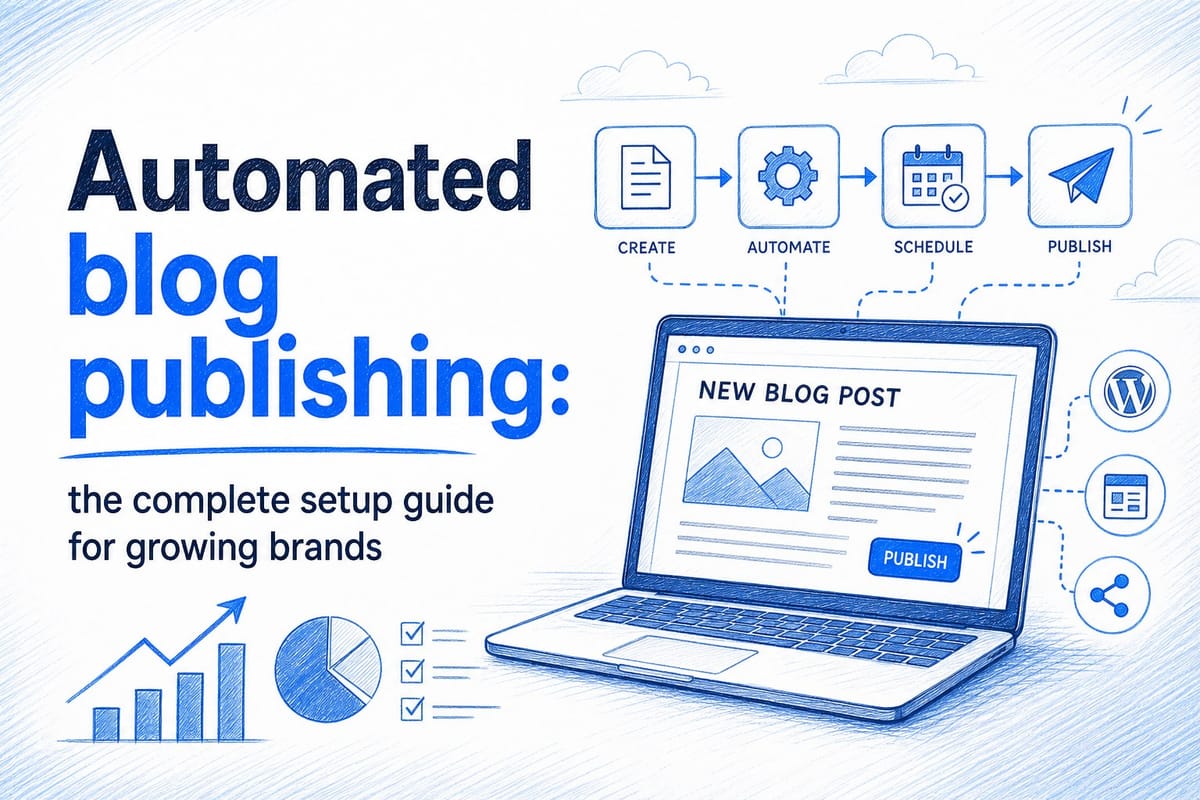
Table of contents
1. What automated blog publishing actually means (and what it does not)
2. How to set up an automated blog publishing system for your brand
3. Making automated content work long-term: quality, strategy, and scale
If you run a growing brand, you already know the content treadmill well. You plan a blog post, life gets busy, and three weeks pass without a single article going live. Inconsistency kills organic growth because search engines reward sites that publish regularly, and readers lose trust when a blog goes quiet for months at a time. Automated blog publishing is the practical answer to this problem. It takes the repeating manual steps out of your content workflow so articles go live on schedule without you having to babysit every stage of the process. In this guide, I will walk through exactly what automated blog publishing involves, how to set up a system that actually works for a growing brand, and how to make sure the content coming out of that system is genuinely useful rather than generic filler.
What automated blog publishing actually means (and what it does not)
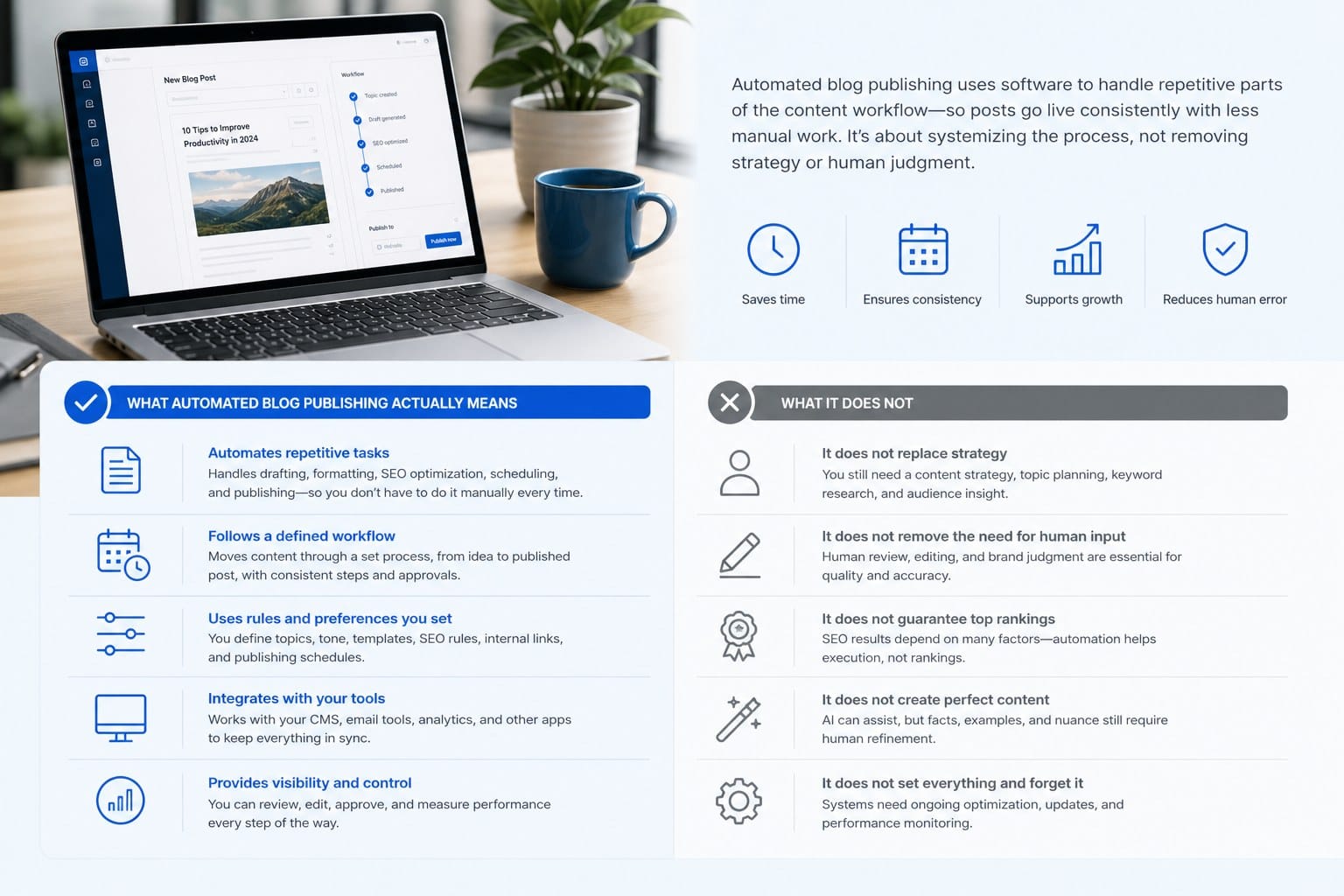
A lot of brands hear the phrase automated blog publishing and picture a robot dumping low-quality articles onto their site at three in the morning. That picture is outdated. Modern automated publishing systems are far more capable, and understanding what they actually do will help you set realistic expectations before you build anything.
At its core, automated blog publishing means using software to handle one or more stages of the content lifecycle without manual intervention at every step. Those stages include topic research, content strategy, writing, editing, formatting, visual creation, and final publishing to your CMS. Some tools handle only one or two of these stages. A complete setup handles all of them in a connected pipeline.
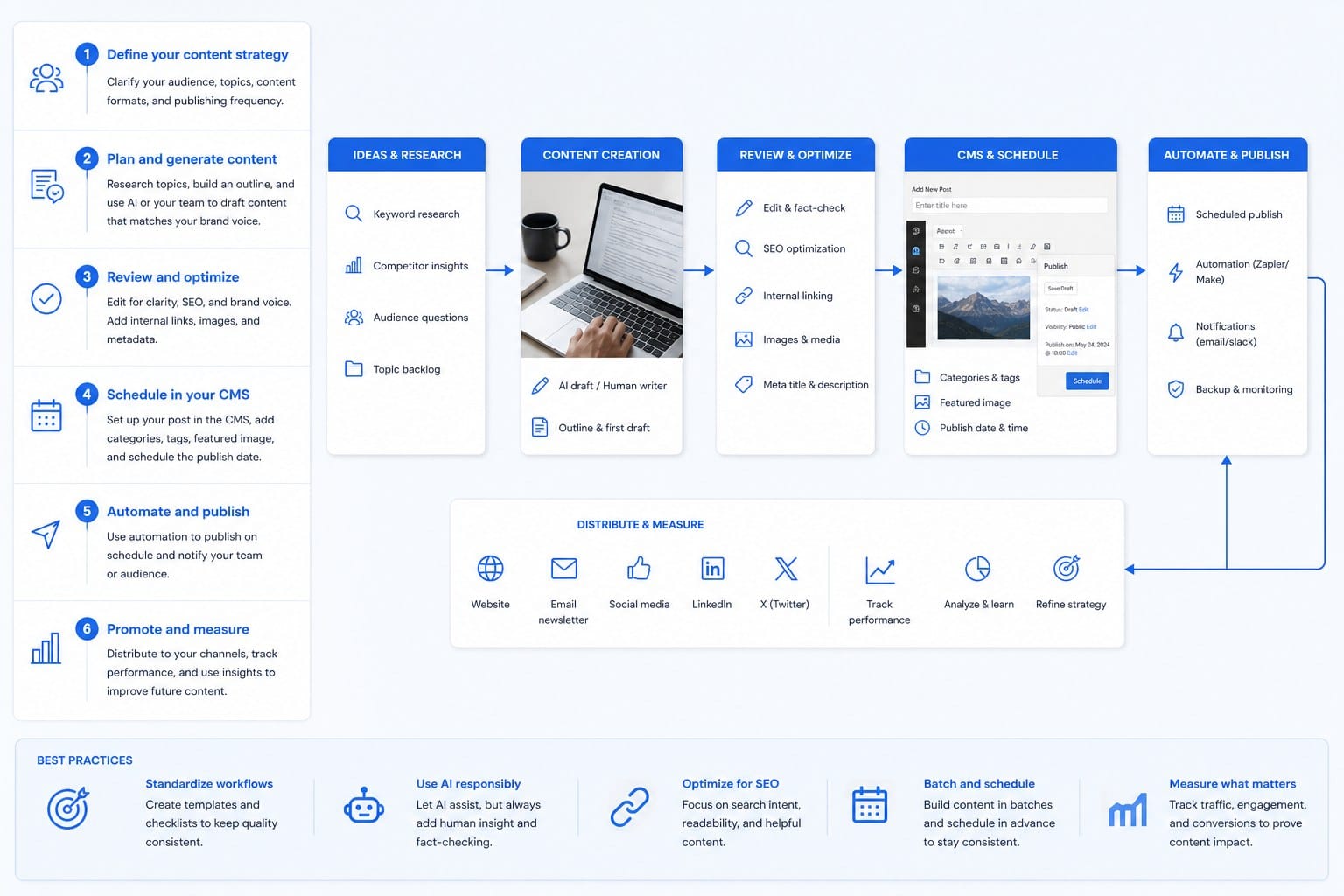
Here is what that pipeline looks like in practice for a growing brand. First, a content strategy layer identifies topics your audience is actively searching for. It looks at keyword opportunity, search intent, and competitive gaps. Rather than guessing what to write about, the system uses real data to build a content calendar, often covering 30 days or more at a time. Second, a writing layer produces actual long-form articles based on those topics. This is not a quick summary or a thin 300-word post. A well-built automated system produces thoroughly researched articles that cover a topic in depth, the kind readers bookmark and share. Third, a visual layer creates or sources images, diagrams, or branded graphics that match the article. A blog post without visuals tends to have higher bounce rates, so this step matters more than it might seem. Fourth, a publishing layer pushes the finished article directly into your CMS, whether that is Ghost, WordPress, or another platform, complete with SEO metadata, featured images, tags, and a scheduled publish date.
The important distinction is that none of this means removing human judgment entirely. The best automated publishing setups include a review step where a human approves, adjusts, or personalizes content before it goes live. Automation handles the heavy lifting of research, structure, and drafting. You handle the final judgment call. That combination gives you speed and volume without sacrificing quality or brand voice.
What automated blog publishing does not mean is setting something live without any oversight and hoping for the best. Google is increasingly good at identifying thin, repetitive, or unhelpful content, and publishing large volumes of bad articles will hurt your site rather than help it. The goal is to automate the time-consuming parts while keeping quality control in the loop.
I also want to be clear about something many brands overlook. Consistency is the single biggest factor in whether a blog actually drives organic traffic over time. A brand that publishes two solid articles per week for a year will outperform a brand that publishes a burst of 20 articles and then goes dark for months. Automated publishing makes consistency achievable even when your team is small, your time is limited, or your budget does not allow for a full content team.
If you want to understand more about the underlying technology that makes this possible, what is an AI content engine and does your brand need one gives a solid breakdown of how these systems work and which types of brands benefit most from adopting one.
How to set up an automated blog publishing system for your brand
Setting up a working automated blog publishing system takes more thought than simply signing up for a tool and pressing go. The brands that get real results from automation are the ones that take a little time upfront to define their inputs clearly. Here is how to do that step by step.
Step one: Define your content goals before you touch any tool.
Before you automate anything, you need to know what you are trying to achieve. Are you building organic search traffic from scratch? Are you targeting readers at a specific stage of the buying journey? Are you trying to rank for a set of competitive industry keywords, or are you going after long-tail terms where there is less competition but more purchase intent?
These answers shape everything that comes after. A SaaS startup trying to generate top-of-funnel awareness needs a very different content strategy than a small business owner trying to rank for local service queries. If you are not sure where to start, how SaaS startups can use blogging to drive organic traffic from day one is worth reading before you build anything, because getting the strategy layer right is what determines whether automation produces results or just produces volume.
Step two: Set your brand voice inputs.
Automated systems produce content in whatever direction you give them. If you give vague inputs, you get generic output. The more clearly you define your brand voice, the better your automated content will feel on-brand.
Write down a short description of how your brand communicates. Is it conversational or formal? Does it use industry jargon or plain language? Does it lean practical and direct, or does it take a more editorial, opinionated tone? Include examples of sentences or phrases that sound right and ones that sound wrong for your brand. Feed this into your setup as a style guide or persona prompt. Most good automated content systems have a place for exactly this kind of input.
Also decide upfront how much personalization you want to add at the review stage. Some brands are happy with content that goes live after a quick scan. Others want to add a personal story, a specific client example, or a unique opinion before publishing. Knowing this in advance helps you set a realistic review workflow rather than being surprised by how much editing you feel you need to do.
Step three: Build your topic and keyword library.
A good automated system generates content strategy for you, but you still need to point it in the right direction. Start by listing the core topics your brand covers. For a digital marketing agency, that might be SEO, content strategy, paid ads, and analytics. For a small e-commerce brand selling outdoor gear, it might be hiking, camping, gear reviews, and trail guides.
From those core topics, think about the questions your customers actually ask. Look at the search queries driving traffic to your competitors. Check the questions appearing in Google's People Also Ask boxes for your main topics. Notice what your customers email or message you about most often. All of this is raw material for your content topic library.
When you feed this library into an automated publishing system, the strategy layer uses it to generate a calendar of articles that cover the space comprehensively rather than jumping around randomly. Comprehensive coverage of a topic cluster is one of the most effective ways to build topical authority, which is a major factor in how Google decides which sites deserve to rank well.
Step four: Connect your CMS and configure publishing settings.
This is the technical step that most people worry about, but it is usually more straightforward than expected. Ghost CMS, for example, has a clean API that integrates well with automated publishing tools. WordPress has a wide range of plugins and API options. The key settings to configure include your publishing schedule (how many posts per week and on which days), your default post status (draft, scheduled, or live), your SEO metadata defaults (title format, meta description length), your category and tag taxonomy so articles are filed correctly, and your featured image settings.
If you are using a platform like Blogtude, the integration with Ghost is built in, which removes a lot of the technical friction. You connect your site once, set your preferences, and the system handles the rest of the pipeline from content strategy through to published article.
Step five: Set up your review workflow.
I mentioned this earlier, but it deserves its own step because skipping it is the most common mistake brands make when they start automating content. Even the best automated system benefits from a human review before articles go live.
Your review workflow does not need to be elaborate. A simple checklist works well. Review each article for factual accuracy, check that the brand voice feels right, confirm the SEO title and meta description are good, scan the headers to make sure the structure makes sense, and check that any links included are correct and relevant. For most brands, this review takes 10 to 20 minutes per article rather than the hours it would take to research and write from scratch. That is the real value of automation: not eliminating human judgment but freeing up your time so your judgment is focused on the parts that actually need it.
Step six: Track performance and feed learnings back into the system.
Once articles start going live, pay attention to what happens. Which topics are getting search impressions? Which articles are ranking for their target keywords within a few weeks? Which ones have strong time-on-page, and which are seeing readers bounce quickly?
These signals tell you what to do more of and what to adjust. A good automated publishing setup is not a one-time configuration. It is a system you tune over time based on what you learn from real performance data. Connect Google Search Console to your site from day one so you have clean data to work with from the moment your first automated articles go live.
For a broader look at how different AI writing tools compare when it comes to producing content that actually reaches this kind of publish-ready quality, AI blog writing tools compared: which actually produces publish-ready content gives a thorough rundown that is worth reviewing as you make your tool selection.
Making automated content work long-term: quality, strategy, and scale
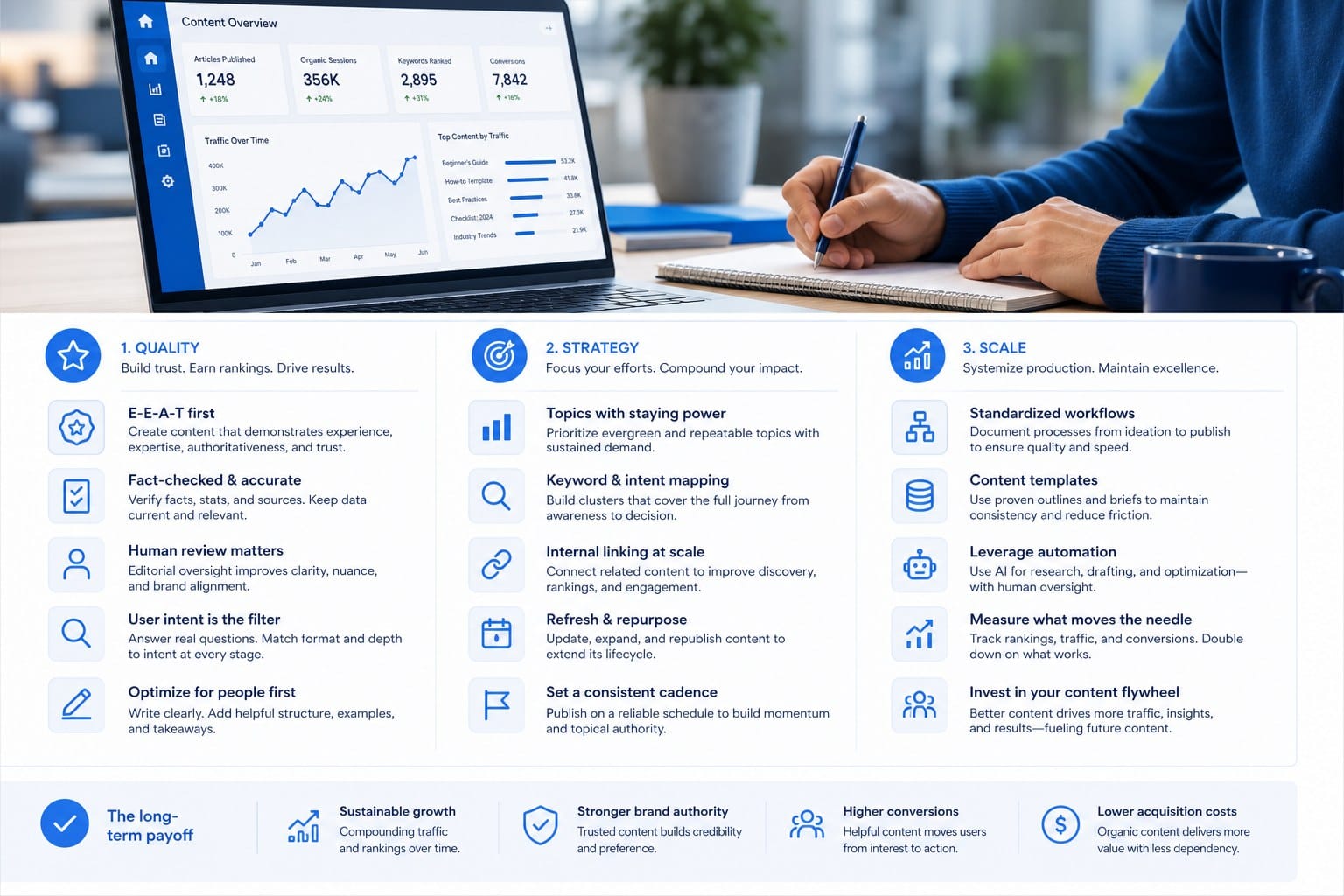
Getting your automated blog publishing system live is one thing. Keeping it working well as your brand grows is where most setups either thrive or fall apart. Long-term success with automated publishing comes down to three things: maintaining content quality at scale, keeping your strategy sharp as your market evolves, and scaling output in a way that serves your audience rather than overwhelming them.
Maintaining quality at scale
Content quality is not just about well-written sentences. It is about whether each article genuinely helps the person reading it accomplish something, understand something, or make a better decision. Google's helpful content guidelines make this explicit: content should be written for people first and search engines second. Automated systems that produce surface-level summaries of a topic without any real depth or original perspective tend to underperform, regardless of how well they are optimized on a technical level.
The way to maintain depth in automated content is to make sure your inputs are specific enough to guide the system toward substance. Vague topic briefs produce vague articles. If your system generates a brief for each article, review that brief before the writing stage runs. Make sure the brief includes the specific angle you want the article to take, the audience it is written for, the key points it must cover, and any unique data, examples, or perspectives that should be included.
For your most important pillar topics, consider adding a more detailed editorial input. For example, if your brand is in the HR software space and you are automating an article about employee onboarding best practices, you might add a note to include a specific statistic about onboarding impact on retention, or a reference to a real scenario your customers face. This kind of specificity is what separates automated content that feels generic from automated content that reads like it came from someone who genuinely knows the subject.
You should also build a quality check into your publishing cadence at a higher level than the per-article review. Once a month, pull your last four weeks of published articles and look at them as a set. Are they covering the right depth? Are they consistent in tone? Are they answering real questions or just hitting keywords? This kind of editorial audit helps you catch drift before it becomes a problem.
Keeping your strategy sharp over time
The content strategy that makes sense for your brand today will need to evolve. New competitors enter your market. Search trends shift. Your audience matures and starts asking more sophisticated questions. New products or features change what you need to communicate. If your automated publishing system is running the same strategy month after month without adjustment, you will start to see diminishing returns.
Schedule a strategy review every 60 to 90 days. Look at what topics are working, what search queries you are starting to rank for, and where the gaps are. Ask yourself what your audience is asking about right now that your blog is not answering. Check if there are new keyword opportunities in your space that did not exist six months ago. Feed these observations back into your content strategy inputs so the next 30-day content calendar reflects what you have learned.
This kind of regular recalibration is one of the biggest advantages of using an integrated system rather than a collection of disconnected tools. When your strategy layer, writing layer, and publishing layer are all connected, you can update your strategy inputs in one place and have that flow through to the entire next content cycle without rebuilding anything from scratch.
Also pay attention to your best-performing articles and think about how to build on them. If one article about a specific topic is generating strong organic traffic, that is a signal to go deeper on that subject. Write follow-up articles that answer related questions. Create a comparison piece. Publish a how-to guide that takes the concept from your high-traffic article and goes further into the practical steps. This kind of content clustering compounds your authority on a topic over time and is far more effective than publishing randomly across a wide range of unrelated subjects.
Scaling output without losing focus
One of the temptations when you first get automated blog publishing working is to scale output as fast as possible. If two articles per week is good, maybe four is better? If 30 articles per month is achievable, why not go for 60?
The answer is that more output only helps if more output serves your readers. Publishing at a volume your audience cannot keep up with, or covering topics so broadly that you lose any sense of focus, dilutes your brand rather than strengthening it. Think about what your audience actually has time and appetite to consume. A weekly newsletter that summarizes your new articles can help with this because it gives readers a curated entry point rather than asking them to keep up with a firehose of content.
For most growing brands, a publishing cadence of two to four substantial long-form articles per week is a strong target. At that pace, you build meaningful content volume within six months, you give each article enough time to be promoted properly, and you maintain the quality bar that makes your blog worth visiting. Automated publishing makes this cadence achievable without burning out your team.
As you scale, also think about content formats. Long-form articles are the backbone of an SEO-driven blog strategy, but not every reader wants to read 2,000 words every time. Consider whether some of your automated content can take a more structured format: step-by-step tutorials, comparison guides, FAQ-style posts, or resource roundups. Different formats serve different reader intents, and a mix of formats keeps your blog engaging for a wider audience.
Finally, keep your internal linking strategy in mind as your content library grows. Each new article you publish is an opportunity to link to relevant older articles, and older articles should be updated periodically to link to newer content that goes deeper on a related point. Automated publishing builds the raw material of a strong internal link structure over time. Making sure those links are actually created, either automatically or as part of your review step, is what turns a collection of articles into a genuine authority resource that both readers and search engines value.
The brands that get the most out of automated blog publishing are the ones that treat it as a system to be managed rather than a machine to be set and forgotten. Automation handles the volume and consistency that would otherwise be impossible for a small team. Strategy and judgment from you and your team are what make that volume valuable. When those two things work together, the results compound in a way that purely manual content production simply cannot match.
Consistent, high-quality content at scale is no longer something only large brands with big content teams can achieve. With the right automated publishing setup, a solo founder, a small business owner, or a lean digital marketing team can build the same kind of authoritative blog presence that used to require a full editorial department. The setup takes some thought upfront, but once it is running, it pays dividends in organic traffic, brand credibility, and audience trust for a long time to come.
Ready to take the next step?
If you are ready to stop struggling with inconsistent publishing and start building a content engine that works for your brand around the clock, Blogtude is built exactly for this. It generates your 30-day content strategy, researches and writes deeply useful long-form articles, creates on-brand visuals, and publishes directly to Ghost and other CMS platforms without you having to manage every step manually. Visit Blogtude to see how it works and start building the automated blog publishing setup your brand actually needs.