What is an AI content engine and does your brand need one

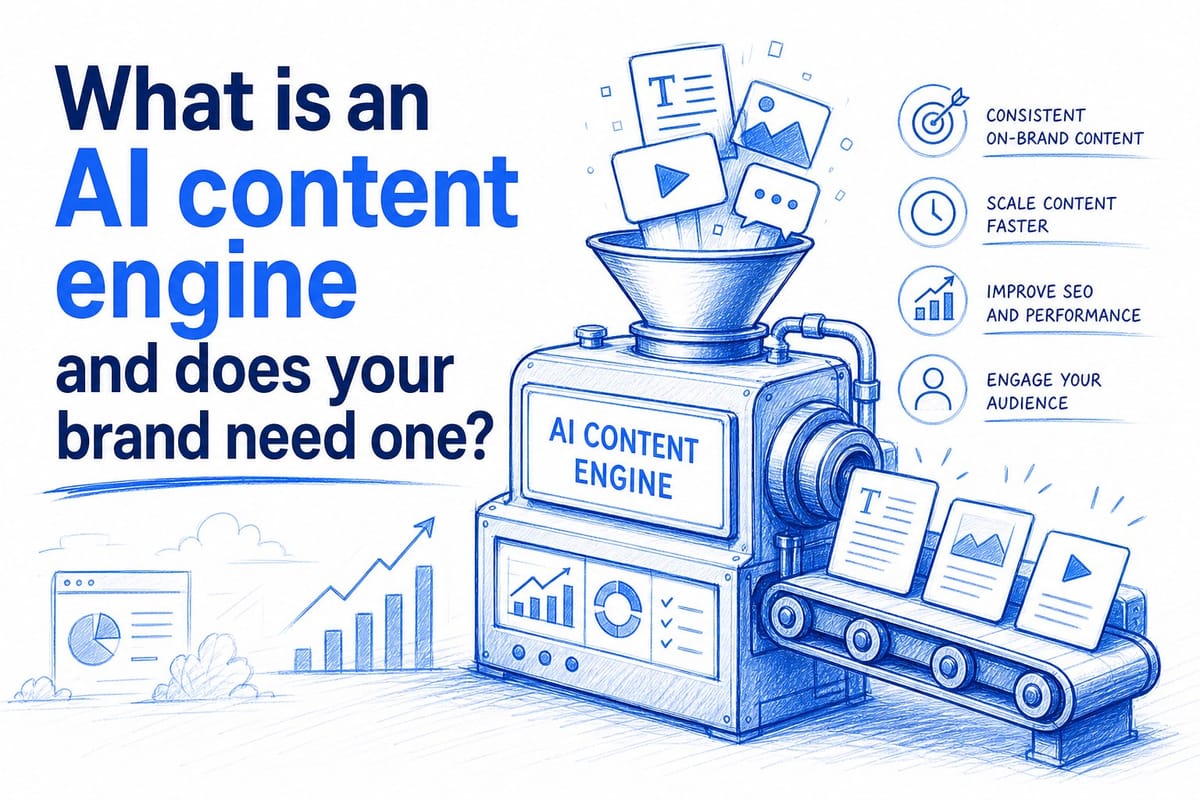
Table of contents
1. What an AI content engine actually does
2. Who benefits most from using one
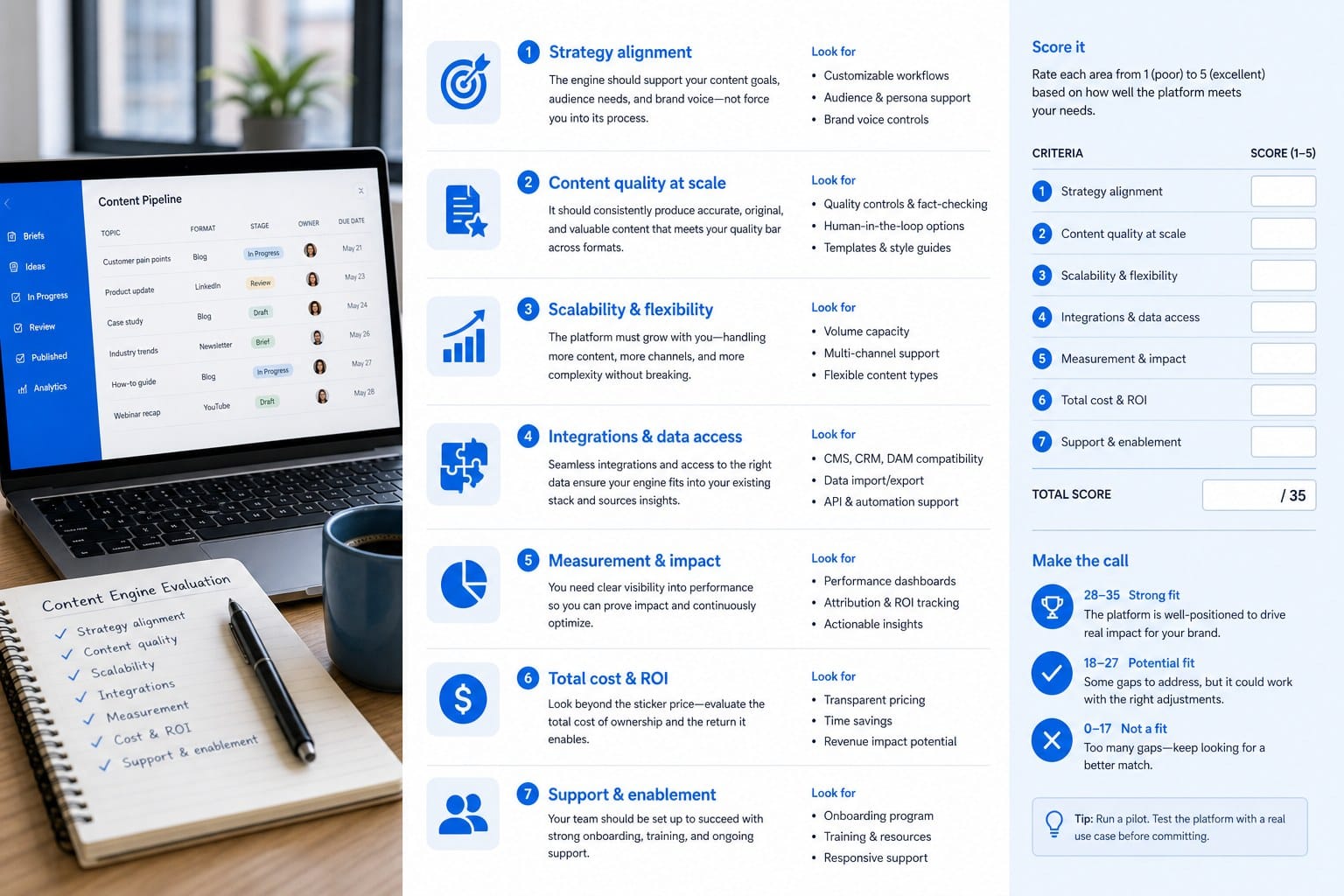
3. How to evaluate whether a content engine will actually work for your brand
If you have spent any time trying to keep a brand blog alive, you already know the problem. You sit down to write, and an hour disappears just figuring out what to cover. Then you need a headline, an outline, the actual draft, images, internal links, and someone to hit publish on the right platform. By the time you finish one post, you are already two weeks behind schedule. That cycle is exactly why the phrase 'ai content engine for brands' has started showing up in so many marketing conversations. People are not just looking for a writing assistant. They want a system that handles the whole workflow so the content keeps moving whether or not anyone has a free afternoon. This article breaks down what an AI content engine actually is, how it differs from simpler tools, and how to figure out whether your brand genuinely needs one.
What an AI content engine actually does
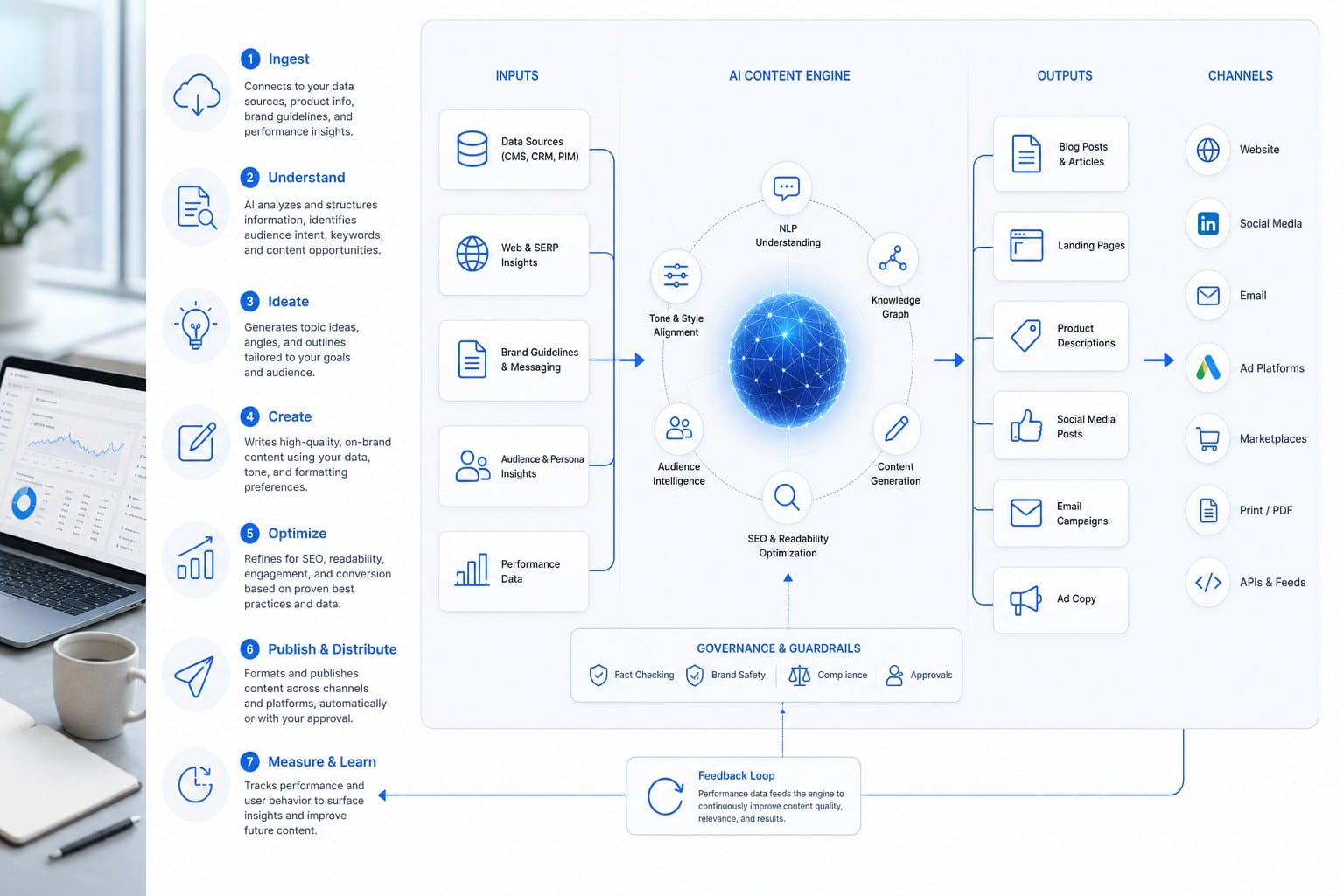
The term gets used loosely, so it helps to be specific. An AI content engine is not just a chatbot you paste a topic into. It is a connected system that takes your brand inputs and produces a repeatable content operation, from strategy through publication, without requiring you to manage each step manually.
Here is how the pieces typically fit together.
Strategy first. A real content engine starts with a content plan, not a single article. It looks at your niche, your target audience, and the search landscape, then maps out a publishing calendar. Some systems generate a 30-day or 90-day strategy with titles, angles, and keyword targets already assigned. That planning layer is what separates an engine from a one-off writing tool.
Research and depth. Good long-form content requires actual research. An AI content engine pulls in relevant information, synthesizes it, and structures an article that covers a topic thoroughly. The output is meant to be something a reader finds genuinely useful, not a thin five-paragraph post stuffed with the same phrase over and over.
Visuals. Written content rarely ships alone. A full engine handles on-brand images or graphics so you are not scrambling through stock photo sites every time a post is ready to go.
Publishing integration. This is where a lot of standalone tools fall short. An AI content engine connects directly to your CMS. If you use Ghost, WordPress, or another platform, the system pushes the finished article there automatically. You do not copy and paste. You do not reformat. The post appears where it needs to be.
Put those pieces together and you get something genuinely different from a writing assistant. You get a workflow that runs without constant supervision.
How it compares to simpler tools
Most AI writing tools handle one job. You give them a prompt, they return a draft, and then you take over. That is useful, but it still leaves the strategy, research, sourcing, formatting, and publishing on your plate.
An AI content engine for brands is designed to reduce that handoff surface. You set your brand parameters once. The system learns your tone, your audience, and your publishing goals. After that, the pipeline runs.
I like to think of it as the difference between hiring a freelance writer for one article and hiring a full content team. The freelancer delivers a file. The team delivers a functioning operation.
If you want a closer look at how different AI writing tools stack up on actual output quality, AI blog writing tools compared: which actually produces publish-ready content walks through what to look for when evaluating them.
The workflow problem most brands ignore
Brands often focus on content quality as the main challenge. Quality matters, but consistency is the variable that actually drives organic growth. A single excellent article published in January and nothing else until April does not build search presence. Google rewards sites that publish regularly. Readers subscribe to sources they can count on.
The real bottleneck for most growing brands is not talent. It is bandwidth. The founder knows what to write about. The marketer can edit a draft. But nobody has four free hours every week to research, write, format, source images, and publish. An AI content engine solves the bandwidth problem, not just the writing problem.
That distinction matters when you are deciding whether to invest in one.
Who benefits most from using one
Not every brand needs an AI content engine. A solo blogger who genuinely enjoys writing and publishes once a month is probably fine with a simpler tool and a good editing workflow. But there are several situations where an engine-level solution makes a real difference.
SaaS founders and startups building organic traffic
Organic search traffic compounds over time. An article that ranks for a relevant keyword keeps bringing in readers for months or years without additional spend. For a SaaS company, that means potential signups arriving without paid acquisition costs.
The challenge is that building a content library big enough to move the needle takes time and volume. A startup with a two-person team cannot dedicate a full-time role to blogging in the early stages. An AI content engine lets them publish consistently at a level that would normally require a dedicated content hire.
The strategy layer matters here especially. A well-structured 30-day content plan targeting specific search terms is more effective than publishing random articles when someone has a free afternoon. The engine provides that structure automatically.
Small business owners who do not have time to write
Small business owners are already running every department simultaneously. Marketing often gets pushed to whatever time is left at the end of the week, which is usually none. The blog goes quiet for months. When they do publish, the post is rushed.
I have seen this pattern across dozens of small businesses. The intent to publish regularly is there. The time is not.
An AI content engine changes the math. You spend time upfront setting your brand voice, your topics, and your goals. After that, the system handles execution. The blog stays active even when you are dealing with everything else a business demands.
If you want context on what drives small business owners to make decisions like this, who small business owners really are and what drives them gets into the mindset behind those choices.
Digital marketers managing multiple brand blogs
A digital marketer managing three or four brand accounts does not have the bandwidth to run a full editorial process for each one. They need a reliable workflow that produces consistent output without requiring manual oversight at every step.
An AI content engine for brands fits this use case well because it standardizes the process. You configure each brand separately with its own voice, audience, and content goals. The engine runs each pipeline independently. The marketer reviews and approves rather than researching and writing from scratch.
That shift from producer to editor saves significant time while keeping quality standards in place.
Ghost CMS users who want publishing automation
Ghost users are often technically comfortable and care about clean, fast publishing workflows. Many already use Ghost specifically because it is designed for serious publishers. An AI content engine that integrates directly with Ghost closes the loop between content creation and content delivery.
Instead of generating a draft somewhere else and then logging into Ghost to format and publish it, the whole process completes automatically. The article arrives in Ghost already formatted and ready.
If you use Ghost and want to understand what that automation actually looks like in practice, Ghost CMS automation: how to automatically publish blog posts covers the mechanics in detail.
Independent creators scaling without hiring
A content creator who wants to run a serious blog operation without building a team faces a scaling problem. They can write a certain number of articles per month. After that, growth requires either working more hours or bringing people on.
An AI content engine offers a third option. You scale output without scaling headcount. The creator focuses on brand direction, topic selection, and quality control. The engine handles the production pipeline.
This model makes particular sense for creators who generate revenue from their content and want to increase publishing volume to grow that revenue, without taking on the overhead of a team.
Signs you probably do not need one yet
I want to be honest here because not every brand is at the right stage for an AI content engine.
If you are still figuring out your brand voice and have not clearly defined your target audience, adding an automated content system before that foundation is set will produce a lot of content that misses the mark. Get clear on who you are writing for and what you want to say before automating the production.
If you publish once a month and that pace is intentional, a simpler tool probably serves you fine.
If your blog is purely supplementary and SEO is not part of your growth strategy, the investment in a full content engine may not pay off for your situation.
The strongest case for an AI content engine is when you have a clear content strategy and the main obstacle is consistent execution at volume.

How to evaluate whether a content engine will actually work for your brand
The market for AI writing and content tools has grown quickly, and the quality varies significantly. Some tools call themselves content engines but are really just template-based writers with a scheduling feature attached. Here is what to actually look for when evaluating options.
Does it start with strategy or just execution?
The strategy layer is what separates a real AI content engine for brands from a glorified writing tool. If the system asks you for a topic and then writes an article about it, that is execution only. You are still doing the strategy work yourself.
A genuine content engine analyzes your brand, your niche, and your audience, then generates a structured content plan. It should tell you what to publish, when to publish it, and why those topics serve your goals. If that planning function is not there, you are buying a faster typewriter, not a content operation.
How deep is the research?
Long-form content that ranks in search and holds a reader's attention requires depth. An article that circles the same three surface-level points for 1,500 words does not serve anyone well.
When evaluating a content engine, look at sample output. Is the content specific? Does it explain things clearly with concrete detail? Does it cite or synthesize actual information, or does it produce vague generalities?
Depth is hard to fake at scale. A system that produces genuinely researched content is doing something technically harder than one that produces fluent but shallow text.
Does it handle visuals?
A complete content workflow includes images. Many AI content systems stop at the text layer and leave you to find and format visuals yourself. That remaining step takes time and often gets skipped, which leads to visually bare articles that underperform.
Look for a content engine that generates on-brand visuals as part of the same pipeline. When the visual work is handled automatically, the post is truly ready to publish without additional effort.
What CMS platforms does it support?
Automatic publishing is a core feature of a real content engine. If the system produces a finished article and then expects you to copy it into your CMS, you are still doing manual work at the last step. That last step is the one that most often gets delayed.
Check whether the system connects natively to the platforms you actually use. Ghost integration is important if you are a Ghost user. WordPress support matters if that is your stack. The fewer manual handoffs between content creation and content appearing on your site, the more the system actually functions as an engine.
How much setup does it require, and what do you control?
Some automation systems require significant technical configuration. Others are designed to be accessible to someone who is not a developer. Consider how much setup time you are actually willing to invest and whether the system matches that reality.
At the same time, look at what you can control. A good content engine gives you clear levers to set your brand voice, define your audience, specify topics you want to cover or avoid, and adjust the output without rebuilding the whole configuration from scratch. You should not need to feel like you are handing your brand voice to a black box with no transparency.
Output quality and your editorial role
Even the best AI content engine produces output that benefits from a human editorial pass. I think of it as changing the editorial role rather than eliminating it. Instead of spending hours researching and drafting from scratch, you spend a focused block reviewing and refining work that is already 80 to 90 percent of the way there.
That shift is significant. It is the difference between spending four hours per article and spending 30 minutes. Over a month of publishing, that time difference compounds dramatically.
When evaluating a content engine, think about what your editorial role looks like after implementation. If you will still be doing extensive rewriting, the system is not saving you as much as it should. If you are primarily reviewing, approving, and occasionally adjusting tone or detail, the engine is doing its job.
Measuring whether it is working
Once you start using an AI content engine, the measures that matter are fairly straightforward. Track publishing consistency first. Are you hitting your target posting frequency? That alone is a meaningful early signal.
Then watch organic traffic over time. SEO results take months to materialize, so do not evaluate search performance after two weeks. Set a six-month review point and look at whether organic traffic is trending upward.
Also track engagement metrics like time on page and return visits. If readers are spending real time on your articles, the content depth is working.
Finally, track what the consistent content operation costs you in time. The goal of using an ai content engine for brands is to get your publishing operation running at a level that would otherwise require significantly more hours or additional headcount. If you can see that gap clearly, the case for continuing becomes easy to make.
The compounding value of consistency
I want to close this section by returning to the consistency point because it is genuinely underappreciated.
Content marketing is one of the slowest-burning but highest-compounding growth channels available to a brand. Articles you publish today will continue to attract search traffic for years if they cover real questions with genuine depth. A brand that publishes consistently for 12 months builds a library that keeps working long after those articles were written.
The brands that see the biggest returns from content are rarely the ones with the single best article. They are the ones that showed up consistently, covered their niche thoroughly, and built a body of work that search engines and readers could depend on.
An AI content engine makes that consistency achievable for a growing brand that cannot staff a full editorial team. That is the core value proposition, and for the right brand at the right stage, it is a substantial one.
Ready to take the next step?
If consistent, high-quality blog content has been on your to-do list for longer than you want to admit, Blogtude is built for exactly that situation. It generates your 30-day content strategy, researches and writes deeply informative long-form articles, pairs them with on-brand visuals, and publishes automatically to Ghost and other CMS platforms. You get a full content operation running without building a team or blocking off hours every week to write. Visit blogtude.com to see how it works and get your brand's content moving.