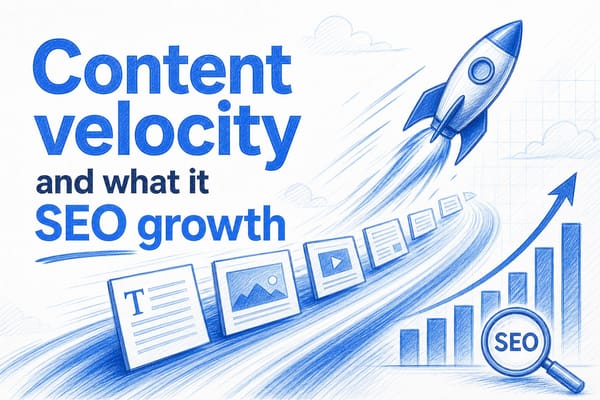
Content compounding: why consistent blogging grows organic traffic exponentially

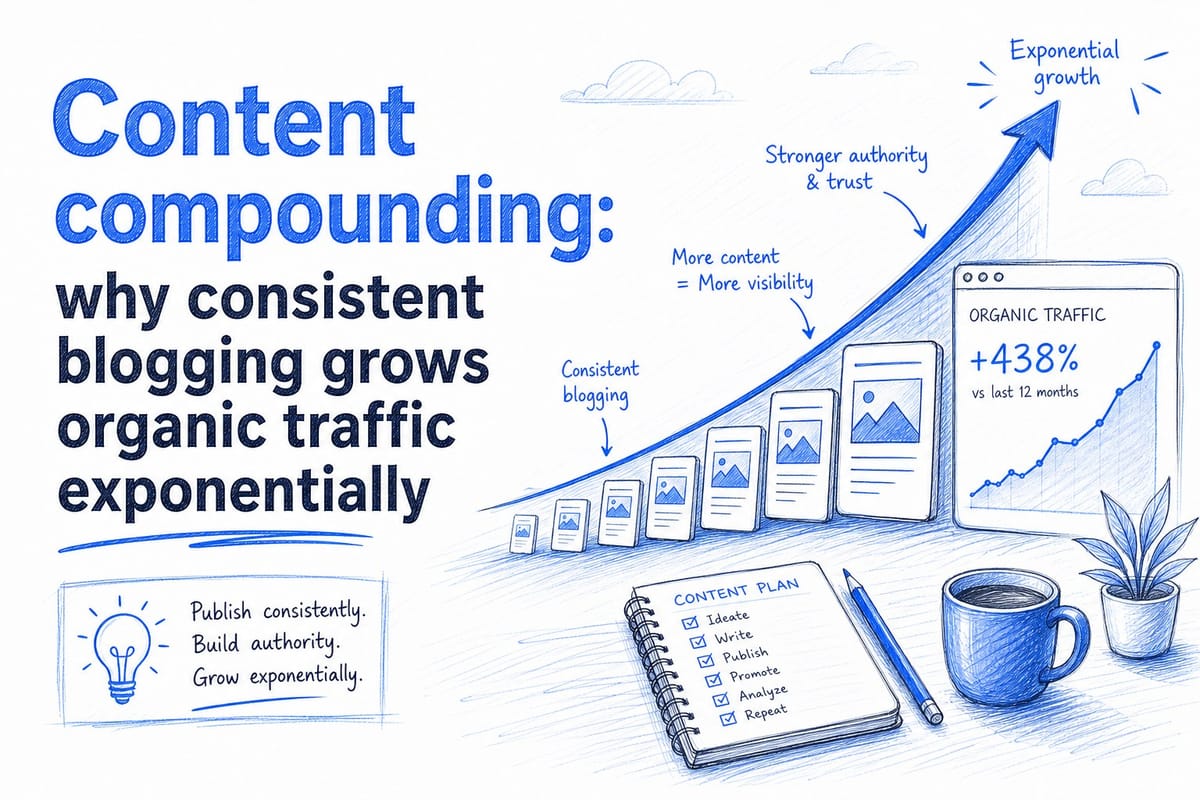
Table of contents
1. What content compounding actually means and why it matters
2. The three ingredients that make a compounding content strategy work
3. How to build a system that compounds without burning out your team
Most people expect blogging to work like a light switch. You publish a post, traffic shows up, done. But that is not how search engines work, and it is not how sustainable organic growth works either. The real mechanism behind long-term blog success is something closer to a savings account than a light switch. Every post you publish earns a little interest. Over time, that interest compounds. I want to walk you through exactly why content compounding blog SEO works the way it does, what makes it so powerful for growing brands, and how you can actually execute it without burning out or hiring a small army of writers.
What content compounding actually means and why it matters
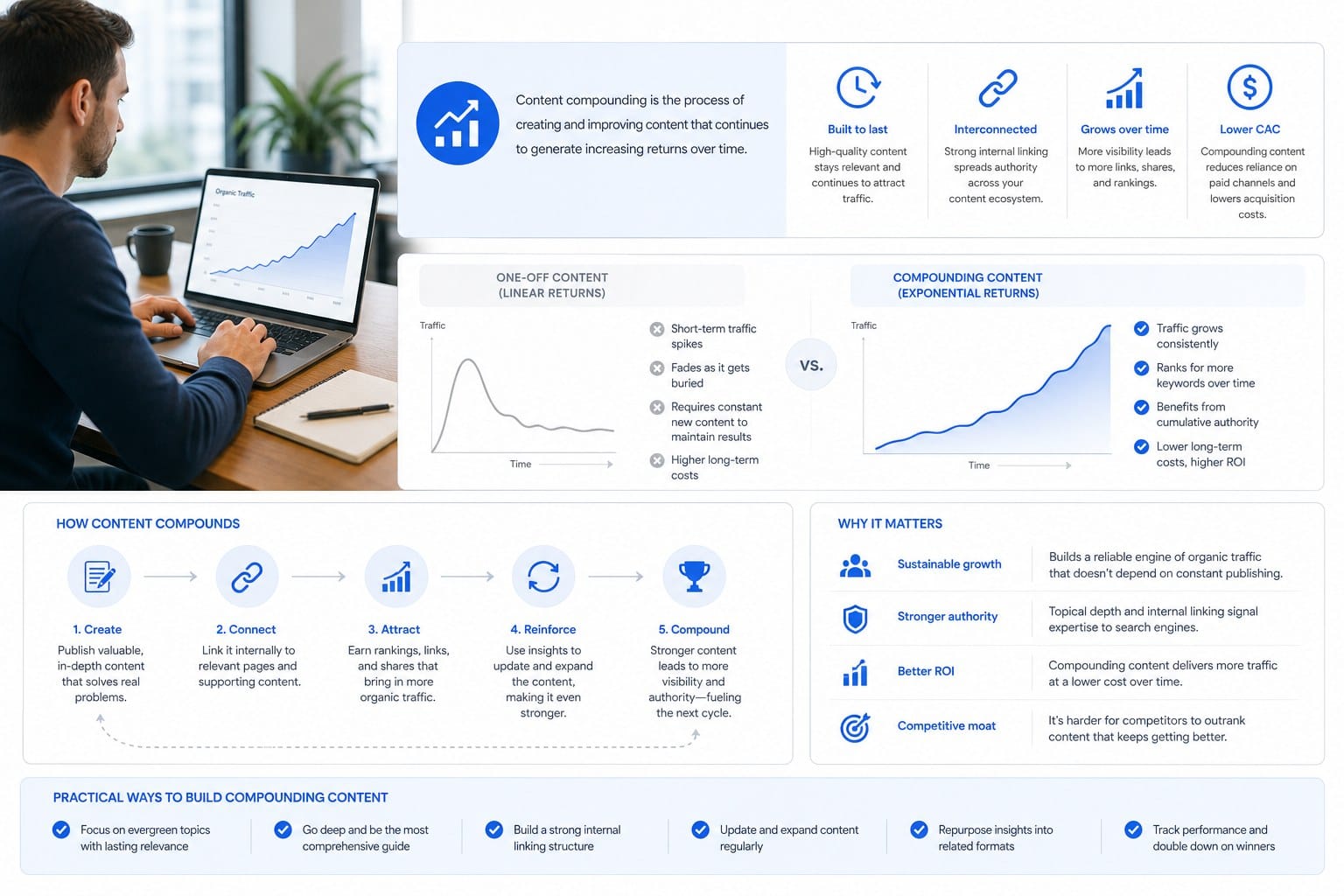
Content compounding is the idea that well-written blog posts do not just perform once and fade away. They keep attracting traffic, earning backlinks, and building topical authority for months or even years after publication. Each new post you publish adds to a growing base of content that search engines trust more with every passing month.
Think about a traditional paid ad. You pay, the ad runs, traffic comes in. You stop paying, the traffic stops. Blogging works completely differently. A post you publish today might rank on page two of Google for the first few weeks. Then it earns a few backlinks. Then Google sees that people are clicking it and staying on the page. Six months later, that same post has climbed to page one and is sending you several hundred visitors every single month, with zero additional spend.
Now multiply that by thirty posts, or a hundred posts. Each one is doing its own version of that slow climb. Some will underperform. A handful will become what researchers at HubSpot and SmartBug Media have identified as true compounding posts, meaning they grow traffic month over month on their own without any updates. The more posts you have working in parallel, the more powerful the cumulative effect becomes.
The compounding part is not a metaphor. It is mathematical. If ten posts each send you 200 monthly visitors, that is 2,000 sessions. If you add another ten posts that do the same, and your older posts have grown to 300 visitors each because of accumulated authority, you are now sitting at 5,000 monthly sessions without changing a single word on your site. Keep publishing consistently, and those numbers keep climbing.
This is very different from the results you get from sporadic blogging. A brand that publishes two posts in January, nothing in February, three posts in March, and then nothing for two months sends a confusing signal to Google. Crawl frequency drops. Topical authority does not consolidate. The posts sit in isolation rather than reinforcing each other. The compounding effect depends almost entirely on consistency, which is exactly why so many brands fail to capture it.
Topical authority is a huge part of what makes this work. When you publish multiple articles around a core subject, search engines start to recognize your site as a trustworthy source on that topic. A SaaS brand that publishes deeply researched articles on email marketing every week for six months is going to outrank a competitor that published one definitive guide two years ago and stopped. The depth and breadth of your content library signals expertise, and expertise is exactly what Google's helpful content guidelines reward.
I also want to address a common misconception here. Some people assume that compounding only works for high-volume keywords. That is not true. A Reddit thread from the IndieHackers community documented a brand that targeted longtail keywords with just ten to a hundred monthly searches each. By publishing two posts per week for eight weeks, they built up to 800 monthly visitors from organic search alone. Those are not massive numbers individually, but they compound. Add another eight weeks of the same effort, and the baseline keeps rising.
For independent bloggers and small business owners, this is genuinely good news. You do not need to compete for terms like "project management software" to benefit from content compounding. You can build real, durable organic traffic by going deep on specific topics that your audience actually searches for. The key is that you have to keep showing up.
One more thing worth understanding here is how internal linking amplifies the compounding effect. When your newer posts link back to your older ones, and your older ones get updated to link forward, you create a web of authority that flows across your entire content library. A post that was sitting on page four of Google can move to page two simply because three newer posts linked to it with relevant anchor text. This is why your content strategy should never treat individual posts as standalone pieces. They are all part of the same compounding system.
The three ingredients that make a compounding content strategy work
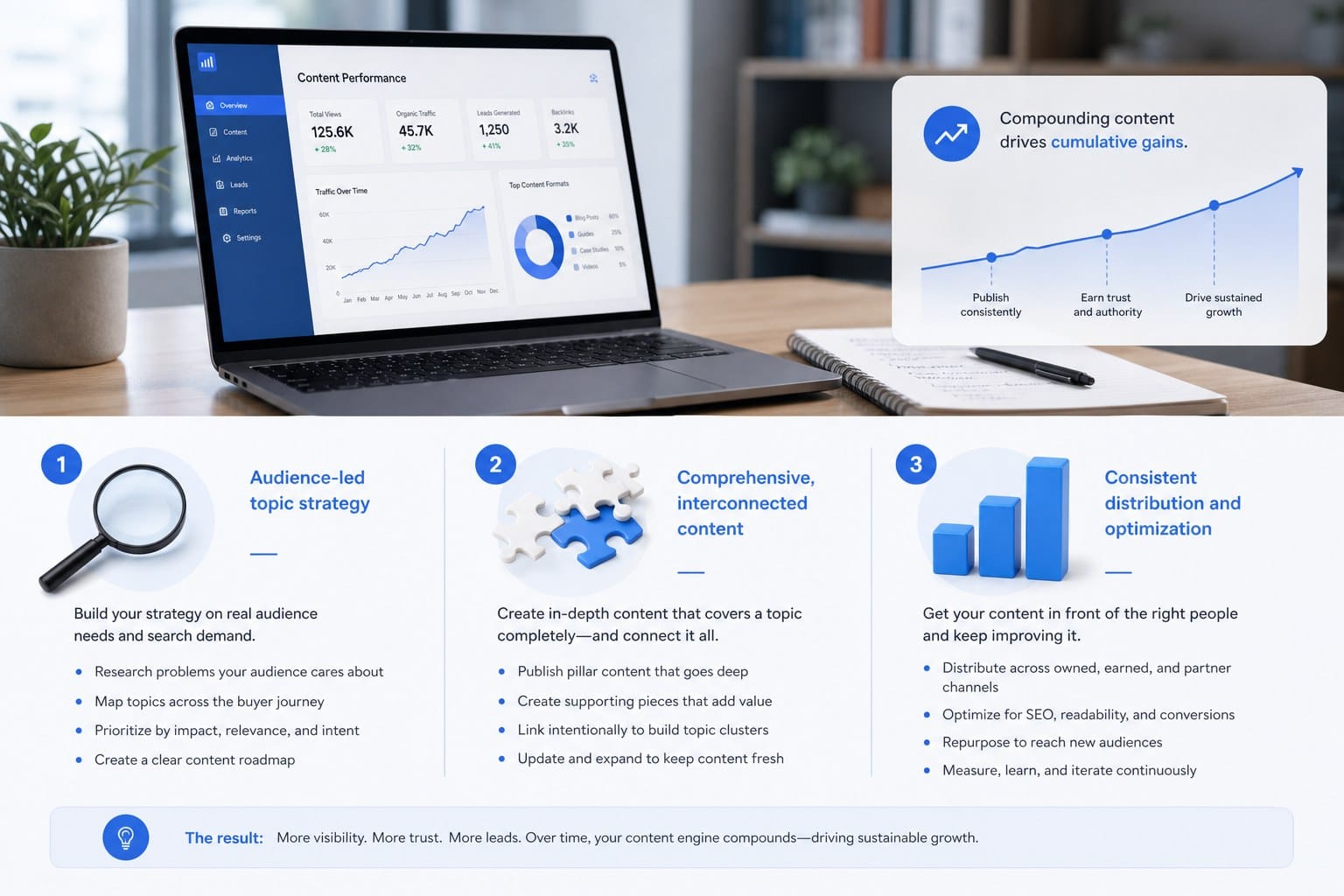
Understanding the theory of content compounding is useful. But execution is where most brands fall short. There are three concrete ingredients that determine whether your blog compounds or just collects dust. I want to walk through each one in practical terms.
The first ingredient is consistency at a sustainable publishing cadence. This does not mean you need to publish every single day. Research consistently shows that publishing frequency matters less than publishing without long gaps. A brand that publishes two solid posts per week every week for a year will dramatically outperform a brand that publishes five posts a week for a month and then goes quiet for six weeks. Gaps in publishing tell Google that your site is not actively maintained, which reduces crawl frequency and slows down indexing of new content.
What counts as consistent? For most growing brands, two to four posts per week is a strong target. For solo bloggers or small business owners who are resource-constrained, even one well-researched post per week adds up significantly over a year. Fifty-two posts in twelve months, each targeting a specific keyword and building on a coherent topical cluster, will generate more compounding traffic than a hundred posts published in bursts with no strategic thread connecting them.
The second ingredient is content depth and research quality. Shallow posts do not compound. A 400-word article that barely scratches the surface of a topic will not earn backlinks, will not satisfy search intent, and will not build topical authority. The posts that compound best are the ones that genuinely answer questions comprehensively, that cite credible information, that include examples and context, and that give readers a reason to stay on the page.
This is where a lot of brands struggle. Producing deeply researched long-form content takes time. A properly researched 2,000-word article can take four to six hours to write well. Multiply that by two posts per week, and you are looking at eight to twelve hours of writing time alone, before editing, formatting, and publishing. For a founder running a SaaS startup, a small business owner juggling operations, or a digital marketer managing multiple clients, that is simply not realistic on a sustained basis.
I will come back to how Blogtude addresses this specific problem. But for now, understand that depth is non-negotiable if you want the compounding effect to kick in. The research supports this clearly. Posts that rank on the first page of Google for competitive terms are almost always longer, more comprehensive, and more thoroughly sourced than posts that rank on page two or three. You can read more about long-form blog articles vs short posts: what actually ranks if you want to dig into the specific data.
The third ingredient is strategic topic selection. Not all blog posts have equal compounding potential. Posts that target informational keywords with clear search intent, that sit within a coherent topical cluster, and that align with your audience's actual questions are the ones most likely to compound over time. Random posts that cover unrelated topics do not build topical authority. They scatter your content library instead of concentrating it.
A good content strategy starts with a topic cluster model. You pick a core subject that is central to your business. Then you map out subtopics, related questions, and supporting articles that all connect back to that core subject. For a SaaS company selling project management software, the core cluster might be "remote team productivity." Supporting posts might cover things like asynchronous communication best practices, tools for tracking distributed team goals, how to run effective remote standups, and how to avoid burnout when working from home. Every one of those posts reinforces the core cluster, and the whole cluster reinforces the brand's authority on the topic.
Visuals also play a larger role in content compounding than most people account for. Posts that include custom, on-brand images get shared more on social media, which drives referral traffic back to the post. They also tend to get cited by other bloggers, which earns backlinks. Backlinks are one of the strongest signals that Google uses to rank content. If your posts look generic or use stock photos that appear on a thousand other sites, they are less likely to earn those citations. If you want to understand how to handle this at scale without a design team, the guide on how to create on-brand blog visuals at scale using AI covers the practical workflow in detail.
Beyond the three core ingredients, there is one operational reality worth naming directly. The brands that capture the compounding effect are almost always the ones that have removed execution friction from their content process. When publishing a post requires six handoffs between a writer, an editor, a designer, and a developer, it does not happen consistently. The process breaks down. Posts get delayed. The cadence falls apart. Removing that friction, whether through better systems, smarter tools, or automation, is what makes consistency actually achievable for teams that are not primarily content organizations.
I want to be specific about what that friction looks like in practice. A digital marketer managing a brand blog might spend an hour briefing a writer, then wait several days for a draft, then spend another hour editing, then coordinate with a designer for a header image, then log into the CMS to format and schedule the post. That is the workflow for a single article. Repeat it two or three times a week and it becomes a part-time job just to manage the pipeline. Tools that handle more of that pipeline automatically are not a luxury for growing brands. They are what makes compounding possible in the first place.
How to build a system that compounds without burning out your team
The gap between knowing content compounding works and actually executing it at scale is where most brands get stuck. I want to get practical here and talk about what a real compounding content system looks like, including where humans need to be involved and where automation can carry the load.
Start with a 30-day content plan before you publish a single post. Map your topic clusters. Identify the primary keyword for each post. Note the search intent for each one, whether it is informational, navigational, or transactional. Decide which posts will link to which others. This planning work takes a few hours upfront, but it transforms your blog from a collection of isolated articles into a coherent content machine. Without this structure, even consistent publishing will underperform because the posts will not reinforce each other.
Once you have a plan, the next challenge is production. Research is the most time-consuming part of writing a quality long-form post. A properly researched 2,000-word article requires reading multiple credible sources, understanding the landscape of existing content on the topic, identifying gaps that your post can fill, and synthesizing information into something that is genuinely more useful than what already exists. Skipping this step produces thin content that does not compound. It just fills your blog with noise.
For many growing brands, the practical answer to the research problem is AI-assisted content generation, used correctly. I want to be careful here because there is a significant difference between using AI to generate low-quality bulk content and using AI to conduct research, build structured drafts, and maintain a consistent publishing schedule while a human applies judgment and brand voice. The former is likely to hurt your SEO. The latter is a legitimate way to maintain the consistency that compounding requires.
This is exactly the model that Blogtude is built around. Rather than asking a founder or a solo blogger to spend ten hours a week researching and writing, Blogtude generates a 30-day content strategy, produces deeply researched long-form articles, creates on-brand visuals, and publishes directly to Ghost and other CMS platforms automatically. The output is not generic filler. It is structured to build topical authority, match search intent, and maintain the cadence that makes compounding work.
For Ghost CMS users specifically, the integration removes almost all of the manual steps from the publishing workflow. You do not need to format posts, upload images, or set metadata manually. The system handles that so you can focus on the strategic decisions, like which topics to prioritize, which posts to promote, and how to respond to what the traffic data tells you. If you are evaluating platforms and want a broader comparison, the article on best CMS platforms for automated content publishing breaks down the options in detail.
Beyond production, there is the question of how to keep your older posts compounding as your site grows. Google rewards freshness in certain content categories, and even evergreen posts benefit from periodic updates. Reviewing your top-performing posts every six months and updating statistics, adding new examples, or expanding sections that users seem to drop off from is one of the highest-leverage activities in content marketing. A post that was earning 500 monthly visitors can often be bumped to 800 or more just by refreshing it with current information and improving the internal link structure.
Tracking is also essential if you want to understand which posts are actually compounding versus which ones are flat. Google Search Console is your best free tool for this. Look at which posts are growing in impressions and clicks month over month. Those are your compounding posts. Look at which ones are declining or flat and consider whether they need to be updated, consolidated with another post, or retired entirely. A healthy compounding blog is not just a growing one. It is a curated one.
Let me also talk about the relationship between compounding content and other traffic channels, because blogging does not operate in isolation. A post that ranks on page one of Google for a longtail keyword might send you 300 organic visitors per month. If you share that post on LinkedIn and it resonates with your audience, it might send another 150 referral visitors that month. Some of those referral visitors might share it themselves, which earns you a backlink, which improves the post's search ranking, which increases the organic traffic, which gives you more content to share socially. This is the flywheel effect that brands with mature content libraries talk about. It starts slowly, but once it gets moving, each channel amplifies the others.
Email is another channel worth building in parallel with your blog. Every post you publish is an opportunity to send a newsletter to your list. That newsletter drives traffic back to the post, signals to Google that people are seeking out your content, and keeps your audience engaged between search-driven visits. Over time, your email list becomes a reliable traffic source that reduces your dependence on search rankings alone, which makes your overall content strategy more resilient.
For SaaS founders and startups specifically, I want to emphasize the long-term ROI case for this approach. Paid acquisition costs money every month and stops the moment your budget stops. A content compounding strategy costs time and resources upfront but pays dividends for years. A post you publish today could be sending qualified leads to your product page three years from now without any additional investment. That is not hypothetical. It is how established SaaS brands like Ahrefs, Buffer, and Intercom built their organic traffic. They published consistently, they went deep on topics their audiences cared about, and they let the compounding effect do the work over time.
For small business owners who feel like this is all too complex to manage, the honest answer is that the complexity is mostly in the setup. Once you have a topic cluster mapped, a publishing cadence set, and a workflow that removes the friction from production and publishing, maintaining the system is far less demanding than building it. The first thirty days are the hardest. After that, you are mostly maintaining momentum rather than building it from scratch.
One practical tip that I find genuinely useful is to batch your content planning and production. Instead of making decisions about what to write each week, spend a few hours once a month mapping out the next thirty days of content. Decide on topics, keywords, and post formats all at once. Then produce in batches rather than one post at a time. This kind of batching reduces the cognitive overhead of constant decision-making and makes it much easier to stay on schedule even during busy weeks.
Finally, patience is a real ingredient in this strategy, and I want to be honest about that. Content compounding does not produce results in two weeks. Most brands that commit to consistent, quality publishing start to see meaningful organic traffic growth at around the four to six month mark. The trajectory after that is usually steep, but you have to get through the early months where it feels like nothing is working. The brands that give up in month two are the ones that never capture the compounding effect. The ones that stay consistent are the ones that look back a year later and wonder why they did not start sooner.
Ready to take the next step?
If you are ready to stop publishing sporadically and start building a blog that compounds over time, Blogtude makes it practical. The platform generates your 30-day content strategy, produces deeply researched long-form articles with on-brand visuals, and publishes automatically to Ghost and other CMS platforms so you can maintain consistent output without doing everything manually. Visit blogtude.com to see how it works and start building your content compounding system today.