Long-form blog articles vs short posts: what actually ranks

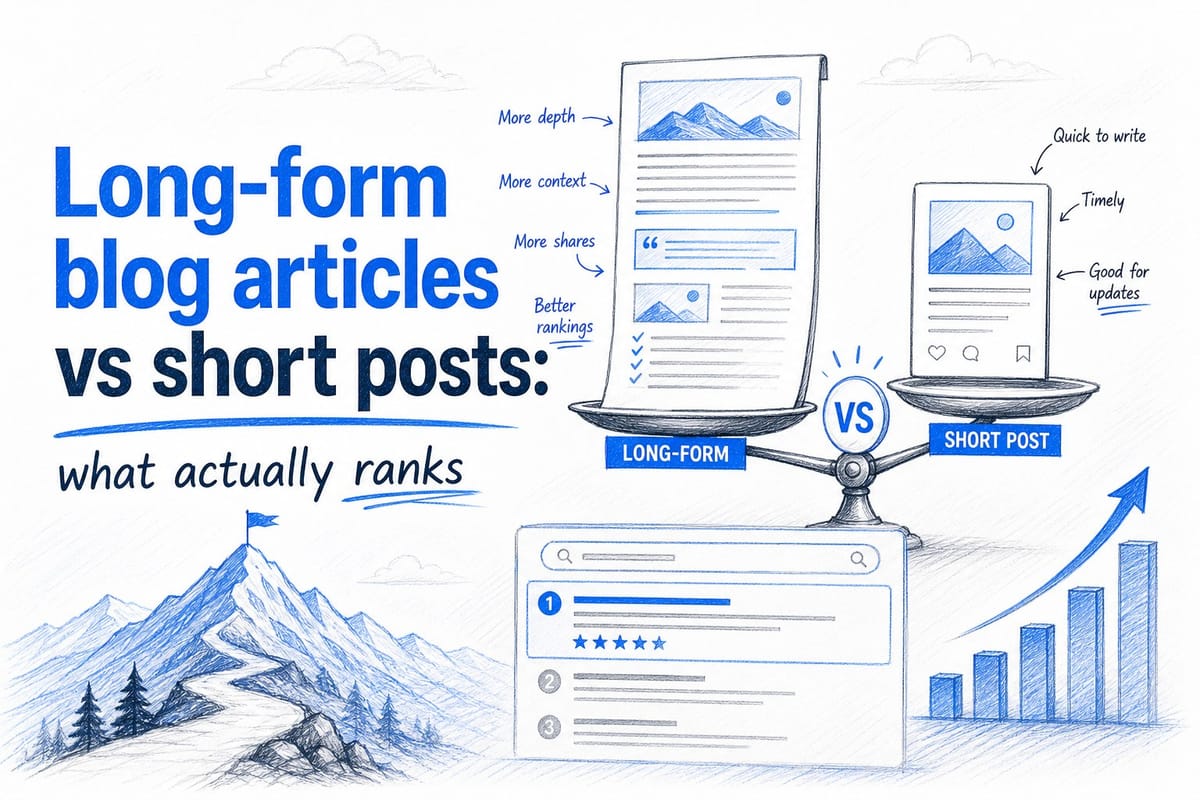
Table of contents
1. What the data says about long-form vs short posts
2. How long-form content builds compounding SEO value over time
3. Building a content mix that actually works in practice
One of the most common questions I hear from bloggers and content teams is whether they should go long or short with their posts. It sounds simple, but the answer shapes your whole content strategy. The debate around long-form blog articles vs short posts SEO performance is real, and there is actual data behind it. I want to walk you through what the research shows, what Google actually rewards, and how to think about your own publishing mix so you can make smart decisions instead of just guessing. This is not about chasing a magic word count. It is about understanding why length matters, when it does not, and how to build a publishing habit that compounds over time.
What the data says about long-form vs short posts
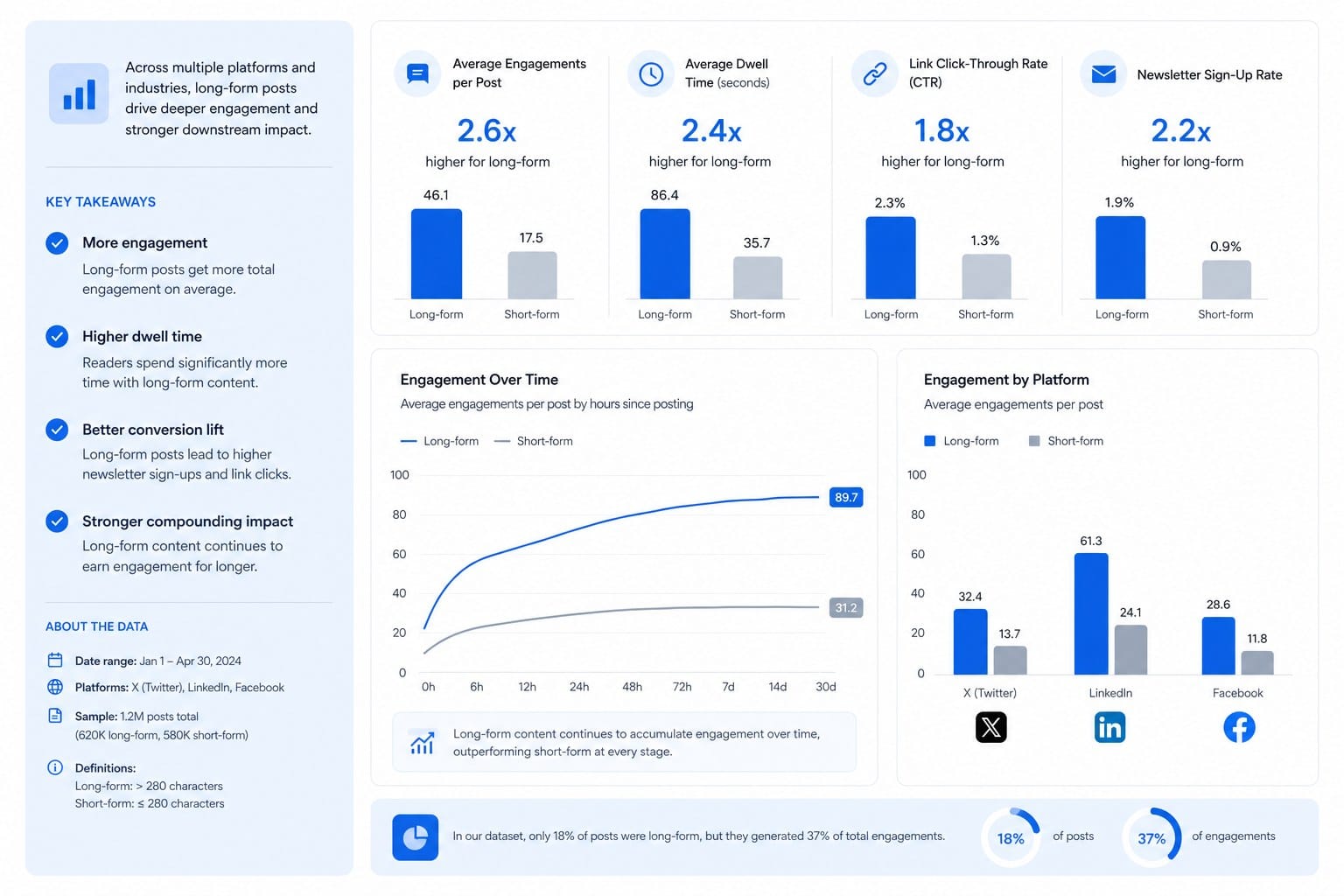
Let me start with the numbers, because they tell a clear story. SEO research firms like Backlinko and HubSpot have consistently found that longer content earns more backlinks and ranks for more keyword variations than shorter posts. Backlinko's analysis of over one million Google search results found that the average first-page result contains around 1,400 words. That does not mean every article needs to hit exactly 1,400 words. It means thin content rarely competes at the top of the results page, and the sites sitting in positions one through three are almost always publishing something substantial.
HubSpot's research found that blog posts between 2,250 and 2,500 words drive the most organic traffic on average. Posts in the 2,000 to 3,000 word range also tend to get shared more on social media and attract more inbound links from other sites. Both of those factors feed directly into how Google evaluates authority and relevance. When other websites link to your content, they are casting a vote of confidence. The more votes a page collects, the more weight it carries in the algorithm.
So why does length tend to correlate with better performance? A few reasons come up consistently. First, longer articles cover a topic more completely. When a reader lands on a post and finds a thorough answer, they stay longer and explore more pages. Google pays attention to that behavior. Dwell time and low bounce rates are signals that the content is actually useful and not just optimized for clicks. Second, comprehensive posts naturally include more semantic variations of a keyword, related terms, and subtopics that help search engines understand the full scope of what you are writing about. A post that covers a topic from multiple angles gives Google more context to evaluate, which often translates to rankings for terms you were not even explicitly targeting.
But here is where people get confused. Length alone does not rank anything. A 3,000-word article padded with repeated points, vague advice, and unnecessary backstory will not outrank a tight, well-researched 800-word post that directly answers a specific question. The difference is substance. Long-form content wins when it is genuinely informative, well-structured, and covers depth that shorter posts simply cannot.
Consider a search like "how to reduce churn for a SaaS product." Someone searching that phrase is probably a founder or product manager dealing with a real business problem. They are not looking for a three-paragraph overview. They want to understand the mechanics of churn, the most common causes, the interventions that actually work, how to measure progress, and what to watch out for. A 2,800-word guide that walks through each of those things serves that reader far better than a quick post. And because it serves the reader better, it tends to rank higher and stay there longer.
Short posts still have a clear place in any content strategy. A 400 to 600 word post can rank well for very specific, low-competition queries where the search intent is simple and direct. If someone types "what is a 301 redirect" into Google, they do not need a 3,000-word essay. They want a clear, fast answer. A short post that gives a clean definition, explains when to use a 301 redirect, and includes one or two examples is exactly what that search needs. Writing more would not make it better. It would make it worse by burying the answer.
Matching content length to search intent is one of the most underrated skills in SEO. You cannot just pick a target word count and apply it across your entire blog. You have to look at each topic and ask what the person searching for it actually needs. Sometimes that is 400 words. Sometimes it is 4,000. Getting that judgment right consistently is what separates sites that grow their organic traffic from sites that spin their wheels publishing content that never ranks.
I also want to address one myth that floats around in SEO circles: the idea that Google has a word count preference baked into its algorithm. It does not. Google has said publicly that word count is not a direct ranking factor. What matters is whether the content satisfies the user's query. If a 300-word post is the most complete and helpful answer for a given search, it can rank above a 3,000-word post on the same topic. The question is never how many words you wrote. The question is whether your content is the most useful result for that search.
The practical takeaway is that long-form content tends to build more authority over time, while short posts can fill in the gaps for quick-answer queries. You need both, but in competitive niches, the weight of your strategy should lean toward substance and depth. Sites that publish a high volume of thin content to chase frequency rarely win against sites that take the time to write the most complete answer available on a given topic.
One more thing worth noting: the sites that consistently rank at the top of competitive searches are not trying to game length. They are trying to answer questions completely. The word count follows from that goal. When you sit down to write a post, start by asking what your reader actually needs to walk away satisfied, and then write until you have delivered that. Sometimes you will end up at 600 words. More often, for topics with any real complexity, you will end up somewhere between 1,500 and 3,000. That range is not a target. It is the natural result of being genuinely thorough.
How long-form content builds compounding SEO value over time
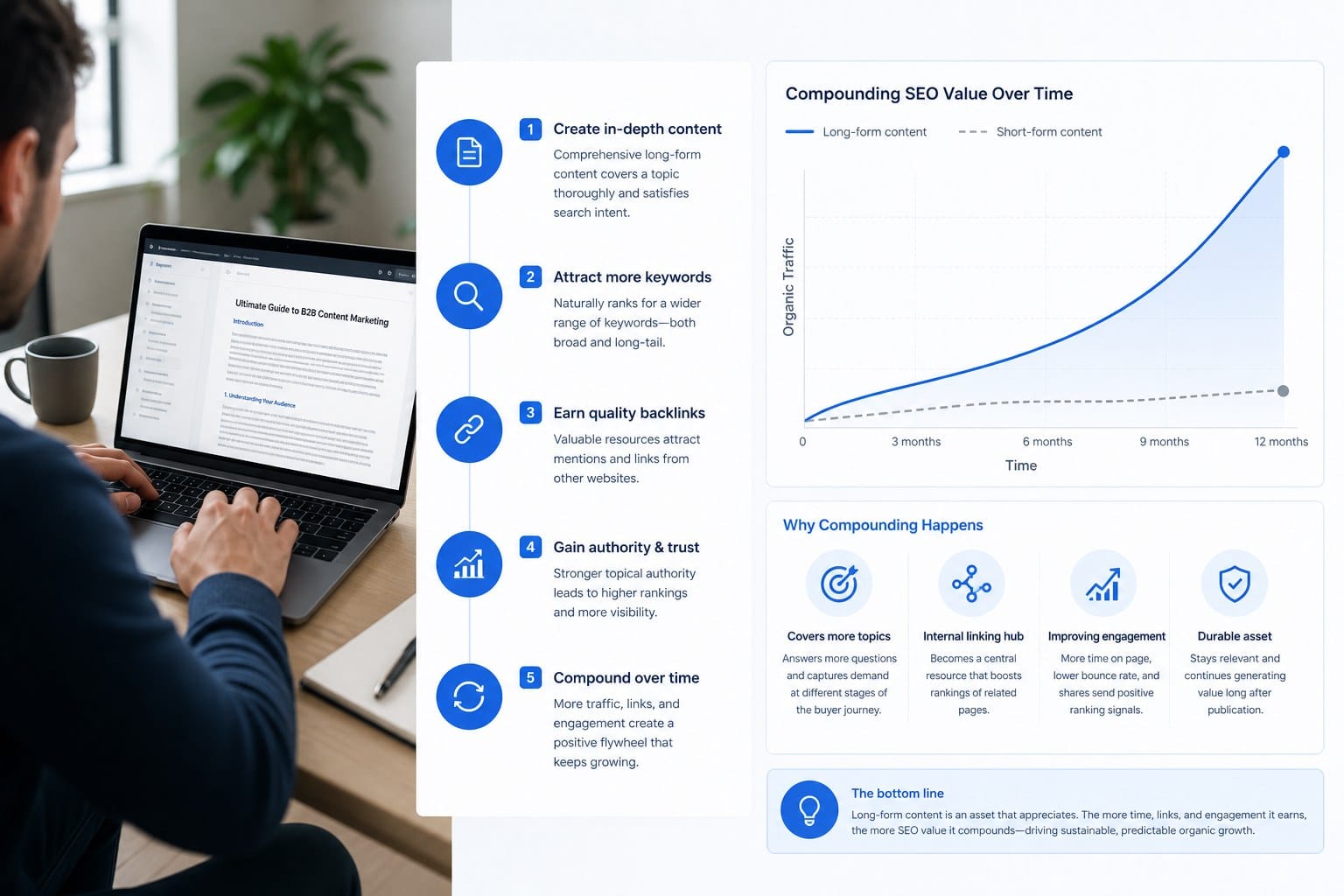
Here is something that often gets overlooked in the long-form blog articles vs short posts SEO conversation: the compounding effect. A well-written, comprehensive article does not just rank for one keyword. It can rank for dozens of related terms simultaneously, pulling in traffic from multiple search queries without any additional work after publication. That is a fundamentally different kind of return than what a short post delivers.
This is called topical depth, and it is one of the strongest arguments for investing in long-form content. When you write a 2,500-word article on, say, email marketing for e-commerce brands, you are going to naturally touch on list segmentation, subject line strategy, automation sequences, send timing, and how to measure conversion rates. Each of those subtopics has its own search volume. A single thorough article can capture traffic from all of them at once. You did not have to write five separate posts. You wrote one comprehensive guide and Google found multiple entry points into it.
Short posts cannot do that as effectively. A 500-word post on email subject lines might rank for a handful of specific terms, but the surface area for ranking is limited by design. There is only so much you can cover in 500 words, which means there are only so many terms you can rank for. That is fine for what those posts are built to do. But it means short content has a lower ceiling for organic reach, and that ceiling matters when you are trying to build a site that grows traffic without constantly adding new pages.
Backlinks tell a similar story. When other websites are looking for resources to reference, they tend to link to authoritative, detailed content rather than short posts. A comprehensive guide, a detailed how-to, or a well-researched analysis is far more linkable than a quick tip post. Think about the last time you linked to something from your own content. You probably linked to a resource that gave your readers something valuable to explore, not a post that restated something they already knew. Over time, backlinks raise the authority of the individual page and of your whole domain. That domain authority makes it easier for every new article you publish to rank faster.
Let me give you a concrete example. Imagine you run a SaaS product for project management. You write a 2,800-word article on how to run agile sprints for remote teams. That post covers sprint planning, daily standups, sprint reviews, retrospective formats, and common pitfalls. It naturally picks up rankings for "agile sprint planning," "remote sprint meetings," "sprint retrospective tips," "how to run a sprint review," and several other related queries. It also earns links from project management blogs and productivity newsletters that find it when researching their own content. Six months later, that one article is driving several hundred organic visitors per month without you having touched it since publication.
That is the compounding effect in action. Short posts can get you quick wins on specific low-competition queries, but they rarely build that kind of lasting, self-reinforcing momentum. The math just does not work out the same way.
There is another angle here worth spending time on: updating long-form content. One of the most underused tactics in SEO is refreshing a well-performing long article with new data, updated examples, expanded sections, and sharper structure. Google favors fresh, accurate content, and when you update an article, it often triggers a re-crawl and a fresh evaluation of where the page should rank. A 2,000-word post you wrote two years ago can become a 3,400-word resource with a few focused hours of work, and it will often climb the rankings again in the weeks following the update.
Short posts are much harder to update meaningfully. You might swap out a statistic or fix a broken link, but there is limited room to expand the value of a 400-word post without essentially rebuilding it as a long-form piece. Long-form content gives you something to work with. Each update makes the article stronger, which in turn makes it more likely to hold its rankings against newer competition.
For growing brands that want consistent organic traffic without an enormous writing team, the most efficient path is a core set of long-form cornerstone articles supported by shorter posts that target specific long-tail queries. The cornerstone articles do the heavy SEO lifting. The shorter posts fill in gaps and support internal linking. If you want to understand how to build that kind of publishing engine without hiring a full content team, I went into detail on exactly that approach in this guide on how to scale blog content without hiring writers.
Publishing frequency also plays into compounding value in a way people often miss. Publishing one excellent long-form article per week will outperform publishing five rushed short posts per week in almost every competitive niche. Google evaluates the quality of your site as a whole, not just individual pages in isolation. A pattern of thin, quickly written content signals low quality at the domain level. A pattern of thorough, well-researched articles builds domain authority over time, and that rising authority benefits even the pages that were not individually strong enough to rank on their own.
For SaaS founders especially, this matters from the beginning. Early organic traffic is built on a foundation of content that answers real questions your target audience is actively searching for. Getting that foundation right early prevents you from having to clean up hundreds of thin posts later, which is a genuinely painful and time-consuming process. I covered this in detail in my article on how SaaS startups can use blogging to drive organic traffic from day one, and the core principle is the same: substance built consistently beats volume every time.
The compounding logic also applies to how Google evaluates your site's topical authority. A site that publishes ten deeply researched articles on a single subject builds stronger topical authority in that area than a site that publishes fifty surface-level posts across a dozen different subjects. Google's systems look for signals of genuine expertise. A concentrated library of thorough content on a specific topic is one of the clearest signals you can send. Long-form content, by its nature, demonstrates expertise better than short posts can. You simply cannot show depth in 400 words.
Building a content mix that actually works in practice
Now that we have covered what the data shows and how long-form content compounds over time, the practical question is: how do you actually build a content strategy that balances long-form and short posts without burning yourself out or losing focus?
The first step is understanding search intent for every keyword you want to target. Search intent refers to what the person typing that query actually wants. There are four main types: informational, where the person wants to learn something; navigational, where they want to find a specific website; commercial, where they are researching options before making a purchase; and transactional, where they are ready to act. Your content format, length, and structure should match the intent behind each keyword. This is not optional. Mismatching intent is one of the most common reasons that technically well-written content fails to rank.
For informational queries with meaningful depth, like "how to build a content calendar for a SaaS blog," you need a long-form article. The person asking that question wants a complete walkthrough with real examples, not a quick tip. For simple factual queries, like "what does CTA stand for," a short, precise answer wins. Trying to write 2,500 words about what CTA stands for would not improve your rankings. It would signal to Google that your content does not match what the searcher needs, and it would waste your readers' time.
The framework I use is this: for every topic cluster, identify three to five core questions your audience is actively asking. The broadest, most competitive questions get long-form treatment. The more specific, lower-competition follow-up questions get shorter posts that link back to the main article. This internal linking structure helps search engines understand the relationships between your content and boosts the authority of the cornerstone article at the center of each cluster.
Here is a concrete example. Say your core article is "The complete guide to onboarding new SaaS customers." That gets a thorough 2,500 to 3,000 word treatment. You support it with shorter posts on "what is the average SaaS onboarding time," "onboarding email sequence examples," and "how to measure onboarding success." Each shorter post answers a specific question, links back to the comprehensive guide, and draws in traffic from related searches. The guide collects more internal links, which signals importance to Google, and the cluster as a whole builds topical authority around onboarding.
This cluster model also makes your content easier to plan. Instead of trying to come up with a fresh topic every week from scratch, you map out your topic clusters first and then write toward them systematically. Each new article you add either strengthens an existing cluster or starts a new one. Over time, your site becomes a genuine resource on the subjects that matter most to your audience, and Google rewards that coherence.
Another practical issue is publishing frequency. Many bloggers and content teams make the mistake of prioritizing volume with short posts because it feels more productive to publish something every day. In most niches, publishing two or three substantive long-form articles per month will generate more organic traffic than publishing twenty thin posts over the same period. This is not a guess. It is what the traffic data shows on sites that have tested both approaches. The short posts pile up without building authority. The long-form articles compound.
That said, consistency matters more than most people realize. Publishing two excellent articles per month, every month, for a full year is far more valuable than publishing ten articles in a burst and then going quiet for two months. Google rewards sites that maintain a steady publishing rhythm. It is a signal that the site is being actively maintained and that readers can expect fresh content. Gaps in publishing, especially long ones, can erode the momentum you have built.
This is exactly where independent bloggers and small business owners hit a real wall. Writing a thorough, well-researched 2,500-word article takes time, focus, and skill. Doing that twice a month while also running a business, managing a team, or serving clients is genuinely hard to sustain. The conventional answer is to hire writers, but good writers are expensive and managing a writing team introduces its own overhead: briefings, revisions, feedback cycles, and quality checks.
A smarter option for a lot of growing brands is to use a content system that handles research, writing, and publishing automatically, without sacrificing quality. That is what Blogtude is built to do. It generates a 30-day content strategy tailored to your niche, produces deeply researched long-form articles with on-brand visuals, and publishes directly to Ghost and other CMS platforms. You get the SEO benefits of consistent, high-quality long-form content without spending hours every week writing, editing, and formatting. If you use Ghost and want to see how automated publishing fits into a broader content workflow, the automated blog publishing: the complete setup guide for growing brands walks through the full setup process.
I also want to address the concern some bloggers raise about AI-generated content and whether Google penalizes it. Google has been consistent on this: the algorithm evaluates content based on quality, accuracy, and whether it genuinely serves the reader. Thin, spammy content gets penalized regardless of whether a human or a machine produced it. High-quality, accurate, well-structured content that answers real questions ranks well regardless of how it was created. The key is that the output has to meet a genuine quality bar. Word count is not the bar. Usefulness is.
Once you are publishing a consistent mix of long and short content, you need to track performance to know what is actually working for your specific audience and niche. The metrics that matter most are organic traffic per article, average position in search results, the number of distinct keywords each article ranks for, backlinks earned over time, and average time on page. These data points together give you a clear picture of which content is building real value and which pieces are not pulling their weight.
In most niches, a relatively small number of long-form articles drive the large majority of organic traffic. This is the classic 80/20 pattern in content marketing. Identify which articles are performing best, then double down by expanding them with new sections, updating the data and examples, and building more internal links to them from newer content. Those high-performing pieces often have more room to grow than you expect.
For the short posts that are not driving traffic, the question to ask is whether they are serving a structural purpose in your internal linking strategy. If a short post links to a cornerstone article and pulls in a small but steady trickle of long-tail traffic, it is earning its place. If it is just sitting there with no traffic and no links, it may be worth either expanding it into a proper long-form piece or consolidating it into a related article that already has momentum.
The short version of everything covered here is this: long-form content wins on authority, backlinks, and compounding keyword rankings. Short posts win on matching simple search intent and filling gaps in your topic coverage. The best content strategies use both, with long-form carrying the weight and short posts supporting the structure. Get the balance right, maintain a steady publishing cadence, and focus on genuine usefulness over word count for its own sake. Do that consistently, and you will build organic traffic that grows reliably over time without having to reinvent your strategy every few months.

Ready to take the next step?
If you are ready to stop guessing how long your posts should be and start publishing a research-backed content strategy automatically, Blogtude handles the whole process. From building your 30-day content plan to writing thorough long-form articles and publishing them directly to your CMS, it removes the bottleneck between your ideas and consistent organic growth. Visit blogtude.com to see how it works.