How digital marketers can automate brand blog workflows without losing quality

Table of contents
1. Where brand blog workflows actually break down
2. What a quality-preserving automation layer actually looks like
3. How to implement automated blog workflows without sacrificing brand voice
Every digital marketer I have talked to lately has the same problem. They know consistent blogging drives organic traffic, but the workflow to produce quality posts is brutal. You need keyword research, an outline, a draft, edits, visuals, SEO metadata, and then the actual publishing step. Do that for one post and it takes most of a day. Do it for four posts a month across a brand blog and you have a part-time job sitting inside your already-full schedule.
That tension is exactly why so many brand blogs go quiet after a strong start. The intent is there. The strategy makes sense. But the execution collapses under its own weight.
The good news is that the tools available today make it genuinely possible to automate brand blog workflow digital marketing teams use without gutting the quality readers and search engines expect. This article breaks down where the bottlenecks actually live, how a smart automation layer addresses each one, and what you need to watch so your blog stays sharp instead of sounding like a machine wrote it alone.
Where brand blog workflows actually break down
Most digital marketers assume the writing step is the hardest part. In my experience, that is rarely true. The writing is visible, which is why it gets the most attention. But the steps before and after writing are what quietly kill consistency.
Let me walk through a typical brand blog workflow so we can name the real problem areas.
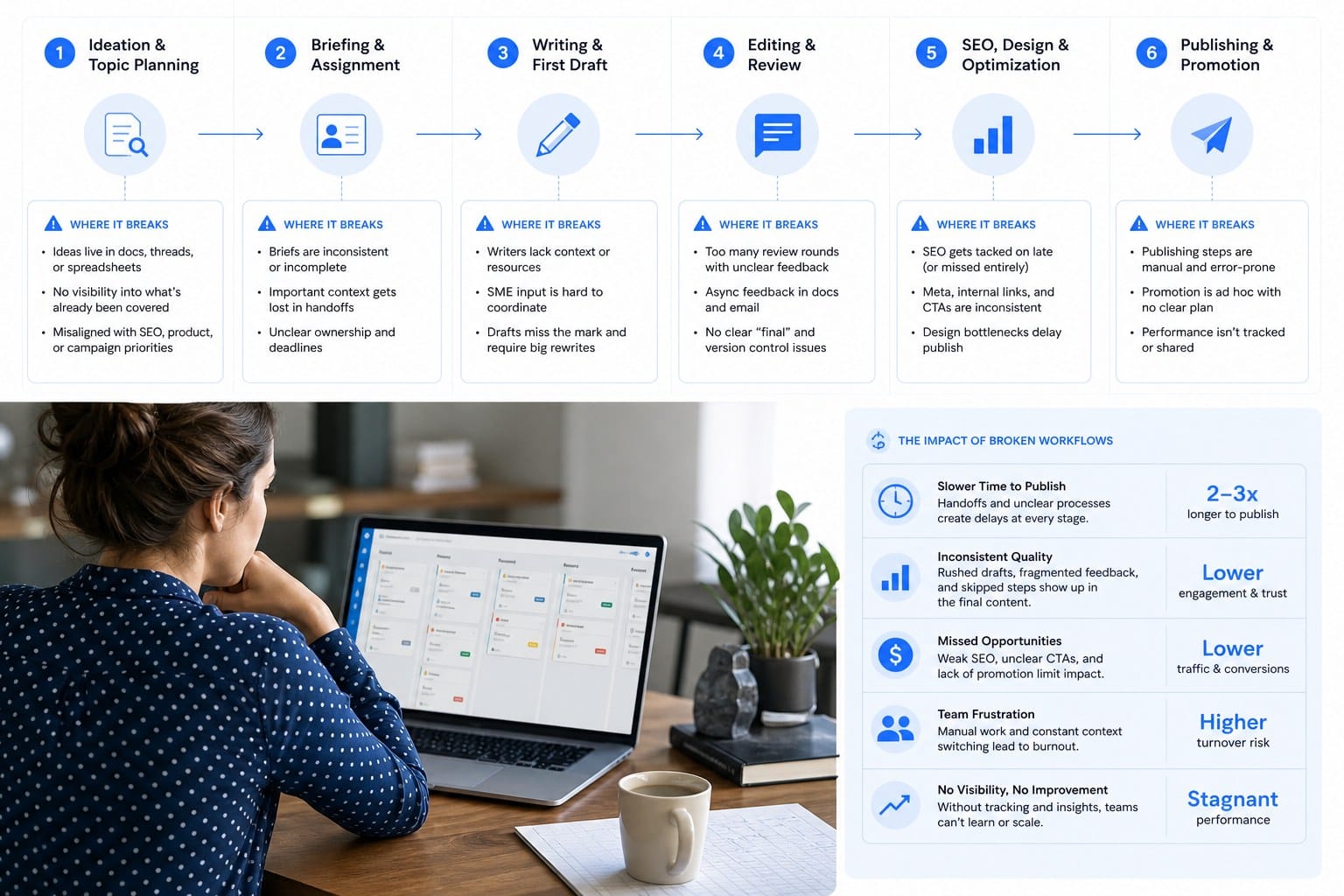
First, someone has to decide what to write about. That means pulling keyword data, checking search intent, looking at what competitors rank for, and matching topic ideas to the brand's content pillars. If you do this properly, it takes two to three hours just to land on a single validated topic. Multiply that by twelve posts a month and you have a research operation on your hands.
Second, someone has to build the brief. A decent article brief covers the target keyword, secondary keywords, the intended audience, the angle that differentiates the post from what already ranks, the approximate word count, the internal linking opportunities, and any sources worth citing. Skipping the brief means writers go off-script and you spend more time editing than you would have spent writing the brief in the first place.
Third, the draft has to be written. This is where most people focus their automation energy, and for good reason. But a draft without a solid brief behind it tends to be shallow. AI writing tools can produce fluent sentences quickly. Producing fluent sentences that are actually accurate, strategically structured, and on-brand is a different matter.
Fourth, visuals have to be created or sourced. Generic stock photos hurt brand perception. Custom graphics take a designer and a budget. Most brand blogs punt on this step and either skip visuals entirely or grab whatever free image comes up first in a search. Neither choice helps the post perform.
Fifth, the post has to be formatted and published. That means adding metadata, setting the SEO title and description, compressing images, adding alt text, linking internally, and hitting publish at the right time. It sounds simple. It is not, especially when you are managing a CMS with its own quirks.
When I lay it out this way, it becomes obvious that a brand blog workflow has at least five distinct phases, and any one of them can become the bottleneck that stops everything else. Automating just the writing step, which is what most people try, only removes one fifth of the problem.
The teams that actually manage to automate brand blog workflow digital marketing without losing quality are the ones who automate across all five phases in a coordinated way. They are not stitching together five separate tools and hoping the handoffs work. They are using a system where strategy, writing, visuals, and publishing are connected from the start.
There is also a less obvious breakdown point worth naming: the approval loop. On teams with more than one person involved in content, every post goes through at least one round of review before it publishes. If the review is catching quality problems, that is healthy. If it is catching inconsistencies that a better brief or a clearer style guide would have prevented, that is wasted time. Automating the inputs to the creative step reduces review cycles because the output lands closer to what was expected.
Content compounding is one of the strongest arguments for solving this workflow problem permanently rather than patching it post by post. When you publish consistently over months and years, each new post adds to the authority you have already built. The organic traffic growth is not linear, it is exponential. But compounding only works if you actually publish. A blog that goes quiet for two months does not just stop growing, it starts to lose ground. You can read more about how that mechanism works in this piece on content compounding: why consistent blogging grows organic traffic exponentially.
The practical implication is that solving the workflow problem is not a nice-to-have. If you want the SEO benefits of blogging, you need a system that can keep producing without requiring heroic effort every single week.
What a quality-preserving automation layer actually looks like
The word automation makes some marketers nervous when it comes to content. That nervousness is reasonable. We have all read AI-generated blog posts that were technically correct and genuinely awful. Thin, repetitive, full of hedged language that says nothing, clearly optimized for a keyword count rather than a reader.
But that kind of output comes from treating automation as a replacement for thinking rather than as a system that does the thinking in a structured way. The distinction matters a lot.
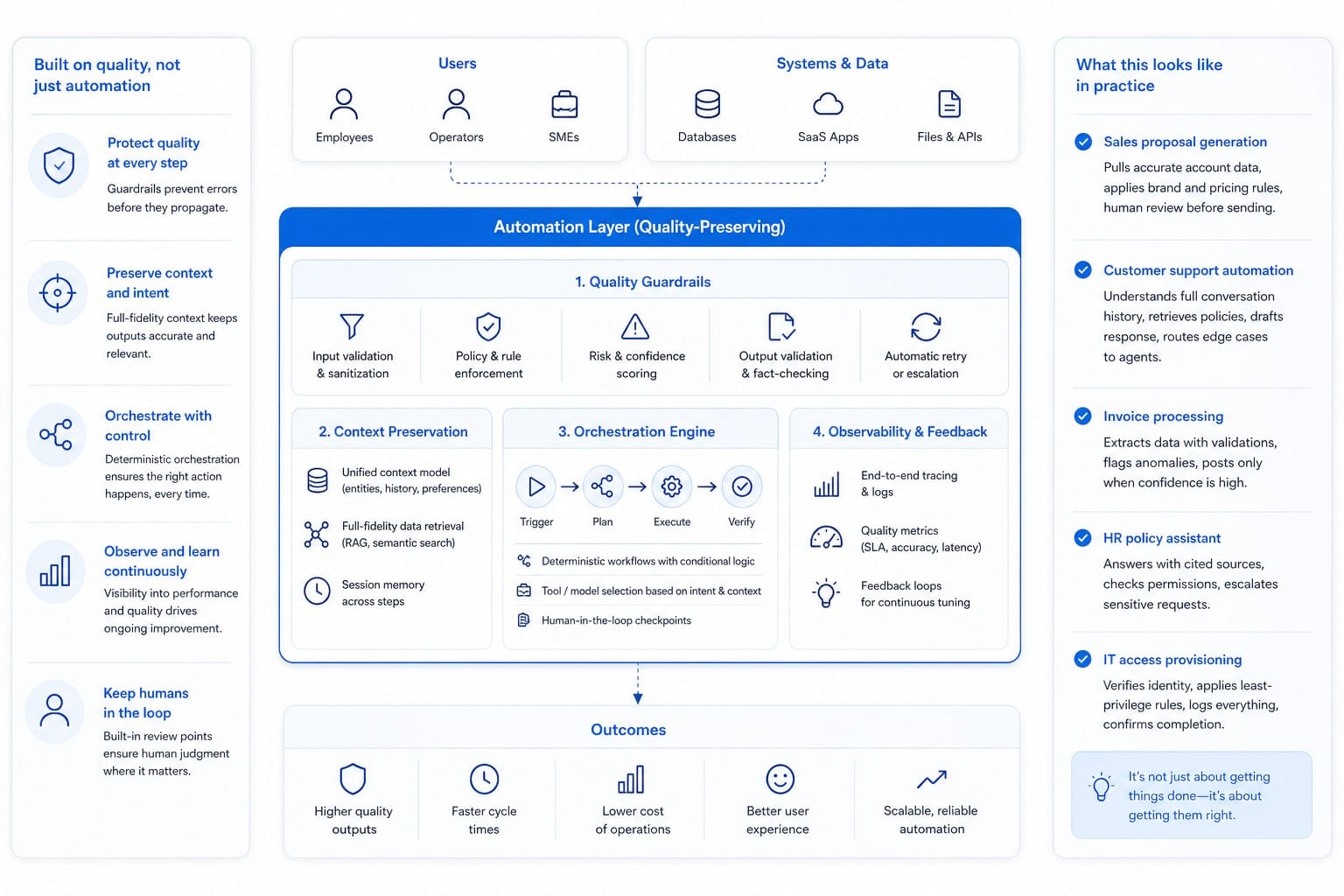
A quality-preserving automation layer has three characteristics that separate it from a prompt-and-paste workflow.
First, it starts with strategy, not content. Before a single word gets written, the system should be generating a content plan rooted in keyword research, search intent analysis, and the brand's existing topical authority. A 30-day content calendar built this way gives every post a purpose. Each article targets a specific query, sits within a topical cluster, and links naturally to related posts. That is not something you can produce by asking an AI to write a blog post about your industry.
Second, the research has to happen before the writing. Long-form articles that rank and that readers trust cite real sources, make accurate claims, and go deeper than the first page of results that a general-purpose AI pulls from its training data. Automation that does research properly will pull current information, identify credible sources, and build an article around facts rather than generating plausible-sounding sentences. The difference in output quality is significant.
Third, the system needs brand context baked in. Your voice is not the same as a competitor's voice. Your audience has specific pain points. You use certain words and avoid others. You have an established way of structuring arguments. An automation layer that produces generic output ignores all of that. An automation layer that holds your style guide, understands your content pillars, and applies them consistently does something a freelance writer hired for a one-off post also struggles to do: it sounds like you every time.
This is where a tool like Blogtude is built differently from a general AI writing assistant. Rather than starting with a blank prompt, Blogtude generates a full 30-day content strategy first, then produces deeply researched long-form articles within that strategy, and then handles publishing directly to Ghost and other CMS platforms. The workflow is coordinated end to end rather than assembled from separate tools.
Visuals are another area where automation tends to fall apart unless it is handled as part of the same system. Most marketers know that posts with relevant, on-brand images perform better than posts without them. But sourcing or creating those images is time-consuming, and the result is often inconsistent. Automated image generation has improved dramatically, but the challenge is keeping visuals consistent with the brand's aesthetic across dozens of posts. If you are thinking about how to approach that problem specifically, this article on how to create on-brand blog visuals at scale using AI covers the practical approach in detail.
The publishing step is one that many marketers underestimate as an automation opportunity. For Ghost CMS users in particular, direct API publishing means a finished post can go from draft to live without anyone touching the CMS interface. Metadata is set, images are attached, the post is scheduled or published immediately, and the team gets notified. That removes a surprisingly large amount of friction, especially on teams where the person who reviews content is not the same person who does the publishing.
Let me be direct about what automation does not replace. It does not replace editorial judgment about whether a topic is right for the brand at this moment. It does not replace a human who can recognize when a piece of research is unreliable or when an angle will land wrong with the audience. It does not replace the strategic thinking that comes from knowing your customers in a way no AI system fully can.
What automation does replace is the mechanical labor. The keyword research spreadsheet. The brief template filled out by hand. The formatting and metadata entry. The image sourcing and resizing. The scheduling. When those tasks are handled systematically, the humans on the team can spend their time on the judgment calls that actually require human judgment.
That shift in where human attention goes is what makes the quality argument work. Teams that use automation well do not produce worse content than teams that do everything manually. They produce more consistent content because the system handles consistency, and they produce better content in the places that matter because skilled people are not buried in mechanical tasks.
How to implement automated blog workflows without sacrificing brand voice
Implementing an automated blog workflow is not just a software decision. It is a process design decision. Getting the implementation right requires a few things to be in place before you turn on any automation.
Start with your brand voice documentation. This sounds obvious but most brands have not written it down in a way that is usable by a content system. A voice guide that says things like conversational and professional is not enough. You need specifics. What sentence length do you prefer? Do you write in first person or third? What topics are off-limits? What tone do you take with technical subjects versus beginner-friendly ones? What words do you actively avoid? The more specific your documentation, the closer the automated output will land to what you would write yourself.
Next, define your content pillars. A content pillar is a broad topic area your brand has authority in and that your audience genuinely cares about. Most brands have three to five. Every piece of content you produce should connect to one of them. When you give an automation system clear pillar definitions, it can generate a content calendar that builds topical authority instead of scattered posts that never add up to anything.
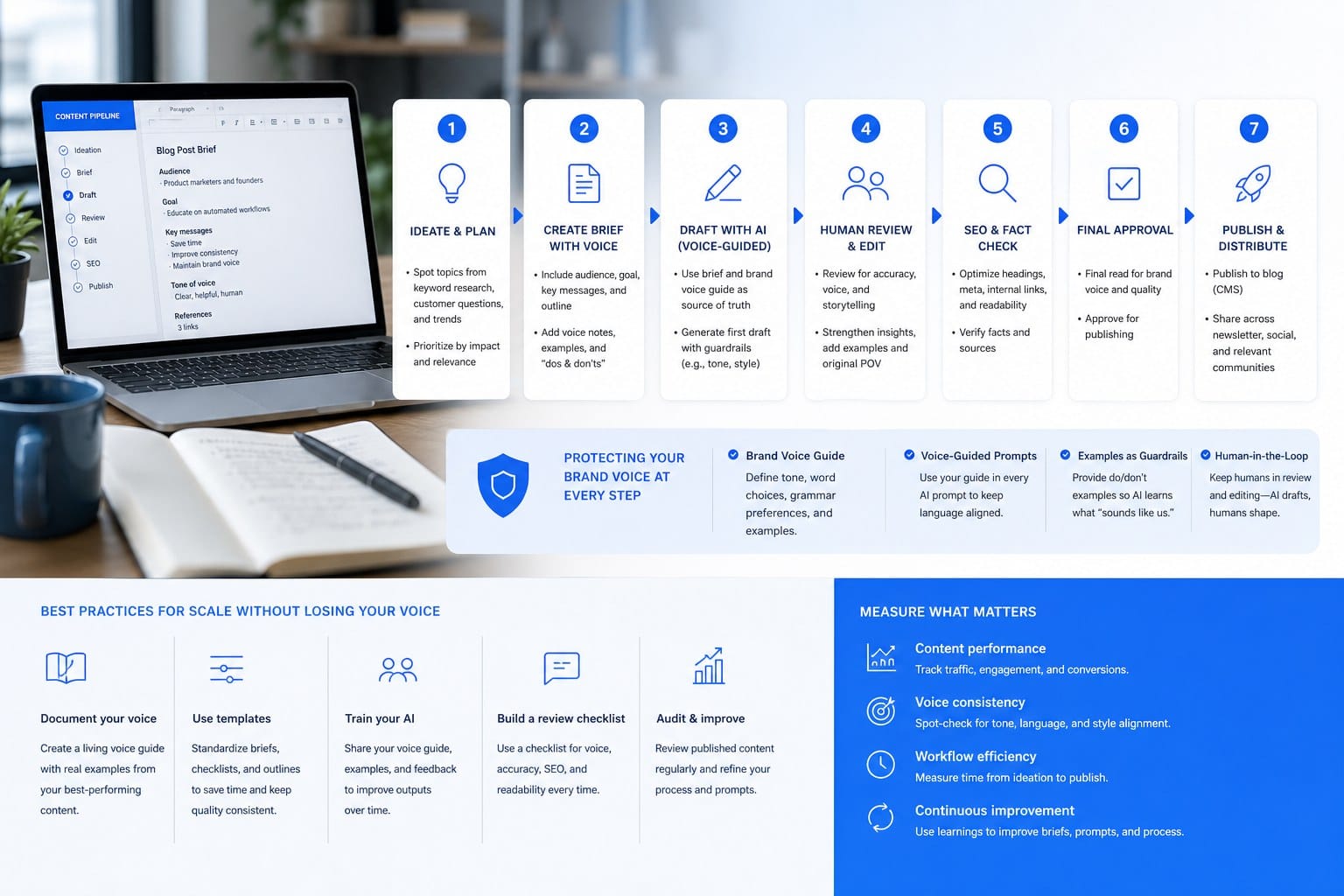
From there, the workflow design looks like this.
Phase one is strategy generation. The automation system analyzes your pillars, pulls keyword data, evaluates search intent, and builds a content calendar with specific article topics, target keywords, and recommended angles. You review this calendar, adjust anything that does not fit, and approve. This review should take less than an hour and happens once a month rather than before every post.
Phase two is article production. For each approved topic, the system conducts research, builds a brief, and produces a full draft with on-brand visuals. Because the brief is generated from the approved strategy and the research is real rather than hallucinated, the drafts require significantly less editing than you might expect. You are not rewriting. You are spot-checking accuracy, adjusting tone in a few places, and confirming the post says what you want it to say.
Phase three is publishing. The approved post goes directly to your CMS. For Ghost users, this integration is native and direct. Metadata is set, the visual is attached, the post is formatted correctly for mobile and desktop, and it is scheduled or published. No copy-pasting. No formatting fights with a CMS editor.
The choice of CMS matters here more than most marketers think. Ghost is built around content performance and has a clean API that makes automated publishing straightforward. If you are currently on WordPress and wondering whether the switch is worth making for a blog-focused brand, this comparison covers the SEO implications in depth: Ghost CMS vs WordPress for blogging: which platform wins for SEO.
A few practical guardrails help keep quality high once the system is running.
Set a review checkpoint before publishing, not after. Even with a well-calibrated system, you want a human to read each post before it goes live. The goal is not to rewrite the post. It is to catch anything that is factually off, tonally wrong, or strategically misaligned. A 15-minute read-through is usually enough. If you are consistently finding significant problems, that is a signal to adjust the voice documentation or content pillar definitions rather than to abandon the system.
Track performance at the post level. Automated systems can produce a lot of content. Without performance tracking, you will not know what is working. Set up simple tracking in Google Search Console and your analytics platform. Look at which posts are gaining impressions and clicks. Look at which topics are driving time-on-page. Use that data to refine your content pillar definitions and inform the next month's strategy generation.
Update your voice documentation when you catch consistent drift. If you keep editing the same kinds of things, that pattern tells you something about what the system needs to know about your brand that it does not currently have. Treat the voice guide as a living document rather than a set-it-and-forget-it file.
Plan for internal linking. One of the most consistent SEO wins from blogging is building a strong internal link structure across your content. When you have a 30-day content calendar planned in advance, you can see the relationships between posts before they are written. That means the automation system can include relevant internal links in each post from the start rather than having someone go back and add them manually later. This is a significant advantage of starting with strategy rather than producing posts one at a time.
Some teams worry that automating the workflow will make their blog feel impersonal. In practice, the opposite often happens. When the mechanical labor is removed, the people on the team have more time to engage with readers in comments, respond to questions, share posts with genuine commentary on social media, and contribute expert opinions that get woven into future posts. The blog becomes more personal because the people behind it are actually present rather than exhausted from production tasks.
Digital marketers managing brand blogs also benefit from the consistency argument in a specific way. When you pitch content to leadership, you can show a full 30-day editorial calendar with keyword targets and projected traffic impact rather than a list of post ideas. That shifts the conversation from whether to invest in blogging to how to use the blog strategically. Automation makes that level of planning possible without requiring a dedicated content strategist on staff.
For SaaS brands and startups specifically, the compounding value of a consistent automated blog workflow is particularly high. Organic traffic acquired through SEO has zero marginal cost once you rank. Every post that lands on the first page of results drives traffic indefinitely without ongoing spend. Building that asset requires time and volume, and both require a workflow that does not depend on heroic manual effort to sustain.
The brands that will have strong organic presences three years from now are the ones that started building content systems today rather than waiting until they had the budget to hire a full content team. Automation makes that possible at the size and budget of a growing brand rather than only at the scale of an enterprise.
Ready to take the next step?
If you are ready to stop producing blog posts one painful draft at a time and build a workflow that actually keeps up with your publishing goals, Blogtude is worth a close look. It handles the full cycle: 30-day strategy, deeply researched long-form drafts, on-brand visuals, and direct publishing to Ghost and other platforms. You get consistent output without the manual grind. Visit blogtude.com to see how it works and start your first automated content calendar.