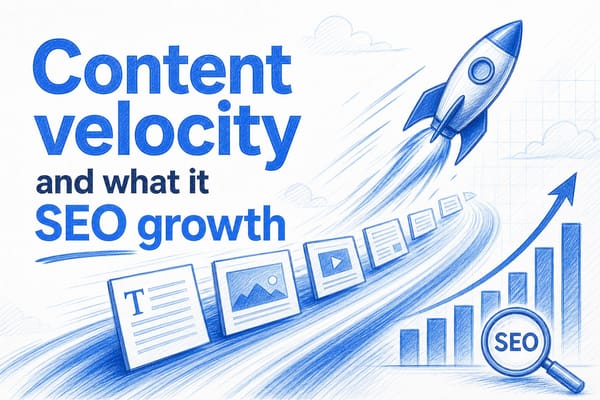
How to turn your website into a content marketing engine

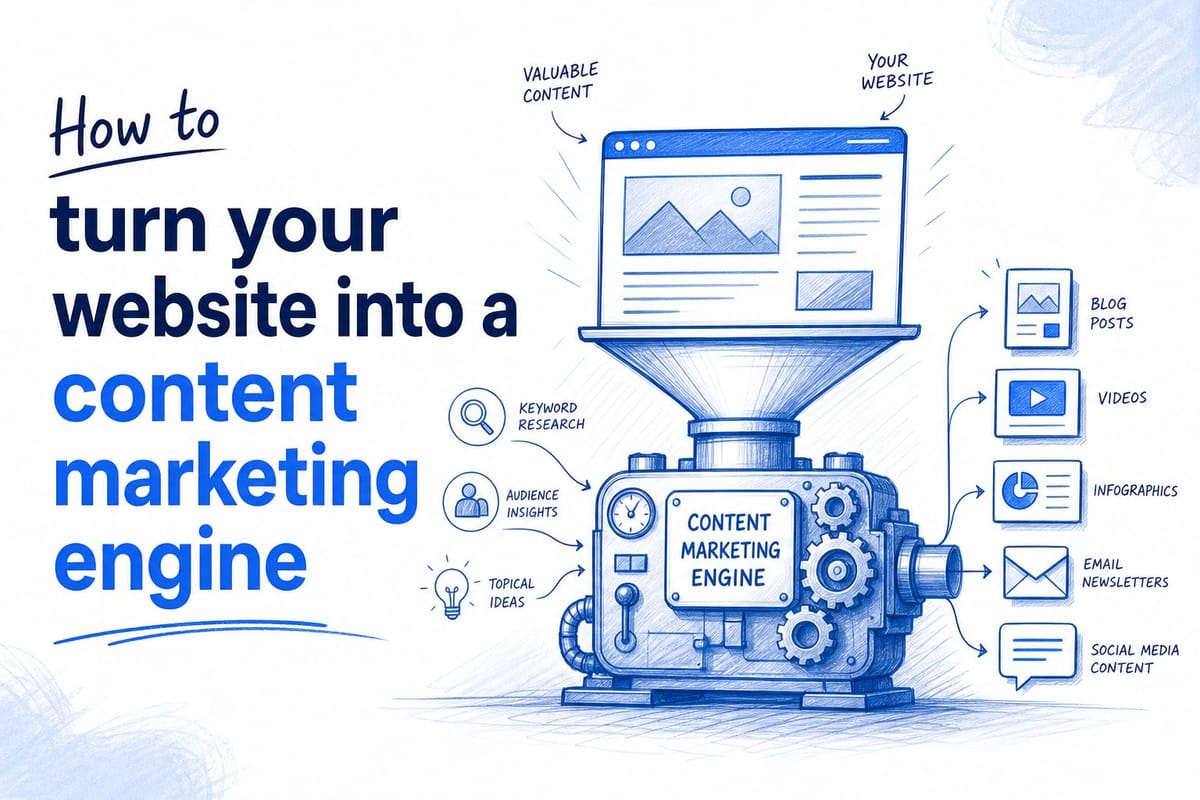
Table of contents
1. Start with a content strategy that gives every article a purpose
2. Build a production process that produces great content at scale
3. Automate distribution and publishing so your engine runs without you
Most websites sit there waiting. They load fast, look good, and do almost nothing between visits. If that sounds familiar, I want to show you how to turn your website into a content marketing engine that pulls in traffic, builds trust, and keeps working even when you are not. This is not about posting more often or chasing every trending topic. It is about building a real system, one where every piece of content has a job, every article feeds the next, and the whole thing compounds over time. I have broken this down into three practical sections that cover strategy, production, and automation. By the end, you will have a clear picture of what it takes to make your site do the heavy lifting for your brand.
Start with a content strategy that gives every article a purpose
The biggest mistake I see website owners make is treating content like decoration. They write a post when inspiration strikes, publish it, and move on. A month later, traffic is flat and they cannot figure out why. The problem is not the writing. The problem is the absence of a strategy.
A real content strategy starts with understanding what your audience is searching for and why. These are not the same thing. Someone searching for 'best project management tools' wants a comparison. Someone searching for 'how to stop missing deadlines' wants advice. Both searches are about productivity, but they represent completely different needs and different stages of the buying journey. If you map your content to those needs at every stage, you stop writing into a void and start writing for people who are already looking for you.
The foundation of this mapping is keyword research, but not the kind where you pick the highest-volume terms and hope for the best. You want to find topics where search intent matches what your site can actually deliver. For a SaaS company, that might mean writing detailed how-to guides around problems your software solves. For a small business, it might mean answering the ten questions customers ask before they call you. For an independent blogger, it means owning a niche so thoroughly that Google sees you as the authority on it.
Once you have your topic map, you need an editorial calendar. Not a vague list of ideas, but a real schedule that assigns topics to dates, formats, and goals. A good calendar shows you what is coming, prevents repetition, and helps you build internal linking opportunities before you write a single word. When article five references article two, and article eight references both, you are building a web of content that reinforces itself and keeps readers on your site longer.
This is also where content pillars come in. A pillar is a broad, comprehensive topic that you own fully. Supporting it are cluster articles, shorter and more specific posts that link back to the pillar. This structure does two things. It tells search engines that you have deep expertise in a subject, which helps rankings. And it gives readers a clear path to follow if they want to go deeper, which helps engagement. Think of it like a library. The pillar is the main subject heading. The clusters are the books filed under it.
For a deeper look at building this kind of structure from scratch, I recommend reading this SEO content strategy for independent bloggers: a step-by-step playbook. It walks through the process in a way that works whether you are writing solo or managing a small team.
One more thing on strategy: consistency beats perfection. Publishing one well-researched article per week beats publishing five mediocre ones in a burst and then going quiet for a month. Search engines reward regular, quality output. So do readers. When someone subscribes to your blog, they are making a small bet that you will show up again. Every time you do, you earn a little more trust. Every time you go quiet, you lose some of it.
A 30-day content plan is a practical starting point. Map out four to six topics for the month, assign each a keyword focus, and connect them so they support each other. That is enough to start seeing whether your strategy is working, and enough runway to adjust before you have invested months in the wrong direction. The goal at this stage is not to have everything figured out. It is to stop publishing randomly and start publishing with intention.

Build a production process that produces great content at scale
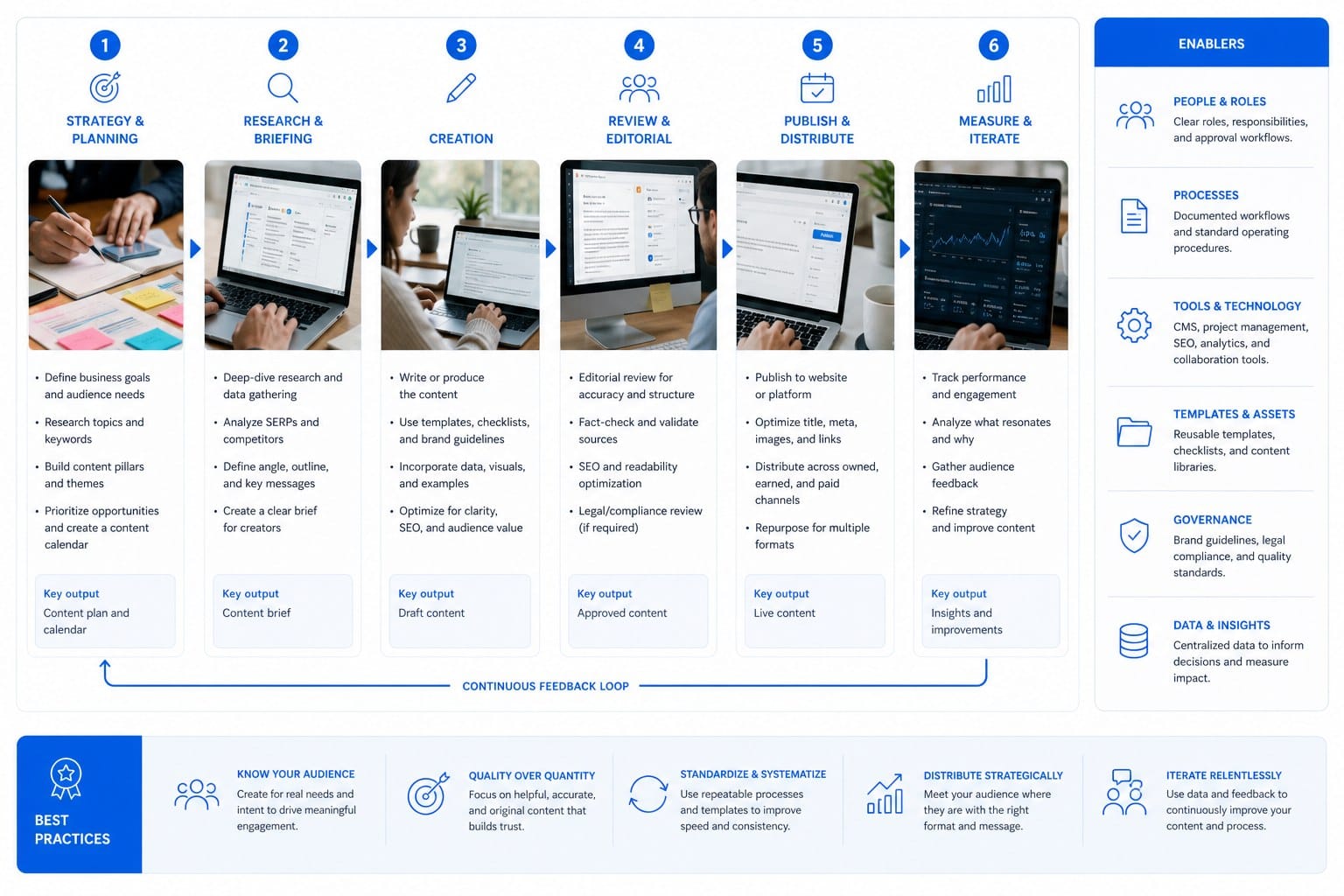
Strategy is the plan. Production is where the plan becomes real. And for most website owners, this is where everything slows down or breaks entirely. Research takes longer than expected. Writing takes even longer. Editing, formatting, adding images, writing meta descriptions, creating internal links, all of it piles up. Before long, a single article takes eight to ten hours, and the editorial calendar starts slipping.
The answer is not to lower your standards. Thin, rushed content does not rank and does not convert. The answer is to build a production process that makes high-quality output more achievable. That means being deliberate about every step from research to publish.
Start with research. Good articles are built on good research, and research done well upfront saves time later. Before you write a word, you want to know what the top-ranking articles on your topic cover, what questions people ask in forums and comment sections, what data or statistics exist to support your points, and what angle or insight you can bring that the existing articles do not. This last part is important. If your article says exactly what every other article says, it gives readers no reason to choose yours. Find the gap. Maybe you have a specific example no one has used. Maybe you can go deeper on a subtopic that others skim. Maybe you can bring a contrarian perspective backed by evidence. Whatever it is, that is your angle.
Next comes the outline. Outlining before writing is one of the highest-leverage habits a content producer can build. A strong outline forces you to think through the structure, catch logical gaps, and decide where your best points belong before you have invested time writing them in the wrong place. It also makes the actual writing faster because you are not making structural decisions while you are trying to find words.
For long-form articles in the 1,500 to 3,000 word range, a good outline has an introduction, three to five main sections with clear headings, and a conclusion or call to action. Each section should have a clear job: establish context, introduce a problem, explain a solution, give examples, or call the reader to act. If a section does not have a clear job, cut it or combine it with another.
Visuals matter more than most bloggers think. Articles with relevant images and diagrams hold readers longer and make complex ideas easier to follow. You do not need professional photography. You need visuals that are on-brand and relevant. That might mean custom screenshots, simple charts built from your data, or styled pull quotes that highlight key insights. Whatever you choose, keep it consistent across articles so your blog looks like a cohesive whole rather than a collection of random posts.
Formatting is another production step that gets skipped. Online readers scan before they read. If your article is a wall of text, many of them will leave without giving it a real chance. Use short paragraphs, subheadings, and bullet points where appropriate. Not every paragraph needs a bullet list. In fact, overusing lists can make content feel choppy and shallow. But breaking long explanations into steps, or summarizing a set of options, works well in list format and makes the page easier to navigate.
Internal linking should happen during production, not as an afterthought. When you are writing about topic A, you should know which other articles on your site relate to it and where you can naturally link to them. This keeps readers on your site longer, distributes SEO value across your pages, and helps search engines understand how your content is organized. Build a simple spreadsheet that tracks your published articles and their primary topics, and consult it when you are producing new content.
Finally, have an editing checklist. Even if you are a solo creator, you need a review step. Read the article aloud to catch awkward sentences. Check that every claim is supported. Confirm that the introduction delivers on what the headline promises. Make sure the article ends with a clear next step for the reader. A short checklist takes five minutes and catches the kinds of errors that can undermine an otherwise great piece.
For digital marketers managing brand blogs, the production challenge is often less about individual quality and more about volume and consistency across a team. If that is your situation, I recommend reading how digital marketers can automate brand blog workflows without losing quality. It covers how to set up repeatable systems that maintain standards even as output scales.
The goal of a strong production process is to make great content the default output, not the exception. When you have a clear research method, a reliable outline format, consistent visual standards, and a review checklist, you stop starting from scratch every time. You follow the process, and the process delivers.
Automate distribution and publishing so your engine runs without you
Strategy gives your content direction. Production gives it quality. But distribution and automation are what make the whole thing run without burning you out. If you are manually formatting, uploading, scheduling, and promoting every article, you are spending a huge portion of your time on tasks that do not require your creativity or expertise. That is the work a system should be doing.
Let me start with your CMS, because it is the hub of everything. Your content management system is where articles live, where they get formatted, where they get published, and where they connect to the rest of your site. Choosing the right one matters more than most people realize when they are starting out. Ghost, for example, is built specifically for content-driven publications. It handles SEO settings natively, renders cleanly on every device, and has membership and newsletter features built in. WordPress has a larger plugin ecosystem and more flexibility, but that flexibility comes with complexity and maintenance overhead.
If you are weighing options and already thinking about SEO performance, the comparison in Ghost CMS vs WordPress for blogging: Which platform wins for SEO breaks down the trade-offs in practical terms. It is worth reading before you commit to one or the other, especially if you are planning to automate publishing.
Once your CMS is set up, the next step is to connect it to your distribution channels. Most blogs live and die on organic search, which is fine, but it is slow. In the early months while you are building authority, you need other channels working for you. Email is the most reliable one. A subscriber list means you have direct access to people who already like your content. Every time you publish, they hear about it. Over time, a strong email list reduces your dependence on search engine rankings because you have an audience that does not require Google to find you.
Social sharing can amplify individual posts, but it is inconsistent and platform-dependent. I would not build your whole distribution strategy around it. Use it to extend reach when something performs well, but treat email and SEO as your primary channels.
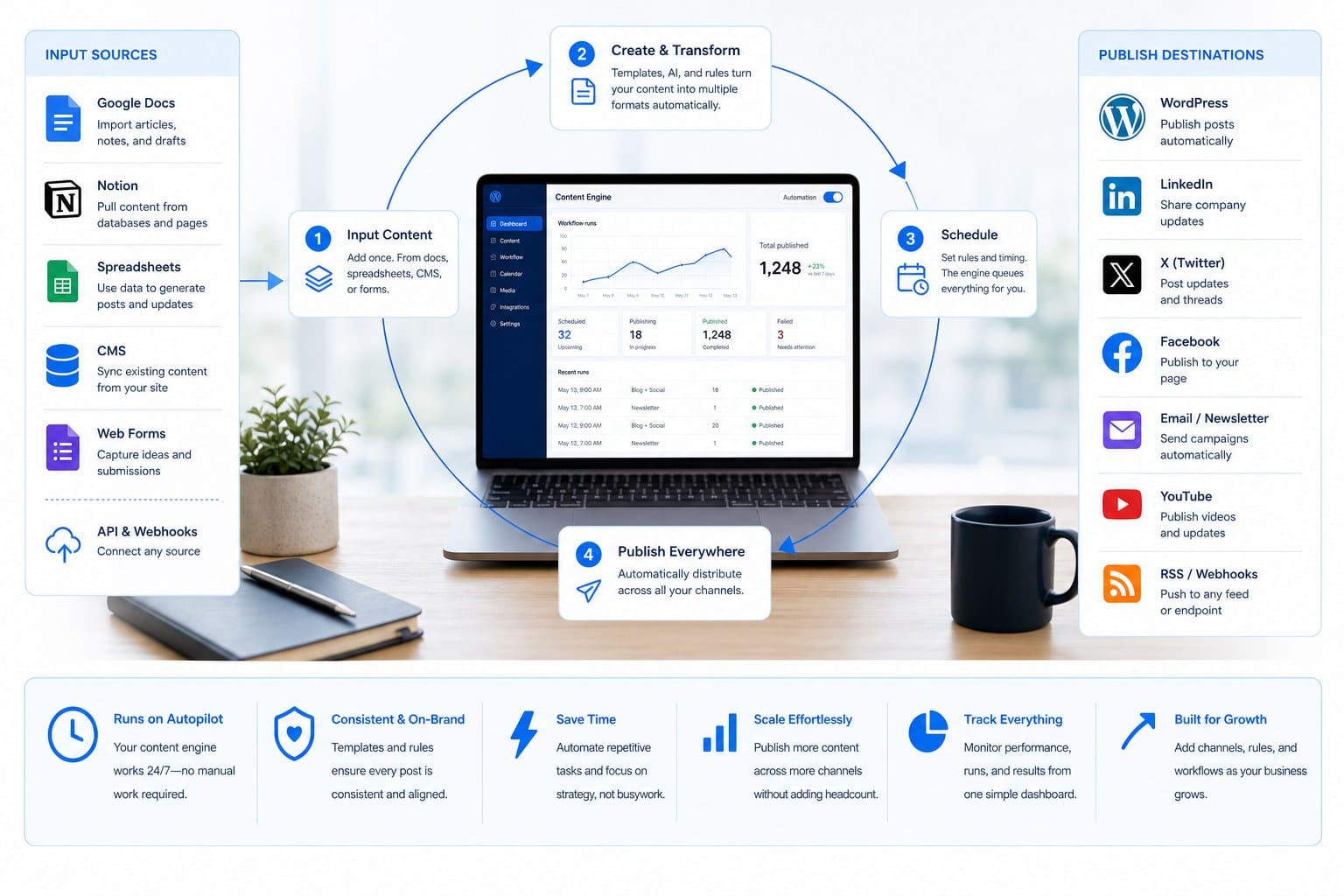
Now let me talk about automation specifically, because this is where a lot of website owners either give up or overpromise to themselves. The goal of automation is not to remove human judgment from your content. It is to remove the repetitive, mechanical tasks that get in the way of thinking and creating. Scheduling articles to go live at the right time, sending automated emails to subscribers when a new post publishes, formatting uploaded drafts to match your site's style, these are all things a well-configured system can handle.
AI-assisted content tools have changed what is possible here. A tool that can generate a 30-day content calendar based on your niche and keywords, produce fully researched draft articles, create on-brand visuals, and push finished posts directly to your CMS is not a future concept. It exists now. The key is to use these tools as a system that extends your capacity, not as a replacement for editorial judgment. The best automated workflows still have a human review step. They just eliminate the hours spent on research, formatting, and scheduling so that review step is the only time a human needs to be involved.
For SaaS founders and startups trying to build organic traffic without a full content team, this kind of system is particularly valuable. You need consistent output to compete in search results, but you cannot afford to have your engineering or product leads writing blog posts every week. An automated workflow means you can maintain a publishing schedule that keeps your site active and your SEO compounding without pulling the wrong people away from their core work.
Small business owners face a different version of the same problem. You know your industry. You know what your customers ask. But finding the time to turn that knowledge into published articles is nearly impossible when you are also running operations, managing customers, and handling everything else. A system that handles the mechanical side of content production means you can focus on reviewing and approving rather than writing and formatting from scratch.
Analytics close the loop on the whole engine. You need to know which articles are driving traffic, which ones are converting readers into subscribers or leads, and which topics are gaining traction over time. Without that data, you are guessing. With it, you can double down on what works, adjust what does not, and continuously improve the strategy based on real evidence. Set up basic tracking from day one. Know where your traffic comes from, how long people stay, and what they do next. That information is the feedback signal that makes the engine smarter over time.
Repurposing is another automation opportunity that most website owners ignore. A long-form article can become an email newsletter, a series of social posts, a short video script, or a presentation. Most of this repurposing can be templated and systematized. When you publish an article, your workflow can automatically queue up a newsletter excerpt, generate a summary for social, and tag the content for future use in a roundup or lead magnet. None of this requires starting from scratch. It requires thinking about content as raw material that can be shaped into multiple formats from a single production effort.
The compounding effect of a well-built content engine is real and significant. An article you publish today can still be driving traffic two years from now. A series of well-linked cluster articles can push a pillar page into the top ten results for a competitive keyword over time. An email list built through consistent publishing becomes one of your most valuable business assets. None of this happens fast, but it happens steadily when the engine is running correctly.
The practical step right now is to audit what you have. Look at your current publishing frequency, your existing articles, and your traffic sources. Ask yourself where the bottleneck is. Is it strategy, where you are not sure what to write? Is it production, where you know what to write but cannot get it done? Or is it distribution, where you are publishing but not reaching enough people? The answer tells you where to focus first.
If you want a system that handles all three layers without requiring you to build it from scratch yourself, Blogtude is built exactly for this. It generates a 30-day content strategy, produces deeply researched long-form articles with on-brand visuals, and publishes directly to Ghost and other CMS platforms. It is designed for the people in this article: independent bloggers, SaaS founders, small business owners, digital marketers, and Ghost CMS users who need a reliable, high-quality content workflow they can trust without managing every step manually.
Ready to take the next step?
If you are ready to stop publishing randomly and start building a content engine that compounds over time, visit Blogtude to see how it works. You can get a 30-day content strategy, fully researched articles, and automated publishing to your CMS without hiring a team or spending your weekends writing. The engine is ready when you are.